The Expanding Universe
The idea
Almost every galaxy is moving away from us, and the farther it is, the faster it recedes. That's not because we're special: space itself is stretching, carrying galaxies apart like raisins in rising dough. Rewind the film and everything converges: the expansion is the Big Bang's ongoing momentum.
Go deeper Advanced
Lemaître and Hubble tied redshift to distance (1927–29). Expansion doesn't stretch bound systems — galaxies, solar systems, you — where gravity and chemistry dominate. Beyond ~14.5 billion ly, recession exceeds light speed (no relativity violation: nothing moves THROUGH space that fast). The rate's modern puzzle is the Hubble tension: early- and late-universe measurements disagree by ~8%.
The deep dive
Researched for the Atlas from Wikipedia — Expansion of the universe (28,831 characters read) · updated Sep 20, 2026
01 Who really discovered the expanding universe
Credit for discovering the expanding universe has never settled neatly on one person. Vesto Slipher made the first crucial measurements between 1912 and 1914, finding that light from remote galaxies was systematically redshifted — a clue that those galaxies were racing away. In 1922 Alexander Friedmann showed theoretically, from Einstein's own field equations, that an expanding universe was a valid solution. Swedish astronomer Knut Lundmark found observational evidence for expansion in 1924, with results described as reasonably accurate even by modern standards, though they rested on unproven distance assumptions. Georges Lemaître in 1927 independently derived the same relativistic solutions and matched them to published redshift data, proposing a clear linear relationship between a galaxy's distance and its speed of recession. Edwin Hubble then firmly established that linear relationship in 1929 using multiple cross-checked methods. Strikingly, Hubble himself did not connect his findings to the idea of an expanding universe, and his value for the proportionality constant was too large by a factor of seven. The law now carries both names — Hubble's law and the Hubble–Lemaître law — reflecting an ongoing debate about where the honor truly belongs.
02 How Walter Baade doubled the known universe
Even after Hubble's 1929 landmark paper, the scale of the universe remained badly miscalibrated. The astronomer Walter Baade tackled this in the 1940s by reexamining the Cepheid variable stars used as cosmic distance markers. Baade recognized that there were two distinct populations of Cepheid stars with different intrinsic brightnesses, and that earlier work had confused them. Correcting for this error, Baade recalculated the size of the known universe and doubled the previous value. This single revision meant that all the galaxies Hubble had measured were twice as far away as believed, which in turn brought the estimated expansion rate down significantly. The episode is a vivid reminder of how a single calibration error can compress or stretch humanity's entire picture of cosmic scale. Baade's revision set off decades of refinement, and for most of the second half of the twentieth century the Hubble constant was estimated to lie somewhere between 50 and 90 km per second per megaparsec — a range wide enough to allow the age of the universe to vary by billions of years.
03 The Hubble Space Telescope fixes a blurry constant
On 13 January 1994, NASA formally announced the completion of repairs to the Hubble Space Telescope's flawed main mirror. The sharper images that followed almost immediately transformed the measurement of cosmic expansion. Wendy Freedman's 1994 Key Project used the repaired telescope to study the galaxy M100 within the Virgo Cluster, yielding a Hubble constant of 80 ± 17 km per second per megaparsec. Later the same year, Adam Riess and colleagues applied an empirical method based on the visual-band light-curve shapes of Type Ia supernovae to reduce systematic errors further, arriving at 67 ± 7 km per second per megaparsec. Riess's measurements of the Virgo Cluster's recession velocity agreed well with subsequent independent analyses of Cepheid-calibrated supernovae, which gave 73 ± 7 km per second per megaparsec. Then in 2003, David Spergel's analysis of the first year of data from the Wilkinson Microwave Anisotropy Probe satellite found 72 ± 5 km per second per megaparsec, broadly consistent with the local galaxy measurements. Within a single decade, the repaired telescope and new supernova techniques had compressed a forty-unit uncertainty into a far tighter range.
04 Inflation: the universe's explosive first instant
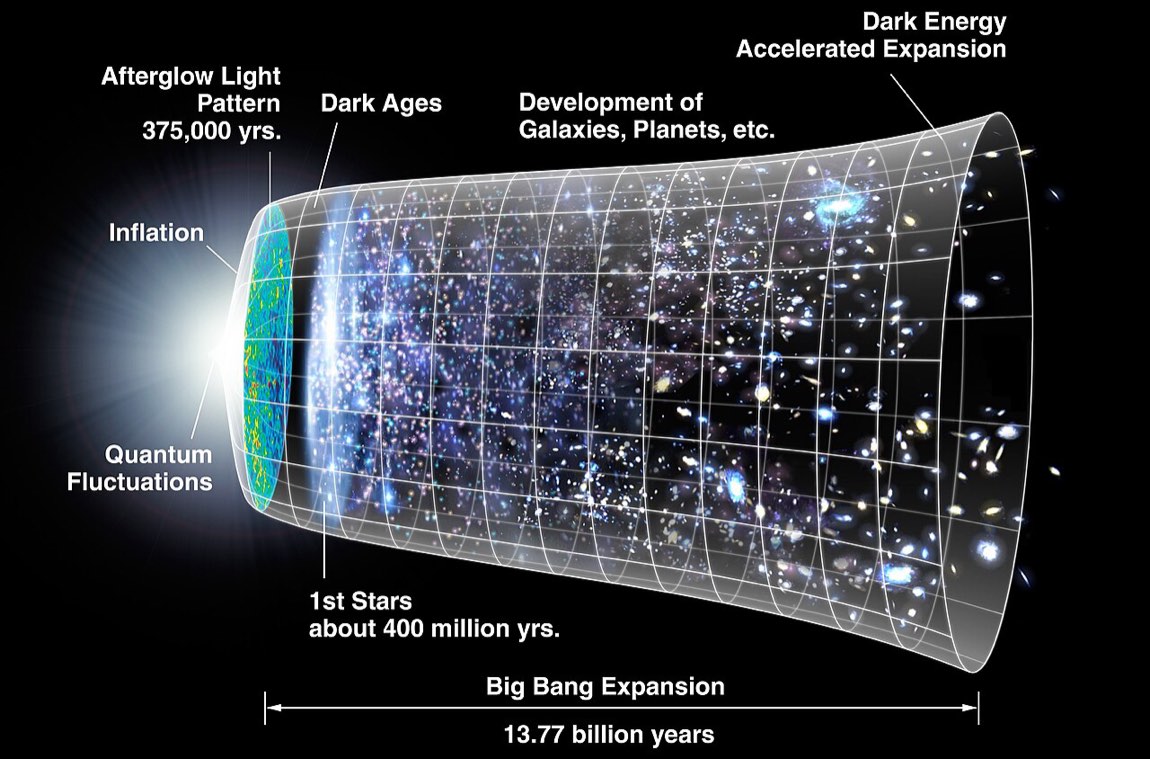
The earliest phase of cosmic expansion dwarfs everything that followed. Called inflation, it is hypothesized to have occurred around 10 to the power of negative 32 seconds after the Big Bang — a sliver of time so brief it has no everyday analogy. During that instant, the scale factor of the universe grew exponentially, expanding by a factor of at least 10 to the power of 26 in every direction. To solve the so-called horizon and flatness problems, inflation had to last long enough for the scale factor to grow by at least a factor of e to the power of 60, which is roughly that same 10 to the 26. The mechanism proposed is a field called the inflaton, sitting in a high-energy false vacuum state. Inflation was originally conceived to explain why exotic relics predicted by grand unified theories, such as magnetic monopoles, are nowhere to be seen: the violent expansion would have diluted them to near-zero density. A bonus outcome, recognized later, is that quantum fluctuations during inflation seeded the tiny density variations that gravity eventually amplified into galaxies and the large-scale web of cosmic structure.
05 Three epochs: radiation, matter, and dark energy Deeper
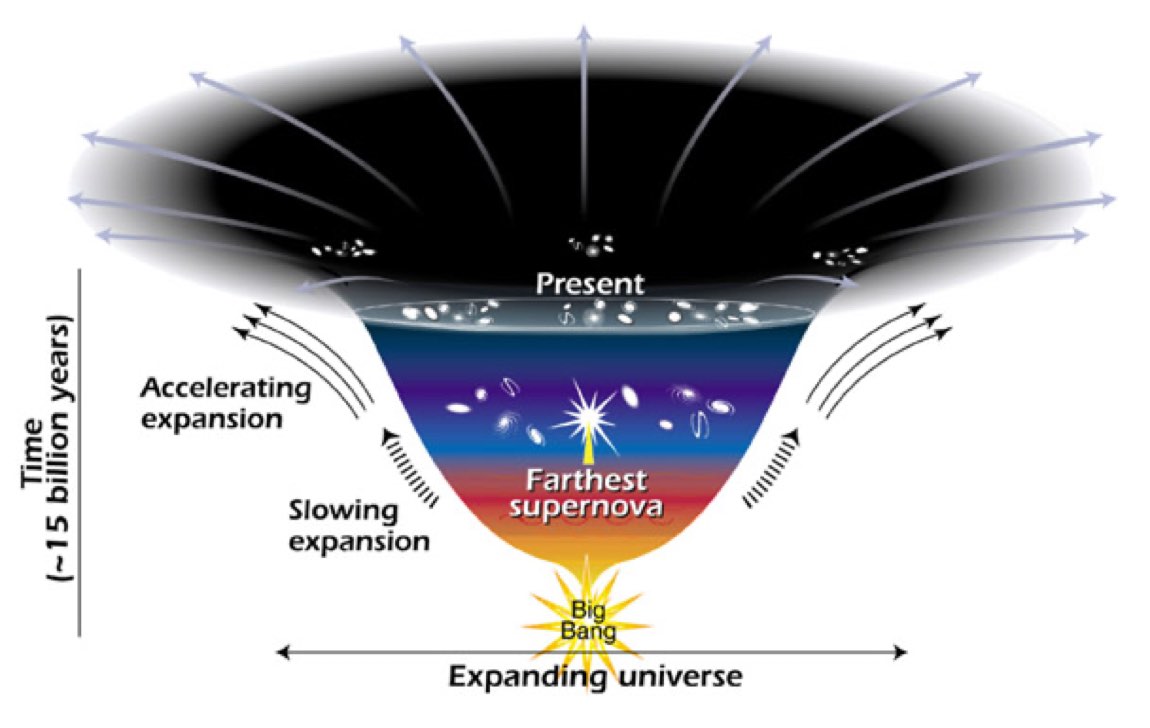
After inflation, the universe's expansion rate was governed in turn by three different dominant ingredients, each imprinting a characteristic mathematical signature on how the scale factor grew with time. During the radiation-dominated epoch — in place by the time of neutrino decoupling at about one second after the Big Bang — the scale factor grew proportionally with the square root of time, and expansion decelerated. Matter took over from radiation roughly 50,000 years after the Big Bang, because radiation redshifts away more quickly than matter dilutes; during this matter-dominated epoch the scale factor grew as the two-thirds power of time, again decelerating. Crucially, it is the matter epoch that built galaxies and the large-scale structure we observe today, because gravitational structure formation is most efficient when nonrelativistic matter dominates. Around three billion years ago — approximately eleven billion years into cosmic history — dark energy, whose density does not dilute as the universe expands, became the dominant term. Since then the scale factor has been growing exponentially in time, mirroring the mathematics of inflation but at an incomparably gentler rate. The universe is estimated to be 13.787 ± 0.020 billion years old in total.
06 Why radiation loses energy faster than matter Deeper
As the universe expands, everything inside it dilutes and cools, but not all ingredients dilute at the same rate. For ordinary nonrelativistic matter, energy density falls as the inverse cube of the scale factor: double the linear size of the universe and matter's energy density drops by a factor of eight, simply because the same particles now occupy eight times the volume. Radiation — ultrarelativistic particles including photons — drops by the inverse fourth power of the scale factor, one power steeper. The extra factor comes from the fact that each photon's energy is set by its momentum rather than rest mass, and that momentum redshifts away in inverse proportion to the scale factor as the universe expands. So doubling the universe's linear scale cuts radiation's energy density by a factor of sixteen. This difference is captured elegantly by the equation-of-state parameter w: nonrelativistic matter has w equal to zero, radiation has w equal to one-third, and dark energy has w equal to negative one, which means its energy density stays constant as the universe grows. A hypothetical fluid with w less than negative one — called phantom energy — would actually grow denser as the universe expands.
07 The Hubble tension: a crisis in cosmology
Two rigorously independent ways of measuring the present-day expansion rate are giving stubbornly different answers, and the discrepancy is now large enough that random measurement error seems an insufficient explanation. Measurements using Type Ia supernovae as standard candles find a Hubble constant of 73.24 ± 1.74 km per second per megaparsec, meaning every megaparsec of distance adds roughly 73 km per second of recession speed — about 160,000 miles per hour per megaparsec. The Planck satellite, inferring the same number from the sizes of fluctuations in the cosmic microwave background and assuming the standard Lambda-CDM cosmological model, finds 67.4 ± 0.5 km per second per megaparsec. These two central values differ by more than the combined error bars allow comfortably. A third approach, gravitational lensing time delays studied by the H0LiCOW collaboration, yields 73.3 km per second per megaparsec, siding with the supernova camp, while lensed supernovae give values ranging from 64.8 to 75.7 km per second per megaparsec depending on the system. Whether the tension signals new physics beyond the standard model or a hidden systematic error remains one of the most actively debated open questions in cosmology.
08 Gravitational lensing as a cosmic ruler Deeper
When a massive galaxy sits precisely between Earth and a more distant quasar or supernova, its gravity bends the incoming light into multiple images of the background source. Each image travels a slightly different path length and passes through a slightly different gravitational potential, so when the background source flickers, those brightness changes arrive at Earth at measurably different times. These time delays are inversely proportional to the Hubble constant, making the geometry a completely independent cosmological ruler. The H0LiCOW collaboration used lensed quasars this way to find a Hubble constant of 73.3 with an uncertainty of about plus 1.7 or minus 1.8 km per second per megaparsec. The successor TDCOSMO collaboration extended this work and in 2025 reported 71.6 with an uncertainty of plus 3.9 or minus 3.3 km per second per megaparsec. Observations of strongly lensed supernovae add further data points: SN Refsdal gave 64.8 and SN H0pe gave 75.7 km per second per megaparsec. A particularly promising system, the cluster MACS J0138-2155, has lensed both SN Encore and SN Requiem; the anticipated reappearance of SN Requiem is expected sometime between April 2026 and November 2027, with the exact date depending on the true value of the Hubble constant.
09 Cosmological redshift is not quite what it seems
The standard classroom explanation of cosmological redshift describes photon wavelengths being physically stretched as the space they travel through expands — as if the photon were a wave painted on a rubber band being pulled apart. The article notes, however, that the redshift is more naturally understood as a consequence of the Doppler effect: the source and receiver are moving apart, so the received frequency is lower. The "expanding space" picture, while not wrong as a bookkeeping device, carries a subtle danger. It implies a preferred rest frame in which galaxies sit still while space moves, which conflicts with the principle of relativity. Galaxies are more accurately described as simply moving apart under their own inertia. A related misconception holds that cosmic expansion is a force pushing objects apart. It is not: expansion is a description of objects already moving outward. The cosmological constant does generate a genuine repulsive influence, but that is a separate and distinct phenomenon. Conflating the background expansion with the dark-energy-driven acceleration is one of the more common errors even in professional science communication.
10 The observable universe has a hard edge — sort of
Because the universe has a finite age of 13.787 ± 0.020 billion years, light has had only a finite time to travel, and particles can have reached us only from within a limited comoving distance called the particle horizon. Everything within that horizon defines the observable universe. If the dark energy dominating the cosmos today behaves like a cosmological constant, the particle horizon converges to a finite value even in the infinite future: dark energy's repulsive gravity creates a cosmic event horizon beyond which signals can never reach us regardless of how long we wait. This means there are galaxies that exist right now whose light will never reach Earth, not because they are too far away today but because the accelerating expansion will carry them beyond contact forever. A separate natural scale, the Hubble horizon, matters for how structure forms. Density fluctuations much larger than the Hubble horizon are essentially frozen — gravitational signals cannot propagate across them fast enough to matter — while fluctuations much smaller than it are governed by familiar Newtonian gravity.
11 How faster-than-light recession is not a paradox
Hubble's law predicts that any galaxy beyond the Hubble horizon is receding faster than light. This sounds alarming, but it does not violate special relativity. Special relativity's speed limit applies strictly to local relative velocities — the speed of one object measured by an observer sitting right next to it. On cosmological scales, spacetime is curved, and there is no single well-defined way to compare the velocities of objects at widely separated locations. Mathematically, relative velocity corresponds to the angle between two worldlines in spacetime, and on a curved sheet there is no unique way to define the angle between lines at different points. Cosmic expansion is consistent with special relativity because nearby objects always have relative velocities well below the speed of light; matching up velocities across large distances requires integrating over many small locally valid patches. The article also notes that Newtonian gravity, reformulated in the geometrical language of Cartan, independently predicts cosmic expansion — so the effect is not exclusively a product of general relativity, contrary to a widespread assumption.
12 Gravitational waves and the future of the tension Deeper
Gravitational wave astronomy has opened a fourth, entirely independent channel for measuring the Hubble constant. When two neutron stars spiral together and merge, they produce both a gravitational wave signal and, in some cases, a visible electromagnetic counterpart. Because the gravitational wave amplitude encodes the luminosity distance to the merger directly — without any calibration ladder of intermediate standard candles — such events can in principle pin down the expansion rate with no assumptions borrowed from other methods. The merger event GW170817 was the first event used this way. The article notes that such measurements do not yet have sufficient precision to resolve the Hubble tension, but they are steadily improving. Meanwhile, proposals exist to watch for redshift drift — the way an object's measured redshift slowly changes over years as the universe expands further — which would be a direct, almost model-free measurement of expansion history. The effect is too small to detect today, but the Square Kilometre Array and the Extremely Large Telescope might observe it in the mid-2030s, offering a potential check on every other method currently in use.