 Photograph · HQ / NASA Image Library
Comet · Deep guide
Comet NEOWISE
Also called: C/2020 F3
The lockdown comet was 2020's gift to a locked-down planet's evening skies.
What is it?
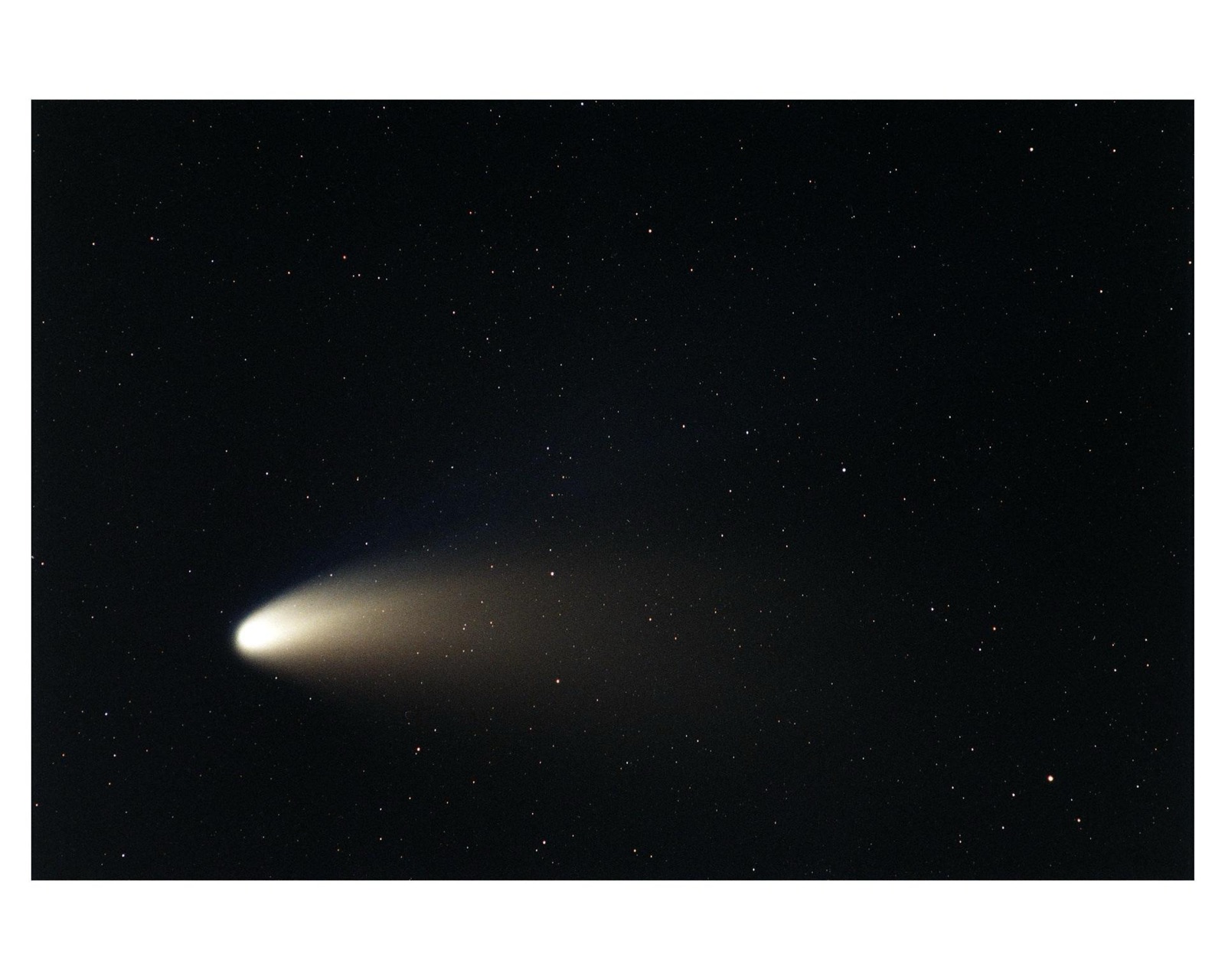
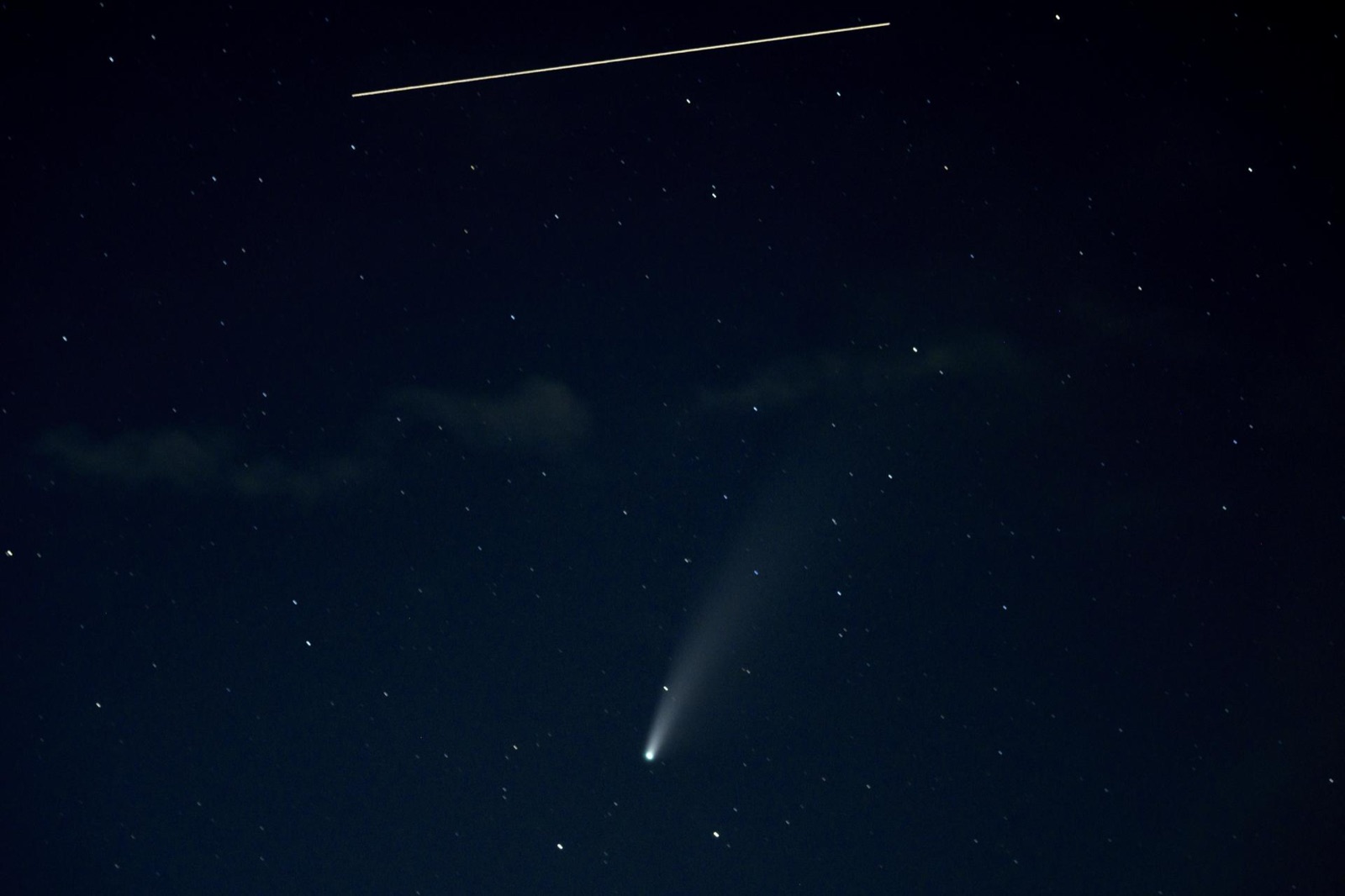
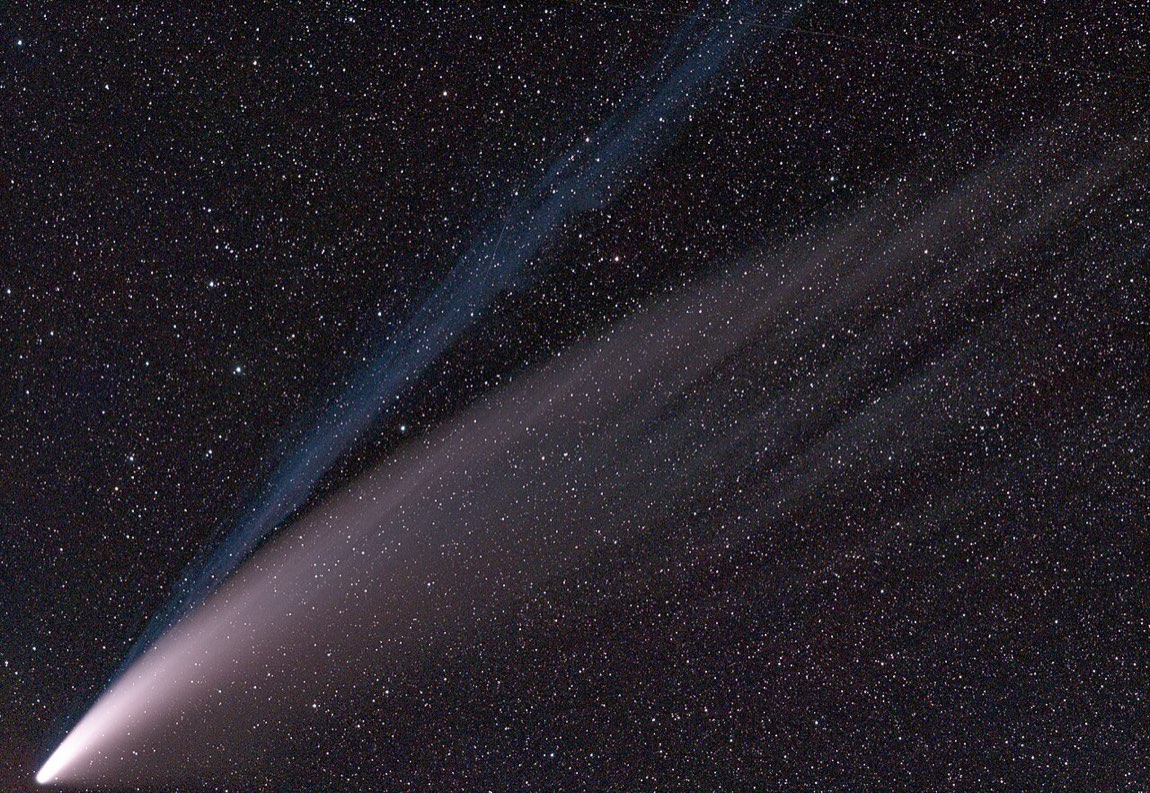
Comet NEOWISE was the brightest comet in northern skies since Hale–Bopp: for a few weeks in July 2020 it hung above the northwestern horizon with a long golden dust tail, photographed above cities, mountains, and the ISS itself. Discovered by a repurposed space telescope only four months earlier, it gave the pandemic summer an unplanned reason to gather (apart) outdoors and look up.
Go deeper
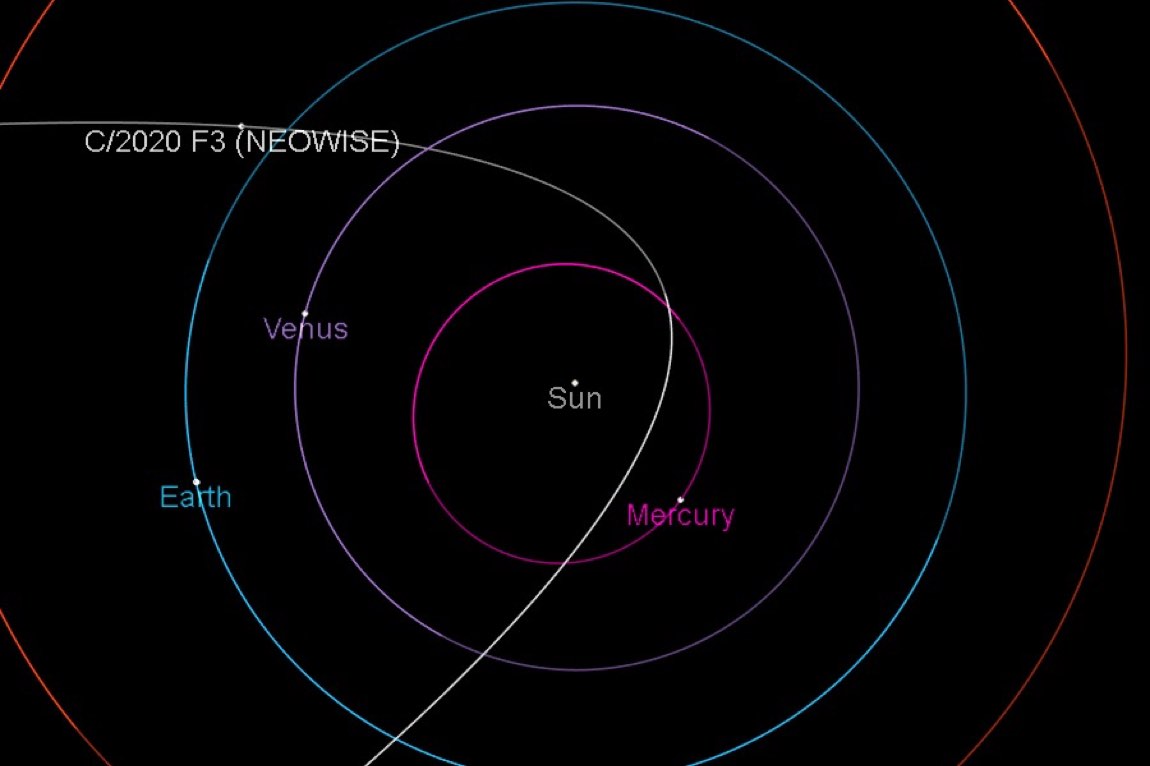
C/2020 F3 survived a 44-million-km perihelion — closer to the Sun than Mercury — which is precisely what made it great: near-death heating drives brilliance, but most sun-grazing comets simply disintegrate (comet ATLAS crumbled months earlier). Its ~4,400-year orbit was stretched to ~6,700 years by planetary tugs on the way out. Sodium tail imaging and ISS astronaut photography made it the best-documented long-period comet apparition yet.
01 How to catch the next one
Great comets give weeks of warning at best. The playbook: follow astronomy news (this site's News tab carries discovery announcements), find dark northwestern or northeastern horizons, bring binoculars — every great comet is finer in 7×50s — and go LOOK, because photographs never match a tail hanging in real sky. On average one bright comet per decade rewards the prepared.
The deep dive
Researched for the Atlas from Wikipedia — Comet NEOWISE (6,852 characters read) · updated Sep 20, 2026
02 Born in the deep freeze of the Oort cloud
Every clue in NEOWISE's orbit points to an origin in the Oort cloud, the vast, spherical reservoir of icy bodies that extends to the outermost fringes of the Solar System. The smoking-gun evidence is its orbital eccentricity of 0.99921 — so close to 1.0 that its path is nearly a perfect parabola rather than an ellipse. Long-period comets arriving fresh from the Oort cloud tend to carry this signature, because they have spent billions of years in cold storage far from the Sun and have experienced little of the gravitational sculpting that would round out their orbits. The orbital inclination of 129 degrees reinforces this picture: NEOWISE travels retrograde, looping around the Sun in the opposite direction to Earth and all the other planets. That retrograde path is not unusual for Oort cloud visitors, which can arrive from any angle. What makes NEOWISE remarkable is that it apparently survived its first close brush with the Sun brilliantly, flaring to naked-eye visibility rather than breaking apart as several anticipated bright comets had done in the years before 2020.
03 How gravity stretched its return journey Deeper
When a long-period comet dives through the inner Solar System, it does not simply retrace its steps. The planets — especially Jupiter and Saturn — exert subtle gravitational tugs that permanently reshape its orbit. For NEOWISE, this effect was measurable and significant. The comet's inbound orbital period, reflecting the path it traveled before the 2020 apparition, was approximately 4,400 years. After swinging around the Sun and passing through the planetary region, the outbound orbital period grew to roughly 6,700 years. That difference of about 2,300 years means the planets effectively handed the comet extra energy, pushing it onto a higher orbit with a more distant aphelion — the farthest point from the Sun. Some sources cite slightly different figures, stating the period increased from about 4,500 years to about 6,800 years, a discrepancy that reflects the difficulty of modeling the precise gravitational perturbations involved. Either way, anyone hoping to see NEOWISE again from Earth will need to wait thousands of human generations. The comet crossed north of the ecliptic plane on June 29, 2020, just days before perihelion on July 3.
 ⤢
⤢
04 Discovered in infrared, confirmed days later
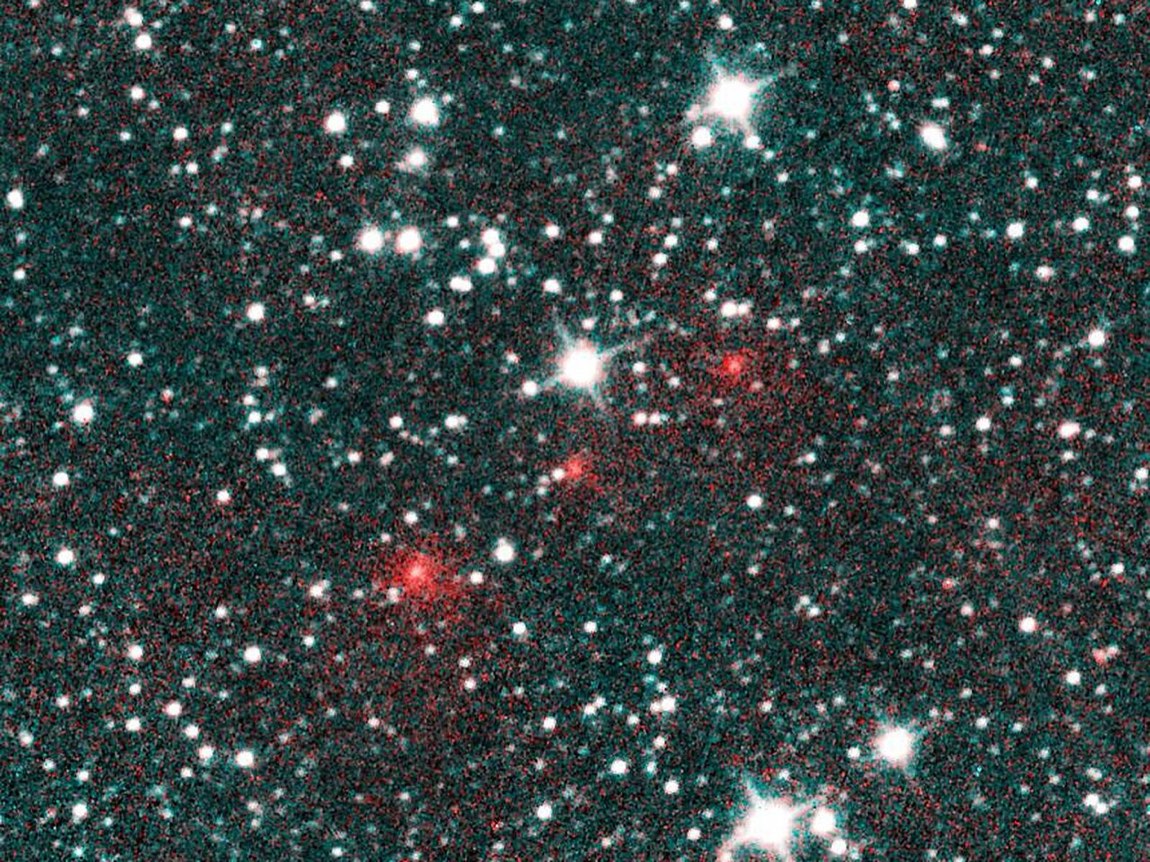
NEOWISE was not found by someone peering through an eyepiece on a clear night. It was detected on March 27, 2020, by a team using the WISE space telescope operating under its NEOWISE asteroid and comet survey program. The telescope hunts in infrared light, which is ideal for spotting icy and rocky bodies that reflect only a fraction of sunlight but glow with their own heat. At the moment of discovery, NEOWISE was a faint 18th-magnitude object — roughly 250,000 times too dim for the unaided eye — sitting 2.0 AU from the Sun and 1.7 AU from Earth. The object was formally classified as a comet on March 31, just four days after detection, and given the name NEOWISE on April 1. Its systematic designation, C/2020 F3, encodes its story: C for a non-periodic comet, 2020 for the discovery year, F for the second half of March, and 3 because it was the third such object found in that fortnight. From a dim infrared blip to the brightest northern-hemisphere comet in 23 years in the space of three months is a remarkable trajectory for any discovery.
05 A comet that outshone all rivals of 2020
The years immediately before 2020 had been frustrating for comet watchers. Several comets had been heralded as potentially spectacular only to fall apart or fizzle before reaching naked-eye brightness. In 2020 itself, two predecessors — C/2020 F8 (SWAN) and C/2019 Y4 (ATLAS) — both disappointed. NEOWISE shattered that streak. By early July it had brightened to magnitude 1.0, far exceeding anything those comets achieved. It then emerged from behind the Sun's glare near magnitude 0.5 to 1, bright enough to be spotted even from light-polluted city centers. Through mid-July it faded to around magnitude 2.0, and by July 30 it had dropped to approximately magnitude 5, at which point binoculars were needed for urban observers. For comparison, NEOWISE was brighter than C/2011 L4 (PanSTARRS) but did not quite match the legendary brilliance of Comet Hale–Bopp in 1997, which remains the benchmark for northern-hemisphere comets. The fact that it was visible at all across a full month from suburban skies earned it the informal title of the Great Comet of 2020, though whether it truly qualifies as a great comet remained a point of debate among astronomers even after the apparition ended.
06 Three tails and a sodium surprise Deeper
Most well-known comets sport two tails: a straight blue ion tail swept back by the solar wind, and a curved golden dust tail trailing along the orbit. NEOWISE displayed both, but with an extra twist. The ion tail carried an unusually high concentration of sodium, producing a visible red separation within the blue gas tail. On July 13, 2020, this sodium tail was formally confirmed by the Planetary Science Institute's Input/Output facility. Sodium tails are extraordinarily rare; before NEOWISE, they had been observed only in very bright comets including Hale–Bopp and C/2012 S1 (ISON). Their detection requires a comet to be both intrinsically active and close enough to the Sun for sodium atoms to be liberated efficiently from dust grains or the nucleus surface. The dust tail, described as golden in color, drew explicit comparison to the tail of Comet Hale–Bopp. By July, a second distinct tail had developed, giving the comet its twin-tailed appearance that photographers captured so vividly. The green coma — caused by diatomic carbon and cyanogen fluorescing in sunlight — remained clearly visible after mid-July even as the nucleus's overall activity began to subside.
 ⤢
⤢
07 What radio waves from Arecibo revealed Deeper
As NEOWISE faded in the summer sky, observatories around the world turned their instruments on it to extract every possible data point before it retreated into darkness. One of the most technically specialized observations came on July 31, 2020, when astronomers at the Arecibo Observatory in Puerto Rico achieved a strong detection of the hydroxyl radical (OH) at its characteristic 18-centimeter radio wavelength. The hydroxyl radical is produced when water molecules in a comet's coma are broken apart by solar ultraviolet radiation, and its radio emission is one of the most reliable proxies scientists have for measuring how much water a comet is releasing. Detecting it at 18 cm with Arecibo's massive dish required the comet to be producing a substantial and sustained outflow of water vapor. This observation slotted into a broader campaign that also included studies of coma morphology and spectrographic emissions reported through July and August 2020. Together, these observations helped characterize NEOWISE as a genuinely active, water-rich nucleus rather than a comet that had put on a brief, surface-level show and quickly exhausted its volatile material.
08 Pinning down the spin of the nucleus Deeper
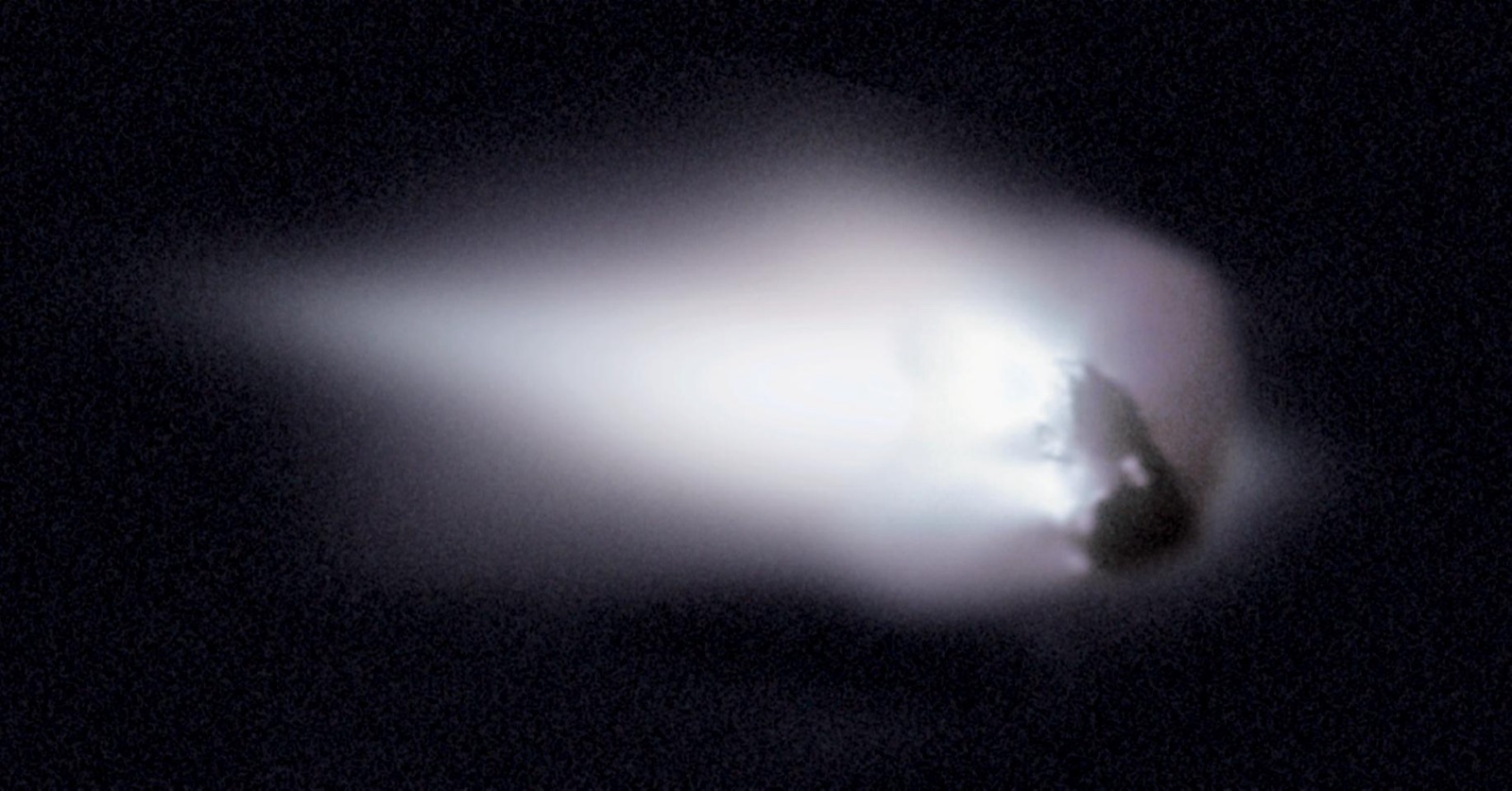
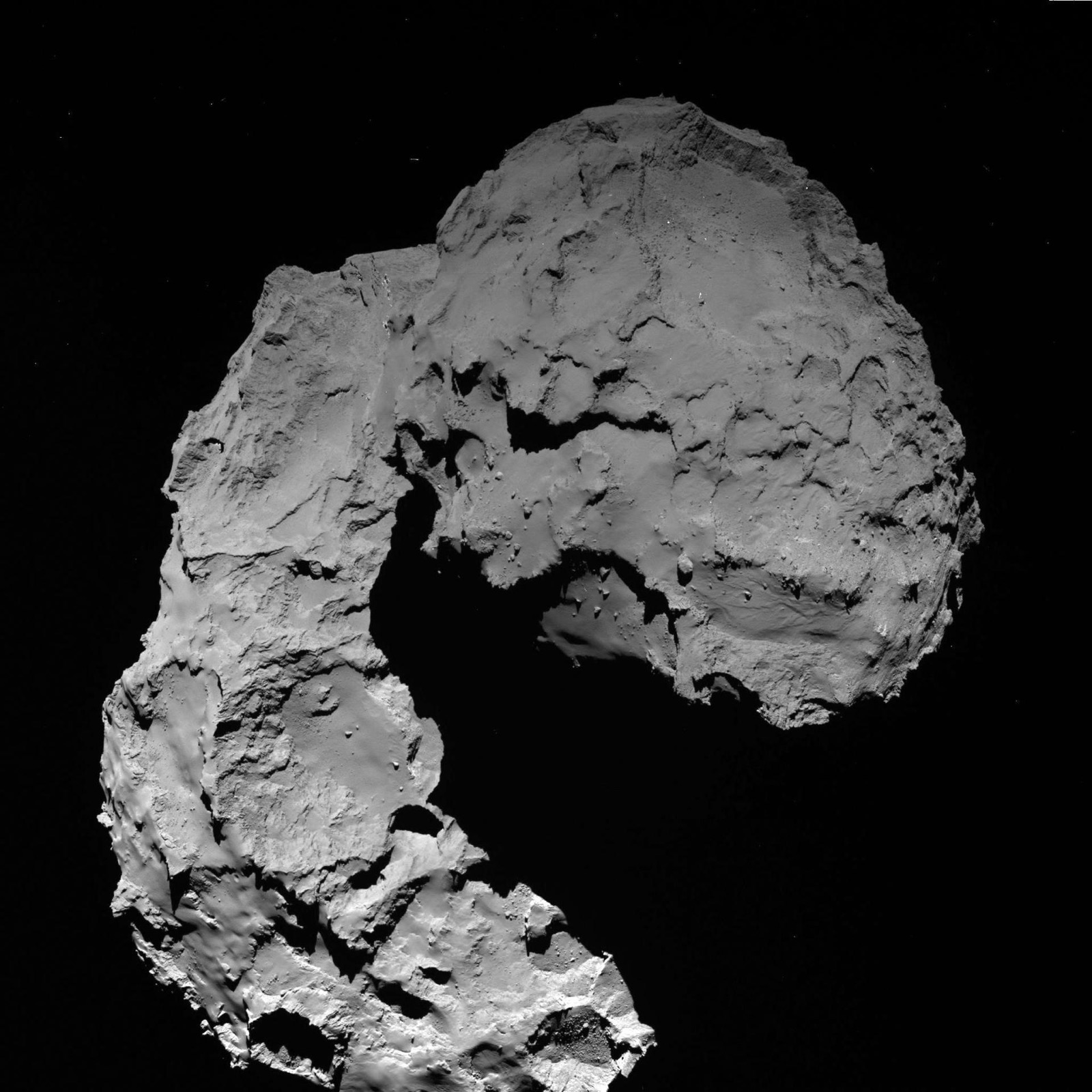
One of the harder physical properties to measure in a comet is the rotation period of its nucleus. The solid icy body is typically hidden inside the bright coma, so astronomers must search for periodic brightness variations caused by jets switching on and off as active regions rotate into sunlight. For NEOWISE, this work paid off on August 14, 2020, when the rotation period was reported to be 7.58 ± 0.03 hours. That figure comes with a formal uncertainty of just 1.8 minutes — a remarkably precise measurement for an object studied for such a short time. A roughly 7.5-hour day means the nucleus completes about 3.2 full rotations every Earth day, and each rotation cycle potentially exposes different surface patches to solar heating. The 5-kilometer nucleus, as estimated from infrared data and later confirmed by images from NASA's Parker Solar Probe, is similar in size to Comet Hyakutake and several well-known short-period comets including 2P/Encke, 7P/Pons–Winnecke, 8P/Tuttle, 14P/Wolf, and 19P/Borrelly. The Parker Solar Probe observation was particularly notable — capturing a comet image was not part of the probe's primary mission, yet it independently corroborated the infrared size estimate.
09 Navigating the sky during its prime weeks
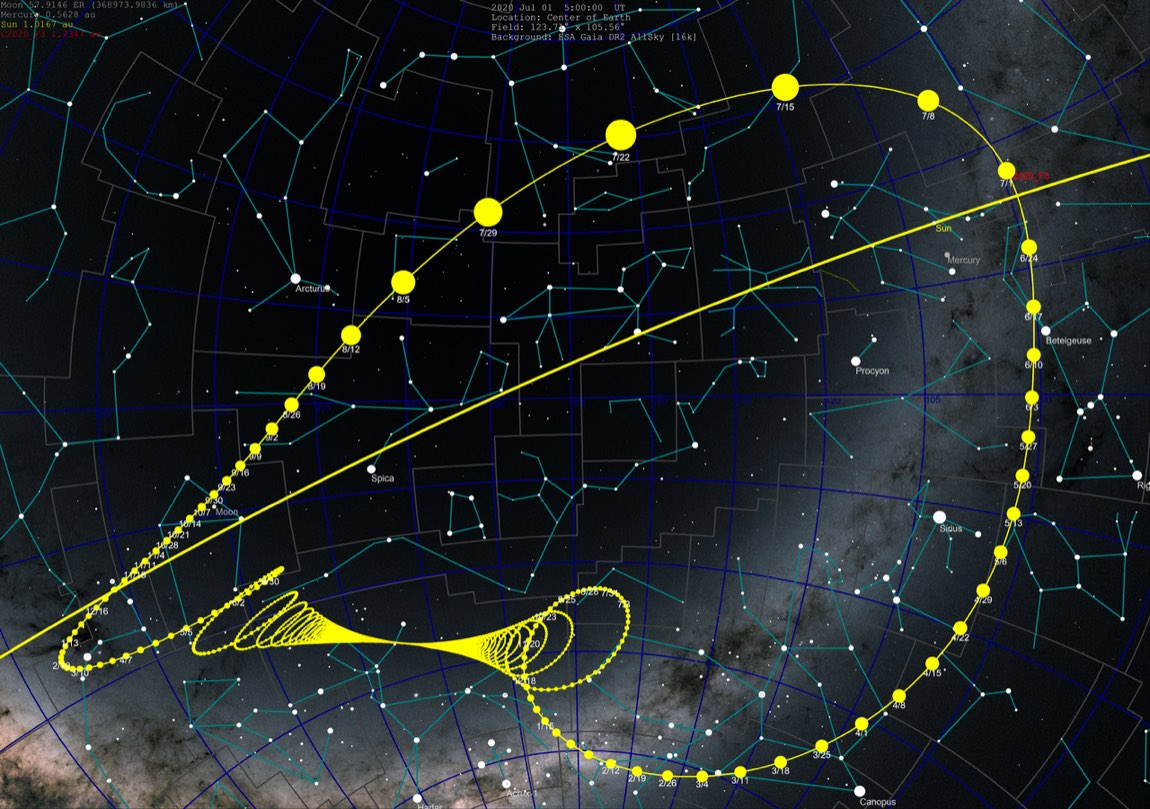
Finding NEOWISE in the sky required knowing where to look as it moved from constellation to constellation over a matter of weeks. In early July, it appeared in the pre-dawn sky just above the north-eastern horizon, positioned below the bright star Capella in Auriga. The window for viewing was narrow because the comet spent the period from June 11 through July 9 within 20 degrees of the Sun as seen from Earth, washed out in the solar glare. As July progressed and it climbed higher, northern observers found the most useful landmark to be the Big Dipper: NEOWISE hung below it on the northwestern horizon in the evening sky. For observers north of 45 degrees north latitude, the comet was circumpolar in mid-July — never setting below the horizon — and could therefore be watched all night long. On July 18, it reached a peak northern declination of +48 degrees, meaning it was circumpolar as far south as latitude 42 degrees north. Its closest approach to Earth came on July 23 at 0.69 AU, 103 million kilometers away, while it was in Ursa Major. By July 30, it had drifted into the constellation of Coma Berenices, located below the bright orange star Arcturus in Boötes.
 ⤢
⤢
10 Great comet or not? The debate explained
The label "great comet" carries no strict scientific definition, but it is generally reserved for comets that are bright enough and well-placed enough to become genuine cultural phenomena — visible to casual observers without any special equipment or knowledge. NEOWISE provoked real disagreement on this point even among people who had watched it. Supporters pointed to its naked-eye visibility throughout July 2020, its double tail, its sodium tail, its magnitude near 0.5 to 1 after perihelion, and the fact that it was seen from city centers affected by light pollution. Critics argued that it never matched the sustained brilliance or dramatic tail length that defined great comets like Hale–Bopp in 1997. Both sides agree that compared to the string of disappointing comets in the years before 2020, NEOWISE was a welcome and genuine spectacle. In the years since the apparition, popular memory has largely settled the debate informally: NEOWISE is routinely remembered and referred to as the Great Comet of 2020, a retroactive designation that reflects how it was experienced by millions of people who stepped outside and looked up.
11 A comet cameo in Hollywood fiction
NEOWISE left a small but traceable imprint on popular culture beyond the photographs and public star-gazing sessions it inspired. The 2021 satirical film "Don't Look Up" featured a fictional comet called Dibiasky hurtling toward Earth as the central plot device. The filmmakers acknowledged that Dibiasky was "very loosely" modelled after Comet NEOWISE. The connection is fitting in a roundabout way: "Don't Look Up" used its comet as a metaphor for ignored scientific warnings, while the real NEOWISE was a reminder of how quickly the sky can offer something genuinely extraordinary with little advance notice. NEOWISE went from an 18th-magnitude infrared detection in late March 2020 to a naked-eye showpiece by early July — a transformation spanning barely three months. The film's comet is a dramatic threat; the real one was a fleeting gift. Both, however, captured public attention in ways that most astronomical events do not, and the loose fictional nod ensures that NEOWISE's name will circulate in cultural conversations well beyond the community of dedicated comet observers.
12 How bright before astronomers could see it Deeper
Tracing NEOWISE's brightening curve reveals how quickly conditions changed in the weeks around perihelion. On June 10, 2020, as the comet was disappearing into the Sun's glare, it was at apparent magnitude 7.0 — just barely below the naked-eye threshold of about 6 — while sitting 0.7 AU from the Sun and 1.6 AU from Earth. Twelve days later, on June 22, it entered the field of view of the LASCO C3 coronagraph aboard the SOHO spacecraft, which routinely monitors the Sun and its surroundings by blocking out the solar disk with an artificial eclipse. At that point NEOWISE had brightened dramatically to about magnitude 3.0, while 0.4 AU from the Sun and 1.4 AU from Earth. Within another week and a half, by early July, it had reached magnitude 1.0. This jump of roughly six magnitudes in about three weeks represents a factor of roughly 250 times in actual brightness — a striking demonstration of how powerfully solar heating drives cometary activity as a nucleus plunges to within 0.29 AU of the Sun. SOHO's ability to observe comets that would otherwise be invisible inside the solar glare proved essential for tracking this critical brightening phase.
 ⤢
⤢
Could life exist here?
An icy messenger, briefly glorious.
Our labels: Confirmed · Strong Evidence · Estimated · Hypothesis · Theoretical · Speculative (see Methodology).
Weird & wonderful
- Astronauts photographed NEOWISE rising over Earth's limb from the ISS.
- Its discovery telescope was built to hunt hazardous asteroids — comet fame was a side quest.
- The next humans to see it will live 250 generations from now.