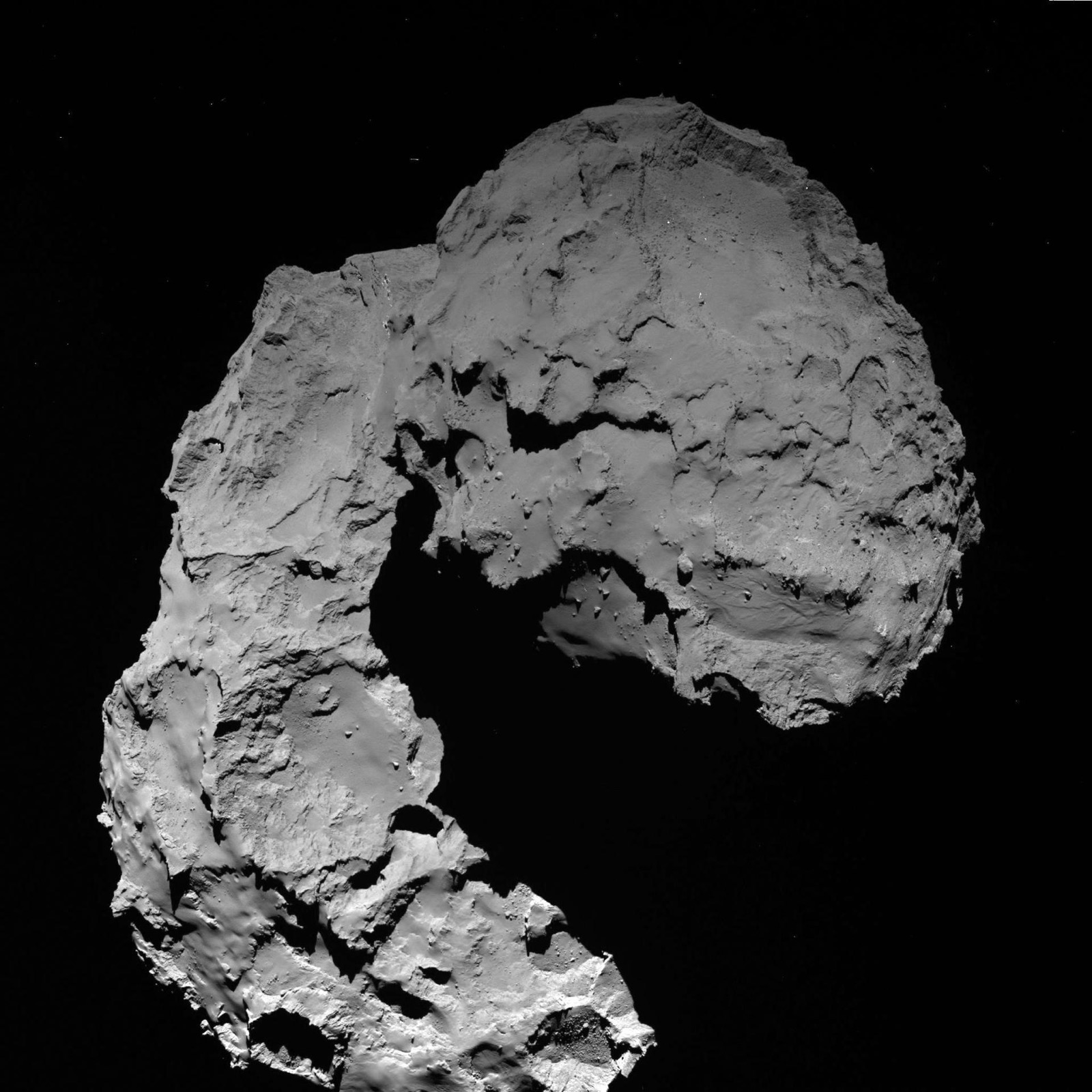
 Photograph · ESA/Rosetta/MPS for OSIRIS Team MPS/UPD/LAM/IAA/SSO/INTA/UPM/DASP/IDA / NASA Image Library
Comet · Deep guide
Comet 67P/Churyumov–Gerasimenko
Also called: 67P · Rosetta's comet
Humanity's robots orbited this rubber-duck comet for two years and landed on it.
What is it?
Comet 67P is the best-studied comet in history: ESA's Rosetta spacecraft chased it for ten years, orbited it for two (2014–16), watched it wake as it neared the Sun, and dropped the lander Philae onto its surface — the first comet landing ever. 67P turned out to be shaped like a rubber duck: two ancient bodies gently fused at a neck.
Go deeper
Rosetta rewrote comet science: 67P's water carries three times Earth-ocean deuterium (so comets like it did NOT fill our oceans — asteroids look likelier); its surface grows and collapses cliffs, sinkholes and dune-like ripples; it hosts molecular oxygen, glycine and phosphorus; and its two-lobed shape records a primordial low-speed merger. Philae's bouncing landing (harpoons failed; it settled in a shaded crack) delivered 60 hours of surface science. Rosetta ended by touching down on the comet itself in September 2016.
01 Landing on a snowflake
67P's gravity is so weak that Philae, dropped gently, still bounced for two hours before settling. Walking there is impossible — a firm step launches you for hours. Rosetta 'orbited' at walking pace, held by a pull 50,000 times weaker than Earth's. Every photograph of its cliffs and boulder fields is of a landscape lighter than fresh snow.
02 Watching a comet breathe Deeper
Because Rosetta stayed through perihelion, it filmed a comet turning on: jets igniting at dawn and dying at dusk, cliffs collapsing to expose blue fresh ice, the whole surface eroding meters per orbit. Comets are not melting snowballs; they are geology in fast forward, resurfacing more in one summer than the Moon does in a billion years.
The deep dive
Researched for the Atlas from Wikipedia — 67P/Churyumov–Gerasimenko (18,021 characters read) · updated Sep 20, 2026
03 A mistaken identity that changed astronomy
The comet's discovery in 1969 hinged on a happy error. Klim Churyumov was studying photographic plates exposed by Svetlana Gerasimenko on 11 September 1969 at the Alma-Ata Astrophysical Institute in the Kazakh Soviet Socialist Republic — plates that were supposed to be tracking the already-known comet Comas Solà. He spotted a fuzzy cometary object near the edge of one plate and assumed it was his target. Only after returning to his home institute in Kyiv and examining every plate more carefully did he realize the object sat about 1.8 degrees away from where Comas Solà should have been. A careful search then turned up a faint image of Comas Solà at its correct position, proving the first object was something entirely new. Without that painstaking re-examination a month after the original photograph was taken, 67P might have gone unnoticed for years longer — and the entire Rosetta mission would never have had a destination.
 ⤢
⤢
04 Two ancient bodies frozen in a slow embrace
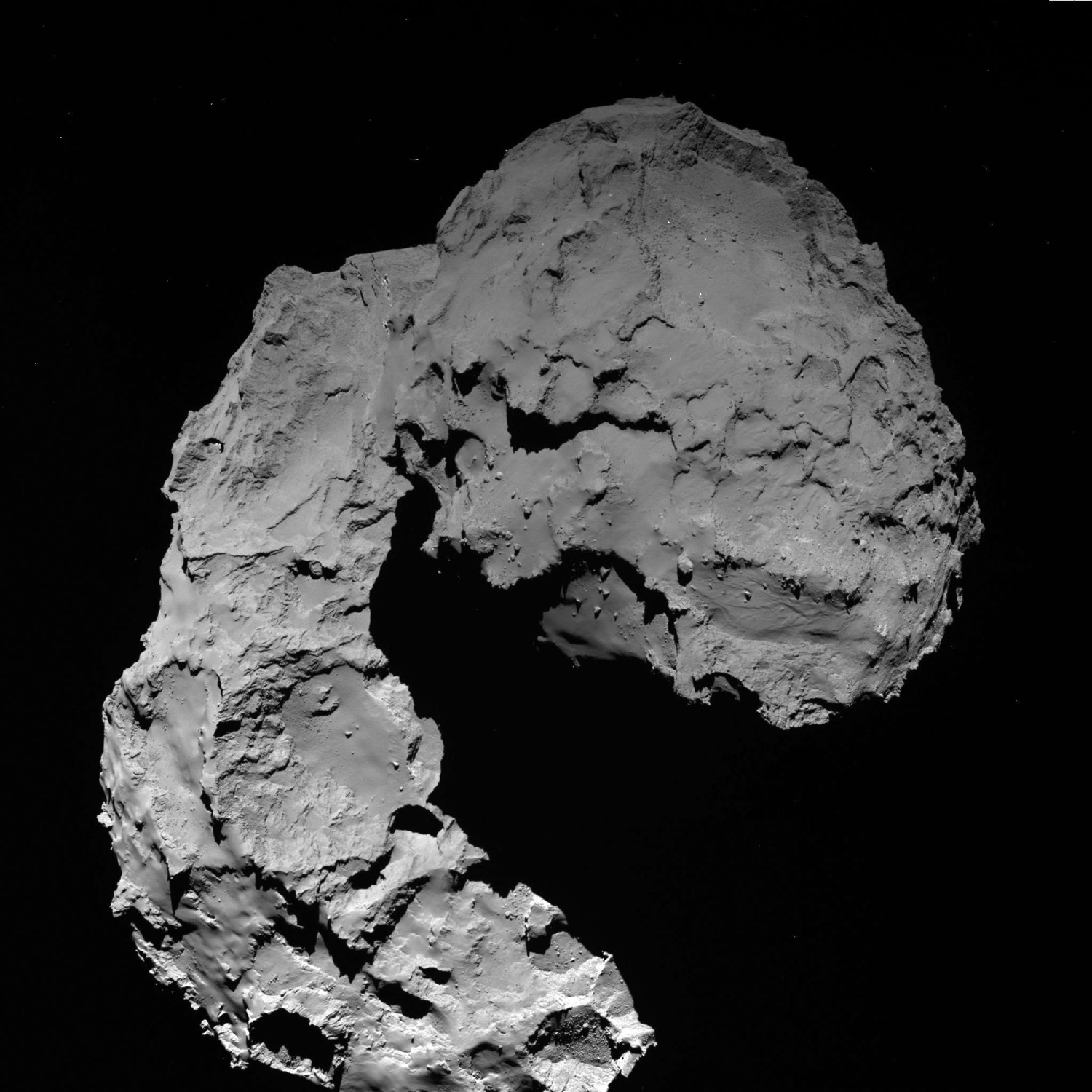
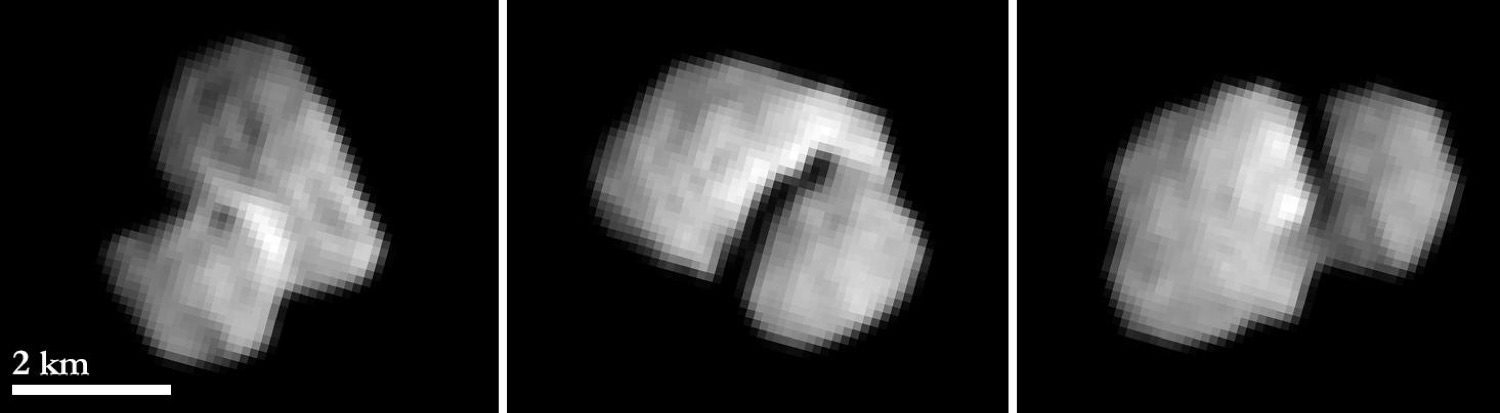
67P's iconic rubber-duck silhouette is not the result of erosion sculpting a single object into an odd shape — it is the frozen record of a collision. Two independent bodies drifted together so gently that they merged without shattering, creating what scientists call a contact binary. The clinching evidence came from the comet's interior: exposed terraces, layers laid down during the early Solar System, run in noticeably different directions in each lobe. If the comet had always been one body, those internal strata would align. Because they do not, mission scientists concluded by September 2015 that the contact-binary explanation was unambiguously correct. The larger lobe measures roughly 4.1 km by 3.3 km by 1.8 km, while the smaller measures about 2.6 km by 2.3 km by 1.8 km, and the two are joined at a narrower neck — the region that concentrates much of the comet's geological drama and where a growing fracture was observed during the Rosetta mission.
05 Jupiter's gravity rewrote the comet's address Deeper
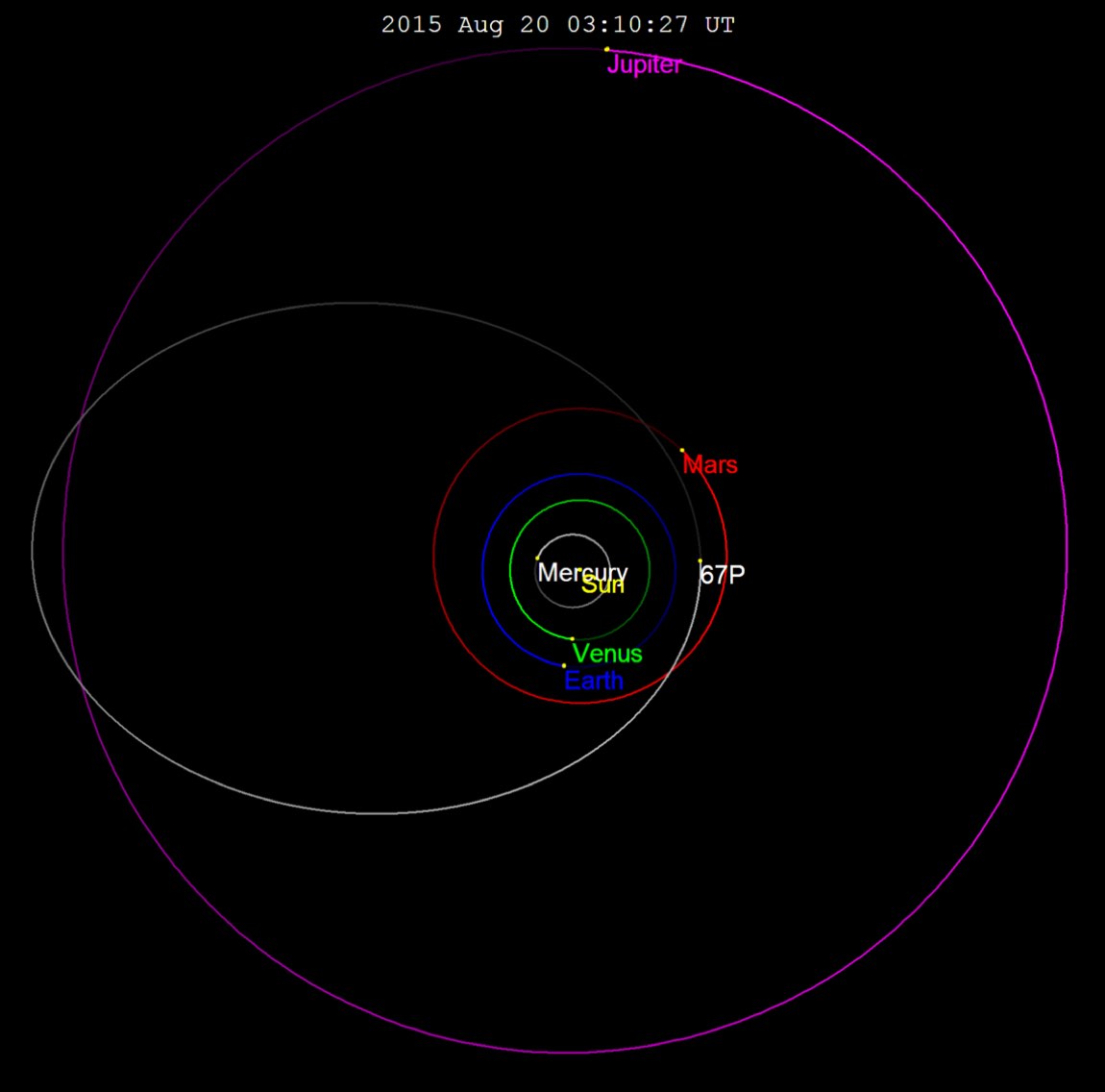
67P did not begin its life where we find it today. Like other Jupiter-family comets, it originally came from the Kuiper belt, the reservoir of icy bodies beyond Neptune, before gravitational nudges from the outer planets sent it inward. The decisive event in its modern history occurred on 4 February 1959, when a close encounter with Jupiter at just 0.0515 AU — about 7.70 million kilometres — dramatically shortened its path around the Sun. Before that flyby, 67P's perihelion sat at 2.7 AU from the Sun, keeping it comfortably in the asteroid belt region and relatively inactive. Afterward, perihelion shifted to 1.28 AU, bringing the comet close enough to the Sun to warm up and become the active, dust-jetting body Rosetta studied. The reshaping is not finished: in November 2220, another Jupiter encounter will move perihelion inward still further, to about 0.8 AU — closer to the Sun than Venus — raising the comet's activity level dramatically. Eventually, gravitational interactions will either eject 67P from the Solar System entirely or send it on a collision course with the Sun or a planet.
06 The comet spins faster every time it swings by Deeper
67P does not rotate at a fixed rate. Before its 2009 perihelion passage, its rotation period was measured at 12.76 hours. By the time it emerged from that perihelion, the period had dropped to approximately 12.4 hours — a spin-up almost certainly driven by sublimation-induced torque. As jets of gas and dust erupt from the sunlit surface, they push back on the nucleus like tiny rocket engines, gradually changing how fast it turns. This same process eats away the comet's mass: scientists estimated that a layer averaging about 1 ± 0.5 metres thick is lost across the entire surface each orbit. With a total mass of approximately 10 billion tonnes, losing a metre per orbit may sound sustainable, but accumulated over many returns it explains why the nucleus is steadily shrinking and why its rotation will keep evolving in ways that mission planners for any future visit will need to account for carefully.
 ⤢
⤢
07 A surface that rewrites itself near the Sun
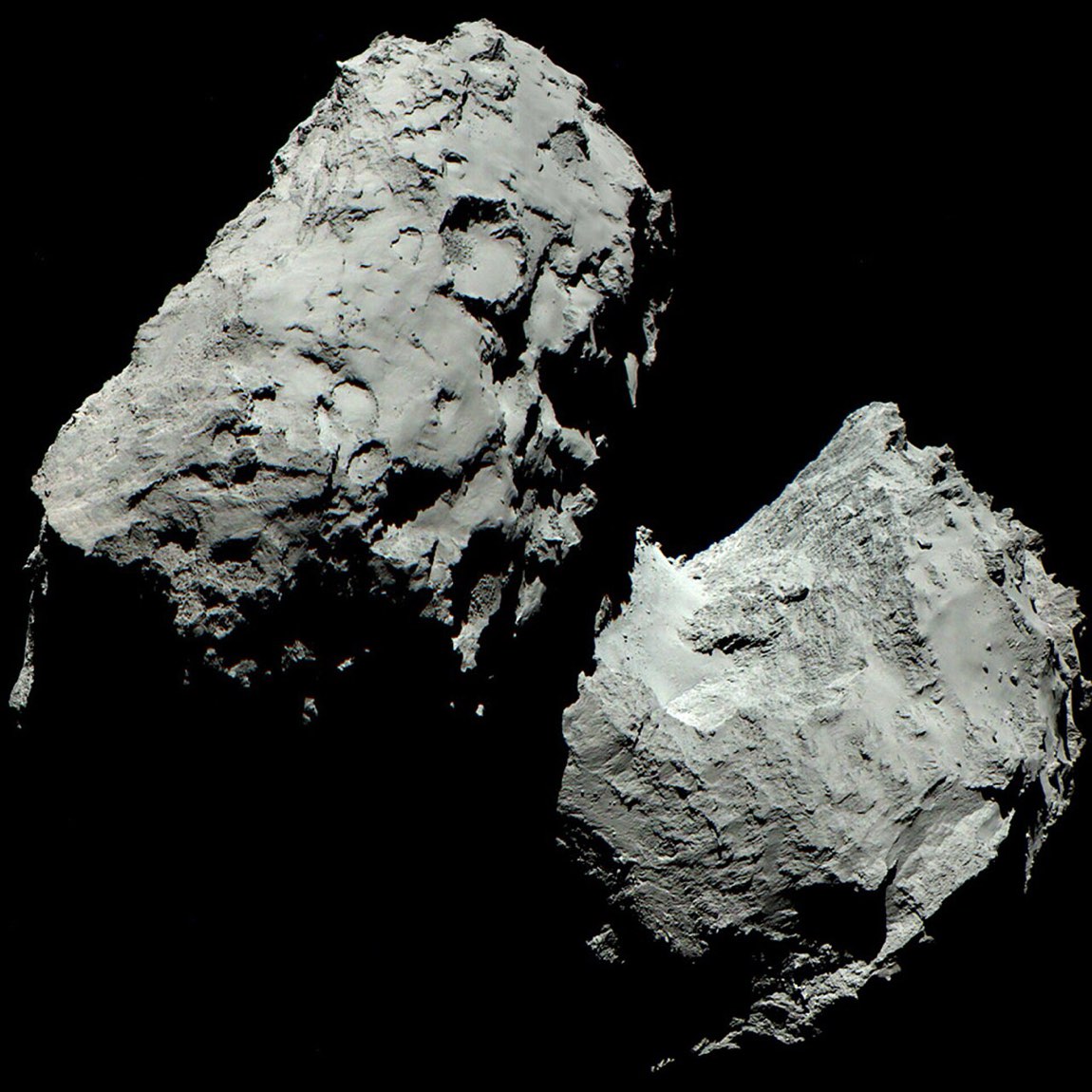
The 26 named regions of 67P — each carrying the name of an Egyptian deity, gods for the large lobe and goddesses for the small — are not static landscapes. Rosetta watched the comet transform in real time as it approached perihelion. Circular depressions in smooth terrain grew by several metres per day. A fracture in the neck region widened visibly. Boulders tens of metres wide were displaced, some travelling more than 100 metres from their original positions. Patches of ground were stripped away to reveal fresh underlying material. In December 2015, Rosetta's navigation camera captured a brilliant flash: scientists determined that a large cliff had collapsed, marking the first observed landslide on a comet that could be directly tied to an outburst of cometary activity. The comet's largest boulder, named Cheops after the pyramid at Giza because of its similar pyramidal shape, measures up to 45 metres across and sits in the larger lobe — a giant relic that has, so far, survived the constant remodelling around it.
08 The shocking chemistry found in the coma Deeper
Rosetta and Philae together built a detailed chemical inventory of 67P that repeatedly surprised researchers. The Philae lander's COSAC and Ptolemy instruments detected sixteen organic compounds in the surface material, four of which had never previously been identified on a comet: acetamide, acetone, methyl isocyanate, and propionaldehyde. Water vapour streaming from the nucleus was laced with formaldehyde at 0.5 weight percent and methanol at 0.4 weight percent, concentrations that fall within the typical range for Solar System comets. Dust particles carried solid organic matter with carbon bound into very large macromolecular compounds, structurally similar to the insoluble organic material found in carbonaceous chondrite meteorites. The only amino acid detected on the comet to date is glycine, accompanied by its precursor molecules methylamine and ethylamine. Scientists think the cometary organic solids and the meteoritic insoluble organics may share a common origin, with the cometary version having experienced less chemical modification over time.
09 Primordial oxygen: the mystery that deepened Deeper
Among all of Rosetta's findings, the detection of abundant free molecular oxygen — O₂ — in the coma of 67P stands out as the most theoretically disruptive. Standard models of Solar System formation predict that molecular oxygen should have been entirely consumed within the first few million years, reacting with hydrogen to form water long before the comet solidified around 4.6 billion years ago. No O₂ had ever been found in a cometary coma before. Crucially, measurements showed that the O₂-to-water ratio is isotropic throughout the coma and does not shift as the comet moves closer to or farther from the Sun, strongly suggesting the oxygen was locked into the nucleus during formation rather than produced later. One competing explanation — that O₂ forms at the surface when water molecules collide with silicates and other oxygen-bearing minerals — was proposed, but by July 2018, researchers had concluded this surface process likely cannot produce oxygen fast enough to account for the observed quantities. The origin of that oxygen remains genuinely unresolved.
 ⤢
⤢
10 No magnetic field: a clue about solar system birth
Before Rosetta arrived, one influential theory of Solar System formation held that magnetic forces helped clump dust and pebbles together into the first solid bodies. A prediction of that theory is that primitive bodies like comets should retain a measurable magnetic field, inherited from the magnetized gas cloud in which they formed. Philae tested this directly during its descent and after touchdown, using its ROMAP instrument, while Rosetta's own RPC-MAG instrument monitored conditions from orbit. The result was unambiguous: 67P's nucleus has no magnetic field of its own. The finding does not rule out magnetism playing some role in the early Solar System, but it removes one line of support for models that gave magnetic forces a starring role in the initial assembly of solid material. It was a result that forced planetary scientists to reconsider some long-held assumptions about how the building blocks of planets first came together more than four and a half billion years ago.
11 Water unlike anything on Earth
One of the most consequential measurements Rosetta made was the ratio of deuterium to hydrogen in the water vapour pouring off 67P. Deuterium is a heavy form of hydrogen with an extra neutron, and the D/H ratio in water is a fingerprint of where and how that water formed. In 67P's water, this ratio turned out to be three times higher than in terrestrial ocean water. This single number carries a major implication: if Earth's oceans were topped up by comets similar to 67P, the oceans should be far richer in deuterium than they actually are. The finding effectively rules out Jupiter-family comets of 67P's type as the primary source of Earth's water, redirecting the search toward other candidates such as asteroids or comets from different dynamical families. By June 2014, before Rosetta had even reached orbit, the spacecraft detected water vapour escaping the nucleus at a rate of roughly 1 litre per second from a distance of 360,000 km. By August 2014, that outgassing rate had risen tenfold.
12 The hunt that finally found Philae
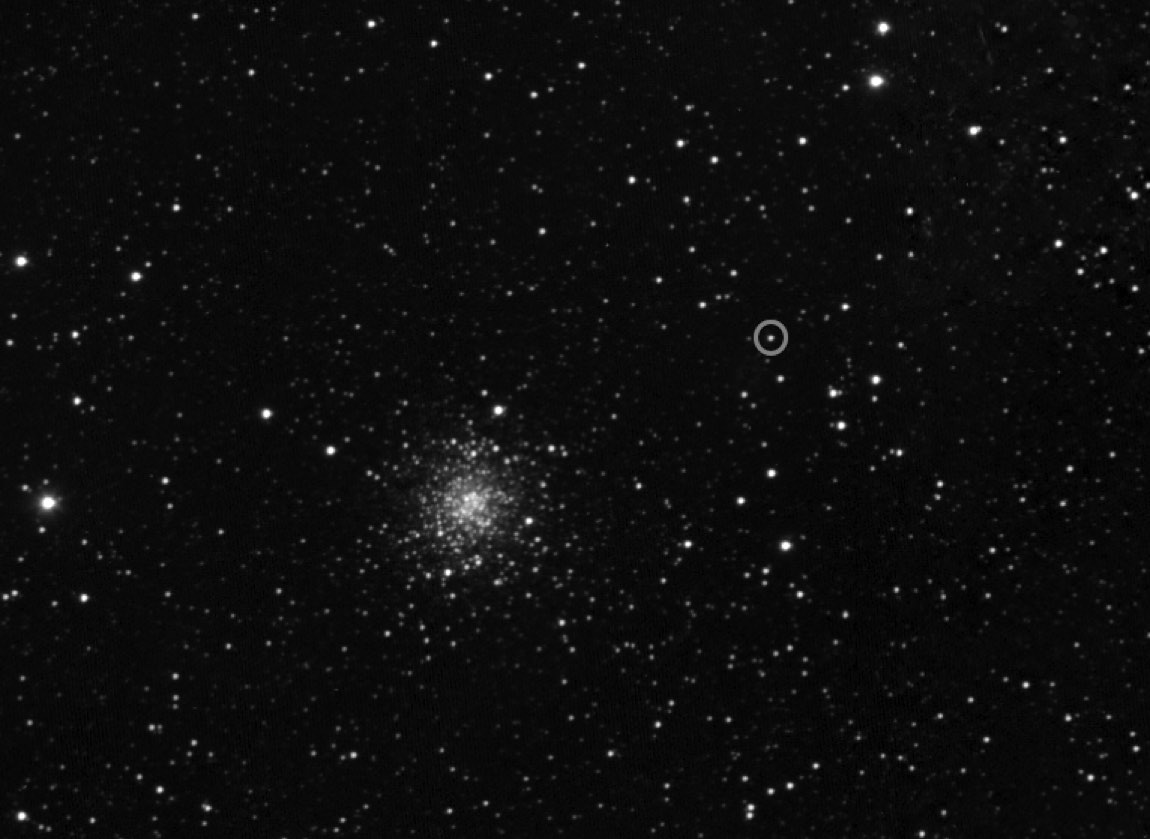
After Philae bounced twice across the surface on 12 November 2014 and came to rest in a shadowed crevice, finding the lander became one of the mission's most painstaking detective stories. The CONSERT radio-ranging instrument narrowed the possible location to an ellipse measuring approximately 16 by 160 metres, but that was still a large patch of rugged terrain to search. Further analysis by CNES-SONC used the timing of radio contacts between Philae and the orbiter, combined with illumination models, to shrink the search area. The breakthrough came when analyst Guillaume Faury identified a single bright spot — about two pixels wide — present in a post-landing OSIRIS-NAC image but absent from a geometrically similar pre-landing image of the same terrain. Every surrounding topographic feature matched perfectly; only that tiny bright point was new. The identification remained unofficial until September 2016, when Rosetta flew close enough to image Philae directly, revealing the lander wedged in a dark crack with only its body and two of its three legs visible.
 ⤢
⤢
13 Reading the comet's hidden interior Deeper
Scientists have used the wealth of images Rosetta gathered to build an extraordinarily detailed model of 67P's nucleus. Using 7,682 images from the OSIRIS narrow-angle camera and 1,504 from the wide-angle camera, researchers reconstructed a high-resolution photogrammetric shape model containing 132.1 million facets — the kind of geometric detail normally reserved for engineered objects. This model revealed the existence of structures called Subsurface Access Points: natural cavities ranging from 20 to 47 metres in depth that cut through the surface crust and expose material that has never been directly heated by the Sun. Analysis showed a clear link between the amount of solar energy reaching the bottom of these pits and the triggering of transient sublimation jets. Because the material at the base of these cavities has been shielded from processing, mission planners regard them as the most scientifically valuable targets for any future sample-return mission seeking genuinely pristine early Solar System material. Separately, Philae's surface measurements found a dust layer up to 20 cm thick overlying hard ice or an ice-dust mixture, with porosity increasing toward the comet's centre.
14 How bright does it get, and can you see it?
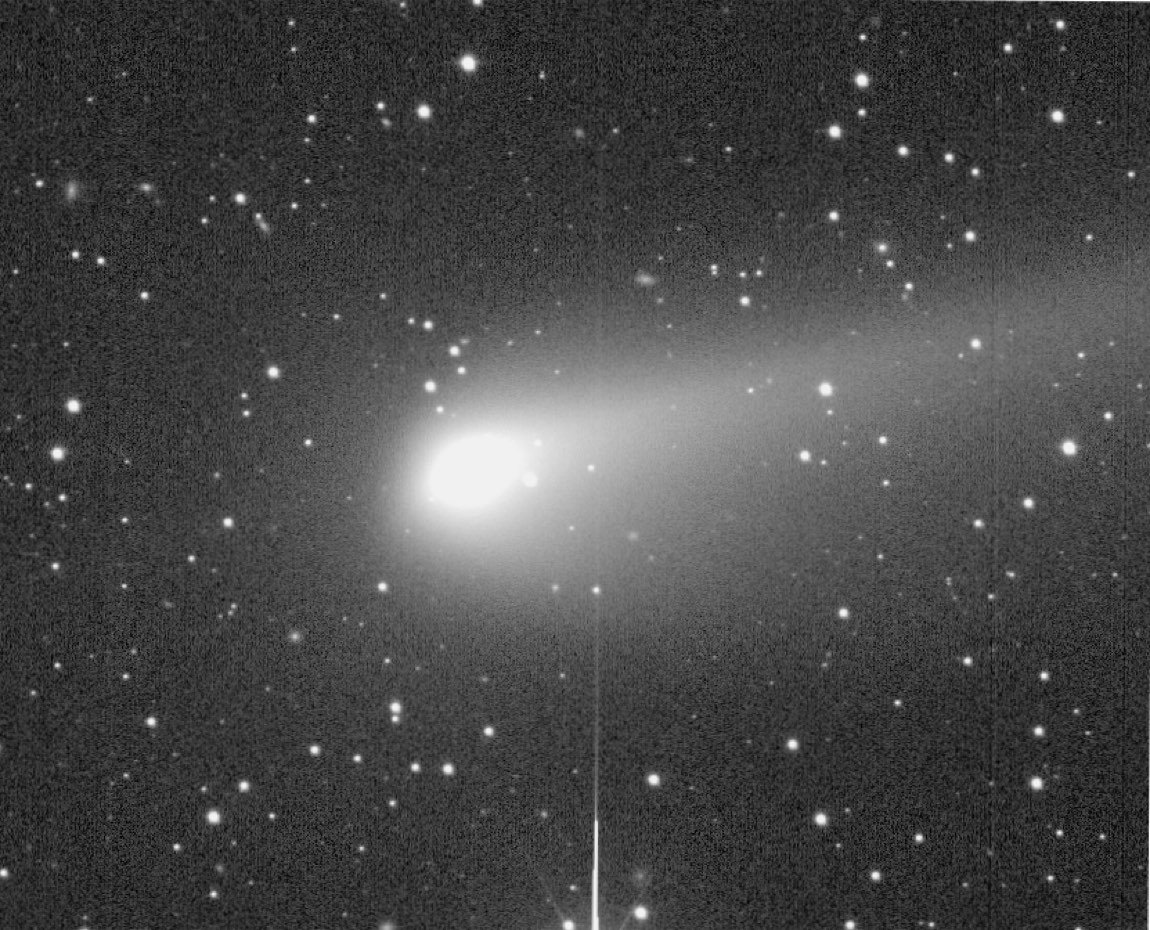
For most of its orbit 67P is far too faint to observe without professional equipment. In September 2014, while Rosetta was already in orbit around it, the comet's nucleus had an apparent magnitude of only about 20 — roughly 100,000 times fainter than the dimmest star the naked eye can detect under a dark sky. Even at perihelion in August 2015, the comet reached only about apparent magnitude 12, requiring a telescope. By July 2016 it had faded back to around magnitude 20. The 2021 apparition was notably more favourable: it was the closest the comet had come to Earth since 1982, passing just 61 million kilometres away on 12 November 2021. At that apparition it brightened to magnitude 9, within reach of amateur telescopes with modest apertures. Two outbursts added brief extra brightness — the first, on 29 October 2021, increased the effective cross-section of its dust cloud by 27% and ejected an estimated 5.3 × 10⁵ kg of dust; the second, on 17 November 2021, was 2.5 times larger still.
15 What a sample-return mission could unlock
Rosetta transformed our understanding of 67P, but every instrument it carried took measurements remotely or from material that had already been processed by sunlight and space weathering. Scientists proposed a follow-up called CAESAR — the Comet Astrobiology Exploration Sample Return — specifically to go back to 67P, scoop up surface material, and bring it to laboratories on Earth. Choosing a comet already thoroughly characterised by Rosetta was deliberate: the orbital history, surface geography, and chemistry are already known, allowing returned samples to be interpreted in rich context. CAESAR competed as a finalist in NASA's New Frontiers mission 4 selection process before being passed over in June 2019 in favour of the Dragonfly mission to Saturn's moon Titan. The newly identified Subsurface Access Points, with their cavities up to 47 metres deep reaching material shielded from solar processing, represent exactly the kind of pristine targets a sample-return mission would prioritise. Whether 67P eventually yields physical samples to terrestrial laboratories remains an open question.
 ⤢
⤢
Could life exist here?
No — but glycine and phosphorus in its halo underline comets' delivery role.
Our labels: Confirmed · Strong Evidence · Estimated · Hypothesis · Theoretical · Speculative (see Methodology).
How would we get there?
Rosetta needed ten years and four gravity assists to match orbits — rendezvous is far harder than flyby.
| Technology | Status | Travel time (one way, straight line) |
|---|---|---|
| Apollo-style spacecraft, about 39,000 km/h | Flown technology | 643 days |
| Ion-propulsion probe, about 90,000 km/h | Flown technology | 278 days |
| Voyager 1, about 61,000 km/h | Flown technology | 408 days |
| Parker Solar Probe, about 690,000 km/h | Flown technology | 36 days |
| Nuclear-thermal rocket, about 120,000 km/h cruise | In development | 210 days |
| Laser light-sail at 20% of light speed | Proposed concept | 2.8 hours |
| Light itself, 299,792 km/s | Physical limit | 33 minutes |
Simplified straight-line times at cruise speed. Real missions fly curved orbital paths and take longer. Full travel calculator →
Weird & wonderful
- 67P sings — a magnetic-field oscillation Rosetta recorded and ESA released as audio.
- Its 'duck' shape is two comets that bumped at less than walking speed and stuck.
- Philae was found two years after landing, wedged in a crack — photographed days before the mission ended.
More real images of Comet 67P/Churyumov–Gerasimenko
Genuine spacecraft and telescope imagery, every frame credited and licensed. Tap any photo to enlarge.