 Photograph · KSC / NASA Image Library
Comet · Deep guide
Comet Hale–Bopp
The Great Comet of 1997 stayed visible to the naked eye for a record 18 months.
What is it?
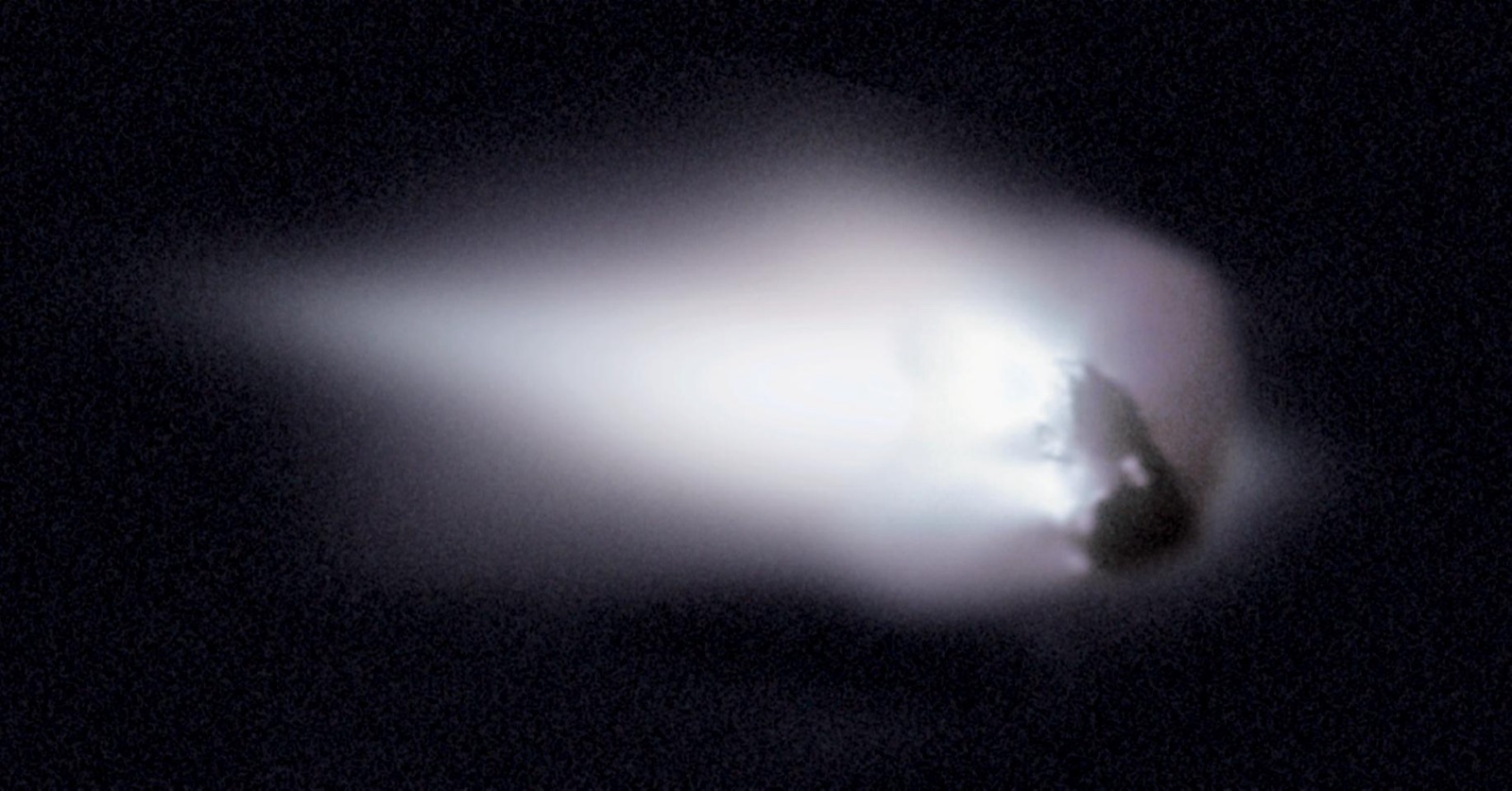
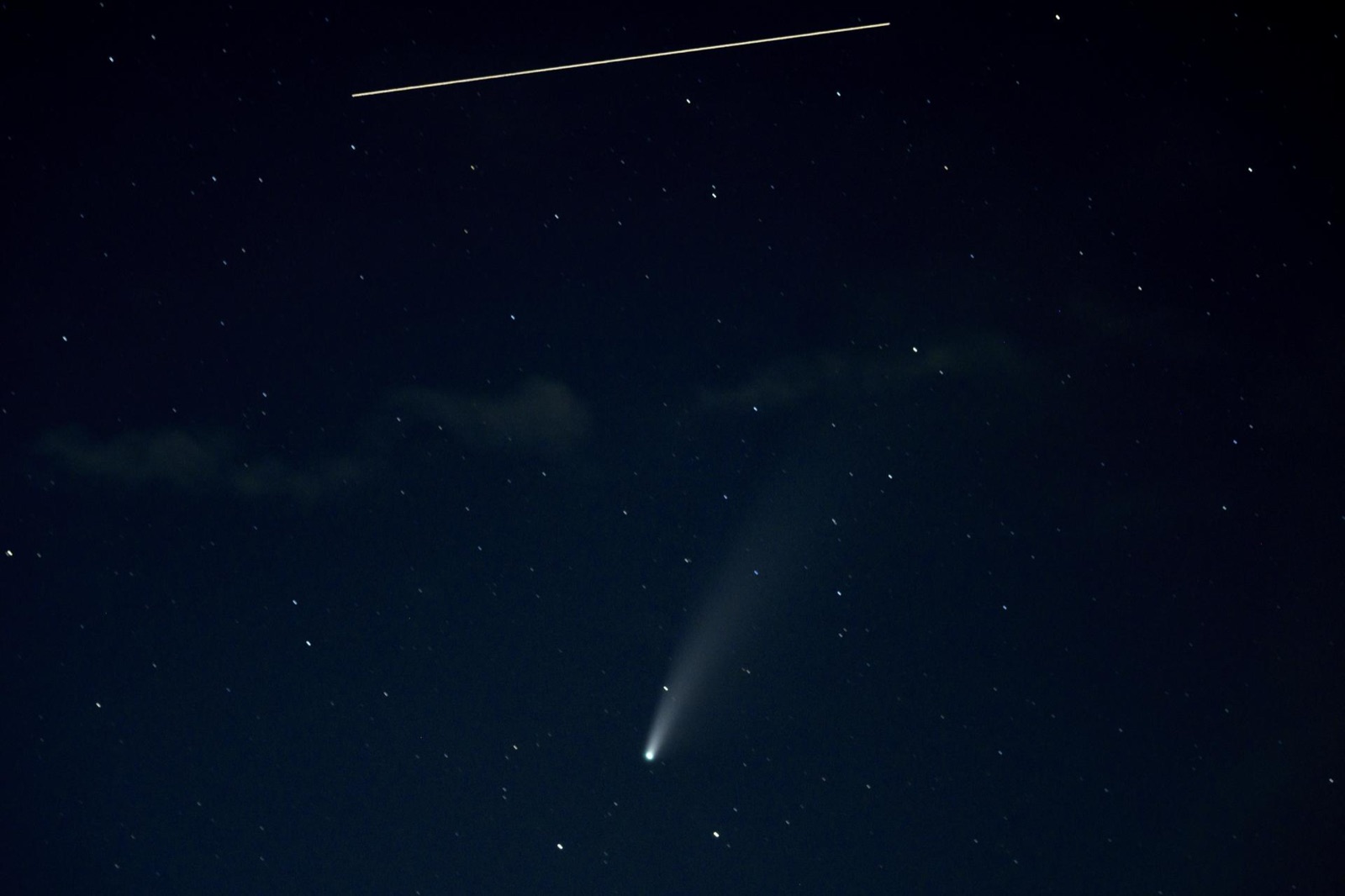
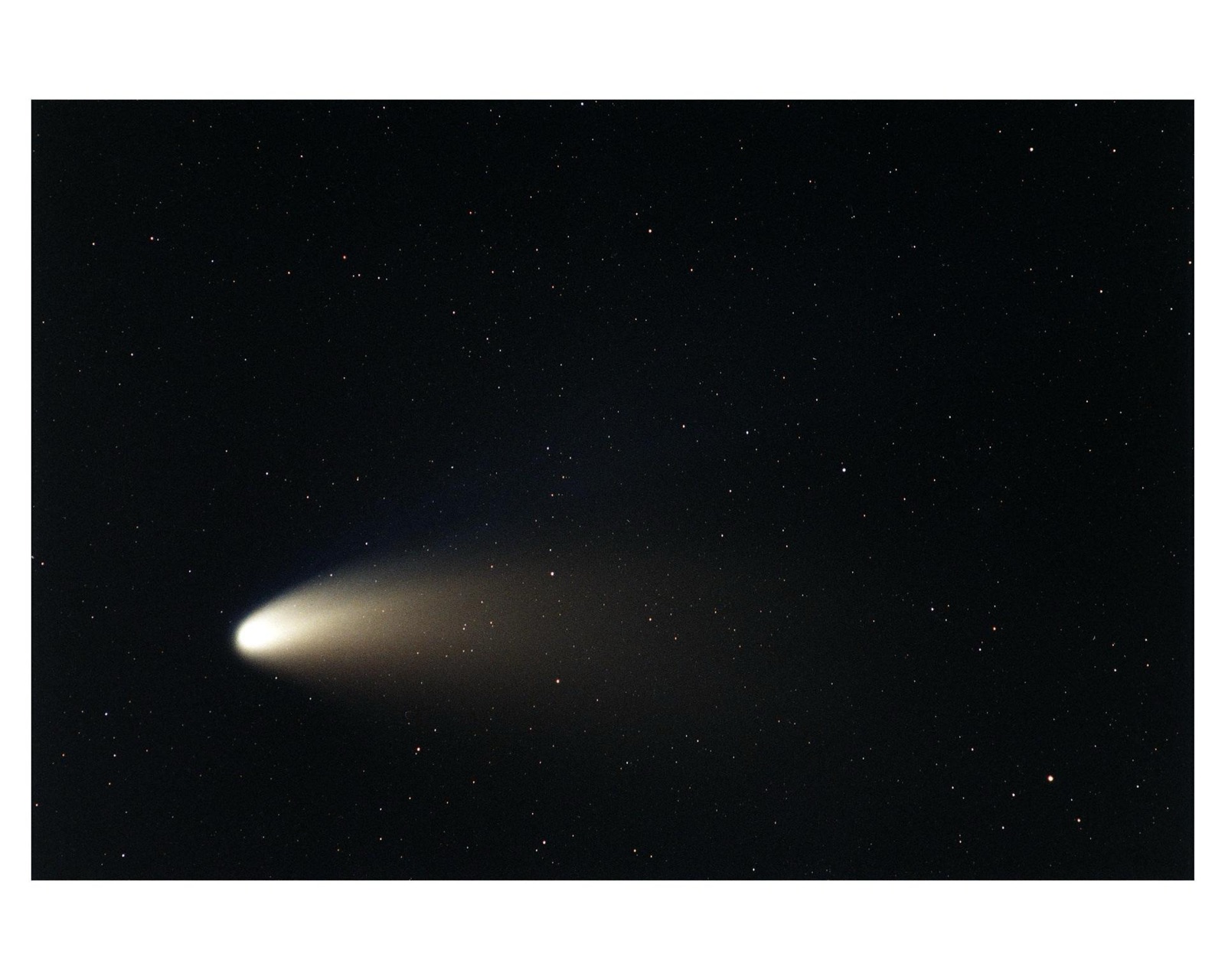
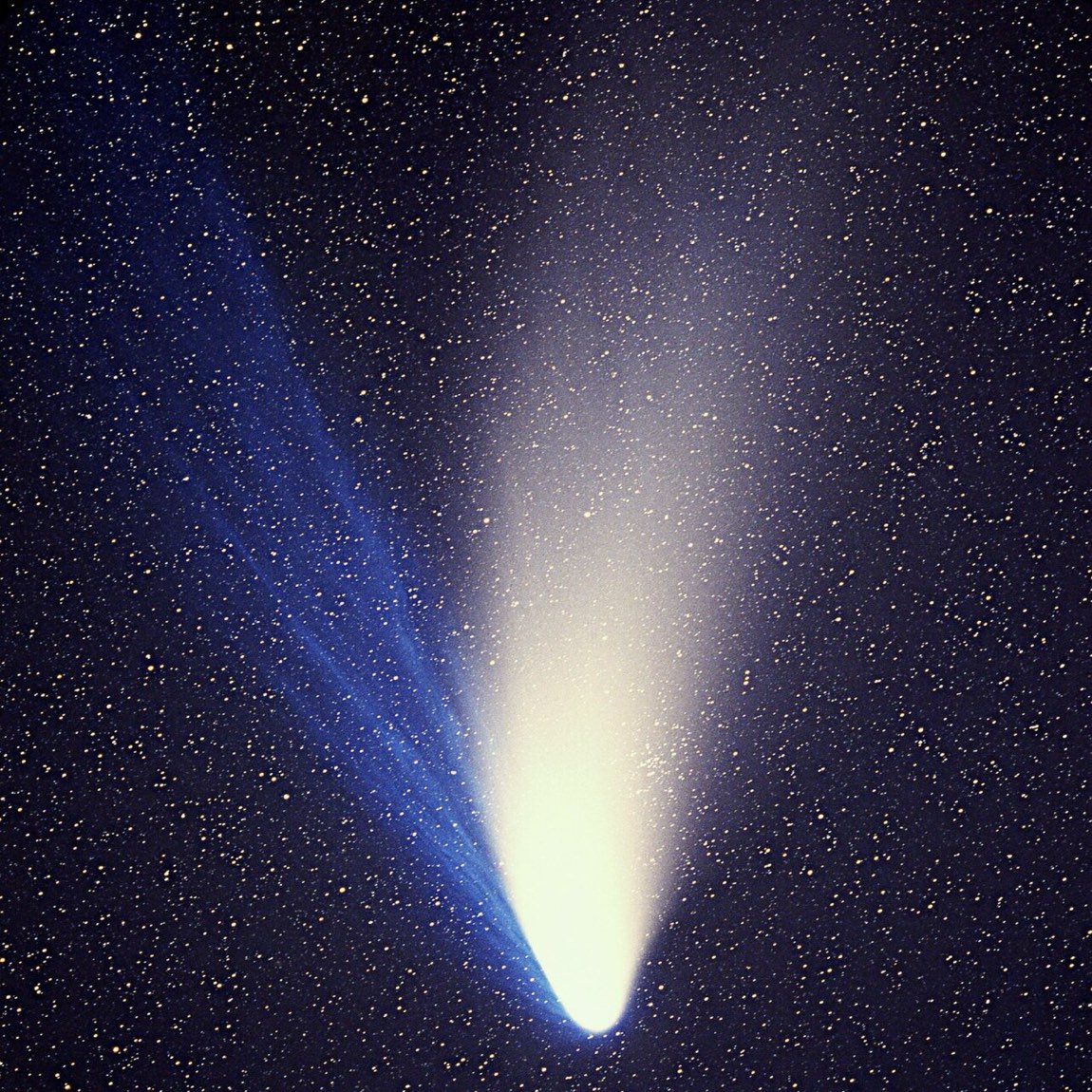
Hale–Bopp was the most-watched comet of the 20th century: a giant, hyperactive comet that stayed visible to the naked eye for 18 months through 1996–97 — a record. Its twin tails, blue gas and cream-colored dust, arched across the sky even over light-polluted cities. It will not return for roughly 2,400 years.
Go deeper
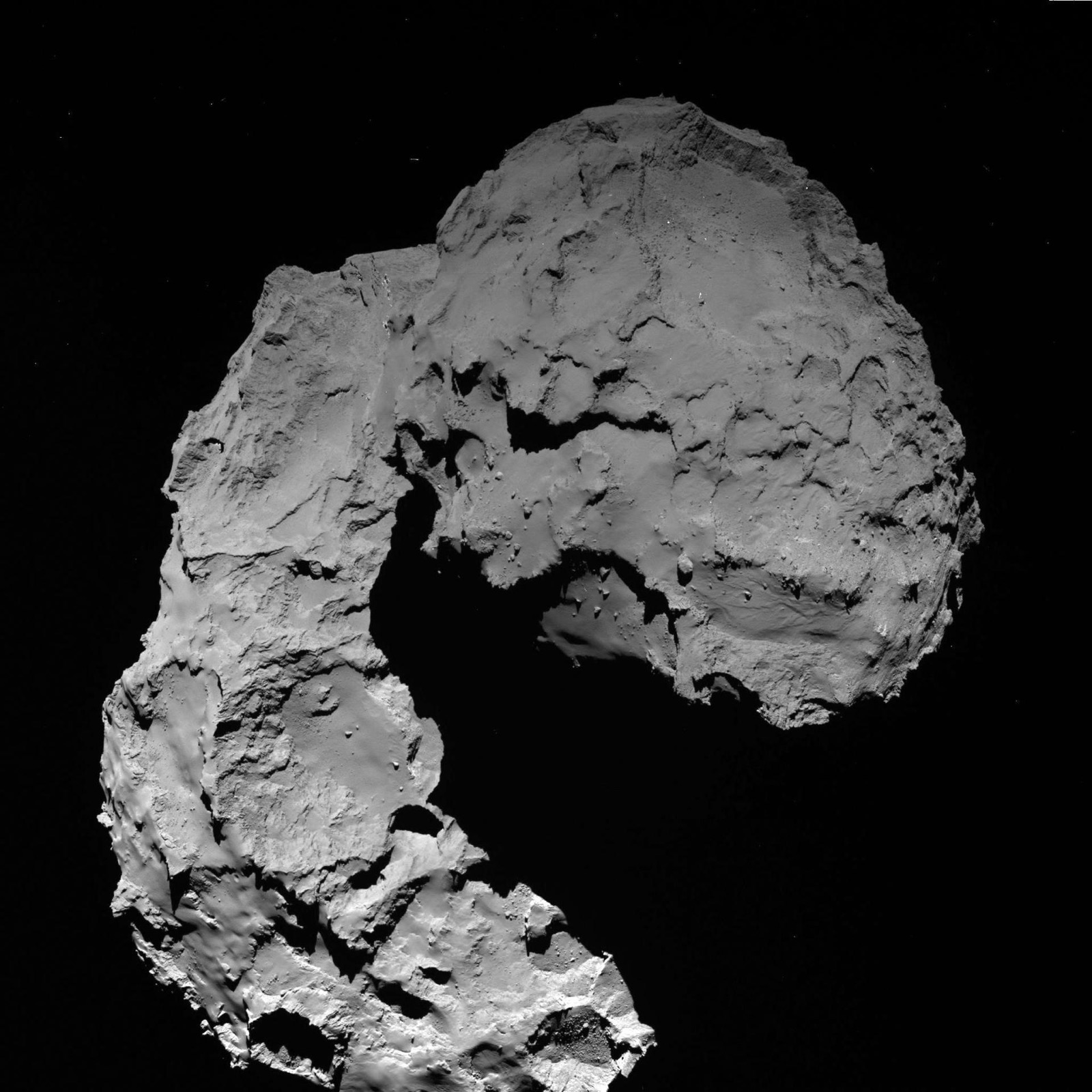
Hale–Bopp's nucleus is enormous by comet standards (~40–60 km vs Halley's 15), which powered its months of brilliance despite never coming very close to Earth (1.315 AU minimum). It showed a rare third tail of neutral sodium and taught planetary science how big comets behave far from the Sun — it remained observable to major telescopes for over two decades outbound. Discovered independently by Alan Hale and Thomas Bopp in July 1995, a full 7.2 AU out — record distance for an amateur comet discovery.
01 Everyone's comet
An estimated 70% of Americans saw Hale–Bopp — it hung in the northwest after sunset for week after week in spring 1997, bright enough to survive city glow. For a generation of future astronomers, it is the reason they looked up in the first place.
02 Why some comets are great Deeper
A comet's show depends on nucleus size, freshness of ices, and geometry. Hale–Bopp had size; NEOWISE (2020) had geometry; Halley has schedule reliability. The rarest event — a huge, fresh comet passing genuinely close — hasn't happened since the Great Comets of the 1800s. Statistically, one is always overdue: the next could be discovered any night.
The deep dive
Researched for the Atlas from Wikipedia — Comet Hale–Bopp (18,763 characters read) · updated Sep 20, 2026
03 Two strangers find the same comet
The discovery of Hale–Bopp on July 23, 1995, is one of astronomy's great coincidences. Alan Hale was working from his driveway in New Mexico, methodically tracking known comets after hundreds of fruitless hours of searching. Just after midnight he noticed an unfamiliar smudge near the globular cluster M70 in Sagittarius, with an apparent magnitude of 10.5 — about 25 times fainter than the human eye can normally detect. He checked directories of known comets, confirmed the object was moving against the background stars, and emailed the Central Bureau for Astronomical Telegrams at around 6:50 UT. Meanwhile, at Vekol Ranch roughly 140 kilometres south of Phoenix, Thomas Bopp — who owned no telescope at all — was peering through a friend's homemade 44 cm Dobsonian reflector when he spotted the same object. He reached the same conclusions independently and alerted the Bureau by Western Union telegram, arriving about two hours after Hale's email. Bureau director Brian Marsden, who had run the office since 1968, noted with some amusement that Hale had already sent three follow-up emails with updated coordinates before the telegram even arrived.
 ⤢
⤢
04 Already active at a record distance Deeper
When Hale–Bopp was discovered, it lay 7.2 AU from the Sun — roughly between the orbits of Jupiter and Saturn — making it by far the greatest distance from Earth at which amateurs had ever found a comet. More striking still, a precovery image from the UK Schmidt Telescope, taken in 1993 but identified only later, showed the comet when it was 13 AU from the Sun, a distance at which most comets are essentially invisible. For comparison, Halley's Comet was more than 100 times fainter at the same distance. This extraordinary early brightness pointed to a nucleus far larger than average: analysis eventually placed the diameter at 60 ± 20 km, approximately six times the size of Halley's Comet. That size also made scientists cautious — they remembered how Comet Kohoutek in 1973 had been heralded as the "comet of the century" and then fizzled. History would show that caution was unwarranted. Hale–Bopp's coma was already detectable at 13 AU, a feat that signalled the comet's enormous reservoir of volatile ices and set the stage for the spectacle that followed nearly four years later.
05 Brightness and the solar-heating lag
Hale–Bopp passed perihelion on April 1, 1997, but it did not actually peak in brightness until April 2–4, 1997 — a detail that illustrates something subtle about how comets work. The most intense solar heating happens at closest approach, yet the outgassing of dust and ions responds with a slight delay as heat penetrates the nucleus and the ejected material builds up in the coma and tails. This "solar heating lag" pushed maximum brilliance just past perihelion. At its peak the comet reached an apparent magnitude of roughly −1.8, making it the brightest object in the night sky after Sirius. Its dust tail stretched 40–45 degrees across the sky — nearly half the distance from the horizon to the zenith — and observers in light-polluted cities could still see it with the naked eye. Unlike many great comets that hug the Sun at perihelion and are hard to observe, Hale–Bopp was well placed for Northern Hemisphere viewers all night long. A comparable spectacle for the Northern Hemisphere would not be seen again until Comet Tsuchinshan–ATLAS in October 2024.
06 The mysterious third tail of sodium Deeper
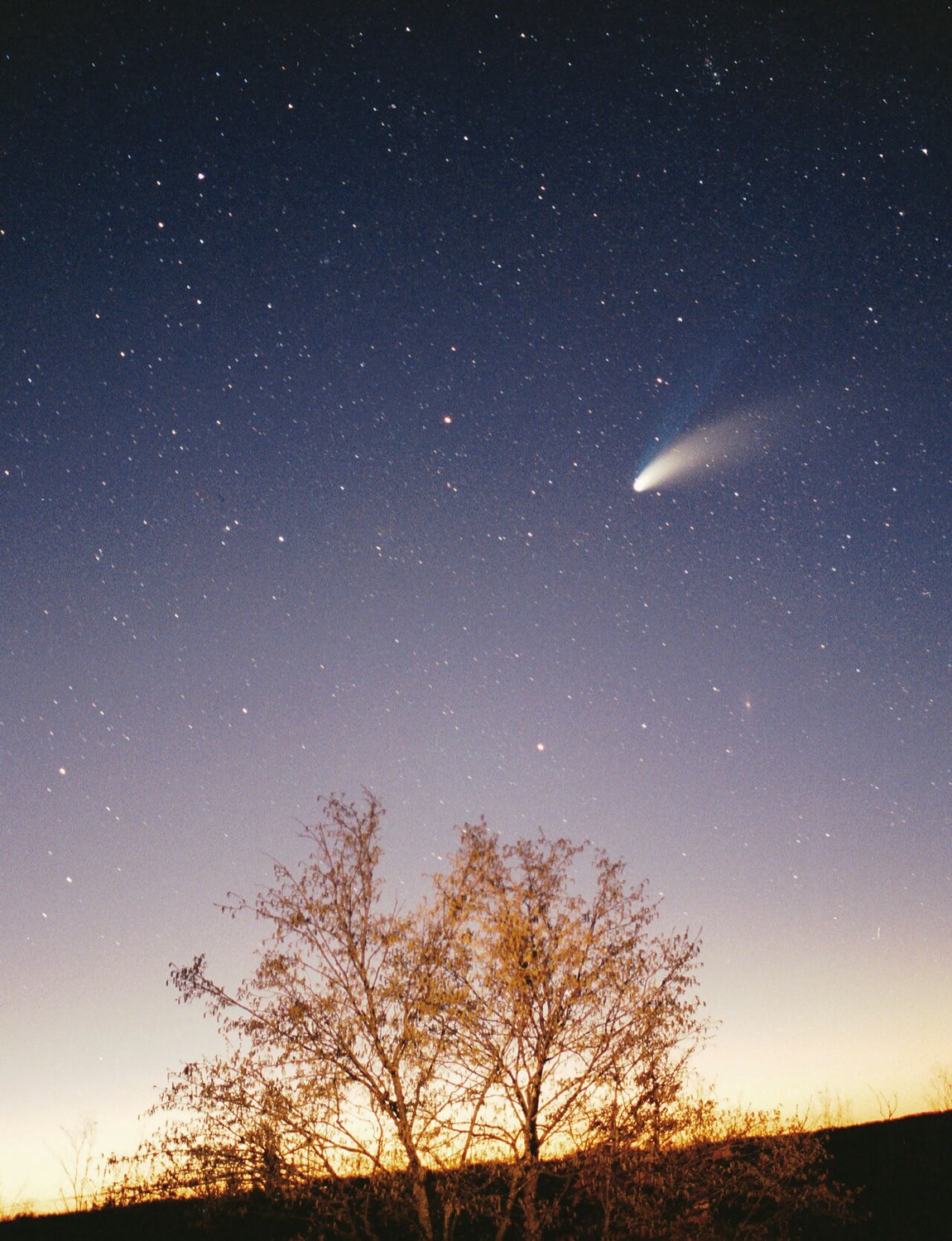
Every comet textbook describes two tails: a straight blue ion tail blown directly away from the Sun by the solar wind, and a curved yellowish dust tail that traces the comet's orbit. Hale–Bopp revealed a third kind. Observers detected a faint sodium tail consisting of neutral atoms — not ions — extending roughly 0.33 AU, or about 49 million kilometres, in length. Sodium emission had been seen in other comets before, but never proven to form a true tail structure. Hale–Bopp's sodium tail lay geometrically between the dust and gas tails, which astronomers interpreted as evidence that radiation pressure from sunlight was pushing the neutral sodium atoms away from the nucleus at a rate intermediate between dust and gas. The source region appears to be the inner coma rather than the nucleus surface itself, though exactly how the atoms are liberated remains debated. Two candidate mechanisms are collisions between dust grains near the nucleus and the "sputtering" of sodium from dust surfaces by ultraviolet light. Both the narrow and diffuse components of the tail may have different origins, and the question of which process dominates has not yet been settled.
 ⤢
⤢
07 What heavy water revealed about Earth's oceans
One of the most consequential measurements made during Hale–Bopp's visit was of deuterium, the heavy isotope of hydrogen. Scientists found that the ratio of heavy water to ordinary water in the comet was about twice that found in Earth's oceans. This matters enormously for a long-standing debate: did cometary impacts deliver much of Earth's water during the period of heavy bombardment early in the solar system's history? The Hale–Bopp result suggests the answer is "not comets alone." If the comet's deuterium ratio is typical, then comets of this kind could not be the dominant source of Earth's oceans because the isotope ratios simply do not match. Beyond water, deuterium was also detected in many other hydrogen-bearing compounds in the comet, and the ratio varied from molecule to molecule. Astronomers interpret this variation as a fingerprint of formation in cold interstellar clouds rather than in the warmer solar nebula. Theoretical models of ice chemistry in such clouds point to formation temperatures of around 25–45 kelvin — colder than liquid nitrogen, which boils at about 77 kelvin.
08 Noble gases and the comet's temperature history Deeper
Hale–Bopp became the first comet in which the noble gas argon was positively detected. Noble gases are chemically inert and have well-defined sublimation temperatures, which makes them precise thermometers for reconstructing the past thermal conditions of cometary ice. Krypton, which sublimates at 16–20 K, was found to be depleted by more than a factor of 25 relative to the solar abundance — meaning it has largely boiled away at some point. Argon, with its higher sublimation temperature, was enriched relative to solar abundance. Read together, these data constrain the comet's interior: it has always been colder than 35–40 K, yet at some point it was warmer than 20 K. Unless the solar nebula was far colder and more argon-rich than standard models suggest, this thermal history implies Hale–Bopp formed beyond Neptune in the Kuiper belt region before migrating outward to the Oort Cloud. The detection of previously unseen organic molecules in the same spectroscopic campaign added to a picture of a chemically complex body that had spent most of its existence in the deep cold of the outer solar system.
09 Does the nucleus have a companion?
In 1997 a theoretical paper proposed that the unusual pattern of dust emission observed in October 1995 could best be explained if Hale–Bopp harboured a binary nucleus — two bodies orbiting each other rather than one. The proposed companion was estimated to be about 30 km in diameter, orbiting a primary nucleus of roughly 70 km at a distance of about 180 km, completing one orbit in approximately three days. The paper was based on modelling, not direct imaging, but subsequent observations using the Hubble Space Telescope's Wide-Field Planetary Camera 2 in 1996 appeared to reveal the satellite. Later adaptive optics observations in late 1997 and early 1998 showed a double peak in nuclear brightness, yet controversy persists about whether that brightness pattern requires a binary interpretation. No independent confirmation of the companion was ever firmly established. The question matters beyond Hale–Bopp: stable binary comet nuclei were essentially unknown at the time, and the first confirmed case of a binary cometary object, P/2006 VW139, was not recognised until 2016, nearly two decades later.
 ⤢
⤢
10 Jupiter reshuffled its orbit — twice Deeper
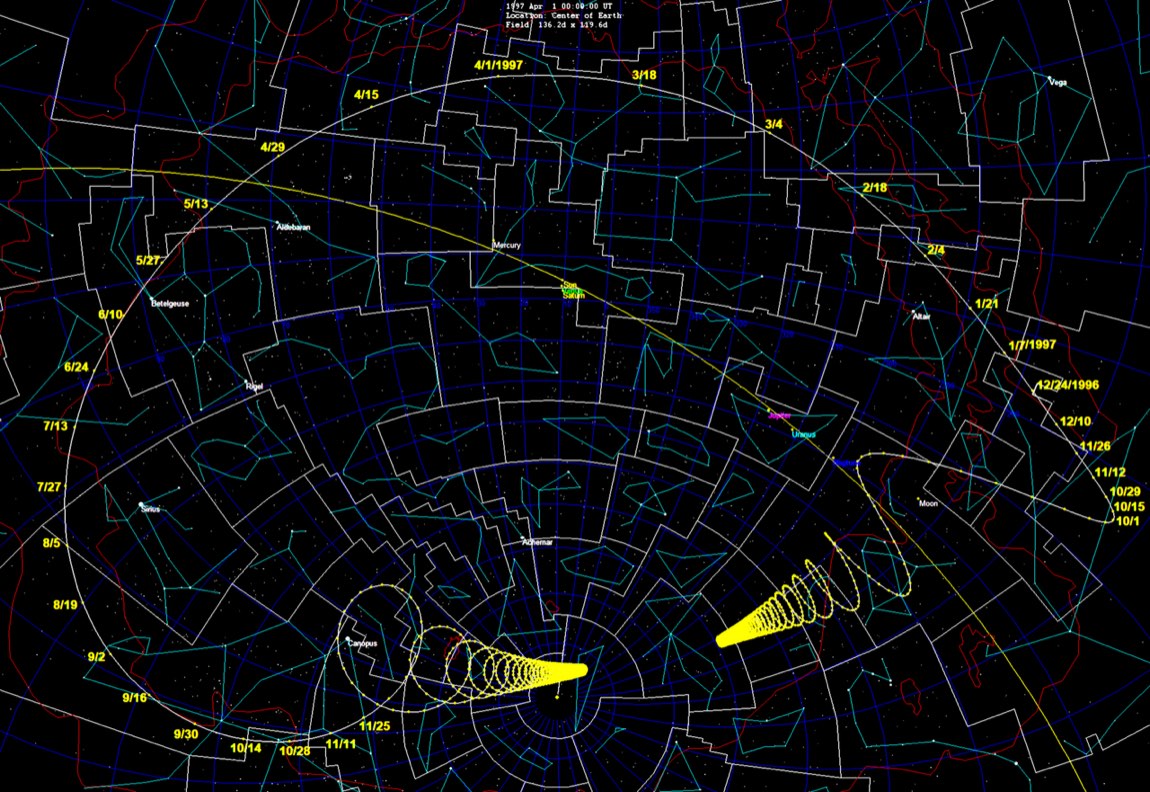
Hale–Bopp's orbital biography reads as a story of giant-planet encounters. Its current path is almost perpendicular to the plane of the ecliptic, and astronomers calculate that its previous perihelion occurred roughly 4,200 years ago, around 2215 BC. At that time its estimated closest approach to Earth was about 1.4 AU, and it may have been visible in ancient Egypt during the reign of Pharaoh Pepi II. A text from Pepi's pyramid at Saqqara refers to an "nhh-star" in the heavens — the hieroglyph "nhh" meaning long hair — which some researchers interpret as a comet description. The 2215 BC visit may also have involved a near-collision with Jupiter, possibly the event that first deflected Hale–Bopp into the inner solar system from the Oort Cloud. In April 1996, during the comet's recent return, it passed within 0.77 AU of Jupiter again. Jupiter's gravity trimmed the orbital period considerably, shortening it to roughly 2,399 years and reducing the aphelion from about 525 AU to roughly 354 AU. As a result, the comet's next inner-solar-system appearance is expected around the year 4385.
11 Still active at the edge of the solar system
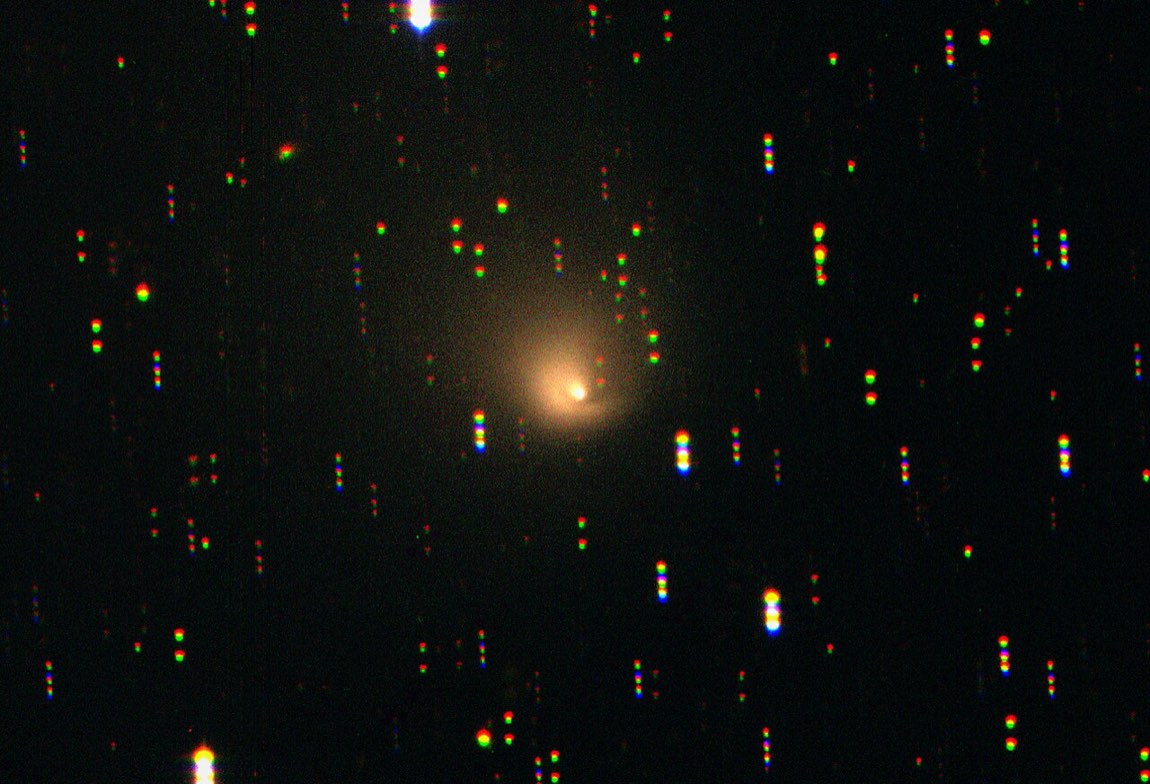
Most comets fade into invisibility within a year or two of perihelion. Hale–Bopp has proved remarkably durable. In October 2007, a full decade after perihelion, the comet was 25.7 AU from the Sun — near the distance of Uranus's orbit — and a coma driven by carbon monoxide outgassing was still detectable. Images from the Herschel Space Observatory taken in 2010 suggested the nucleus was coated in a fresh frost layer, indicating ongoing surface activity. The comet was detected again in December 2010 at 30.7 AU, and once more in 2012 at 33.2 AU. Most remarkably, the James Webb Space Telescope observed Hale–Bopp in 2022 when it had retreated to 46.2 AU — farther than Neptune's orbit — demonstrating that the nucleus retains enough volatile material to remain observable even at that enormous distance. For context, light traveling at 300,000 km/s takes more than six hours to cover 46.2 AU. The comet's eventual aphelion will be around 354 AU, a journey into a region of the solar system so cold and remote that most telescopes cannot follow it.
12 Impact risk: remote but apocalyptic Deeper
The probability of Hale–Bopp striking Earth on any future inner-solar-system passage is extraordinarily small — estimated at about 2.5 × 10⁻⁹ per orbit. With an orbital period of roughly 2,399 years, this risk is not something any currently living generation needs to contemplate. However, astronomers have calculated what such an impact would mean, and the numbers are staggering. Using a conservative nucleus diameter of 35 km and an estimated density of 0.6 g/cm³, Paul Weissman derived a cometary mass of about 1.3 × 10¹⁹ grams. At a probable impact velocity of 52.5 km/s, the kinetic energy released would be approximately 1.9 × 10³² ergs, equivalent to roughly 4.4 × 10⁹ megatons of TNT. That is about 44 times the estimated energy of the Cretaceous–Paleogene (K–T) impact event that ended the dinosaurs. A separate long-term concern: over many orbits, gravitational perturbations tend to shrink the perihelion distances of high-inclination comets like Hale–Bopp, and astronomers estimate there is about a 15% chance it eventually becomes a sungrazing comet.
 ⤢
⤢
13 Rotation, jets, and the comet's spin
Rather than outgassing evenly from its entire surface, Hale–Bopp vented material through several specific jets — localised regions where sunlight was most intense or ice most exposed. This patchy activity turned out to be scientifically useful. By tracking the material streaming away from each jet as the nucleus rotated, astronomers could measure the spin period with considerable precision, arriving at a rotation period of approximately 11 hours and 46 minutes. That is a moderately fast spin for a nucleus 60 km across; for comparison, Earth rotates once in 24 hours. The jet activity also produced the non-uniform dust emission patterns that prompted the binary-nucleus hypothesis, underscoring how a single phenomenon — uneven outgassing — can drive discoveries across multiple areas of cometary science. The comet's dust production rate reached as high as 2.0 × 10⁶ kilograms per second at peak activity, a figure so large that the inner coma may have become optically thick, meaning light could not pass straight through it.
14 A tragedy and a lasting legacy
Hale–Bopp's passage left marks beyond astronomy. Geologist and comet hunter Gene Shoemaker — co-discoverer of comet Shoemaker–Levy 9, the object that struck Jupiter in 1994 — was involved in a car crash while returning from photographing Hale–Bopp alongside his wife Carolyn. Gene died in the crash. His ashes were later carried to the Moon aboard NASA's Lunar Prospector mission, along with an image of Hale–Bopp described as "the last comet that the Shoemakers observed together." On a broader scale, by April 9, 1997, surveys found that 69% of Americans had seen the comet. Astronomers consider it probably the most observed comet in history, eclipsing even the return of Halley's Comet in 1986 in public impact. It held the magnitude-0-or-brighter record for eight consecutive weeks, longer than any other documented comet, and it held the naked-eye visibility record at approximately 569 days — or about 18.5 months — more than twice the previous record set by the Great Comet of 1811. Composer Dmitry Kayukin memorialised the experience in an album titled Comet 97.
Could life exist here?
See Halley — same story, bigger truck.
Our labels: Confirmed · Strong Evidence · Estimated · Hypothesis · Theoretical · Speculative (see Methodology).
Weird & wonderful
- Hale–Bopp was discovered beyond Jupiter's orbit — while still 'asleep.'
- Observatories tracked it outbound until it was farther than Neptune, still faintly active.
- Its 4,200-year previous orbit means the pyramid builders saw the same comet.