 Photograph · SomeAstroStuff · CC BY-SA 4.0
Comet · Deep guide
Comet Nishimura (C/2023 P1)
Also called: C/2023 P1
A comet found by a Japanese amateur only weeks before it swept close to the Sun in 2023.
What is it?
Japanese amateur astronomer Hideo Nishimura discovered this comet on 12 August 2023. It was already approaching the Sun and reached perihelion just five weeks later, on 17 September 2023, brightening to about magnitude 2.5. Its orbit takes roughly four centuries, and its last visit is estimated around 1590. It is not expected back until around the year 2429.
The deep dive
Researched for the Atlas from Wikipedia — C/2023 P1 (Nishimura) (3,361 characters read) · updated Nov 14, 2026
01 How an Amateur Found It in Two Nights
Hideo Nishimura did not discover his comet through a dedicated survey telescope or a professional observatory — he used a 200-mm f/3 telephoto lens attached to a Canon EOS 6D camera, the kind of equipment a serious photography hobbyist might own. On the night of 11 August 2023 he captured images that would later prove to show the comet, then confirmed the object the following night, 12 August 2023, when it lay 1.0 AU from the Sun. At that moment it shone at an estimated apparent magnitude of around 10 to 11, far too faint for the naked eye but within reach of a telephoto lens under dark skies. The comet was already deep in the dawn sky and had been within 50 degrees of the Sun since April 2023, which helps explain why no one had reported it sooner despite its proximity. The discovery is a vivid reminder that amateurs working with modest, off-the-shelf gear can still find objects that professional automated surveys miss, particularly when those objects lurk in the solar glare.
02 Precovery: Seven Months of Hidden History Deeper
Once Nishimura announced his find, astronomers went looking for earlier images in archival data. Robert Weryk identified pre-discovery detections in PanSTARRS images taken on 19, 24, and 25 January 2023 — nearly seven months before the official discovery date. In those frames the comet appeared as nothing more than a stellar point of light at an apparent magnitude of about 22, roughly 1.6 million times fainter than the limit of unaided human vision. That extended observation arc, now spanning seven months, was crucial: it allowed orbital calculators to pin down the comet's path with enough precision to estimate an outbound orbital period of about 406 years and project future returns. Without precovery data the orbit would have been far more uncertain. The PanSTARRS survey, operated to hunt near-Earth objects and other solar system bodies, routinely produces the archival images that make this kind of historical recovery possible, turning a serendipitous amateur detection into a scientifically usable dataset almost immediately.
03 A Rapid Brightening That Caught Everyone's Attention
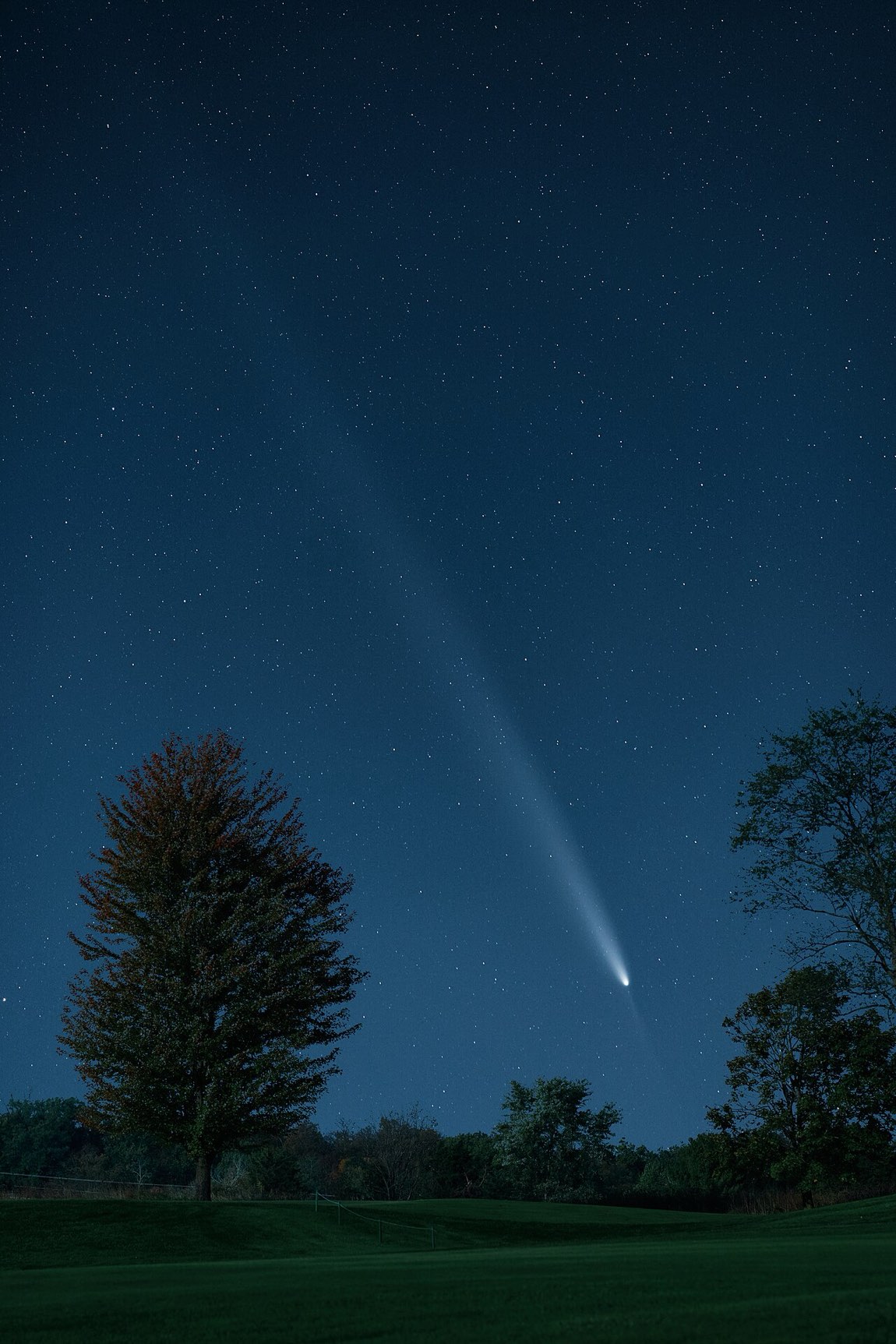
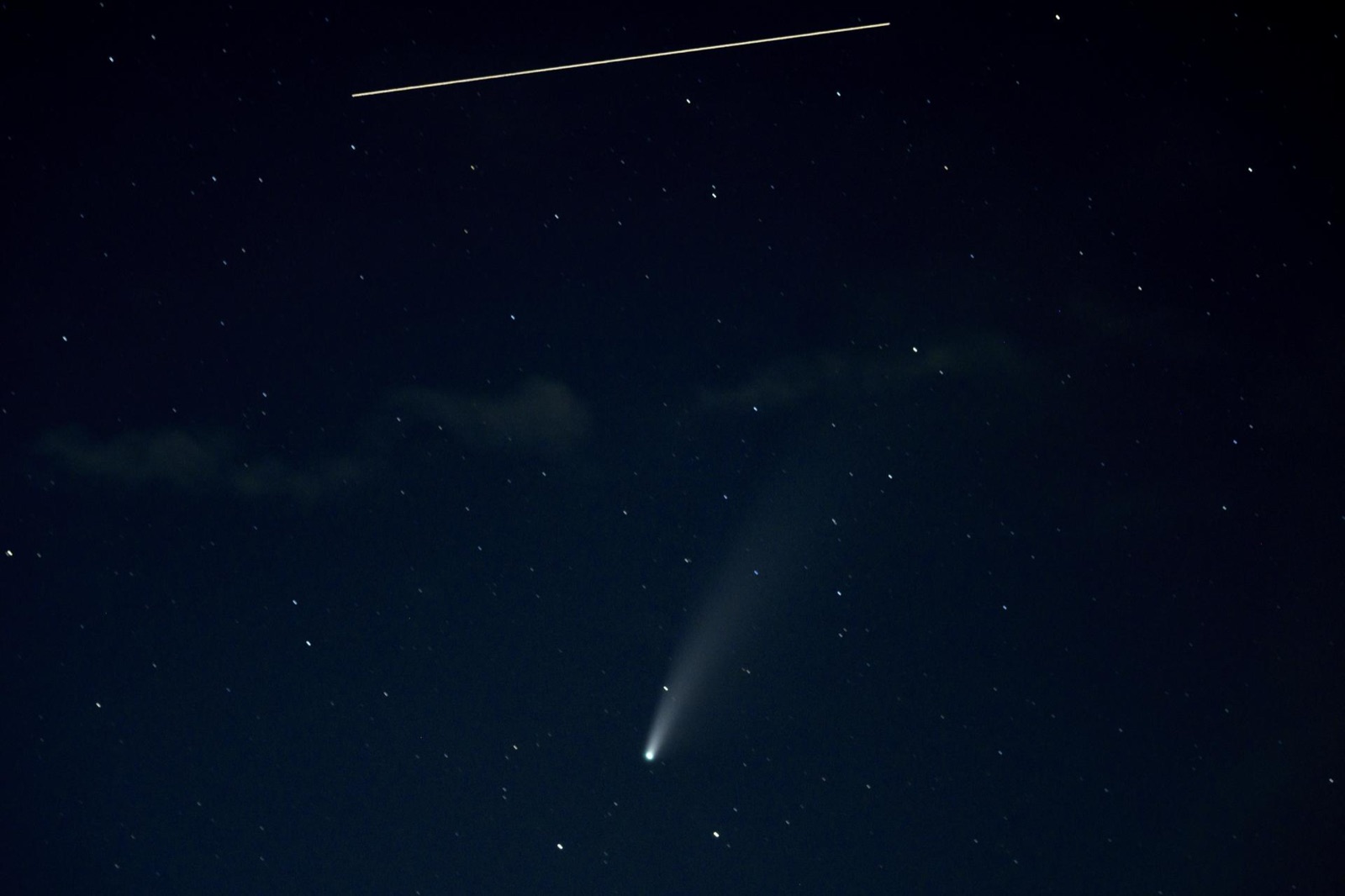
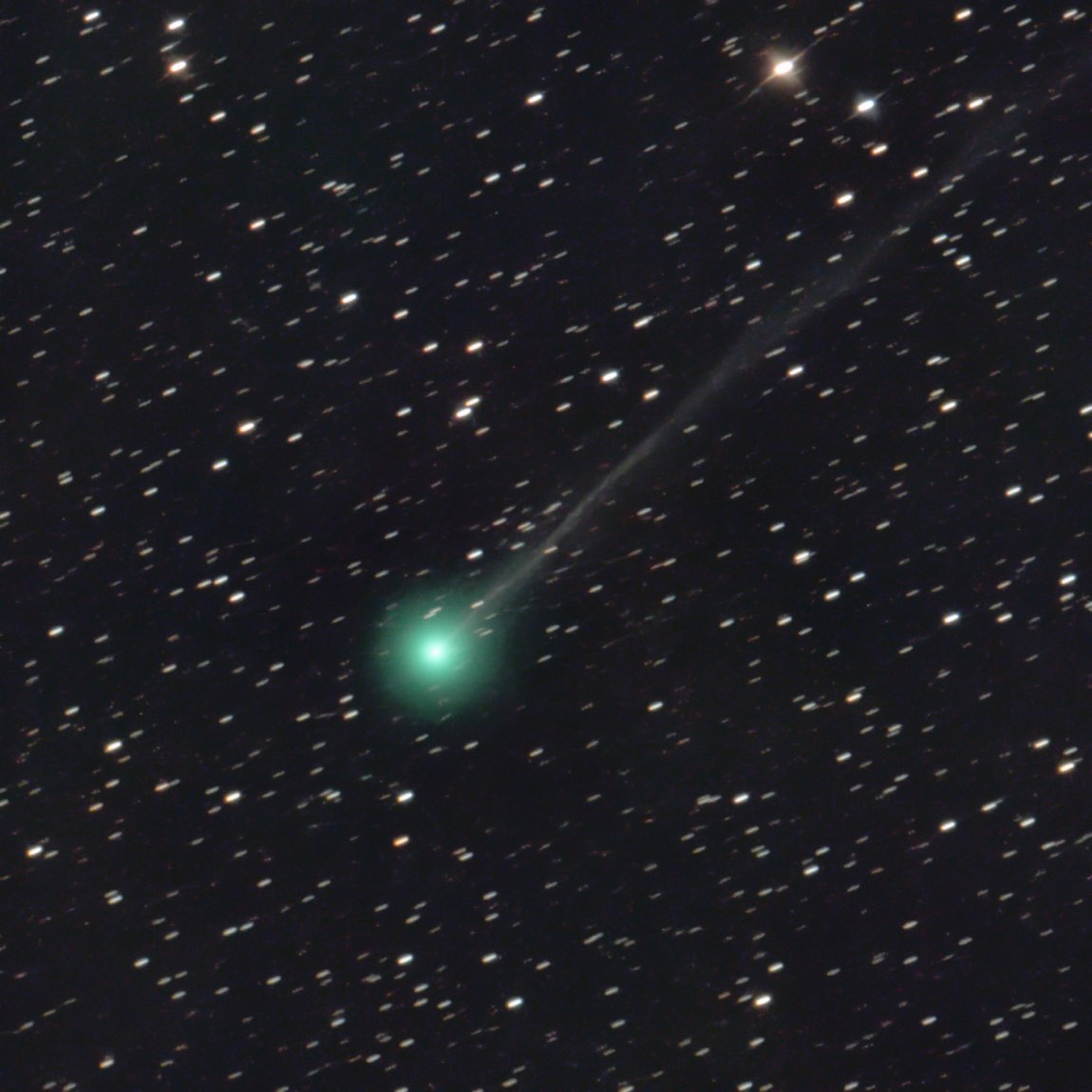
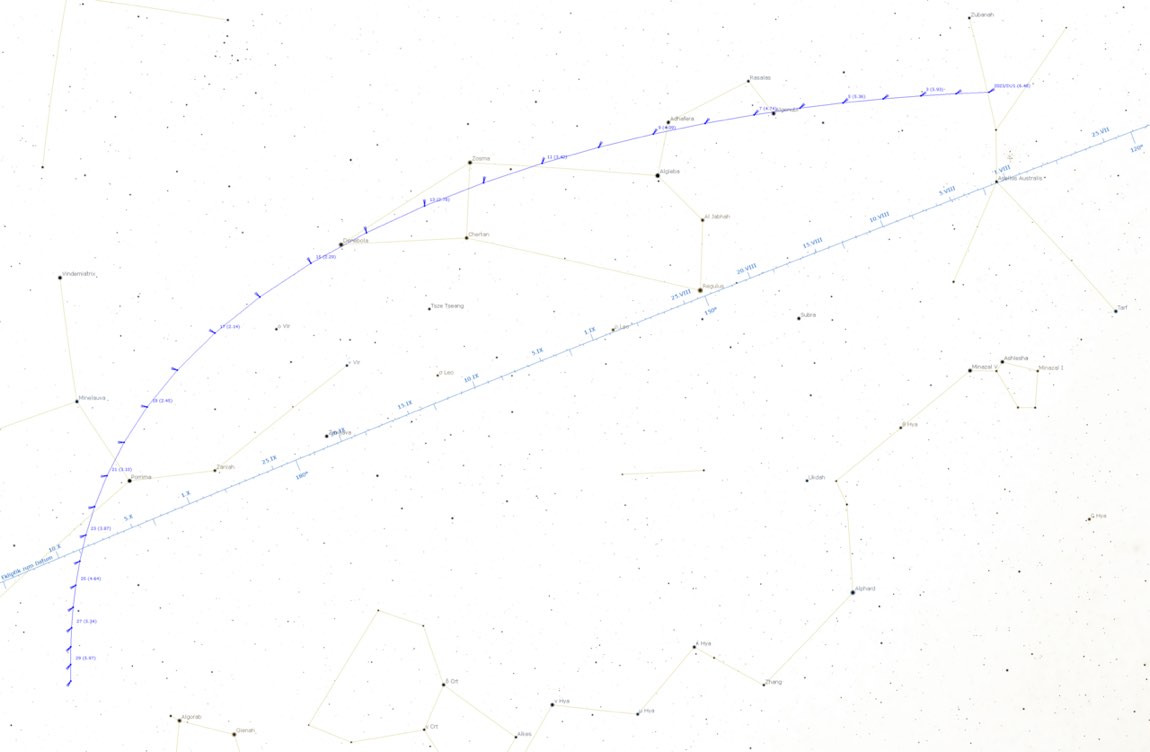
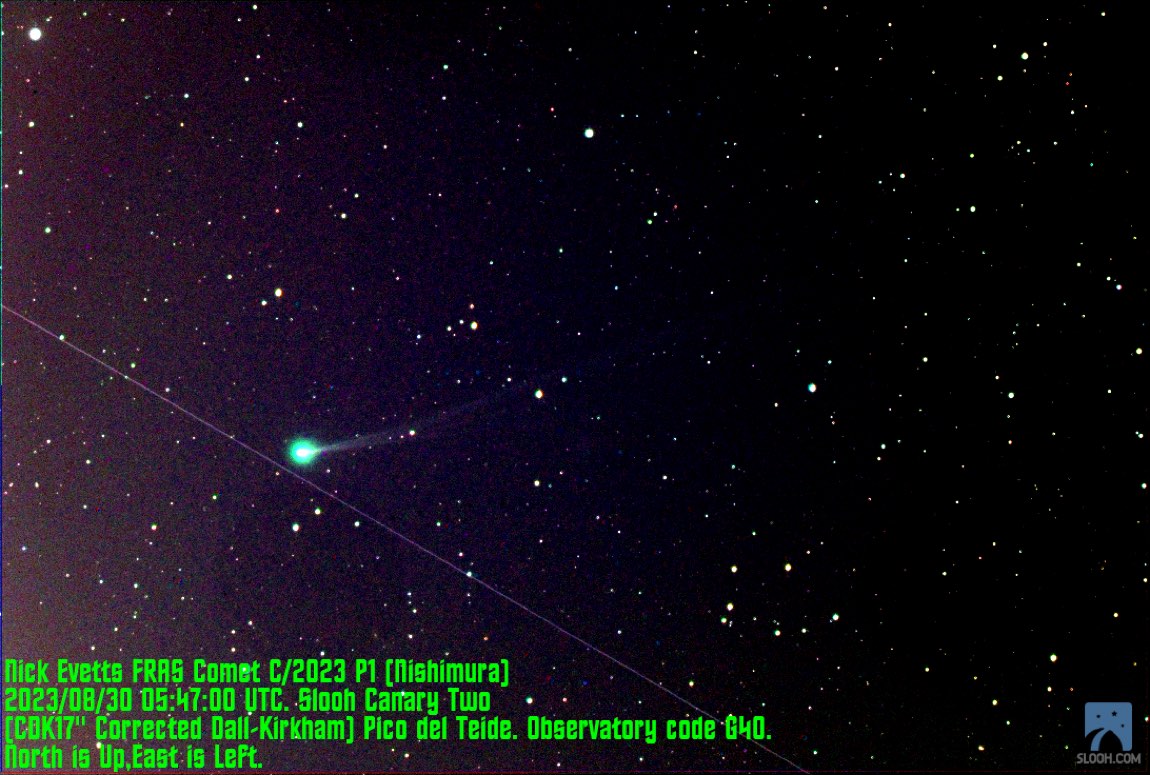
From its discovery brightness of magnitude 10 to 11 in mid-August 2023, Comet Nishimura faded nothing like a typical distant comet — it blazed. By 27 August 2023, just fifteen days after discovery, its apparent magnitude had climbed to 7.3 and its coma had spread to a diameter of 5 arcminutes, roughly one-sixth the apparent width of the full Moon. A thin ion tail stretching 1.5 to 2 degrees was already visible in photographs. By 8 September 2023, amateur astronomer Piotr Guzik spotted it with the naked eye at an estimated magnitude of 4.7. When imaged with a CCD detector the tail extended up to 7.5 degrees across the sky — fifteen full Moon widths. The comet ultimately reached an apparent magnitude of about 2.5 near perihelion, technically naked-eye bright, though its proximity to the Sun made it genuinely difficult to see. This kind of dramatic brightening over just weeks is driven by the increasing solar heat sublimating ices and flooding the coma with fresh gas and dust.
 ⤢
04 Solar Orbiter Watches Four Tail Disconnections Deeper
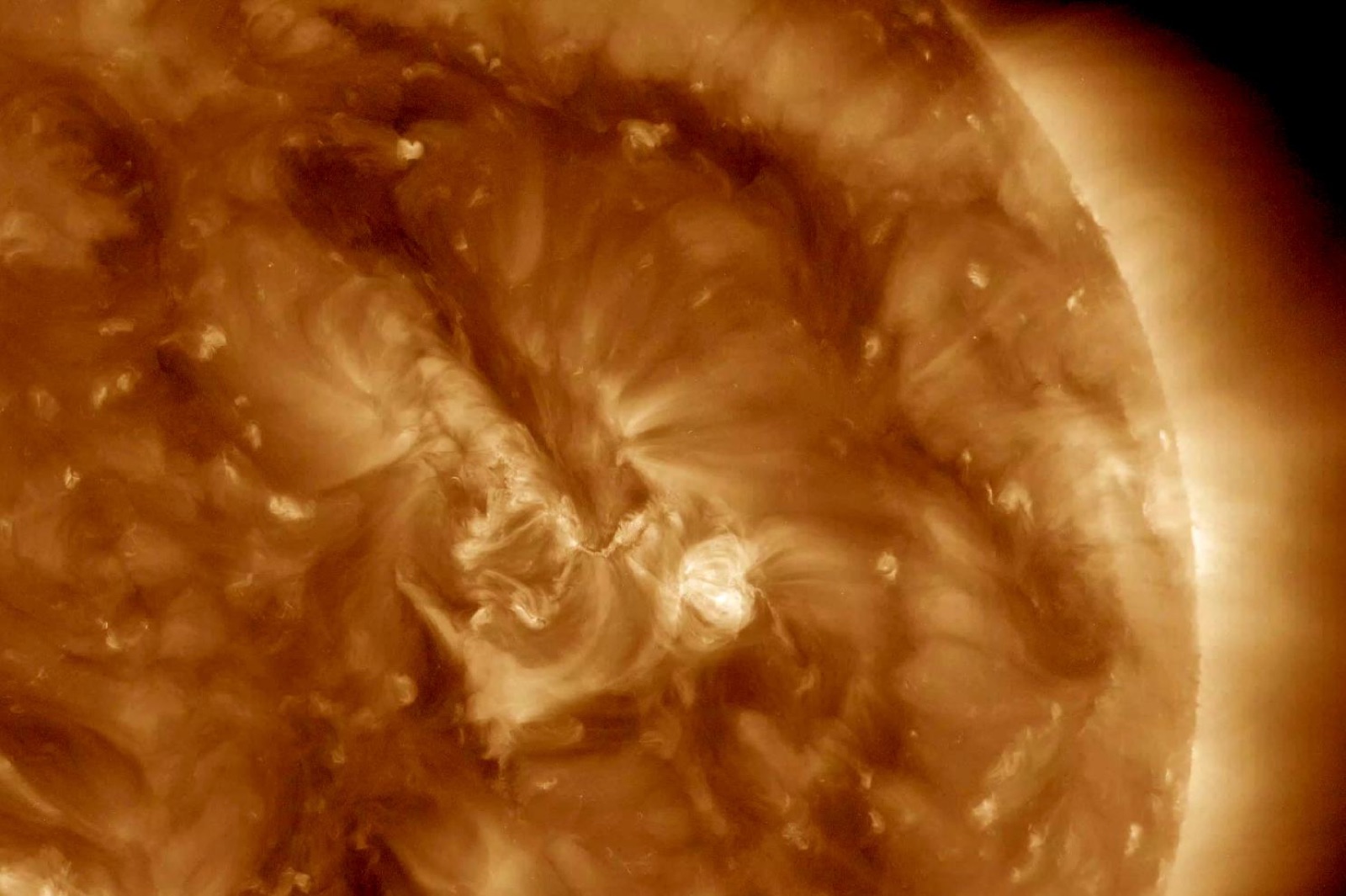
Between 1 and 14 September 2023, the European Space Agency's Solar Orbiter mission trained its instruments on Comet Nishimura and recorded four separate tail disconnection events. These events occur when a comet's ion tail — the straight, glowing streamer of charged particles blown directly away from the Sun — is severed from the coma and drifts off before a new tail forms. The culprit in each case was a coronal mass ejection, or CME: a large burst of magnetized plasma hurled outward from the Sun. When a CME's magnetic field meets the comet's ion tail, the interaction can effectively pinch and sever it. Capturing four such events in a single two-week window is remarkable and offered scientists a natural laboratory to study how solar wind structures interact with cometary plasma. Solar Orbiter's vantage point, designed specifically to observe the Sun and inner solar system, made it ideally placed to link each disconnection to a specific CME source event, providing a chain of cause and effect that ground-based observers could never reconstruct on their own.
05 Parker Solar Probe Gets a Close-Up Look
On 27 and 28 September 2023, ten days after perihelion, NASA's Parker Solar Probe observed Comet Nishimura during the spacecraft's seventeenth solar encounter. Parker Solar Probe is built to fly closer to the Sun than any previous spacecraft, and its instruments are designed to study the solar wind and corona in situ — making it a natural, if opportunistic, comet observer whenever a bright comet passes through the inner solar system. The observation came after the comet had already swung around the Sun and begun its long outward journey, giving scientists a chance to study the post-perihelion behavior of the coma and tail in an environment of intense solar radiation and particle flux. Following perihelion, the comet also became visible in the coronagraph of the STEREO spacecraft, which uses an occulting disk to block direct sunlight and reveal faint structures nearby. Crucially, neither STEREO nor any other instrument showed signs of the comet disintegrating, confirming that the nucleus survived its close solar passage.
06 An Orbit That Stretches Almost to Eris Deeper
Comet Nishimura moves on an extremely elongated ellipse. Its eccentricity of 0.996 — where a perfect circle has zero eccentricity and a parabola has exactly one — places it among the minority of comets that are definitely bound to the Solar System but only barely. This eccentricity corresponds to a semi-major axis of about 57 AU, where one AU is the average Earth-Sun distance of roughly 150 million kilometers. For comparison, the dwarf planet Eris averages about 68 AU from the Sun, so Nishimura's orbit reaches out to a distance in the same general neighborhood as the outer Solar System's most remote known worlds. The comet will reach aphelion — its farthest point from the Sun — in late 2226, more than two centuries from now. It will then fall back inward and return to perihelion around the year 2429. With an outbound orbital period of about 406 years, the comet's previous perihelion passage would have occurred sometime in the early seventeenth century, when Galileo had only recently turned a telescope to the sky.
 ⤢
07 Viewing Challenges: When Bright Means Hard to See
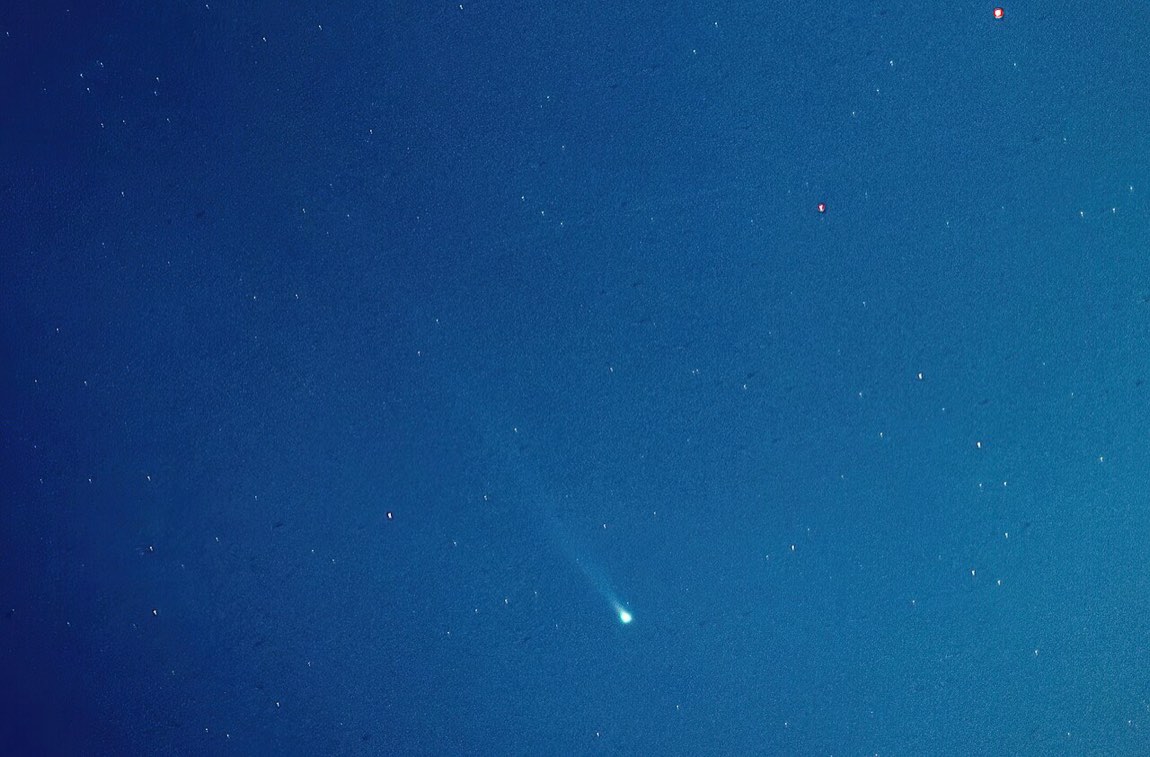
Despite reaching an impressive apparent magnitude of about 2.5, Comet Nishimura was one of the more frustrating naked-eye comets in recent memory, simply because of geometry. On 12 September 2023, when it passed 0.84 AU from Earth — about 126 million kilometers, or roughly the distance from the Sun to Venus — the comet was only 15 degrees from the Sun's glare, a gap smaller than the width of a hand held at arm's length. Near perihelion on 17 September it briefly appeared in the evening sky for observers at 35 degrees north latitude, but only about 5 degrees above the horizon thirty minutes after sunset. Finding any object in bright twilight that close to the horizon requires a very flat, unobstructed western horizon and excellent atmospheric transparency. Many experienced observers reported the comet as effectively unobservable with the naked eye despite its technical brightness. The episode illustrates how a comet's visibility depends as much on its solar elongation and your local horizon as it does on its intrinsic brightness.
08 The Sigma Hydrids Connection Deeper
One of the most scientifically interesting questions Comet Nishimura raised involves a meteor shower most people have never heard of: the Sigma Hydrids, active each year from 22 November to 18 January and peaking around 30 November. Researchers noticed that the comet and the Sigma Hydrid meteors share very similar orbits, with only a small offset between the meteor stream's perihelion and the comet's perihelion. This kind of orbital similarity is the standard evidence used to propose that a comet shed the debris that now produces a shower. The idea was not universally accepted at first; an alternative hypothesis held that some other, still-unknown comet was the true parent body. However, a follow-up study published in 2024 strengthened the Nishimura connection considerably: orbital reconstructions of the Sigma Hydrid meteors matched the comet's precovery positions from nearly eight months before its official discovery. That independent match — using data the comet's discoverer did not have access to — constitutes strong evidence that Comet Nishimura has been leaving debris along its orbit for long enough to build a recognizable annual meteor shower.
09 What 406 Years Means for Scientific Context
An orbital period of about 406 years places Comet Nishimura in an interesting historical bracket. Its last perihelion passage, counting backward, would have fallen around the year 1617, in the middle of the European Renaissance and roughly a decade after Galileo first used a telescope for astronomical observation. No telescopic comet records survive from that era that can be matched to Nishimura's earlier return. This is partly because systematic comet observation and orbit calculation only became routine in the eighteenth century following the work of Edmond Halley. For comparison, Halley's Comet has a period of roughly 75 years and has been confidently traced back through historical records for more than two millennia. Nishimura's 406-year cycle means only about three or four returns have occurred since the invention of the telescope, and without the PanSTARRS precovery data extending the observation arc, even the current orbital estimate would carry substantial uncertainty. Long-period comets like this one offer snapshots of the outer Solar System's primordial material, since they spend most of their lives in the deep cold far from the Sun's heat.
 ⤢
10 How the Coma and Tail Grew Week by Week
The evolution of Comet Nishimura's visible features over the weeks before perihelion gives a vivid picture of cometary activity ramping up under increasing solar heat. At discovery in mid-August 2023 the coma — the fuzzy, roughly spherical cloud of gas and dust surrounding the nucleus — was present but compact. By 27 August the coma had expanded to a diameter of 5 arcminutes on the sky, and a distinct ion tail 1.5 to 2 degrees long appeared in photographs. An ion tail forms when solar ultraviolet light ionizes gas escaping from the coma and solar wind pressure pushes those ions directly away from the Sun; it typically appears blue-white in color photographs. The dust tail, made of larger particles pushed more gently by radiation pressure, curves gracefully behind the comet's orbital path. CCD imaging captured the total tail extent growing to as much as 7.5 degrees by early September — a structure spanning fifteen times the full Moon's diameter, embedded in the twilight sky where most observers struggled to find the comet at all.