 Photograph · Jim Vajda · CC BY 2.0
Comet · Deep guide
Comet Tsuchinshan–ATLAS (Great Comet of 2024)
Also called: C/2023 A3 · Great Comet of 2024 · Comet Tsuchinshan-ATLAS
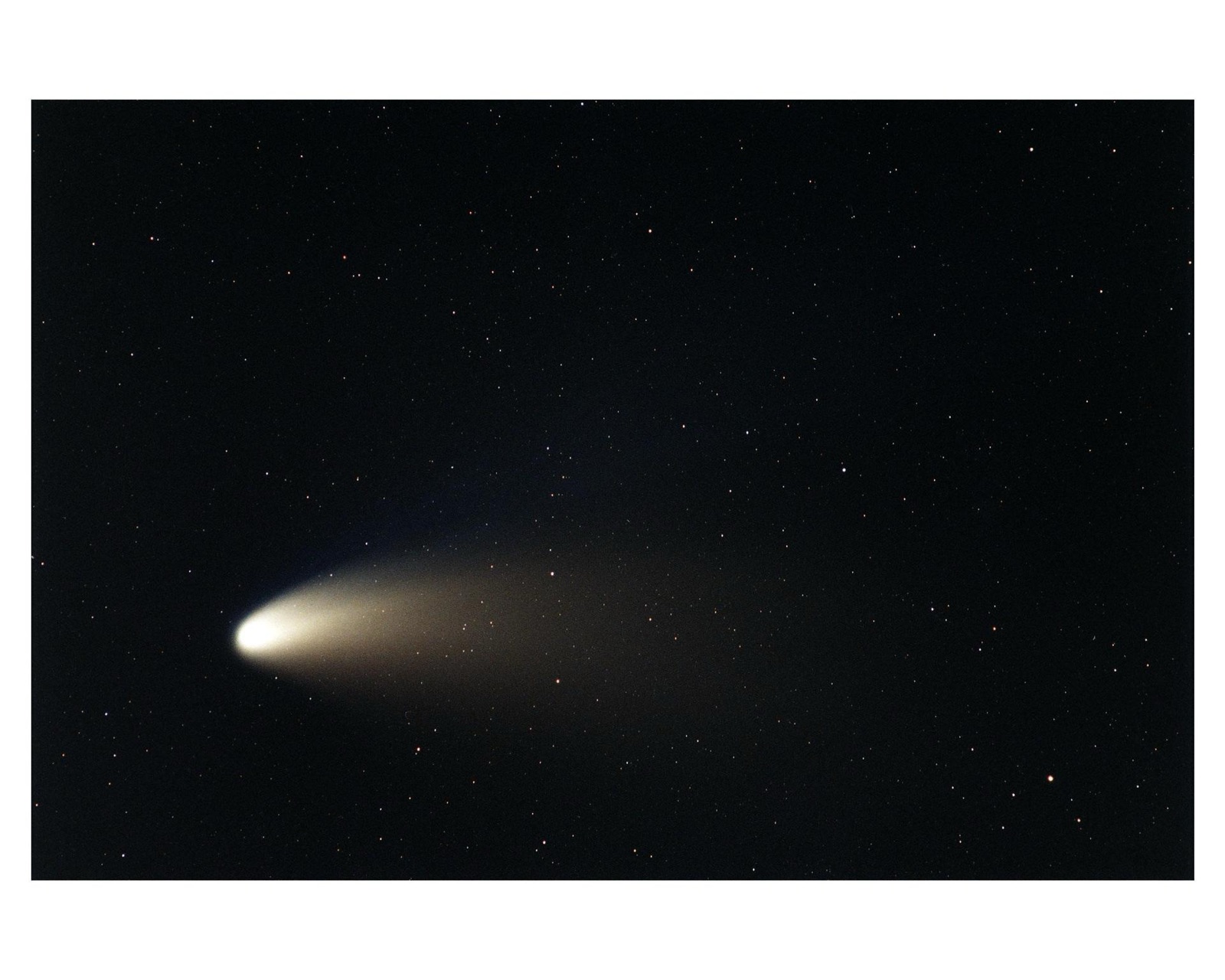
The brightest comet seen from the Northern Hemisphere since Hale–Bopp, shining in October 2024.
What is it?
Comet Tsuchinshan–ATLAS came from the distant Oort cloud. China's Purple Mountain Observatory found it in January 2023, and the ATLAS survey station in South Africa found it independently a few weeks later. It passed perihelion on 27 September 2024 and reached about magnitude −4.9 on 9 October, making it the brightest comet seen from the Northern Hemisphere since Hale–Bopp in 1997. Its outbound orbit is expected to carry it out of the Solar System.
The deep dive
Researched for the Atlas from Wikipedia — Comet Tsuchinshan–ATLAS (10,221 characters read) · updated Nov 14, 2026
01 Two Observatories, One Wandering Snowball
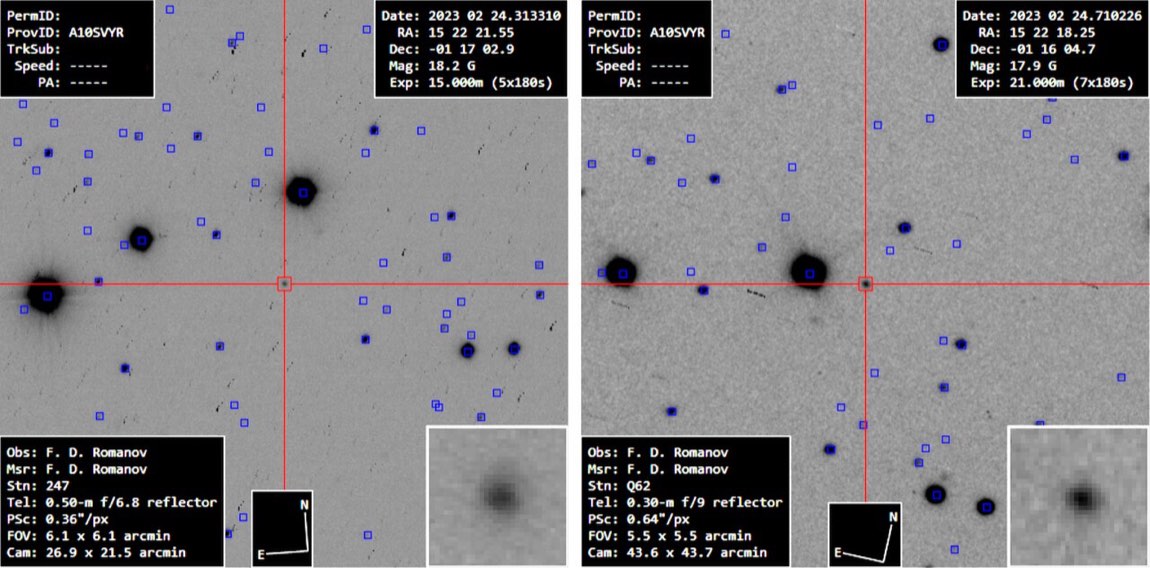
The comet's double-barreled name tells a story of near-miss and lucky recovery. Astronomers at China's Purple Mountain Observatory spotted a faint 18.7-magnitude smudge on 9 January 2023, but reported it to the Minor Planet Center without being able to confirm it. By 30 January 2023, with no follow-up observations filed and its predicted position growing too uncertain to pin down, the object was officially declared lost. Then, on 22 February 2023, the Asteroid Terrestrial-impact Last Alert System — ATLAS — picked up an 18.1-magnitude asteroidal-looking dot using a 0.5-meter f/2 Schmidt reflector at Sutherland Observatory in South Africa, with the comet sitting about 7.3 AU, roughly 1.09 billion kilometers, from the Sun. Only after ATLAS computed an orbit did anyone realize the two detections matched the same object. Comet naming conventions required honoring both discoverers, producing the hyphenated title Tsuchinshan–ATLAS — with Tsuchinshan being the traditional postal romanization of Zijinshan, the Chinese name for Purple Mountain Observatory, the form historically used for discoveries credited to that institution.
02 Already a Comet at Nearly Eight AU Out Deeper
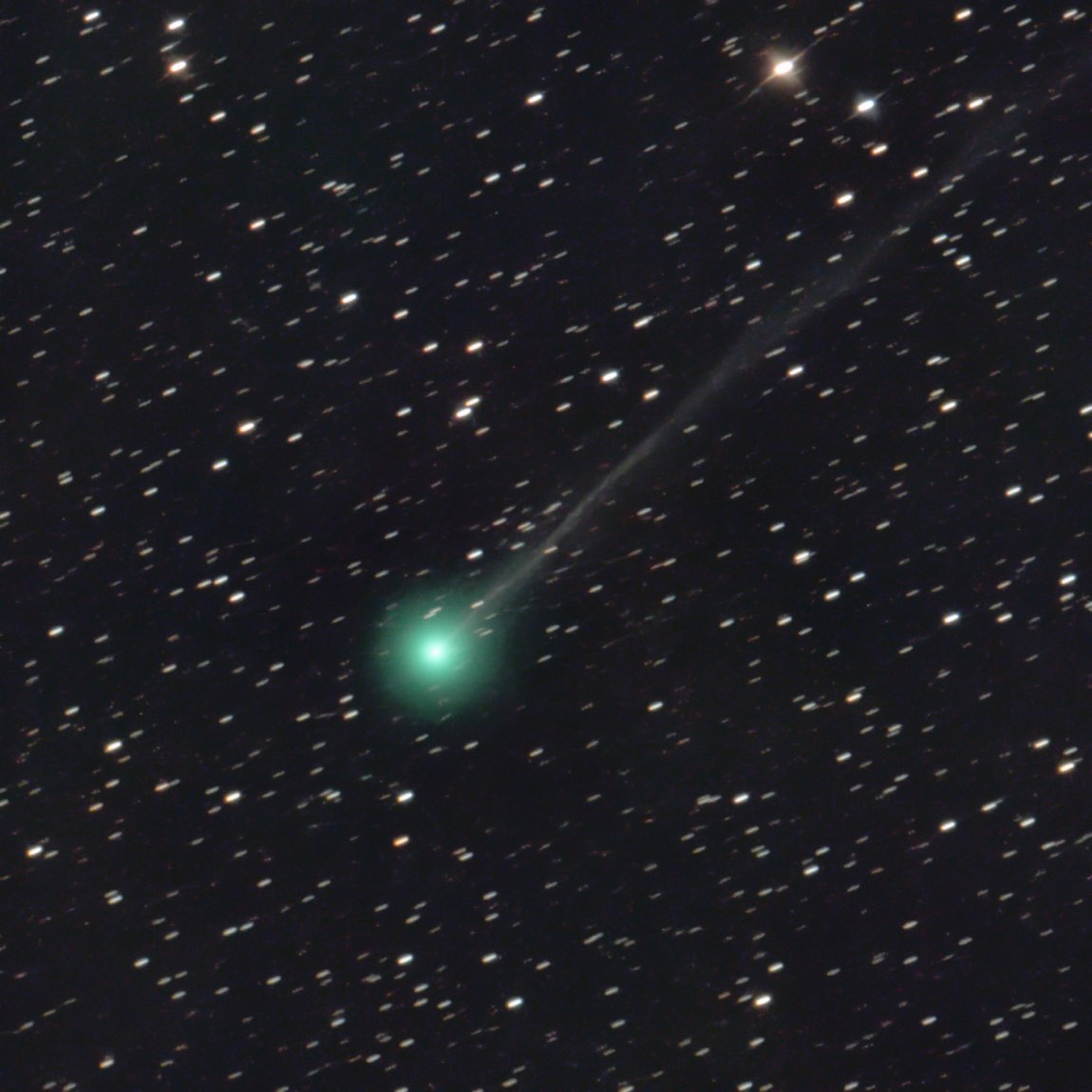
Most comets show no activity until they close within about 3 AU of the Sun, where water ice begins sublimating in earnest. Tsuchinshan–ATLAS broke that rule dramatically. When archivists searched back through images from the Zwicky Transient Facility at Palomar Observatory, they found the comet recorded on 22 December 2022 at a magnitude of 19.2 to 19.6 — still more than a year before its official discovery date. Those deeper, better-resolved frames revealed something remarkable: the comet already carried a very condensed coma and a small but distinct straight tail measuring 10 arcseconds in length. At that moment it was 7.9 AU, about 1.18 billion kilometers, from the Sun — well beyond Jupiter's orbit. Additional evidence of early cometary activity was independently reported by observers Hidetaka Sato, M. Mattiazzo, and Cristóvão Jacques. By June 2023, a visible dust tail had developed, and the coma displayed a predominantly red color. Early activity at such distances points to volatile ices more reactive than water — perhaps carbon monoxide or carbon dioxide — driving outgassing even in the deep cold of the outer Solar System.
03 A Carbon-Depleted Chemical Fingerprint Deeper
On 31 May 2024, when the comet was 2.33 AU, about 349 million kilometers, from the Sun, spectroscopic observations recorded strong cyanide emission while simultaneously flagging the comet as carbon depleted. This chemical classification matters because most long-period comets from the Oort cloud carry similar proportions of carbon-bearing molecules, so a carbon-depleted object stands out as compositionally unusual — possibly reflecting differences in where and when it formed within the early solar nebula. Alongside the depletion, the comet showed a large dust-to-gas ratio, meaning it shed proportionally more particulate material than volatile gas compared with typical comets. After perihelion, by early October 2024, spectra confirmed prominent sodium emission lines while the depletion in carbon-bearing species persisted. The sodium signal then faded rapidly: observations with the FLECHAS Échelle spectrograph on the 90-centimeter telescope at the Friedrich Schiller University Jena observatory, taken between 22 and 26 October, detected strong sodium emission in the 500–700 nanometer wavelength range, but by 3 November 2024 sodium could no longer be detected in emission at all — a striking change over just one week.
04 Did the Nucleus Begin to Fall Apart? Deeper
Throughout May and June 2024, the comet's brightening stalled unexpectedly, hovering between magnitudes 10 and 11 instead of continuing its steady climb. Astronomer Zdenek Sekanina interpreted the pattern as evidence of nucleus fragmentation beginning in late March 2024. The clues he cited were a sudden increase in brightening rate followed by a sharp decrease in dust production, the appearance of a narrow teardrop-shaped dust tail rather than the broader fan typical of healthy comets, and measurable non-gravitational changes in the orbit — small but telling deviations from a purely gravitational path that can signal jets or outbursts from a crumbling nucleus. Sekanina went so far as to predict that the comet would disintegrate entirely before reaching perihelion. Observations from the TRAPPIST robotic telescope added nuance: dust production reached a minimum in May, when the comet was near a phase angle of zero, then began increasing again about a month later, while gas production rose slowly throughout the period. The comet ultimately survived perihelion intact, complicating but not fully refuting the fragmentation hypothesis — the nucleus may have shed material without completely breaking apart.
 ⤢
05 Forward Scattering: Nature's Brightness Amplifier
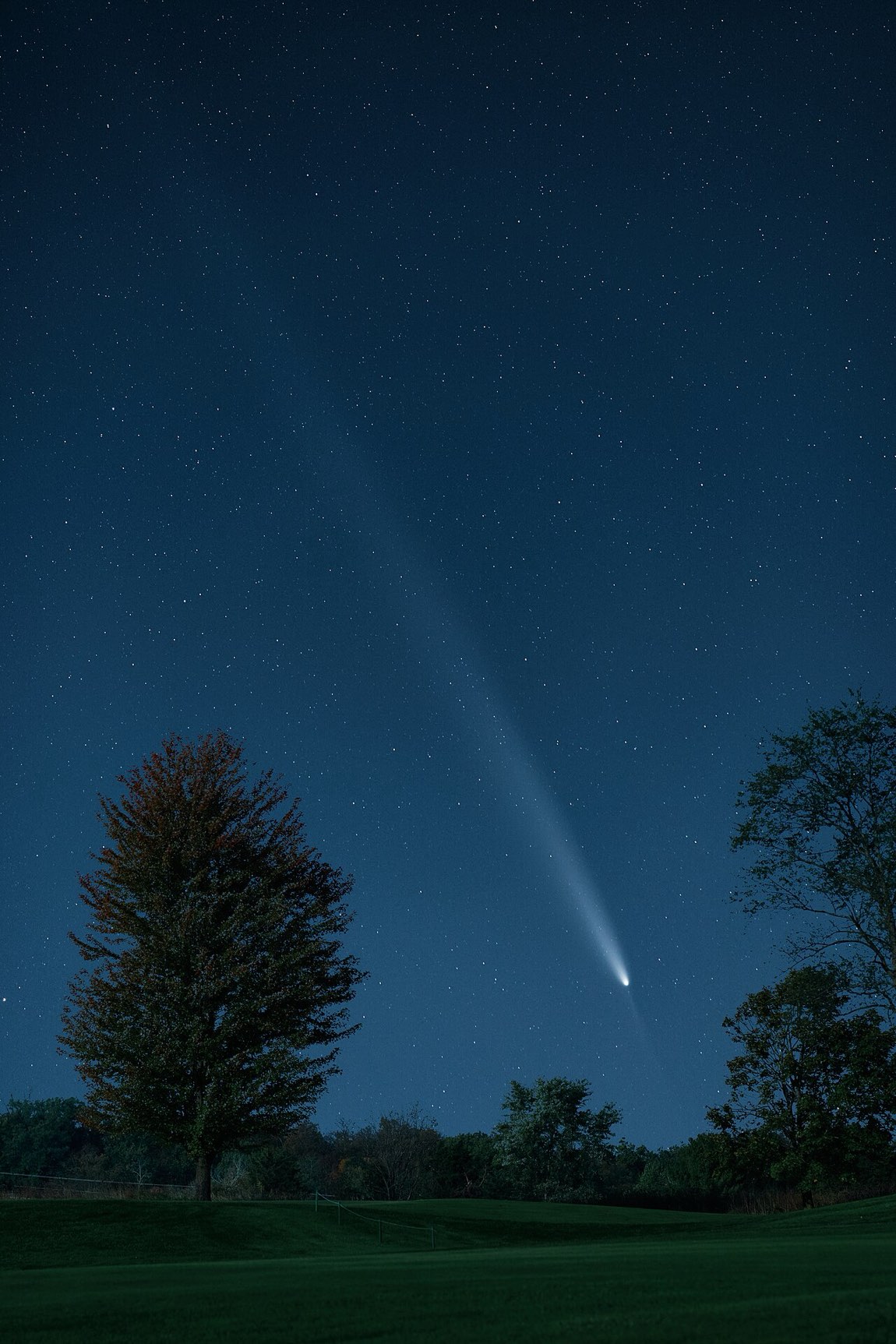
The comet's extraordinary peak brightness was not simply a matter of closeness to the Sun. A geometric effect called forward scattering supercharged the display. When a comet swings almost between Earth and the Sun, fine dust particles in the coma and tail scatter sunlight forward toward the observer with exceptional efficiency — the same reason a dusty car windshield blazes when you drive toward the Sun. Calculations from early September 2024 predicted that forward scattering alone would boost Tsuchinshan–ATLAS by almost 6 magnitudes near its peak, expected around 9.8 October. The comet was forecast to exceed magnitude 0 between 5 and 13 October and peak above −4 on 9 October. Reported observations at the Comet Observation Database confirmed a peak apparent magnitude of −4.9 on that date. With the comet only 3.5 degrees from the Sun on 9 October, no naked-eye daytime sightings were confirmed, suggesting the true visual peak was closer to −2 or −3, while binocular observers that same day recorded roughly −3. The forward-scattering window is brief and geometry-dependent, which is why the comet faded so rapidly afterward.
06 Seen from Space Before Seen from Earth
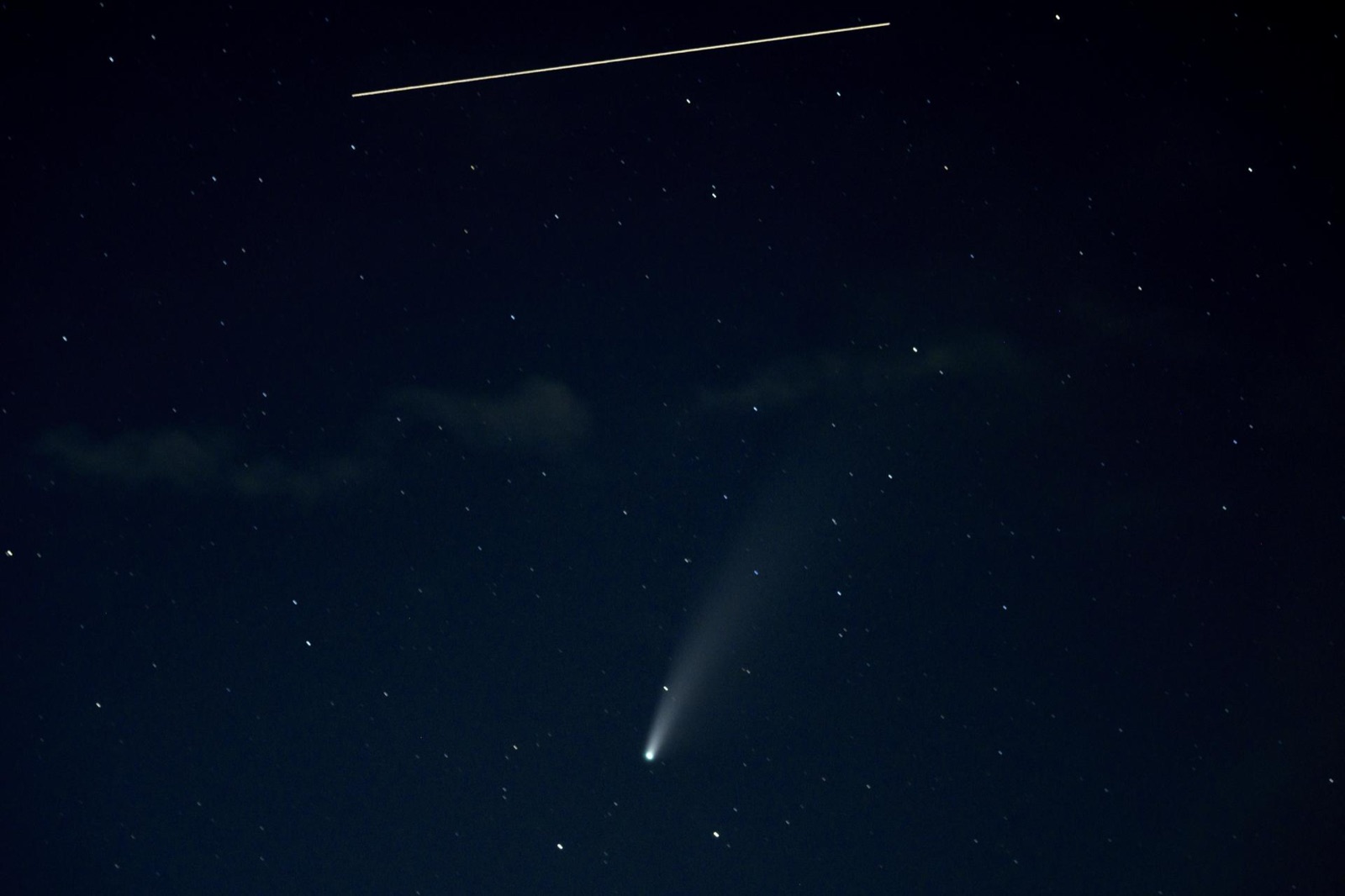
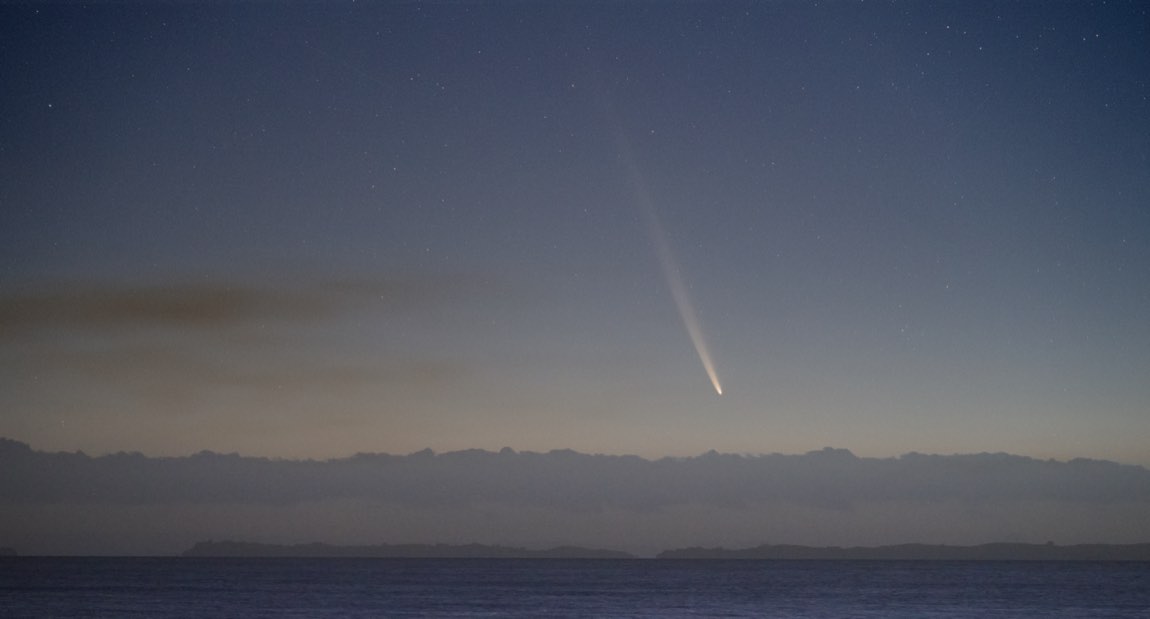
The first naked-eye views of Tsuchinshan–ATLAS came not from the ground but from orbit. Astronaut Matthew Dominick spotted and photographed the comet from aboard the International Space Station on 20 September 2024, when the comet was still approaching perihelion. Fellow astronaut Donald Pettit photographed it two days later. The first confirmed naked-eye observation from Earth's surface came on 23 September, with an estimated magnitude of 3.3 and a tail already reported as 2.5 degrees long when viewed through binoculars. The comet had been recovered in morning twilight by well-known comet hunter Terry Lovejoy on 11 September, when it shone at magnitude 5.5 in the constellation Sextans. After perihelion on 27 September, the SOHO spacecraft's coronagraph tracked the comet from 7 to 11 October, making it the second-brightest comet SOHO had observed since its launch in 1995, surpassed only by Comet McNaught in 2007. By 1 October, ground observers estimated a tail length of 10 to 12 degrees — longer than twenty full Moons placed end to end.
07 The Anti-Tail: Pointing the Wrong Way
On 14 October 2024, Earth crossed the orbital plane of Comet Tsuchinshan–ATLAS, producing one of the more visually arresting comet phenomena: an anti-tail. Under normal circumstances, a comet's dust tail is swept back away from the Sun by radiation pressure, trailing behind the nucleus. But when Earth lies exactly in the plane of the comet's orbit, perspective geometry makes larger, slower-moving dust particles — which lag behind in the comet's orbital path rather than being pushed backward — appear to project forward, toward the Sun. The result is a spike of light seeming to point in the wrong direction from the nucleus. Photographically, the main tail was estimated to extend over 20 degrees on 16 October, while visual observers using averted vision under dark skies could trace roughly 10 degrees. By 20 October, the comet had faded to 4th magnitude, and by 2 November it had dropped below magnitude +6, disappearing from naked-eye visibility entirely. The speed of this decline reflects how quickly distance from both Earth and Sun drains a comet's surface activity.
08 An Orbit Shaped by Planetary Gravity Deeper
Tsuchinshan–ATLAS follows a retrograde orbit inclined 139 degrees to the ecliptic plane, meaning it circles the Sun in the direction opposite to the planets. Before it plunged into the inner Solar System, the orbit was weakly bound to the Sun — the gravitational grip barely enough to call it a true solar-family member. As it passed through the planetary region, gravitational tugs from the giant planets altered the trajectory. On the outbound leg, those perturbations are expected to push the orbit into a weakly hyperbolic shape. The article is careful to note that this may or may not result in the comet being ejected permanently from the Solar System — the outcome is not certain. What is predictable is that by the year 2237, the comet is expected to be 200 AU from the Sun, more than five times farther than Pluto's average distance. Unlike many comets that make close approaches to Jupiter or Saturn and experience dramatic orbital reshaping, Tsuchinshan–ATLAS does not approach the giant planets closely, making the perturbation effect subtler but still consequential over the centuries ahead.
 ⤢
09 Peak Dust Production at Perihelion Deeper
At its closest approach to the Sun on 27 September 2024, Tsuchinshan–ATLAS was estimated to be shedding dust at a peak rate of 100,000 kilograms per second — roughly equivalent to unloading a fully loaded large freight train every two seconds, continuously. This enormous mass flux built the extensive tail that observers later measured at more than 20 degrees in photographic images. The dust-to-gas ratio had already been flagged as unusually high from spectral observations in May 2024, so the comet's visual brilliance owed much to this lavish dust output rather than purely to gas emission. The timing matters too: perihelion on 27 September placed peak dust production just two weeks before Earth crossed into the most favorable geometry for forward scattering on 9 October, so observers benefited from both a maximally dusty coma and the light-amplifying effect of near-solar geometry simultaneously. By early November the sodium emission had vanished and the coma had faded below naked-eye threshold, suggesting surface activity had diminished dramatically as the comet receded.
10 Brightness Forecasts and Why They Failed
Predicting comet brightness is notoriously unreliable, and Tsuchinshan–ATLAS illustrated the problem in both directions. The initial forecast at discovery in early 2023 called for a modest total magnitude of +3 at perihelion — a decent binocular object, nothing spectacular. That estimate assumed an absolute magnitude H of 7 and a standard brightening exponent. By June 2024, revised photometry shifted the prediction to magnitude 2.2, using H of 6 and a brightening rate of 2.5n equal to 7.5. Meanwhile Zdenek Sekanina was warning the comet might not survive at all. The comet ultimately outperformed both the optimists and pessimists who worried about fragmentation, reaching a reported −4.9 at peak — more than 500 times brighter than the June 2024 forecast implied. Much of that gap is explained by forward scattering, which the later September calculations correctly anticipated would add nearly 6 magnitudes of apparent brightness. The episode is a reminder that comet nuclei are inherently unpredictable: composition, internal structure, rotation state, and geometric effects combine to make precise brightness forecasting more art than science even with modern instrumentation.
11 The Brightest Northern Comet Since Hale–Bopp
To appreciate Tsuchinshan–ATLAS's place in comet history, context is essential. The article states it became the brightest comet observed from the Northern Hemisphere since Comet Hale–Bopp in 1997 — a gap of 27 years. It was also the second-brightest comet observed by the SOHO spacecraft since that instrument launched in 1995, behind only the spectacular Comet McNaught of 2007. The formal designation as the Great Comet of 2024 was announced by NASA on 21 October and confirmed again on 11 November. The "Great Comet" label is informal but historically significant, reserved for objects bright enough to attract widespread public attention without any optical aid. The comet's total magnitude within 5 arcminutes of the nucleus peaked at −2.9, while the broader COBS-reported peak of −4.9 reflects the extended coma and tail caught in wider aperture measurements. At its closest approach to Earth on 12 October 2024, the comet was 71 million kilometers away — roughly half the distance from Earth to the Sun — shining near magnitude 0, comparable to the brightest stars in the night sky.
12 How Observers Tracked It Month by Month
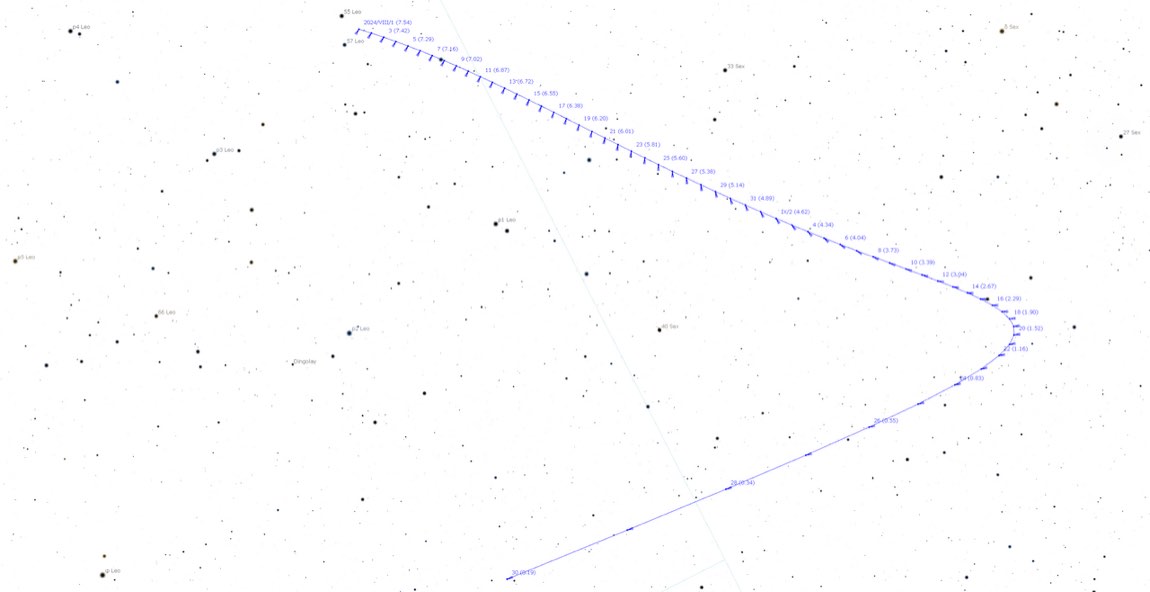
The observational arc of Tsuchinshan–ATLAS stretched from the deep outer Solar System to the inner sky over more than a year. In January 2024, the comet had reached magnitude 13.6 and required 15-inch telescopes at 142× magnification to see well, as described by Sky & Telescope author Bob King, while it drifted through Libra and Virgo. By late April it had climbed to about magnitude 10, accessible through small telescopes with a stubby tail beginning to form. Through May and June the brightening stalled, with the comet lurking between magnitudes 10 and 11, its dusty tail stretching 5 to 15 arcminutes eastward. In mid-June it entered Leo in the evening sky; by early July a faint ion tail about 1.5 degrees long appeared in photographs. After mid-July the Sun swallowed it from ground-based view until September, though the STEREO spacecraft tracked it brightening steadily to magnitude 7 in August. Recovery came on 11 September when Terry Lovejoy found it at magnitude 5.5. The comet then raced through its perihelion passage and closest Earth approach in just three weeks, putting on the finest northern cometary display in a generation before fading below naked-eye visibility by early November 2024.
 ⤢