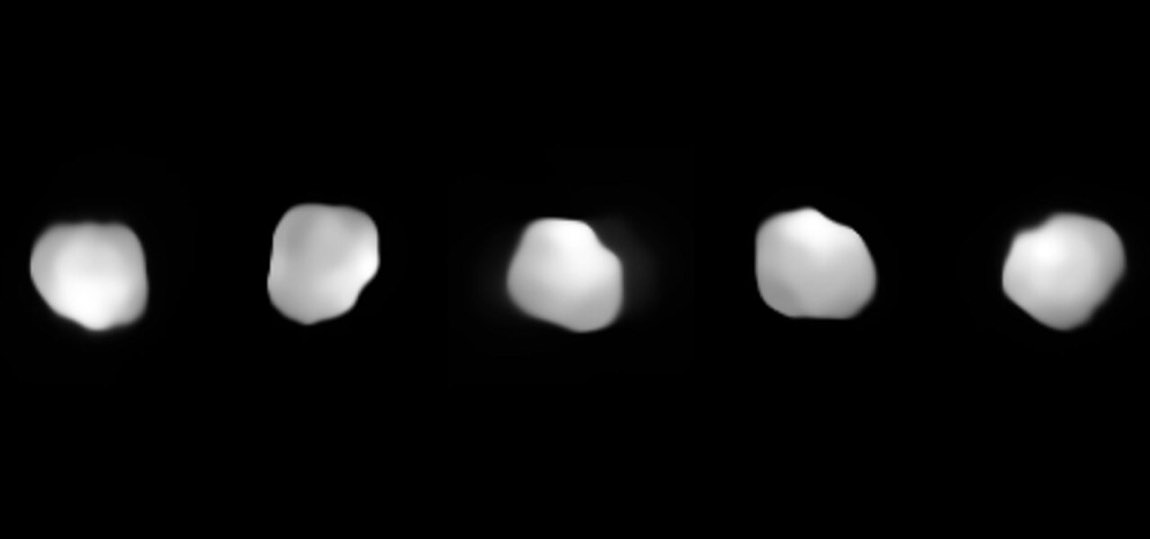
 Photograph · ESO/LAM · CC BY 4.0
Asteroid · Deep guide
Psyche
Also called: 16 Psyche
A metal world that may be the exposed core of a shattered baby planet.
What is it?
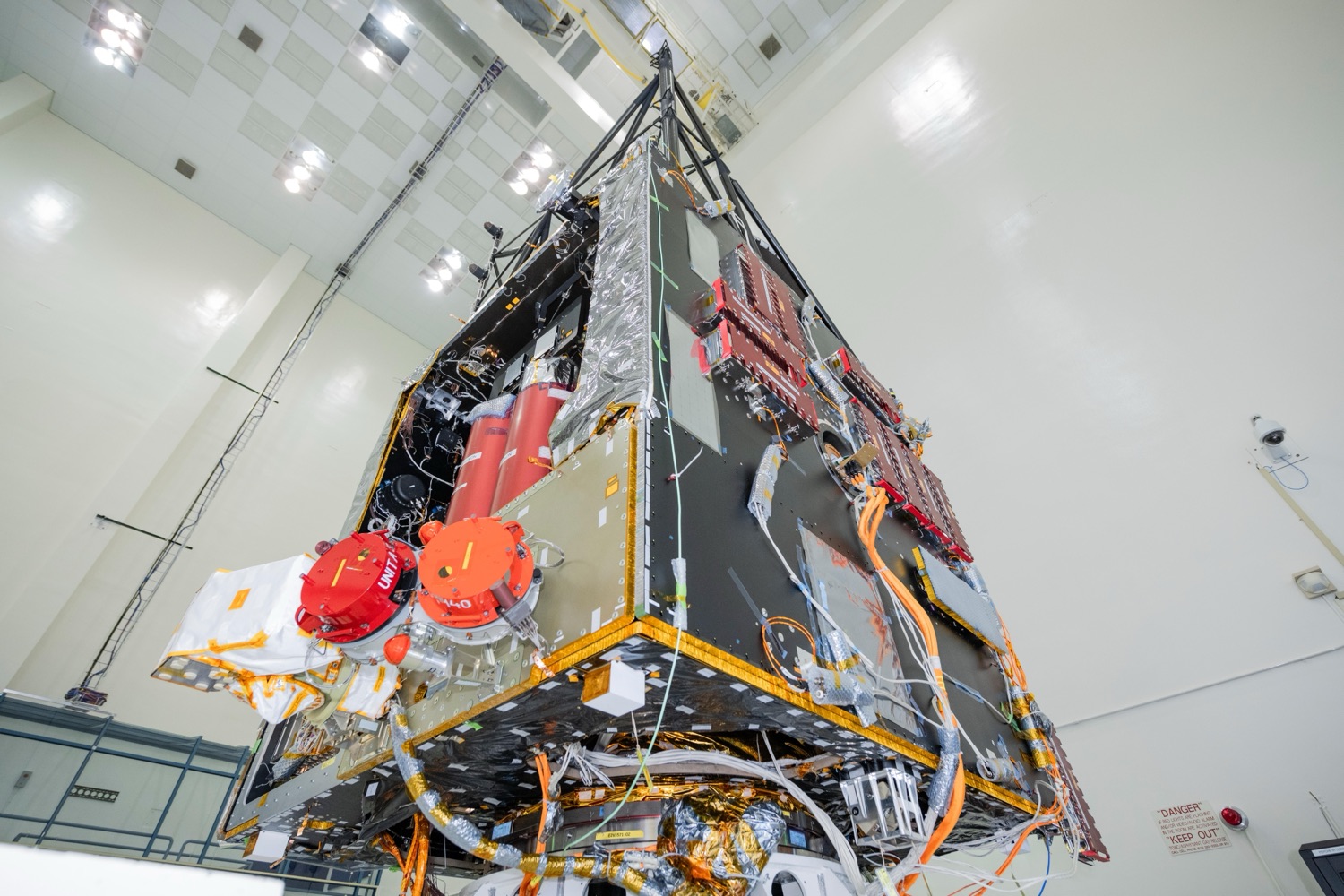
Psyche is a 220-km asteroid unlike almost anything else: it appears to be made largely of metal — nickel and iron, the stuff of planetary cores. The leading idea is that Psyche is the exposed heart of a protoplanet whose rocky outside was smashed away by ancient collisions. A NASA spacecraft (also named Psyche) launched in October 2023 and arrives in 2029 to find out.
Go deeper
Radar albedo and density (~3.9–4.2 g/cm³) suggest a metal-rich but porous body — possibly 30–60% metal mixed with silicates, rather than solid steel. Competing models: stripped core, or a body that erupted iron volcanoes ('ferrovolcanism'). Either way it is our only chance to 'visit' a planetary core — Earth's is 2,900 km down and forever out of reach. Headlines about its metal being 'worth $10 quintillion' are fun and meaningless: landing that much metal on any market would simply make it worthless.
01 Journey to a core
Every rocky planet hides a metal core, and no drill will ever reach one — Earth's core is hotter than the Sun's surface and crushed under 3.6 million atmospheres. If Psyche really is a core with the planet sanded off, flying there is the only core visit physics permits. Its landscape might include cliffs of metal and frozen iron lava flows — terrain no one has ever seen.
02 About that quintillion dollars Deeper
Value = scarcity. Psyche's iron is priceless as science and worthless as commerce: there is no way to move planet-scale metal to Earth, and any fraction of it arriving would crash the price of iron to zero. Asteroid mining's real business case is water and materials used IN space — skipping the cost of launching them from Earth — not shipping gold home.
The deep dive
Researched for the Atlas from Wikipedia — 16 Psyche (11,310 characters read) · updated Sep 20, 2026
03 Discovered in a golden age of asteroid hunting
Psyche was discovered on 17 March 1852 by Italian astronomer Annibale de Gasparis, arriving during one of history's most productive bursts of asteroid detection. The number 16 attached to its name is simply a counting badge — it was the sixteenth minor planet found in order of discovery. That same era was already straining the conventions astronomers used to label these objects. Since the early discoveries, astronomers had assigned each asteroid its own hand-drawn symbol in the tradition of classical planets. Psyche's symbol was a butterfly wing topped by a star, a nod to the Greek word psyche meaning both soul and butterfly. But by 1851 the growing list of asteroids made unique symbols impractical, and German astronomer J. F. Encke proposed switching to numbered disks. Psyche became the first asteroid officially designated under that new system in 1852, when American astronomer J. Ferguson published his observations using ⑯ as its label — a notational revolution triggered partly by Psyche's own discovery.
04 A symbol encoded for the digital age
Psyche's original 19th-century symbol — a butterfly wing topped by a star — never quite died. It outlasted the era when asteroid symbols fell out of everyday scientific use, and the design may have quietly influenced the official insignia created for NASA's Psyche mission more than 170 years after de Gasparis first spotted the asteroid. Today the symbol has been formally enshrined in the Unicode standard as U+1CEC9, rendered as and officially labeled PSYCHE. That encoding means the ancient symbol can now appear in any modern document or digital interface that supports the relevant Unicode block, linking a 19th-century hand-drawn glyph directly to 21st-century computing. It is a small but striking example of how astronomical heritage threads its way into the infrastructure of everyday technology.
05 An orbit between Mars and Jupiter
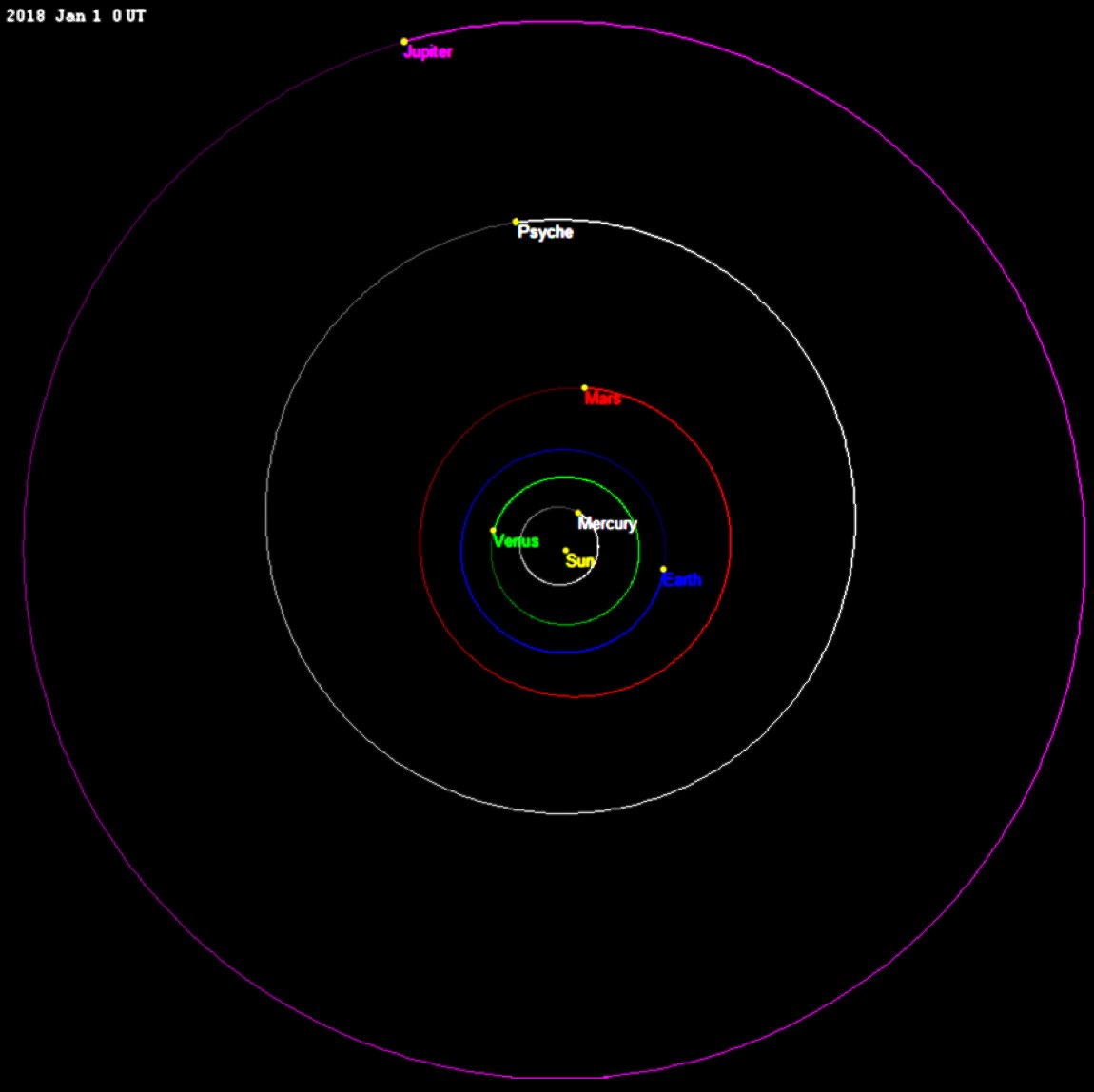
Psyche travels through the main asteroid belt on an orbit that keeps it between 2.53 and 3.32 astronomical units from the Sun, with a semi-major axis of 2.92 AU. For comparison, the dwarf planet Ceres orbits at 2.77 AU, placing Psyche somewhat farther out. One full trip around the Sun takes 4.998 years. The orbit is only mildly elongated, with an eccentricity of 0.1343, and it tilts just 3.097 degrees relative to the ecliptic — the plane in which Earth orbits. That modest inclination means Psyche stays fairly close to the main traffic lane of the solar system, making it reachable without the dramatic plane-change maneuvers that would be needed for more steeply inclined targets. At its closest approach to Earth, Psyche still sits about 1.5 AU away, roughly 220 million kilometers — about 580 times the distance from Earth to the Moon.
 ⤢
⤢
06 Measuring a world from afar Deeper
Pinning down Psyche's true size took decades of increasingly clever observations. The first estimate of 253 kilometers came from NASA's IRAS satellite, which measured Psyche's thermal infrared glow. That figure turned out to be 13.96 percent larger than today's accepted value — but not because it was wrong in spirit. IRAS happened to observe Psyche pole-on, capturing its widest cross-section, so the measurement was accurate for that particular viewing angle. A more complete picture emerged from stellar occultations: on nine separate occasions Psyche has passed in front of a background star, briefly snuffing out its light. Four of those events — in 2004, 2010, 2014, and 2019 — produced multi-chord data sets, meaning observers at multiple ground stations each timed the disappearance and reappearance independently. Combined with adaptive optics imaging and three-dimensional modeling, those events converged on an equivalent-volume mean diameter of 222 ± 3 kilometers. The asteroid's full dimensions are approximately 278 km × 238 km × 171 km, an elongated, lumpy shape consistent with what mathematicians call a Jacobi ellipsoid.
07 Craters, dark patches, and bright spots Deeper
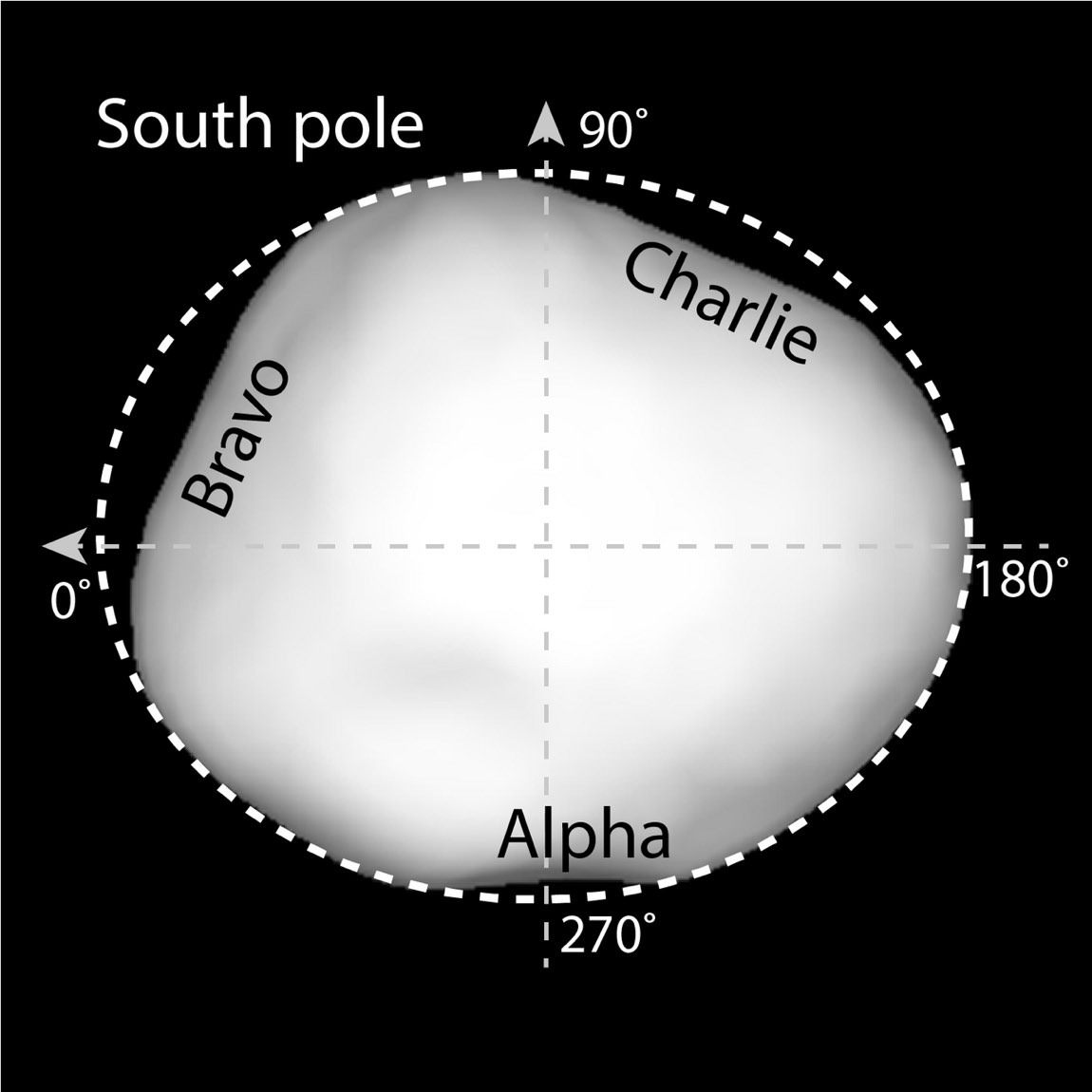
Psyche's surface is far from featureless. Observers using the Very Large Telescope's SPHERE adaptive optics imager identified two large craters, each roughly 90 kilometers across — wide enough to stretch from London to Birmingham — and gave them the provisional names Meroe and Panthia, after twin witches in the Roman novel Metamorphoses by Apuleius. Radar work at the Arecibo telescope turned up additional features: a south-polar depression called Delta, a southern-midlatitude feature called Eros, and a north-polar one called Foxtrot. Not all of them are certain; analysis suggests Panthia and Eros are almost certainly real, Foxtrot is likely real, while Meroe and Delta remain uncertain. Albedo — surface brightness — varies dramatically too, differing from the mean by more than 20 percent in some locations. Meroe sits in an unusually dark patch, while Panthia coincides with an unusually bright one. Radar data echo this pattern: Panthia and two other bright regions show radar albedo nearly twice the background value of 0.26, pointing to locally high concentrations of metal phases and hinting at a physical link between whatever brightens the terrain and whatever enriches it in metal.
08 Why its density is such a puzzle Deeper
Psyche's bulk density of roughly 3.977 ± 0.253 g/cm³ sits at the heart of most debates about what this asteroid actually is. Pure iron-nickel metal — the stuff found in most iron meteorites — has a density of 7.9 g/cm³, more than twice Psyche's measured value. If Psyche were a solid metallic core, the numbers only balance if the body is about 50 percent empty space — a porosity that scientists consider improbable for an object 222 kilometers across. Instead, researchers have proposed several meteorite types as better compositional matches, including enstatite chondrites, bencubbinites, and mesosiderites, all of which have bulk densities closer to Psyche's. Radar reflectivity across the surface ranges from 0.22 to 0.52, two to four times higher than most main-belt asteroids, consistent with regolith bulk densities of 2.6 to 4.7 g/cm³. That wide range fits most metal-rich meteorite classes and aligns with spectroscopic detections of silicate minerals — but it rules out a pure iron-nickel regolith unless it is highly porous.
09 Water where none should be
One of the more surprising findings about Psyche came from spectra taken in October 2016 at the NASA Infrared Telescope Facility atop Maunakea in Hawaii. The data showed a feature near 3 micrometers in wavelength — a telltale sign of hydroxyl ions, the building block of water molecules — suggesting hydrated silicates on the surface. This is unexpected because Psyche is thought to have formed under dry conditions, far from the regions of the early solar system where water ice could survive. The leading explanation is that the hydroxyl did not originate on Psyche at all, but was delivered by past impacts from smaller carbonaceous asteroids, which are known to carry hydrated minerals. If confirmed, this would make Psyche a kind of geological scrapbook, preserving chemical signatures from entirely different populations of solar system bodies that happened to collide with it over billions of years.
10 Three competing stories of its birth
How Psyche came to be remains genuinely contested, and astronomers have put forward three distinct hypotheses. The oldest idea is that it is the exposed metallic core of a protoplanet roughly 500 kilometers in diameter whose rocky crust and mantle were blasted away — either in one catastrophic collision or in more than three slower, glancing hits by bodies of comparable or larger size. This picture has lost favor as mass and density measurements fail to match what a solid metal core should look like. A second idea proposes that Psyche was shattered and then gravitationally reassembled into a mixture of metal and silicate, which would make it a candidate for the parent body of mesosiderites — a class of stony-iron meteorites found on Earth. A third hypothesis suggests Psyche differentiated like 1 Ceres and 4 Vesta, but then experienced iron volcanism, or ferrovolcanism, while cooling, concentrating metal at the surface only near ancient volcanic centers. Recent radar observations have lent some support to this third idea.
 ⤢
⤢
11 How much of the asteroid belt is this one rock?
Psyche is both the largest and most massive of the M-type asteroids, and ranks among the dozen most massive asteroids overall. Its most recent mass estimate has converged on approximately (2.29 ± 0.14) × 10¹⁹ kilograms — a figure derived partly from the gravitational nudges Psyche exerts on other asteroids it passes near. Those orbital perturbations are measurable enough to serve as a natural weighing scale for an object no spacecraft has yet visited. Despite that impressive mass, the number is still modest on a solar-system scale: Psyche accounts for about one percent of the total mass of the entire asteroid belt. That single percentage point, however, represents an enormous concentration of material in one body — enough to meaningfully shape its immediate gravitational neighborhood and make it one of the belt's dominant objects.
12 A peculiar tilt changes the view from the surface Deeper
Psyche spins in a way that sets it apart from many asteroids. All recent shape models agree that its rotation axis points toward ecliptic coordinates of approximately λ = 35°, β = −8°, with an uncertainty of about 3°. That translates to an axial tilt of 98 degrees — meaning Psyche is tipped slightly past sideways relative to its orbital plane, much like the planet Uranus. The practical consequence is dramatic seasonal behavior: the poles of Psyche receive extended periods of direct sunlight and extended periods of darkness as the asteroid crawls along its 4.998-year orbit. For a future orbiting spacecraft, this tilt also means that the geometry of observation changes significantly over the mission, with different latitudes cycling in and out of view. The original IRAS measurement that came in 13.96 percent too large is itself a direct consequence of this spin orientation — the satellite happened to catch Psyche during a pole-on geometry, measuring the widest possible cross-section.
13 The long road to a mission approval
The campaign to send a spacecraft to Psyche began in 2014 when a team led by Lindy Elkins-Tanton, director of the School for Earth and Space Exploration at Arizona State University, formally proposed a robotic orbiter to NASA. Their pitch emphasized that Psyche appeared to be the only metallic core-like body yet discovered, making it scientifically unique. The concept called for orbiting Psyche for 20 months, studying its topography, surface features, gravity, magnetism, and other properties using existing technology rather than requiring costly new development. The proposal made it to the final round of NASA's Discovery Program in September 2015 as one of five semifinalists, and was formally approved on 4 January 2017. An initial plan to launch in 2022 with a Mars gravity assist in 2023 and arrival in 2026 was abandoned after problems with the spacecraft's flight software forced a return to the original, later timeline. On 28 February 2020, NASA awarded SpaceX a $117 million contract to launch the mission on a Falcon Heavy rocket.
14 Watching Psyche from Earth
Even without a spacecraft in orbit, astronomers have managed to extract a remarkable amount of information about Psyche from Earth-based platforms. The Very Large Telescope's SPHERE imager resolved craters on the surface. The Arecibo Radar Telescope mapped albedo variations and detected localized regions of unusually high metal concentration. The NASA Infrared Telescope Facility on Maunakea picked up chemical signatures suggesting hydroxyl on the surface. Nine separate stellar occultation campaigns provided precise size constraints. Psyche most recently reached opposition — the point when it is opposite the Sun in Earth's sky, and therefore closest and brightest — on 6 August 2024, when it was 1.7 AU, or about 250 million kilometers, from Earth. Its Earth minimum orbital intersection distance is 1.5 AU, meaning it never gets dramatically close, but dedicated telescopes can still gather enough light to study its spectrum, brightness variations, and radar signature with considerable precision.
15 Open questions the spacecraft must answer Deeper
Despite decades of observation, Psyche remains fundamentally ambiguous in ways that only an orbiting spacecraft can resolve. Astronomers still do not know whether it is a stripped planetary core, a re-accreted rubble pile of mixed metal and rock, a ferrovolcanic world, or something else entirely. Its bulk density of roughly 3.98 g/cm³ is inconsistent with a solid iron-nickel body but compatible with several different mixtures of materials, leaving the composition genuinely open. The origin of hydroxyl on the surface — whether delivered by carbonaceous impactors or produced by some other process — is unconfirmed. The reality of specific craters, including Meroe and Delta, is uncertain. The spacecraft, launched on 13 October 2023 and expected to arrive in 2029, will orbit for 20 months measuring topography, gravity, magnetism, and surface composition. Its findings will either rehabilitate the exposed-core hypothesis, support one of the competing origin stories, or potentially reveal something entirely unexpected about how metal-rich bodies form and evolve in the early solar system.
 ⤢
⤢
Could life exist here?
Bare metal and rock.
Our labels: Confirmed · Strong Evidence · Estimated · Hypothesis · Theoretical · Speculative (see Methodology).
How would we get there?
The Psyche spacecraft cruises 6 years on solar-electric propulsion with a Mars assist — the standard price of the outer belt.
| Technology | Status | Travel time (one way, straight line) |
|---|---|---|
| Apollo-style spacecraft, about 39,000 km/h | Flown technology | 482 days |
| Ion-propulsion probe, about 90,000 km/h | Flown technology | 208 days |
| Voyager 1, about 61,000 km/h | Flown technology | 306 days |
| Parker Solar Probe, about 690,000 km/h | Flown technology | 27 days |
| Nuclear-thermal rocket, about 120,000 km/h cruise | In development | 158 days |
| Laser light-sail at 20% of light speed | Proposed concept | 2.1 hours |
| Light itself, 299,792 km/s | Physical limit | 25 minutes |
Simplified straight-line times at cruise speed. Real missions fly curved orbital paths and take longer. Full travel calculator →
Weird & wonderful
- Psyche may have had volcanoes that erupted molten iron.
- Its metal would dwarf every mine in human history — and be worth nothing if delivered.
- The mission tests laser space communications — video bandwidth from the asteroid belt.