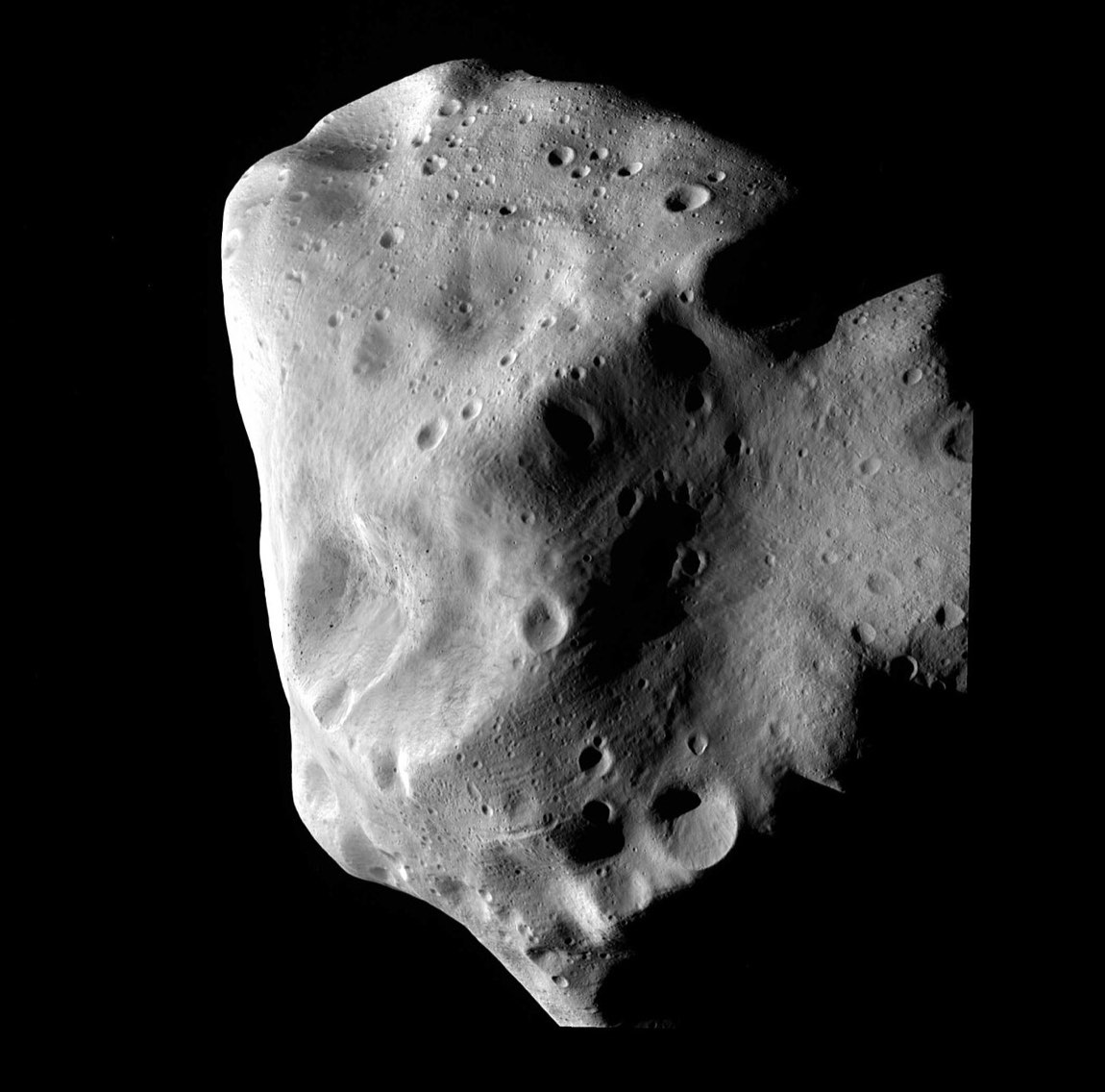
 Photograph · ESA 2010 MPS for OSIRIS Team MPS/UPD/LAM/IAA/RSSD/INTA/UPM/DASP/IDA · CC BY-SA 2.0
Asteroid · Deep guide
21 Lutetia
Also called: 21 Lutetia · (21) Lutetia · A852 VA
A dense, possibly metal-rich asteroid that Rosetta swept past in 2010.
What is it?
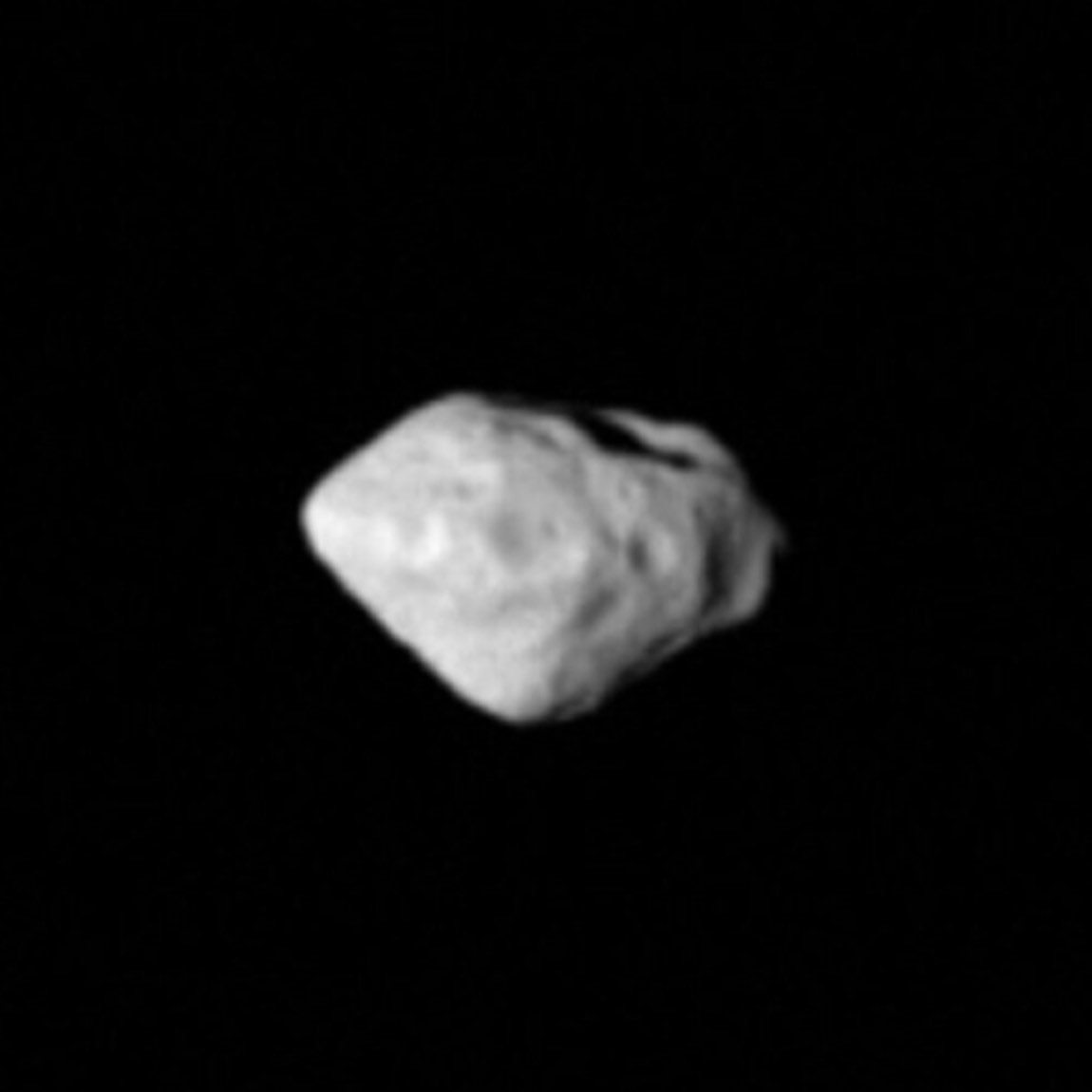
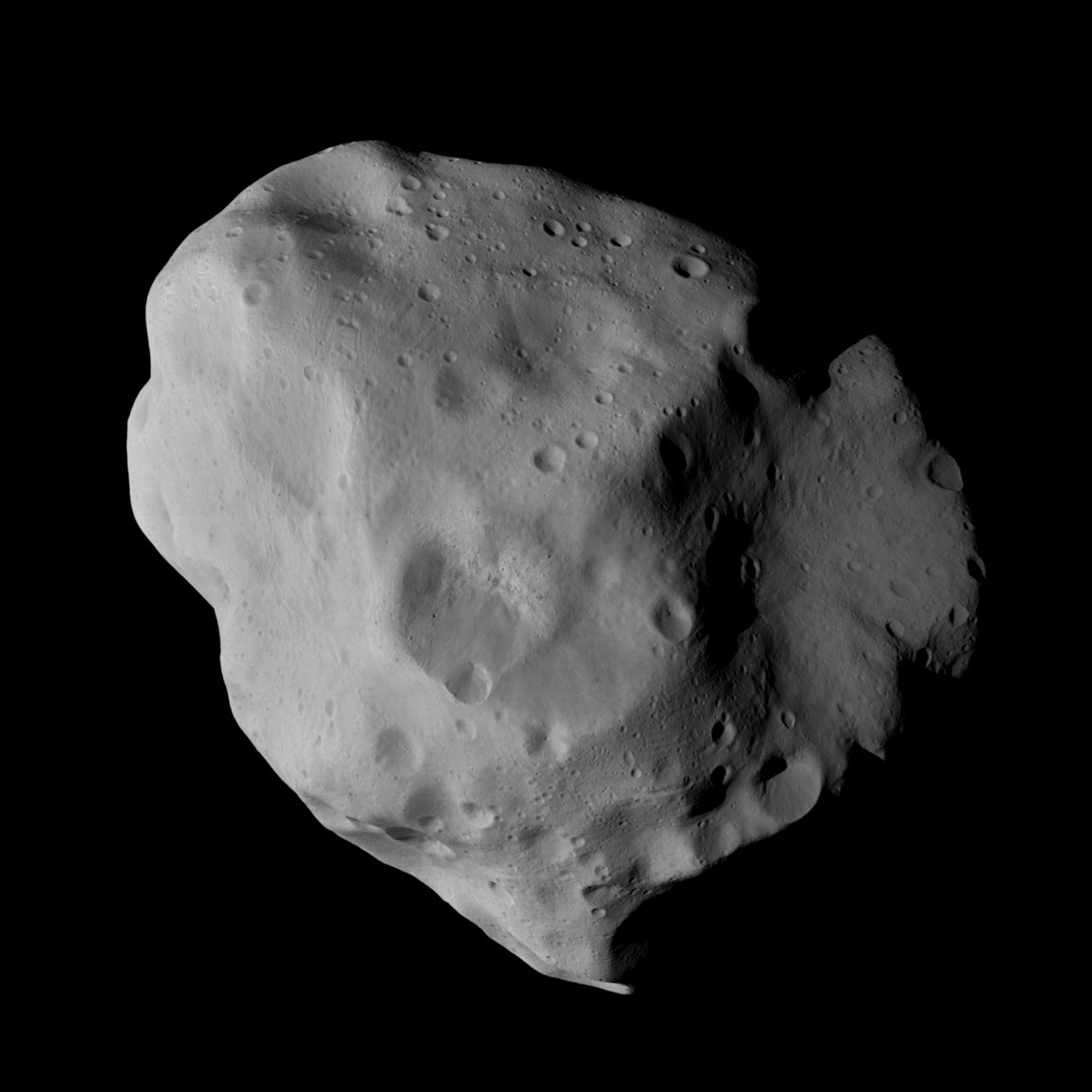
Lutetia is a large main-belt asteroid about 100 km wide, named after the Latin name for Paris. Europe's Rosetta spacecraft passed within about 3,160 km of it in July 2010 on its way to comet 67P. The images showed an irregular, heavily cratered body crossed by grooves and fractures, with a largest crater about 45 km wide. Its high density suggests it contains metal-rich rock, and it was the largest asteroid visited by a spacecraft until Dawn reached Vesta in 2011.
The deep dive
Researched for the Atlas from Wikipedia — 21 Lutetia (8,638 characters read) · updated Nov 14, 2026
01 A Parisian Discovery on a Balcony
Lutetia was not found through the eyepiece of a great observatory telescope but from something far more domestic: the balcony of Hermann Goldschmidt's Paris apartment on 15 November 1852. Goldschmidt was a German painter who had taken up asteroid hunting as a passionate side pursuit, and his urban vantage point proved perfectly adequate. Within weeks, German astronomer Georg Rümker and others had computed a preliminary orbit from the new observations. The asteroid was named Lutetia after the Latin name the Romans gave to Paris itself — a neat echo of its discovery site. Half a century later, in 1903, Edward Pickering photographed Lutetia at opposition from Harvard College Observatory and calculated an opposition magnitude of 10.8, faint enough to need a telescope but a useful calibration point for later size estimates. The name would eventually anchor an entire Roman-themed nomenclature system for the asteroid's surface features, approved by the International Astronomical Union in March 2011.
02 An M-Type That Defies Its Own Category Deeper
Lutetia belongs to the M-type asteroid class, historically assumed to be composed of nearly pure metal — essentially bare nickel-iron cores exposed by ancient collisions. Lutetia has repeatedly refused to behave accordingly. Radar surveys of M-types suggest that roughly two-thirds of them, Lutetia included, are more likely metal-enriched silicates than solid metal. Ground-based telescopic spectra showed a flat, low-frequency spectral signature resembling carbonaceous chondrites and C-type asteroids rather than metallic meteorites, along with hints of hydrated minerals and abundant silicates. When the Rosetta probe arrived in 2010, it complicated the picture further: the spacecraft detected a moderately red spectrum in visible light and an essentially flat near-infrared spectrum, with no absorption features across the 0.4–3.5 μm range observed — directly contradicting earlier ground reports of hydration signatures and carbon-rich compounds. No evidence of olivine appeared either. Rosetta's results, combined with Lutetia's high bulk density, led scientists to propose that it may be composed of enstatite chondrite material, or possibly metal-rich, water-poor carbonaceous chondrite types such as CB, CH, or CR classes.
03 Why Lutetia Is Surprisingly Heavy
Before Rosetta arrived, astronomers estimated Lutetia's mass at about 2.57×10¹⁸ kilograms. The flyby measurements told a different story: the true mass is (1.700 ± 0.017)×10¹⁸ kg — meaningfully smaller than expected, yet the asteroid's density still stands out dramatically. Lutetia's bulk density is 3.4 ± 0.3 g/cm³, one of the highest measured for any asteroid. For comparison, ordinary granite on Earth has a density around 2.7 g/cm³, so Lutetia is notably denser than common rock. Even accounting for 10–15% internal porosity, the corrected bulk density still exceeds that of a typical stony meteorite. This combination of high density and spectral ambiguity is precisely what makes Lutetia so puzzling: it is too dense to be a loose rubble pile and too spectrally unusual to be straightforwardly metallic. The density was one of the key measurements Rosetta was sent to obtain, and the result has shaped nearly every compositional interpretation proposed since the flyby.
04 Rosetta's Brief but Revelatory Visit
On 10 July 2010, the European Space Agency's Rosetta probe swept past Lutetia at a minimum distance of 3,168 ± 7.5 km, moving at 15 kilometres per second. Rosetta was not on a Lutetia mission — it was en route to comet 67P/Churyumov-Gerasimenko — but the opportunity to study a large, poorly understood asteroid was too good to pass up. During the flyby, Rosetta captured 462 images through 21 narrow- and broad-band filters spanning wavelengths from 0.24 to 1 μm, achieving a best resolution of up to 60 metres per pixel. The imaging covered roughly 50% of the surface, concentrated in the northern hemisphere. Alongside the cameras, the VIRTIS visible and near-infrared imaging spectrometer observed surface composition, while dedicated instruments measured Lutetia's magnetic field and plasma environment. From these high-resolution images, scientists later reconstructed a photogrammetric model capable of simulating a complete trajectory around the asteroid — released in both standard and stereoscopic versions so viewers could appreciate its three-dimensional relief.
05 A Spinning World Tilted Like Uranus Deeper
Lutetia is a retrograde rotator with an axial tilt of 96°, meaning its rotation axis lies almost parallel to the plane of the ecliptic. This extreme obliquity is shared with the planet Uranus and is quite unusual among main-belt asteroids. Rosetta's images, combined with photometric light-curve analysis, pinned down the north rotational pole position to a right ascension of 51.8° ± 0.4° and a declination of +10.8° ± 0.4°. As a consequence of this geometry, Lutetia's poles are pointed roughly sunward for extended periods during its 3.8-year orbit, creating extreme seasonal illumination patterns across its surface. The 2003 lightcurve analysis had already hinted at an unusual shape, describing the asteroid as a rough sphere with sharp and irregular features, and a 2004–2009 study proposed a non-convex profile likely caused by the large Suspicio Crater on the southern hemisphere — though whether Rosetta's data fully support that conclusion remains unclear.
06 Seven Geological Regions, One Layered History
Scientists divided Lutetia's imaged surface into seven named geological regions: Baetica, Achaia, Etruria, Narbonensis, Noricum, Pannonia, and Raetia — all named after provinces of the Roman Empire, honoring the asteroid's Latin Parisian name. Baetica, clustered around the north pole, is the youngest surface unit. It features a cluster of 21-km-diameter impact craters draped in a smooth ejecta blanket roughly 600 metres thick, which has partially buried older craters beneath it. Nearby landslides and ejecta blocks reach up to 300 metres across, and the outcrops associated with landslides tend to be visibly brighter — a detectable albedo contrast. At the other end of the age scale, Achaia and Noricum are the two oldest regions. Achaia is a remarkably flat, heavily cratered terrain whose oldest surfaces carry a crater retention age of about 3.6 ± 0.1 billion years, essentially dating to the early Solar System. Noricum is sliced by a prominent groove 10 km long and roughly 100 metres deep, one of many linear features thought to be surface expressions of internal fractures.
07 Craters, Grooves, and What Lies Beneath Deeper
Across the hemisphere Rosetta imaged, 350 craters were counted, ranging in diameter from 600 metres to 55 km. The largest confirmed crater — Massilia, in the Narbonensis region — reaches 45 km across and is accompanied by pit chains and grooves formed during a later epoch. The Narbonensis region itself is thought to coincide with this giant impact. Pannonia and Raetia may also be the remnants of large ancient impacts. Beyond craters, the surface is laced with fractures, scarps, and grooves interpreted as surface manifestations of deep internal fractures. Numerical simulations of the Massilia-forming impact showed that even that enormous collision seriously fractured Lutetia but did not shatter it. This matters: an asteroid that survived such a blow while maintaining structural integrity is not a loosely bound rubble pile, as many smaller asteroids are. The impact crater morphology and the linear fracture patterns together indicate that Lutetia's interior has considerable mechanical strength, supporting the classification of Lutetia as a primordial planetesimal that has persisted largely intact since the early Solar System.
08 The Regolith: Three Kilometres of Fine Dust
Rosetta revealed that Lutetia is blanketed in a thick layer of regolith — loosely aggregated dust particles ranging from 50 to 100 micrometres in size, comparable to coarse talcum powder. This blanket is estimated to be about 3 kilometres thick, which is remarkably deep for an asteroid of Lutetia's size. The sheer depth of this regolith layer is thought to explain why many of the larger craters on the surface appear softened and rounded rather than sharp-rimmed: billions of years of impact gardening and seismic shaking have allowed the fine material to slump gradually into crater interiors, muting their outlines. The existence of such a thick regolith also has compositional implications, since surface spectra collected by remote sensing reflect this uppermost dusty layer rather than any fresher bedrock below. This is one reason scientists are cautious about ruling out minerals — such as hydrated compounds suggested by earlier ground-based observations — that may be present at depth but hidden beneath the regolith blanket.
09 Suspicio: The Crater That Might Not Exist
On the southern hemisphere of Lutetia — the hemisphere Rosetta never photographed — astronomers suspect there is a massive impact structure roughly 45 kilometres across, named Suspicio Crater. Its existence is inferred from patterns of fractures visible on the imaged northern side, which seem geometrically consistent with a large southern impact that sent shock waves propagating through the whole body. A 2004–2009 study also proposed that Lutetia's overall shape is non-convex precisely because of this putative crater. But the name itself encodes the uncertainty: "suspicio" is Latin for suspicion. No spacecraft has ever confirmed the structure visually, and because Rosetta covered only about half the surface, the southern terrain remains completely unimaged at high resolution. Whether Suspicio Crater is a real feature, a phantom created by fracture-pattern extrapolation, or something between those extremes is one of the most tangible open questions about Lutetia.
10 A Refugee From the Inner Solar System Deeper
Lutetia's composition offers a striking clue about its birthplace. The mix of properties — high bulk density, spectral characteristics matching certain rare carbonaceous chondrite classes, and the absence of features typical of outer-belt material — has led scientists to propose that Lutetia did not form where it now orbits. Instead, the evidence suggests it formed in the inner Solar System, in the same region where the terrestrial planets assembled. At some point in the early Solar System's turbulent dynamical history, a gravitational interaction with one of the growing terrestrial planets is thought to have flung Lutetia outward into the main asteroid belt, where it has remained ever since. If correct, this means Lutetia is a surviving sample of the material that built, or nearly built, planets like Earth and Venus — a preserved relic of conditions in the inner protoplanetary disk more than 4.5 billion years ago. This interpretation is consistent with the evidence that Lutetia is a primordial planetesimal that was never broken apart or reassembled.
11 Naming the Landscape: Roman Provinces in Space
In March 2011, the Working Group for Planetary Nomenclature at the International Astronomical Union formalized a thematic naming scheme for Lutetia's surface features, rooted entirely in Roman geography and history. Because Lutetia was the Roman name for Paris, the scheme carries that identity outward: craters are named after cities of the Roman Empire and the adjacent parts of Europe during the period of the city's existence. The seven geological regions take their names from Roman provincial names, most of them also honoring the asteroid's discoverer, Goldschmidt, in one of the designations. Other linear features such as grooves and scarps are named after rivers of the Roman Empire and neighboring European territories of that era. This layered naming logic means that every feature on Lutetia can be traced back to a specific historical place in the ancient Roman world, giving the asteroid's geography an unusually coherent cultural identity — one that ties a battered rock in the asteroid belt directly to the ancient city beneath whose skies it was first spotted.
12 Occultations: Measuring a Shadow Deeper
Before Rosetta arrived, one of the few ways to constrain Lutetia's true size from Earth was to watch it pass in front of a background star — a stellar occultation. Two such events were reported: one observed from Malta in 1997 and one from Australia in 2003. Each produced only a single chord, meaning only one observer's line of sight was blocked at the right moment, which is the minimum useful measurement. A single chord cannot reconstruct a full cross-sectional profile, but both observations roughly agreed with the size estimates derived from IRAS infrared measurements, lending some confidence to those earlier figures. The paucity of chords illustrates the practical difficulty of occultation astronomy: observers must be positioned precisely within a narrow shadow track, and for a relatively small and distant asteroid like Lutetia, that track is narrow and hard to predict with the orbital precision available at the time. The subsequent Rosetta flyby rendered these shadow measurements less critical but historically they represent the best pre-mission size data available.
 ⤢