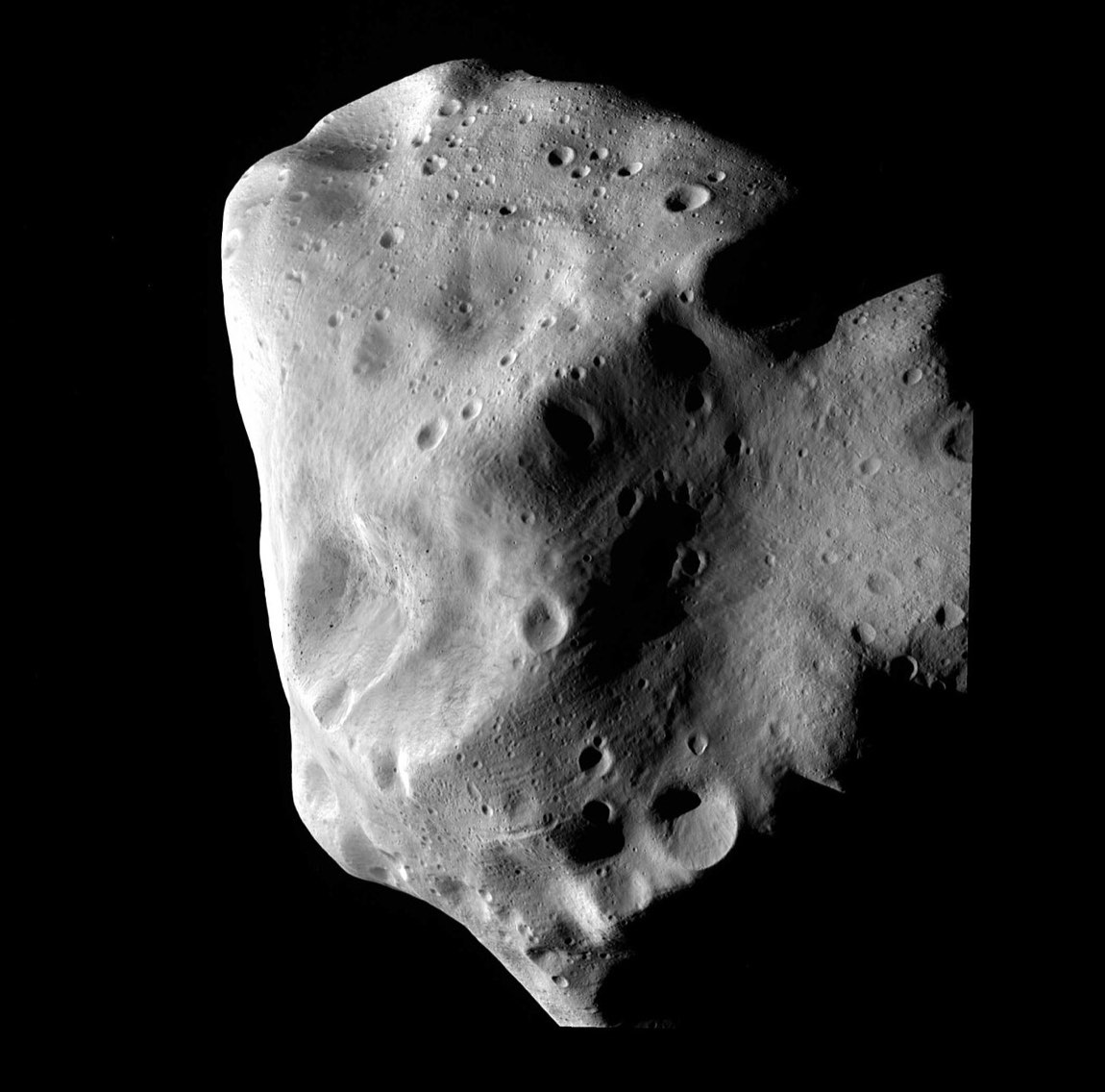
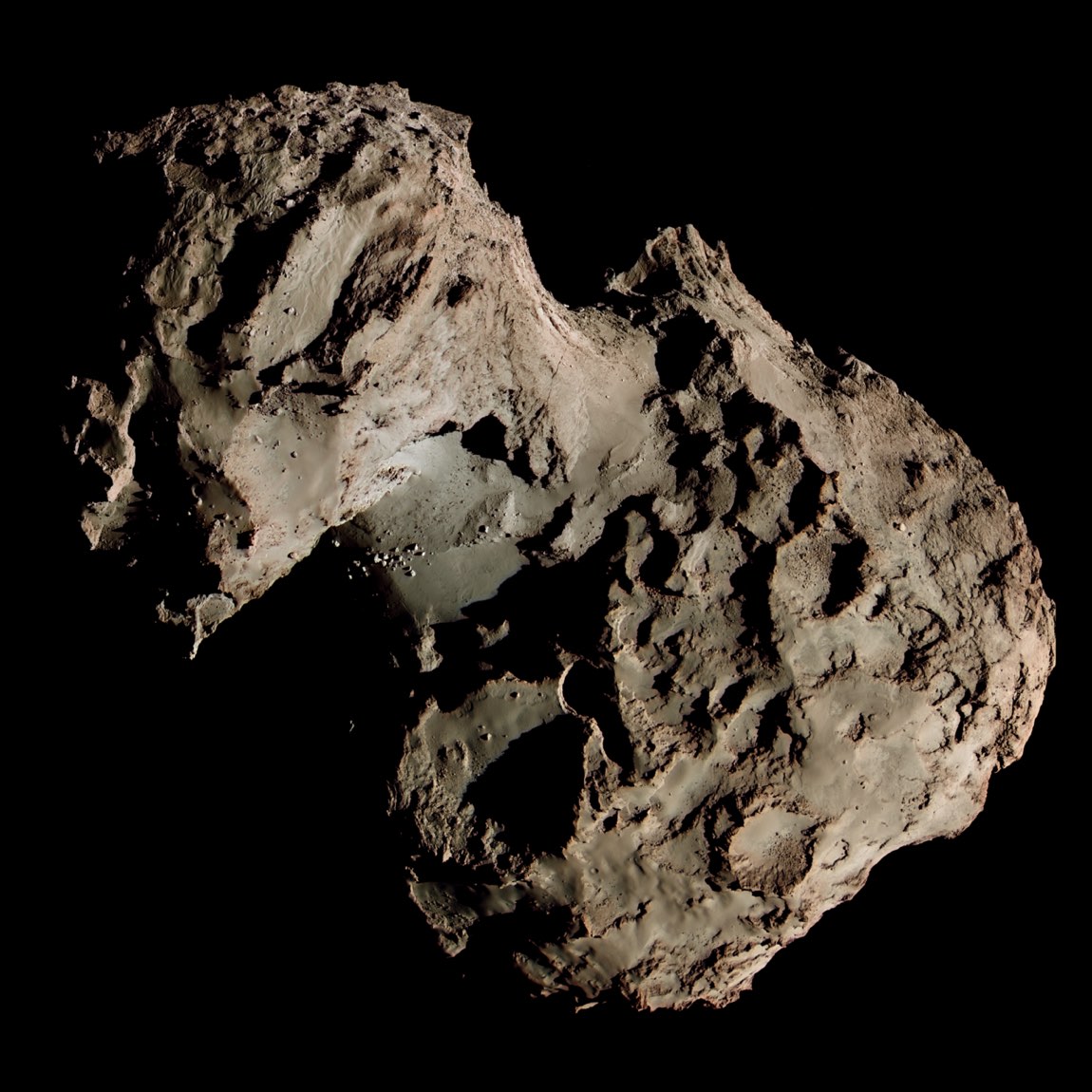
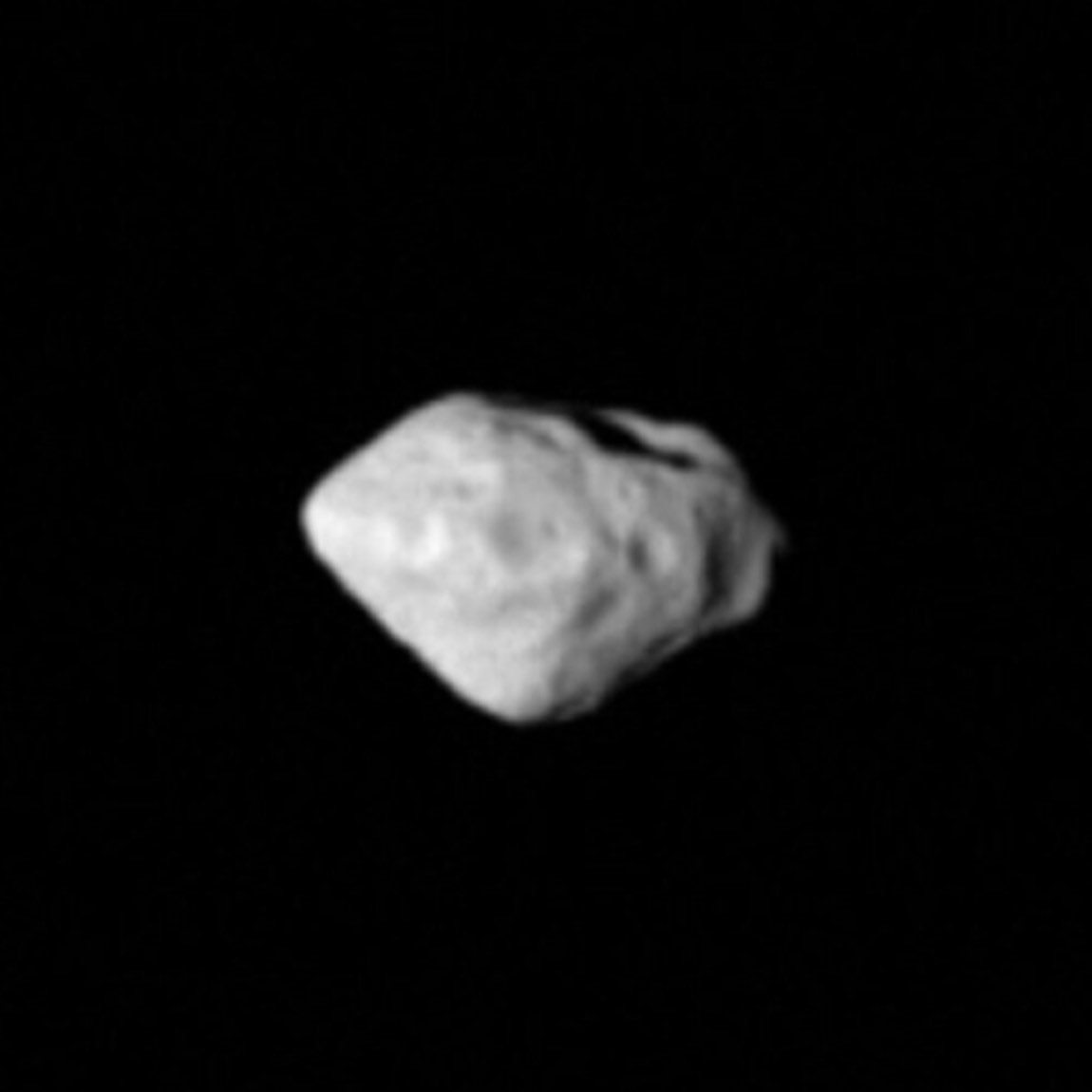
 Photograph · ESA/OSIRIS Team MPS/UPD/LAM/IAA/RSSD/INTA/UPM/DASP/IDA · CC BY-SA 3.0 igo
Asteroid · Deep guide
2867 Šteins
Also called: 2867 Šteins · 2867 Steins · (2867) Šteins · 1969 VC
A small, diamond-shaped asteroid that Rosetta photographed on its way to a comet.
What is it?
Šteins is a bright, gem-shaped asteroid only about 5 km across in the inner asteroid belt. It is a rare E-type asteroid, a class with highly reflective surfaces. The European Space Agency's Rosetta probe flew past it in September 2008, revealing a body pocked with craters — 23 of which now have names. It was discovered in 1969 in Crimea and named after the Latvian astronomer Kārlis Šteins.
The deep dive
Researched for the Atlas from Wikipedia — 2867 Šteins (5,113 characters read) · updated Nov 14, 2026
01 A Diamond Born in the Inner Belt
Šteins occupies a quiet corner of the inner asteroid belt, circling the Sun between 2.0 and 2.7 astronomical units — roughly twice to nearly three times the Earth–Sun distance. It completes one full orbit every 3 years and 8 months, or 1,327 days, tracing a mildly elliptical path with an eccentricity of 0.15 and a gentle tilt of 10° relative to the ecliptic. Crucially, it belongs to the belt's background population rather than any named dynamical family, meaning it probably was never part of a larger catastrophic collision cluster. Its semi-major axis sits at 2.36 AU, anchoring it firmly in the inner belt's quieter suburbs. Despite being classified as a minor planet discovered in 1969, astronomers found a precovery image at Palomar Observatory dating back to November 1951 — extending the known observation arc by 18 years and improving orbital calculations considerably. That long baseline of observations underpins the confidence scientists have in its well-defined, stable orbit today.
02 What Makes an E-Type Asteroid Special Deeper
Šteins belongs to the E-type asteroid class, one of the brightest categories in the solar system. Its surface has an albedo — a measure of reflectivity — of between 0.30 and 0.34 depending on which survey you consult, with NEOWISE and the Spitzer Space Telescope giving values of 0.30 and 0.34 respectively. Its overall Bond albedo, which accounts for all wavelengths of reflected light, is 0.24 ± 0.01. For comparison, Earth's Moon has an average albedo of only about 0.12, making Šteins roughly two to three times more reflective. E-type asteroids are thought to have surfaces rich in enstatite, a magnesium silicate mineral, which accounts for their unusually high brightness. This mineral composition suggests a history of intense heating — possibly from proximity to the early Sun or from internal radiogenic processes — that differentiated or at least thermally processed the surface material. The 2006 study from astronomers at the European Southern Observatory confirmed the E-type classification and estimated a diameter of approximately 4.6 kilometers, a figure later refined considerably by the Rosetta flyby.
03 The Gem That Survived a Giant Blow
ESA's nickname for Šteins — 'a diamond in the sky' — was inspired not only by its faceted, gem-like shape but also by the enormous crater dominating its widest end. Diamond crater stretches 2.1 kilometers across on a body whose mean volume-equivalent diameter is only 5.26 kilometers. That gives a crater-to-body diameter ratio of 0.79, meaning the crater is nearly as wide as the asteroid itself is wide on average. When scientists first saw the images from Rosetta, many were astonished that the asteroid had survived the impact at all. A collision energetic enough to carve a crater that large should, by some estimates, have shattered a small body entirely. Later analysis showed, however, that this ratio actually fits a trend seen in other small solar system bodies, so Šteins is unusual but not uniquely so. The crater is so large that it essentially sculpts the asteroid's overall silhouette — the wide base of the diamond shape is, in effect, the rim of Diamond crater viewed from the side.
04 23 Craters Named After Gemstones
On 11 May 2012, the International Astronomical Union's Working Group for Planetary System Nomenclature unveiled a naming scheme for surface features on Šteins that is almost unique in the solar system. Because the asteroid's shape reminded scientists of a cut gem, all 23 named craters received the English-language names of precious stones. Diamond crater is the largest, but the full catalog spans the spectrum of gemstone vocabulary. This approach is genuinely rare: except for the montes of Mercury and the lunar maria — and names proposed for asteroids 2 Pallas and 7 Iris — the craters of Šteins are the only features anywhere in the solar system whose official names are not derived from proper nouns such as people, places, or mythological figures. Beyond the craters, a distinct surface region has been designated Chernykh Regio, honoring Nikolai Chernykh, the Soviet astronomer who first identified the asteroid in 1969.
05 Mapping a Tiny World in Three Dimensions Deeper
Before Rosetta arrived, Šteins was known only as a point of light whose brightness varied slightly over time. The flyby images transformed that point into a world with measurable topography. Using a technique called stereophotoclinometry — which extracts three-dimensional shape information from overlapping photographs taken at slightly different angles and lighting conditions — scientists published in 2012 that Šteins measures 6.83 × 5.70 × 4.42 kilometers along its three principal axes. That elongated, tapered profile is what creates the characteristic diamond silhouette visible in Rosetta's images. The mean diameter calculated from this volume works out to 5.26 kilometers, a figure larger than but broadly consistent with the infrared estimates from NEOWISE (5.16 km) and Spitzer (4.92 km). The asteroid has no moons, simplifying the shape determination because there is no need to account for tidal distortions. Its irregular, asymmetric geometry also reflects the cumulative violence of billions of years of impacts in a crowded inner belt.
06 A Spin Axis Pointing Nearly Straight Down Deeper
Šteins rotates once every 6.052 ± 0.007 hours, a period confirmed with high precision by OSIRIS cameras aboard Rosetta just before the flyby and cross-checked against ground-based photometric observations, which independently measured 6.049 hours. The brightness amplitude of the rotational lightcurve ranges between 0.18 and 0.31 magnitudes — a relatively modest variation suggesting the body, while irregular, is not wildly elongated in its cross-section as seen from Earth. Perhaps more striking is the spin axis orientation derived from lightcurve inversion modeling using 26 separate lightcurves: the pole points toward ecliptic coordinates of 250.0° longitude and −89.0° latitude. A latitude of −89° means the spin axis is tilted almost perfectly perpendicular to the ecliptic plane — in other words, one pole points nearly straight toward the south ecliptic pole. This extreme obliquity would produce dramatic seasonal illumination cycles if Šteins were large enough to have a significant atmosphere, though at 5 kilometers across it has nothing of the sort.
07 Seven Minutes That Changed What We Knew
The entire close encounter between Rosetta and Šteins on 5 September 2008 lasted approximately 7 minutes. In that brief window, Rosetta passed within 800 kilometers of the asteroid at a relative speed of 8.6 kilometers per second — fast by human standards but slow compared to many asteroid flybys. The geometry of the encounter was fortunate: the Sun happened to illuminate Šteins from the same direction the spacecraft was traveling, so the images came back without shadowing that might have obscured surface detail. All 15 of Rosetta's scientific instruments were operating during the encounter, capturing data across a wide range of wavelengths and physical parameters simultaneously. The European Space Operations Centre held a press conference streamed publicly later the same day. This was Rosetta's first of two planned asteroid flybys; the second took the probe past the much larger asteroid 21 Lutetia in 2010 before Rosetta continued on to its primary target, comet 67P/Churyumov–Gerasimenko.
08 The Soviet Latvian Astronomer Behind the Name
The asteroid's name honors Kārlis Šteins (1911–1983), a Latvian and Soviet astronomer whose career was centered at the University of Latvia in Riga, where he served for many years as observatory director. Šteins contributed to two quite different fields of astronomy: cometary cosmogony, the study of how comets form and evolve, and the precise measurement of Earth's rotation — a discipline demanding extreme patience and instrumental accuracy. He also designed astronomical instruments, combining theoretical and practical skills that were valuable at a university observatory with limited resources. The official naming citation was published by the Minor Planet Center on 18 September 1986, in Minor Planet Circular 11157, more than three decades before the ESA spacecraft bearing the comet-destination name Rosetta would bring global attention to the small world carrying his name. The asteroid's discoverer, Nikolai Chernykh, worked at the Crimean Astrophysical Observatory in Nauchnij — the same institution that produced many Soviet-era asteroid discoveries.
09 Rediscovering Šteins in Old Palomar Plates
Although Nikolai Chernykh is credited with discovering Šteins on 4 November 1969, the asteroid had already been photographed nearly two decades earlier without anyone realizing it. A precovery image — a detection found retrospectively in archival data — was identified in observations taken at the Palomar Observatory in November 1951. Palomar's wide-field sky surveys, which aimed to catalog millions of objects, frequently captured asteroids that were only identified as such years or decades after the plates were taken. Extending the observation arc backward by 18 years is scientifically significant: a longer baseline of positional measurements allows far more precise determination of an asteroid's orbital elements, reducing uncertainty in predictions of its future path. For Šteins, this meant that by the time mission planners at ESA began designing the Rosetta trajectory in the early 2000s, they had access to an orbital solution spanning more than half a century of data — giving them the confidence to plan a precisely timed flyby at 800 kilometers distance.
10 Open Questions After the Flyby Deeper
Despite the richness of data returned in just 7 minutes of close encounter, Šteins still holds unanswered questions. The survival of Diamond crater — 2.1 kilometers wide on a body only about 5.26 kilometers in mean diameter — was initially baffling. While later analysis showed the crater-to-body size ratio of 0.79 fits a known trend for small bodies, the physical mechanism that allowed the asteroid to absorb such an impact without fragmenting is not fully understood. The internal structure of Šteins remains uncharacterized: whether it is a solid monolith, a fractured rubble pile held together by gravity, or something intermediate cannot be determined from flyby imagery alone. The E-type composition implies a thermally processed history, but the precise conditions and timeline of that processing are debated. The asteroid's nearly pole-on spin axis orientation raises questions about whether this configuration was caused by the Yarkovsky–O'Keefe–Radzievskii–Paddack (YORP) effect reshaping its spin over geological time — a hypothesis the article does not resolve.