 Photograph · Justin Cowart · CC BY 2.0
Spacecraft · Deep guide
Rosetta & Philae
Europe's comet chaser, and the first to orbit a comet and land on one.
What is it?
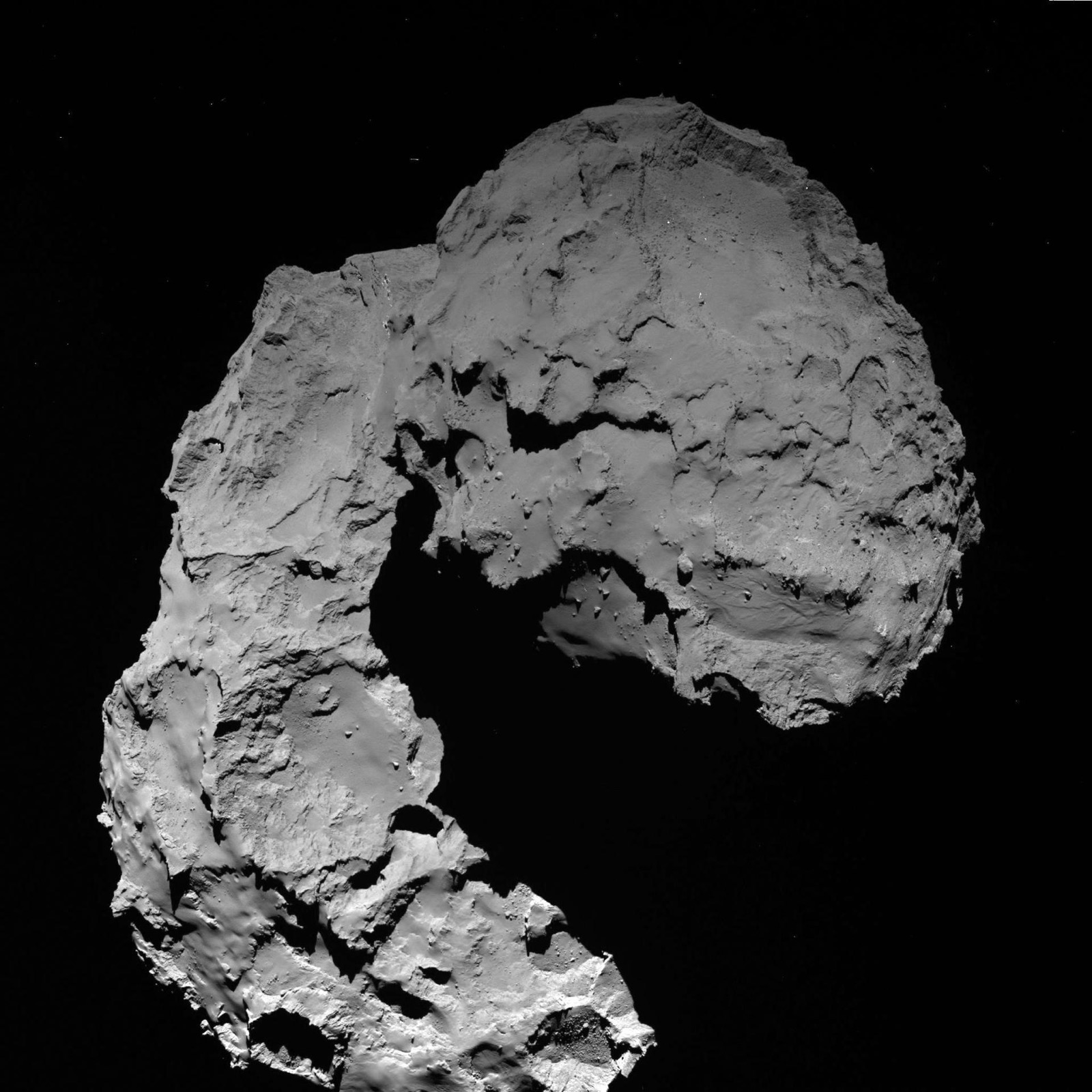
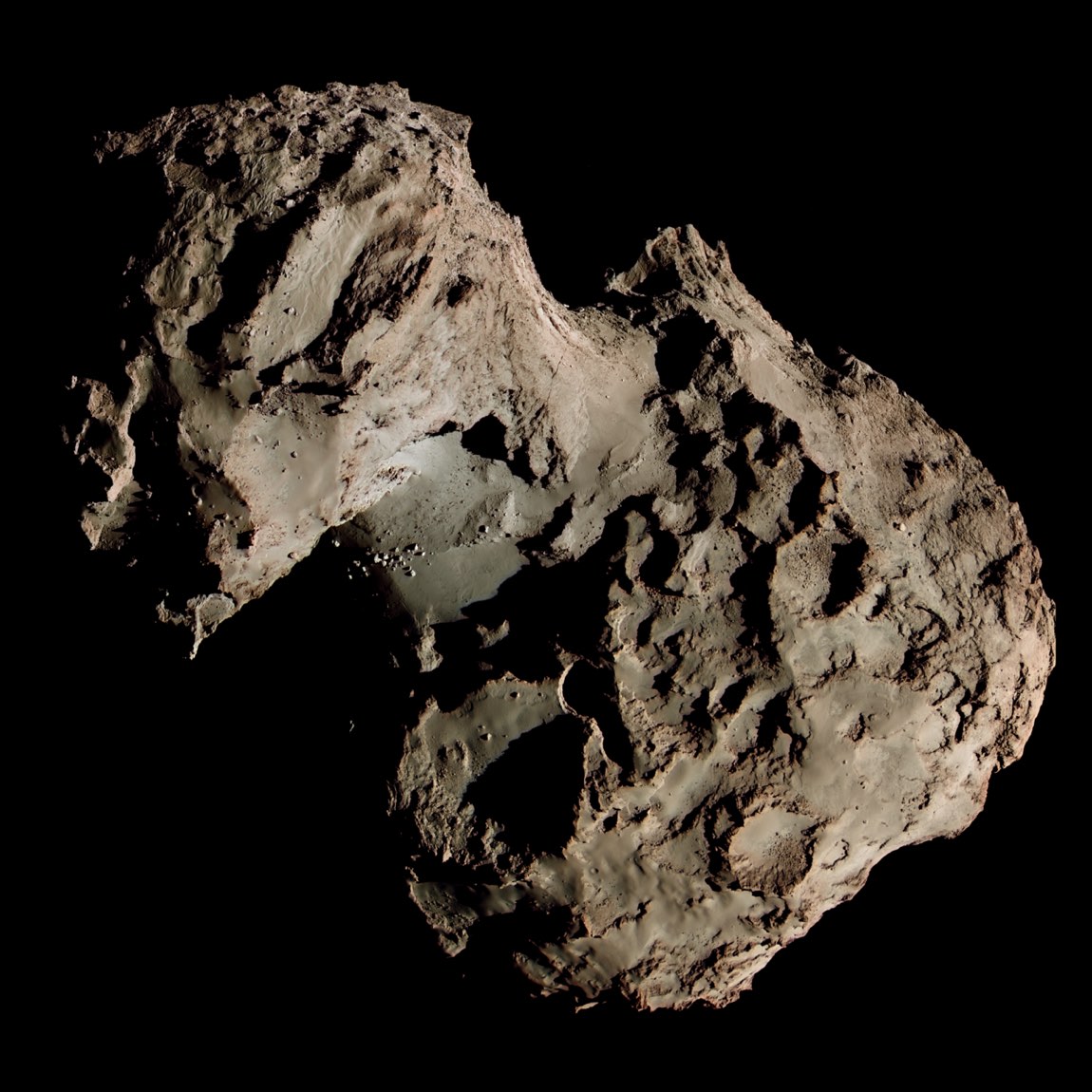
ESA's Rosetta chased comet 67P for ten years, became the first spacecraft ever to orbit a comet in 2014, and dropped the lander Philae onto its surface — history's first comet landing, bounces and all. For two years it watched a comet come alive around perihelion. The mission ended in 2016 with Rosetta itself set down gently on the comet it had made famous.
The deep dive
Researched for the Atlas from Wikipedia — Rosetta (spacecraft) (38,201 characters read) · updated Sep 20, 2026
01 Why 67P and not the original target
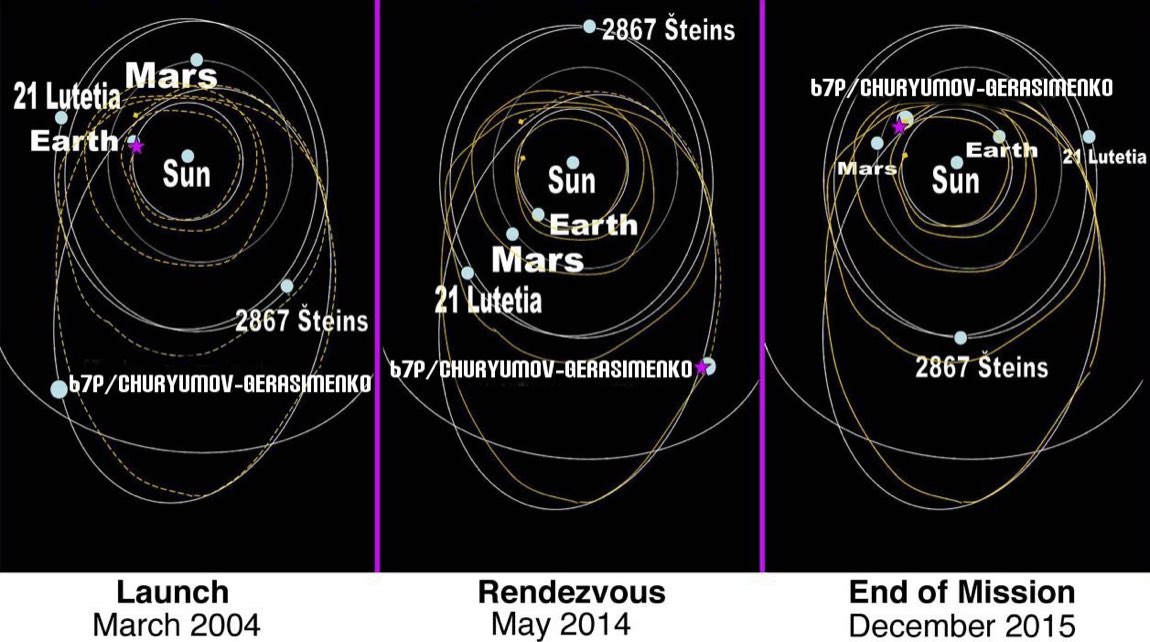
Rosetta was never supposed to visit comet 67P/Churyumov–Gerasimenko at all. The original plan called for a launch in January 2003 toward comet 46P/Wirtanen, with a rendezvous in 2011. That schedule collapsed when an Ariane 5 ECA rocket failed during the launch of Hot Bird 7 on 11 December 2002, grounding the entire rocket family until engineers could find the fault. With the launch window to Wirtanen gone, mission planners spent months hunting for a replacement target. By May 2003 they settled on 67P, pushing the launch to late February 2004 and the comet rendezvous to 2014 — three extra years of cruise time. The switch was not painless: 67P is larger and heavier than Wirtanen, which meant the lander would hit the surface harder on arrival. Engineers had to redesign Philae's landing gear to survive the increased impact velocity. Both co-discoverers of the substitute comet, Klim Churyumov and Svetlana Gerasimenko, were present at the Guiana Space Centre to watch the eventual launch on 2 March 2004.
02 A billion-euro gamble at Mars
Reaching a comet requires enormous speed changes, and Rosetta's engines alone could not supply them all. The mission therefore threaded a careful path through the inner Solar System, using the gravity of Earth and Mars to build velocity for free. The Mars flyby on 25 February 2007 was by far the most nerve-wracking leg. Rosetta skimmed only 250 kilometres above the Martian surface — close enough that it slipped into the planet's shadow for 15 minutes. With no sunlight reaching its solar panels, the spacecraft had to run entirely on batteries that were never designed for the job. Communication was impossible during this period. Mission engineers nicknamed the manoeuvre "The Billion Euro Gamble" because a dead battery or a software glitch could have ended the entire €1.3 billion mission in those silent quarter-hours. Rosetta survived, returned detailed images of the Martian surface and atmosphere, and continued on course. The probe also made three Earth flybys — on 4 March 2005, 13 November 2007 at 5,700 km distance, and 12 November 2009 at 2,481 km — before heading into the outer Solar System.
03 Mistaken for an asteroid about to hit Earth
During its second Earth flyby in November 2007, Rosetta nearly triggered a planetary-defence alarm. An astronomer working with the Catalina Sky Survey spotted the approaching spacecraft on 7 and 8 November and logged it as an uncharted near-Earth asteroid roughly 20 metres in diameter — about the size of a large house. Orbital calculations showed it would pass extremely close to Earth, and speculation quickly spread that it might be on an impact trajectory. The provisional designation 2007 VN84 was assigned. Fortunately, astronomer Denis Denisenko recognised that the object's path matched the published trajectory of Rosetta exactly. The Minor Planet Center confirmed the identification in an editorial release on 9 November, days before the actual flyby on 13 November at a distance of 5,700 km. The episode illustrated both how precisely Rosetta's trajectory had been planned and how active sky-survey networks had become — capable of spotting a human-made spacecraft and briefly classifying it as a potential impactor.
04 Two asteroid encounters along the way Deeper
Rosetta's long cruise gave scientists two bonus science targets: asteroids 2867 Šteins and 21 Lutetia. During the Šteins flyby on 5 September 2008, the spacecraft closed to less than 800 km at a relative speed of 8.6 km/s — about 19,000 mph — while onboard instruments collected data from 4 August to 10 September. Lutetia, a large main-belt asteroid, received a more thorough inspection on 10 July 2010. Rosetta passed within 3,168 ± 7.5 km at 15 kilometres per second, capturing 462 images through 21 narrow- and broad-band filters spanning 0.24 to 1 μm wavelength, with resolution as fine as 60 metres per pixel and coverage of roughly 50 percent of the surface, mostly the northern hemisphere. The VIRTIS spectrometer studied it in the visible and near-infrared, and the RPC suite measured its magnetic field and plasma environment. Between these two encounters, Rosetta also observed the dust tail of object P/2010 A2 on 16 March 2010; combined with Hubble Space Telescope data, this confirmed that P/2010 A2 was not a comet but an asteroid whose tail was debris from a collision with a smaller body.
05 Thirty-one months of deep-space sleep
After the Lutetia flyby, mission controllers faced an uncomfortable reality: Rosetta would spend years travelling through the outer Solar System where sunlight is too faint to power active operations. On 8 June 2011, the spacecraft was spun up into a stabilised rotation and nearly every system except the onboard computer and hibernation heaters was shut down. It drifted in this near-dead state for a planned 31 months. The reaction wheels that keep the spacecraft pointed correctly had already been causing anxiety — one showed elevated bearing friction after the Šteins encounter and had to be switched off, and a second followed suit. Engineers on the ground tested a spare wheel at the European Space Operations Centre in Darmstadt and developed new software so Rosetta could, if necessary, operate with only two active wheels. When Rosetta finally woke in January 2014, the lessons learned were applied: wheel speeds were capped below 1,000 rpm and operating temperatures were raised. All four wheels then performed well enough to support the entire comet mission, though the team kept one in reserve and monitored the others closely for friction anomalies throughout the orbital phase.
06 Eight engine burns to slip into comet orbit Deeper
Matching velocities with a comet is not a single dramatic braking manoeuvre — it is a carefully choreographed sequence of burns spread over months. Starting 7 May 2014, when Rosetta was roughly 2,000,000 km from 67P and travelling 775 m/s faster than the comet, the team executed eight thruster firings. Three burns did most of the work: a 291 m/s reduction on 21 May, 271 m/s on 4 June, and 91 m/s on 18 June. By 23 July the distance had shrunk to just over 4,000 km and the relative velocity to 7.9 m/s — roughly walking pace. The spacecraft then flew two successive triangular paths averaging 100 and then 50 km from the nucleus before closing to within 30 km on 10 September 2014 and entering true orbit, beginning what scientists called the Global Mapping Phase. The propellant Rosetta carried at launch tells the scale of the task: 659.6 kg of monomethylhydrazine fuel and 1,059.5 kg of dinitrogen tetroxide oxidiser — together more than half the spacecraft's total launch mass of approximately 3,000 kg — providing a total delta-v capability of at least 2,300 metres per second.
07 Philae's two bounces and a shadow landing
Philae separated from Rosetta on 12 November 2014 at 08:35 UTC and descended at about 1 m/s — roughly the speed of a gentle walking pace, chosen because 67P's escape velocity is only about 1 m/s. Two harpoons were designed to fire on contact and anchor the lander, but they failed to deploy. Philae touched down at 15:33 UTC, bounced, bounced again, and finally came to rest at 17:33 UTC. Confirmation reached Earth at 16:03 UTC, a delay caused by the roughly 28-light-minute signal travel time at that distance. Telemetry showed the initial surface was soft, covered with granular material about 0.25 metres deep. The final resting place was in the shadow of a cliff, with Philae tilted at roughly 30 degrees — enough to starve its solar panels of usable light. Its batteries lasted about three days. Brief, intermittent contact was re-established between 13 June and 9 July 2015. Rosetta's lander communication module was switched off on 27 July 2016 to conserve power. Philae's exact location remained unknown until September 2016, when Rosetta moved close enough to photograph it; knowing the precise spot helped scientists interpret the two days of surface science correctly.
08 What the instruments discovered at the comet Deeper
Rosetta carried 12 instruments on the orbiter and Philae added nine more, together producing a portrait of 67P unlike anything from previous comet flybys. ROSINA, built at the University of Bern, detected large amounts of free molecular oxygen gas around the comet, with local O2 abundance ranging from 1 to 10 percent relative to water — a striking and unexpected find. The Alice ultraviolet spectrograph showed that electrons produced by photoionization of water molecules within 1 km of the nucleus, rather than direct solar photons, are responsible for breaking apart water and carbon dioxide in the coma. The VIRTIS spectrometer found nonvolatile organic macromolecular compounds across the entire surface, with carbon present as polyaromatic solids mixed with sulfides and iron-nickel alloys, but little to no water ice visible. Philae's COSAC instrument, during its descent, detected 16 organic compounds, four seen for the first time on a comet: acetamide, acetone, methyl isocyanate, and propionaldehyde. The only amino acid identified was glycine, accompanied by its precursor molecules methylamine and ethylamine. On the water-isotope question, early data suggested 67P's deuterium-to-hydrogen ratio was three times Earth's, but a re-analysis published in November 2024 identified a measurement error; corrected results show 67P's water isotopic composition is similar to Earth's.
09 The comet's surprising magnetic silence
One of Rosetta's early and attention-grabbing findings was a signal oscillating at 40 to 50 millihertz in 67P's magnetic environment. The measurement inspired a German composer and sound designer to render the data audible, and the result was widely described in the media as the comet's "song," even compared to György Ligeti's Continuum for harpsichord. The excitement was tempered when Philae's landing measurements provided a clearer answer: the comet's nucleus itself has no detectable magnetic field. The oscillating signal Rosetta had picked up is almost certainly generated by the solar wind interacting with the comet's outgassing coma rather than by any intrinsic magnetism in the nucleus. The Rosetta Plasma Consortium, a suite of five sensors including a fluxgate magnetometer, a Langmuir probe, and an ion composition analyser, made these measurements possible. Its lower boom, 1.55 metres long, carried two fluxgate magnetometers and one Langmuir probe, while an upper boom — a full metre longer than the high-gain antenna — carried a second Langmuir probe and a mutual impedance probe for studying plasma wave characteristics.
10 The spacecraft's structure and power system Deeper
Rosetta's central frame measured 2.8 × 2.1 × 2.0 metres and was built around an aluminium honeycomb platform, giving structural stiffness without excessive mass. At launch the total spacecraft mass was approximately 3,000 kg, of which the Philae lander accounted for 100 kg and science instruments for 165 kg — propellant made up most of the rest. Because the mission took Rosetta as far as Jupiter's orbit, where sunlight is about 25 times weaker than at Earth, its designers chose unusually large solar arrays: two wings totalling 64 square metres, each divided into five panels of 2.25 × 2.736 metres. The individual silicon cells were just 200 micrometres thick. Output ranged from a maximum of about 1,500 watts near the Sun at perihelion down to only 400 watts during deep hibernation at 5.2 AU — roughly Jupiter's distance. At the start of comet operations at 3.4 AU, the arrays produced 850 watts. Power was stored in four 10 ampere-hour lithium-ion batteries supplying 28 volts. For communications Rosetta used a 2.2-metre steerable high-gain parabolic dish, a fixed 0.8-metre medium-gain antenna, and two omnidirectional low-gain antennas. The ESA logo was printed on the high-gain dish reflector as deliberate branding.
11 The controlled crash that ended the mission
As comet 67P swung away from the Sun after perihelion in 2015, the light reaching Rosetta's solar panels faded steadily. Engineers considered a second hibernation but could not guarantee the heaters would keep critical systems from freezing. Instead, on 23 June 2015, ESA confirmed a mission extension and announced that Rosetta would end its life by descending onto the comet on 30 September 2016. The final descent began with a 208-second thruster burn at approximately 20:50 UTC on 29 September, starting a 19 km fall toward a site in the Ma'at region, an area of active dust- and gas-producing pits. Impact came 14.5 hours later. The spacecraft was travelling at just 3.2 km/h — slower than a person walks — when it hit. The final image, taken by the OSIRIS camera from an altitude of 23.3 to 26.2 metres about 10 seconds before contact, showed an area 0.96 metres across on the comet surface. The touchdown point was named Sais by the operations team, after the Egyptian temple that was the Rosetta Stone's original home, and landed only about 40 metres off-target. Upon detecting surface contact, onboard software sent Rosetta into safe mode, silencing its transmitter in accordance with International Telecommunication Union rules.
12 Names carved across ancient and modern worlds
Every name in the Rosetta mission was chosen to echo the theme of decipherment. The spacecraft took its name from the Rosetta Stone, a stele inscribed with the same Egyptian decree in three scripts, whose comparison enabled scholars to crack hieroglyphics. The lander was named after the Philae obelisk, which bears a bilingual Greek and Egyptian hieroglyphic text; comparing its hieroglyphs with those on the Rosetta Stone was a key step in decoding the ancient writing system. The analogy was not purely symbolic: Rosetta literally carried language into space in the form of a micro-etched pure nickel disc donated by the Long Now Foundation, inscribed with 6,500 pages of language translations — a Rosetta disc for any future reader. The primary landing site on 67P's "head" was named Agilkia, chosen by public contest in honour of Agilkia Island in the Nile, where ancient Egyptian monuments were relocated when the Aswan dam flooded the original Philae island. The final touchdown site for the spacecraft itself was named Sais, after the Egyptian city that housed the temple where the Rosetta Stone decree was originally issued, threading the naming all the way from launch to the mission's last second.
13 Open questions the mission leaves behind Deeper
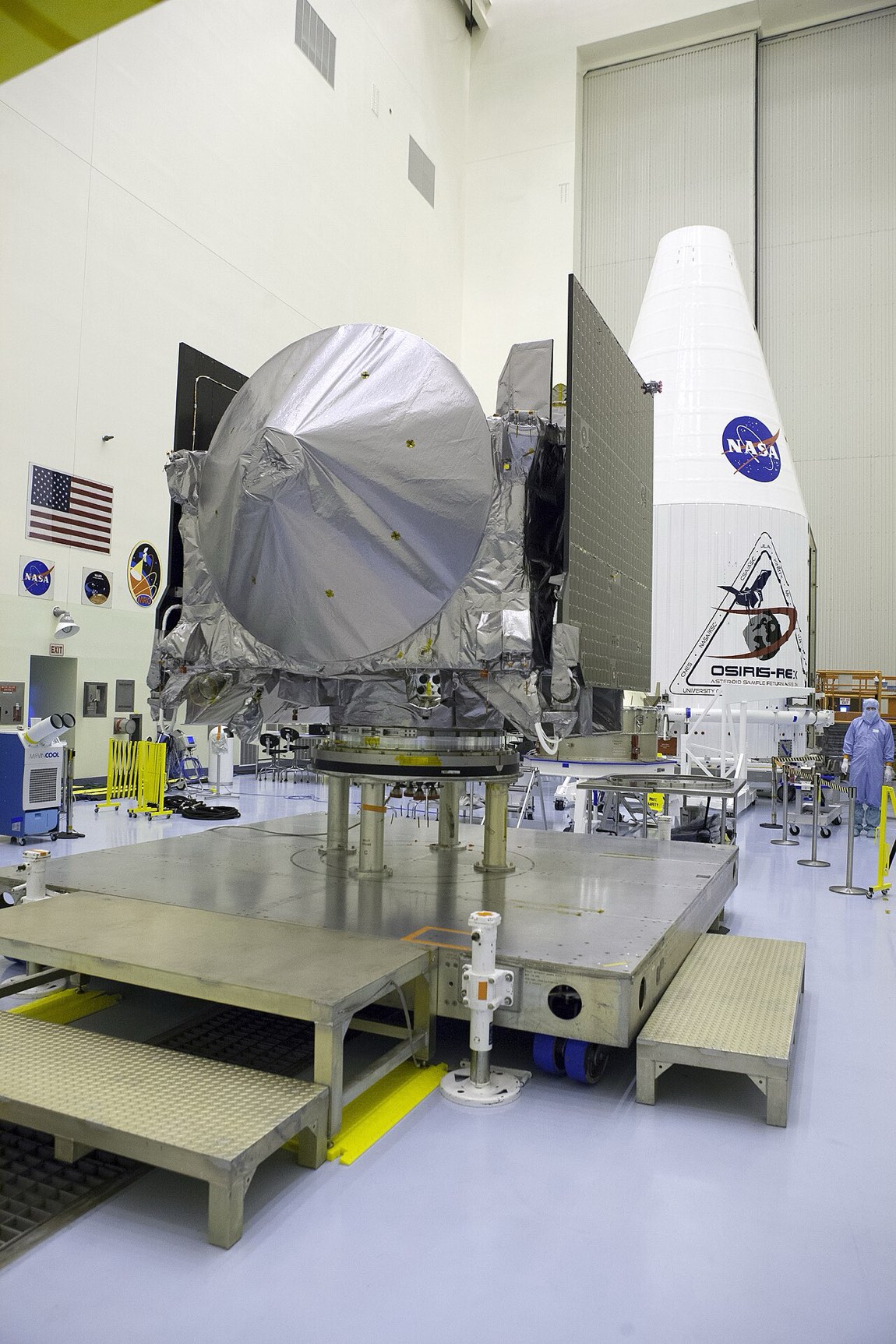
Rosetta answered many questions about comets while generating new ones that researchers expect to work through for decades. The abundance of free molecular oxygen around 67P — between 1 and 10 percent relative to water — was entirely unexpected and its origin remains debated. The re-analysis of water isotope ratios published in November 2024 rehabilitates comets as a plausible source of Earth's water, but the story is not closed: the corrected 67P data must now be reconciled with measurements from other comet families. The chirality puzzle — why life on Earth uses almost exclusively left-handed amino acids — could not be addressed because the only amino acid Rosetta found on 67P was the non-chiral glycine. Subsequent asteroid sample-return missions Hayabusa2 and OSIRIS-REx found racemic mixtures on Ryugu and Bennu, suggesting the selection of handedness happened on Earth rather than in space, but this remains an active research question. Philae's precise final location, only confirmed in September 2016 from late high-resolution Rosetta images, is now helping scientists reinterpret the two days of surface data the lander collected, work that continues as the full Rosetta dataset is mined by investigators around the world.
 ⤢
⤢