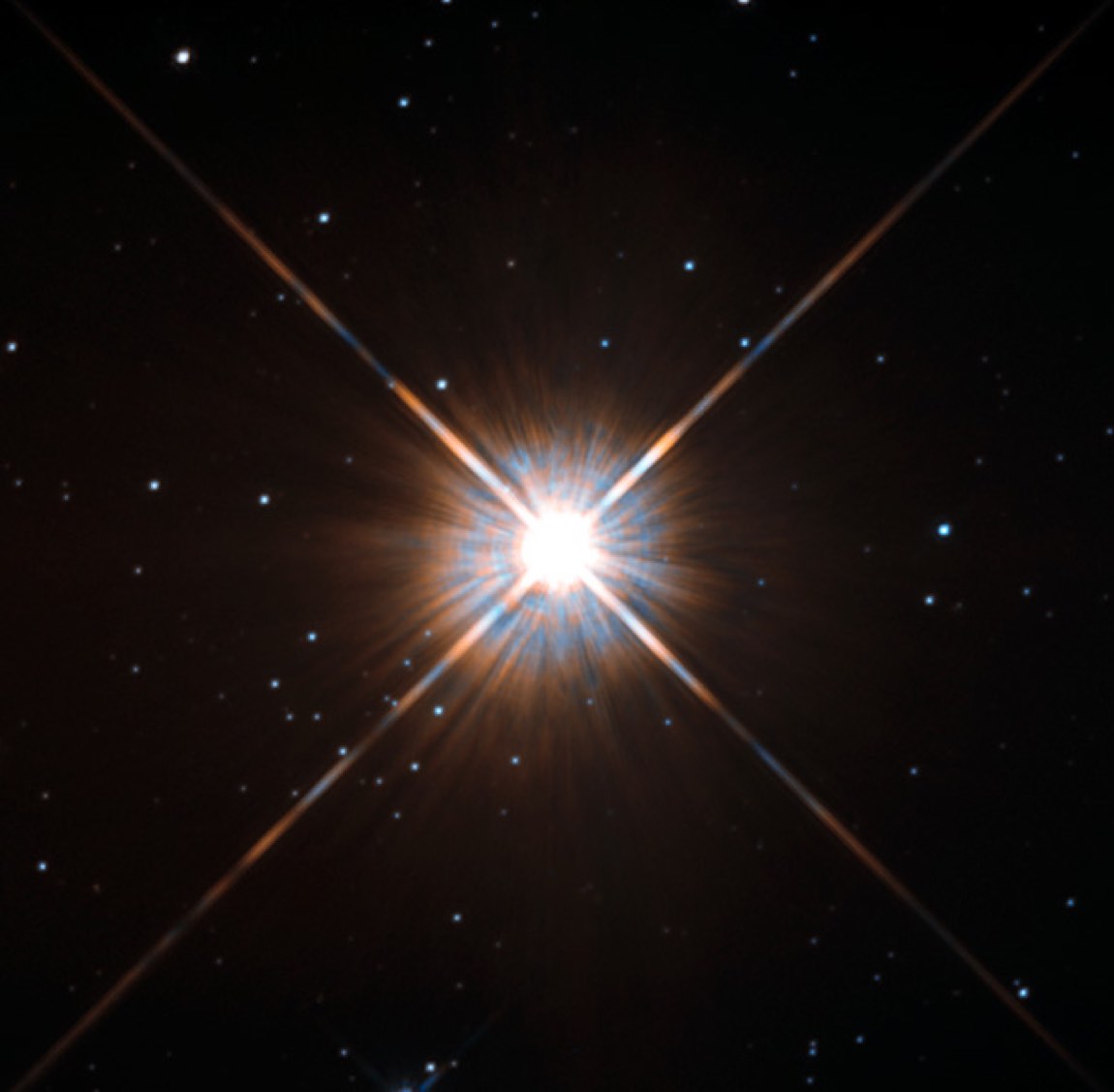
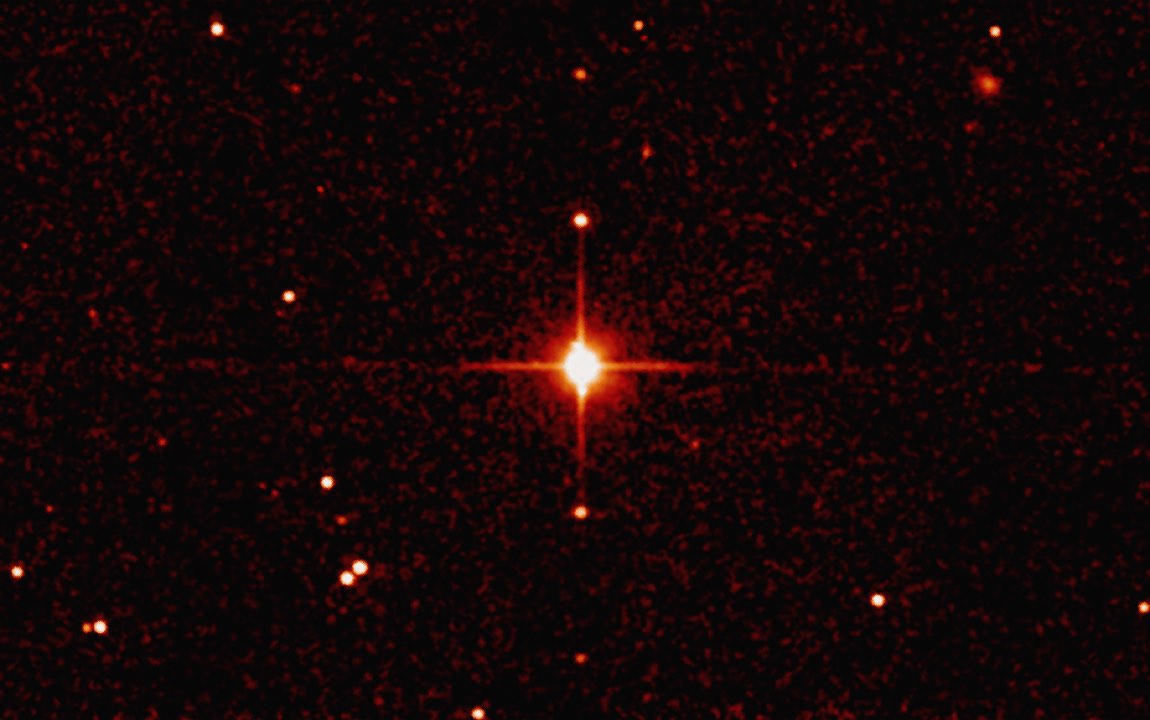
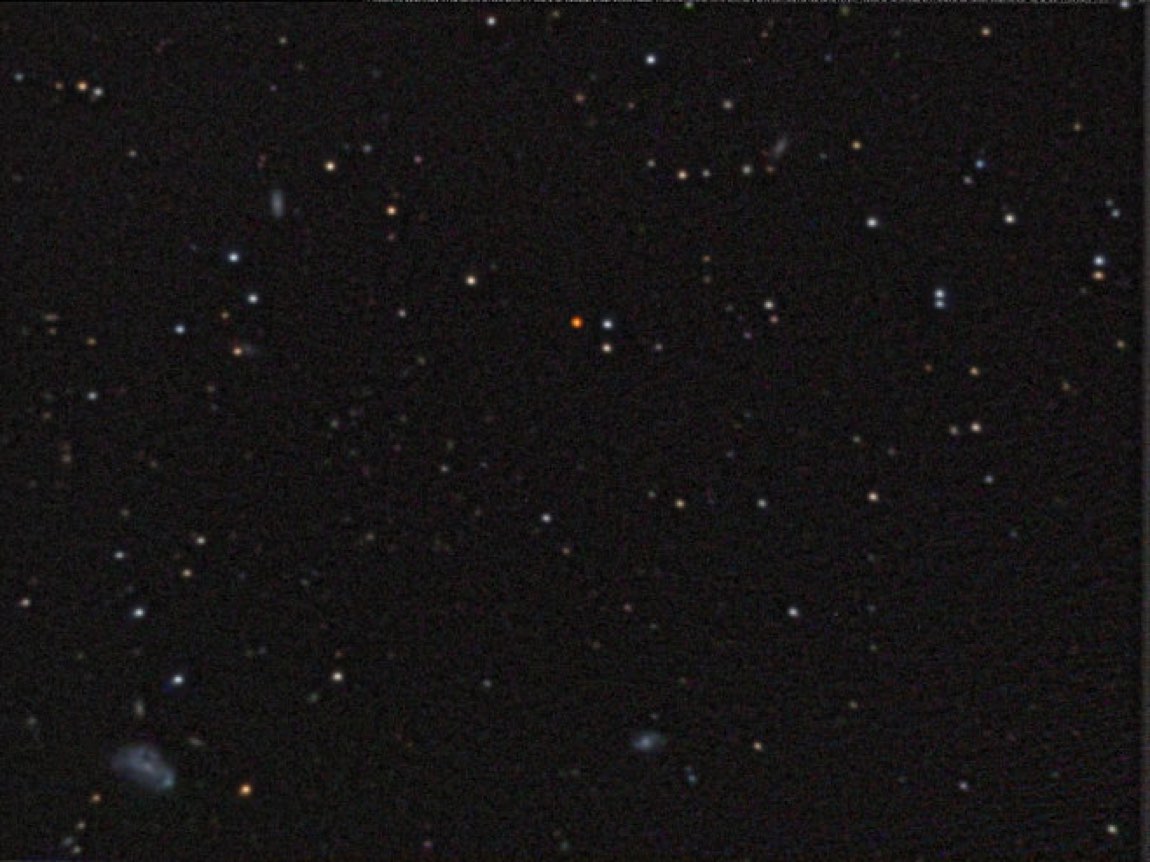
 Photograph · Klaus Hohmann, http://astrofotografie.hohmann-edv.de/ · Public domain
Star · Deep guide
Wolf 359
One of the faintest, smallest stars known, yet famous in two universes.
What is it?
Wolf 359 sits just 7.9 light-years away — the fifth-closest star system — yet shines at magnitude 13.5, ten thousand times too faint for naked eyes: a red dwarf barely massive enough to be a star at all, not much larger than Jupiter. It is a violent flare star despite its tiny size. Star Trek fans know it as the site of the Federation's darkest battle.
The deep dive
Researched for the Atlas from Wikipedia — Wolf 359 (11,165 characters read) · updated Sep 20, 2026
01 How Max Wolf put this star on the map
Wolf 359 owes its name to a patient German astronomer and a stack of photographic plates. Max Wolf measured the star's proper motion in 1917 using astrophotography, noticing that it was sliding across the sky at an unusually brisk pace relative to background stars. A high proper motion is a strong hint that a star is close, because nearby objects can cover the same angular distance with a lower actual speed. Wolf compiled his findings into a catalogue published in 1919, listing more than a thousand high-proper-motion stars. This particular one appeared as entry number 359, and astronomers have called it Wolf 359 ever since. The first distance measurement followed in 1928, when researchers at Mount Wilson Observatory reported a parallax shift of 0.407 ± 0.009 arcseconds per year — a tiny wobble in the star's apparent position caused by Earth's annual orbit around the Sun, from which its distance of roughly 7.86 light-years could be calculated. At that point Wolf 359 held the record as the faintest and least-massive star known, a title it kept until VB 10 was discovered in 1944.
02 A star barely larger than Jupiter
Wolf 359 sits right at the edge of what it means to be a star at all. Its mass is estimated at just 11% of the Sun's mass, placing it barely above the roughly 8% solar-mass threshold below which hydrogen fusion cannot ignite in a core — objects below that line are brown dwarfs rather than stars. Its radius is equally humbling: an estimated 14.4% of the Sun's, working out to about 100,200 km. For perspective, Jupiter's equatorial radius is 71,490 km, meaning Wolf 359 is only about 40% wider than the solar system's largest planet. Its luminosity matches its modest dimensions: the star emits only about 0.1% of the Sun's total power output. If you somehow relocated Wolf 359 to the Sun's position, it would shine in Earth's sky at roughly ten times the brightness of a full Moon — dazzling compared with a point of light but feeble compared with daylight. In spite of all this, Wolf 359 is a genuine hydrogen-fusing star, steadily converting protons into helium deep in its core through the proton–proton chain reaction.
03 Why this star will outlive the Sun by trillions of years Deeper
The interior of Wolf 359 works very differently from the Sun's, and that difference has a staggering consequence for its lifespan. The entire star undergoes convection: plasma heated at the core rises, cools, and sinks back in a continuous loop that stirs the interior from center to surface. In the Sun, by contrast, the outer layers are convective but the core region is not, so helium produced by fusion gradually piles up there and cannot escape. That helium accumulation will eventually end the Sun's main-sequence life in roughly five billion years. In Wolf 359 the convective churning constantly dilutes any helium build-up, recycling fresh hydrogen throughout the star. Combined with a much lower rate of hydrogen consumption — a consequence of its low mass and cool core — this gives Wolf 359 an extraordinary fuel efficiency. Models estimate it will continue fusing hydrogen for approximately eight trillion years before exhausting its supply. The Sun's total main-sequence lifespan is around ten billion years by comparison, making Wolf 359 roughly eight hundred times more long-lived. When its hydrogen is finally gone, the expected end state is a helium white dwarf, not the dramatic fate awaiting heavier stars.
04 A photosphere cool enough for chemistry Deeper
The light-emitting surface of Wolf 359, its photosphere, has a temperature estimated to range between 2,500 K and 2,900 K depending on the measurement method used. That range is cool enough — by stellar standards — for genuine chemical compounds to form and persist rather than being torn apart by heat. The star's spectrum accordingly shows a rich collection of molecular absorption bands: water (H₂O), carbon monoxide (CO), titanium(II) oxide (TiO), vanadium(II) oxide (VO), iron hydride (FeH), chromium hydride (CrH), magnesium hydride (MgH), and possibly the molecule CaOH. Many of these same compounds appear in the atmospheres of giant planets and cool brown dwarfs, making Wolf 359's photosphere chemically more akin to a planetary atmosphere than to the simple hydrogen-and-helium plasma of hotter stars like the Sun. One notable absence in the spectrum is lithium: because no lithium absorption lines appear, astronomers conclude that the star has already burned through its lithium supply via core fusion, establishing that Wolf 359 must be at least 100 million years old — though other evidence points toward an age of less than one billion years.
05 Flares, X-rays, and a ferocious magnetic field
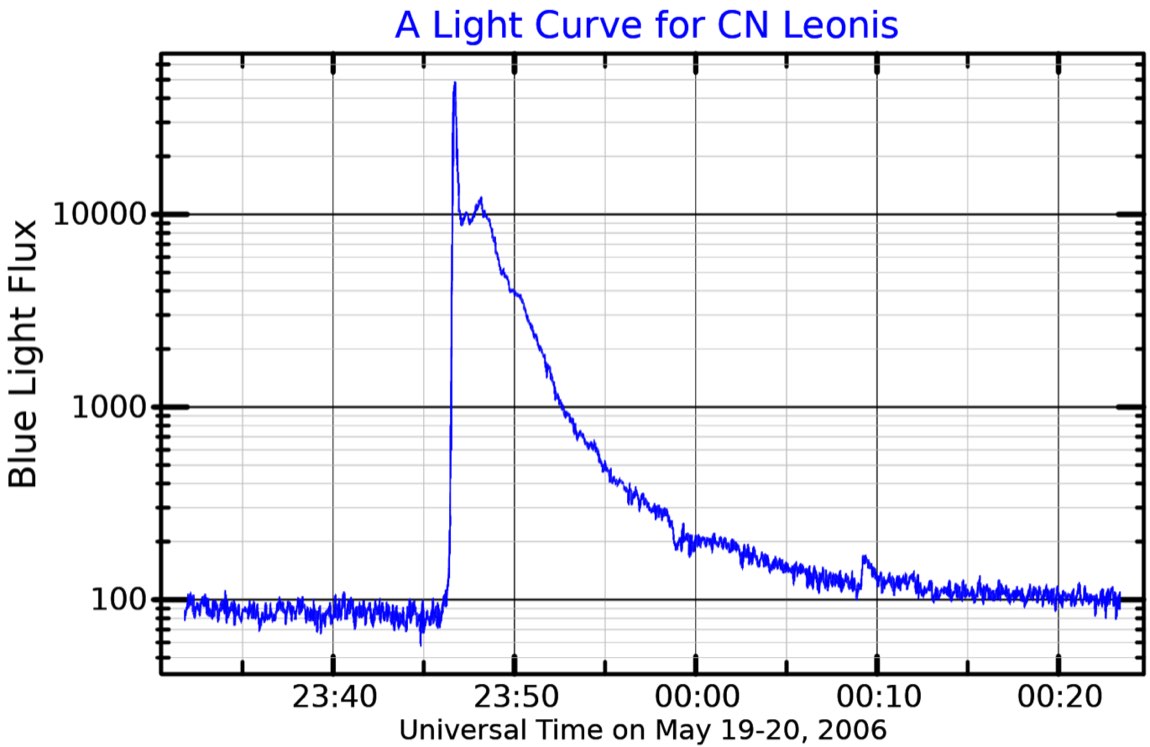
Wolf 359 carries a mean surface magnetic field of around 2.2 kG, or 0.22 teslas — hundreds of times stronger than the Sun's average field of just 1 gauss (100 μT), though the Sun can reach up to 3 kG in active sunspot regions. That intense magnetism is generated by the star's thorough convection, which churns its plasma continuously and acts like a powerful dynamo. The result is a highly active flare star, designated CN Leonis in the variable-star catalogue and classified as UV Ceti type. Hubble Space Telescope observations detected 32 separate flare events within a single two-hour observation window, with energies of 10²⁷ ergs (10²⁰ joules) and higher. These flares produce sudden, dramatic spikes in brightness and release strong bursts of X-ray and gamma-ray radiation detectable by space telescopes. The magnetic field's strength is not stable: it can vary significantly on timescales as short as six hours. The connection between Wolf 359's flare behavior and its variable star nature was first established in 1969, when astronomers observed a brief luminosity outburst that matched the defining characteristics of flare stars.
06 The first star with a coronal spectrum from the ground Deeper
Beyond the photosphere, every star possesses a corona: a tenuous, superheated halo of plasma that can reach temperatures of millions of degrees even though the photosphere below it is far cooler — a long-standing puzzle in solar physics. For decades, studying stellar coronae required space-based instruments. In 2001, Wolf 359 became the first star other than the Sun to have its coronal spectrum captured by a ground-based telescope, a landmark achievement in observational astronomy. The spectrum revealed emission lines of Fe XIII, meaning iron atoms that have been stripped of twelve of their twenty-six electrons — a process requiring an extreme temperature environment. The intensity of this Fe XIII line was found to vary over periods of just a few hours, which researchers interpreted as possible evidence of microflare heating: a process in which numerous small, rapid energy releases sustain the corona's extreme temperature rather than a single continuous heat source. This finding made Wolf 359 a scientifically valuable laboratory for understanding the relationship between magnetic activity, flaring, and coronal heating in low-mass stars.
07 How Wolf 359 moves through the galaxy Deeper
Wolf 359 races across the sky at a proper motion of 4.696 arcseconds per year, and it is also moving away from the Sun at roughly 19 km/s. Translating its total motion into the galactic coordinate system gives a space velocity of (U, V, W) = (−26, −44, −18) km/s, a pattern that places it among the population of old-disk stars in the Milky Way. Its orbit around the galactic center is mildly elliptical, with an eccentricity of 0.156, carrying it as close as 20,500 light-years (6.3 kpc) and as far as 28,000 light-years (8.6 kpc) from the galactic center. The star also wanders up to 444 light-years (136 pc) above or below the galactic plane. Wolf 359's closest stellar neighbor is the red dwarf Ross 128, which sits 3.79 light-years (1.16 pc) away. The star reached its closest historical approach to our own Sun approximately 13,850 years ago, when the two were separated by about 7.35 light-years (2.25 pc). Since that moment of minimum distance, Wolf 359 has been steadily receding.
08 Rotation, stellar wind, and slowing down Deeper
Measuring a star's rotation speed relies on the Doppler broadening of its spectral lines: faster rotation spreads those lines wider. For Wolf 359, the projected equatorial rotational velocity is less than 3 km/s, which falls below the detection threshold of the spectral line broadening method, making it one of the slower-spinning stars of its type. The leading explanation is angular momentum loss driven by its stellar wind. During flare events, the wind intensifies dramatically, carrying angular momentum away from the star and gradually applying the brakes. Fully convective stars like Wolf 359 are thought to shed rotational speed more slowly than partially convective stars, with a spin-down timescale for a spectral class M6 star estimated at roughly 10 billion years. This creates an apparent paradox: if Wolf 359 is already rotating this slowly, and spin-down is gradual, its youth — estimated at under one billion years — might seem surprising. Evolutionary models reconcile this by suggesting the star may have formed with a relatively low initial rotation rate, though the question of its exact rotational history remains an active area of interpretation.
09 The planet search: candidates, false positives, and limits
Finding planets around Wolf 359 has proven genuinely difficult. Radial velocity observations taken in 2011 with the NIRSPEC instrument at the Keck II observatory found no detectable gravitational tug from any companion, setting an upper limit sensitive enough that any Neptune-mass or larger object in a short-period orbit should have been detectable. In June 2019, a team led by Mikko Tuomi of the University of Hertfordshire reported a preprint describing two candidate exoplanets detected by HARPS in Chile and HIRES in Hawaii. Subsequent observations by the CARMENES survey showed that the inner candidate, Wolf 359 c, was a false positive: its radial velocity signal was produced by the star's own rotation rather than an orbiting body. The outer candidate, Wolf 359 b, described as a cool super-Neptune receiving roughly a quarter to a third of the energy per unit area that Neptune receives from the Sun, remains unconfirmed. A comprehensive 2023 study using MAROON-X, CARMENES, HARPS, and HIRES data plus imaging could neither confirm nor rule out Wolf 359 b, while definitively excluding brown dwarfs or massive gas giants within 10 AU, planets more than half Jupiter's mass within 1 AU, and planets more massive than Uranus within 0.1 AU.
10 How to observe Wolf 359 from Earth
Despite being one of the Sun's nearest neighbors, Wolf 359 is completely invisible to the naked eye and challenging even with modest equipment. Its apparent magnitude is 13.54, which is more than sixty times fainter than the dimmest stars a person with excellent vision can see under a perfectly dark sky, and roughly forty times fainter than Pluto at its brightest. Seeing it requires a large amateur or professional telescope under good conditions. The star sits in the constellation Leo, positioned near the ecliptic — the apparent path the Sun, Moon, and planets trace across the sky — which means that when Leo is well placed in the spring sky, Wolf 359 occupies roughly that region too. Its high proper motion of 4.696 arcseconds per year, while imperceptible in a single viewing session, means that over decades it noticeably shifts position relative to background stars, a property historically useful for identifying it and one that originally drew Max Wolf's attention over a century ago.
11 Wolf 359 in fiction and popular culture
For a dim, unremarkable red dwarf, Wolf 359 has had an outsized cultural footprint, largely because its status as one of the Sun's nearest neighbors made it an attractive destination for science fiction writers seeking a plausible nearby star. The star's name appeared in an episode of the original Outer Limits television series, which first aired on 7 November 1964 during the show's second season. It gained far wider recognition through Star Trek, where the Battle of Wolf 359 became one of the franchise's defining dramatic moments — a catastrophic conflict named for the star's real-world location. That fictional battle has given the name a lasting resonance with generations of fans who may not know the star's astronomical properties. More recently, a podcast called Wolf 359 uses a space station orbiting the star as its primary setting, demonstrating continued creative interest in the system. The star's proximity to Earth, just 7.86 light-years away, makes it a natural anchor point for stories exploring humanity's nearest possible interstellar neighborhood.
 ⤢
⤢