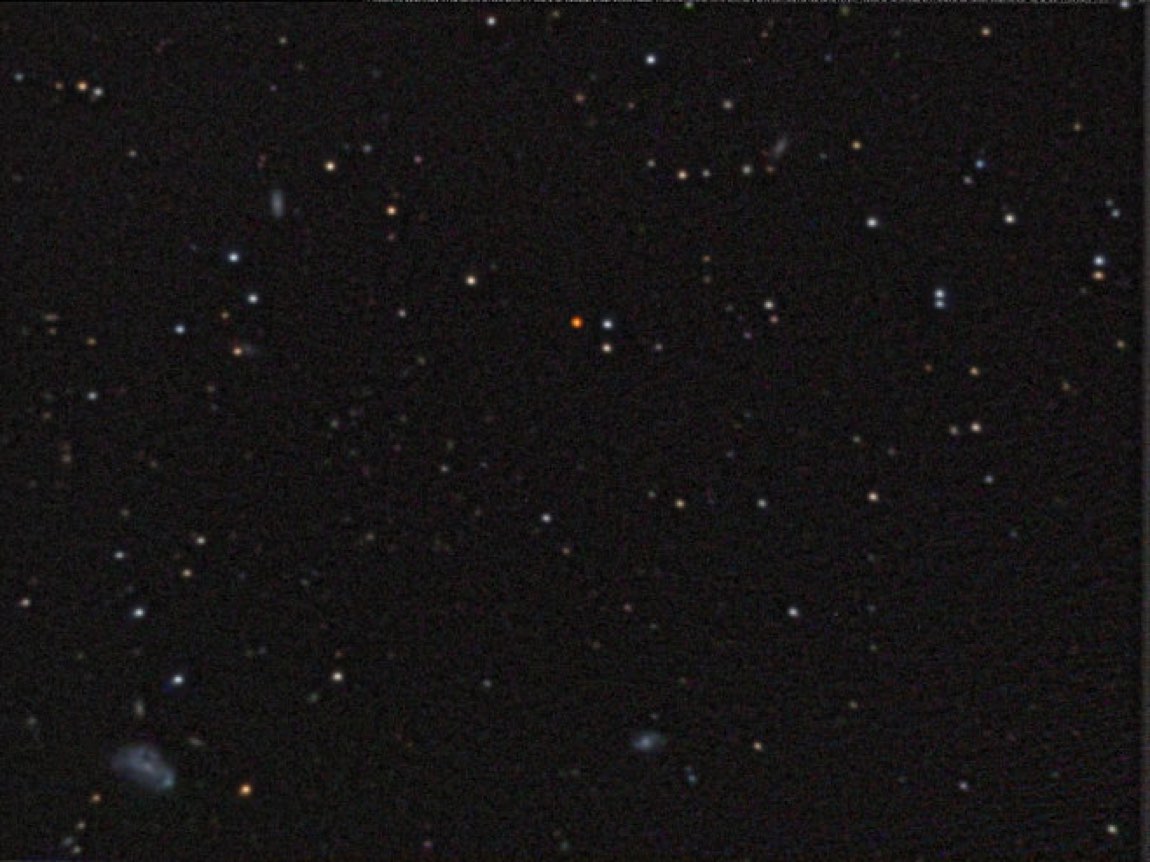
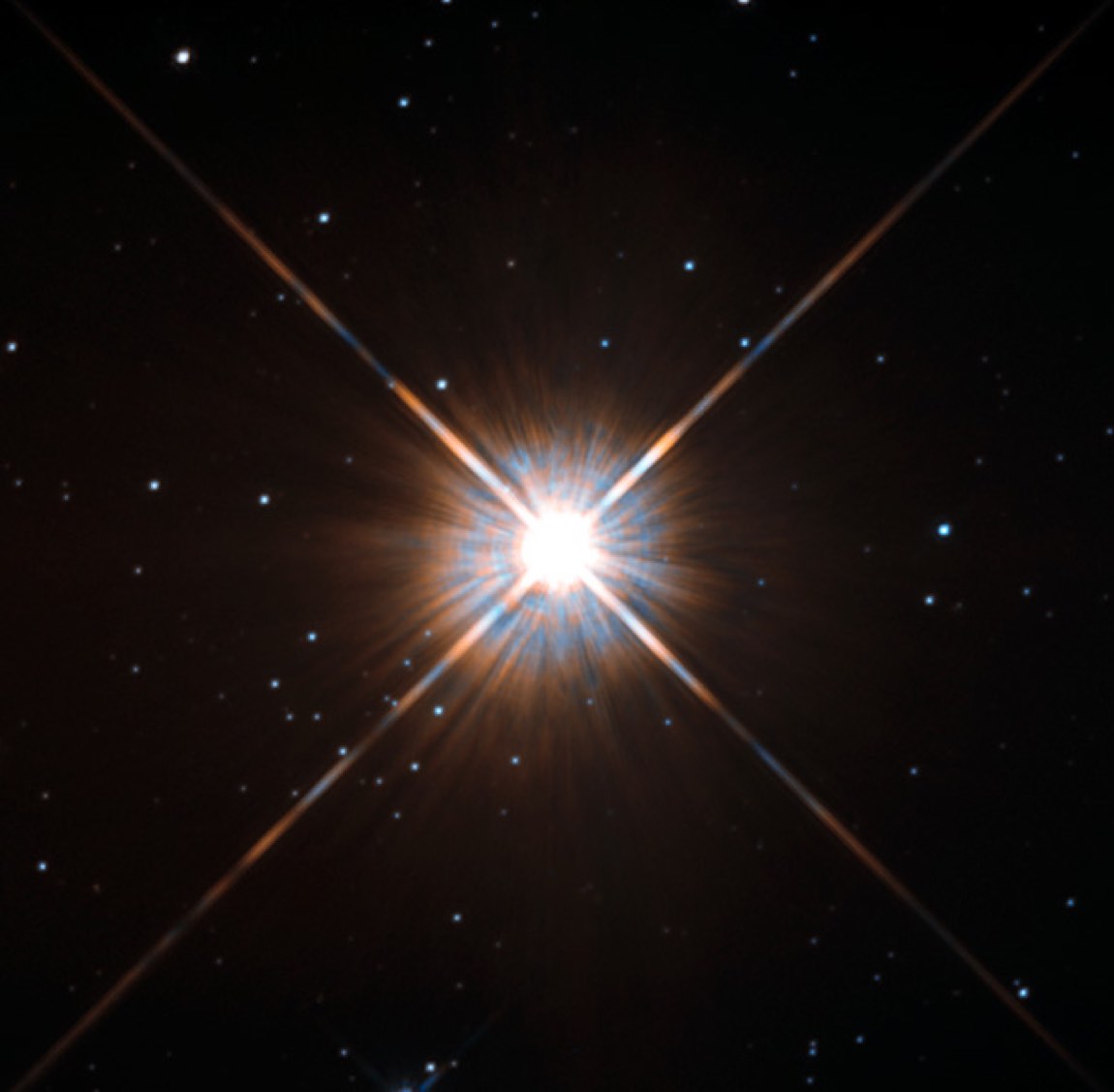
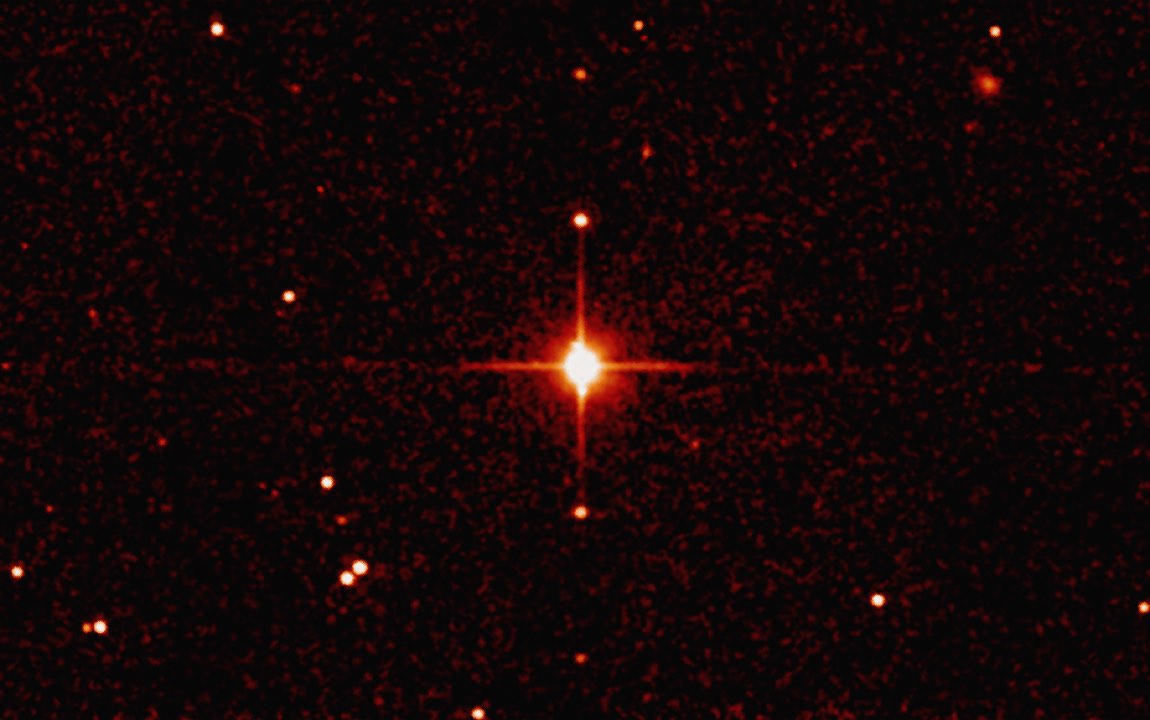
 Photograph · Wikimedia Commons · Public domain
Star · Deep guide
Luyten 726-8 (UV Ceti)
These twin red dwarfs, the original flare stars, erupt without warning.
What is it?
Luyten 726-8, 8.7 light-years away, is a pair of dim red dwarfs whose junior member, UV Ceti, gave its name to an entire class of variable stars. These little suns can brighten severalfold in minutes as magnetic eruptions dwarf anything our Sun produces — a sobering benchmark for anyone hoping red-dwarf planets keep their atmospheres.
The deep dive
Researched for the Atlas from Wikipedia — Gliese 65 (3,266 characters read) · updated Sep 20, 2026
01 How Willem Luyten Found This System
The Gliese 65 system was discovered in 1948 by Dutch-American astronomer Willem Jacob Luyten, who was systematically combing the sky for stars with unusually high proper motion — the apparent drift of a star across the celestial background over time. What caught his attention was an exceptionally large annual proper motion of 3.37 arc seconds per year. That might sound tiny, but it is enormous by stellar standards; most stars crawl far more slowly across the sky over a human lifetime. Luyten cataloged the object as Luyten 726-8, and that catalog designation stuck alongside the Gliese 65 label it later received. The discovery came not from a dramatic single observation but from the painstaking comparison of photographic plates taken years apart — a method Luyten pioneered and pursued across decades. The high proper motion itself was a strong clue that the system was nearby, since close objects appear to move faster against the distant stellar background, much like how a nearby tree flickers past a car window faster than a distant mountain.
02 A True Binary: Two Stars Locked Together
Gliese 65 is not a single star but a gravitationally bound pair. The two red dwarfs orbit their common center of mass once every 26.5 years — about one human generation. Their separation is not fixed; because the orbit is elliptical, the distance between them ranges from as close as 2.1 astronomical units to as far as 8.8 astronomical units (roughly 310 to 1,320 gigameters). To put that in perspective, 2.1 AU is slightly larger than the average distance between the Sun and Mars, while 8.8 AU is close to Saturn's average distance from the Sun. The two stars are nearly equal in brightness: BL Ceti has a visual magnitude of 12.7 and UV Ceti a magnitude of 13.2 as seen from Earth. Neither is visible to the naked eye. Both are listed as spectral standard stars — meaning astronomers regard them as definitive, textbook examples of their respective spectral classes, M5.5V and M6V.
03 UV Ceti: The Star That Defines a Class
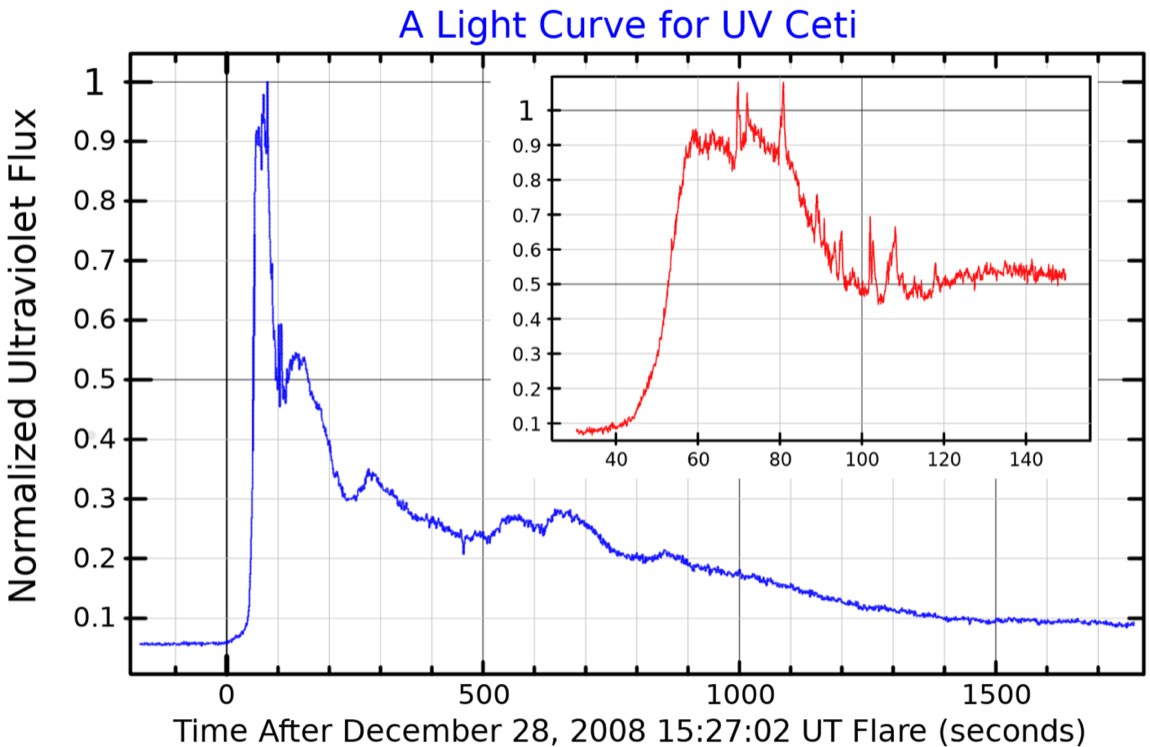
Although UV Ceti was not the very first flare star ever discovered, it is so dramatically active that the entire category of similar stars is now named after it: UV Ceti type variables. The naming reflects just how extreme this star's behavior is. In 1952, astronomers recorded UV Ceti brightening by a factor of 75 in only 20 seconds — an explosive release of energy on a timescale shorter than a typical television commercial break. Flare stars are red dwarfs whose magnetic activity drives sudden, violent eruptions on their surfaces, analogous to solar flares on our own Sun but far more powerful relative to the star's baseline luminosity. UV Ceti is classified spectral type M6V, meaning it is a cool, low-mass red dwarf. Its companion, BL Ceti (spectral type M5.5V), is also a flare star and also a UV Ceti type variable, but the article notes it is not nearly as remarkable or extreme in its behavior as UV Ceti itself.
04 The System's Place Among Nearby Stars
Gliese 65 sits 2.63 parsecs — about 8.58 light-years — from the Solar System, making it the seventh-closest star system to Earth. Its host constellation is Cetus, the whale or sea monster of ancient sky mythology. Interestingly, Gliese 65's own nearest stellar neighbor is not the Sun but Tau Ceti, which lies only 0.98 parsecs (3.20 light-years) away from it. That makes Tau Ceti and Gliese 65 relatively close companions in the local stellar neighborhood, even though both are among Earth's nearest neighbors as well. The system is close enough that its distance has been measured precisely, and its high proper motion means its position on the sky shifts noticeably over decades — a useful property for astronomers tracking it over time. This combination of proximity and measurable motion has made Gliese 65 a recurring target for parallax studies and astrometric monitoring.
05 A Past and Future of Close Encounters Deeper
The Gliese 65 system has not always been at its current distance from the Sun, and the article supplies some striking numbers about its orbital history and future. Approximately 28,700 years ago, assuming a radial velocity of +29 km/s, Gliese 65 reached its closest historical approach to the Sun at a minimum distance of 2.21 parsecs (7.2 light-years) — somewhat closer than today's 2.63 parsecs. Looking forward, in approximately 31,500 years the system will have a close encounter with Epsilon Eridani, passing within a minimum distance of about 0.93 light-years. That is close enough that Gliese 65 could penetrate a conjectured Oort cloud surrounding Epsilon Eridani, potentially gravitationally perturbing long-period comets in that cloud. The two star systems are estimated to remain within 1 light-year of each other for about 4,600 years during this passage — a fleeting cosmic moment by astronomical standards, but still longer than all of recorded human history several times over. Gliese 65 is also noted as a possible member of the Hyades Stream, a moving group of stars sharing a common origin and velocity through the galaxy.
06 Hunting for Planets with Extreme Precision Deeper
In 2024, astronomers reported the detection of a candidate planet in the Gliese 65 system using the astrometry technique with the GRAVITY instrument on the Very Large Telescope. Astrometry detects planets by measuring the tiny wobble a planet induces in its host star's position on the sky — an extremely demanding measurement requiring extraordinary precision. The candidate world is estimated to have a mass of about 40 Earth masses, placing it in the super-Neptune category — larger than Neptune but smaller than Saturn. Its orbital period would be 156 days. Based on mass-radius relationships, it is estimated to be roughly seven times the physical size of Earth. One unresolved uncertainty is which of the two stars the planet orbits; the article notes this is currently unclear, and the planet's exact properties shift slightly depending on the answer. A semi-major axis of about 30% of an astronomical unit — roughly 45 million kilometers — places it close to whichever parent star it circles.
07 What a Super-Neptune Here Would Be Like
The candidate planet detected in 2024 belongs to a class sometimes called super-Neptunes: worlds more massive than Neptune (which is about 17 Earth masses) but not quite reaching the gas giant heft of Saturn or Jupiter. At an estimated 40 Earth masses, this world would be a substantial planet — more than twice Neptune's mass. Its estimated size of about seven Earth radii gives it a diameter in the range of a large ice giant or a small gas giant. Orbiting at roughly 30% of an AU, it sits well inside what would be the habitable zone of a Sun-like star, but around two dim red dwarfs its energy environment would be very different. It is worth noting that the detection is still described as a candidate planet rather than a confirmed one, reflecting the difficulty of astrometric planet detection and the need for follow-up observations before the result can be considered established.
08 Spectral Standards: Textbook Stars in the Sky Deeper
One underappreciated distinction of both BL Ceti and UV Ceti is that they are listed as spectral standard stars for their respective classes. In stellar astronomy, a spectral standard is a star whose spectrum is considered so cleanly representative of its classification that it serves as a reference against which other stars are compared. BL Ceti is the standard for spectral type M5.5V, and UV Ceti is the standard for M6V. These are late-type M dwarf classifications, meaning both stars are among the cooler, redder, and lower-mass end of the red dwarf family. The designation carries real practical weight: when astronomers debate whether another star belongs to a particular spectral class, they may refer back to the spectra of BL Ceti or UV Ceti as anchors. It is somewhat ironic that UV Ceti, whose defining characteristic is extreme and unpredictable flaring behavior, is simultaneously a standard reference for the quiet baseline properties of its spectral class.
09 Observing Gliese 65 from Your Backyard
Gliese 65 is found in the constellation Cetus, which is visible from most of Earth's inhabited latitudes during autumn and early winter evenings in the Northern Hemisphere. The two component stars have visual magnitudes of 12.7 and 13.2 — both far below the naked-eye limit of about magnitude 6. A moderate amateur telescope under dark skies can reach magnitude 12 to 13 with patience, but detecting this particular pair also requires knowing exactly where to look. What makes observing Gliese 65 especially compelling for dedicated amateurs is the chance of witnessing a UV Ceti type flare. When a major flare occurs, the system's total brightness can surge dramatically in seconds — the 1952 event that brightened it 75-fold is the most famous example. Such flares are unpredictable, requiring patient monitoring rather than a single planned observation. The system's high proper motion of 3.37 arc seconds per year means its position shifts noticeably relative to background stars over the span of years, something that can be tracked with careful long-term imaging.
10 The Hyades Stream Connection Deeper
The article notes that Gliese 65 is a possible member of the Hyades Stream, also called the Hyades moving group. This is a collection of stars that share similar velocities through the Milky Way, suggesting they may have formed in the same stellar nursery as the Hyades open cluster — one of the closest clusters to Earth, located in Taurus. Stars in a moving group are not necessarily close to each other in space today; they can be scattered across hundreds of light-years while still traveling in roughly the same direction at roughly the same speed, like passengers from the same origin city dispersed across a highway. Membership in the Hyades Stream would give Gliese 65 an approximate age consistent with the cluster, though the article does not state an age figure explicitly. The word "possible" reflects genuine uncertainty: membership criteria for moving groups can be debated, and Gliese 65's status has not been definitively confirmed as of the information in the article.
 ⤢
⤢