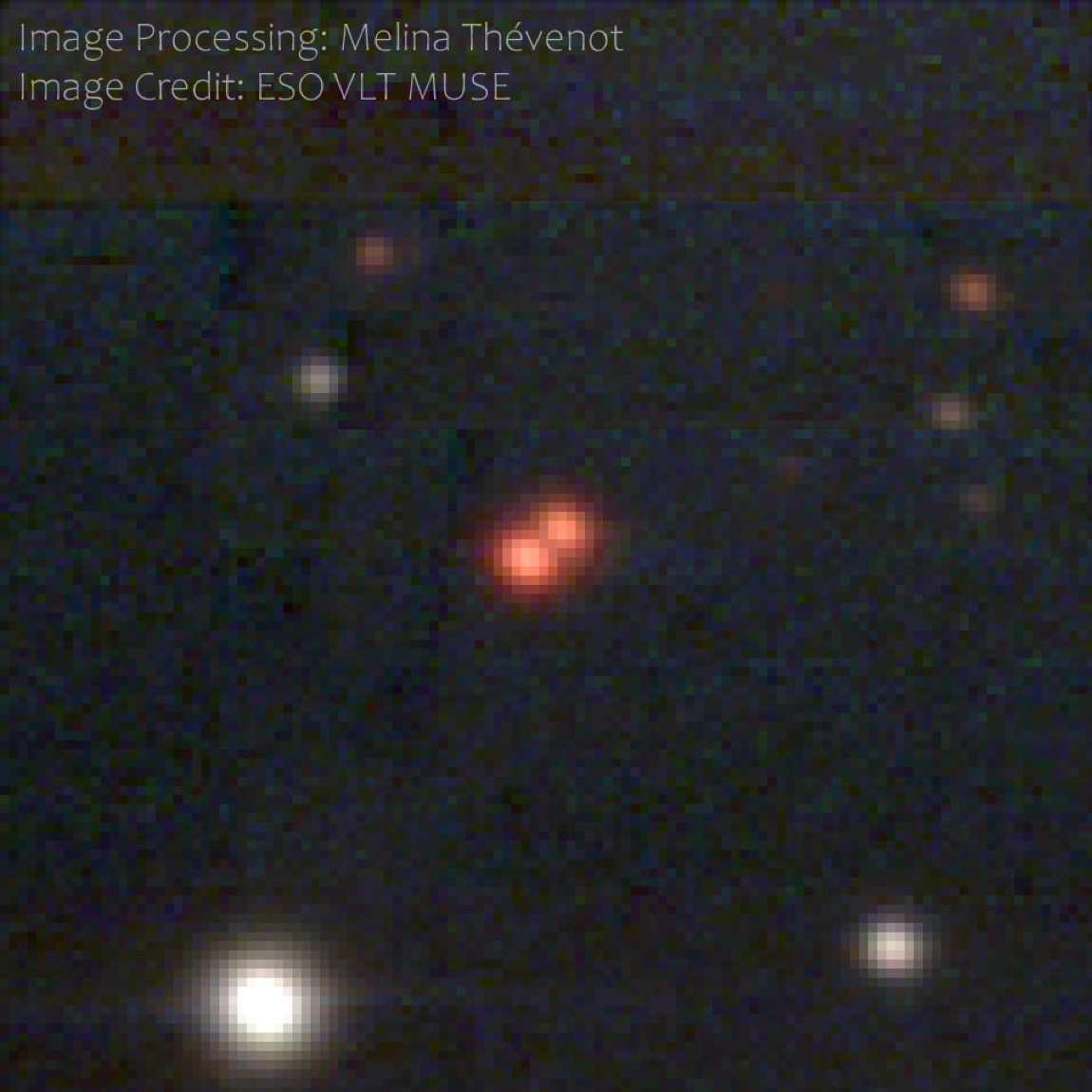
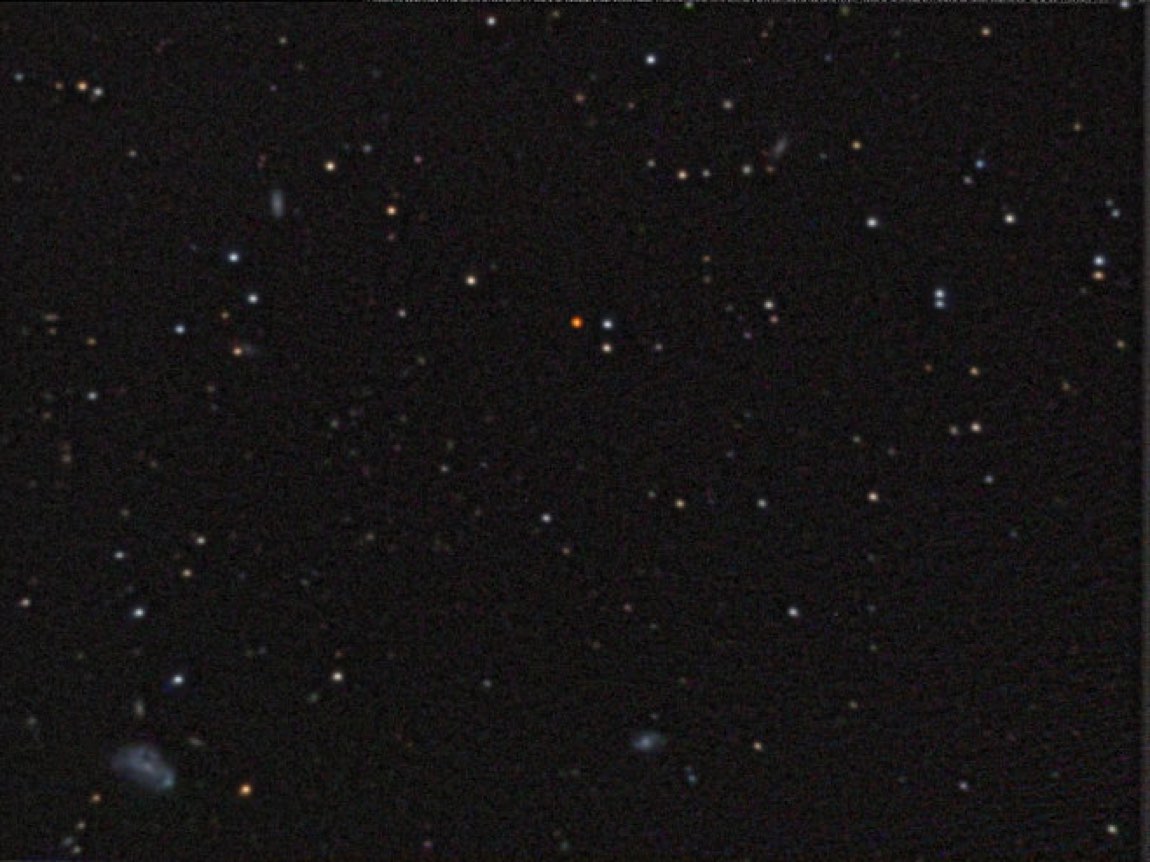
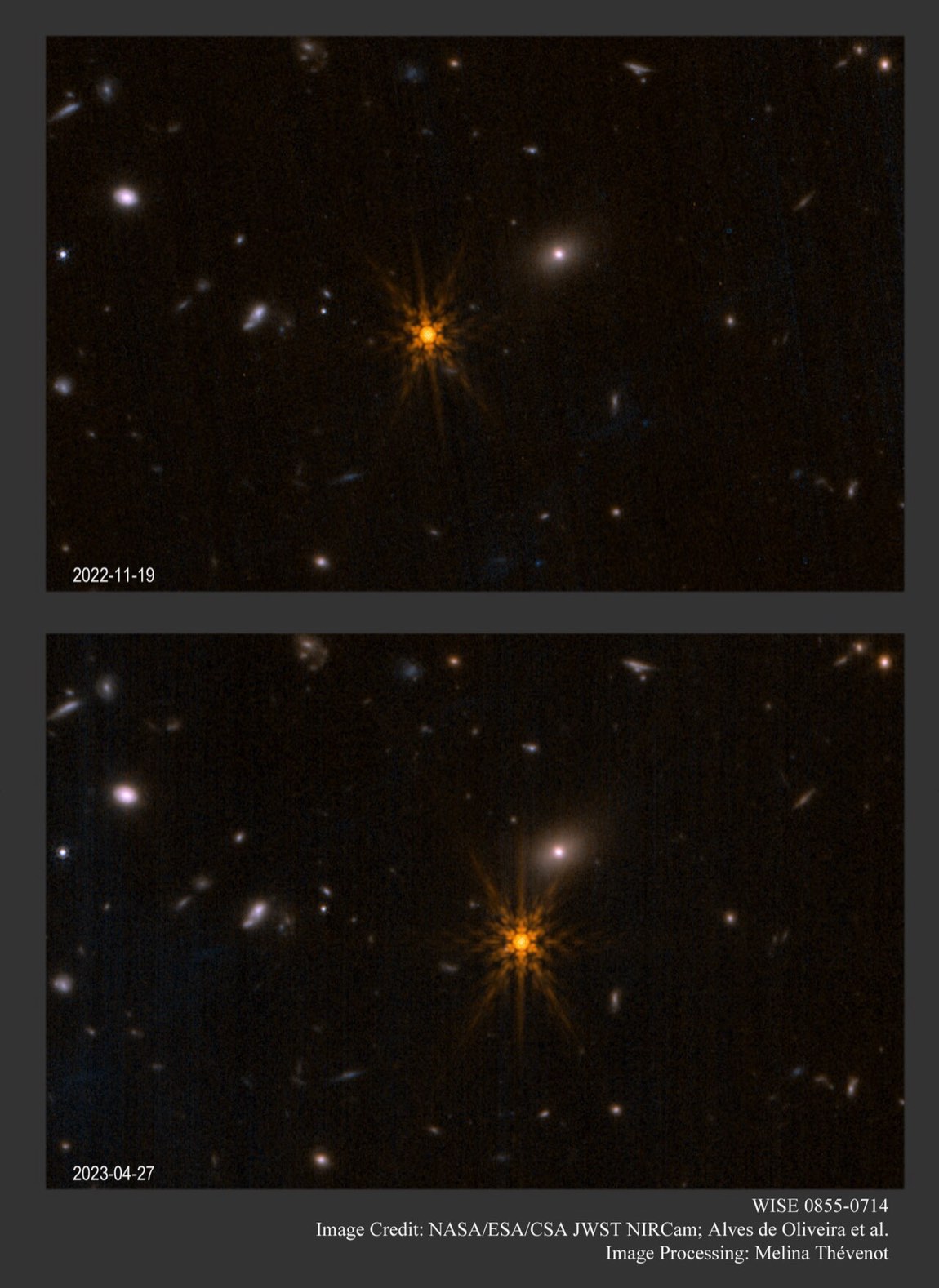
 Photograph · NASA/ESA/CSA JWST NIRCam; Alves de Oliveira et al. & Melina Thévenot · CC BY-SA 4.0
Star · Deep guide
WISE 0855
The coldest known world-like object outside a solar system is below freezing, and glowing.
What is it?
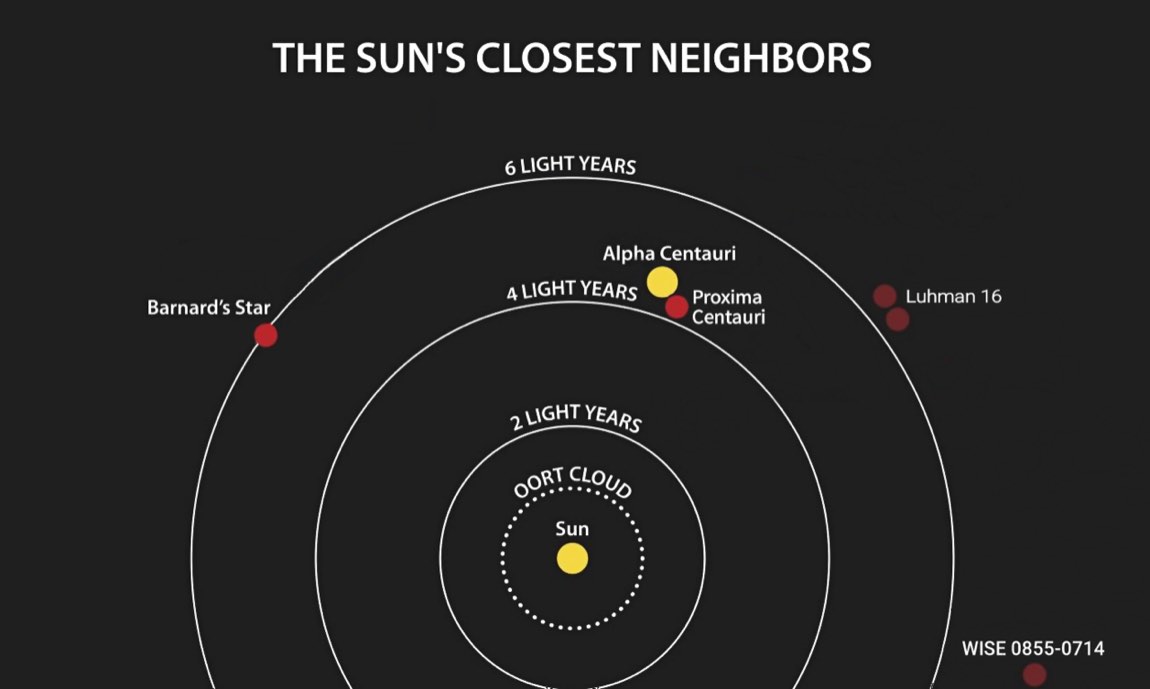
WISE 0855−0714, 7.4 light-years away, is the coldest free-floating object of its kind found: a sub-brown dwarf with cloud tops around −20 °C, colder than a winter day — yet it formed like a star. Only the WISE infrared telescope could spot something this dim; evidence even hints at water-ice clouds. It blurs the line between star and rogue planet.
The deep dive
Researched for the Atlas from Wikipedia — WISE 0855−0714 (9,332 characters read) · updated Sep 20, 2026
01 How Kevin Luhman spotted a cold neighbor
WISE 0855 was first imaged on 4 May 2010 by the Wide-field Infrared Survey Explorer during its primary all-sky survey mission, but it sat unnoticed in the data for nearly three years. The breakthrough came in March 2013 when astronomer Kevin Luhman was searching WISE images for potential binary companions of the Sun and noticed that this particular dot was moving across the sky at an unusually high rate. That large proper motion was the immediate tip-off that something very nearby was lurking in the data. To confirm the object's distance and spectral character, Luhman arranged follow-up observations with both the Spitzer Space Telescope and the Gemini North telescope throughout 2013 and into 2014. NASA made an official public announcement of the discovery in April 2014. The story is a reminder that major discoveries sometimes come not from a dedicated targeted search but from patient, methodical combing through archival survey data — the kind of work that turns a telescope's vast image library into a map of the solar neighborhood.
02 Racing across the sky: its extraordinary proper motion
One of the most striking numbers attached to WISE 0855 is its proper motion: 8,151.6 ± 1.8 milliarcseconds per year. That figure places it third on the all-time list of fastest-moving objects in the sky, behind only Barnard's Star at 10,300 mas/yr and Kapteyn's Star at 8,600 mas/yr. To put the motion in context, the full Moon spans about 1,800,000 milliarcseconds across, so WISE 0855 creeps roughly one Moon-width every 220 years — glacial by human standards, but remarkable in astronomy. Its parallax of 439.0 ± 2.4 mas pins its distance at 2.28 ± 0.01 parsecs, or 7.43 ± 0.04 light-years, making it the fourth-closest stellar or substellar system to the Sun. Both the large parallax and the large proper motion are geometric consequences of genuine physical closeness: the object is simply very near, so small real-space velocities translate into large apparent angular shifts when observed from Earth.
03 A disputed identity: brown dwarf or rogue planet? Deeper
What exactly WISE 0855 is depends partly on which definition you use. As of 2003, the International Astronomical Union reserves the label 'brown dwarf' for free-floating objects capable of fusing deuterium, which requires a mass above roughly 13 Jupiter masses. WISE 0855 falls well short of that threshold: evolutionary models constrain its mass to between 3 and 10 Jupiter masses, and a 2024 study derived even lower values of 3.44 and 4.33 Jupiter masses from surface gravity measurements of 10^3.93 and 10^4.04 cgs, combined with an assumed radius of one Jupiter radius. Under the strict IAU criterion it should be called a free-floating planetary-mass object rather than a brown dwarf, yet the scientific literature widely continues to call it a brown dwarf. There is a third framing: if classification rests on how an object formed rather than what it can fuse, it could be considered a 'failed star' — a possibility also raised for the object Cha 110913-773444. The ambiguity is not merely semantic; it reflects a genuine unresolved debate about whether formation history or present-day physics should define substellar categories.
04 Measuring mass when you cannot weigh something directly Deeper
Because WISE 0855 is an isolated object with no stellar host and no confirmed companion, astronomers cannot measure its mass through orbital dynamics in the usual way. Instead they rely on two indirect approaches. The first uses evolutionary models: knowing the object's current temperature, and assuming an age range of 1 to 10 billion years, models of how brown dwarfs cool over time predict a mass between 3 and 10 Jupiter masses. The logic cuts both ways — a lower mass means faster cooling and implies a younger age, while a higher mass means slower cooling and implies an older age. The second approach uses spectral fitting to pin down surface gravity, then combines that with an assumed radius to back out a mass. A 2024 study applied this method using NIRSpec data from two separate datasets and retrieved surface gravity values of 10^3.93 and 10^4.03 cgs; adopting a radius of one Jupiter radius yielded mass estimates of 3.44 and 4.33 Jupiter masses respectively. Crucially, a November 2024 detection of deuterated methane (CH3D) in the atmosphere provided independent evidence that the mass lies below the deuterium-burning limit, corroborating the lower end of earlier estimates.
05 A layered atmosphere rich with surprising chemistry
Despite its frigid temperature of around 276 K (3 °C; 37 °F), WISE 0855 hosts a chemically complex atmosphere. Observations with JWST's NIRSpec instrument have confirmed the presence of methane (CH4), water vapor (H2O), ammonia (NH3), and carbon monoxide (CO). The M-band spectrum spanning 4.5–5.1 μm is dominated by water vapor absorption, while the L-band from 3.4–4.14 μm is dominated by methane absorption. One notable absence was surprising: Jupiter's atmosphere contains phosphine (PH3), and initial observations found none in WISE 0855. A November 2024 analysis of archived and new NIRSpec data finally detected phosphine — but only at around one part per billion, a level far lower than planetary models had predicted. Carbon dioxide (CO2) has not been confirmed. The discrepancy between the expected and observed phosphine abundance reveals that current models of phosphorus chemistry in cold substellar atmospheres remain incomplete, making WISE 0855 an important test bed for atmospheric physics at temperatures that no other known brown dwarf occupies.
06 Clouds that rain out before they can float Deeper
Early infrared photometry and Gemini North spectra hinted at water ice clouds, and cloud models have long been a central feature of WISE 0855 atmospheric analyses. Yet when JWST's MIRI instrument examined the atmosphere in detail, it found no confirmed water ice clouds — a direct contradiction of earlier predictions. The explanation proposed is a process called rainout: water condenses into particles high in the atmosphere, but those particles sink quickly into the deeper, warmer layers before they can accumulate into a visible cloud deck. Whether clouds form at all depends on whether upward mixing counteracts this settling. MIRI also detected a water vapor abundance that varies with atmospheric pressure, consistent with water condensing out in the upper atmosphere. A separate tension exists with disequilibrium chemistry, which implies vigorous mixing, whereas a simple rainout picture implies weak mixing. In September 2026, a NIRSpec time-series study reported a better spectral fit using patchy water ice cloud models, and the observed variation pattern led the research team to infer an edge-on viewing orientation for the object. The cloud question is therefore not fully settled and remains one of the liveliest open debates surrounding this object.
07 The nitrogen isotope clue to its birthplace Deeper
JWST observations detected 15NH3 in WISE 0855's atmosphere for the first time, enabling a measurement of the nitrogen isotope ratio. The atmosphere has a 14NH3 to 15NH3 mass fraction of 332, with an uncertainty of +63 and -43, meaning the atmosphere contains approximately 99.7% nitrogen-14 and 0.3% nitrogen-15. Compared to solar values and to the ratio measured in the brown dwarf WISE 1828, WISE 0855 is enriched in the heavier nitrogen-15 isotope. The enrichment pattern resembles that of the present-day interstellar medium, which is itself 15N-enriched relative to the Sun. One interpretation is that WISE 0855 formed from a relatively young molecular cloud that had already accumulated 15N from stellar nucleosynthesis. However, researchers are cautious about drawing firm conclusions: more measurements of 15N in other brown dwarfs are needed before evolutionary trends can be reliably established. If the interpretation holds, isotope ratios could eventually become a powerful tool for tracing where and when substellar objects like WISE 0855 first condensed out of interstellar gas.
08 Weather and variability on a world without a sun
WISE 0855 does not sit quietly. Spitzer IRAC measurements detected infrared brightness variations with an amplitude of 4 to 5 percent. Water ice cloud models had predicted much larger swings, so the small observed amplitude suggests that cloud coverage is relatively uniform across the two hemispheres — there is not a dramatic difference between one side and the other. The light curve is irregular enough that a clean rotation period cannot be extracted, though measurements bracket the rotation somewhere between 9.7 and 14 hours. JWST NIRSpec time-series data added further detail: carbon monoxide absorption varies by up to 10 percent at some wavelengths, and this CO variability correlates with phosphine variations. Researchers attribute most of these correlated changes to deep temperature modulations occurring in the convective zone of the interior. The remaining variability is attributed to patchy water ice clouds at lower pressures, meaning higher altitudes. Taken together, the picture is of an active, weather-driven atmosphere despite the absence of any external star driving circulation.
09 Searching for moons around a rogue world
Could WISE 0855 have its own moons? A research team used 11 hours of JWST observation time specifically to look for the tiny dips in brightness that a transiting moon would produce. They found no transits. To understand what the non-detection means, they performed an injection-recovery test: artificial transit signals were inserted into the light curve to determine what size of object could have been reliably caught. The result was that any object producing a transit depth of 0.5 percent or greater would have been detected with a 96 percent success rate. Translating that depth into physical size, a detectable moon would need to be at least roughly twice the diameter of Saturn's moon Titan. The absence of detected transits does not prove that no moons exist — only that no sufficiently large moon happened to transit during the observation window — but it sets a meaningful upper limit and demonstrates that JWST has the sensitivity to probe the satellite systems of even the coldest, faintest known brown dwarfs.
10 Why infrared eyes are essential to study it
WISE 0855 is practically invisible to ordinary optical telescopes. Its temperature of about 276 K (3 °C; 37 °F) is close to room temperature, which means it radiates almost entirely in the thermal infrared rather than in visible light. The shortest wavelength at which it has been detected is 1.15 μm — near-infrared — where it already carries an apparent magnitude of only 26.3, making it extraordinarily faint. Its most readily measured brightness is in the W2 band centered on 4.6 μm, where it has an apparent magnitude of 13.89 ± 0.05, and it becomes brighter still at longer infrared wavelengths. Visible-light telescopes cannot see it at all in practice. This is why the original WISE satellite, the Spitzer Space Telescope, the Gemini North Telescope with its GNIRS spectrograph, the Magellan Baade Telescope, and ultimately the James Webb Space Telescope have all been essential to characterizing it. JWST in particular, with its NIRSpec and MIRI instruments, has transformed what was once a faint infrared dot into a chemically detailed world.
11 The spectral class Y and what it means
WISE 0855 is classified as spectral class Y4, currently the extreme cold end of the brown dwarf spectral sequence. The Y spectral class was introduced specifically to accommodate objects too cold to fit the earlier L and T classifications. The number after Y indicates how extreme the object is within the class, with higher numbers meaning cooler objects. At Y4, WISE 0855 sits at the frontier of the known substellar temperature range. Its bolometric luminosity is just 6.03 × 10^-8 solar luminosities — roughly one ten-millionth of the Sun's total energy output — and its radius is 0.107 solar radii, or about 1.045 Jupiter radii. Because it is isolated and generates energy only from slow gravitational contraction and residual heat rather than nuclear fusion, that tiny luminosity is the only thing keeping it from cooling indefinitely toward the temperature of the surrounding interstellar medium. The fact that anything so faint could be found at all, even at 7.43 light-years distance, speaks to how dramatically sensitive modern infrared survey telescopes have become.
12 The deuterium detection and what it proves Deeper
In November 2024, a research team analyzing archived and new JWST NIRSpec data announced the detection of deuterated methane, written CH3D, in the atmosphere of WISE 0855. Deuterium is the heavy isotope of hydrogen, and its presence in this specific molecule provided a direct atmospheric fingerprint that the object's mass lies below the deuterium-burning limit of approximately 13 Jupiter masses. This matters because the deuterium-burning limit is the dividing line between brown dwarfs and lower-mass planetary objects under the IAU definition. An object above that limit gradually depletes its deuterium through fusion early in its life; an object below the limit retains it. Finding CH3D in WISE 0855's atmosphere thus constitutes observational evidence — independent of evolutionary model assumptions — that the object never sustained deuterium fusion. The detection complements the mass estimates derived from surface gravity and evolutionary cooling models, and it demonstrates that atmospheric isotopic chemistry can serve as a new, direct tool for probing the internal history and classification of substellar objects.
 ⤢
⤢