 Photograph · 0x010C · CC BY-SA 4.0
Star · Deep guide
Polaris
Also called: The North Star · Alpha Ursae Minoris
The North Star is the sky's fixed point, and secretly a pulsing triple star.
What is it?
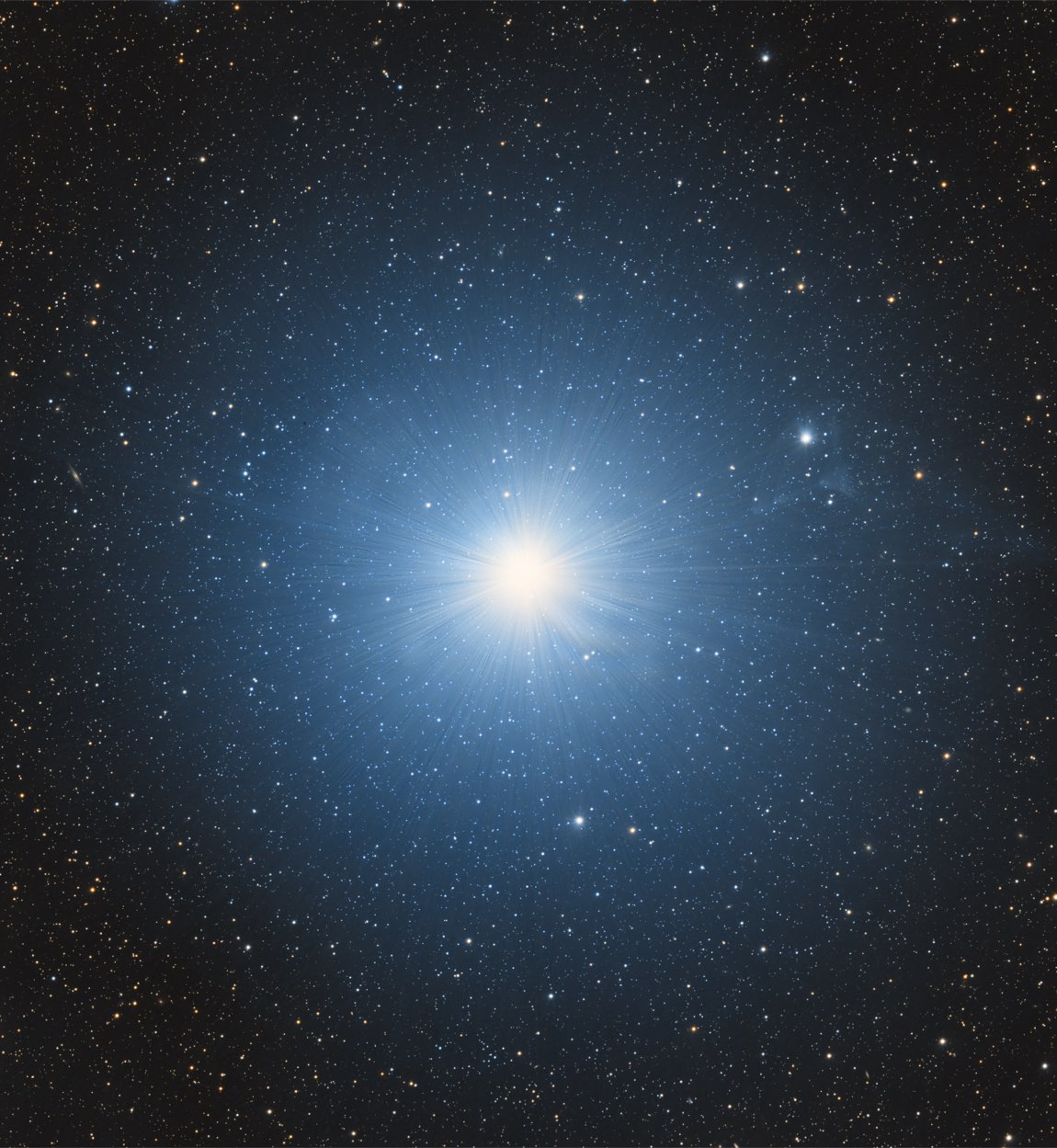
Polaris is the famous North Star: it sits almost exactly above Earth's north pole, so the whole sky appears to wheel around it while it stands still. Despite its fame it is only the ~48th brightest star — its superpower is position, not brilliance. Look closely and Polaris is actually three stars, and the main one rhythmically swells and shrinks: it is the nearest cepheid variable, the type of star that taught us the size of the universe.
Go deeper
Polaris A is a classical Cepheid — a yellow supergiant whose 4-day pulsation follows the period–luminosity law Henrietta Leavitt discovered, the first rung of the cosmic distance ladder. Its distance (~433 ly, Hipparcos; Gaia struggles with stars this bright) is still debated at the 10% level — mildly embarrassing for astronomy's most famous star. Precession moves the celestial pole: Polaris is 'north star' only for our era — closest alignment comes around 2100, then the title drifts onward toward other stars, returning in ~26,000 years.
01 How to find it
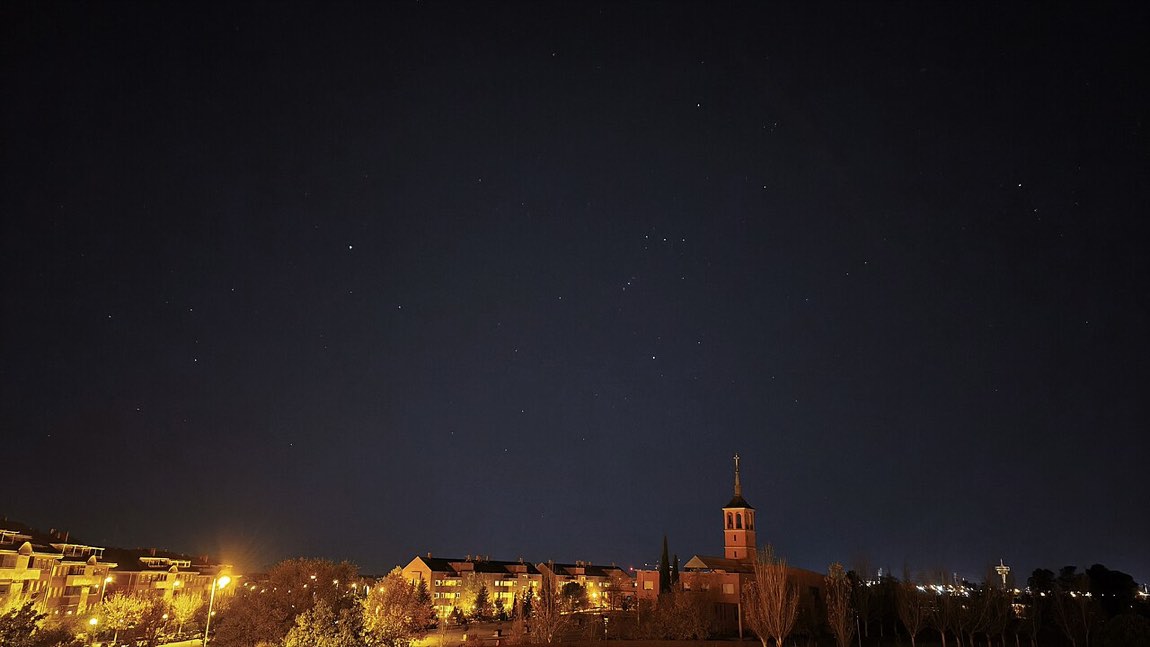
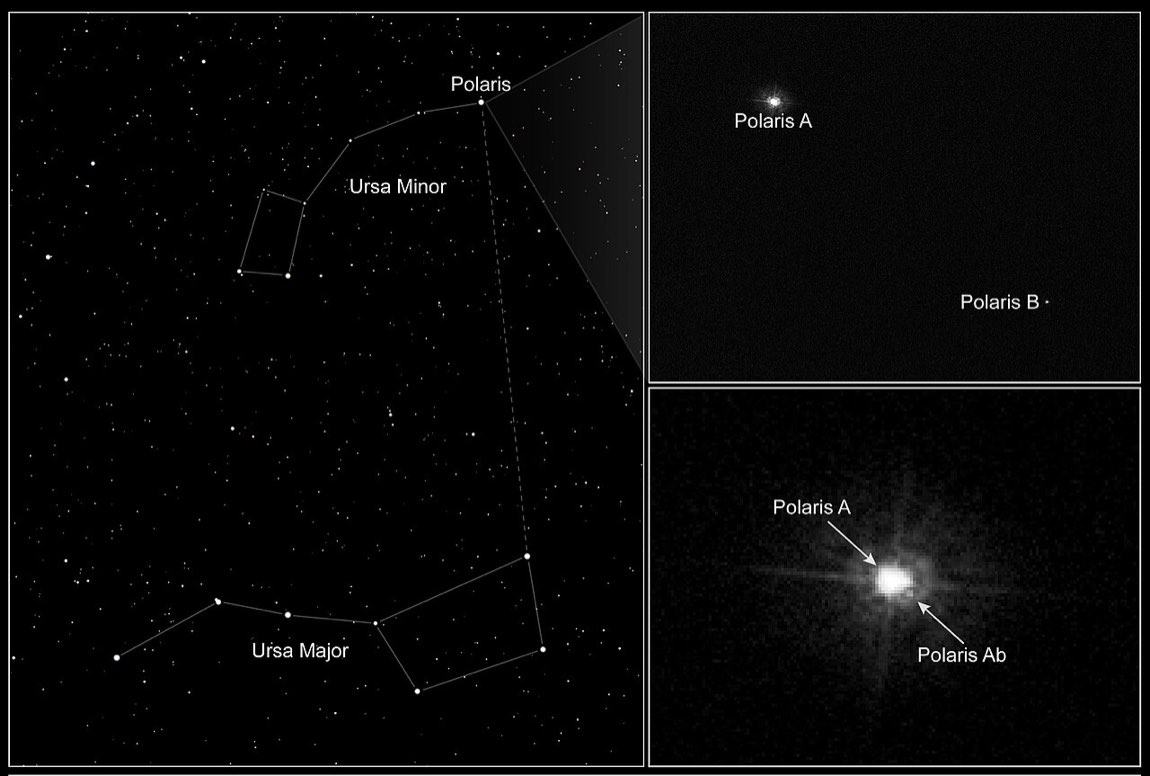
Find the Big Dipper. The two stars at the end of its bowl — the 'pointers' — aim almost exactly at Polaris, about five pointer-lengths away. Face Polaris and you face true north; its height above your horizon equals your latitude. Sailors have bet their lives on this for a thousand years.
02 The star that measured the universe Deeper
Cepheids pulse with a rhythm set by their true brightness — so timing one tells you its wattage, and comparing that to its apparent glow gives distance. Leavitt found the law (1908–12); Hubble used cepheids in Andromeda (1923) to prove other galaxies exist. The nearest example of astronomy's most important measuring stick is the star every child can find.
The deep dive
Researched for the Atlas from Wikipedia — Polaris (22,246 characters read) · updated Sep 20, 2026
03 A triple star hiding in plain sight
To the naked eye Polaris looks like a single steady point of light, but it is actually three stars sharing the same patch of sky. The brightest member, Polaris Aa, is the yellow supergiant that does all the pulsating. Wound tightly around it is Polaris Ab, a smaller F6 main-sequence star with a mass of 1.26 solar masses, whose orbit was only confirmed in the early 20th century after W. W. Campbell noticed the primary's radial velocity shifting back and forth in 1899. Much farther out, at a distance of 2,400 astronomical units — roughly 60 times the width of our entire solar system out to Neptune — sits Polaris B, a 1.39 solar-mass F3 main-sequence star that William Herschel spotted with his own handmade reflecting telescope in August 1779. In January 2006, NASA released Hubble Space Telescope images showing all three members together for the first time. Two other stars, once designated Polaris C and Polaris D, were later shown to be unrelated background objects with no physical connection to the system.
04 Pinning down a notoriously slippery orbit Deeper
Working out the orbit of Polaris Ab around the supergiant Polaris Aa required more than a century of patient radial-velocity monitoring. J. H. Moore showed in 1927 that the velocity variations were a blend of the star's four-day pulsation and a much longer orbital wobble with a large eccentricity near 0.6. Moore published preliminary orbital elements in 1929, estimating a period of about 29.7 years. Elizabeth Roemer refined this in her 1955 doctoral thesis to 30.46 years with an eccentricity of 0.64. K. W. Kamper tightened that further in 1996 to 29.59 ± 0.02 years and an eccentricity of 0.608 ± 0.005. The most recent high-precision solution, from R. I. Anderson in 2019, gives 29.32 ± 0.11 years and an eccentricity of 0.620 ± 0.008. The 2024 Evans et al. study combined the interferometric CHARA Array with archival Hubble measurements to refine the primary's mass to 5.13 ± 0.28 solar masses and the companion Ab's mass to 1.316 ± 0.028 solar masses — making Polaris Aa the first classical Cepheid to have its mass determined directly from its orbit.
 ⤢
⤢
05 A pulsation that refuses to behave
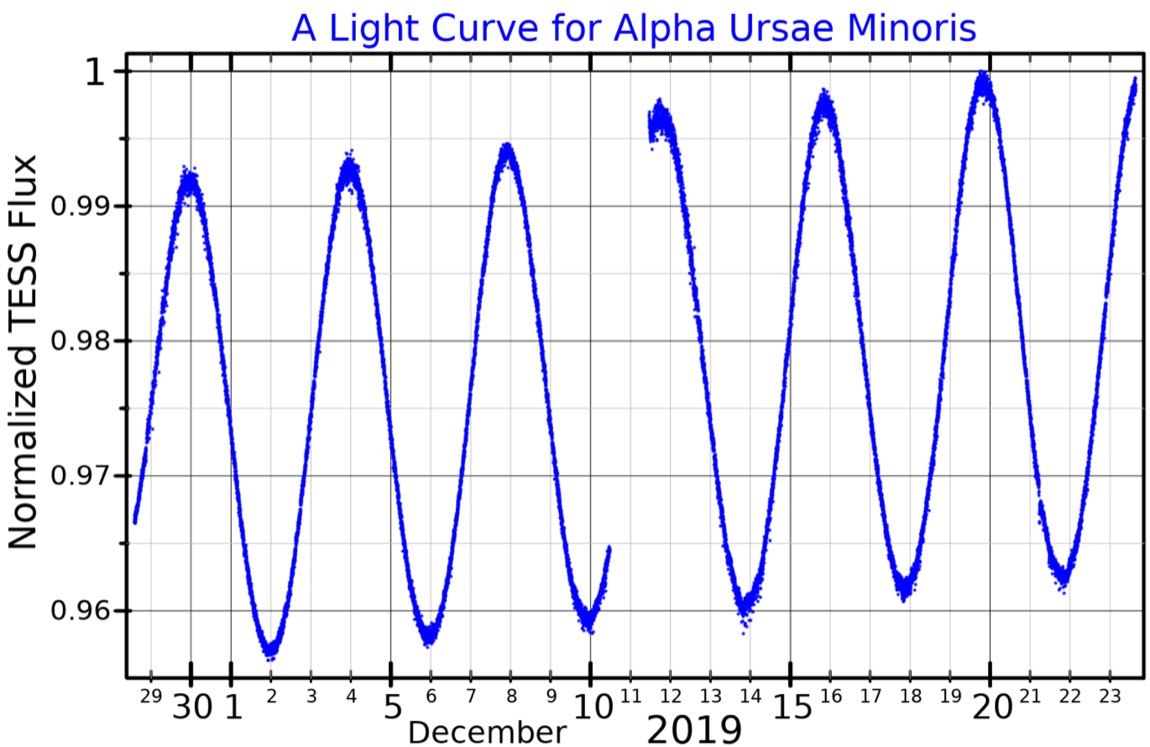
Polaris Aa beats like a slow cosmic heart roughly every four days, but that heartbeat has been misbehaving in ways no other Cepheid variable has shown. The amplitude of its brightness change — once more than 0.1 magnitude — shrank rapidly after 1966 to less than 0.05 magnitude, then began erratically creeping back up, a reversal never seen in any other Cepheid. Meanwhile the pulsation period itself has been lengthening by about 4.5 seconds per year ever since reliable measurements began, except for a mysterious pause between 1963 and 1965. That rate of change was originally chalked up to the star slowly evolving across the Cepheid instability strip, but another explanation now favored by researchers is interference between two competing pulsation modes. To make matters more puzzling, the star's temperature during each cycle fluctuates by anywhere from less than 50 K to at least 170 K, and that range itself changes unpredictably from cycle to cycle — possibly because of gravitational tugging by the close companion Ab. Torres (2023) also found that the period increase may have reversed and begun shrinking again around 2010.
06 Tides, heartbeats, and a meddlesome neighbor Deeper
Because Polaris Ab's orbit is highly elongated, the two inner stars make a close pass — what astronomers call periastron — every 29 or so years. At the Gaia distance of 446.5 light-years, that closest approach places Ab just 6.2 AU from Polaris Aa. The supergiant's radius is 46 solar radii, which works out to roughly 0.21 AU, so Ab sweeps past at only about 29 times the supergiant's own radius. That is close enough for significant tidal forcing on the primary's outer atmosphere. The phenomenon has a well-studied parallel in so-called heartbeat stars, where highly elliptical companions trigger bursts of complex multimode oscillations near periastron — oscillations that on a graph resemble an electrocardiogram trace. Research by Szabados (1992) noted that among Cepheids, sudden "phase slips" like the one Polaris experienced in the mid-1960s tend to occur in binary systems rather than isolated stars, lending further support to the idea that Ab is actively disturbing the pulsation of its giant neighbor. A definitive link between these irregularities and the exact timing of periastron passages remains uncertain because of imprecision in the combined dataset.
07 The long argument over how far away it is Deeper
For most of the 20th century, astronomers had no instrument precise enough to measure Polaris's parallax directly, so they relied on theoretical stellar-evolution models blended with photometric and spectroscopic data — methods struggling to achieve even 10% precision as recently as 2013. The Hipparcos satellite, whose first data release came in 1997, broke that deadlock but immediately sparked controversy. David Turner and collaborators argued through multiple papers between 2004 and 2013 for a "short" distance of about 99 parsecs (323 light-years), roughly 25% closer than the Hipparcos value of about 133 parsecs (432 light-years). Floor van Leeuwen countered in 2013 that Hipparcos data could not support the short distance and questioned the existence of the sparse star cluster Turner's group used as supporting evidence. Bond et al. (2018) added an independent Hubble parallax that placed Polaris even farther than Hipparcos. Gaia has since become the definitive voice: Gaia DR3 gives 136.9 ± 0.3 parsecs (446.5 ± 1.1 light-years) for Polaris B, and the even more precise Gaia DR4 release is expected in December 2026, which may finally resolve the outer AB orbital parameters as well.
08 Brighter now than in ancient times?
One of the most striking — and most disputed — claims about Polaris is that it may have brightened dramatically over recorded history. Research published in the journal Science argued that Polaris is about 2.5 times brighter today than when the Greek astronomer Ptolemy catalogued it, effectively changing from a third-magnitude star to a second-magnitude one. Astronomer Edward Guinan called this change remarkable, stating on record that "if they are real, these changes are 100 times larger than [those] predicted by current theories of stellar evolution." That conditional matters: the claim rests on comparing modern photometry against ancient naked-eye estimates, which carry significant uncertainty. If confirmed, it would challenge the standard picture of how a yellow supergiant evolves over millennia. For now the question remains open, illustrating how a star that has been watched for thousands of years can still surprise the scientists studying it.
 ⤢
⤢
09 Imaging spots on a star 447 light-years away Deeper
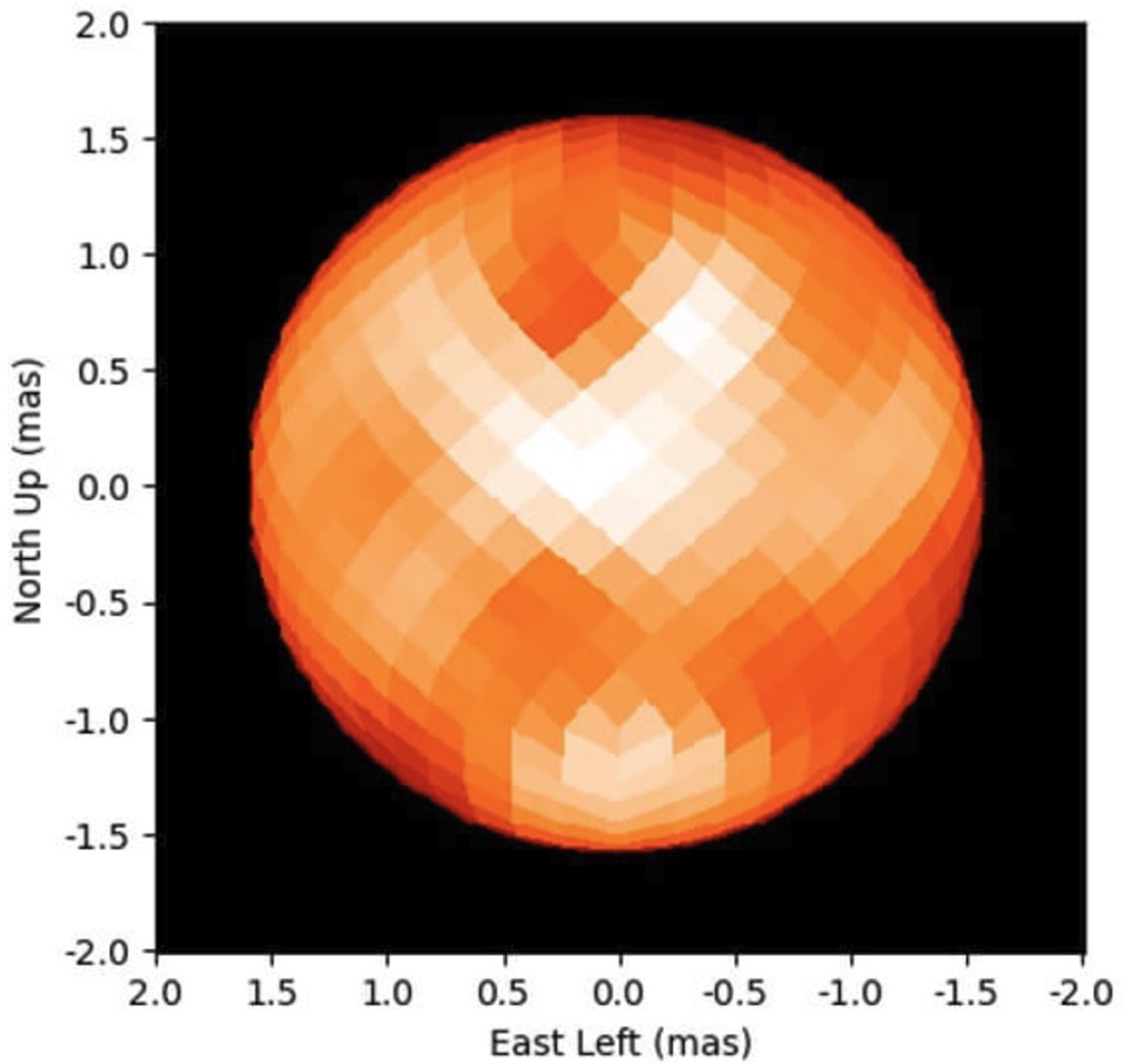
In 2024, a team led by Nancy Evans at the Harvard & Smithsonian Center for Astrophysics used the CHARA Array, an interferometric instrument capable of resolving tiny angular details, to obtain what may be the first tentative close-up images of Polaris Aa's surface. The images show large bright and dark patches that appear to change over time — structures analogous to giant convective features or star spots. The team was careful to describe the detection as tentative, noting that follow-up imaging campaigns are required to confirm it. The same study confirmed the supergiant's radius at 46 solar radii and pinned down its mass at 5.13 ± 0.28 solar masses. Despite this new precision, Polaris Aa remains overluminous compared to the best current Cepheid evolution models, a puzzle it shares with the Cepheid V1334 Cygni. The star's age also presents a conundrum: current best estimates suggest the Cepheid is significantly younger than Polaris B and Polaris Ab, which would make a common origin for all three stars surprisingly difficult to explain for what should be a single-birth triple system.
10 The pole star's slow drift across the centuries
Polaris has not always been the North Star, and it will not always remain one. Earth's rotational axis wobbles like a spinning top over a cycle of roughly 26,000 years, a motion called the precession of the equinoxes, and the point it traces in the sky shifts accordingly. In 2018, Polaris stood 0.66 degrees — about 39.6 arcminutes, or 1.4 times the apparent diameter of the Moon — from the exact celestial north pole, circling it in a small loop 1.3 degrees across. It will reach its closest approach of about 0.45 degrees (27 arcminutes) shortly after the year 2100, then begin drifting away. Around 4000 AD the pole will pass Errai (Gamma Cephei); by 10,000 AD it will be near Deneb; by 14,500 AD it will point toward the bright star Vega. Looking backward, the pole was near Thuban around 2750 BC, and the Greek navigator Pytheas around 320 BC described the pole region as essentially starless. Polaris only became unmistakably the closest naked-eye star to the pole during the early medieval period.
11 Not always a navigator's star
The name Polaris is a Renaissance coinage, shortened from the Neo-Latin stella polaris — "polar star" — and first appeared in print in the Alfonsine Tables of 1492, the same year Columbus crossed the Atlantic. Gemma Frisius, writing in 1547, still placed the star 3 degrees 8 arcminutes from the pole, a gap large enough that Columbus on his first trans-Atlantic voyage had to consciously correct for "the circle described by the pole star about the pole." In antiquity, no single star served as the pole marker; instead, sailors and astronomers used the entire constellation of Ursa Minor. The star collected many names along the way: scip-steorra ("ship-star") in Old English; lodestar, attested in English since the 14th century and cognate with the Old Norse leiðarstjarna; and the Latinized Cynosura, from the Greek for "the dog's tail." In Arabic pre-Islamic astronomy it was al-Jady, meaning "the kid" (a juvenile goat). In Hindu tradition it became personified as Dhruva, meaning "immovable, fixed," while in Finnish cosmology it was the naulatähti — the "nail star" — imagined as the pin on which the entire wheel of the sky rotates.
12 What kind of Cepheid is Polaris, really? Deeper
Classifying Polaris precisely within the Cepheid family has proven surprisingly contentious. It was once believed to be a Type II Cepheid — an older, population-II star — partly because its position sits at an unusually high galactic latitude. Closer study established it as a classical, population-I Cepheid, the type tied to the period-luminosity relationship that Henrietta Swan Leavitt identified and that underpins the cosmic distance ladder. Even within that category, debate continues: astronomers disagree about whether Polaris pulsates in its fundamental mode or its first-overtone mode, and whether it is making its first crossing of the Cepheid instability strip in the Hertzsprung-Russell diagram or a subsequent one. Torres (2023) and Evans et al. (2024) both note that recent literature has cautiously converged on the first-overtone interpretation, but neither study claims the question is settled. Polaris's unusually rapid period change and erratic amplitude variations mark it as an outlier among Cepheids, and the TESS space telescope — though it has observed Polaris — is of limited help because Polaris is so bright it saturates TESS's detectors, making accurate brightness measurements extremely difficult.
 ⤢
⤢
13 Polaris in the flags and myths of nations
Few stars have embedded themselves so deeply into human culture across so many independent traditions. The Lakota name Wičháȟpi Owáŋžila — "The Star that Sits Still" — comes with a story of grief: the star-being married Red Cheeked Woman, who fell from the heavens, and in his sorrow he stared down from the sky forever. The Plains Cree call it acâhkos êkâ kâ-âhcît, "the star that does not move." The Hawaiian name used by the Polynesian Voyaging Society is Hōkūpa'a, meaning "fixed star." In Finnish tradition it was the taivaannapa and naulatähti, the cosmic nail pinning the sky in place. Shakespeare captured the same idea in Sonnet 116, describing love as "the star to every wandering bark," and in Julius Caesar a character claims the constancy of the northern star — even though in Caesar's actual lifetime no such fixed northern star existed. Today Polaris appears on the flags of Alaska, Maine, Minnesota, and the Canadian Inuit territory of Nunavut, and on Duluth, Minnesota's city flag, cementing its status as a symbol of constancy across multiple continents and cultures.
Could life exist here?
A pulsating supergiant is a poor host; no planets known.
Our labels: Confirmed · Strong Evidence · Estimated · Hypothesis · Theoretical · Speculative (see Methodology).
How would we get there?
Four centuries at light speed. Its role is navigation: it brings travelers home, not the other way around.
Weird & wonderful
- Polaris hasn't always been the North Star — the pyramids were aligned to a different one (Thuban).
- From the equator, Polaris sits exactly on the horizon; from the South Pole, it never rises at all.
- It has brightened noticeably over the last century — cepheids evolve within human lifetimes.