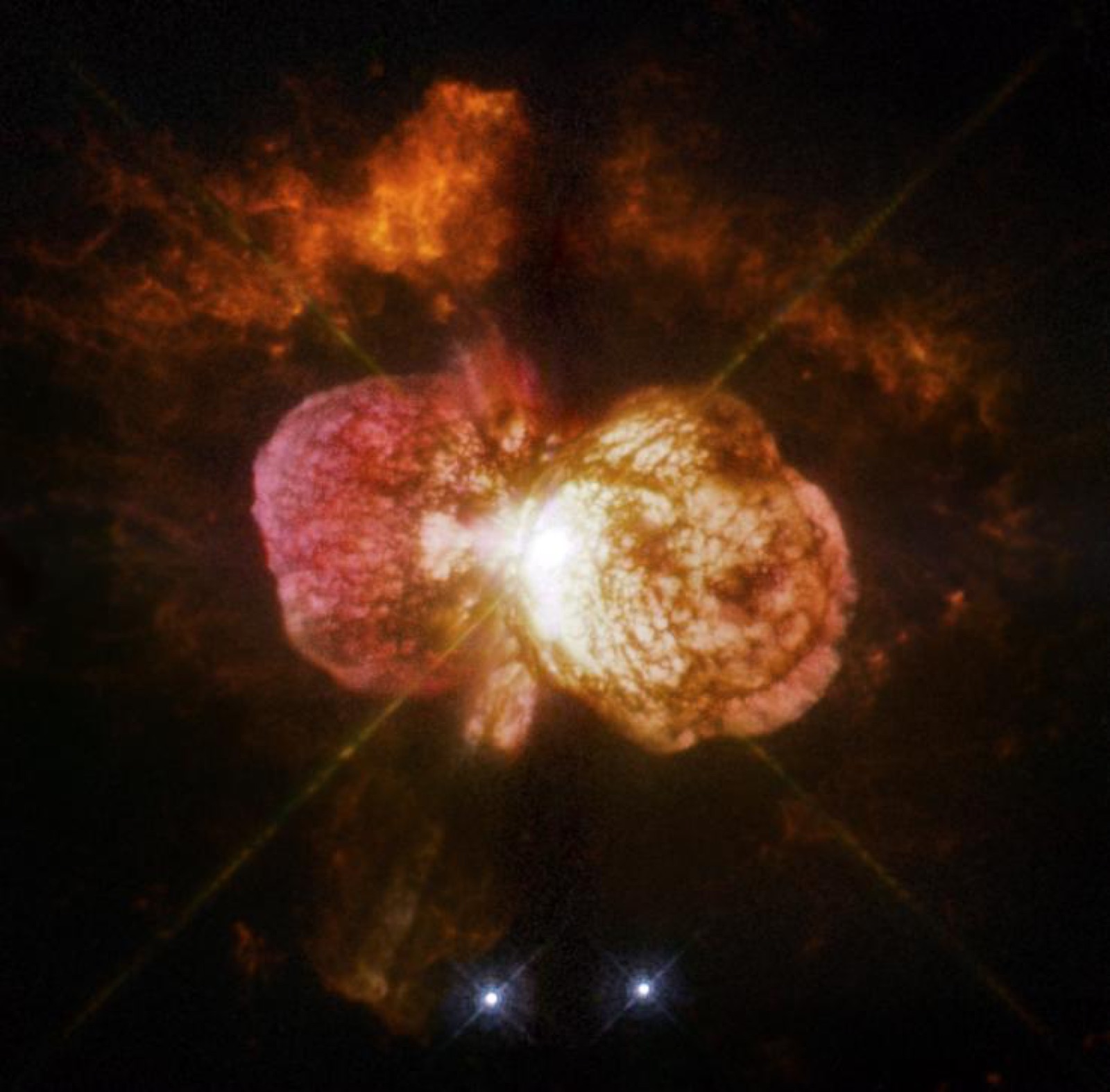
 Photograph · NASA, ESA and the Hubble SM4 ERO Team
Star · Deep guide
Eta Carinae
The star that almost died in 1843 will not survive its next tantrum.
What is it?
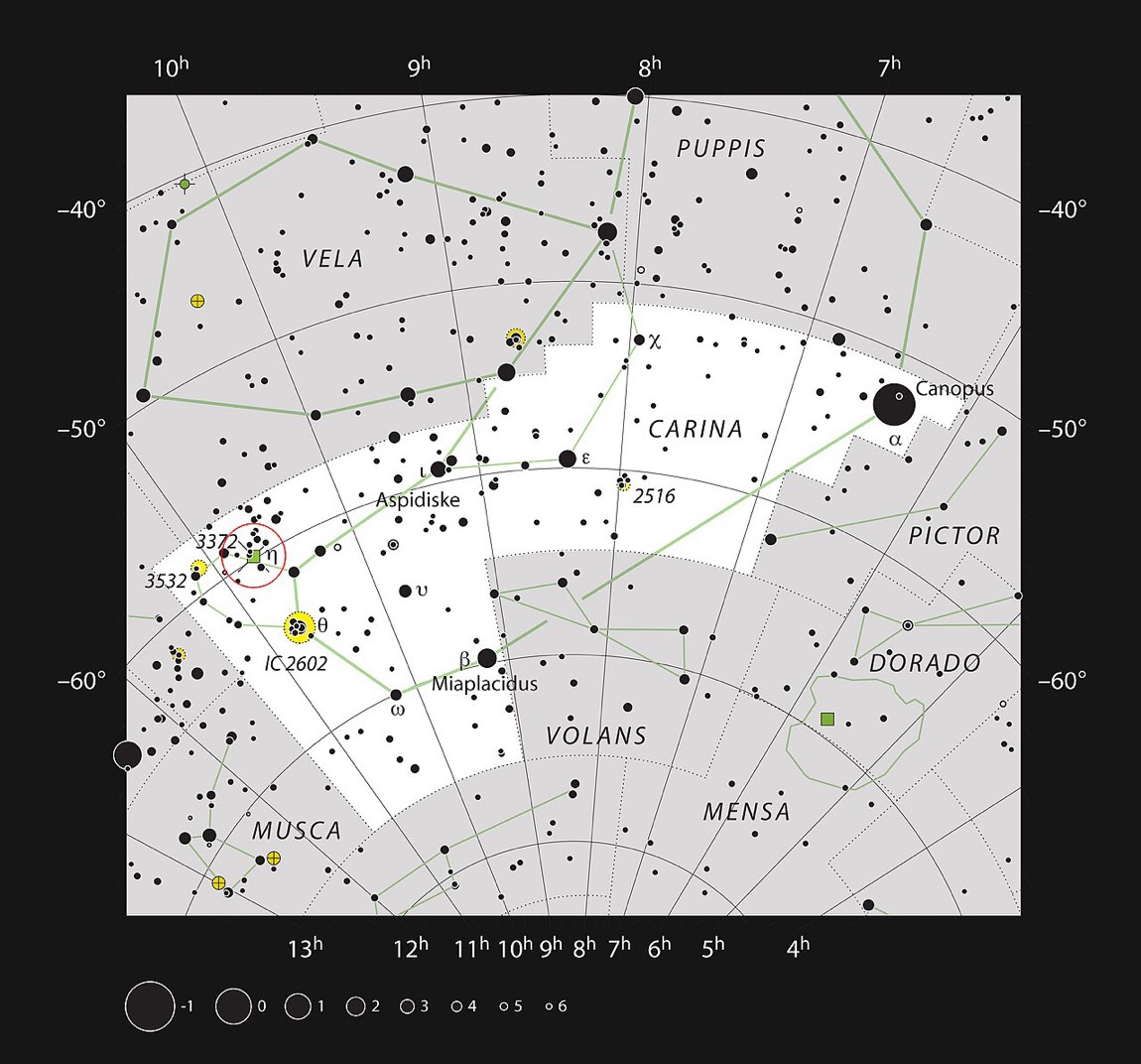
Eta Carinae is a colossal binary — roughly 90 and 30 solar masses — buried in the Carina Nebula 7,500 light-years away. In the 1840s it erupted so violently it briefly became the sky's second-brightest star and ejected more than ten Suns of material, yet survived: the definitive 'supernova impostor'. The dumbbell-shaped Homunculus cloud from that outburst still expands around it. Its true supernova is a matter of when.
The deep dive
Researched for the Atlas from Wikipedia — Eta Carinae (52,427 characters read) · updated Sep 20, 2026
01 The star Edmond Halley first wrote down
The earliest firm record of Eta Carinae comes from Edmond Halley in 1677, who catalogued it simply as Sequens — Latin for "following" — relative to a nearby star, within a constellation he invented called Robur Carolinum. He estimated its apparent magnitude at roughly 4, which modern calibration places at about magnitude 3.3. Dutch navigator Pieter Keyser may have glimpsed it around 1595–1596, and his position was copied onto the celestial globes of Plancius and Hondius and into the famous 1603 Uranometria of Johann Bayer, but that record is considered unreliable. The star collected several Bayer designations over the decades — η Roboris Caroli, η Argus, η Navis — before Nicolas-Louis de Lacaille reorganised the sprawling constellation Argo Navis in 1751 and the Greek letter η landed in the keel section. It did not officially become Eta Carinae until 1879, when Benjamin Gould assigned the daughter-constellation epithets in his Uranometria Argentina. Even the occasional Latin alias Foramen, meaning "hole" or "opening," traces only to a 1923 astrology book, not to any classical astronomical tradition.
02 How brightness swung across eighteen years
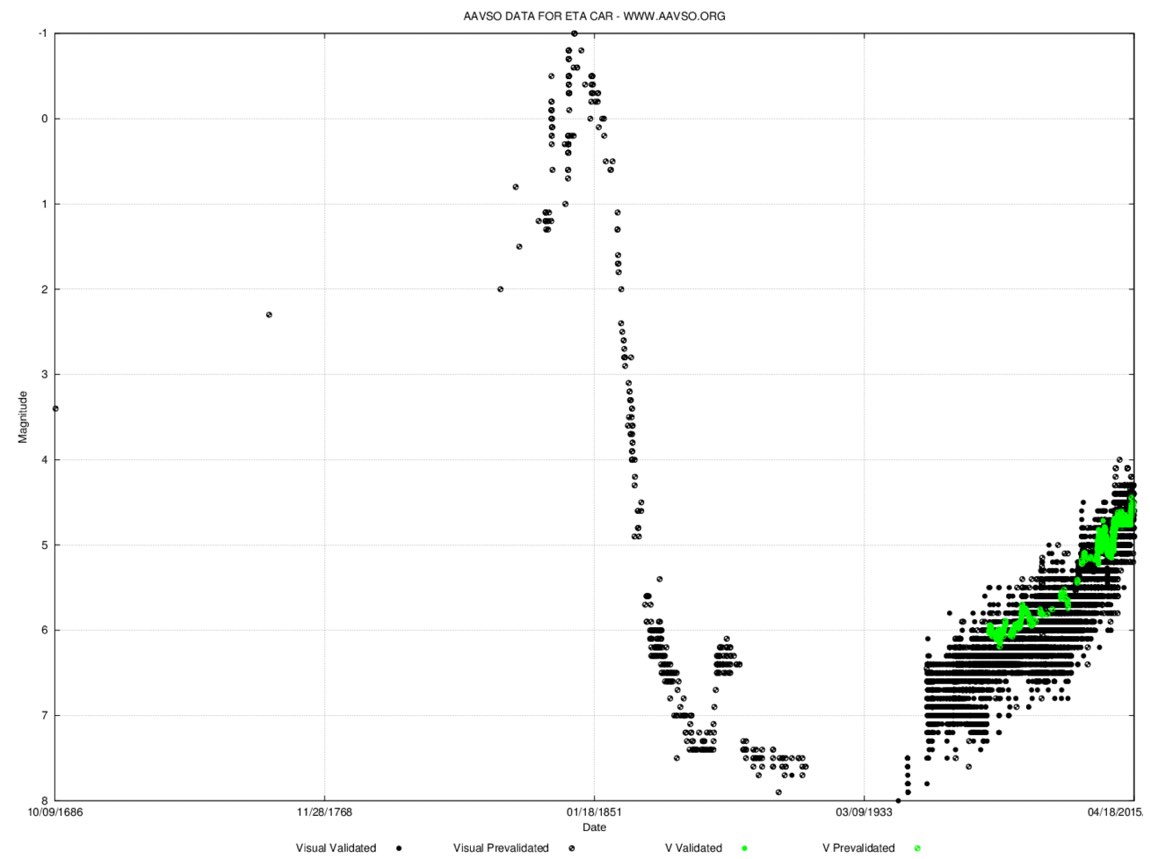
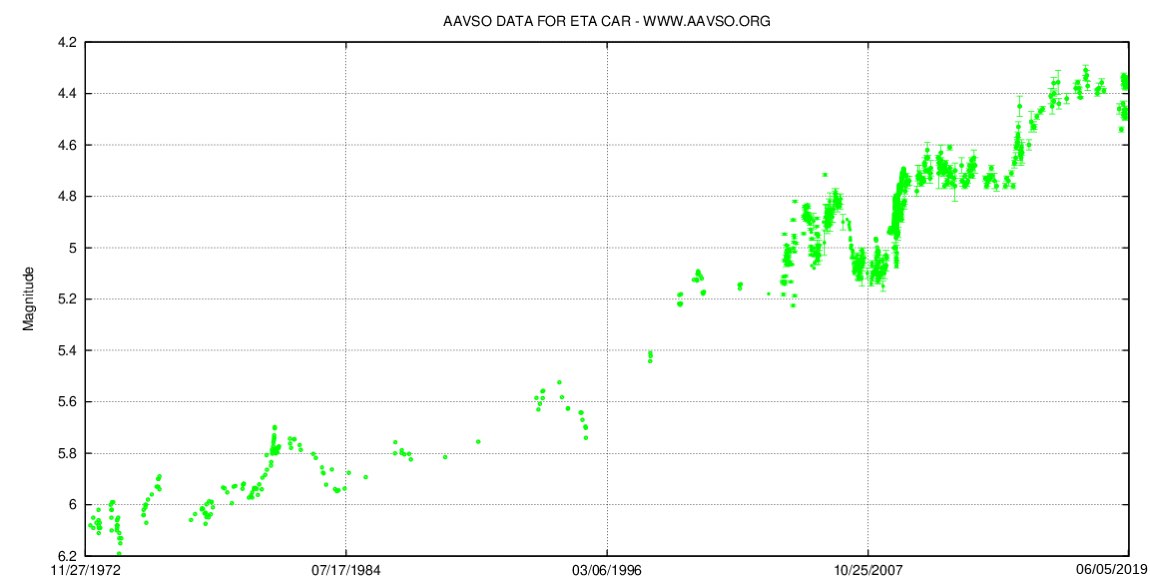
John Herschel, stationed in South Africa, made systematic measurements through the 1830s showing the star holding steadily near magnitude 1.4 — until the evening of 16 December 1837, when it suddenly outshone Rigel. That moment opened the Great Eruption. By 27 January 1838 it equalled Alpha Centauri in brightness, then faded briefly before surging again. Correspondence from Reverend W. S. Mackay in Calcutta described it in March 1843 as "fully as bright as Canopus." Observers at the Cape of Good Hope pinned the peak to 11–14 March 1843, when it likely reached apparent magnitude −0.8; by 1845 it may have hit −1.0. Through much of 1844 it hovered around magnitude +0.2. The peaks in 1827, 1838, and 1843 are thought to coincide with periastron passages of the binary orbit — the moments when the two stars swing closest together. From 1845 onward, brightness dropped roughly 0.1 magnitudes per year, sometimes with rapid large fluctuations, until the star vanished below the naked-eye limit by 1886. Dust condensing in the ejected shell, not any intrinsic dimming of the star itself, drove that disappearance.
03 An Aboriginal oral tradition records the eruption
In 2010, astronomers Duane Hamacher and David Frew of Macquarie University in Sydney identified an oral tradition from the Boorong clan of the Wergaia people of Lake Tyrrell in north-western Victoria, Australia, that almost certainly describes Eta Carinae during its Great Eruption in the 1840s. The Boorong knew a reddish star they called Collowgullouric War, meaning "Old Woman Crow," and considered it the wife of War — their name for Canopus. During the eruption, Eta Carinae was indeed comparable in brightness to Canopus and conspicuously reddish in colour, placed in the sky very close to it. The matching of the description to the event required the eruption to have been noticed and remembered across generations, preserved in a living oral tradition until scholars could connect it to the 19th-century photometric record. It is one of the most striking examples of indigenous astronomical observation being independently confirmed by modern astrophysics, and it underlines just how visually dramatic the Great Eruption was to anyone living in the southern hemisphere at the time.
 ⤢
⤢
04 The Lesser Eruption hiding in plain sight Deeper
Between 1887 and 1895, Eta Carinae underwent a second, smaller outburst now called the Lesser Eruption. It peaked at about magnitude 6.2 in 1892, then faded rapidly to around magnitude 7.5 by the end of March 1895. At face value this is a modest event, but the numbers are deceptive: calculations show that by this point the star was suffering 4.3 magnitudes of visual extinction from the gas and dust thrown out during the Great Eruption. Correcting for that absorption, the unobscured brightness would have been equivalent to magnitude 1.5–1.9 — comparable to the Great Eruption itself. The amount of material expelled was far smaller, however: the Little Homunculus Nebula nested inside the main Homunculus is thought to represent only about 0.1 solar masses ejected in this event, compared with 10–20 solar masses or more during the Great Eruption. The spectral transition observed during the 1890 eruption — from an early F supergiant spectrum to one dominated by strong emission lines — mirrors what is seen in classical novae, where ejected material first radiates like a pseudo-photosphere and then the envelope expands, thins, and an emission spectrum develops.
05 Inside the Homunculus: lobes, skirts, and blobs
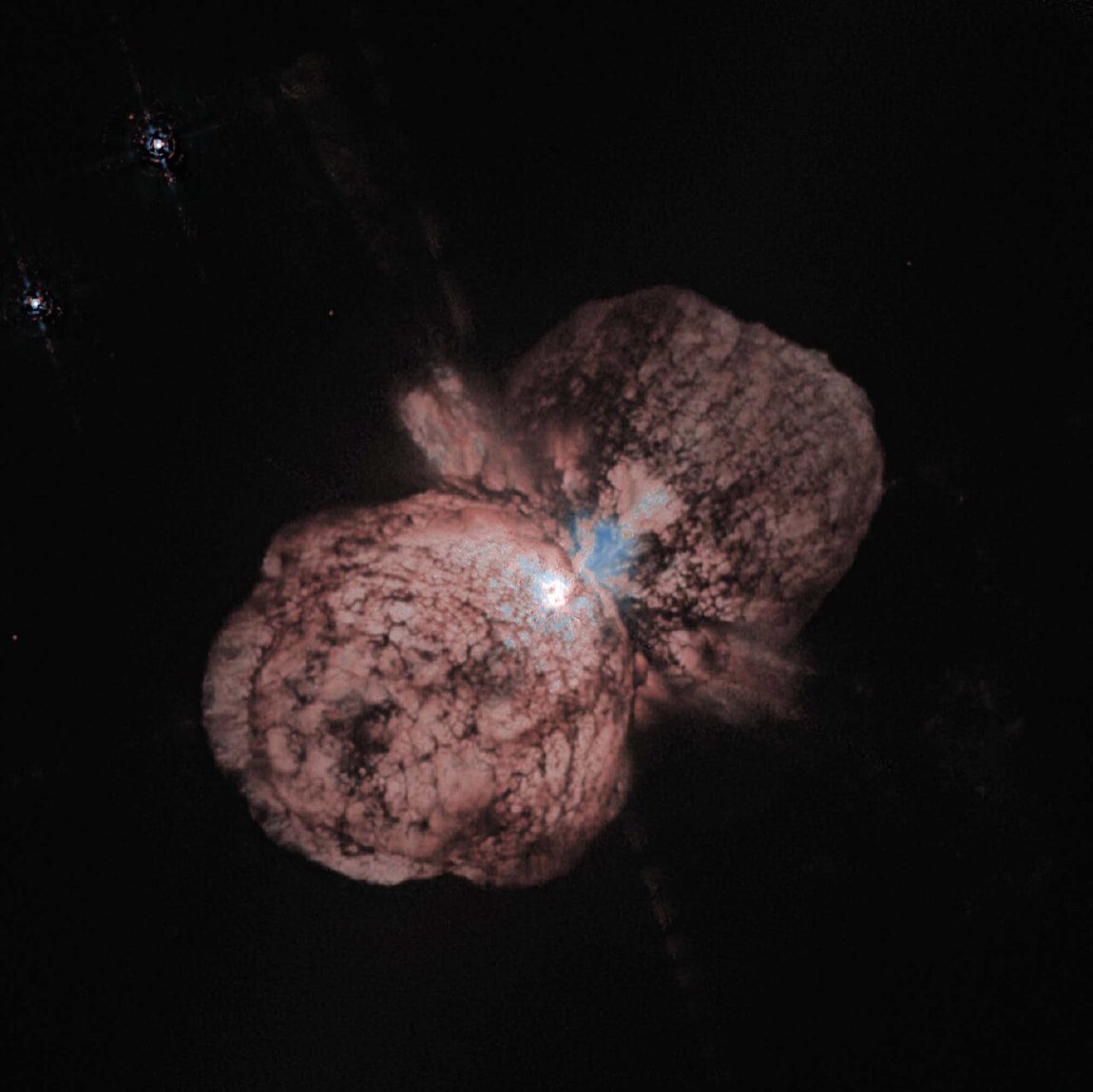
The Homunculus Nebula, whose name means "little man" in Latin, encloses Eta Carinae in two polar lobes aligned with the star's rotation axis, plus an equatorial skirt, spanning about 18 arcseconds end to end. The lobes are thought to have formed almost entirely from material blasted out during the Great Eruption rather than swept-up interstellar gas. That conclusion matters because it means the lobe mass is a direct census of the eruption itself; estimates range from 12–15 solar masses up to as high as 45 solar masses. Strikingly, 75% of that mass and 90% of the kinetic energy were released at latitudes above 45 degrees — strongly concentrated toward the poles. A smaller Little Homunculus, probably formed in the 1890 eruption, sits nested within the larger structure. Three dense gas concentrations called the Weigelt Blobs orbit very close to the primary star and are responsible for some of the system's most unusual spectral features, including the ultraviolet laser emission. Far-infrared observations suggest the total mass of the Homunculus, including dust at temperatures of 100–150 K, may be 20 solar masses or more — larger than earlier visual-wavelength estimates captured.
06 A star that lases in ultraviolet Deeper
Eta Carinae holds a distinction unique among all known stars: it produces ultraviolet laser emission. The mechanism begins when ionised hydrogen between the Weigelt Blobs and the central stars generates intense Lyman-alpha ultraviolet radiation. That radiation penetrates the blobs, which contain atomic hydrogen mixed with small amounts of other elements including iron that has been photo-ionised by the central stars' radiation. An accidental resonance — where the Lyman-alpha photons happen to have just the right energy to excite iron ions to certain pseudo-metastable states — creates a population inversion, the physical condition necessary for stimulated emission, or lasing. The resulting amplified emission is detected in specific FeII ultraviolet lines that are far stronger than any normal excitation process could explain. A second UV laser involving oxygen ions pumped by Lyman-beta emission has also been confirmed. The article notes that maser emission from dense gas around cool supergiant stars is a related phenomenon, but that effect is far weaker at optical and UV wavelengths. No other star has yet been shown to produce this kind of UV astrophysical laser.
 ⤢
⤢
07 The orbit: 1.6 AU to 30 AU in 5.54 years Deeper
The two stars of Eta Carinae follow an orbit with a period accurately measured at 5.539 years and an eccentricity of e = 0.9, making it one of the most elongated stellar orbits known for a confirmed binary. The semi-major axis is approximately 15–16 AU. Because the orbit is so eccentric, the separation swings from about 1.6 AU at closest approach (periastron) — similar to the distance of Mars from the Sun — out to roughly 30 AU at farthest separation, comparable to Neptune's distance from the Sun. At periastron the two stars' stellar winds collide furiously in a roughly conical wind-wind collision zone reaching temperatures as high as 100 million kelvin, producing the hard X-rays and gamma rays observed close to the system. The orbital period has not been constant: between the Great Eruption and the 1890 Lesser Eruption it was apparently 5.52 years, and before the Great Eruption it may have been even shorter, possibly between 4.8 and 5.4 years. This drift reflects the enormous mass loss and possible accretion during the eruptions. Brazilian astronomer Augusto Damineli first proposed the binary nature in 1996; it was confirmed in 2005.
08 What the X-ray and gamma-ray sky reveals Deeper
The region around Eta Carinae is a rich source of high-energy radiation detected across multiple instruments and decades. The earliest X-ray detection came from the Terrier-Sandhawk sounding rocket, followed by observations with Ariel 5, OSO 8, and Uhuru. More detailed mapping was performed by the Einstein Observatory, ROSAT, ASCA, and Chandra. The resulting picture is complex: hard X-rays and gamma rays arise within about one light-month of the stars themselves from the wind-wind collision zone; a distinct partial-ring "horseshoe" structure in lower-energy X-rays spans 0.67 parsecs (about 2.2 light-years), tracing the main shockfront where material from the Great Eruption has slammed into surrounding interstellar gas at temperatures around 5 million kelvin; and diffuse X-ray emission fills the whole extent of the Homunculus. All this high-energy emission varies with the 5.54-year orbital cycle. A notable X-ray eclipse occurred in July–August 2003, with similar events in 2009 and 2014 intensively monitored. In July 2018, NuSTAR observations revealed Eta Carinae has the strongest colliding-wind shock in the solar neighbourhood, with non-thermal X-ray emission whose photon index matches the gamma-ray spectrum observed by Fermi.
09 Radio waves and a lasing recombination line Deeper
Radio emission from Eta Carinae has been detected across the microwave band, including the 21-centimetre hydrogen line, but the system has been most intensively studied at millimetre and centimetre wavelengths. High-resolution imaging shows the radio emission originating from a disk-like structure a few arcseconds in diameter — corresponding to about 10,000 astronomical units at the star's distance — and the emission is consistent with free-free radiation, also called thermal bremsstrahlung, from ionised gas at around 10,000 K, similar to a compact HII region. Unusually, masing hydrogen recombination lines have been detected in this range; these arise when an electron and a proton combine to form a hydrogen atom in conditions that allow stimulated emission of microwave radiation. The radio emission varies continuously over the 5.54-year orbital cycle. The HII region and recombination lines vary very strongly, while the continuum emission is less affected. During the spectroscopic event near periastron, there is a dramatic reduction in ionisation level — the same event that produces the X-ray eclipse and spectral changes across all wavelengths — confirming that a single orbital phenomenon drives changes from radio waves all the way up to gamma rays.
 ⤢
⤢
10 How the Great Eruption lit up light echoes
Because Eta Carinae is embedded in the large Carina Nebula, light from the Great Eruption has been bouncing off surrounding gas clouds and only now reaching Earth — a phenomenon called a light echo. Astronomers detected these echoes using the Blanco 4-meter telescope at the Cerro Tololo Inter-American Observatory. By analysing the spectrum of this reflected ancient light, they could read what Eta Carinae looked like during the eruption itself, without relying solely on the historical brightness records. The result was striking: the spectrum matched a star of spectral type G2 to G5 with a surface temperature near 5,000 K — about 2,000 K cooler than typical supernova impostor events. Later in the eruption, the echoes show the spectrum developing prominent P Cygni profiles and CN molecular bands, similar to a Type IIn supernova where ejecta collide with previously ejected circumstellar material. The light echoes also show that the eruption brightened in multiple peaks over roughly 20 years, followed by a plateau period in the 1850s during which the outflow of material was higher than at the eruption's peak — information that no 19th-century observer could have captured directly.
11 Evidence of eruptions before the 19th century Deeper
The two eruptions witnessed by 19th-century astronomers are not necessarily the whole story. Analysis of outlying nebulosity surrounding the system suggests at least one earlier eruption occurred around 1250 CE, and possibly another around 1550 CE, though that second event may alternatively represent material from the Great Eruption that was slowed by colliding with older ejecta rather than a distinct outburst. The mechanism driving any of these eruptions remains unknown. Even the basic question of whether they are true explosive events or so-called super-Eddington winds — an extreme form of stellar mass loss driven by a runaway increase in luminosity — is unresolved. Proposed explanations include a binary merger within what may once have been a triple-star system; mass transfer to the companion during successive periastron passages; or a pulsational pair-instability explosion in which runaway nuclear burning causes a partial disruption of the star without destroying it. Any successful theory must account for repeated eruptions of varying sizes, the ejection of 20 solar masses or more without destroying the star, and the highly asymmetric bipolar shape of the resulting nebula.
12 What a future supernova would look like from Earth
When Eta Carinae eventually explodes, it will be a spectacle with no modern precedent. A standard core-collapse supernova at its distance of 7,500 light-years would peak at roughly apparent magnitude −4, comparable to Venus at its brightest — easily visible in daylight. If the explosion is a superluminous supernova, energised by the vast shell of ejected material surrounding the star, it could be five magnitudes brighter still, potentially surpassing even SN 1006, currently the brightest supernova in recorded history. At 7,500 light-years the direct biological threat to life on Earth is low: the atmosphere absorbs gamma rays completely, and the magnetosphere deflects many cosmic rays. The main physical damage would fall on the ozone layer, spacecraft, satellites, and any astronauts in space. Research cited in the article notes that complete ozone loss from a supernova would require the explosion to occur within 50 light-years of Earth, and even a hypernova would need to be closer than Eta Carinae's actual distance. Eta Carinae's rotation axis is also not currently aimed near Earth, further reducing any gamma-ray burst risk. The resulting stellar remnant would almost certainly be a black hole — a core that massive is unlikely to produce a neutron star.
 ⤢
⤢