 Photograph · Mark Booth · CC BY-SA 4.0
Star · Deep guide
Epsilon Eridani
A young Sun next door, with planets and asteroid belts still settling into place.
What is it?
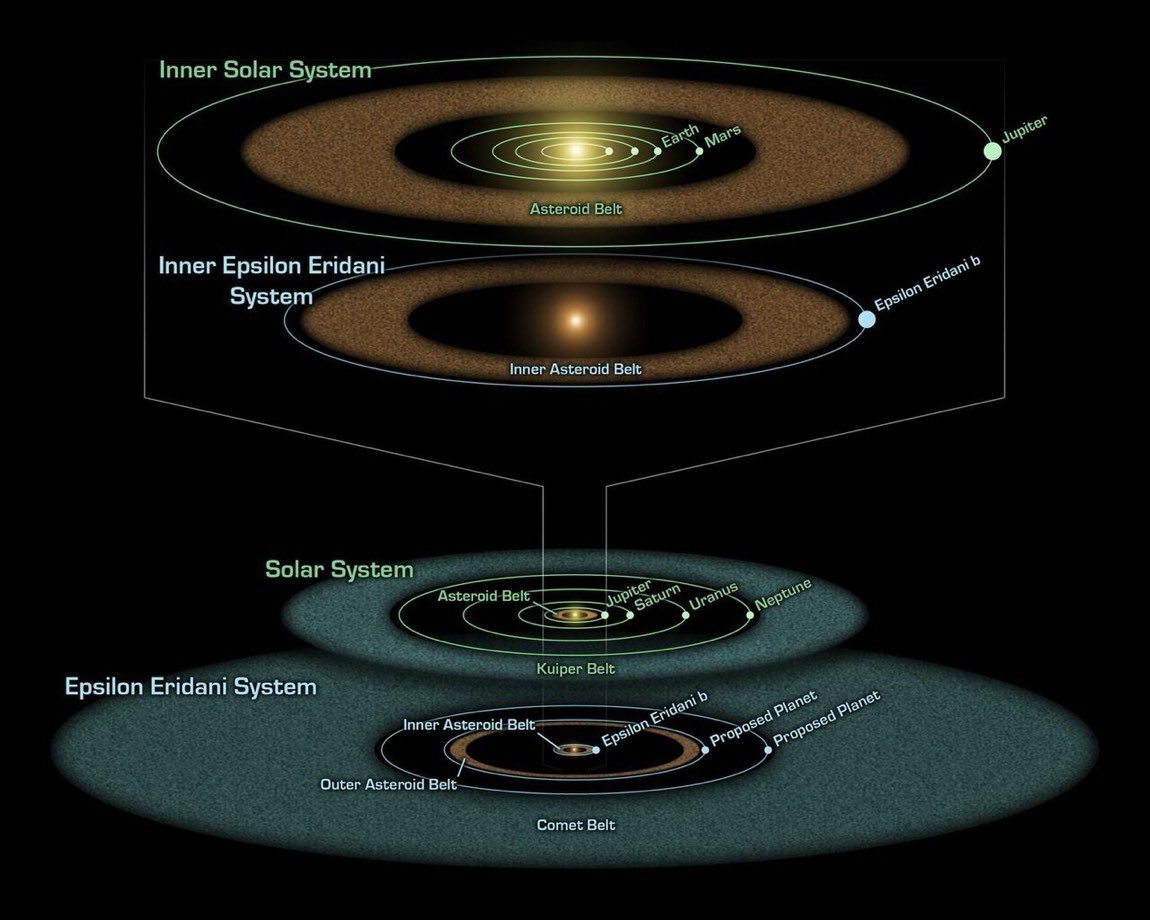
Epsilon Eridani, 10.5 light-years away, is what our Solar System may have looked like in its youth: a K-type star under a billion years old, wrapped in asteroid belts and a comet ring, with a confirmed Jupiter-class planet (Epsilon Eridani b, formally named Ægir) orbiting where Jupiter sits at home. It is among the closest stars with a confirmed planet.
The deep dive
Researched for the Atlas from Wikipedia — Epsilon Eridani (34,023 characters read) · updated Sep 20, 2026
01 A Star That Astronomers Have Watched for Two Millennia
Epsilon Eridani has been tracked since at least the 2nd century AD, when Claudius Ptolemy of Alexandria listed it as the thirteenth star in the constellation he called Ποταμού — Ancient Greek for 'River' — and assigned it a magnitude of 3, which matches modern measurements remarkably well. Medieval Islamic astronomers carried the tradition forward: Abd al-Rahman al-Sufi included it in his Book of Fixed Stars in 964, al-Biruni cited it in his Mas'ud Canon in 1030, and Ulugh Beg measured its coordinates fresh at his observatory in Samarkand for his Zij-i Sultani of 1437. Johann Bayer locked in its familiar Greek-letter label in 1603 via his Uranometria atlas, though the epsilon designation reflects its position within a brightness class rather than a true rank — the star is actually the tenth brightest in Eridanus. Its modern HD catalogue number, HD 22049, appeared in 1918 with a preliminary spectral classification of K0. That unbroken paper trail, stretching across more than 1,800 years of human record-keeping, makes Epsilon Eridani one of the longest-continuously-observed individual stars in history.
02 The Names Ran and AEgir, and How They Were Chosen
For most of its documented history, Epsilon Eridani carried no proper name at all — a remarkable gap for such a nearby and bright star. That changed in December 2015, when the International Astronomical Union announced the results of its NameExoWorlds public competition. The winning names, Ran for the star and AEgir for its planet, were submitted by eighth-grade pupils at Mountainside Middle School in Colbert, Washington. Both names come from Norse mythology: Rán is the goddess of the sea, and Ægir, her husband, is the god of the ocean — an evocative pairing for a planetary system orbiting in the cosmic deep. The IAU's Working Group on Star Names formally catalogued Ran in July 2016. In Chinese astronomical tradition, the star had long held a quieter identity: it is 天苑四 (Tiān Yuàn sì), meaning the Fourth Star of the Celestial Meadows, part of an asterism grouping sixteen stars across Eridanus and Cetus. Despite the official IAU name, professional astronomers have mostly continued to use the designation Epsilon Eridani in published research.
03 Magnetic Storms Across an Active Young Star Deeper
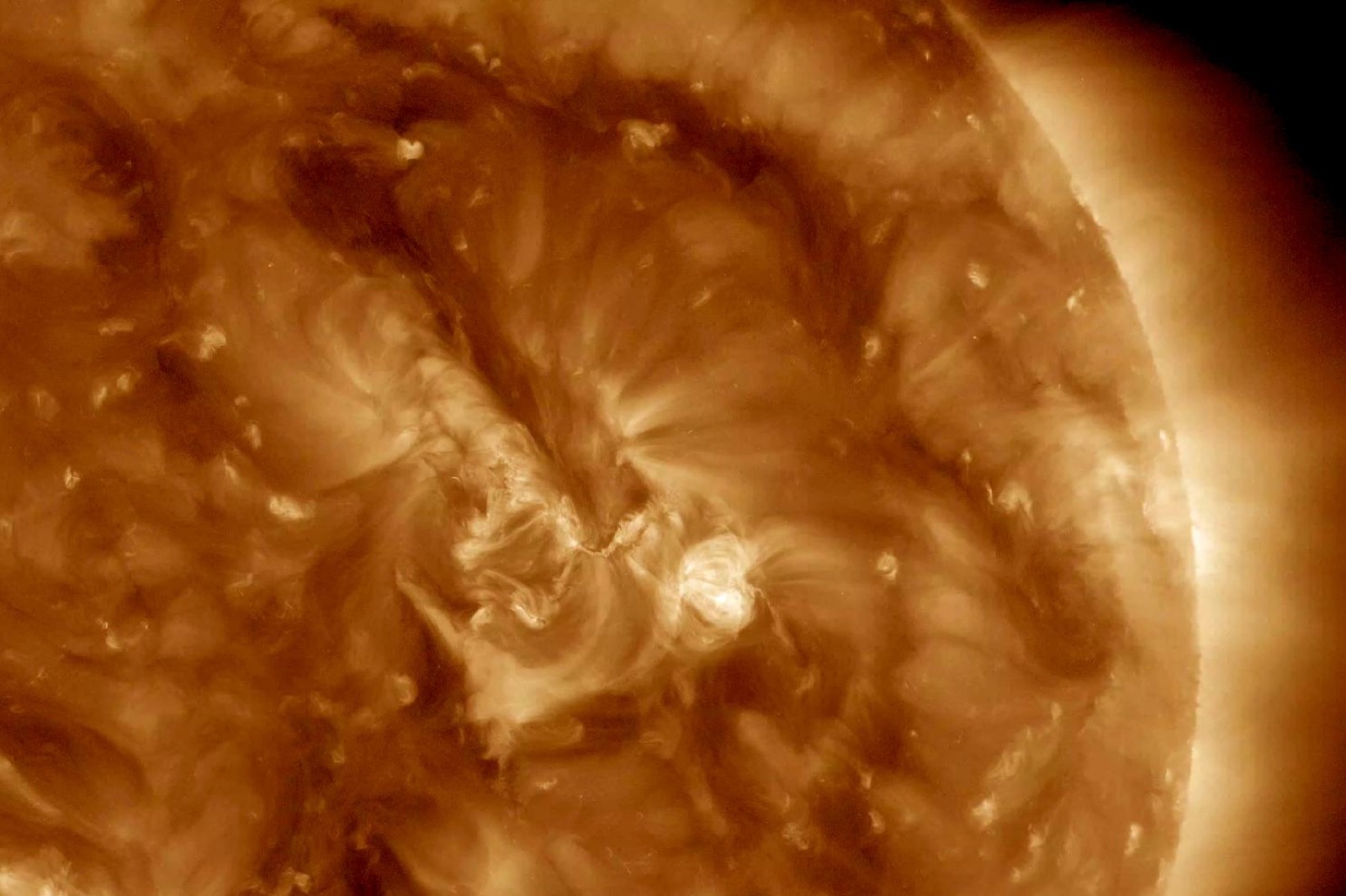
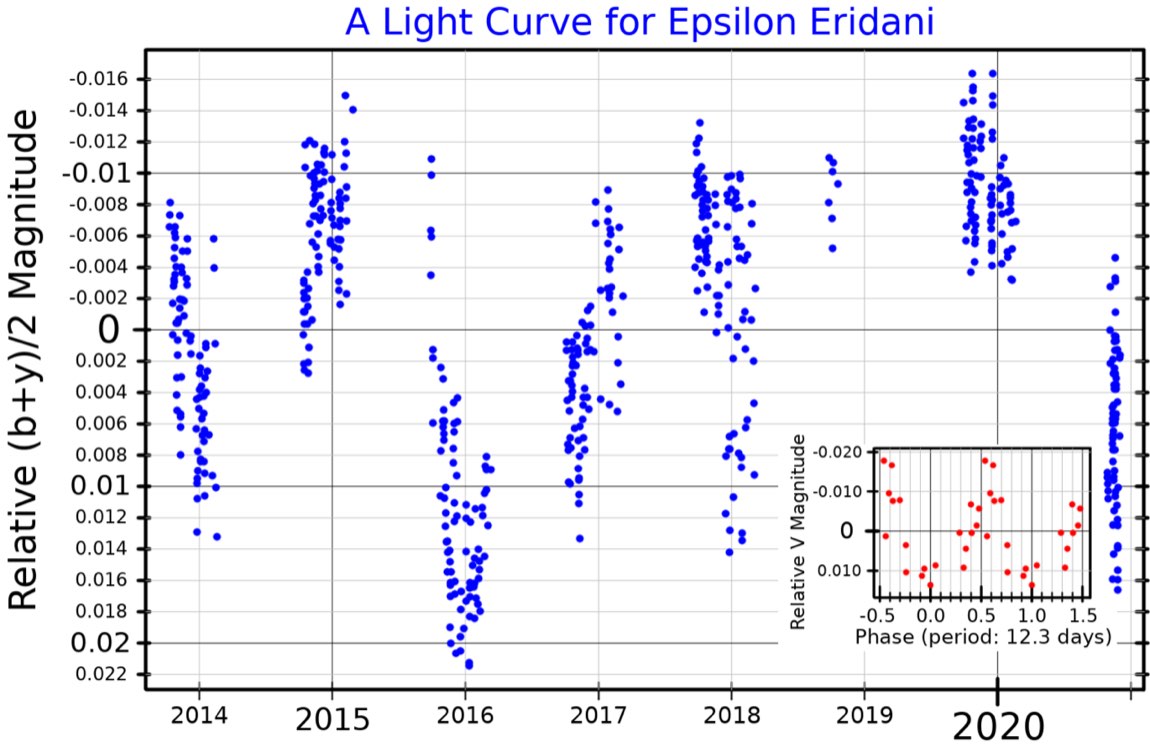
Epsilon Eridani's relative youth — estimated between 200 million and 800 million years old — expresses itself most vividly in its magnetic behaviour. The average magnetic field strength across its entire surface is (1.65 ± 0.30) × 10⁻² tesla, more than forty times greater than the (5–40) × 10⁻⁵ T field typical of the Sun's photosphere. The best model for this field assumes that patches carrying a flux of about 0.14 T randomly cover roughly 9% of the photosphere, with the remaining surface largely field-free. These active regions migrate into and out of view as the star rotates, classifying it as a BY Draconis variable with brightness variations of as much as 0.050 in visual magnitude. The star also exhibits two overlapping magnetic activity cycles of 2.95 ± 0.03 years and 12.7 ± 0.3 years — shorter and more complex than the Sun's single 11-year cycle. The long-term variation in activity level produces a temperature swing of 15 K and a corresponding visual magnitude change of 0.014. This magnetic turbulence also creates radial velocity jitter of 15 m s⁻¹ over a 20-year span, far above the 3 m s⁻¹ measurement uncertainty, complicating the search for orbiting planets.
04 A Stellar Wind That Dwarfs the Sun's
The hot corona of Epsilon Eridani drives a stellar wind 30 times more powerful than the Sun's in terms of mass loss rate. That wind streams outward until it rams into the surrounding interstellar medium, inflating a vast bubble of heated hydrogen called an astrosphere — the stellar equivalent of our own heliosphere. Measurements of the absorption spectrum of this gas, taken with the Hubble Space Telescope, have allowed scientists to characterize the wind's properties indirectly. The resulting astrosphere spans approximately 8,000 au (0.039 parsecs), with a bow shock sitting 1,600 au (0.0078 parsecs) out from the star itself. Seen from Earth, this astrosphere subtends about 42 arcminutes on the sky — wider than the apparent diameter of the full Moon, even though the structure itself is almost incomprehensibly large. Inside the planetary system, this intense wind efficiently sweeps fine dust grains out of the innermost 2.5 au, helping keep that region clear. The corona responsible for powering the wind reaches a temperature of 3.4 × 10⁶ K and produces an X-ray luminosity of about 2 × 10²⁸ erg s⁻¹ (2 × 10²¹ W) — brighter in X-rays than the Sun even at the Sun's most active.
05 The Debris Disc: A Young Solar System in Progress
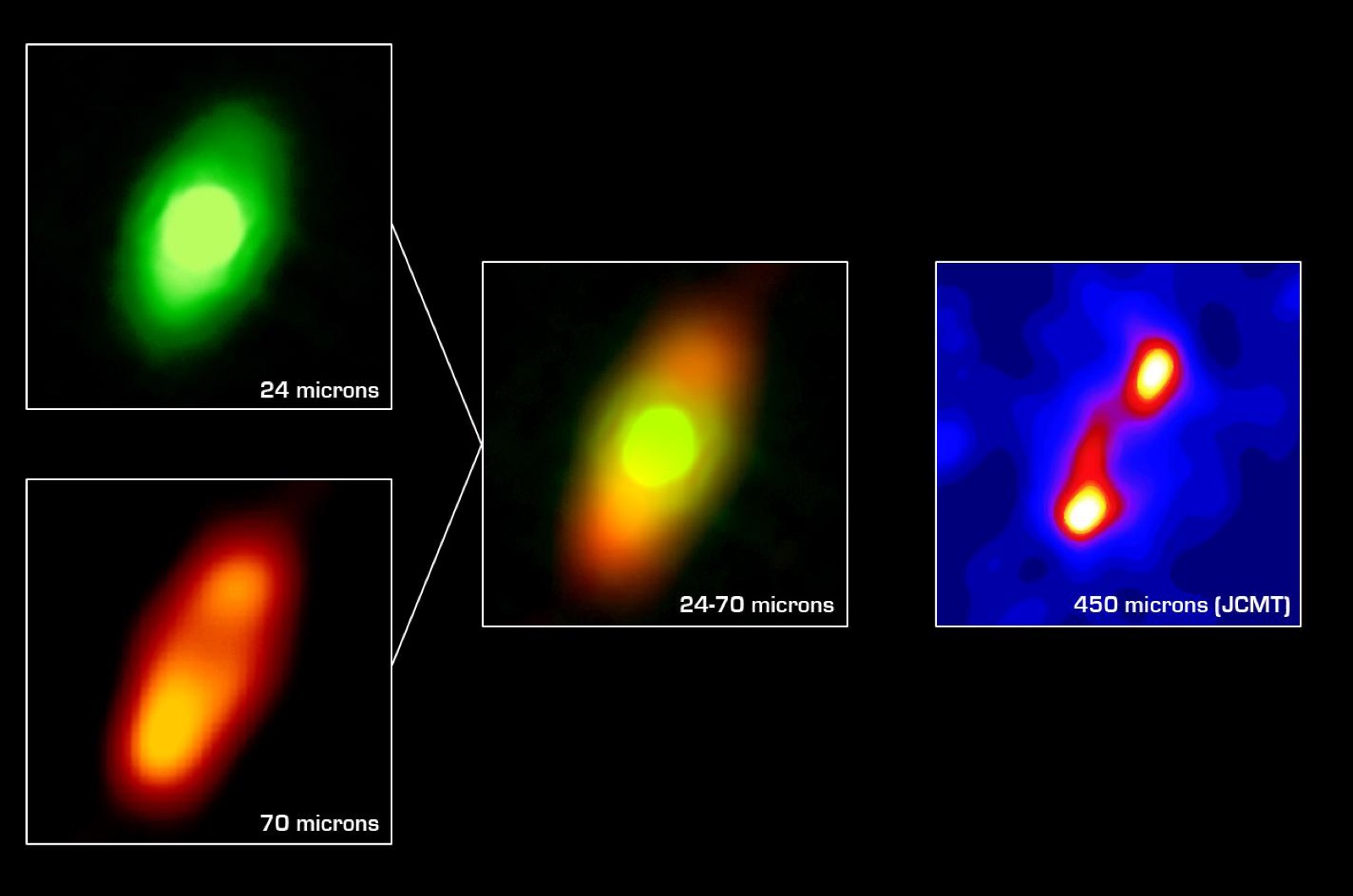
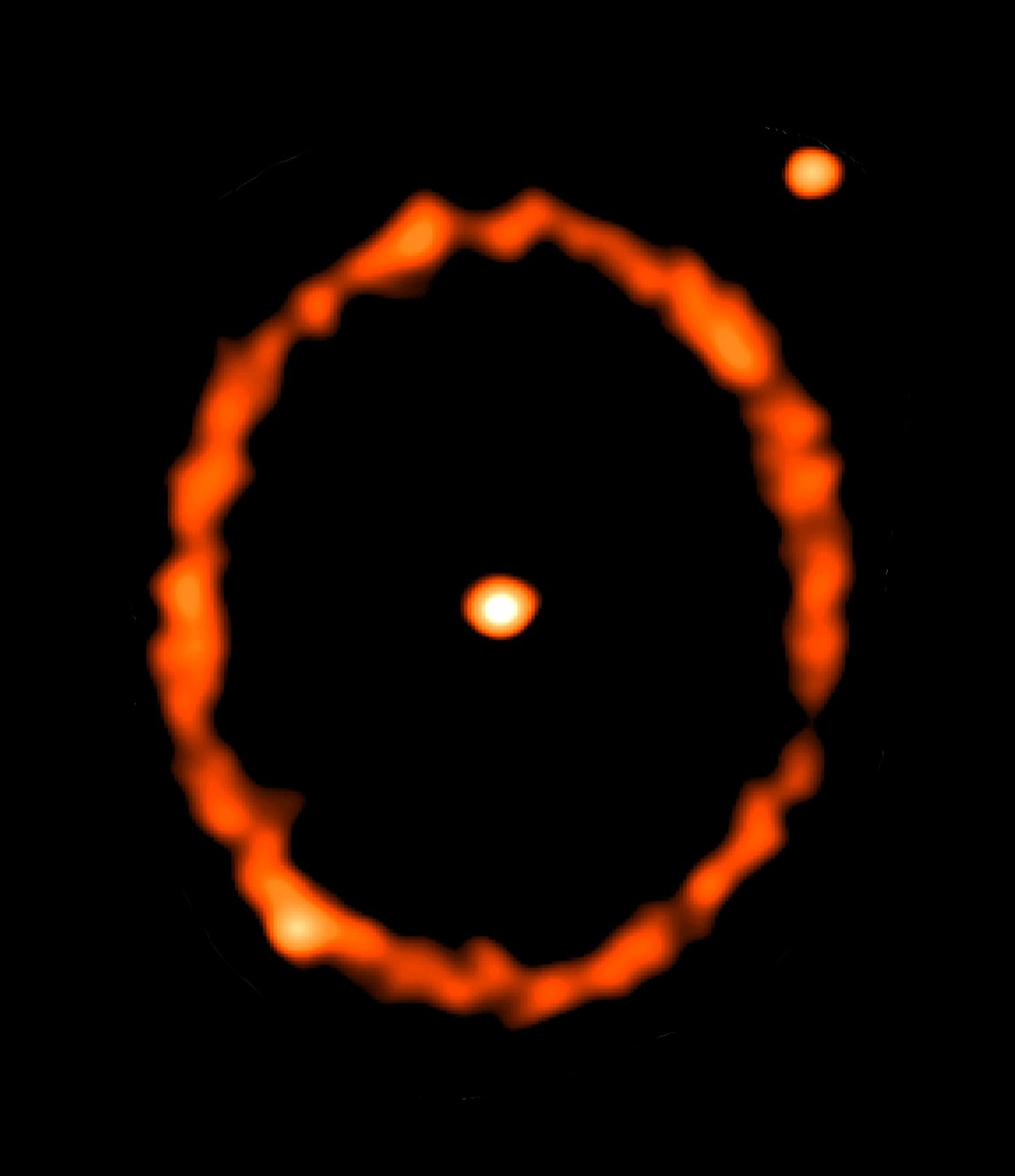
The first hint of a disc around Epsilon Eridani came from the IRAS space telescope, launched in 1983, which detected excess infrared emission from the star. Later observations with the James Clerk Maxwell Telescope at a wavelength of 850 μm resolved the disc for the first time, revealing extended emission out to 35 arcseconds. High-resolution follow-up with the Atacama Large Millimeter Array pinned the main outer belt at 70 au from the star — about twice the Sun–Pluto distance — with a width of just 11 au, and tilted 33.7° from face-on. The disc contains an estimated dust mass equal to about one sixth of the Moon's mass, with individual grains larger than 3.5 μm at a temperature of roughly 55 K. That dust is being generated by collisions among comets ranging 10 to 30 km in diameter, whose combined mass is 5 to 9 times Earth's — comparable to the estimated 10 Earth masses once held in the primordial Kuiper belt. Crucially, the timescale for all existing dust to be swept away is shorter than the star's age, confirming that the disc is actively replenished rather than a primordial remnant.
06 Three Asteroid Belts and a Cloud of Zodiacal Dust Deeper
Spitzer Space Telescope observations revealed that Epsilon Eridani's inner system is more architecturally complex than a single outer belt. There appear to be two distinct inner asteroid belts separated by a gap, plus a diffuse cloud of exozodiacal dust analogous to the fine particles that occupy the plane of our own Solar System. The innermost belt orbits at 3.00 ± 0.75 au from the star and is composed of silicate grains 3 μm in diameter with a combined mass of about 10¹⁸ kg. A second, denser belt sits between this inner ring and the outer comet disc at 70 au. The innermost 2.5 au appears clear of dust down to the detection limit of the 6.5 m MMT telescope, swept clean by the intense stellar wind. Modellers note that maintaining all three disc components simultaneously requires more than two planets in the system. An alternative explanation for the exozodiacal dust traces it to grains migrating inward from the outer belt via the Poynting–Robertson effect and stellar wind drag, with the mix transitioning from ice-and-silicate outside 10 au — where temperatures fall below 100 K — to pure silicate grains closer in, where volatiles would sublimate away.
 ⤢
⤢
07 The Planet AEgir: Confirmed After Two Decades of Debate
The story of Epsilon Eridani b — now named AEgir — is one of the most prolonged confirmation sagas in exoplanet science. Radial velocity evidence was announced in 2000 after a campaign led by Artie P. Hatzes that ran from 1980 to 2000. The signal showed a period of about seven years with no matching variation in ionized-calcium emission lines, which would have betrayed stellar activity rather than a planet. Astrometric support came from Hubble Space Telescope measurements between 2001 and 2003. Yet a 2008 study still called the detection "tentative," and a 2013 La Silla Observatory search program failed to confirm it. Studies from 2018 onward gradually rebuilt the case using combined radial velocity and astrometry data. Recent orbital solutions place the period between 7.3 and 7.6 years, the semimajor axis between 3.38 and 3.53 au, and the mass between 0.63 and 0.78 Jupiter masses from newer astrometry — though some parameters, especially orbital eccentricity, remain debated, with values ranging from 0.055 to 0.26. The uncertainty matters practically: an eccentricity as high as 0.7 would drive the planet through the inner asteroid belt and clear it within about ten thousand years, which seems inconsistent with the belt's observed existence.
08 Close Stellar Encounters, Past and Future Deeper
Epsilon Eridani is not standing still relative to its neighbours. It moves across the sky at a combined proper motion of 0.962 arcseconds per year and is receding from the Sun at +15.5 km/s (35,000 mph). It traces an orbit around the Milky Way at a mean galactocentric distance of 28.7 thousand light-years, with a low orbital eccentricity of 0.09. Over the past million years, three stars are believed to have come within 7 light-years of Epsilon Eridani. The most recent was Kapteyn's Star, which passed as close as about 3 light-years (0.92 pc) roughly 12,500 years ago. Earlier, more distant encounters occurred with Sirius and Ross 614. None are thought to have been close enough to disturb the circumstellar disc. Epsilon Eridani itself made its closest approach to the Sun about 105,000 years ago, when the two stars were 7 light-years apart. Looking ahead, simulations predict that the binary system Luyten 726-8 — which includes the flare star UV Ceti — will encounter Epsilon Eridani in roughly 31,500 years at a minimum separation of about 0.9 light-years (0.29 pc), remaining within 1 light-year for approximately 4,600 years. If Epsilon Eridani possesses an Oort cloud, that passage could gravitationally perturb long-period comets orbiting within it.
09 How the Disc Was Mapped, Clump by Clump Deeper
When the James Clerk Maxwell Telescope first resolved the outer disc at 850 μm, the images hinted at clumpy structure — uneven concentrations of dust suggesting that a planet was herding material into resonant orbits. A hypothetical second planet, informally called Epsilon Eridani c, was proposed to sit between 40 and 50 au and to be responsible for corralling dust into integer orbital resonances, such as the 3:2 resonance where disc material completes two orbits for every three of the planet. However, subsequent higher-resolution investigation identified the brightest apparent clumps as background sources unrelated to the disc, and the remaining clumps remain a subject of active debate rather than settled evidence. Separately, imaging with the James Webb Space Telescope has ruled out any planet more massive than Saturn orbiting beyond 16 au, while Spitzer data constrain objects of three or more Jupiter masses out to at least 500 au. The disc also contains less than 2.2 × 10¹⁷ kg of carbon monoxide, indicating a relative scarcity of volatile-bearing comets and icy planetesimals compared with our own Kuiper belt — a chemical fingerprint of how differently this system may have evolved.
10 Frank Drake, Project Ozma, and the Signal That Never Came
Epsilon Eridani has the distinction of being one of the first two stars ever targeted in a formal scientific search for extraterrestrial intelligence. In 1960, physicist Frank Drake used the 26-metre Tatel Telescope to observe Epsilon Eridani and Tau Ceti at 1,420 MHz — the 21 cm emission frequency of neutral hydrogen — reasoning that a technologically advanced civilisation might choose that wavelength as a universal beacon. The project, called Ozma, detected nothing of intelligent origin. Drake repeated the experiment in 2010, again without success. In 1977, William I. McLaughlin proposed using observable nova explosions as synchronisation signals for interstellar communication; the National Radio Astronomy Observatory tested the idea in 1988 by using outbursts of Nova Cygni 1975 as a timer and monitoring Epsilon Eridani for 15 days — again, no anomalous signals were found. Project Phoenix, a microwave survey launched in 1995, also included Epsilon Eridani among its targets; by 2004 the project had checked about 800 stars without detecting any signals. In a 1964 RAND Corporation study, space scientist Stephen H. Dole estimated the probability of a habitable planet orbiting Epsilon Eridani at 3.3%, ranking it among the 14 nearby stars then considered most promising.
11 Differential Rotation and What It Tells Us Deeper
Like the Sun, Epsilon Eridani does not spin as a rigid body. Photometric monitoring has revealed differential rotation: its equatorial region completes a rotation in about 11.2 days on average, while higher latitudes take longer, with the full measured range spanning 10.8 to 12.3 days. This is already strikingly fast — less than half the Sun's equatorial rotation period of about 25 days — and consistent with the star's youth. The axial tilt of Epsilon Eridani toward Earth's line of sight remains highly uncertain, with published estimates ranging from 24° to 72°, a spread that reflects how difficult it is to determine inclination without complementary data. This uncertainty cascades into planet-mass estimates: the radial velocity method yields only m sin i, where i is the orbital inclination, so the true planetary mass depends on knowing which way the system is tilted. Early Hubble astrometry suggested an inclination of about 30° for the orbit of planet b, implying a mass of 1.55 ± 0.24 Jupiter masses, but more recent astrometric studies favour a range of 0.63 to 0.78 Jupiter masses, pointing to a higher inclination than initially assumed.
12 How to Find Ran in the Night Sky
Epsilon Eridani sits in the northern part of the constellation Eridanus, approximately 3° east of the slightly brighter star Delta Eridani. With a declination of −9.46°, it is accessible from nearly the entire inhabited world — only observers north of latitude 80° N are permanently denied a view. Its apparent magnitude of 3.73 is bright enough to see with the naked eye under reasonably dark skies, though light pollution over cities can render it difficult to spot. In the late-autumn and winter evenings in the Northern Hemisphere, Eridanus rises in the southeast after nightfall, and Epsilon Eridani appears as a distinctly orange-tinted star — its K2 spectral class gives it an effective temperature of about 5,084 K, noticeably cooler and redder than the Sun's white-yellow light. For observers who want a sense of cosmic reciprocity: from Epsilon Eridani itself, our Sun would appear as a star in the constellation Serpens with an apparent magnitude of 2.4 — visible to the naked eye, but not dramatically bright.
 ⤢
⤢