 Photograph · NASA/JPL/Caltech/Maxwell Telescope
Star · Deep guide
Fomalhaut
Ringed by dust, the lonely autumn star is home to a famous vanishing 'planet'.
What is it?
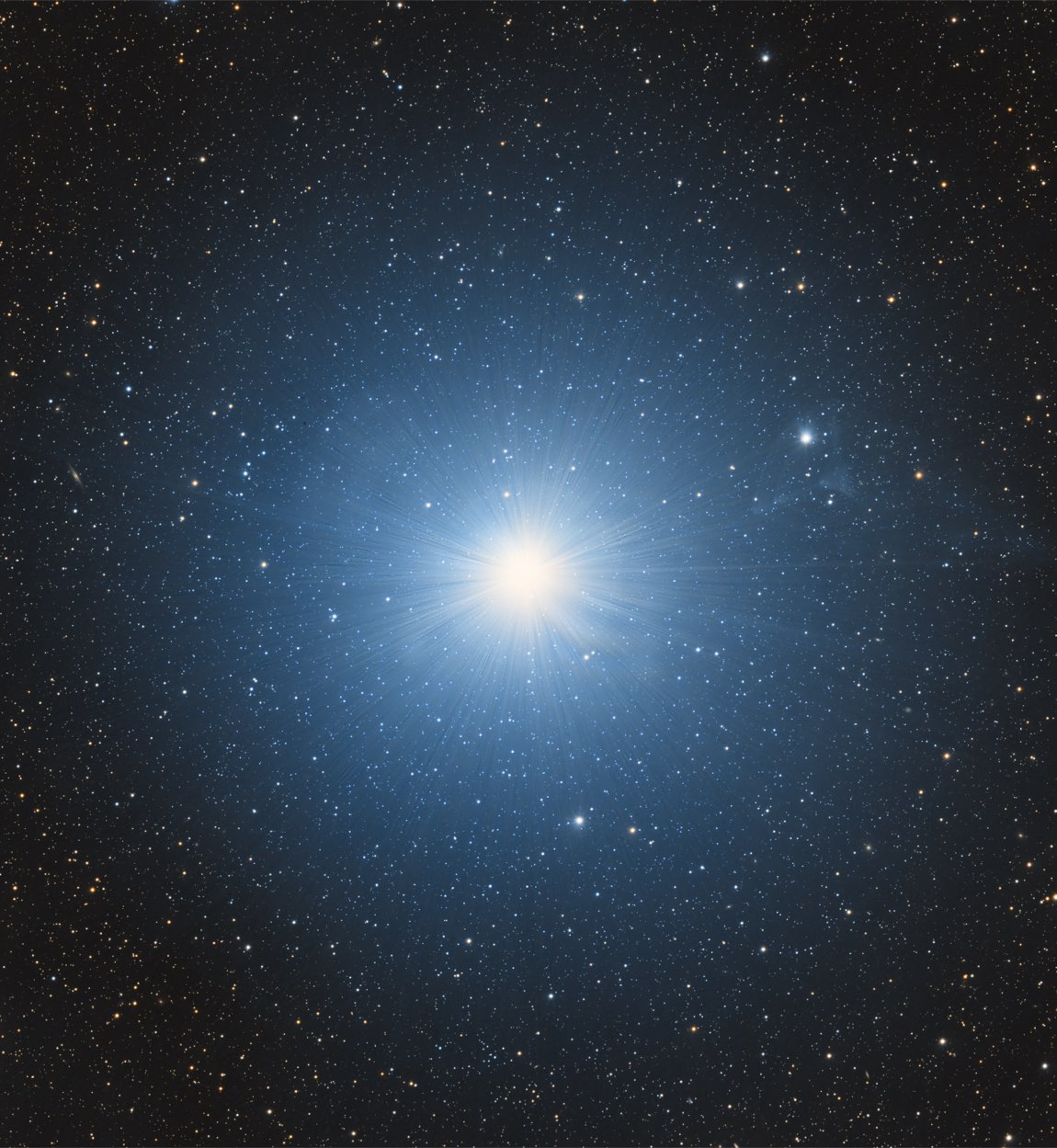
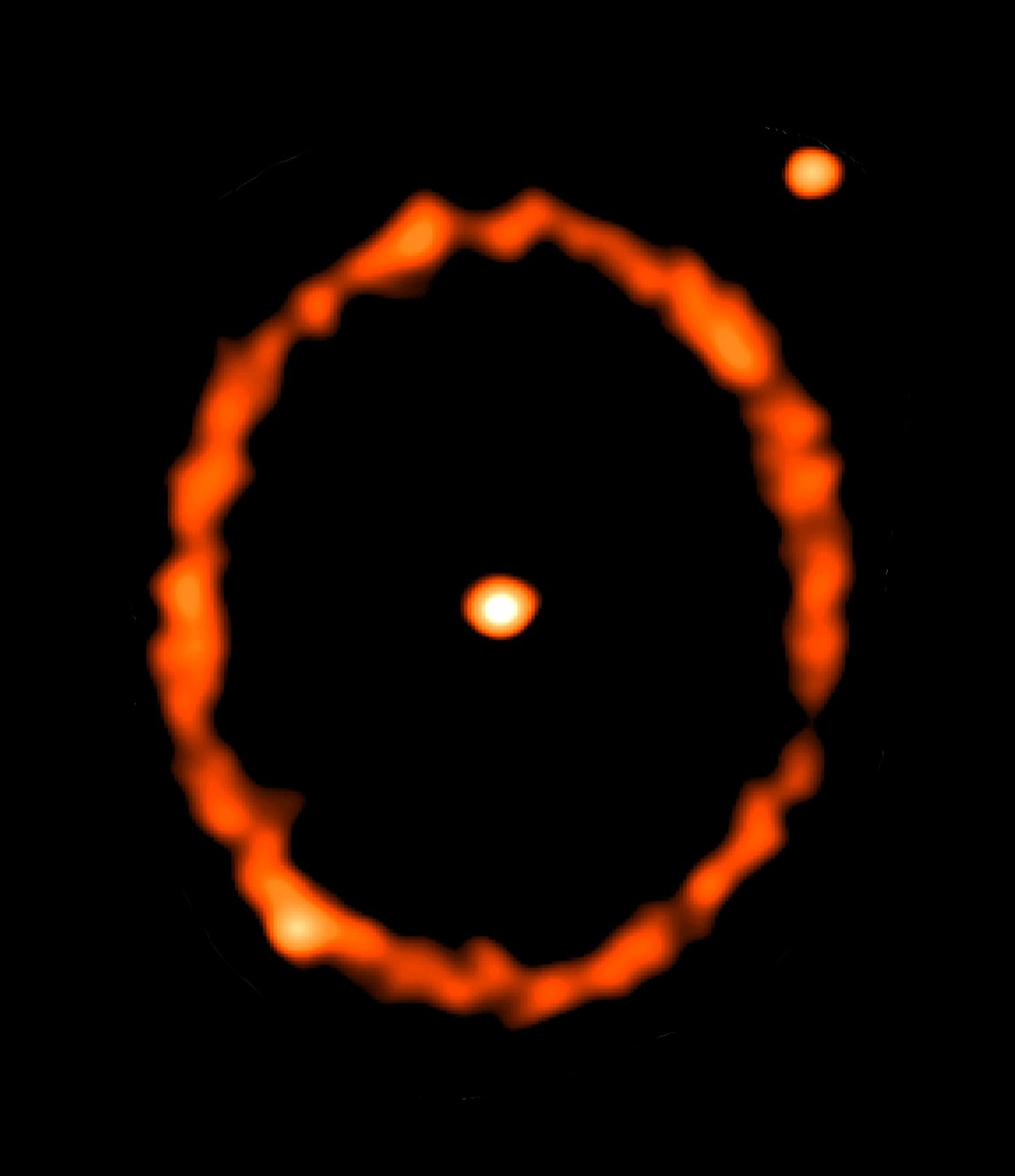
Fomalhaut, 25 light-years away, is the solitary bright star of northern autumn evenings, surrounded by a vast ring of planet-forming debris that Hubble and JWST have imaged in stunning detail. Its cautionary tale: 'Fomalhaut b', hailed in 2008 as the first directly photographed exoplanet, gradually faded and spread — it was almost certainly an expanding dust cloud from a collision, not a planet. Science corrected itself in public.
The deep dive
Researched for the Atlas from Wikipedia — Fomalhaut (14,230 characters read) · updated Sep 20, 2026
01 A Star That Anchors the Classification System
Since 1943, Fomalhaut's spectrum has served as one of the stable anchor points by which astronomers classify other stars. That means when researchers need to pin down what a class A main-sequence star looks like, Fomalhaut is one of the fixed reference standards they reach for. It is also designated a Vega-like star, a category defined by the emission of excess infrared radiation beyond what the star's own heat would produce. That excess infrared is the telltale fingerprint of a surrounding circumstellar disk — solid material orbiting the star and radiating warmth it has absorbed from starlight. Fomalhaut is therefore not just a bright star but a calibration tool embedded in the infrastructure of modern astronomy. Its Bayer designation, Alpha Piscis Austrini, marks it as the leading star of the Southern Fish constellation, a position it was formally assigned in the 17th century by Johann Bayer, settling an older dispute: the classical astronomer Ptolemy had grouped it with Aquarius, and John Flamsteed in 1725 still labeled it 79 Aquarii before the modern consensus settled on Bayer's placement.
02 A Triple Star Hidden in Plain Sight
Most people think of Fomalhaut as a solitary beacon in an otherwise sparse patch of southern sky, but it is actually the brightest member of a triple star system. Its companion Fomalhaut B is the K4-type main-sequence star TW Piscis Austrini, sitting 0.28 parsecs — roughly 0.91 light-years — away, and its space velocity agrees with Fomalhaut's own motion to within 0.1±0.5 km/s, consistent with a gravitationally bound pair. A recent age estimate for TW PsA of 400±70 million years matches Fomalhaut's own isochronal age of 450±40 million years, strengthening the case that the two formed together. Then there is Fomalhaut C, the red dwarf LP 876-10, a spectral type M4V star located about 0.77 parsecs (2.5 light-years) from Fomalhaut A and so far away it sits in the neighbouring constellation Aquarius — roughly 5.7 degrees from Fomalhaut A on the sky. Despite that enormous separation, LP 876-10 falls well within the system's tidal radius of 1.9 parsecs (6.2 light-years). Astronomer Eric Mamajek and collaborators from the RECONS consortium announced the connection in October 2013, matching LP 876-10's distance, velocity, and position on the color-magnitude diagram to the Fomalhaut system.
03 A Flare Star and a Suspected Planet Next Door Deeper
Fomalhaut B, TW Piscis Austrini, is classified as a BY Draconis variable — a category of flare star — and varies in apparent magnitude between 6.44 and 6.49 over a period of 10.3 days. While technically a flare star, it is notably larger than most members of that class; the typical flare star is a red M-type dwarf, making TW PsA's K4 classification a relative giant among flares. In 2019, a team analyzing astrometry, radial velocity measurements, and direct images of Fomalhaut B proposed that a planet orbits it with a mass of 1.2 with an uncertainty of +0.7 and −0.6 Jupiter masses, and an orbital period loosely estimated around 25 years, though that period estimate remains poorly constrained. Meanwhile, LP 876-10, Fomalhaut C, was originally catalogued by astronomer Willem Luyten in his 1979 NLTT catalogue purely as a high-proper-motion star; a precise trigonometric parallax and radial velocity were only measured much more recently. Although LP 876-10 appears in the Washington Double Star Catalog under the designation WSI 138 as a binary, the Mamajek et al. study found no evidence of a close stellar companion in their imaging, spectral, or astrometric data.
 ⤢
⤢
04 Layers of Debris: A Complex Disk System Deeper
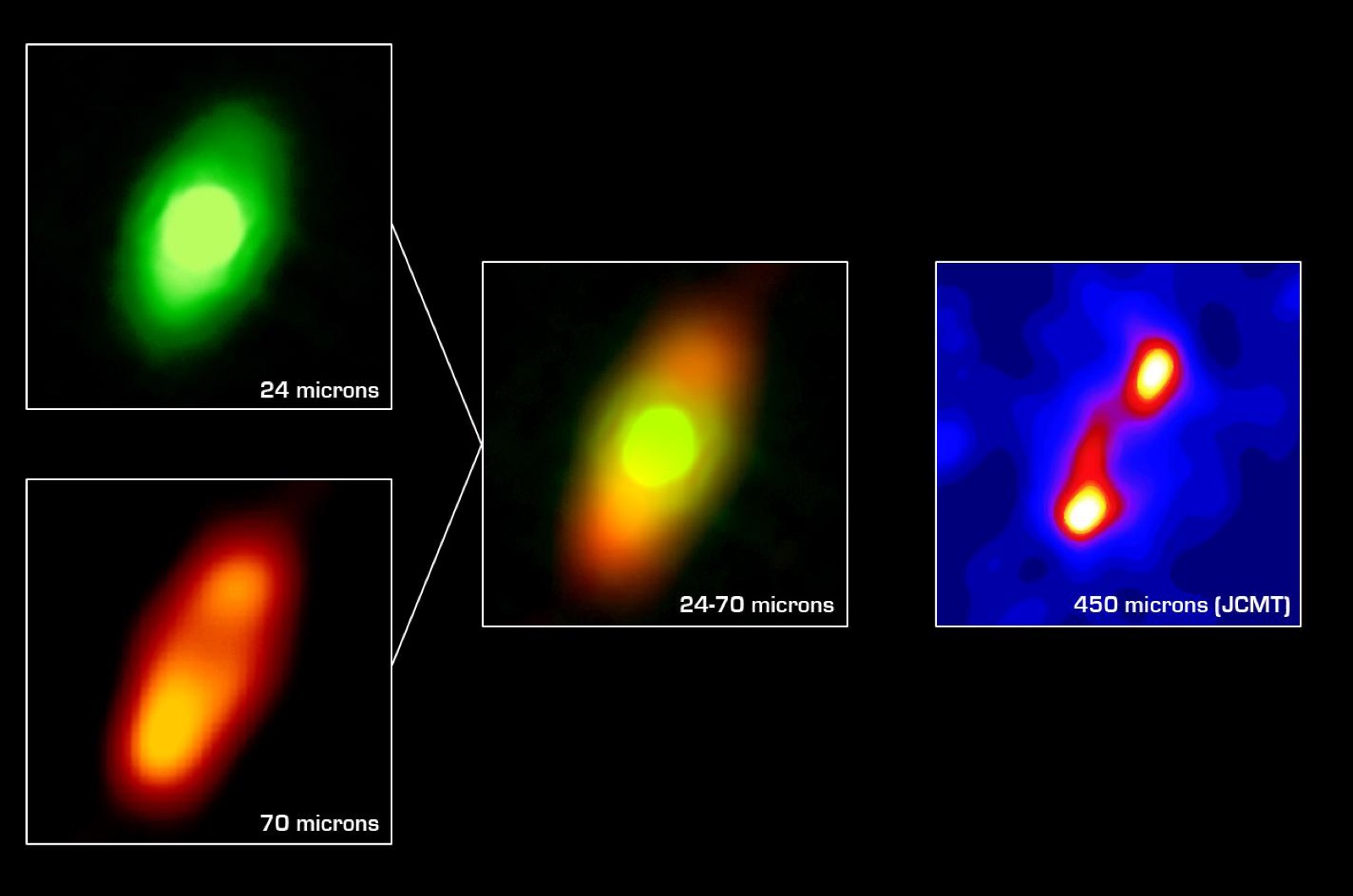
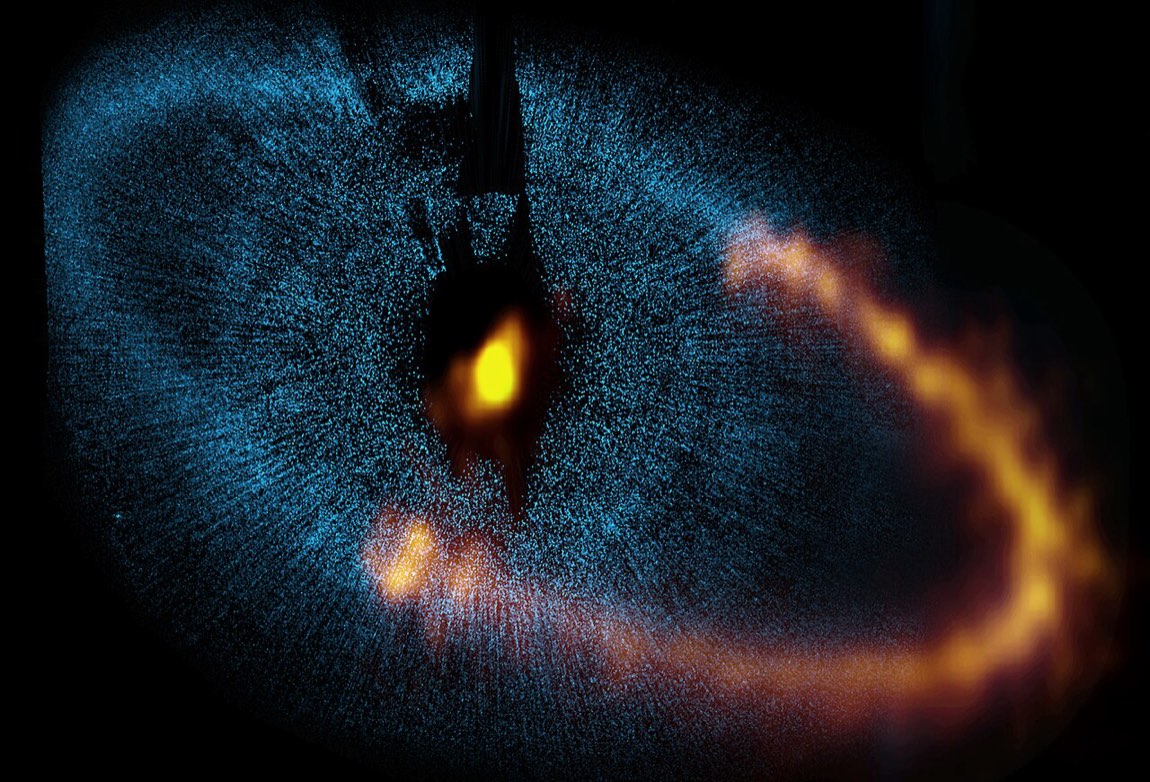
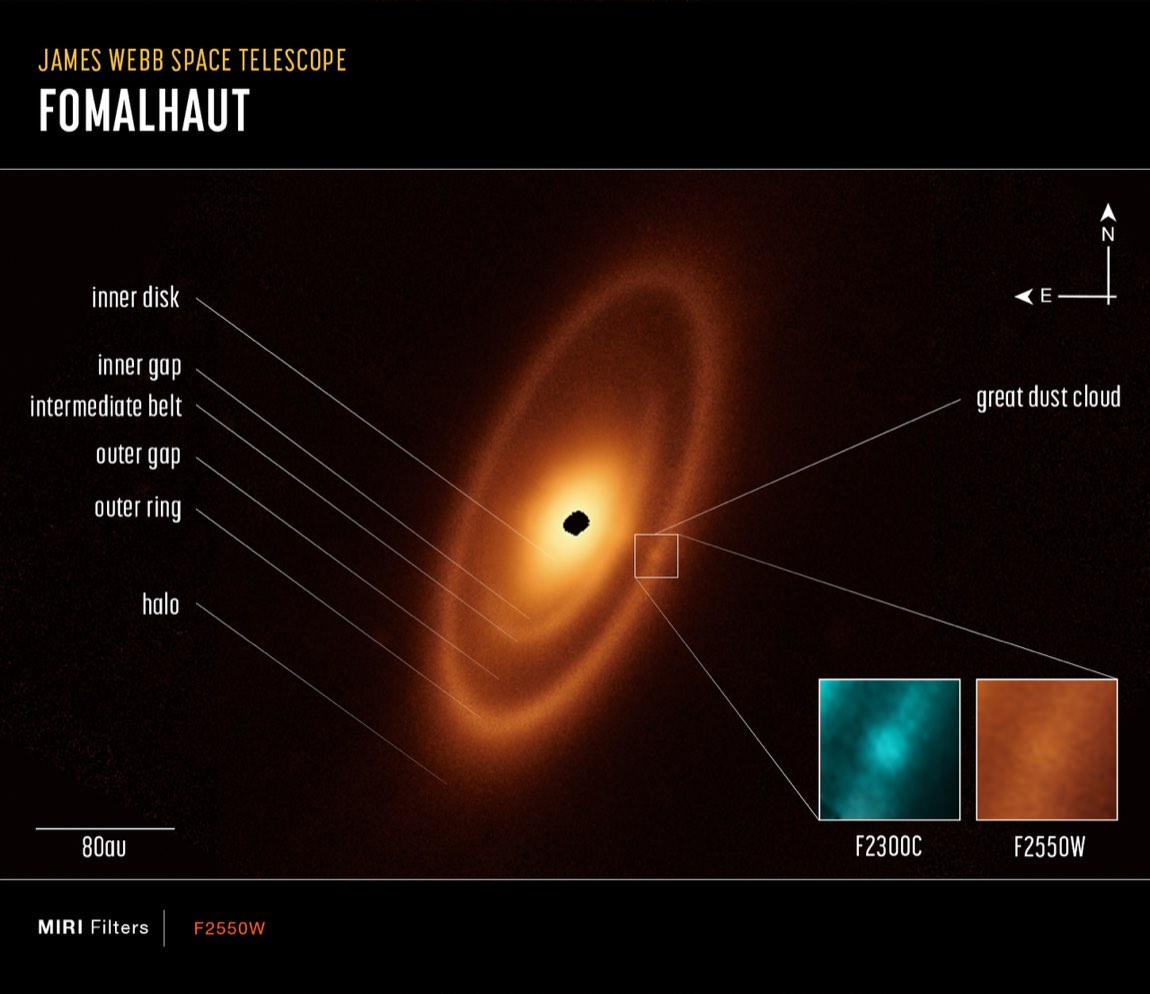
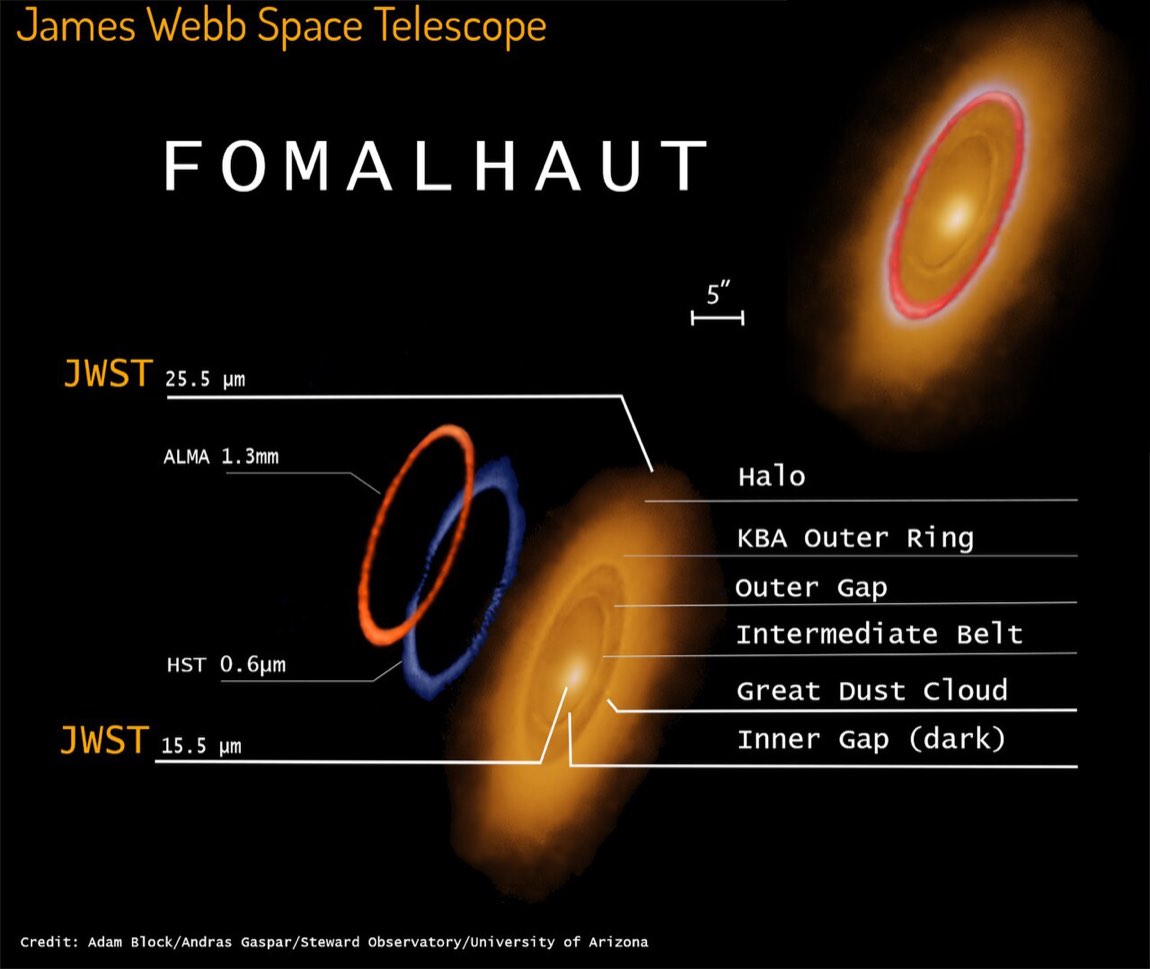
Fomalhaut is not surrounded by a single neat ring but by several distinct debris disks nested at very different distances. Closest to the star is a high-carbon, small-grain ash disk, with grain sizes between 10 and 300 nanometres, clustering at just 0.1 AU — a region whose origin remains unexplained. Beyond that lies a disk of larger particles with an inner edge between 0.4 and 1 AU. The most famous structure is the outermost disk, centered at a radial distance of 133 AU (equivalent to 1.99×10¹⁰ km), shaped as a torus about 25 AU wide with a strikingly sharp inner edge, and inclined 24 degrees from edge-on. Its geometric center is offset from Fomalhaut itself by about 15 AU, and it is often compared to the Solar System's Kuiper Belt. Measurements of Fomalhaut's rotation confirm the disk sits in the star's equatorial plane, as planet-formation theory predicts. Herschel Space Observatory images analyzed in 2012 showed the outer belt is rich in fluffy micrometer-sized dust whose grain morphology suggests a cometary origin, and because stellar radiation pressure should sweep such grains away quickly, their persistence implies constant replenishment at a rate of approximately 2,000 kilometre-sized comets colliding per day.
05 How Fomalhaut b Went from Planet to Debris Cloud
On November 13, 2008, astronomers announced a world-first: an extrasolar planet candidate directly imaged in visible light by the Hubble Space Telescope, orbiting just inside Fomalhaut's outer debris ring. Named Fomalhaut b and later given the public name Dagon, it was estimated to have a mass less than three times that of Jupiter and at least the mass of Neptune. The discovery made headlines globally, but doubts accumulated quickly. M-band images from the MMT Observatory placed strong limits on gas giants within 40 AU, and Spitzer Space Telescope imaging suggested the object behaved more like a dust cloud than a planet. A 2019 synthesis of new and archival direct observations confirmed that the object was expanding, losing brightness, and lacked enough mass to measurably perturb the outer ring as it crossed it. The conclusion: Fomalhaut b is most likely a dispersing cloud of debris from a massive planetesimal collision, traveling on a hyperbolic orbit that will eventually carry it out of the Fomalhaut A system entirely. Follow-up James Webb Space Telescope observations in 2022 at mid-infrared wavelengths using the MIRI instrument failed to resolve the object, which the research team reported was consistent with that dispersing-cloud interpretation.
06 New Collisions and a Lingering Mystery Object Deeper
The story of violent collisions in the Fomalhaut system did not end with Fomalhaut b. The same 2022 James Webb Space Telescope imaging data that failed to detect Fomalhaut b revealed another apparent feature in the outer disk, quickly dubbed the "Great Dust Cloud." However, a separate team analyzing the same data alongside other existing observations concluded it is more likely a coincident background object unrelated to the ring. A 2023 study then detected ten point sources around Fomalhaut in total; analysis determined all but one to be background objects — including the Great Dust Cloud — but the nature of the remaining point source is still unclear: it could be a background object or a genuine planetary companion to Fomalhaut. Then in December 2025, yet another major collision event was reported in the system, noted to resemble the original Fomalhaut b collision, reinforcing the picture of an active, collision-rich debris environment. ALMA observations of the outer dust ring had also previously suggested the possible existence of two planets in the system, with constraints placing any planet between 4 and 10 AU at under 20 Jupiter masses, and any planet from 2.5 AU outward likewise below 20 Jupiter masses.
 ⤢
⤢
07 How Young Is Fomalhaut, Really? Deeper
Pinning down Fomalhaut's age has proven surprisingly tricky. For many years the star was thought to be only 100 to 300 million years old, which would make it extraordinarily young on stellar timescales — the Sun, for comparison, is about 4.6 billion years old. A 2012 study revised that estimate upward to 440±40 million years, and the isochronal age from stellar evolutionary modeling sits at 450±40 million years, broadly consistent with companion star TW PsA's age of 400±70 million years. Fomalhaut has also been claimed as a member of the Castor Moving Group, an association of stars including Castor and Vega that supposedly share a common origin and motion through space, with an estimated group age of 200±100 million years. However, more recent work found that the purported members of the Castor Moving Group show a wide spread of ages and velocities too different to plausibly trace back to a shared birthplace, meaning membership in that group cannot be used to constrain Fomalhaut's age. The star's total expected lifespan on the main sequence is only about a billion years — short by stellar standards — meaning even at 450 million years it is already nearly halfway through its life.
08 Fomalhaut's Chemistry: Slightly Metal-Poor Deeper
Stars are described as metal-rich or metal-poor based on how much of their mass consists of elements heavier than hydrogen and helium — astronomers collectively call these "metals" regardless of whether they are iron, carbon, or oxygen. Fomalhaut is slightly metal-deficient compared to the Sun, meaning a smaller fraction of its composition is these heavier elements. The precise degree of that deficiency, however, is contested. A 1997 spectroscopic study measured iron abundance at 93% of the Sun's value; a second 1997 study, inferring metallicity from companion star TW Piscis Austrini, arrived at 78%. A 2004 stellar evolutionary model yielded 79%, close to that figure. But a 2008 spectroscopic measurement came back significantly lower at just 46% of solar iron abundance — a striking divergence that has not been fully resolved. This spread from 46% to 93% across different methods and epochs illustrates how sensitive metallicity determinations can be to observational technique and underlying assumptions, and it means Fomalhaut's precise heavy-element content remains an open question.
09 Finding Fomalhaut in the Night Sky
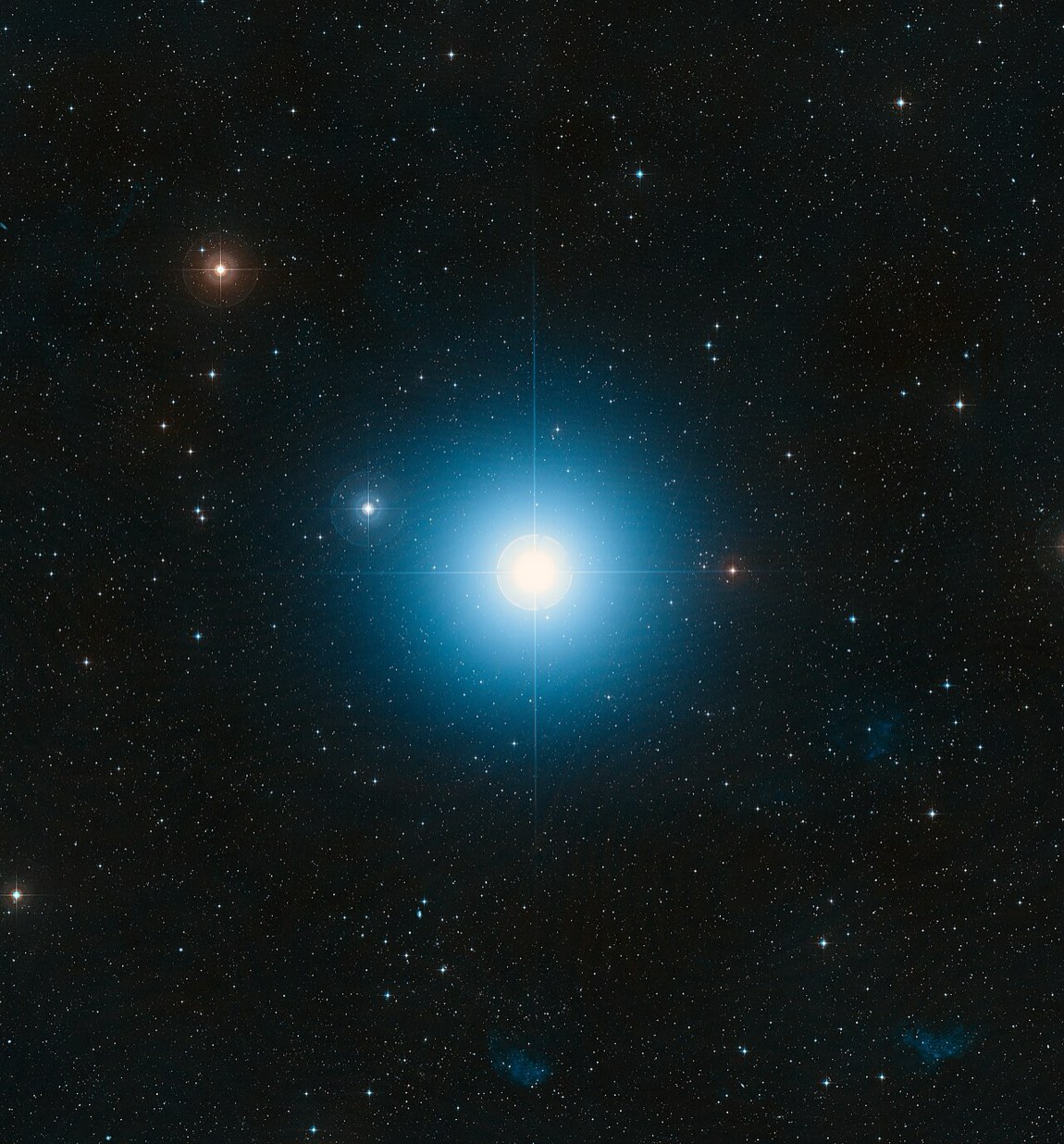
Fomalhaut sits at a declination of −29.6°, placing it south of the celestial equator and making it easiest to observe from the Southern Hemisphere. Yet its southerly declination is not as extreme as stars like Acrux, Alpha Centauri, or Canopus, so it remains visible across a large portion of the Northern Hemisphere as well, with autumn being the best season. From 40°N latitude, Fomalhaut rises above the horizon for just eight hours and climbs no higher than 20° above the horizon — a low skim that can make it appear orange-red from atmospheric dispersion, somewhat similar to Antares in its sky position. Compare that to Capella, which rises at roughly the same time but stays above the horizon for twenty hours. Northern observers can locate Fomalhaut using the Square of Pegasus as a pointer: trace a line southward from Beta Pegasi through Alpha Pegasi and continue for about 45 degrees; Fomalhaut appears with no bright stars interrupting the path. Its declination is similar to that of Antares and greater than that of Sirius, useful reference points for gauging its position.
 ⤢
⤢
10 Royal Star, Frog, and White Cockatoo
Fomalhaut carries one of the richest accumulations of cultural names of any star in the sky. Its traditional name flows from scientific Arabic, فم الحوت (fam al-ḥūt), meaning "the mouth of the Southern Fish" — or more literally "mouth of the whale" — translating Ptolemy's original Greek labeling. In Persian astronomical tradition it was counted as one of only four "royal stars," a distinction shared with Aldebaran, Regulus, and Antares, marking the four quarters of the sky. Early Arab astronomers also called it Difdi' al Awwal, "the first frog," with Beta Ceti serving as "the second frog." In Chinese astronomy it bore the name 北落師門 (Běiluòshīmén), meaning "Gate of the Northern Military Camp," where it stood alone marking that asterism. Indigenous Australians saw it differently: to the Moporr people of South Australia it is a male being called Buunjill, while the Wardaman people of the Northern Territory named it Menggen, meaning "white cockatoo." The star also marked the winter solstice in 2500 BC and was associated with worship of Demeter at Eleusis, reflecting its ancient calendrical importance. In more recent popular culture, the roughly circular shape of its debris ring prompted New Scientist magazine to dub it the "Great Eye of Sauron."
11 Ancient Earthworks Aligned to Its Rising
Fomalhaut's prominence in ancient skies left traces on the ground as well as in mythology. According to the Indiana Department of Natural Resources, the earthwork known as Fomalhaut-Earthwork B in Mounds State Park near Anderson, Indiana, is aligned with the rising of the star during autumn months, suggesting deliberate astronomical orientation by its builders. In 1980, astronomer Jack Robinson extended that argument further, proposing that the rising azimuth of Fomalhaut was intentionally marked by cairn placements at the Bighorn Medicine Wheel in Wyoming and the Moose Mountain Medicine Wheel in Saskatchewan, Canada. If correct, these alignments would place Fomalhaut among a select group of stars important enough to ancient North American peoples that they embedded its rising point into large-scale landscape architecture. The name Dagon, chosen by public vote in December 2015 as the formal IAU name for Fomalhaut b, adds yet another layer of cultural resonance: Dagon was a Semitic deity frequently depicted as half-man, half-fish, a fitting namesake for an object orbiting the star known as the Mouth of the Fish. The winning name was proposed by Todd Vaccaro and submitted by the St. Cloud State University Planetarium of St. Cloud, Minnesota.
12 Multiple Debris Disks Across Multiple Stars Deeper
One of the Fomalhaut system's most unusual distinctions is that debris disks have been detected around more than one of its stellar members — an exceedingly rare configuration. Fomalhaut A's outermost disk is the most famous, but in December 2013, Kennedy et al. reported the discovery of a cold dusty debris disk around Fomalhaut C (LP 876-10), detected in infrared images from the Herschel Space Observatory. Having multiple debris disks spread across multiple stars in the same gravitationally bound system is described in the article as exceedingly rare among known multiple-star systems. The disk around Fomalhaut A is believed to be protoplanetary — that is, the kind of structure from which planets form or recently tried to form — and emits considerable infrared radiation that first flagged the star as a Vega-like object. The fact that the outermost disk's geometric center is offset by about 15 AU from Fomalhaut A itself is one of the structural clues that suggested a shepherding planet might be shaping the ring's sharp inner edge, though Fomalhaut b's reclassification as a debris cloud has left that shepherding body unidentified.
 ⤢
⤢