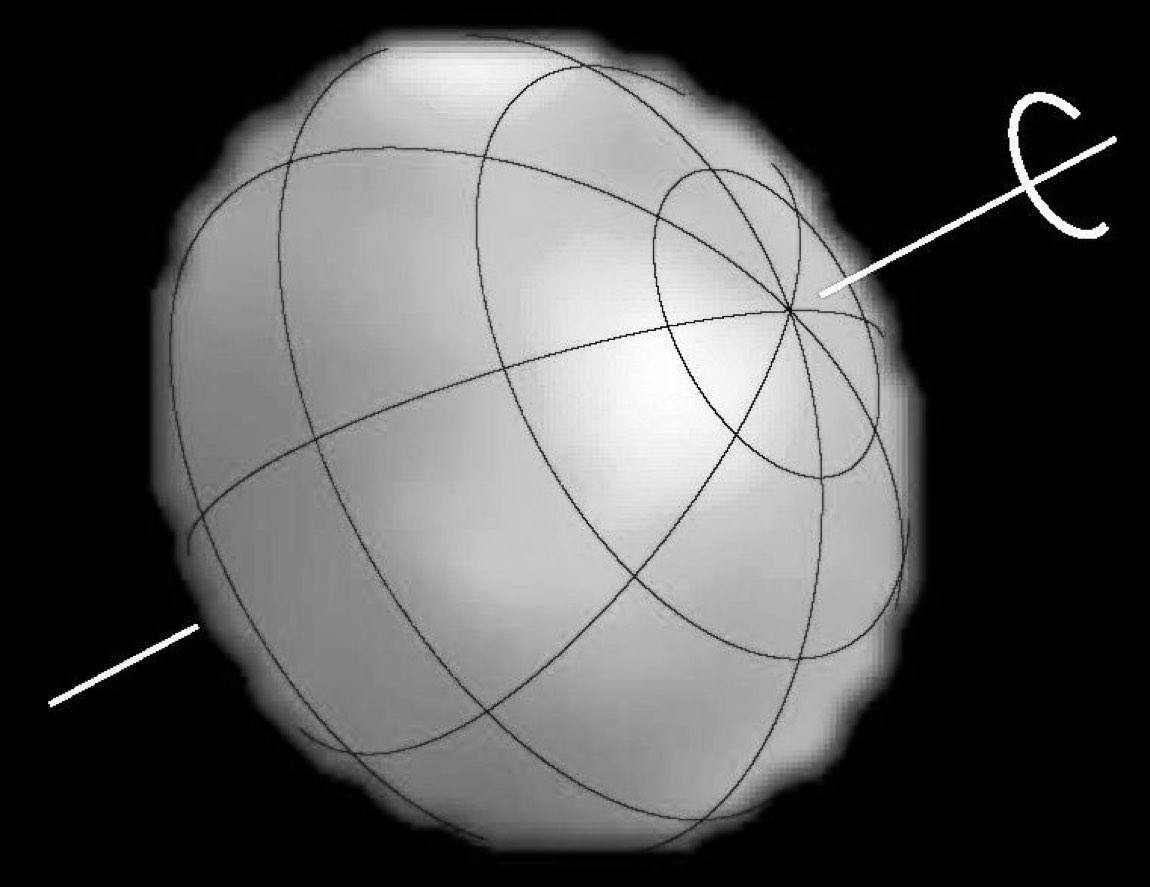
 Photograph · Altair_PR_image6.jpg : Ming Zhao, John Monnier derivative work: [[User:Omnidom 9 · Public domain
Star · Deep guide
Altair
A nearby star spinning so fast it flattens itself, Altair is the Eagle's eye.
What is it?
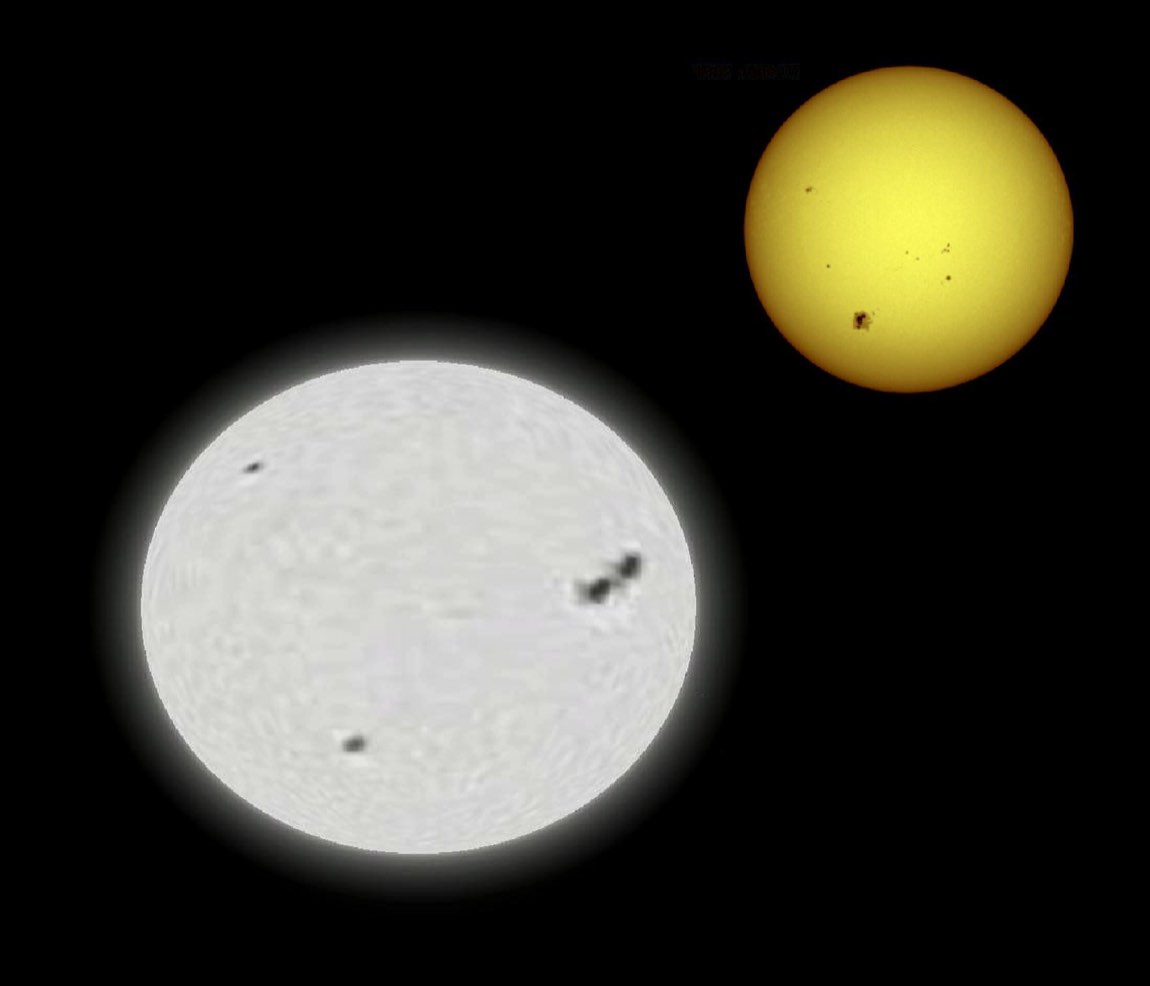
Altair, 16.7 light-years away in Aquila, is one of the closest bright stars and the Summer Triangle's southern point. It rotates in under 9 hours — so fast that it bulges into an oval, its equator about 20% wider than its poles. Interferometers have actually imaged its flattened shape, gravity-darkened poles and all.
The deep dive
Researched for the Atlas from Wikipedia — Altair (7,803 characters read) · updated Sep 20, 2026
01 A Star Spinning Near Its Breaking Point
Altair's most dramatic physical trait is its ferocious spin. Its equator whips around at approximately 286 km/s — fast enough that if you could stand on the equatorial surface, you would be moving at roughly 1,030,000 kilometres per hour. More striking still, that speed is already about 71 percent of the estimated 400 km/s breakup velocity at which the star's own gravity could no longer hold it together. For comparison, the Sun's equator rotates in just over 25 days; Altair completes a full rotation in under eight hours — a pace closer to the giant planets Jupiter and Saturn than to any typical star. This extreme spin is not just a curiosity: it reshapes the star physically, thermally, and in terms of its brightness distribution across its surface, making Altair one of the most geometrically distorted single stars known.
02 Squashed Like No Other Main-Sequence Star
Because Altair spins so fast, centrifugal effects push material outward at the equator, giving the star a pronounced oblate shape. Interferometric observations published in 2007 by J. D. Monnier and colleagues, using the MIRC instrument on the CHARA array, allowed astronomers to measure this distortion directly. They found an equatorial radius of 2.03 solar radii and a polar radius of only 1.63 solar radii — meaning the star bulges 25 percent wider at its waist than at its poles. To put that in perspective, Saturn's equatorial bulge is about 11 percent and Jupiter's about 9 percent. Even Vega, another famously fast rotator, shows only a 19 percent difference. Altair's oblateness had first been suspected by R. Hanbury Brown and colleagues at Narrabri Observatory in the 1960s, when they measured an angular diameter of 3 milliarcseconds, though their data were insufficient to confirm the flattening directly. Confirmation came from Palomar Testbed Interferometer measurements made in 1999 and 2000, published in 2001 by G. T. van Belle, David R. Ciardi, and co-authors.
03 Gravity Darkening: A Dimmer Waist, Brighter Poles Deeper
Rapid rotation does more than distort Altair's shape — it creates a striking temperature gradient across the star's surface. Because the equatorial regions bulge outward, local surface gravity there is weaker than at the poles. Weaker gravity means lower pressure in the outer layers, which in turn means a lower effective temperature and reduced luminosity. This phenomenon is called gravity darkening, or the von Zeipel effect, after the physicist who first predicted it theoretically. For Altair, gravity darkening was confirmed using measurements from the Navy Precision Optical Interferometer in 2001, subsequently analyzed by Ohishi et al. (2004) and Peterson et al. (2006). A further independent verification was published by A. Domiciano de Souza et al. (2005), combining Palomar and Navy interferometer data with new measurements from the VINCI instrument at the VLTI. The practical result is that Altair's poles glow hotter and brighter than its equatorial belt — a temperature map that no non-rotating star would ever produce and that had to await 21st-century interferometry to be seen directly.
04 The First Main-Sequence Star Ever Imaged
In a landmark achievement for observational astronomy, Altair became in 2007 the first main-sequence star other than the Sun to have its surface resolved into an actual image. J. D. Monnier and his coworkers captured infrared data in 2006 using the MIRC instrument on the CHARA array interferometer, then published the resulting false-color image in 2007. The image confirmed both the oblate shape and the gravity-darkening gradient simultaneously — darker at the equator, brighter toward the poles — in a single direct view. The polar axis was found to be inclined by about 60 degrees to the line of sight from Earth. Before this achievement, the internal structures and surface conditions of main-sequence stars could only be inferred from indirect measurements. Altair's proximity at 16.7 light-years and its large physical size made it the ideal target for breaking through this barrier.
 ⤢
⤢
05 A Young Star Still Near Its Starting Line
Altair is classed as a type-A main-sequence star with about 1.8 times the mass of the Sun and 11 times its luminosity. Current thinking places it at approximately 100 million years old — astronomically young, close to what scientists call the zero age main sequence, the point at which a star first begins burning hydrogen steadily in its core. Earlier estimates had put the age closer to one billion years, so there is genuine uncertainty in the figure. At 100 million years, Altair would have formed around the same time as the dinosaurs were flourishing on Earth, making it a cosmic newcomer by stellar standards. Its youth may be relevant to its extreme rotation: stars tend to spin down over time as stellar winds carry away angular momentum, and a younger star would not yet have had as many billions of years to brake.
06 Subtle Pulsations: A Variable Star in Disguise Deeper
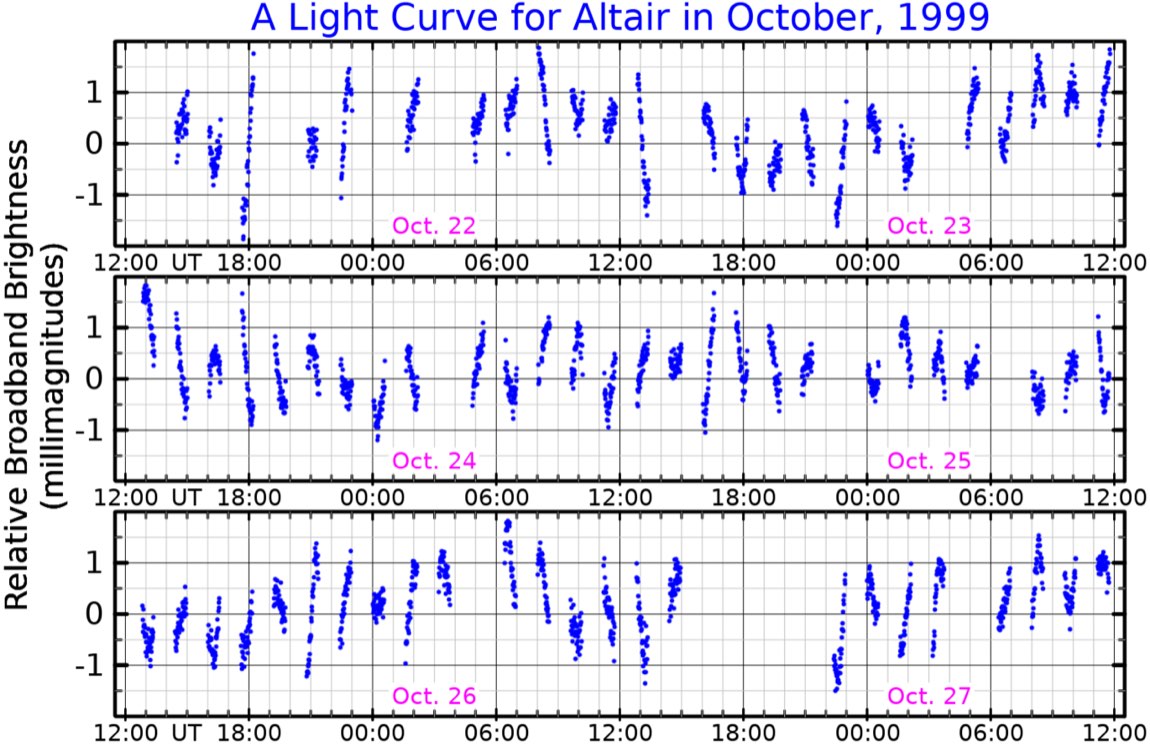
Altair's light is not perfectly steady. Satellite measurements made in 1999 with the Wide Field Infrared Explorer revealed that the star's brightness fluctuates by just a few thousandths of a magnitude, with multiple distinct periods all shorter than 2 hours. Based on those observations, Altair was formally identified in 2005 as a Delta Scuti variable star — a class of pulsating stars whose brightness variations arise from oscillations in the stellar interior and atmosphere. Altair's light curve can be reconstructed by superimposing a set of sine waves with periods ranging between 0.8 and 1.5 hours. These tiny, rapid pulsations make Altair a target for asteroseismology, where the frequencies of oscillations can be used to probe a star's internal structure much the way seismologists use earthquakes to map Earth's interior. The interaction between rapid rotation and pulsation modes adds extra complexity that researchers are still working to untangle.
07 X-Ray Glow and Convection at the Equator Deeper
Despite being classified as a relatively quiet A-type star, Altair is a weak but detectable source of coronal X-ray emission. What makes this particularly interesting is the location of the most active emission regions: they are concentrated near the star's equator rather than distributed uniformly. This equatorial concentration is thought to be linked to convection cells forming preferentially in the cooler, gravity-darkened equatorial zone. Convection — the churning of hot plasma rising and cooler plasma sinking — is the same process that drives much of the activity and magnetism seen on the Sun's surface. For an A-type star, which theoretically should have very thin or no convective outer envelope, detecting convection-driven activity at all is notable. Altair's rapid spin may be the key factor, creating the temperature and pressure conditions at the equator that allow convection to take hold in a region where it would normally be suppressed.
08 Living Inside the G-Cloud
Altair does not sit in empty interstellar space. It currently resides within the G-cloud, a nearby interstellar cloud made up of an accumulation of gas and dust in the Sun's cosmic neighbourhood. The Sun itself sits near the inner edge of a related structure, the Local Bubble, and the G-cloud is one of several diffuse clouds drifting through that region of the galaxy. The presence of such clouds matters for stellar environments: the density of interstellar material around a star can influence everything from the structure of its heliosphere-equivalent to the flux of interstellar particles that reach any orbiting bodies. Altair's placement in the G-cloud is a reminder that even nearby stars exist within a dynamic, structured interstellar medium rather than a uniform void.
 ⤢
⤢
09 A Name Carried Down from Babylon
The name Altair traces a long path through human history. Scholars believe the concept of Altair as an eagle star reaches back to the ancient Babylonians and Sumerians, who identified it explicitly as "the eagle star." Arab astronomers later called it Al-Nasr Al-Ṭā'ir, meaning "the flying eagle," and the modern name Altair is a direct abbreviation of that Arabic phrase. The alternative spelling Atair also appeared in historical records. Al Achsasi al Mouakket's catalogue listed the phrase Al Nesr Al Tair, which was translated into Latin as Vultur Volans — "the flying vulture." Medieval astrolabes made in England and Western Europe went further, depicting both Altair and Vega as birds. In 2016, the International Astronomical Union's Working Group on Star Names formally standardized "Altair" for this star, entering it into the IAU Catalog of Star Names, anchoring millennia of tradition with an official scientific designation.
10 Eagles, Cowherd Stars, and Pillars of Heaven
Across the world, Altair has inspired remarkably diverse stories. The Koori people of Victoria, Australia, knew it as Bunjil, the wedge-tailed eagle, while the neighbouring stars β and γ Aquilae were his two wives, the black swans. The Murray River people called Altair Totyerguil, a hunter whose spear-strike on a giant Murray cod carved out the course of the Murray River itself before the wounded fish rose into the sky as the constellation Delphinus. In Chinese tradition, Altair is Niú Láng Xīng, the cowherd star, separated from his wife Zhinü — represented by Vega — by the Milky Way, permitted to reunite only once a year when magpies form a bridge across it. Japan celebrates this story in the Tanabata festival, where Altair is called Hikoboshi. The people of Micronesia call it Mai-lapa, meaning "big or old breadfruit," while the Māori name Poutu-te-rangi translates as "pillar of heaven." Bugis sailors of the Indonesian archipelago used it for open-ocean navigation, calling it bintoéng timoro, the eastern star.
11 How to Find Altair in Your Own Sky
Altair is genuinely easy to locate without any equipment. With an apparent visual magnitude of 0.77, it ranks as the twelfth-brightest star in the night sky — well above the threshold of easy naked-eye visibility even from moderately light-polluted suburbs. It sits in the constellation Aquila, the eagle, and the fastest route to it is through the Summer Triangle, a prominent asterism that dominates Northern Hemisphere summer and autumn evenings. The Triangle's three vertices are Deneb in Cygnus, Vega in Lyra, and Altair itself in Aquila. Altair is the southernmost of the three and the one that rises and sets closest to due east and west. A useful additional signpost is the "Family of Aquila" or "Shaft of Aquila" — a straight line formed by Altair flanked by the slightly dimmer stars β Aquilae and γ Aquilae. Because Altair lies in an equatorial constellation, it is visible from virtually every inhabited location on Earth at some point during the year.
12 A Lunar Lander, a Seaplane, and a Radio Message
Altair's fame has spilled well beyond astronomy. In 1983, a group of Japanese scientists transmitted a radio signal directed at Altair with the explicit goal of contacting extraterrestrial life — though at 16.7 light-years' distance, any reply would take at minimum 33.4 years to make the round trip. On December 13, 2007, NASA announced that it was naming its planned Lunar Surface Access Module "Altair" — a spacecraft intended to carry astronauts from lunar orbit to the Moon's surface as part of the Constellation program. The Russian-built Beriev Be-200 Altair, an amphibious aircraft designed for firefighting and search-and-rescue, also carries the star's name. Western astrology has long classified Altair as a military star, associating it with boldness, determination, and risk-taking — qualities that may explain its recurring appeal as a name for vehicles meant to operate at the edge of human capability.
 ⤢
⤢