- Surface temperature
- 4,230 K
- Radius
- 20 × the Sun
- Luminosity
- 116 × the Sun
- Spectral type
- K2IIIp
Star · Deep guide
Arcturus
An old visitor racing through our neighborhood, and the northern sky's brightest star.
What is it?
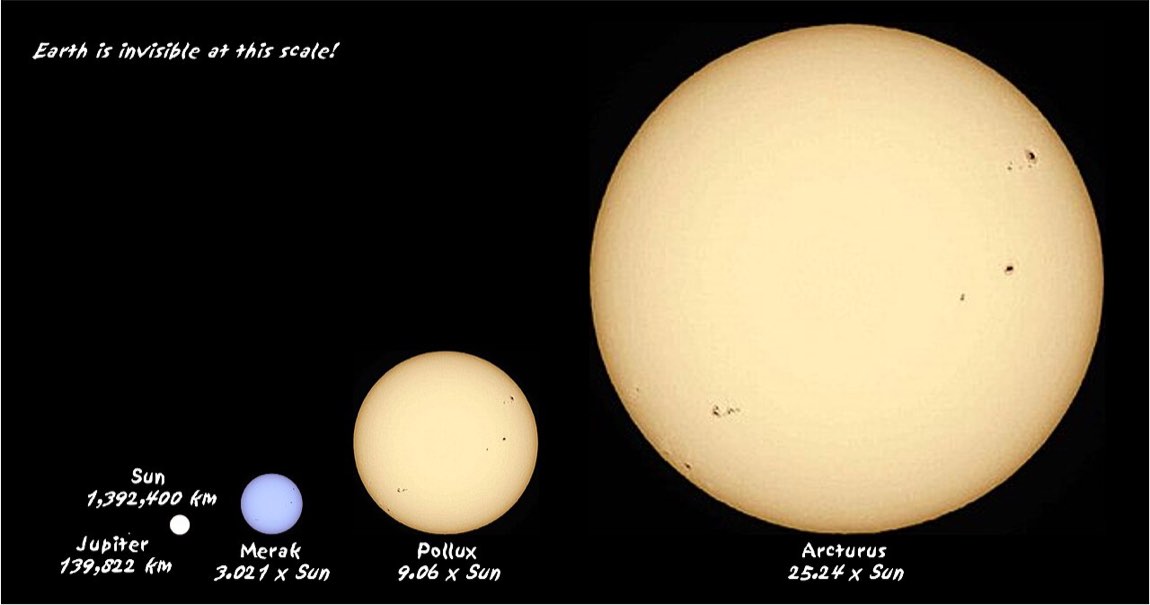
Follow the Big Dipper's handle in an arc and you reach Arcturus, the brightest star of the celestial north. It is an orange giant 36.7 light-years away — an old star that has finished its hydrogen and swollen to 25 times the Sun's width. It moves unusually fast across the sky: Arcturus belongs to an older stellar population just passing through our part of the galaxy.
The deep dive
Researched for the Atlas from Wikipedia — Arcturus (19,644 characters read) · updated Sep 20, 2026
01 The ancient star that opened a World's Fair
Arcturus has a gift for showmanship. When Chicago threw open the gates of its Century of Progress World's Fair in 1933, the mechanism that switched on the lights was triggered by light collected from Arcturus itself. The star was chosen because organizers believed its light had begun its 36.7-light-year journey around the time of the previous Chicago World's Fair in 1893. The math was slightly off — at that distance, the light actually left Arcturus in 1896 — but the gesture captured something real: this star is close enough that its light carries a datable human timestamp. Abraham Lincoln had already made his own appointment with Arcturus decades earlier, peering at it through a 9.6-inch refractor telescope at the Naval Observatory in Washington, D.C., in August 1863, at the height of the Civil War. Few stars can claim to have been witnessed by both a wartime president and a World's Fair opening ceremony.
02 A star drifting fast through our neighborhood
Arcturus is not sitting still. It is moving at 122 km/s — about 76 miles per second — relative to the Sun, which is fast enough to make it the highest proper-motion first-magnitude star in the sky other than Alpha Centauri. That motion amounts to two arcseconds per year as seen from Earth, a shift that builds up noticeably over human timescales: in antiquity, Arcturus sat closer to the centre of its constellation than it does today. The star is currently near its closest approach to the Sun, and in roughly 4,000 years it will be a few hundredths of a light-year nearer than it is now — after which it will gradually draw away. Arcturus appears to travel with a retinue of 52 other stars called the Arcturus stream, suggesting they share a common origin as old-disk stars that formed together long before the Sun existed and have been drifting through the galaxy ever since.
03 What its light truly reveals: spectrum and metals Deeper
Arcturus carries a chemically distinctive fingerprint. Its atmosphere holds only about a third of the Sun's metallicity — meaning the elements heavier than helium are substantially depleted — and it shows an enrichment of alpha elements relative to iron, a pattern that hints at a Population II origin, meaning it may have formed from gas that had not yet been thoroughly seeded by generations of stellar nucleosynthesis. In 1989, Arcturus was formally adopted as the spectral standard for the type K1.5III Fe−0.5, the suffix signaling a mild iron underabundance. Its spectrum shifts dramatically with wavelength: ultraviolet wavelengths show emission lines, the visible range shows atomic absorption lines, and the infrared reveals molecular absorption — a transition driven by how deeply light can escape the atmosphere at different wavelengths. Carbon monoxide lines in particular trace a molecular shell extending two to three stellar radii outward, where a chromospheric wind accelerates steeply to 35–40 km/s.
04 Heartbeat of a giant: stellar oscillations Deeper
Arcturus breathes. In April and May 1988, Belmonte and colleagues measured the star's radial velocity by tracking Doppler shifts in its spectral lines and found regular variability at frequencies of a few microhertz. The strongest peak sat at 4.3 μHz — a period of about 2.7 days — with an amplitude of 60 meters per second, and oscillations were separated by roughly 5 μHz. The team concluded the most plausible explanation was stellar oscillations, the same physics that lets astronomers probe the Sun's interior by listening to its resonant modes. This placed Arcturus among the pioneering targets of asteroseismology. Using those oscillation signals, researchers calculated a mass of 0.8 ± 0.2 solar masses and a radius of 27.9 ± 3.4 solar radii — somewhat different from other modeling approaches, illustrating that asteroseismological techniques applied to giant stars were still being refined. These measurements remain a useful independent cross-check on evolutionary models.
 ⤢
⤢
05 An unresolved question: is Arcturus alone? Deeper
Whether Arcturus has a companion is one of the genuinely open questions about this well-studied star. Astrometric data from the Hipparcos satellite suggested a binary system, with the putative companion roughly twenty times fainter than Arcturus and orbiting close enough to push the limits of current resolution. More recent results are inconclusive but do not rule out the marginal detection. Separately, radial velocity measurements from 1993 found a long-period oscillation that could be interpreted as a substellar companion of nearly 12 Jupiter masses orbiting at about 1.1 astronomical units — almost exactly Earth's distance from the Sun. However, Aldebaran and Pollux showed strikingly similar signals, leading the authors to conclude the oscillation was more likely intrinsic to the stellar atmosphere than caused by a companion's gravity. No substellar companion has been confirmed. Because a confirmed binary companion would allow a direct mass measurement, resolving this question carries real scientific weight.
06 Magnetic activity on a gentle giant Deeper
Arcturus is not magnetically inert. A weak magnetic field has been detected directly in its photosphere at a strength of around half a gauss — far weaker than a refrigerator magnet, but measurable in the spectrum of a star 36.7 light-years away. The activity appears to be organized along four distinct latitudes and is modulated by the star's rotation, meaning different parts of the stellar surface take turns presenting their magnetic structures toward us as the giant slowly turns. That activity heats coronal structures — thin outer layers of extremely hot gas — in a process similar to what the Sun does. Arcturus also undergoes a solar-type magnetic cycle, analogous to the Sun's roughly 11-year sunspot cycle, though the duration for Arcturus is probably less than 14 years. Studying this cycle in a star of different mass, age, and evolutionary state helps astronomers understand how magnetic behavior changes as stars age off the main sequence.
07 The evolutionary crossroads Arcturus stands at Deeper
Arcturus sits at an uncertain moment in its life story. The star has almost certainly exhausted the hydrogen in its core and is now burning hydrogen in a shell around an inert core — the standard red-giant-branch picture. Under that model it will continue expanding until its helium core becomes degenerate enough to trigger the helium flash, the dramatic ignition event that transforms a red giant into a horizontal-branch star. Its age is estimated between 6 and 8.5 billion years, older than the Sun's 4.6 billion years. However, Charbonnel et al. (1998) placed Arcturus slightly above the horizontal branch, suggesting it may have already completed the helium flash and is now in a later phase of evolution. The two interpretations require different internal structures and predict different futures. Evolutionary mass modeling gives 1.08 ± 0.06 solar masses, while oxygen isotope ratios for a first-dredge-up star suggest 1.2 solar masses — and asteroseismology yields a somewhat lower 0.8 ± 0.2 solar masses. The disagreement reflects how challenging it is to pin down the interior of a star seen only from the outside.
08 Polynesian navigators' star of gladness
Of all Arcturus's cultural roles, the one with the most practical consequence belongs to the Polynesian navigators who used it as a wayfinding beacon for voyages across the Pacific. Arcturus sits almost directly overhead at the latitude of the Hawaiian Islands — making it the zenith star of Hawaii — and prehistoric navigators exploited this precisely. Departing from Tahiti or the Marquesas Islands, canoe crews sailed east and north until Arcturus hung directly above them in the summer night sky, confirming they had reached the correct latitude. They then turned due west on the trade winds to find the island chain. Since 1976, the Polynesian Voyaging Society's vessel Hōkūleʻa — named after the Hawaiian name for Arcturus, meaning "Star of Joy" — has crossed the Pacific many times using this non-instrument navigation. The crew's landing in Waitangi, New Zealand in December 1985 earned them recognition under the name Ngāti Ruawāhia, meaning "Tribe of the Arcturus" in Māori. In the Society Islands, Arcturus was described as "a pillar to stand by" and counted among the ten pillars of the sky representing the ten heavens of the Tahitian afterlife.
 ⤢
⤢
09 How to find Arcturus in your own sky
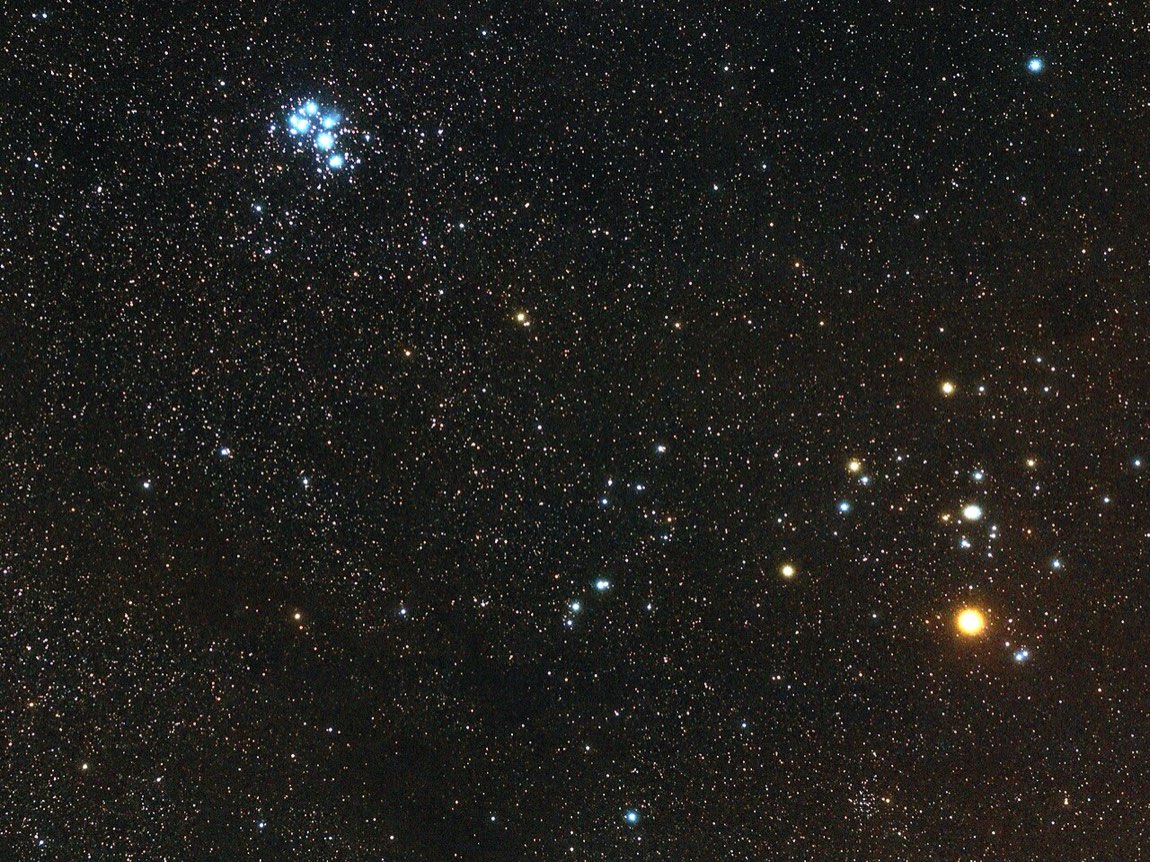
Finding Arcturus requires no equipment and almost no effort from anywhere in the world. From northern latitudes, locate the handle of the Big Dipper and simply follow the curve of its arc outward — a technique remembered as "arc to Arcturus." Continuing that same arc leads onward to Spica, giving the mnemonic "arc to Arcturus, then spike to Spica." The star culminates at midnight on April 27 and at 9 p.m. on June 10, making late northern spring the prime season. At magnitude −0.05, it blazes as the brightest point of light in the northern half of the sky and, under the right conditions, is visible to the naked eye just before or at sunset. Its B-V color index of +1.23 places its orange-red hue clearly between Pollux (B-V +1.00) and the redder Aldebaran (B-V +1.54) — an immediately visible warmth compared to bluish or white stars nearby. Because it sits 19 degrees north of the celestial equator, observers in both hemispheres can see it, though southern hemisphere viewers see it lower in their northern sky.
10 Jean-Baptiste Morin and the first daytime star
In 1635, the French mathematician and astronomer Jean-Baptiste Morin did something that had never been recorded before: he pointed a telescope at a star in full daylight and successfully observed it. That star was Arcturus. Before Morin's observation, the only stellar objects seen in daylight without optical aid were the Sun itself and the rare, brief spectacle of a supernova. Arcturus earned that distinction by being both close — at 36.7 light-years, it is the second-closest giant star to Earth after Pollux — and intrinsically luminous, pouring out roughly 180 times the total power of the Sun once infrared output is included. In visible light alone it is about 110 times brighter than the Sun, but its cooler surface temperature means much of that energy escapes as heat rather than visible photons, which actually underestimates how formidable the star truly is. Arcturus's proximity and luminosity together give it an apparent magnitude of −0.05, enough to be picked out against a daytime sky with a correctly aimed telescope.
11 Arcturus in myth: bears, wine, and tragedy
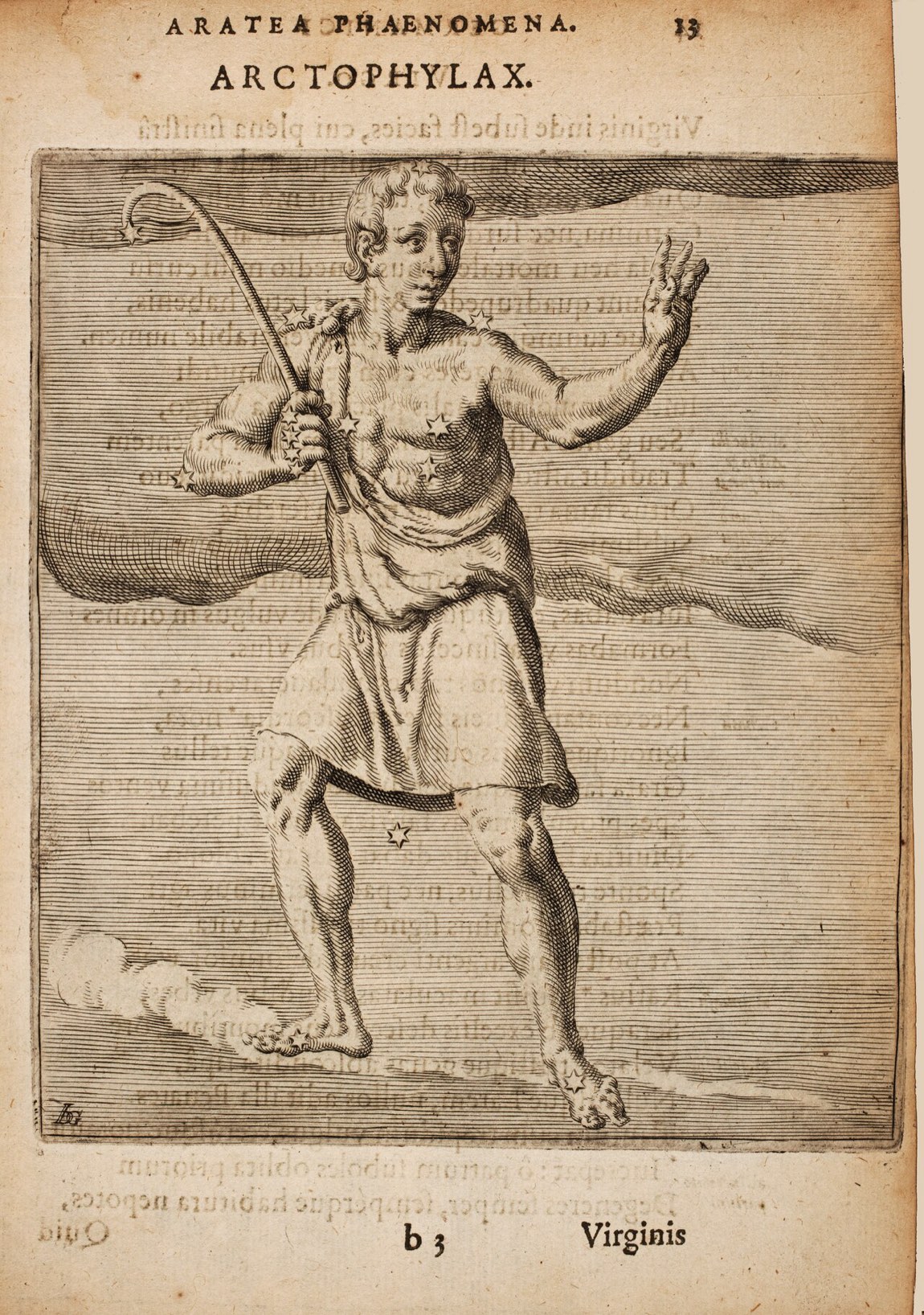
The name Arcturus comes from the ancient Greek Arktouros, meaning "Guardian of the Bear" — from arktos (bear) and ouros (watcher or guardian). Since arktos also came to mean "north," the name doubles as "Guardian of the North." One mythological tradition ties the star to Arcas, a boy about to unknowingly shoot his own mother Callisto, who had been transformed into a bear. Zeus averted the tragedy by turning Arcas into the constellation Boötes — called Arctophylax, "bear guardian," by the Greeks — and Callisto into Ursa Major. A separate tradition links the name to Icarius, who received the gift of wine from Dionysus and shared it with other men, who killed him thinking they had been poisoned. In this version, Icarius became Arcturus while his dog Maira became Procyon. Ptolemy described Arcturus's sky position as lying between the thighs of the figure of Boötes, while Aratus placed it below the constellation's belt. These precise positional references show how central Arcturus was to ancient astronomical description.
12 A seasonal clock in ancient literature
For ancient Mediterranean civilizations, Arcturus was not merely a star — it was a calendar. Hesiod, writing around 700 BC in Works and Days, instructed farmers to harvest grape clusters when Orion and Sirius reached mid-heaven at dawn and "rosy-fingered dawn sees Arcturus" in September. Plato, in Laws, used "the rising of Arcturus" as a synonym for the autumn vintage of figs and grapes. Sophocles placed it in Oedipus Rex, where a shepherd describes grazing his flock on Cithaeron "from spring until Arcturus" — the star marking summer's end. The Book of Job mentions it twice alongside Orion and the Pleiades. In ancient Mesopotamia it was associated with the god Enlil and listed in the Three Stars Each catalogues and later in MUL.APIN around 1100 BC. Arabic tradition called it as-simāk ar-rāmiħ, "the uplifted one of the lancer," a name that reached Chaucer's A Treatise on the Astrolabe in 1391 as Alramih. Ptolemy himself described the star's color as subrufa — "slightly red" — confirming that its warm orange hue was recognizable to the naked eye in antiquity.
 ⤢
⤢