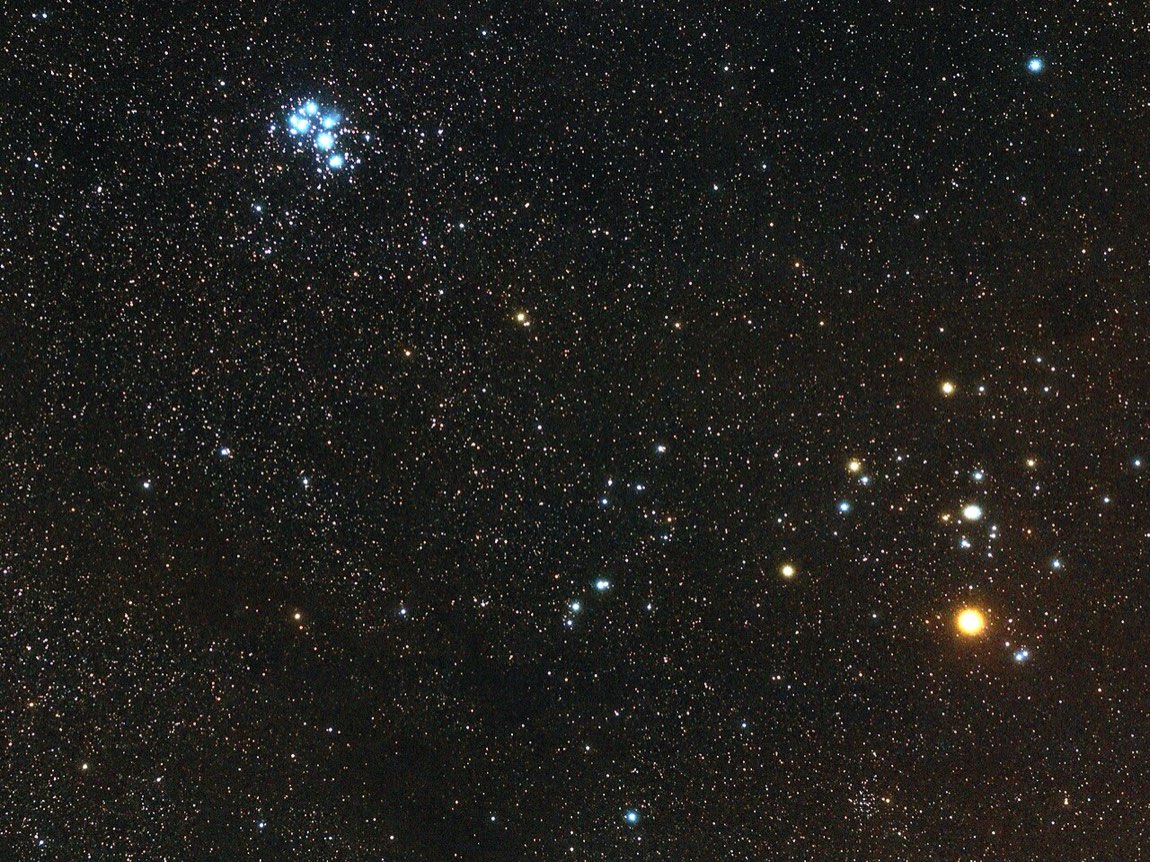
- Surface temperature
- 4,760 K
- Radius
- 8.31 × the Sun
- Luminosity
- 32.1 × the Sun
- Spectral type
- K0IIIvar
Star · Deep guide
Pollux
The nearest giant star has a planet found by a future Nobel laureate.
What is it?
Pollux, the brighter of Gemini's twin stars at 34 light-years, is the closest giant star to Earth — a preview of the Sun's fate, swollen to nine times solar width after finishing its core hydrogen. It hosts a confirmed planet, Thestias, detected by the same radial-velocity craft that later won planet-hunting's founders the Nobel Prize.
The deep dive
Researched for the Atlas from Wikipedia — Pollux (star) (5,432 characters read) · updated Sep 20, 2026
01 The Brightest Star With a Misleading Name
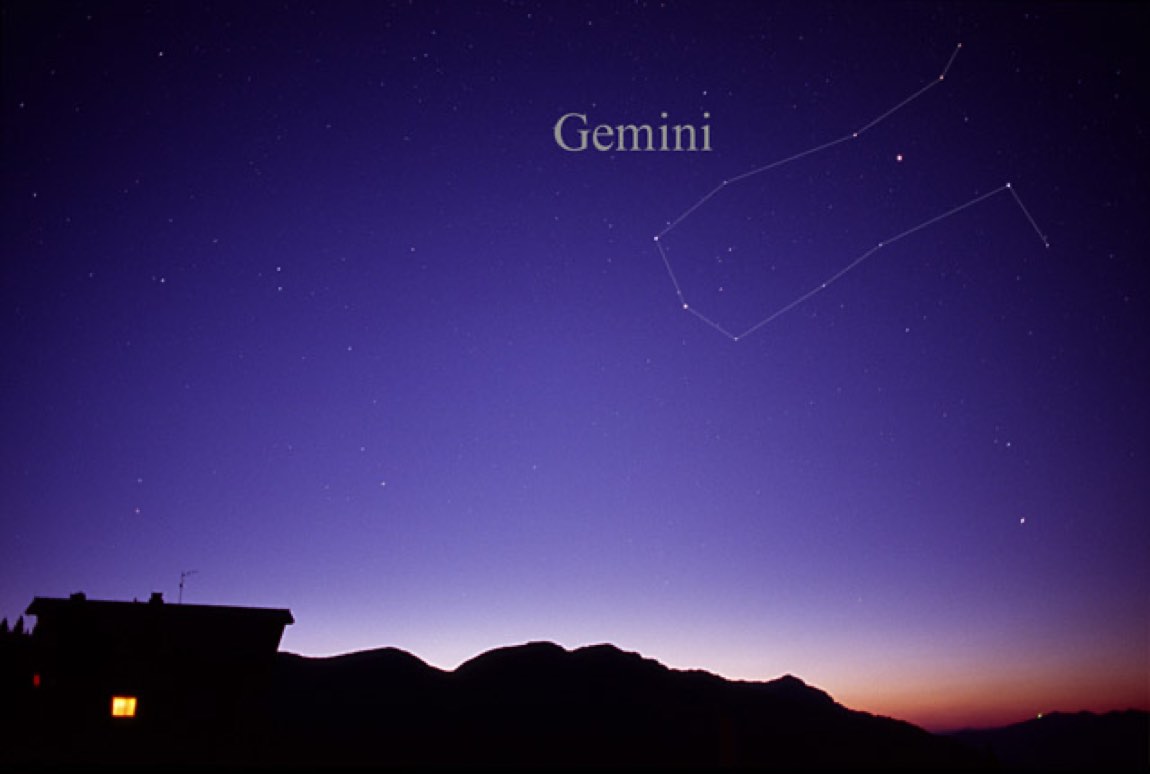
Pollux carries the Bayer designation β Geminorum — the Greek letter beta — which traditionally implies it is the second-brightest star in Gemini. Yet at an apparent visual magnitude of 1.14, Pollux is actually brighter than its neighbor Castor, which holds the alpha designation. This quirk is a reminder that Johann Bayer, who assigned these Greek-letter labels in 1603, did not always rank stars strictly by brightness. The name Pollux itself comes from Greek and Roman mythology, where Castor and Pollux were the heavenly twin brothers who give the constellation Gemini — Latin for 'the twins' — its identity. The International Astronomical Union's Working Group on Star Names formally approved 'Pollux' as the standardized proper name in its very first bulletin, issued in July 2016. The star also carries a medieval Arabic designation: Muekher al Dzira, recorded in the Calendarium of al-Achsasi al-Mouakket, meaning 'the end in the paw,' translated into Latin as Posterior Brachii. In Chinese astronomy it is known as 北河三, the Third Star of North River, part of an asterism also containing Castor and ρ Geminorum.
02 Pollux and Castor: Twins Only in Name
Despite sharing a mythological identity as celestial twins, Pollux and Castor could hardly be more different in physical reality. Pollux is a single, cool, orange-hued giant star. Castor, by contrast, is a complex sextuple system — six stars gravitationally bound together — composed of hot, bluish-white type A stars and faint red dwarfs. The two stars only appear to be neighbors because they happen to lie in roughly the same direction from Earth; they are not physically associated. Pollux is also the closer of the two to our solar system, sitting at about 33.78 light-years away. The contrast between the pair is striking when examined through even a modest telescope: Pollux glows with a warm amber tone produced by its surface temperature of about 4,810 K, while Castor's components radiate a much hotter, bluer light. Poet Percy Shelley captured something of Pollux's gentler character in his 1818 work Homer's Hymn to Castor and Pollux, where he described 'mild Pollux, void of blame' — a poetic intuition that, in stellar terms, isn't entirely wrong.
03 From Sirius's Twin to a Bloated Giant Deeper
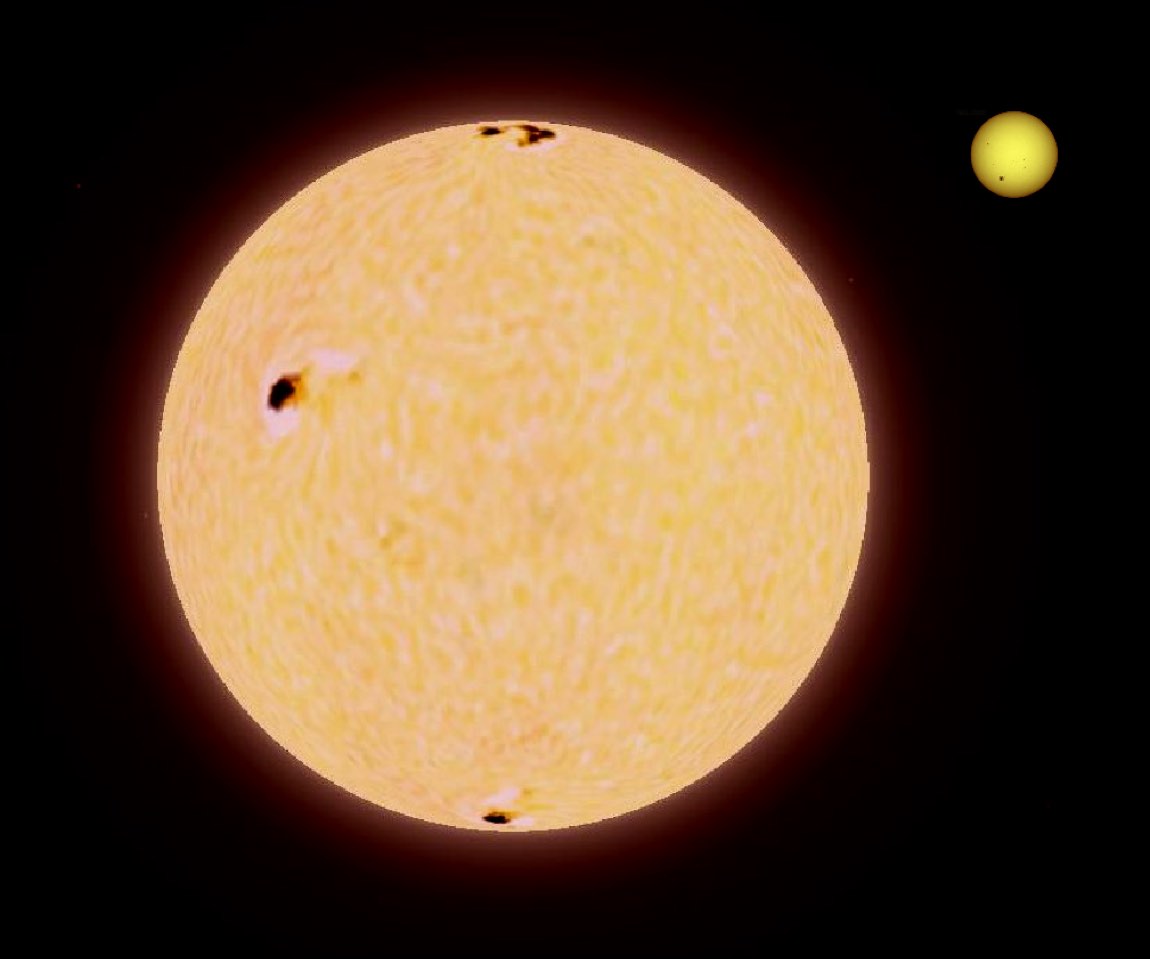
Pollux was not always the orange giant it is today. Early in its life, the star was an A-type main-sequence star — similar in character to Sirius, one of the brightest stars in our night sky. Over billions of years, Pollux exhausted the hydrogen fuel at its core and began to swell outward, evolving into the giant it is now, carrying the stellar classification K0 III. During this transformation it grew to nearly nine times the Sun's radius, expanding from what would have been a relatively compact, hot star into a sphere that, if placed at the center of our solar system, would extend roughly nine times farther than the Sun's current surface. Its mass, however, is only about twice that of the Sun — meaning the same amount of material spread across a vastly greater volume produces a much lower average density. This evolutionary journey also appears to have dramatically weakened its magnetic field, which the article suggests was once far stronger when Pollux was an Ap star — a class of chemically peculiar, magnetically active stars on the main sequence.
04 Measuring a Giant: A Century of Estimates Deeper
Getting an accurate size for Pollux has been a century-long exercise in improving technology. In 1925, astronomer John Stanley Plaskett used interferometry to estimate Pollux's diameter at 13 million miles — equivalent to about 20.9 million kilometers, or 18.5 solar radii. That figure turned out to be significantly larger than what modern instruments find. More precise measurements from the Navy Precision Optical Interferometer, which combines the light from multiple telescopes to achieve very fine angular resolution, yield a radius of 8.97 solar radii. A separate estimate derived from analyzing Pollux's spectral lines independently arrived at 8.9 solar radii — reassuringly close agreement. To put 8.97 solar radii in perspective, that is a sphere roughly 12.4 million kilometers in radius, larger than the distance from the Sun to Mercury, which orbits at about 57.9 million kilometers. The large discrepancy between Plaskett's 1925 estimate and modern values illustrates how dramatically interferometric technology has improved over the past hundred years, moving from early pioneering measurements to the precision achievable with dedicated optical arrays.
05 A Magnetic Field Barely There Deeper
Pollux possesses one of the weakest magnetic fields ever detected on any star. Confirmed measurements place its surface field strength below 1 gauss — for comparison, a simple refrigerator magnet typically produces around 50 gauss, making Pollux's field roughly fifty times weaker than the magnet holding your grocery list. The first hint of magnetic activity came not from direct field measurements but from X-ray emission detected by the ROSAT orbiting telescope. That X-ray output is approximately 10²⁷ ergs per second, a level that happens to be roughly the same as the Sun's own X-ray luminosity. The presence of even this faint magnetic field carries an important historical implication: it suggests that Pollux was once an Ap star — an 'Astrophysically Peculiar' star — with a significantly stronger field during its main-sequence life. As the star expanded into a giant, the field appears to have been diluted across a much larger surface area, leaving only the ghostly trace detectable today. Despite showing small radial velocity variations, Pollux is not photometrically variable — its brightness remains steady even as other subtle activity continues.
06 The Spectrum That Anchors a Classification System
Since 1943, Pollux's spectrum has served as one of astronomy's fundamental reference points — a so-called anchor standard by which other stars are classified. When astronomers want to determine what type of star they are looking at, they compare its spectrum against a set of carefully chosen, stable benchmark stars. Pollux is one of those benchmarks for the K giant classification. This means that for more than eighty years, every orange giant star classified in the Milky Way has been measured, in some sense, against Pollux. The reason it works so well as a standard is precisely its stability: Pollux is not photometrically variable, meaning its light output does not fluctuate in ways that would undermine its usefulness as a ruler. Its spectral classification is K0 III, where K indicates its temperature range producing the orange color, 0 places it at the hotter end of the K category, and III denotes a giant luminosity class — a star that has evolved off the main sequence and expanded dramatically compared to its original size.
 ⤢
⤢
07 Why the Moon Can No Longer Cover Pollux
Pollux sits 6.7 degrees north of the ecliptic — the plane in which the Moon and planets travel across the sky. That might sound like a small angular distance, and historically it was close enough for the Moon to occasionally pass in front of Pollux in events called lunar occultations. The last such occultation visible from Earth occurred on September 30, 117 BCE, seen from high southern latitudes. Since then, the slow drift of Earth's axial orientation — a wobble called precession, which completes one full cycle over roughly 26,000 years — has shifted the apparent positions of stars relative to the ecliptic, moving Pollux just far enough north that the Moon's path no longer reaches it. From our current vantage point in history, Pollux is presently too far north to be occulted by the Moon. This makes it a useful stable marker in the night sky, uninterrupted by lunar passages, contributing to its value as a long-term spectral standard.
08 Thirteen Years of Suspicion, Then Confirmation
The story of Pollux's planet began not with a discovery announcement but with a suspicion. Since 1993, scientists noticed that Pollux's radial velocity — the speed at which the star moves toward or away from us along our line of sight — was oscillating in a regular pattern. Such oscillations can be caused by the gravitational tug of an orbiting planet, which makes the star wobble slightly as both the star and planet orbit their common center of mass. For thirteen years this signal was studied, debated, and checked. Finally, on June 16, 2006, the existence of Pollux b was confirmed and formally announced. The planet orbits Pollux with a period of about 590 days — roughly 1.6 Earth years — and has a minimum mass at least 2.3 times that of Jupiter. The word 'minimum' matters here: the radial velocity technique only reveals the component of a planet's mass projected along our line of sight, so the true mass could be higher depending on the orbit's orientation relative to Earth.
09 A Planet Whose Existence Is Still Debated Deeper
Despite the 2006 confirmation announcement, the existence of Pollux b — officially named Thestias — is not entirely beyond question. The same radial velocity oscillations used to infer the planet's presence could, in principle, be produced by magnetic activity on the star's surface rather than by a gravitational companion. Starspots, convective motions, and pulsations can all mimic the signatures of an orbiting body in radial velocity data. The article states plainly that 'the possibility that the observed radial velocity variations are caused by stellar magnetic activity cannot be ruled out.' This kind of honest scientific uncertainty is typical for radial velocity planet detections around giant stars, which have inherently more complex and active surfaces than quieter main-sequence stars like the Sun. The weak magnetic field confirmed on Pollux adds another layer of complexity, since magnetic activity at any level could in theory contribute spurious velocity signals. Thestias therefore sits in an interesting category: a planet formally named by the IAU yet still carrying a asterisk of scientific doubt.
10 The Mythology Behind the Planet's Name
The planet orbiting Pollux went through a layered naming process that reveals how carefully astronomical naming must navigate existing conventions. When the IAU launched its NameExoWorlds public voting initiative in July 2014, the winning submission for Pollux b came from theSkyNet of Australia, who proposed the name Leda — Pollux's mother in Greek mythology, which was a natural and elegant choice. However, the name Leda was already taken twice over: it had been assigned to an asteroid and to one of Jupiter's moons. To preserve mythological coherence while avoiding duplication, the IAU substituted 'Thestias,' the patronym of Leda herself, derived from her father Thestius. The name was formally announced in December 2015. This chain — public nomination, mythological logic, institutional conflict-checking, and substitution — illustrates how modern astronomical nomenclature balances public engagement, historical tradition, and the practical management of an enormous and ever-growing catalog of named objects across the solar system and beyond.
11 How Close Is Close? Pollux as a Neighbor
At 33.78 light-years from the Sun, Pollux holds a distinction that makes it uniquely interesting for stellar astronomers: it is the closest red giant, and indeed the closest giant star of any kind, to our solar system. A light-year is about 9.46 trillion kilometers, so 33.78 light-years works out to roughly 319 trillion kilometers — an unimaginable distance in everyday terms, yet remarkably near on a galactic scale. This proximity is part of why Pollux's apparent magnitude of 1.14 and its absolute magnitude are quite close to each other: absolute magnitude is defined as how bright a star would appear from exactly 10 parsecs away, and at 10.36 parsecs, Pollux is almost exactly at that standard distance. The star is therefore a rare case where what you see in the sky is nearly what you would measure on an astronomer's standard ruler. Its closeness also made it an early and fruitful target for interferometric diameter measurements, radial velocity planet searches, and magnetic field detections.
12 Metallicity: An Unresolved Question Deeper
One of the more surprising uncertainties about Pollux concerns something seemingly straightforward: how metal-rich is it? In astronomy, 'metallicity' refers to the abundance of all elements heavier than hydrogen and helium — everything from carbon and oxygen to iron. For the Sun, this is a well-measured quantity, and stellar metallicity is often expressed as a percentage of the Sun's value. For Pollux, however, estimates range from 85% to 155% of solar abundance — a spread wide enough to make a real difference to stellar models. At 85% the star would be mildly metal-poor compared to the Sun; at 155% it would be substantially metal-rich. This uncertainty likely arises from the difficulties of modeling the spectra of cool giant stars, whose complex atmospheres with large convective cells and molecular absorption features make precise chemical analysis harder than for simpler main-sequence stars. Resolving this question matters because a star's metallicity influences planet formation, internal structure calculations, and age estimates — all relevant to understanding Pollux and its planetary companion Thestias more completely.
 ⤢
⤢