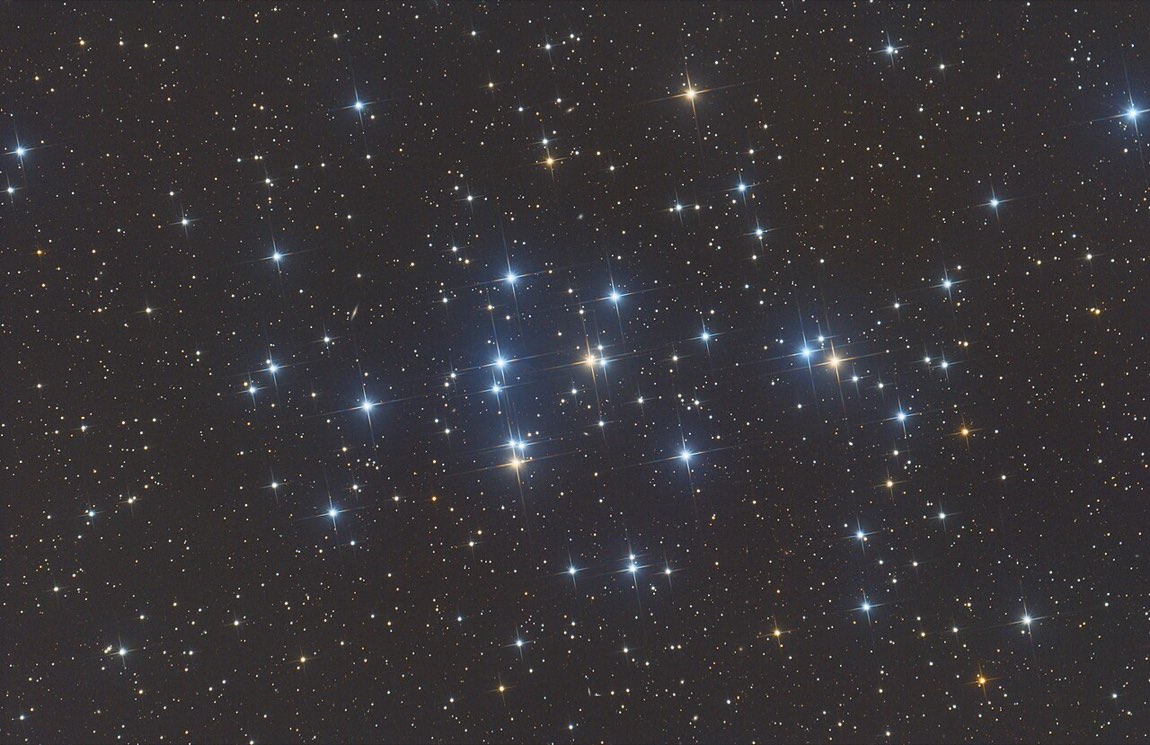
 Photograph · Fried Lauterbach · CC BY-SA 4.0
Star Cluster · Deep guide
The Beehive Cluster (Messier 44)
Also called: M44 · Messier 44 · NGC 2632 · Praesepe
A swarm of about a thousand stars in Cancer, known since ancient times.
What is it?
The Beehive Cluster, also called Praesepe, is an open cluster in Cancer and one of the closest star clusters to Earth, at roughly 520 to 610 light-years. Under dark skies it looks like a small misty patch, and it has been known since antiquity: Ptolemy called it a nebulous mass in the breast of Cancer. It was one of the first things Galileo turned his telescope to. The cluster holds about 1,000 stars and is around 600 million years old, close to the age of the Hyades, suggesting a shared origin.
The deep dive
Researched for the Atlas from Wikipedia — Beehive Cluster (6,527 characters read) · updated Nov 15, 2026
01 A Cluster Known Since Ancient Skies
The Beehive Cluster has captured human attention for well over two millennia, accumulating a remarkable variety of names across cultures. Greek poet Aratus, writing around 260–270 BC, called it Achlus, meaning "Little Mist," while Hipparchus labeled it Nephelion, or "Little Cloud," in his star catalog around 130 BC. Ptolemy's Almagest went further, listing it among seven "nebulae" — four of which are real astronomical objects — and described it as "The Nebulous Mass in the Breast of Cancer." Ancient Greeks and Romans interpreted the fuzzy patch as a manger, with the neighboring stars Asellus Borealis and Asellus Australis playing the role of two donkeys eating from it — the very donkeys that Dionysos and Silenus reportedly rode into battle against the Titans. Meanwhile, ancient Chinese skywatchers placed it in the Ghost lunar mansion and imaginatively described its appearance as a "cloud of pollen blown from willow catkins," though they also gave it the considerably grimmer name Jishi qi, meaning "Exhalation of Piled-up Corpses." Few star clusters can claim such a vivid and culturally diverse biography.
02 From Galileo's Lens to Messier's List
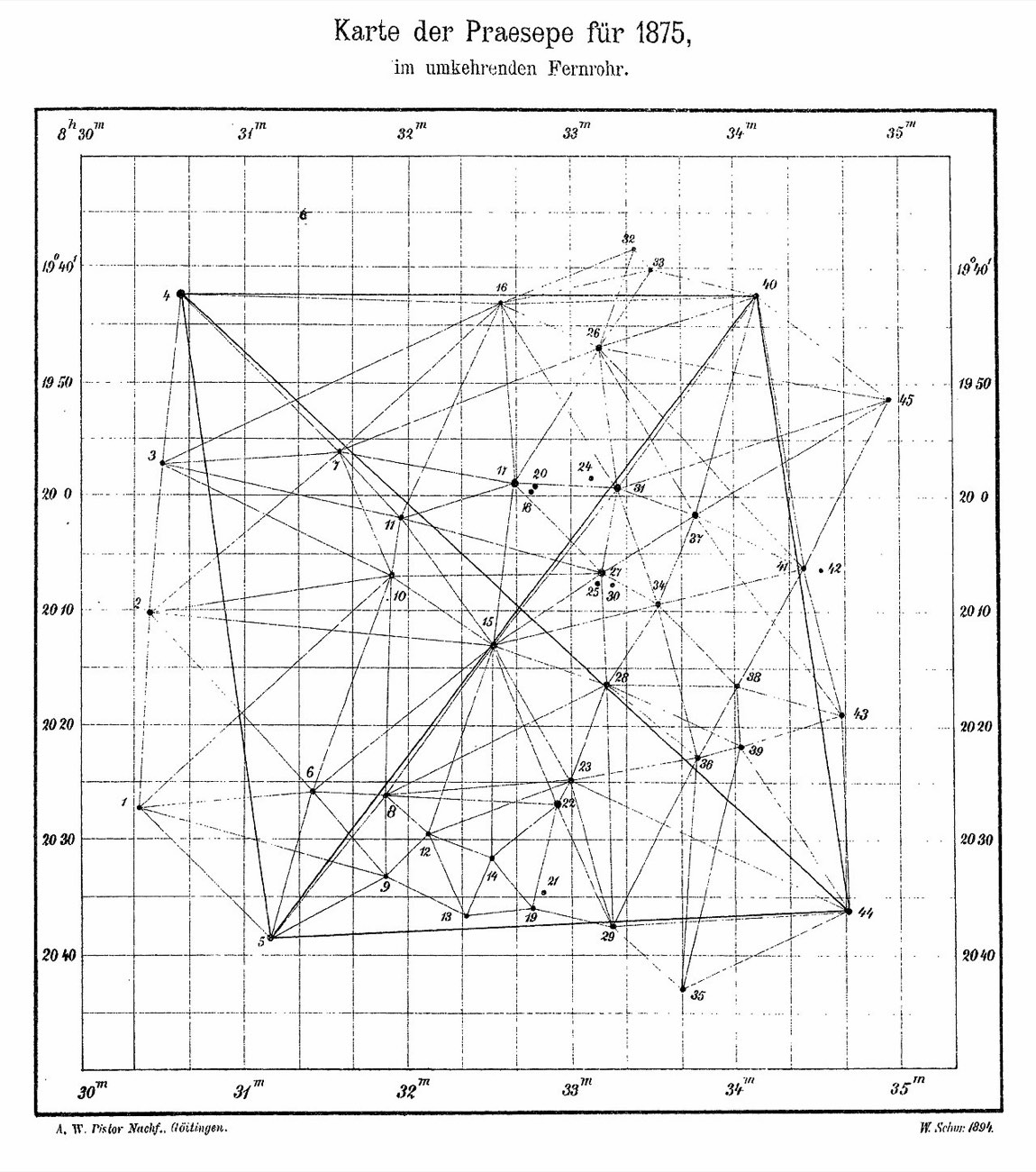
In 1609, Galileo turned his newly built telescope toward the Beehive and resolved what the naked eye perceived as a faint smudge into 40 individual stars — one of the earliest demonstrations of the telescope's power to reveal hidden cosmic structure. The cluster earned its formal catalog entry 160 years later, when Charles Messier precisely measured its position and added it as M44 in 1769. Messier's inclusion of the Beehive alongside other bright, obvious objects like the Orion Nebula and the Pleiades has puzzled historians, since the rest of his catalog focused on faint objects that could be mistaken for comets. One compelling explanation is competitive: Messier may have padded his list with well-known bright objects simply to surpass his rival Lacaille, whose 1755 catalog contained 42 entries. Johann Bayer had earlier depicted the cluster as a nebulous star in his 1603 Uranometria atlas and labeled it Epsilon — a letter now applied specifically to Epsilon Cancri, the cluster's brightest star at magnitude 6.29. Bayer also recorded the Arabic-derived name Melleff, from Al Ma'laf meaning "the Stall," which today also attaches to that same star. Wilhelm Schur, as director of the Göttingen Observatory, produced a detailed map of the cluster in 1894.
03 The Cluster's Size, Shape, and Inner Architecture Deeper
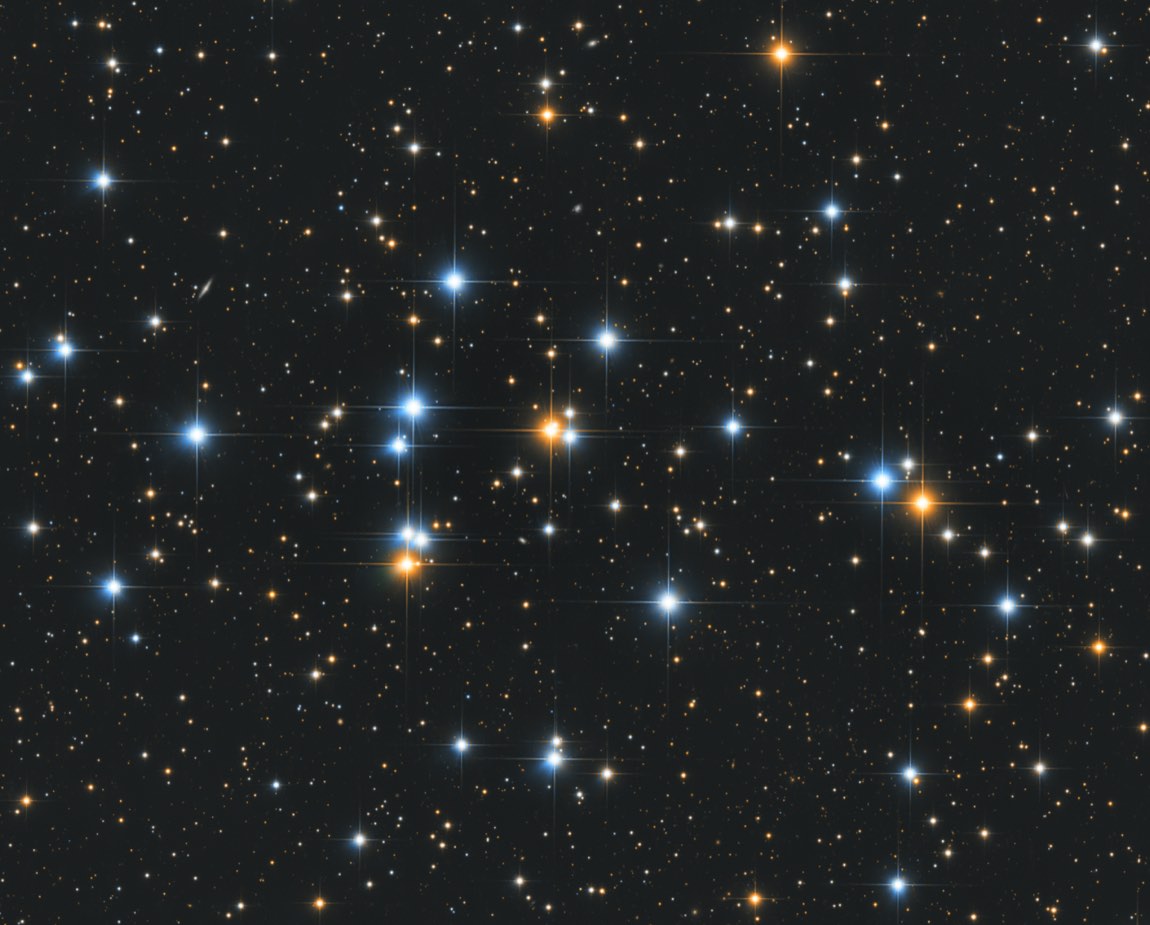
Praesepe displays a layered structure that astronomers describe in terms of three distinct radii. Its core radius — the densely packed central region — measures 3.5 parsecs, or about 11.4 light years across. The half-mass radius, the distance within which half the cluster's total mass is contained, sits slightly larger at 3.9 parsecs (12.7 light years). The tidal radius, the outermost gravitational reach of the cluster, extends to roughly 12 parsecs, or 39 light years — but this boundary also sweeps in stars that are merely passing through rather than true members. The bright inner core alone spans about 7.0 parsecs (23 light years) in diameter. Like many clusters of all kinds, Praesepe has undergone mass segregation: the heaviest, most luminous stars have sunk toward the center over time, while dimmer and less massive stars drift outward to populate the halo, sometimes called the corona. The cluster's total visual brightness reaches magnitude 3.7, and its brightest individual stars are blue-white objects shining at magnitudes 6 to 6.5 — just at or beyond the threshold of naked-eye visibility under ideal conditions.
 ⤢
04 A Thousand Stars and What They Are Deeper
A recent careful survey counts 1,010 high-probability member stars in the Beehive, gravitationally bound together with a combined mass of roughly 500 to 600 solar masses — about the weight of half a millennium's worth of Suns packed into a region you could cross in a few decades at the speed of light. The membership breakdown is dominated by M dwarfs, the small, cool red stars that make up 68% of the total. Sun-like stars of spectral classes F, G, and K contribute another 30%, while only about 2% are the brighter, hotter A-type stars. Five giant stars round out the notable members: four carry spectral class K0 III and one is classified G0 III, all representing stars that have exhausted their core hydrogen and swelled in their later evolutionary stages. Eleven white dwarfs have been identified so far, the dense Earth-sized remnants left behind by the cluster's most massive original members, which would have belonged to spectral type B when young. Brown dwarfs — objects too small to ignite hydrogen fusion — are surprisingly rare, most likely because they have been stripped away over time by tidal forces acting on the cluster's loosely bound outer halo. One brown dwarf has been found in the eclipsing binary system AD 3116.
05 A Twin Cluster Born from the Same Nursery
One of the most intriguing aspects of the Beehive is its apparent kinship with the Hyades cluster in Taurus. The two clusters share strikingly similar ages — the Beehive is estimated at around 600 million years old while the Hyades is about 625 million years old — and their proper motions across the sky align closely enough to suggest they may have been born from the same giant molecular cloud long ago. Both clusters also share comparable stellar compositions, containing red giants and white dwarfs alongside the more common main sequence stars, which points to parallel evolutionary histories rather than coincidence. Despite this shared ancestry, the two clusters look quite different today because the Beehive is significantly more distant. Revised Hipparcos parallax measurements from 2009 and infrared color-magnitude diagram analysis favor a distance of 182 parsecs for the Beehive, compared to the Hyades which are much closer to Earth. The Beehive's distance has been debated, with figures ranging from 160 to 187 parsecs (520 to 610 light years) appearing in the literature, but modern analyses converge on 182 parsecs as the best current estimate.
06 The First Planets Found in a Sun-Like Cluster Star
In September 2012, astronomers announced a landmark discovery: two planets orbiting separate stars within the Beehive Cluster. What made this finding especially significant was not merely that planets had been found in a cluster — that had happened before — but that these were the first planets detected orbiting stars genuinely comparable to our own Sun within a stellar cluster environment. The two worlds were designated Pr0201 b and Pr0211 b, with the lowercase "b" indicating planetary status. Both turned out to be hot Jupiters: massive gas giants that, unlike Jupiter in our own solar system, orbit extremely close to their host stars. The discovery announcement, published in the Astrophysical Journal Letters, was led by Sam Quinn, working alongside David Latham of the Harvard–Smithsonian Center for Astrophysics and using the Fred Lawrence Whipple Observatory operated by the Smithsonian Astrophysical Observatory. The existence of hot Jupiters in a cluster environment raised new questions about how planetary systems form and migrate in regions of higher stellar density.
 ⤢
07 A Multi-Planet System and the Kepler Follow-Up Deeper
The planetary story in the Beehive did not end with the 2012 discoveries. In 2016, follow-up observations revealed a second planet in the Pr0211 system, designated Pr0211 c, making Pr0211 the first multi-planet system ever discovered in an open cluster — a milestone that added another layer to our understanding of planetary system architecture in clustered star-forming environments. The Kepler space telescope, operating in its extended K2 mission, then surveyed the cluster further and found planets around several additional stars. Stars designated K2-95, K2-100, K2-101, K2-102, K2-103, and K2-104 each host a single planet, while K2-264 hosts a two-planet system. This growing census of planetary systems within a single open cluster provides astronomers with a controlled laboratory of sorts: because the stars in Praesepe share the same age, distance, and chemical origin, differences in their planetary systems can be more cleanly attributed to the properties of the individual stars rather than to environmental variables — a comparison that is far harder to make among field stars scattered across the galaxy.
08 How to Find and Observe the Beehive
Despite lying in the relatively faint constellation Cancer — itself sandwiched between the bright stars of Gemini and Leo — the Beehive is one of the most accessible deep-sky objects for casual observers. Under genuinely dark skies, it is visible to the naked eye as a soft, nebulous smudge, and it has been seen this way since antiquity. The cluster spans 1.5 degrees across the sky, meaning it fits comfortably within the field of view of a standard pair of binoculars or any low-powered small telescope — in fact, binoculars are often considered the ideal instrument because higher magnification can cause the cluster to overfill the eyepiece and lose its pleasing swarm-like character. To locate it, observers can use the nearby bright stars Regulus, Castor, and Pollux as guide stars; the Beehive sits roughly midway between Pollux in Gemini and Regulus in Leo. Its overall visual brightness of magnitude 3.7 makes it theoretically bright enough to glimpse without any optical aid from a truly dark site, though its light is spread across a large area rather than concentrated at a point.
09 Open Questions the Beehive Still Poses Deeper
Even after centuries of observation and decades of modern survey work, the Beehive retains genuine scientific uncertainties. The cluster's distance, while now favored at 182 parsecs by revised Hipparcos parallaxes and infrared color-magnitude analysis, has historically been cited across a range of 160 to 187 parsecs (520 to 610 light years), and pinning it down with precision remains important because distance underpins almost every other derived property of the cluster. The scarcity of brown dwarfs — thought to have been tidally stripped from the halo over time — is consistent with expectations but not yet conclusively proven, and the full brown dwarf population may remain incompletely characterized. The tidal radius of about 12 parsecs (39 light years) encompasses stars that may or may not be true members, complicating membership counts and total mass estimates of 500 to 600 solar masses. The proposed shared origin with the Hyades, while supported by coinciding age estimates and proper motions, is not proven: distinguishing a genuine birth-sibling relationship from a statistical coincidence requires more precise measurements than currently exist. The expanding census of planets within the cluster, meanwhile, continues to test models of hot Jupiter formation and migration in dense stellar environments.
 ⤢