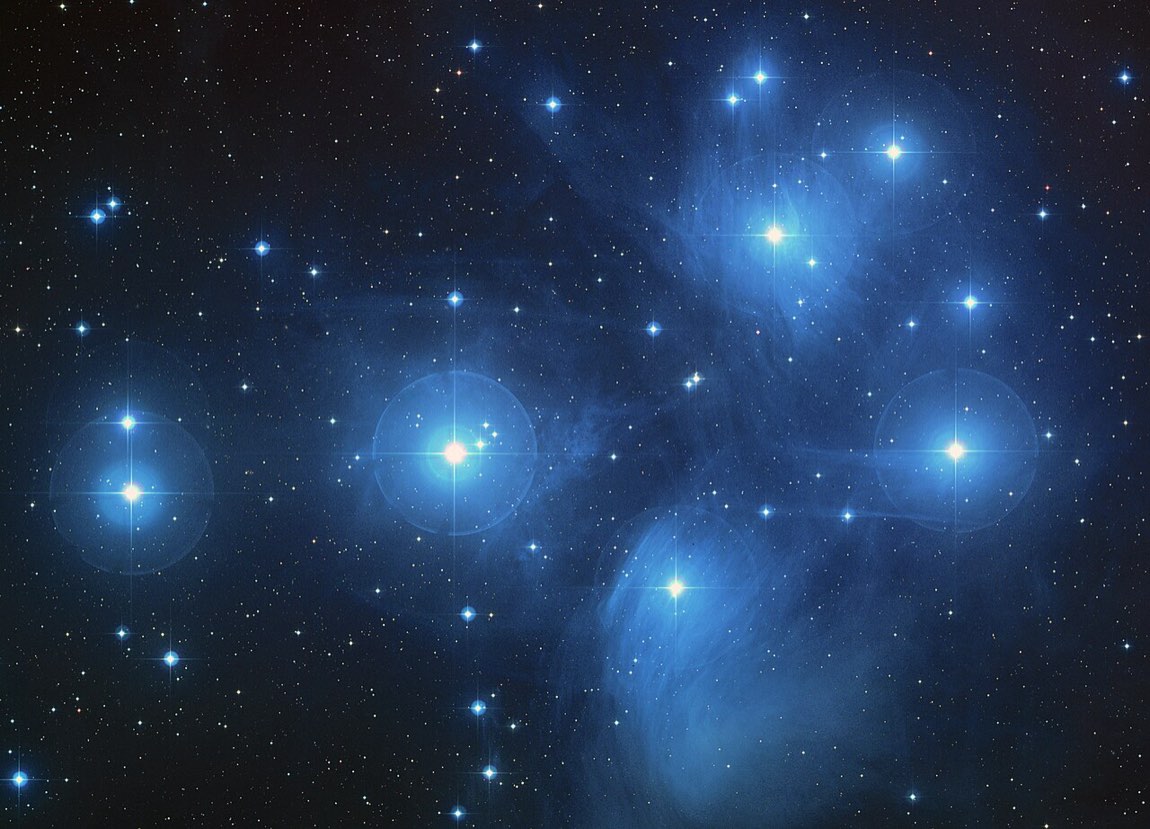
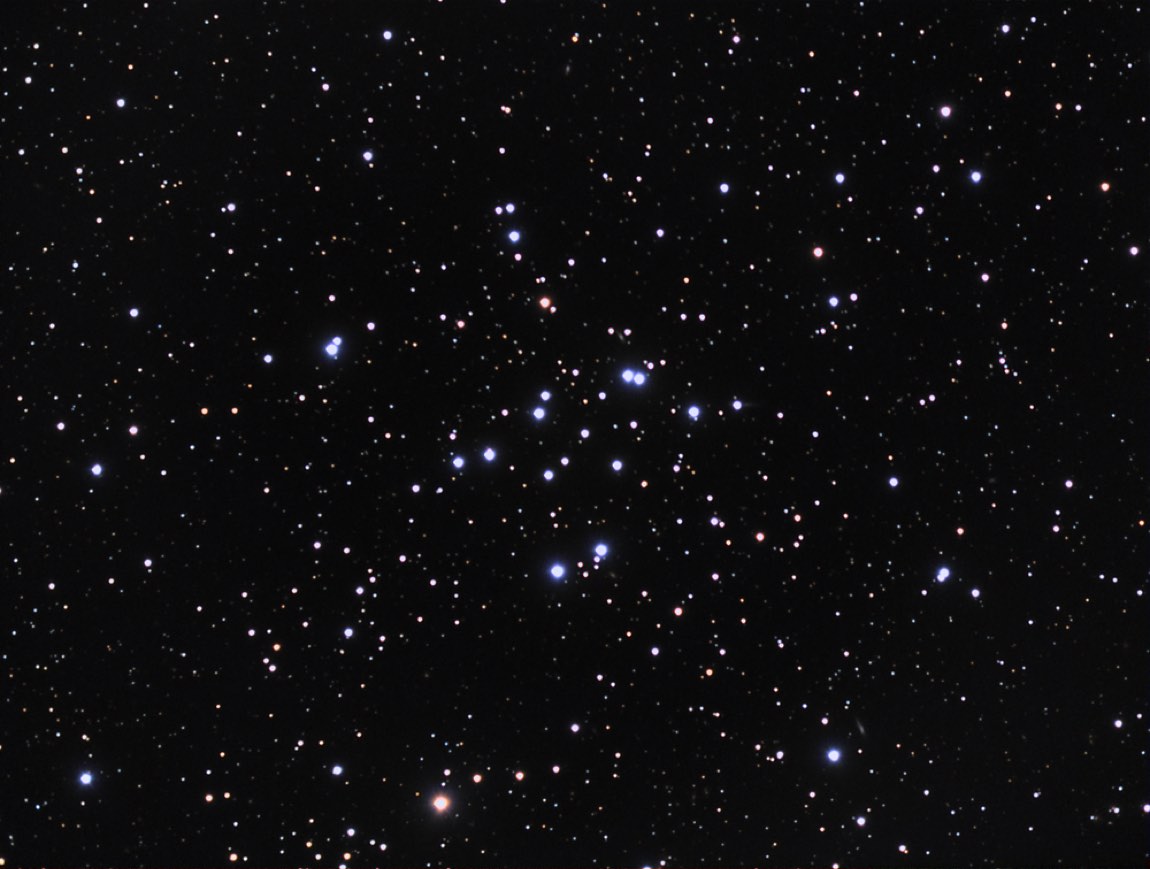
 Photograph · Jim Mazur · CC BY-SA 4.0
Star Cluster · Deep guide
Messier 34 (Spiral Cluster)
Also called: M34 · NGC 1039 · Spiral Cluster
A large, nearby open cluster in Perseus, about the size of the full Moon.
What is it?
Messier 34 is a large, relatively close open cluster in Perseus. Giovanni Battista Hodierna probably found it before 1654, and Messier catalogued it in 1764. It lies about 1,500 light-years away and contains about 400 stars spread across 35 arcminutes of sky. Very dark skies let you glimpse it without optical aid. At 200 to 250 million years old, it sits in age between the Pleiades and the Hyades.
The deep dive
Researched for the Atlas from Wikipedia — Messier 34 (2,088 characters read) · updated Nov 15, 2026
01 How Giovanni Hodierna Found It First
The story of Messier 34's discovery begins not with its famous namesake but with a Sicilian priest-astronomer named Giovanni Batista Hodierna, who probably catalogued the cluster before 1654 — more than a century before Charles Messier ever pointed a telescope at it. Hodierna was a systematic observer who compiled lists of nebulous objects at a time when the telescope was still a novelty, and M34 was among his finds. It was Messier, however, who cemented the cluster's place in astronomical history when he added it to his celebrated catalog of comet-like objects in 1764. Messier's own description is charmingly practical: he noted it as 'a cluster of small stars a little below the parallel of γ Andromedae,' and remarked that an ordinary telescope of three feet in length was sufficient to resolve the individual stars. That casual observational note tells us something important — by the standards of eighteenth-century instruments, M34 was an easy and rewarding target, its stars separating cleanly rather than blurring into the nebulous smudges that so often fooled comet hunters of the era.
02 A Cluster Sandwiched in Time
Astronomers have a clever way of dating open clusters: they compare the observed spectra of their stars against the predictions of stellar evolutionary models and ask which age fits best. For Messier 34, that method yields an age of 200 to 250 million years. To put that in context, the cluster sits neatly between two of the sky's most famous stellar families — the Pleiades, which are a relatively youthful 100 million years old, and the Hyades, a more mature 800 million years old. Two hundred and fifty million years ago on Earth, the first dinosaurs had not yet appeared and the supercontinent Pangaea was only beginning to break apart. The age estimate is also physically meaningful in a stellar sense: it corresponds roughly to the moment when stars with half a solar mass are just arriving on the main sequence, beginning their long hydrogen-burning lives. By contrast, a star like the Sun reaches that milestone in a mere 30 million years, making solar-type stars relative sprinters compared to their lower-mass cousins. This age bracket makes M34 a valuable laboratory for studying the intermediate stages of stellar and cluster evolution.
03 Iron-Rich Stars: Reading the Metallicity Deeper
One of the most diagnostic numbers astronomers extract from a star cluster is its metallicity — the average proportion of elements heavier than helium locked inside its stars. The term sounds esoteric but the measurement is straightforward in principle: spectroscopists compare the strength of iron absorption lines in stellar spectra against those seen in the Sun, then express the result as a logarithmic ratio written as [Fe/H]. For Messier 34, that value is +0.07 ± 0.04, which translates to a iron abundance roughly 17 percent higher than the Sun's. A positive [Fe/H] means the cluster's birth cloud was slightly more chemically enriched than the material that formed our own solar system — a sign that previous generations of stars had already seeded the interstellar medium with heavier elements before M34's stars condensed. The pattern holds for most elements across the cluster, suggesting a broadly metal-rich composition. There is one notable exception: nickel is underabundant relative to what the solar-scaled pattern would predict. The reason for nickel's deficit is not explained by the article, and it stands as a small but genuine puzzle in the cluster's chemical portrait, the kind of anomaly that often drives follow-up spectroscopic studies.
04 Sizing Up the Cluster's True Extent
On the sky, Messier 34 spreads across about 35 arcminutes — slightly larger than the full Moon's apparent diameter of 30 arcminutes. That already hints at a generously sized object, but the true physical scale only becomes clear once you account for the cluster's distance. Using a measured distance modulus of 8.38, astronomers place M34 at approximately 470 parsecs, equivalent to around 1,500 light-years from Earth. At that remove, the 35-arcminute angular span converts into a true radius of 7.5 light-years. To appreciate that number: a beam of light leaving one edge of the cluster would take 15 years to reach the opposite edge. The cluster contains roughly 400 confirmed members spanning the mass range from 0.12 to 1 solar mass. That lower limit of 0.12 solar masses is significant — it sits just above the threshold below which a body cannot sustain hydrogen fusion and becomes a brown dwarf rather than a true star, meaning M34's census extends all the way down toward the bottom of the stellar mass function.
05 Seeing It With Your Own Eyes
Messier 34 earns its place on naked-eye observing lists — just barely. Under genuinely dark skies, well away from the orange glow of city lights, the cluster is visible to the unaided eye as a faint misty patch in Perseus. When light pollution is low rather than absent, binoculars will reveal it comfortably, and a small telescope begins to resolve individual stellar points just as Messier himself found with his three-foot instrument in 1764. Its location in Perseus makes it a northern-hemisphere autumn and winter object, riding high during the long nights of that season. The cluster's relatively large angular size of 35 arcminutes is actually a slight challenge for high-magnification telescope users, since pushing the magnification too far will spread the cluster beyond the comfortable field of view; low-power wide-field eyepieces tend to show it most attractively. Observers frequently describe M34 as one of the more rewarding Messier clusters precisely because its stars resolve cleanly and arrange themselves in patterns that reward careful attention — a character that must have pleased Messier when he first noted it as a cluster rather than the comet he was hunting.
06 The White Dwarf Population of M34 Deeper
Among the most scientifically important inhabitants of Messier 34 are its white dwarfs — at least 19 confirmed members. These are the collapsed remnant cores of stars that were once up to eight solar masses, burned through their nuclear fuel, shed their outer layers as planetary nebulae, and left behind dense, earth-sized embers. Because white dwarfs in a cluster all share the same age and distance, they offer a rare controlled sample for testing theories of stellar evolution and the so-called initial-to-final mass relationship, which describes how much of a star's original mass ends up in the remnant. The 19 white dwarfs in M34 are not all alike: seventeen carry the spectral classification DA or DAZ, meaning their atmospheres are hydrogen-dominated, with the DAZ subtype additionally showing traces of heavier elements accreted from surrounding material. One white dwarf is classified DB, indicating a helium-dominated atmosphere rather than hydrogen. The final member carries the classification DC, the designation given to white dwarfs whose spectra show no detectable absorption lines at all — a featureless continuum that makes precise atmospheric characterization difficult. This variety of types within a single cluster of known age makes M34 a particularly useful benchmark for white dwarf atmospheric physics.
07 What DA, DB, and DC White Dwarfs Tell Us Deeper
The spectral classification system for white dwarfs follows a logic quite different from the familiar OBAFGKM sequence used for main-sequence stars. For white dwarfs, the letters describe atmospheric composition rather than temperature in a straightforward way. A DA white dwarf shows only hydrogen Balmer absorption lines — the most common type, and seventeen of M34's nineteen remnants fall here. The DAZ variant adds the presence of metallic absorption lines, implying that heavier elements, which should sink rapidly out of a white dwarf's thin atmosphere under intense gravity, are being continuously replenished, most likely by infalling asteroid or planetary debris. The single DB member of M34's white dwarf family instead shows helium lines, with no detectable hydrogen — a distinction whose origin is still debated among white dwarf specialists, with atmospheric mixing and evolutionary transformation between types being active areas of research. The lone DC white dwarf is in some ways the most intriguing: its featureless spectrum yields almost no compositional information, leaving its atmospheric makeup uncertain. Finding all four of these subtypes within one cluster whose age and distance are well constrained gives researchers an unusually clean comparison set for probing how white dwarf atmospheres evolve over the roughly 200-to-250-million-year timespan since the cluster formed.
08 Low-Mass Stars and Their Slow Arrival
One of the most striking facts the article reveals about Messier 34 is what its age implies for the low-mass stars in its population. Stars arrive on the main sequence — the stable hydrogen-burning phase that defines most of a star's life — at different rates depending on their mass. A star like the Sun, with one solar mass, takes about 30 million years to settle onto the main sequence after forming from a collapsing gas cloud. But a star with only half a solar mass needs dramatically longer: approximately 200 to 250 million years, which is essentially the entire current age of M34. This means that right now, in this cluster, the half-solar-mass stars are only just beginning their long hydrogen-burning careers. They spent the entire history of the cluster still contracting and warming toward ignition. This makes M34 a snapshot of a population in transition, with its lower-mass members crossing the threshold from pre-main-sequence to main-sequence status at the very moment we observe it — a coincidence that makes the cluster particularly useful for calibrating models of how slowly-evolving, low-mass stars behave in their early lives.
09 M34's Place in the Messier Catalog Story
Charles Messier compiled his famous catalog not out of love for nebulae and clusters but out of practical frustration: objects that looked like comets but stubbornly refused to move kept distracting him from his comet-hunting. His solution was to list them so that he and other astronomers could ignore them. Messier 34 entered that list in 1764, tagged as a cluster of small stars in Perseus. Its designation as a comet-like nuisance is mildly ironic given what it actually is — a bright, resolvable, genuinely beautiful cluster that any amateur with binoculars can enjoy. The catalog entry also preserves a piece of observational history in Messier's note about its visibility through an ordinary three-foot telescope, grounding the object in the technology of its era. Hodierna's earlier observation, made before 1654, reminds us that the Messier catalog is in part a compilation of rediscoveries rather than purely original finds, and that systematic sky surveys have a history much longer than the catalog that now serves as many observers' first guided tour of the deep sky.
10 Open Questions the Cluster Still Poses Deeper
Despite being a well-studied and relatively nearby cluster, Messier 34 leaves several questions open. The underabundance of nickel relative to the otherwise solar-scaled chemical pattern is noted but unexplained in current literature — a small chemical puzzle that hints at either localized nucleosynthetic quirks in the stars that enriched M34's birth cloud, or possible systematic errors in abundance analyses that future high-resolution spectroscopy might resolve. The white dwarf population raises its own questions: the DAZ subtype's metallic contamination implies ongoing accretion of rocky material, raising the intriguing possibility that some of M34's white dwarfs are consuming remnant planetary systems — but which progenitor stars had planets, and how those planetary systems survived the giant-branch evolution of their host stars, is not addressed. The DC white dwarf's featureless spectrum leaves its composition genuinely uncertain. And at the lower end of the stellar mass function, the cluster's 400-member census spanning masses down to 0.12 solar masses invites questions about whether the cluster is losing members over time through dynamical evaporation, a process common in open clusters that gradually leaks stars into the surrounding field of the Milky Way.