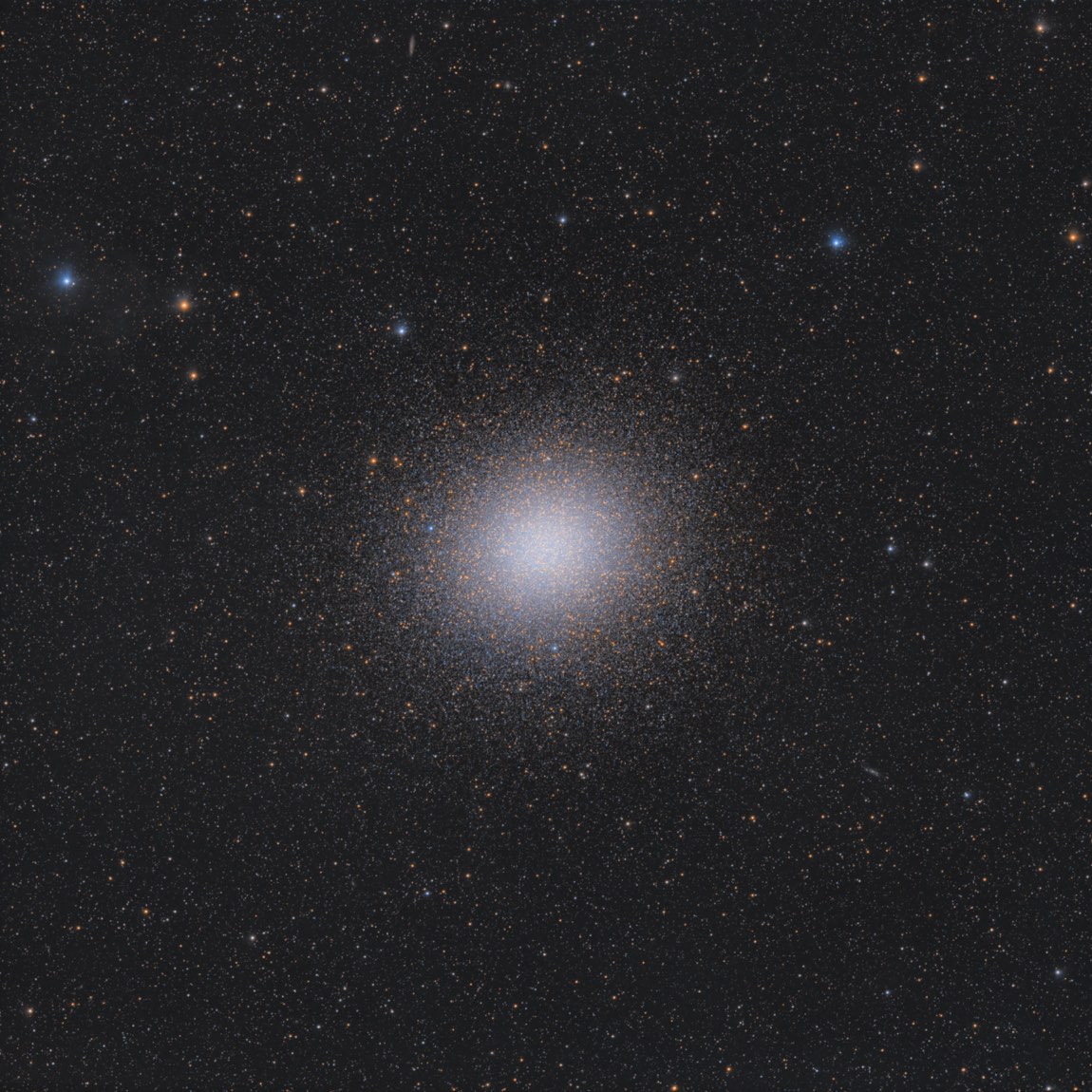
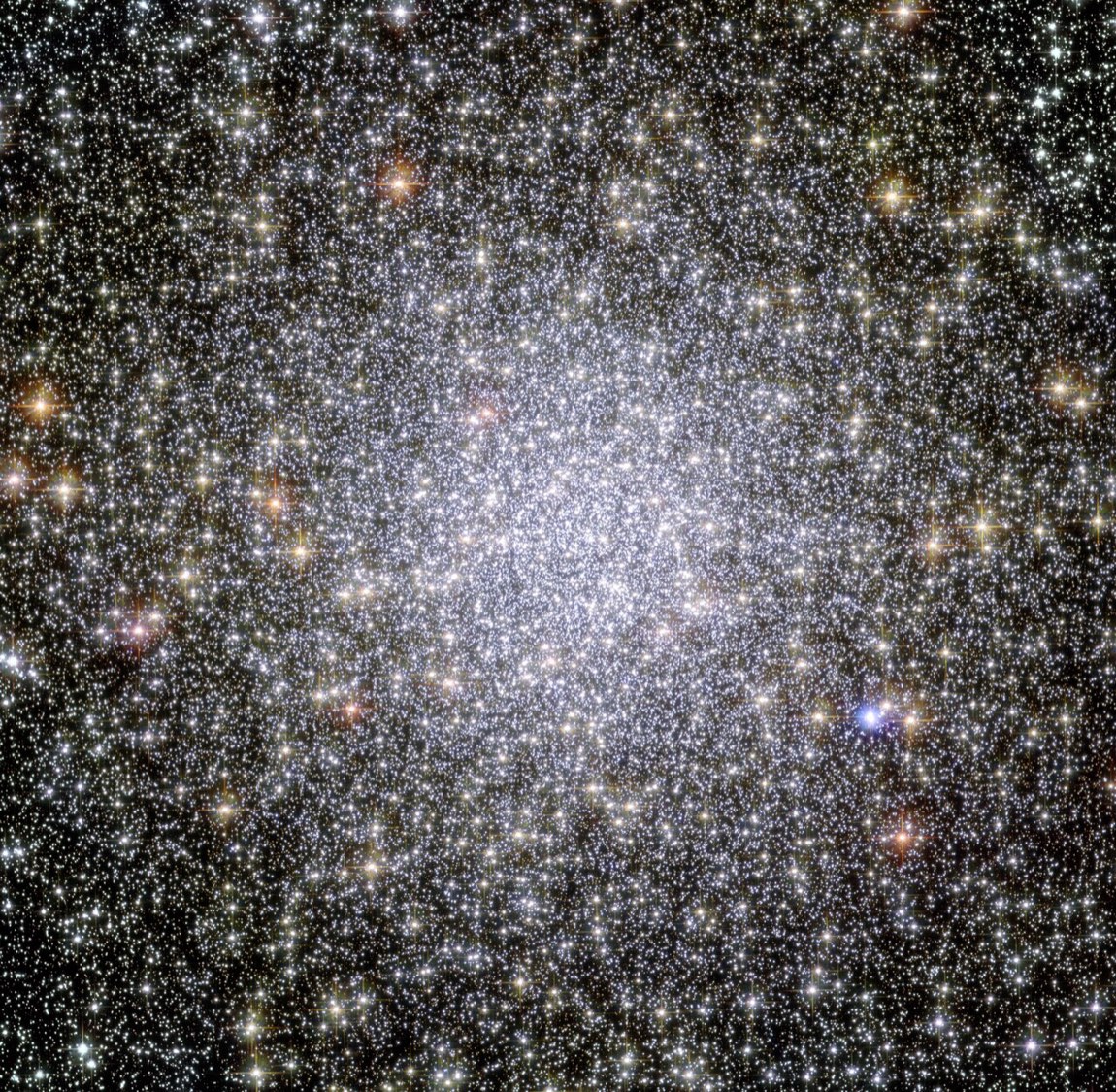
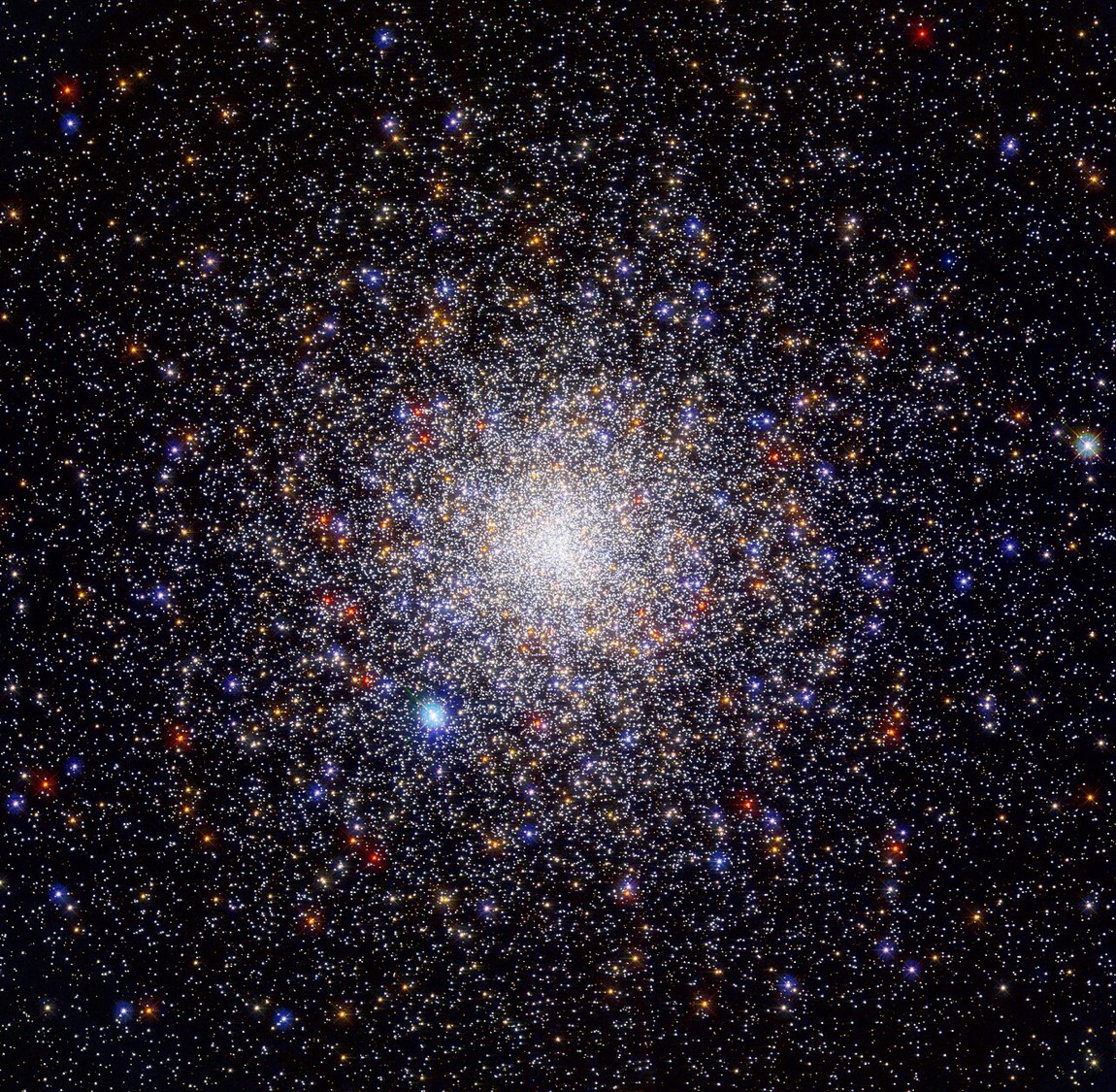
 Photograph · NASA Hubble Space Telescope · CC BY 2.0
Star Cluster · Deep guide
NGC 1851
Also called: Caldwell 73 · NGC 1851
A massive, tightly packed globular cluster that may be the stripped core of a lost dwarf galaxy.
What is it?
NGC 1851 is a globular cluster in Columba with one of the densest cores of any globular in the Milky Way. It follows a highly elongated orbit around the galaxy. It holds two distinct groups of subgiant stars and is wrapped in a wide halo of stars, which has led some astronomers to suggest it is the leftover nucleus of a dwarf galaxy swallowed by the Milky Way, like Omega Centauri. It is estimated to be 9.2 billion years old with about 551,000 solar masses.
The deep dive
Researched for the Atlas from Wikipedia — NGC 1851 (2,815 characters read) · updated Nov 15, 2026
01 A cluster so dense it stands apart
NGC 1851 earns a Shapley–Sawyer Concentration Class of II, placing it among the most centrally packed globular clusters in the entire Milky Way. This classification system runs from loosely scattered (Class XII) down to extremely concentrated (Class I), so a Class II rating means the stars crowd toward the center with unusual ferocity. John Dreyer, compiling his New General Catalogue in the nineteenth century, described the object as not very bright but very large, round, well resolved, and clearly consisting of stars — a tidy summary that still holds. That central density is not merely an aesthetic feature; it has real physical consequences, driving stellar collisions and interactions that produce exotic objects like millisecond pulsars. The cluster carries the additional designation Caldwell 73, after Patrick Caldwell-Moore's catalogue of showpiece deep-sky objects, reflecting how visually rewarding it is even in a modest telescope despite sitting in the relatively unfamiliar southern constellation of Columba.
02 A relic of a devoured galaxy?
One of the most striking features of NGC 1851 is a diffuse halo of stars stretching outward to a radius of 240 parsecs or more — roughly 780 light-years from the cluster's heart. Structures this extended are not typical of ordinary globular clusters, and astronomers have proposed a dramatic explanation: NGC 1851 may be the surviving nucleus of a dwarf galaxy that the Milky Way stripped apart and swallowed long ago. This would make it a sibling of sorts to Omega Centauri, the largest and most massive globular cluster in our galaxy, which is widely believed to share the same stripped-nucleus origin. A true accreted nucleus would normally leave behind a tidal tail or stellar stream tracing its orbit, and while the article notes the tidal tail is still present, the overall picture remains contested. An alternative explanation — that the cluster formed when two separate globular clusters merged — is considered less likely because both progenitors would have needed nearly identical metallicities, a coincidence that stretches plausibility.
03 Three stellar generations in one object Deeper
NGC 1851 is not the simple, single-age stellar population that early astronomers assumed all globular clusters to be. The evidence for internal complexity comes from several directions. The cluster displays two separate populations of subgiant stars, with the brighter subgiant branch preferentially concentrated in the outer regions rather than the core — a spatial offset that implies the two populations did not form in exactly the same way or place. Observations of horizontal branch stars reveal a pair of populations whose ages differ by roughly two billion years, a gap wide enough to span the entire history of complex life on Earth. And spectroscopic analysis of red giant branch members pushes the picture further still, suggesting that there are actually three distinct stellar populations within the cluster. Together these layers of evidence paint NGC 1851 as a composite object with a complicated formation history, though precisely how those populations arose — whether through multiple bursts of star formation, accretion, or merger — remains an open question.
04 A pulsar factory unlike most clusters
The dense core of NGC 1851 is an extraordinarily productive factory for millisecond pulsars, the ultra-fast-spinning neutron stars spun up by stealing mass from a companion star. The TRAPUM Large Survey Project, using the MeerKAT radio telescope in South Africa, discovered thirteen new pulsars in the cluster in a single campaign. Those thirteen divide into six isolated millisecond pulsars, six binary millisecond pulsars, and one mildly recycled pulsar — a category that sits between a fully spun-up millisecond pulsar and an ordinary slow pulsar. The sheer number reflects how the cluster's crowded core constantly throws stars into close gravitational encounters, pairing neutron stars with new companions and restarting the spin-up process. MeerKAT's extraordinary sensitivity, combined with the TRAPUM survey's systematic approach to known globular clusters, has made it one of the most productive pulsar-hunting tools ever deployed.
05 The pulsar orbiting a mass-gap mystery Deeper
Among NGC 1851's pulsars, PSR J0514−4002E has attracted particular scientific excitement because its companion object appears to occupy the so-called mass gap — the range of masses between the heaviest known neutron stars and the lightest confirmed black holes. Astrophysicists have long debated whether the mass gap is a true desert in nature or merely a gap in our detection capability, so finding an object that sits squarely within it is significant. The system is considered potentially useful for studying theories of gravity, because the pulsar acts as an extraordinarily precise clock whose timing can be used to test how spacetime behaves around a massive compact object. A separate pulsar in the same cluster, PSR J0514-4002A, orbits a massive companion — possibly another neutron star — with an orbital period of 18.8 days and a large eccentricity of 0.89, meaning its orbit is far more elongated than circular, stretching and compressing the system in ways that offer further tests of general relativity.
06 A possible black hole lurking at the center
Analysis of the eccentricities of pulsars within NGC 1851 has led astronomers to propose that the cluster's core may harbor an intermediate-mass black hole with a mass of up to 7,500 times the mass of the Sun. Intermediate-mass black holes — those falling between the stellar-mass black holes formed by dying stars and the supermassive monsters at galactic centers — are among the most elusive objects in astrophysics. Direct confirmation remains difficult because such a black hole would be far too small to resolve with current telescopes and far too quiet, in its dense stellar environment, to be easily distinguished from the collective gravitational effects of many ordinary stars. The pulsar timing method offers one of the more promising routes to detection: if a black hole is present, its gravitational influence should perturb the orbits of nearby pulsars in measurable ways. As of the time the source article was written, this remains an inference rather than a confirmed detection.
07 Variable stars and a classification puzzle Deeper
Forty-three RR Lyrae variable stars have been identified within NGC 1851, and their properties present a genuine classification puzzle. RR Lyrae stars are pulsating giants used as distance indicators and as tracers of a cluster's age and chemical history. Globular clusters are sorted into two groups based on their RR Lyrae populations: Oosterhoff type I clusters, whose RR Lyrae stars pulsate with relatively short periods, and Oosterhoff type II clusters, with longer-period pulsators and typically lower metal abundances. NGC 1851 formally falls into the type I category based on its RR Lyrae periods, yet its other properties show characteristics more typical of type II. This ambiguity is consistent with the cluster's broader identity crisis — a composite object with multiple stellar populations whose properties don't fit neatly into standard frameworks developed for simpler, more uniform clusters.
08 An orbit that swings wild through the galaxy
NGC 1851 does not travel in a gentle, nearly circular path around the Milky Way. Its orbit is highly eccentric, with an eccentricity of about 0.7 — for comparison, Earth's orbit around the Sun has an eccentricity of just 0.017, barely a whisker from a perfect circle. An eccentricity of 0.7 means the cluster swings dramatically inward and outward, spending part of its orbit relatively close to the Galactic Center and part of it far out in the halo. Currently, it sits 39.5 kilolight-years from the Sun and 54.1 kilolight-years from the Galactic Center. This wild orbital path is itself a clue to the cluster's origin: objects captured from infalling dwarf galaxies tend to arrive on eccentric, tilted orbits rather than the more settled paths of clusters born within the Milky Way itself, lending additional circumstantial support to the stripped-nucleus hypothesis.
09 How and where to observe NGC 1851
NGC 1851 sits in Columba, a small and dim constellation south of Lepus and Orion, best placed for observation from southern hemisphere locations but still accessible from mid-northern latitudes at low elevations during the Southern Hemisphere's summer season. Its apparent magnitude makes it a rewarding target even in binoculars as a fuzzy, roundish glow, while a modest telescope begins to resolve individual stars at the cluster's outer edges. Dreyer's original description — not very bright but very large and well resolved — remains a fair preview of what an observer will see. The cluster's high central concentration means the core appears significantly brighter than the halo even at moderate magnification, and larger amateur telescopes reveal the dense, compressed nucleus quite dramatically. Observers from latitudes south of about 20 degrees north will find it rises high enough in the sky for genuinely satisfying views on a steady, transparent night.
10 Mass, age, and place in cosmic time
NGC 1851 is estimated to be 9.2 billion years old, meaning it formed roughly 4.5 billion years before our Solar System even existed — when the universe was less than half its current age. Its mass is estimated at 551,000 times the mass of the Sun, making it one of the more massive surviving globular clusters in the Milky Way. That mass, combined with the cluster's age and its dense concentration, means it has had enormous amounts of time for internal gravitational dynamics to work: stars have sunk toward the center, low-mass stars and stellar remnants have been flung outward, and exotic objects have been created through close encounters. The cluster's extended stellar halo — stretching to at least 240 parsecs — may itself be a fossil record of mass lost over those billions of years, whether through tidal stripping by the Milky Way or through internal dynamical processes that gradually evaporate stars from the cluster's outer regions.
11 What the discovery of 13 pulsars reveals Deeper
The TRAPUM survey's haul of thirteen new pulsars in NGC 1851 more than doubled what was previously known in the cluster and illustrates how transformative next-generation radio telescopes are for globular cluster science. The MeerKAT array in the Karoo desert of South Africa offers a collecting area and sensitivity that allow it to detect much fainter, more distant pulsars than earlier instruments could reach. The mix of pulsar types found — isolated millisecond pulsars, binary millisecond pulsars, and one mildly recycled object — reflects the full range of evolutionary pathways available in a dense stellar environment. Isolated millisecond pulsars may have formed in binaries that were later disrupted by gravitational encounters, while the binary systems still in progress represent the spin-up process caught mid-stream. Each new pulsar adds a new clock to the cluster, and the more clocks astronomers have, the better they can map the cluster's gravitational potential and search for the signatures of a central intermediate-mass black hole.