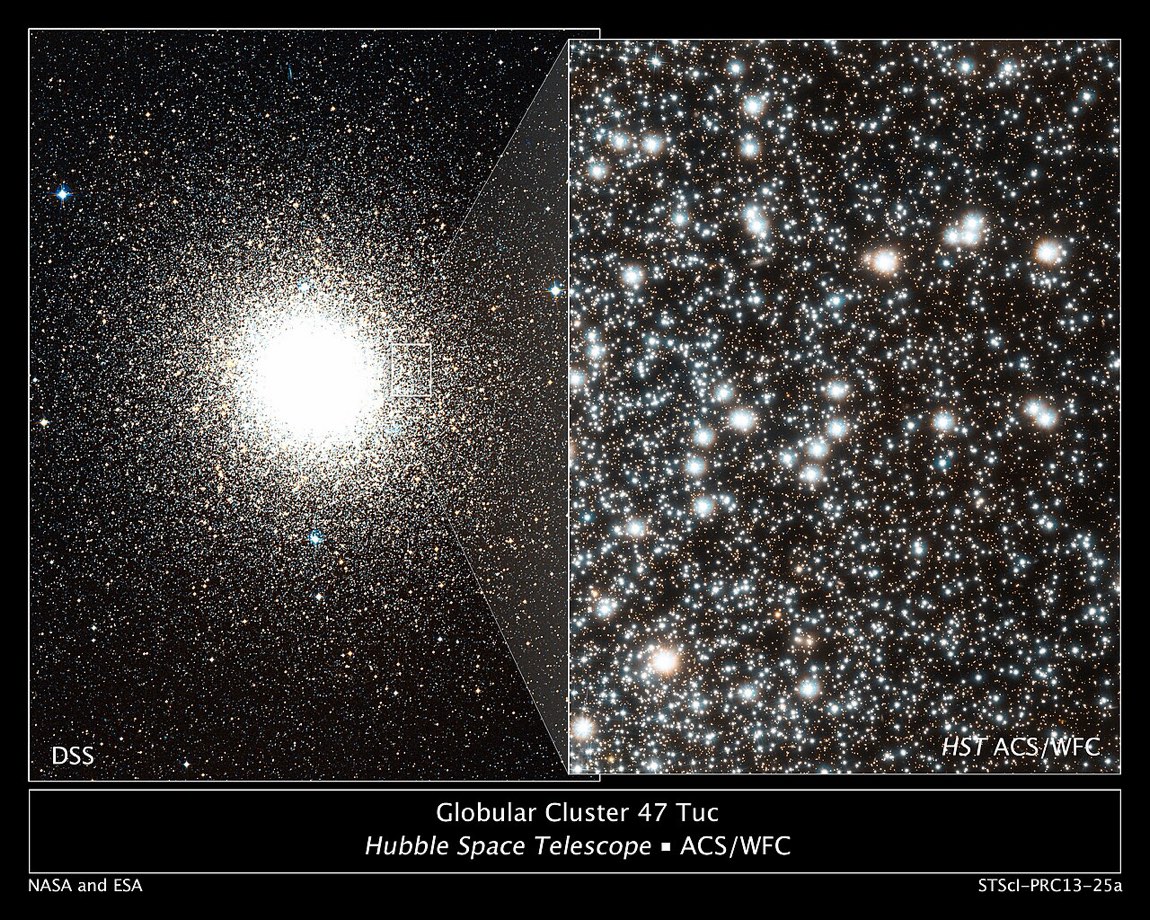
 Photograph · Credit: NASA, ESA, and the Hubble Heritage (STScI/AURA)-ESA/Hubble Collaboration · CC BY 4.0
Star Cluster · Deep guide
47 Tucanae
Also called: Caldwell 106 · NGC 104 · 47 Tuc · Xi Tucanae
The second-brightest globular cluster in the sky, a naked-eye ball of stars near the Small Magellanic Cloud.
What is it?
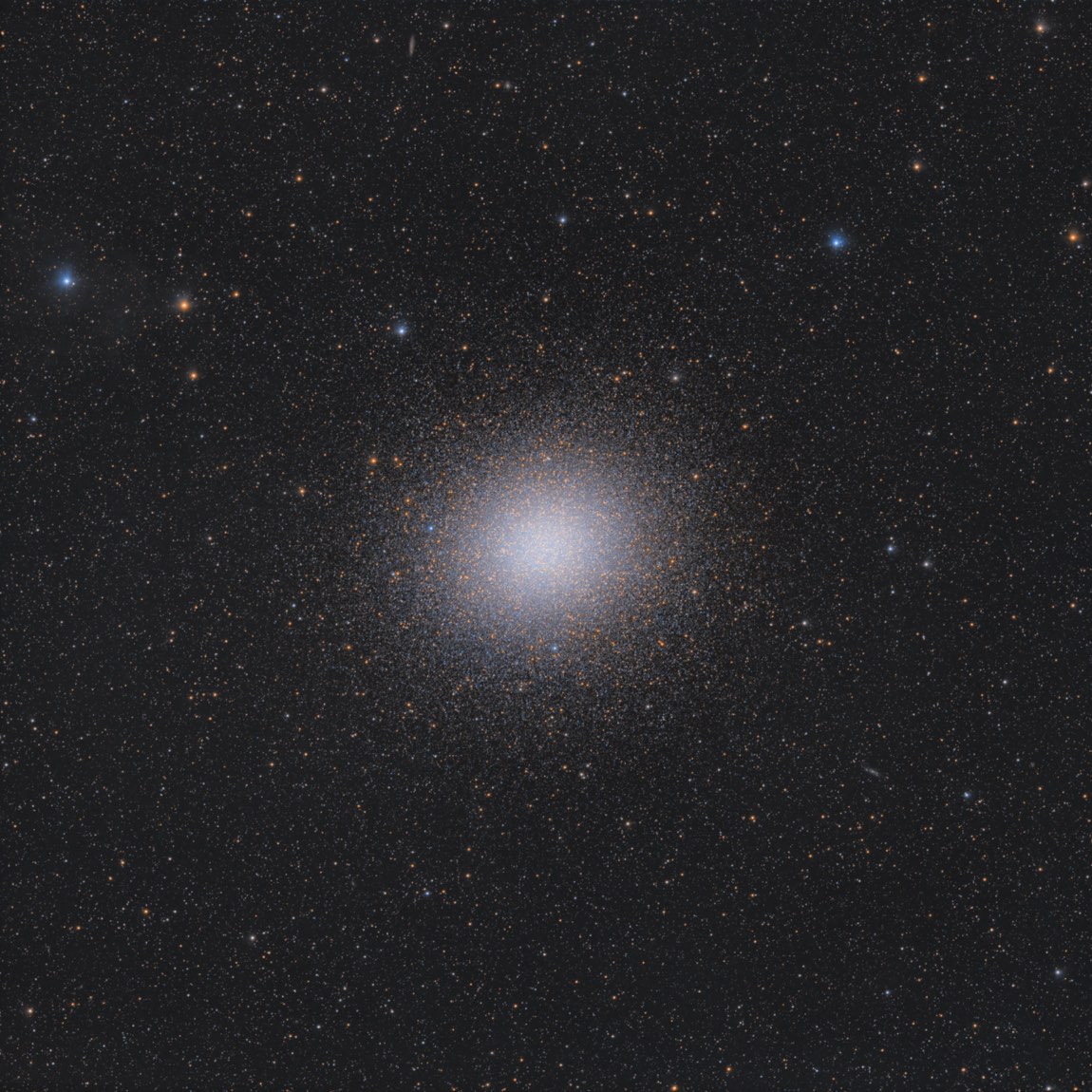
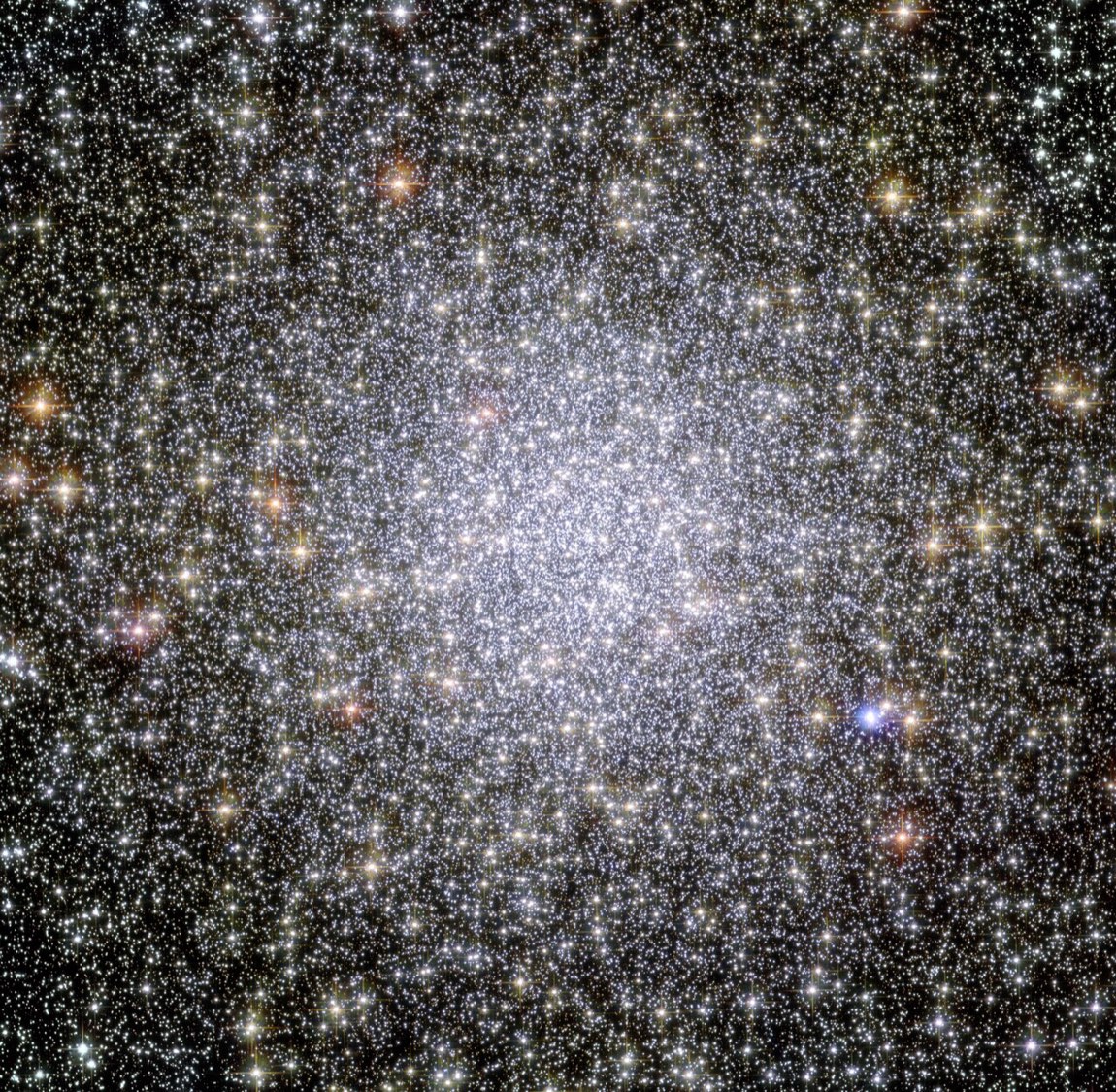
47 Tucanae is a globular cluster in Tucana and, after Omega Centauri, the second-brightest in the sky, easily seen with the naked eye. It lies only 18° from the south celestial pole, so European astronomers did not record it until Lacaille saw it in 1751–52 and first mistook it for a comet. It is about 120 light-years across, and a telescope shows about ten thousand stars crowding into a dense core. Whether a middle-sized black hole hides at its centre is still debated.
The deep dive
Researched for the Atlas from Wikipedia — 47 Tucanae (6,043 characters read) · updated Nov 15, 2026
01 How 47 Tuc Got Its Unusual Name
The cluster's name is a small puzzle in the history of astronomy. Nicolas-Louis de Lacaille first recorded it in 1751–52 from South Africa, initially mistaking it for the nucleus of a bright comet. He catalogued it as "Lac I-1" — literally the first object in his entire deep-sky catalogue. The number "47" came later, assigned by Johann Elert Bode in his 1801 Berlin publication, a comprehensive star atlas that reordered Lacaille's objects by constellation and right ascension. Bode never observed the cluster himself; he was essentially a compiler, reshuffling existing data. In the 19th century, Benjamin Apthorp Gould tried a different approach, assigning it the Greek letter Xi, calling it ξ Tucanae, but that designation never caught on. The cluster also carries the designations NGC 104 and Caldwell 106. Its far southern sky position — just 18° from the south celestial pole — explains why European astronomers ignored it entirely until the mid-18th century, while southern-hemisphere observers would have seen it with the naked eye for millennia.
02 A Cluster That Rivals the Full Moon
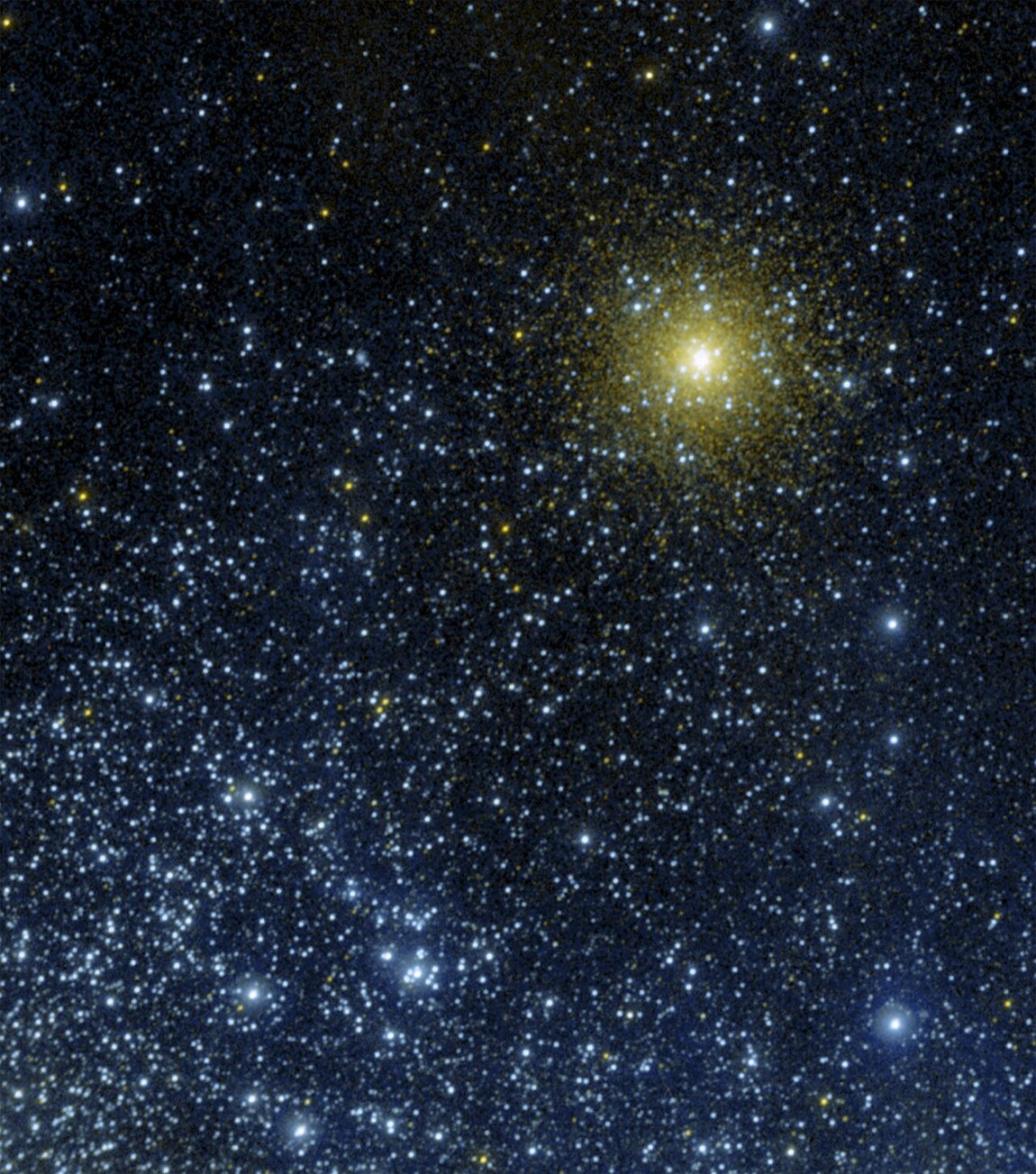
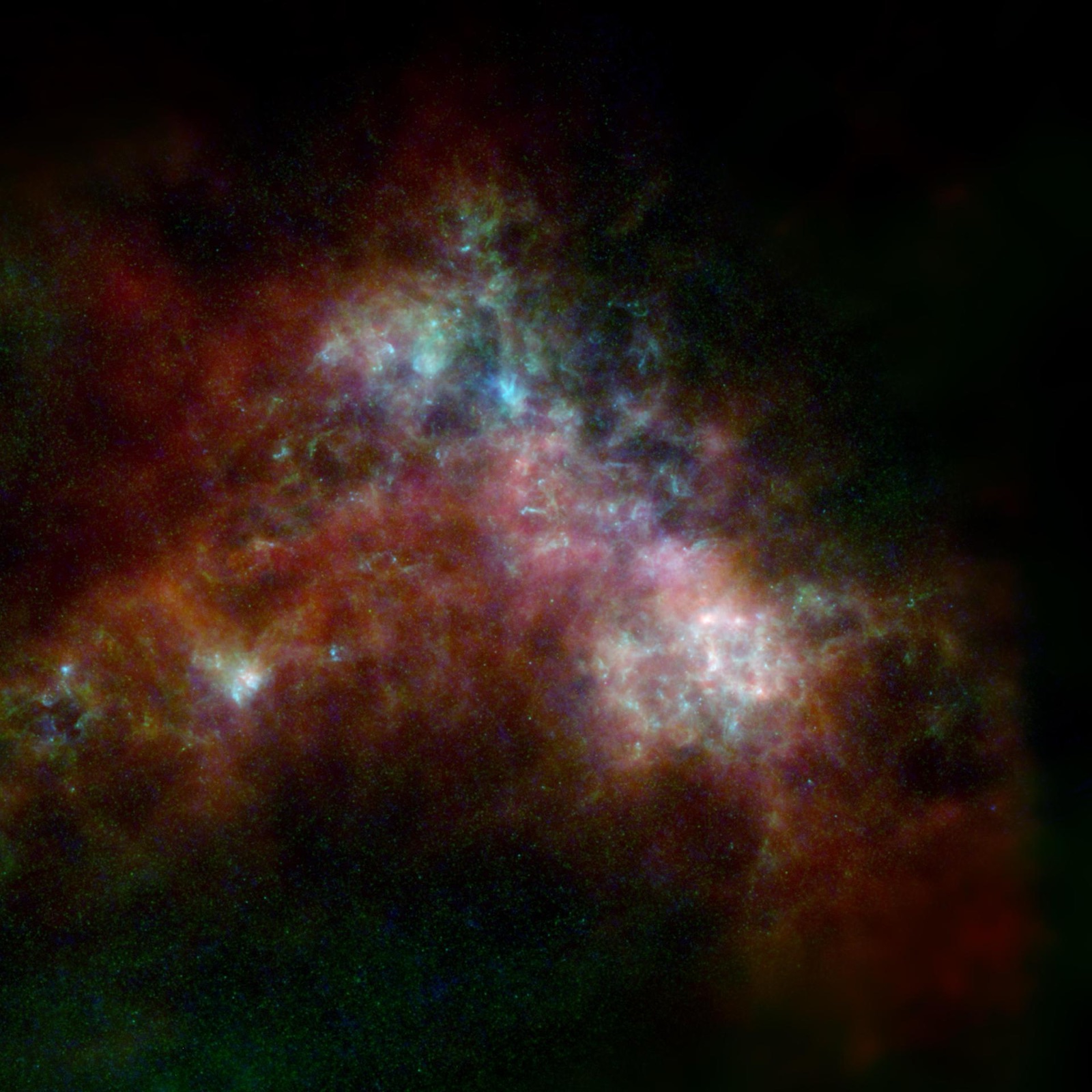
On the sky, 47 Tucanae is a genuinely impressive object by any measure. Its apparent magnitude of 4.1 makes it easily visible to the naked eye, and under ideal conditions the cluster spans roughly 44 arcminutes in its full extent — close to the apparent diameter of the full Moon. Its physical diameter is 120 light-years, an immense volume of space packed with millions of stars. It sits 4.45 ± 0.01 kiloparsecs from Earth, which works out to 14,500 ± 32.6 light-years — a distance so precisely pinned down that the uncertainty is only about 33 light-years. By apparent brightness it ranks second among all globular clusters in the sky, behind only Omega Centauri. One striking visual quirk: 47 Tuc appears adjacent to the Small Magellanic Cloud in photographs, but the two are nowhere near each other physically. The SMC lies about 60.6 ± 1.0 kpc away, more than fifteen times farther than 47 Tuc.
03 The Dense, Exotic Heart of the Cluster Deeper
The core of 47 Tucanae is what makes it scientifically exceptional. Globular clusters naturally sort themselves by stellar mass through a process called mass segregation — the most massive stars sink toward the center over time — and in 47 Tuc this process is dramatically visible. The first evidence for mass segregation was formally announced in May 2015, confirming what theorists had long predicted. The dense core hosts at least 21 blue straggler stars, objects that appear younger and bluer than the rest of the population and are thought to have gained mass through collisions or binary mergers. Beyond blue stragglers, the core is crowded with cataclysmic variables — white dwarfs actively pulling material from companion stars — and low-mass X-ray binaries containing neutron stars. Altogether the cluster harbors hundreds of X-ray sources. Many of these are stars with enhanced chromospheric activity driven by their membership in tight binary systems, where tidal forces spin stars up and amplify magnetic activity.
04 35 Millisecond Pulsars and a Historic First Deeper
Among globular clusters, 47 Tucanae is a pulsar powerhouse. It contains 35 known millisecond pulsars, the second-largest population in any globular cluster after Terzan 5. These are neutron stars spinning hundreds of times per second, spun up over long periods by accreting material from binary companions during an earlier X-ray binary phase — a process sometimes called "recycling." One of these pulsars, 47 Tuc W, appears to still be in mid-transition: its companion seems to be actively transferring mass even now, offering astronomers a rare live view of the moment a low-mass X-ray binary becomes a millisecond pulsar. The Chandra X-ray Observatory has individually detected X-ray emission from most of the cluster's millisecond pulsars, likely originating from the hot neutron-star surface. Even more significantly, the Fermi Gamma-ray Space Telescope detected gamma-ray emission from the millisecond pulsar population as a whole — making 47 Tucanae the first globular cluster ever detected in gamma rays, a landmark in high-energy astrophysics.
05 The Brightest Star: a Fading Helium Burner Deeper
The cluster's brightest member in both visible and ultraviolet light is known simply as the "Bright Star," which is as literal a name as astronomy gets. It is a blue giant with a spectral class of B8III and a luminosity about 1,100 times that of the Sun — yet it weighs in at only about 54% of a solar mass. That odd combination of high luminosity and low mass is explained by its evolutionary stage: it is a post-asymptotic giant branch star, meaning it has already passed through the red giant and asymptotic giant branch phases and is now fusing helium in its interior. Its effective surface temperature is around 10,850 K, which puts it in the blue-white part of the spectrum. The fact that such a luminous star has less than half the Sun's mass tells us it has shed enormous amounts of material during its giant phases — a fate that awaits most stars in the cluster, which the Hertzsprung–Russell diagram suggests formed approximately 13 billion years ago.
06 Two Stellar Populations, One Cluster Deeper
For a long time, globular clusters were held up as textbook examples of "simple stellar populations" — single-age, single-composition groups of stars born together from one cloud of gas. 47 Tucanae complicates that picture. The cluster is now known to contain at least two distinct stellar populations, differing in either age or metallicity or both. The presence of multiple populations suggests that star formation in the cluster was not a single instantaneous event, or that stars formed from gas with different chemical enrichment histories. This finding fits a broader revolution in globular cluster science, where clusters like Omega Centauri have been found to contain even more complex multi-population structures. The low overall metallicity of 47 Tuc's environment also carries consequences beyond stellar evolution: a ground-based planet survey of the cluster's outer, less crowded regions found no planets even though several were expected, strongly suggesting that metal-poor environments are hostile to planet formation, rather than the crowding of the cluster's core being the main culprit.
07 The Planet Search That Found Nothing
One of the most closely watched experiments carried out on 47 Tucanae was a large-scale planet hunt using the Hubble Space Telescope, which searched the cluster's dense core for transits — the brief dimmings that occur when a planet crosses in front of its star. Based on the rate of planet discoveries around Sun-like stars in the solar neighborhood, researchers expected to find somewhere between ten and fifteen planets. They found none. A later ground-based survey shifted attention to the cluster's outer regions, where stellar crowding is not an issue, and again found no planets where several had been anticipated. The combined result points strongly to a single explanation: the low metallicity of 47 Tuc's stars, not the extreme crowding of its core, is what suppresses planet formation. Planets appear to form more readily around metal-rich stars because heavy elements provide the raw material for solid planetary cores. In 47 Tuc, that raw material was simply too scarce when the stars were born roughly 13 billion years ago.
08 Is There a Black Hole in the Center?
Whether 47 Tucanae hosts a central black hole remains one of the genuinely open questions in the study of globular clusters. Data from the Hubble Space Telescope place an upper limit of roughly 1,500 solar masses on any black hole that could sit at the cluster's center. Yet in February 2017, a separate team announced evidence for a black hole of approximately 2,200 solar masses — just above that upper limit — detected through the motions and spatial distribution of the cluster's pulsars. That would qualify it as an intermediate-mass black hole, a class that sits between stellar-mass black holes and the supermassive varieties found in galactic nuclei, and whose very existence is debated. However, a more recent analysis using an updated and more extensive set of pulsar timing data found no solid evidence supporting the black hole's presence. Then in January 2024, a team led by ICRAR in Western Australia announced the detection of a previously unknown radio source at the heart of 47 Tuc, raising the possibility of a supermassive black hole there. The question is very much unresolved.
09 A Mysterious Laser Signal in 2008
In December 2008, Ragbir Bhathal of the University of Western Sydney reported detecting a strong laser-like signal apparently coming from the direction of 47 Tucanae. The claim attracted attention in part because optical SETI — the search for extraterrestrial intelligence through laser pulses rather than radio waves — was still a relatively young field, and a globular cluster containing millions of old stars might seem, at first glance, like a plausible address for a technologically advanced civilization. The article does not describe any subsequent confirmation of the signal or further details about its characteristics. It remains a curiosity rather than a confirmed detection, but it is worth noting that 47 Tuc's planet surveys ultimately found no planets in the cluster, which would considerably dampen any expectations for life there regardless of the signal's origin. The episode illustrates how even a well-studied, nearby cluster can produce unexpected observational claims.
10 How to Find It in the Southern Sky
47 Tucanae sits in the constellation Tucana, just 18° from the south celestial pole, which makes it permanently invisible from most of Europe and North America but a spectacular and easy naked-eye object from the southern hemisphere. Its apparent magnitude of 4.1 means it is comfortably visible without optical aid from a dark site, appearing as a fuzzy star. Through binoculars or a small telescope it resolves into a glowing, concentrated ball with a noticeably brighter core. Under the telescope, roughly ten thousand stars become individually distinguishable, crowding toward the small, intensely dense central region. The cluster spans about 44 arcminutes in its full extent, comparable to the full Moon, so it is best observed at modest magnifications that keep the whole object in the field of view. Its most recognizable sky landmark is the Small Magellanic Cloud: 47 Tuc appears right next to it in photographs and to the eye, though the two objects are physically unrelated, with the SMC being more than fifteen times farther away.
11 X-ray Astronomy's Crowded Laboratory Deeper
The sheer variety of X-ray sources in 47 Tucanae makes it one of the most productive laboratories in high-energy astrophysics. The cluster contains hundreds of X-ray sources, falling into several distinct classes. Stars in binary systems can be spun up by tidal forces, boosting their magnetic activity and generating X-ray-bright chromospheres — these are called active binaries. Cataclysmic variables are a step more extreme: white dwarfs accreting material from companion stars, releasing energy as the infalling gas heats up and sometimes triggers nova outbursts. Low-mass X-ray binaries, containing neutron stars, shine in X-rays when actively accreting, but 47 Tuc also hosts systems where accretion has stopped and the neutron star is detectable only by the thermal X-rays leaking from its still-hot surface. The Chandra X-ray Observatory has resolved and identified individual sources in this dense environment, disentangling what in earlier telescopes appeared as a single blended glow. Together, these populations make 47 Tuc a unique site for studying stellar evolution, binary interactions, and the life cycles of compact objects.
 ⤢