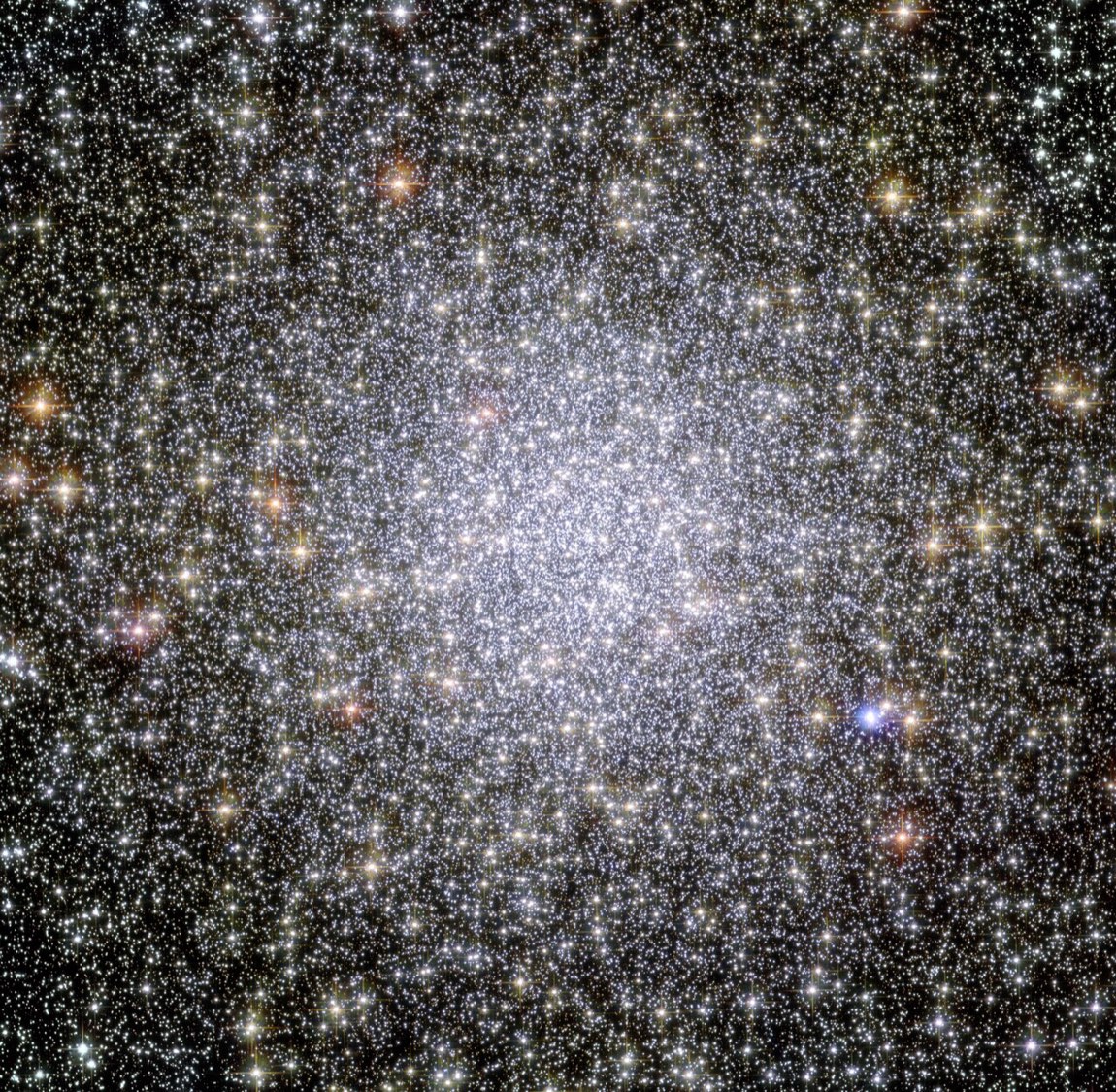
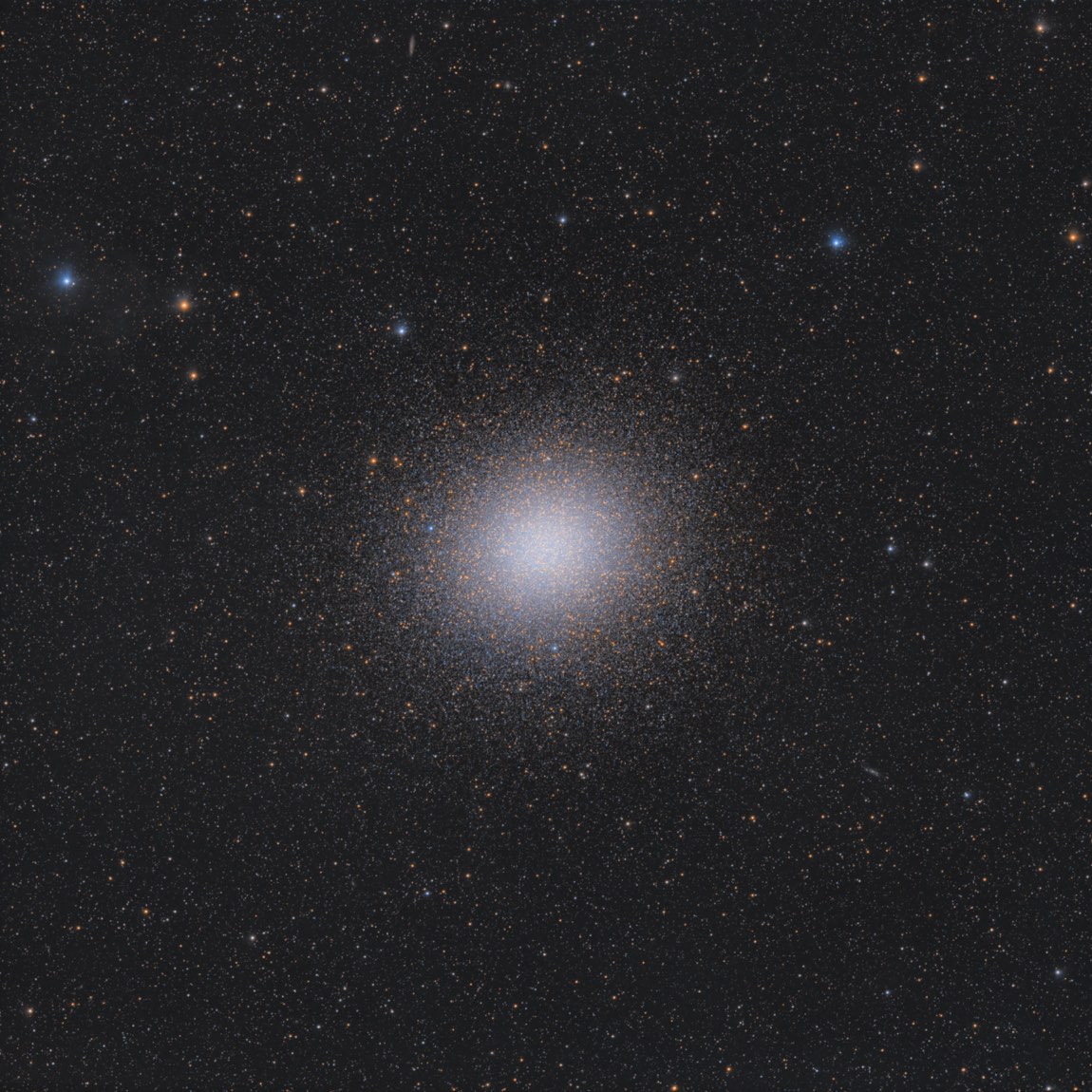
 Photograph · en:NASA , en:STScI , en:WikiSky · Public domain
Star Cluster · Deep guide
NGC 6752 (Great Peacock Globular)
Also called: Caldwell 93 · NGC 6752 · Great Peacock Globular
The fourth-brightest globular cluster in the sky, shining in the southern constellation Pavo.
What is it?
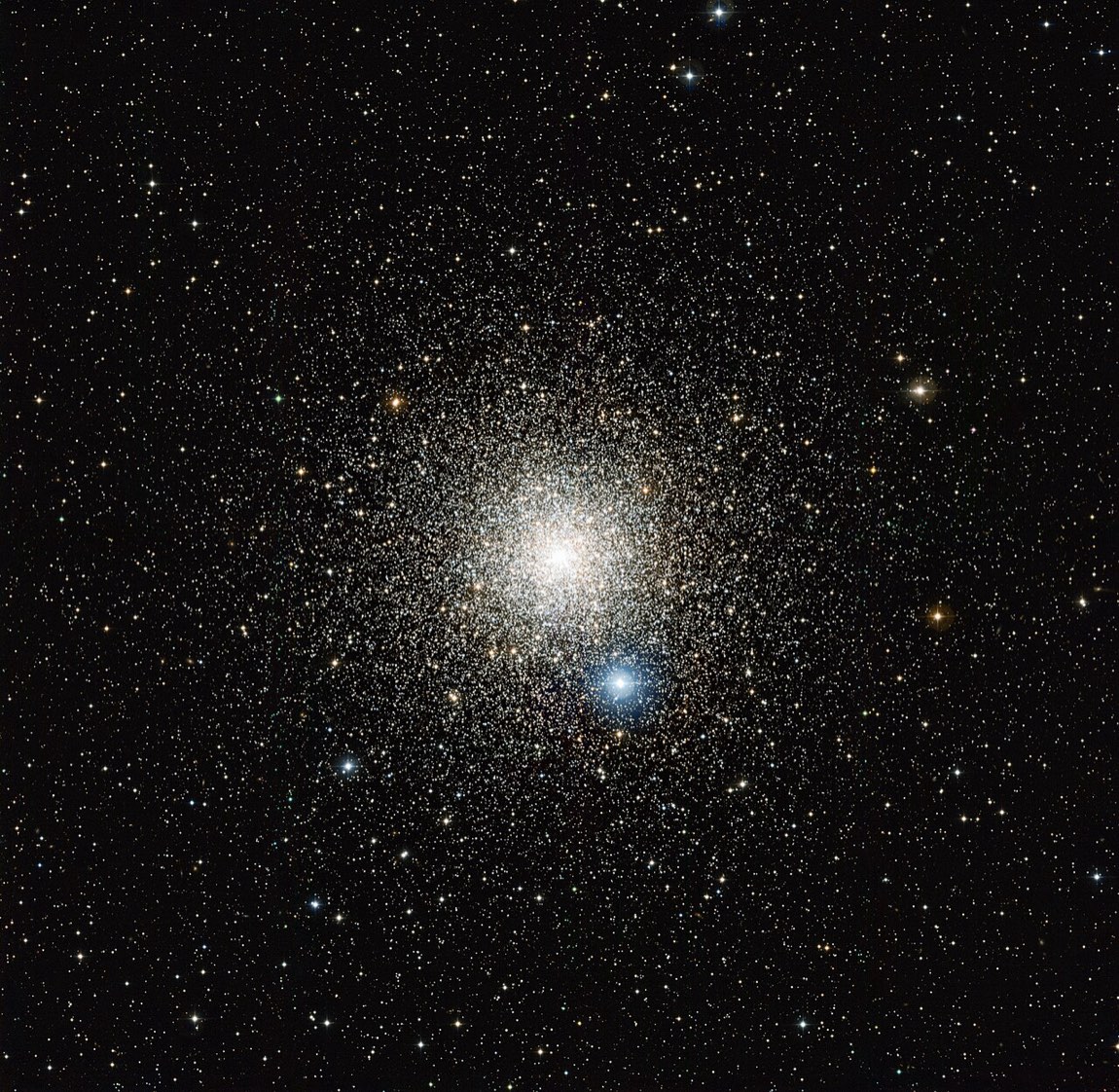
NGC 6752 is a globular cluster in Pavo and the fourth-brightest in the sky after Omega Centauri, 47 Tucanae and Messier 22. James Dunlop first described it from Parramatta in 1826. Its densely packed core, about 1.3 light-years across, shows it has undergone core collapse. At about 13,000 light-years it is one of the closer globulars, and it is estimated to be 11.8 billion years old.
The deep dive
Researched for the Atlas from Wikipedia — NGC 6752 (1,722 characters read) · updated Nov 15, 2026
01 A Globular Ranked Fourth Brightest in the Sky
Among the roughly 150 known globular clusters orbiting the Milky Way, NGC 6752 stands out as the fourth-brightest visible from Earth, trailing only Omega Centauri, 47 Tucanae, and Messier 22. That ranking is a direct consequence of two things working together: the cluster's genuine luminosity and its relative closeness to us. At around 13,000 light-years away, it is considered one of the nearer globular clusters to Earth, which means its light hasn't had nearly as much interstellar dust and distance to dim it before reaching our eyes. The apparent magnitude of 5.4 sits right at the edge of naked-eye visibility, so on a dark, clear night in the Southern Hemisphere — ideally between June and October when it rides highest — a careful observer can spot it without any optical aid at all. That is a remarkable achievement for an object consisting of stars packed together more than a thousand light-years away. Its unofficial nickname, the Great Peacock Globular, reflects both its impressive brightness and its home constellation, Pavo the Peacock.
02 James Dunlop and the Discovery of 1826
The credit for first identifying NGC 6752 belongs to James Dunlop, an astronomer working at Parramatta, Australia. On 30 June 1826 he recorded the object, describing it as an irregular bright nebula that could be resolved into a cluster of many stars, highly compressed at the centre. That description, written nearly two centuries ago without modern photographic or electronic detectors, turns out to be remarkably accurate. The compressed centre Dunlop noted corresponds precisely to what modern measurements confirm: a dense core region roughly 1.3 light-years in diameter. The cluster also carries the alternative catalog number NGC 6777, though the article notes this identification is uncertain, leaving a small historical puzzle unresolved. Dunlop's survey from Parramatta was part of a broader effort to catalog southern-sky objects inaccessible from European observatories, and NGC 6752 stands as one of his more striking finds. It is additionally listed as Caldwell 93 in Patrick Caldwell-Moore's catalog of notable non-Messier deep-sky objects.
03 Core Collapse: Stars Crowded Beyond Comfort Deeper
One of the most physically significant features of NGC 6752 is what astronomers call core collapse. The cluster's core region is densely populated with stars within a diameter of only about 1.3 light-years — a space so compact that the nearest star to our Sun, Proxima Centauri, would comfortably fit within it with room to spare, since Proxima is just over 4 light-years away. Core collapse happens when gravitational interactions between stars drain energy from the cluster's center, causing stars there to sink inward and pack ever more tightly together. The result is a sharply concentrated, luminous core rather than a smoothly graded brightness profile. This process is not just a curiosity; it drives stellar collisions and mergers, which in turn produce some of the cluster's more unusual stellar populations. The fact that Dunlop himself noticed the strong central compression in 1826, using the instruments available to him, underlines just how extreme this concentration truly is. Core collapse is considered an advanced dynamical state, and NGC 6752 serves as a well-studied example of a cluster that has reached it.
04 Blue Stragglers: Stars That Refused to Age Deeper
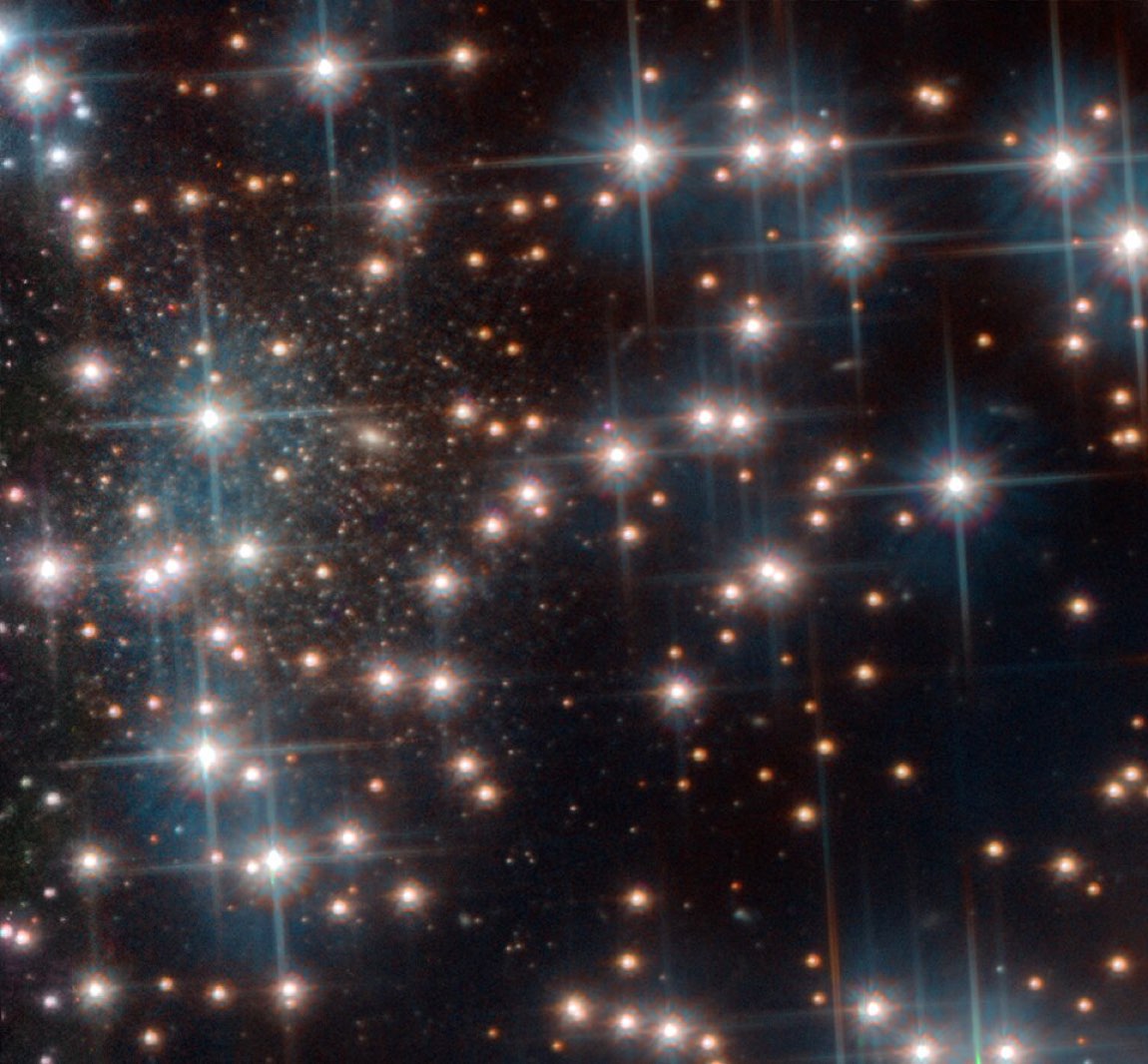
NGC 6752 hosts a population of blue straggler stars, objects that appear younger, hotter, and bluer than the rest of the cluster's aging stellar population should allow. In a globular cluster 11.78 billion years old, the physics of stellar evolution predicts that all stars above a certain mass should long ago have expanded into red giants and eventually faded. Blue stragglers defy that expectation, sitting in a region of the color-magnitude diagram where no star of the cluster's age ought to remain. The leading explanation, supported by the article, is that blue stragglers form through collisions and mergers of smaller stars. When two stars collide or when mass transfers between binary companions, the merged or rejuvenated object gains enough mass to effectively restart a hotter, bluer phase of stellar life. The dense, dynamically active environment of NGC 6752 — particularly in its collapsed core — provides exactly the conditions needed for such encounters to occur at meaningful rates. Binary stars, which are described as numerous within the cluster, are central players in this process.
 ⤢
05 Binary Stars: A Crowded Cluster's Hidden Pairs
The article emphasizes that NGC 6752 contains many binary stars — systems in which two stars orbit each other rather than traveling solo through space. In the dense environment of a globular cluster that has undergone core collapse, binary pairs play an outsized role in the cluster's dynamics. They act as a kind of energy reservoir: gravitational encounters with passing single stars can extract kinetic energy from a binary, causing the pair to tighten while the interloper flies away faster. This process, repeated over billions of years, helps support the cluster against further collapse and keeps the core stirred up. Binaries are also the nurseries of some of the cluster's most exotic objects. When one star in a pair dumps mass onto its companion, the companion can be spun up, rejuvenated, or transformed into something unusual entirely. The prevalence of binary stars in NGC 6752 therefore connects directly to both its structural history and to phenomena like the blue stragglers described above, making these pairs far more than background curiosities.
06 X-Ray Sources: Chandra Peers into the Core Deeper
Using the Chandra X-Ray Observatory, astronomers have identified six X-ray sources within the core of NGC 6752. X-ray emission in globular clusters typically signals energetic processes that ordinary stars cannot produce on their own. The leading candidates for such sources include low-mass X-ray binaries, in which a neutron star or black hole pulls material from a companion star and that infalling gas heats to temperatures of millions of degrees, radiating X-rays as it spirals inward. Cataclysmic variables — close binaries in which a white dwarf accretes material from a normal stellar companion — are another common contributor. Millisecond pulsars, neutron stars spun up to extraordinary rotation rates by accretion in binary systems, also emit X-rays. All of these objects are products of the dense, collision-rich environment that core collapse creates. The detection of six such sources by Chandra illustrates that NGC 6752 is not a quiet, dormant stellar city but an active environment where gravity continually forces stars into transformative and sometimes violent interactions.
07 Where the Cluster Sits in the Galaxy
NGC 6752 occupies a specific address within the Milky Way's halo. At roughly 13,000 light-years from Earth and 17,000 light-years from the galactic centre, it sits in a kind of middle distance — not so far out as the most remote halo clusters, but not embedded in the crowded, dusty inner regions of the galaxy either. That galactic positioning has practical consequences for observers: clusters near the galactic plane must be viewed through far more interstellar dust, which reddens and dims their light. NGC 6752's location gives it a relatively clean line of sight to Earth, contributing to its high apparent brightness. The Shapley–Sawyer Concentration Class assigned to it is VI, which describes an intermediate density — neither the most compact, highly concentrated globulars nor the loosest, most spread-out ones. This classification places it in a broad middle category of globular cluster structure, even as its collapsed core marks it as dynamically evolved.
08 An Ancient Object: 11.78 Billion Years Old
NGC 6752 has been calculated to be 11.78 billion years old — an age that places its formation in the very early universe, when the cosmos itself was only about 2 billion years old. For comparison, Earth is roughly 4.5 billion years old, meaning this cluster had already been shining for more than 7 billion years before our planet even formed. Such extreme age is typical of globular clusters, which are among the oldest gravitationally bound structures known. Stars that formed in the cluster 11.78 billion years ago would have done so from gas that was far less enriched with heavy elements than the interstellar medium today, because only a few generations of massive stars had yet lived and died to seed the galaxy with carbon, oxygen, iron, and other heavier atoms. This ancient origin shapes the chemical composition of the cluster's stars and has implications for discussions about the kinds of chemistry — and potentially the habitability — available in such environments. The age figure itself is a calculated value derived from stellar evolution models applied to the cluster's color-magnitude diagram.
 ⤢
09 How to Find It: A Sky-Watcher's Guide
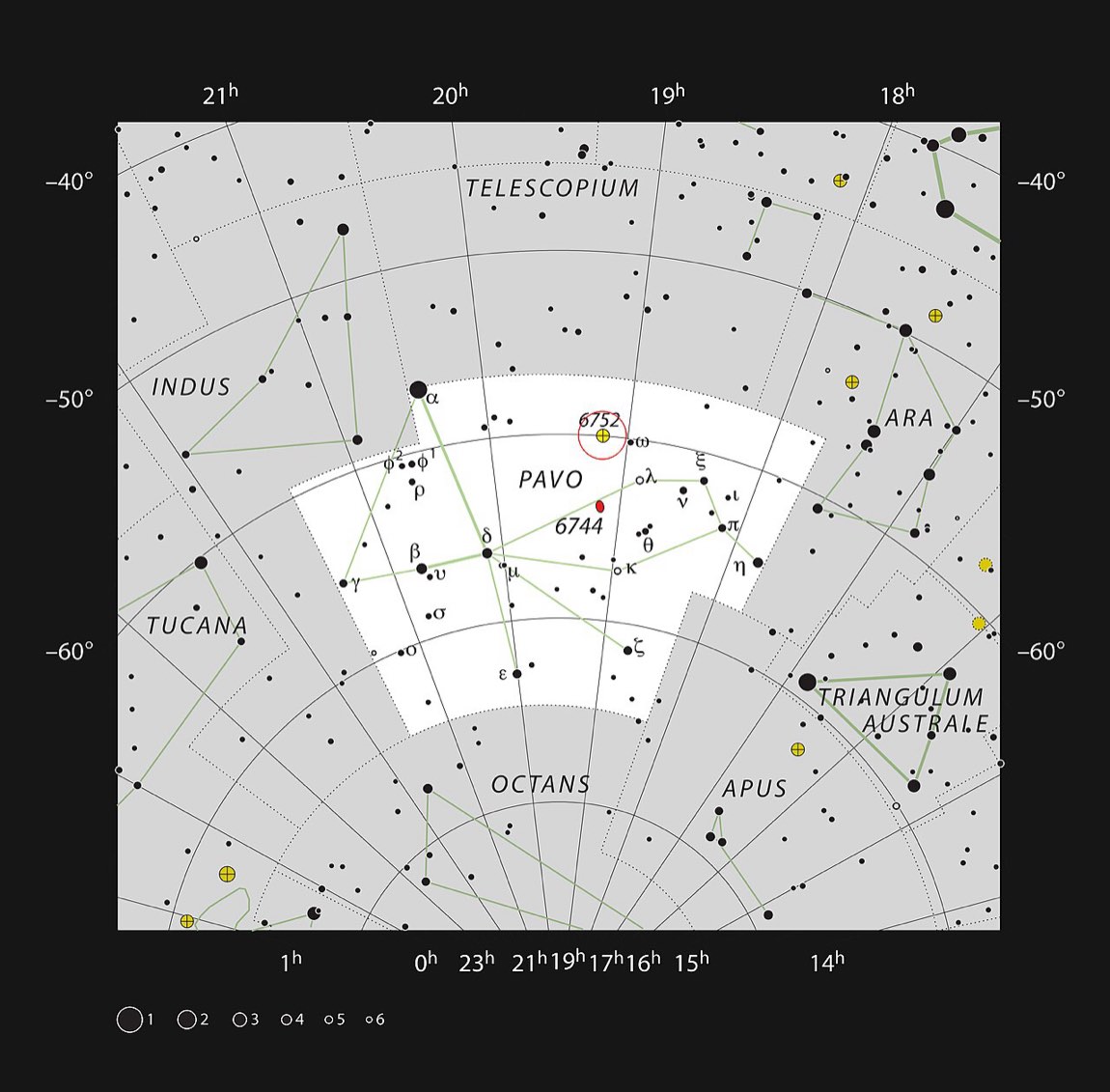
NGC 6752 is a rewarding target for observers in the Southern Hemisphere, best placed in the sky from June through October. With an apparent magnitude of 5.4, it sits right at the threshold of naked-eye visibility, meaning a dark sky with minimal light pollution is essential if you want to spot it without optical aid. Even modest binoculars transform the experience: through binoculars the cluster appears to cover an area three-quarters the size of the full moon, a strikingly large apparent size that reflects both its physical extent and its relative proximity. For star-hopping purposes, the cluster lies 1.5 degrees east of Omega Pavonis, a 5th-magnitude star, making it relatively straightforward to locate once you have identified that guide star. The nearest prominent bright star is Peacock — the alpha star of Pavo — which sits approximately 3.25 degrees to the north and 9.25 degrees to the east of the cluster. A small telescope will begin to resolve individual stars across its face, giving a first glimpse of its densely packed core.
10 The Shapley–Sawyer Scale and What Class VI Means Deeper
The Shapley–Sawyer Concentration Class is a classification scheme running from Class I, the most centrally concentrated globular clusters, to Class XII, the most loosely structured. NGC 6752 falls at Class VI, described as intermediate density. At first glance this might seem at odds with the cluster having undergone core collapse, which implies an extremely dense center. The resolution is that the Shapley–Sawyer system is based primarily on the overall visual appearance and brightness gradient of the cluster across its full extent, not solely on the innermost region. A cluster can have a sharp, collapsed core while still displaying a moderately extended outer halo that pushes its global classification toward the intermediate range. Class VI therefore tells observers what to expect when they look at the cluster through a telescope — a noticeable but not extreme central brightening surrounded by a resolvable outer envelope — while the core collapse designation, inferred from the 1.3-light-year core diameter, adds a layer of physical interpretation about the cluster's dynamical history that the visual classification alone does not capture.
11 Open Questions Surrounding This Ancient Cluster Deeper
Despite being one of the most studied globular clusters in the sky, NGC 6752 leaves several questions unresolved. The uncertain identification with NGC 6777 is a minor but nagging historical ambiguity — it remains unclear whether both catalog entries truly refer to the same object. More scientifically significant is the nature of the six X-ray sources detected by Chandra: identifying each one precisely, determining whether any involves a stellar-mass black hole, and understanding how they formed in the context of the cluster's dynamical history all remain active areas of investigation. The mechanisms driving blue straggler formation — whether direct stellar collisions, mass transfer in binaries, or some combination — are still debated across globular cluster research generally, and NGC 6752's population contributes data to that ongoing argument. The precise age of 11.78 billion years, while well constrained, still carries uncertainties tied to the accuracy of stellar evolution models and the cluster's chemical composition. Each of these threads represents a place where the cluster continues to teach astronomers about stellar physics, cluster dynamics, and the early universe.
 ⤢