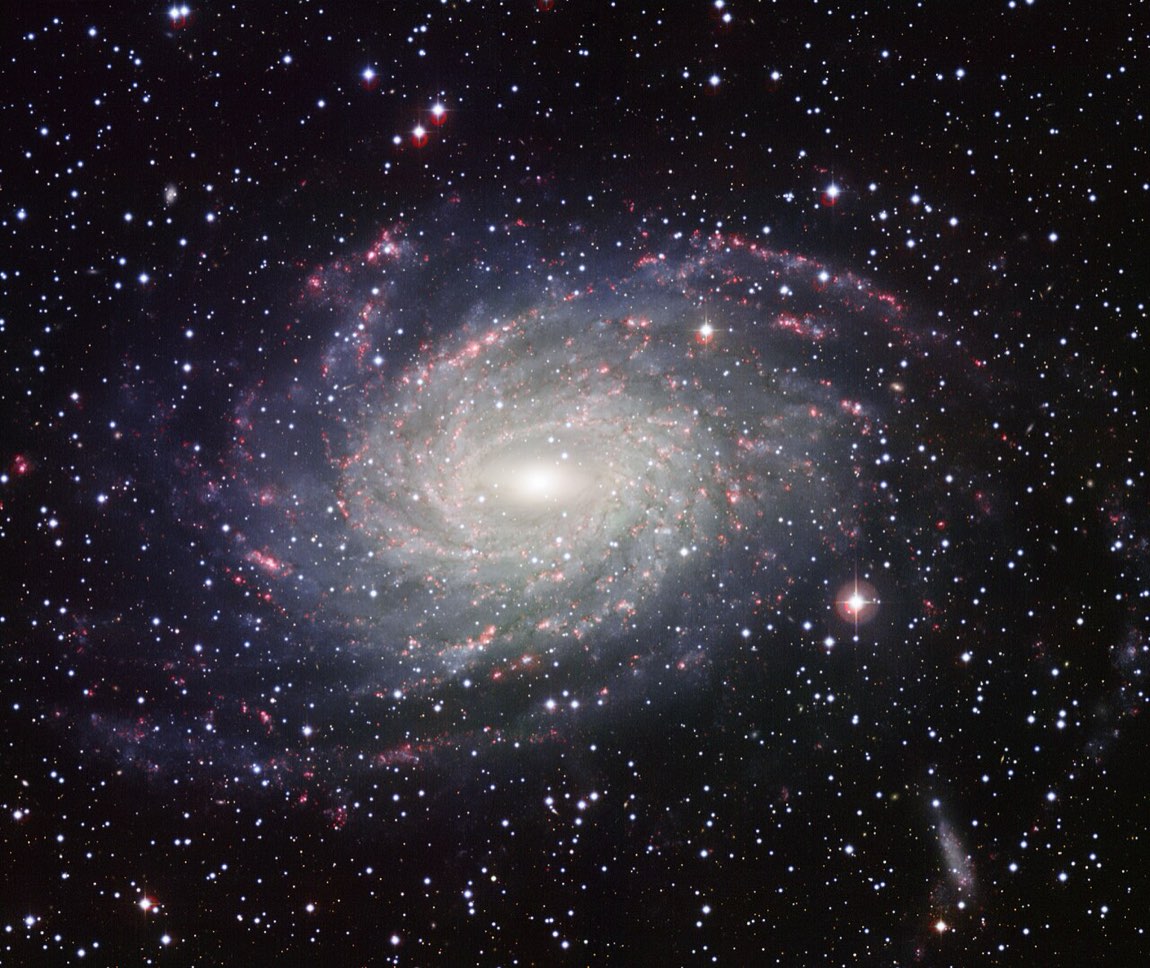
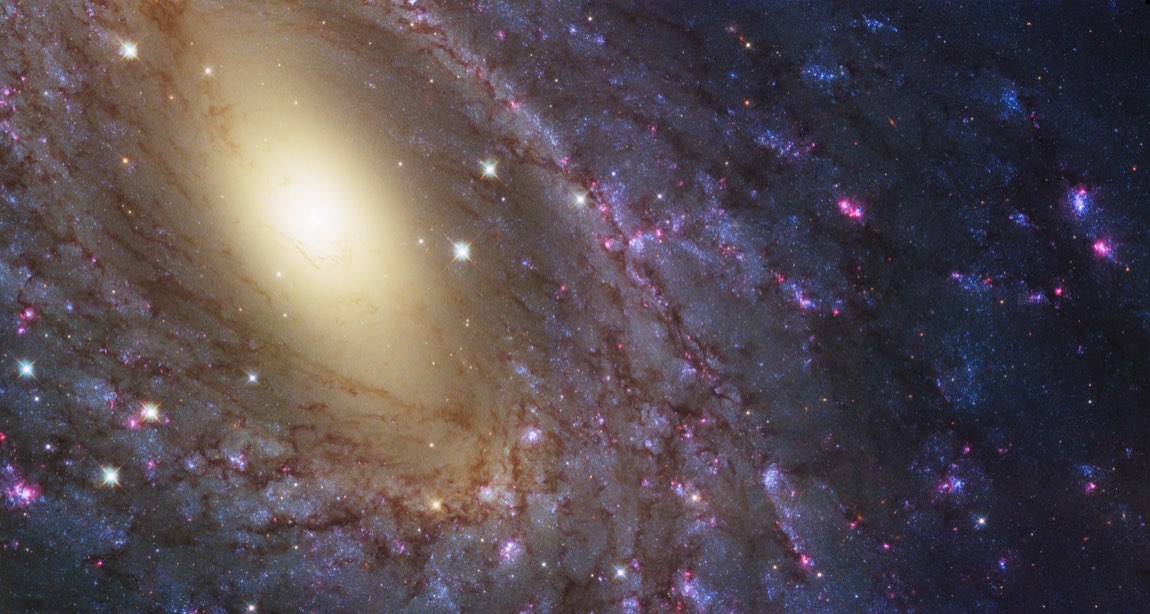
 Photograph · ESO · CC BY 3.0
Galaxy · Deep guide
NGC 6744
Also called: Caldwell 101 · NGC 6744 · Pavo Galaxy
One of the nearest look-alikes of the Milky Way, a big fluffy spiral in Pavo.
What is it?
NGC 6744 is an intermediate spiral galaxy in Pavo, discovered by James Dunlop from Parramatta on 30 June 1826. It is one of the largest spiral galaxies in the local universe and is often described as a nearby Milky Way look-alike, with fluffy (flocculent) arms, an elongated core and a distorted companion, NGC 6744A, that resembles a Magellanic Cloud. Its nucleus is a low-luminosity active galactic nucleus of the LINER type.
The deep dive
Researched for the Atlas from Wikipedia — NGC 6744 (1,540 characters read) · updated Nov 15, 2026
01 A Galaxy That Mirrors Our Own
NGC 6744 has earned a special nickname among astronomers: the Milky Way mimic. It is an intermediate spiral galaxy that displays the same broad family of features astronomers believe characterize our own home galaxy — remarkable ongoing star formation, loosely wound flocculent arms that look almost fluffy rather than sharply defined, and an elongated central core. This resemblance makes it one of the most scientifically valuable nearby large spirals, because studying it offers a rare outside view of a system structured much like the one we cannot step back far enough to photograph whole. It is considered one of the largest spiral galaxies in the local universe, which makes the comparison even more striking. Unlike our own galaxy, we can observe NGC 6744 face-on and in full, letting astronomers map its spiral structure, measure its star-forming regions, and study its nucleus in ways that are simply impossible when you are embedded inside the subject of study.
02 Flocculent Arms and What They Tell Us Deeper
The spiral arms of NGC 6744 are described as flocculent — a term meaning fluffy or patchy — rather than the grand, continuous sweeping arcs seen in classic "grand design" spirals like M51. Flocculent arms arise not from a single organizing density wave rippling through the disk, but from local gravitational instabilities and star-formation episodes scattered across the disk. The result is a galaxy whose arms look broken into clumps and feathers of star-forming material when examined closely. This texture is significant because it mirrors the kind of arm structure many researchers believe the Milky Way possesses, particularly in its outer disk. Studying the star-formation activity distributed across NGC 6744's flocculent arms gives astronomers a template for understanding how stellar nurseries are organized in a galaxy like ours, where dust and our own position inside the plane prevent us from seeing the full picture directly.
03 A Quiet but Real Active Nucleus Deeper
At the heart of NGC 6744 sits an active galactic nucleus, though one of notably low luminosity. The galaxy is classified as a LINER — a Low Ionization Nuclear Emission-line Region — meaning its nucleus produces an emission spectrum dominated by broad lines from weakly ionized atoms. LINER galaxies occupy a middle ground in the zoo of active galactic nuclei: they are not the blazing quasars or powerful Seyfert galaxies that pour out enormous energy, but their nuclei are nonetheless doing something energetically unusual compared with a purely passive galactic center. The exact power source of LINER activity is still debated among researchers — candidates include a low-luminosity accreting supermassive black hole, shock-heated gas, or evolved stellar populations. Whatever the mechanism, the AGN in NGC 6744 is real but restrained, which again echoes the situation suspected in the Milky Way's own center, where the black hole Sgr A* is similarly underluminous for its mass.
04 Its Companion Looks Like a Magellanic Cloud
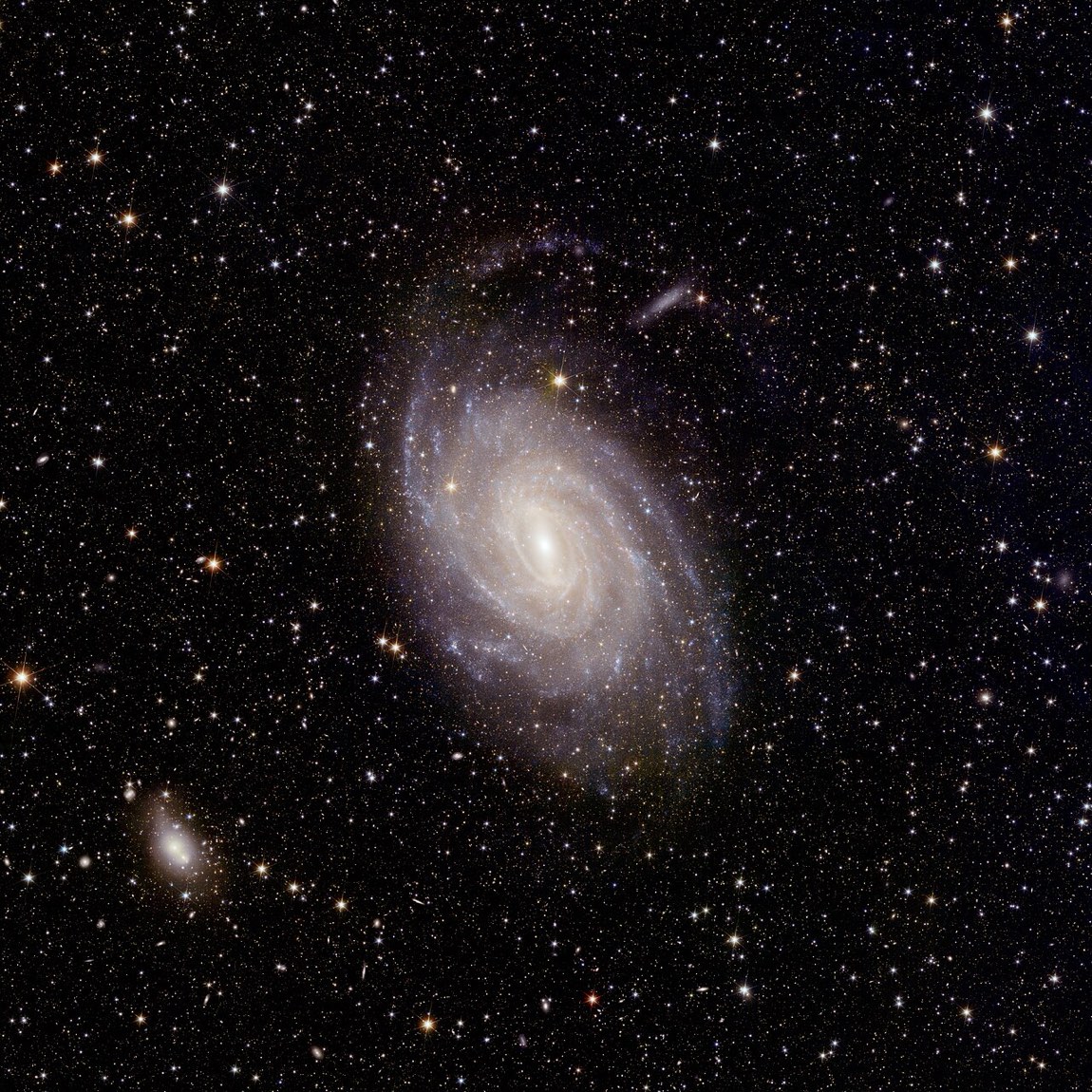
NGC 6744 is not alone. It hosts at least one companion galaxy, designated NGC 6744A, whose appearance is described as superficially similar to one of the Magellanic Clouds — the irregular dwarf galaxies that orbit the Milky Way. The distorted shape of NGC 6744A suggests that gravitational interaction with the much larger NGC 6744 has pulled and stretched it out of a more regular form. This pairing deepens the Milky Way analogy considerably: just as our galaxy is attended by the Large and Small Magellanic Clouds, NGC 6744 appears to have its own disturbed dwarf companion trailing in its gravitational wake. These kinds of asymmetric, distorted satellite galaxies are common around large spirals and are thought to gradually lose stars and gas to their hosts through tidal stripping over billions of years.
05 How Far Away Is It, Really? Deeper
The distance to NGC 6744 is an open question with two meaningfully different answers depending on which method you trust. Using its recession velocity relative to the cosmic microwave background — 802 ± 3 km/s — and applying the Hubble law yields a distance of 38.6 ± 2.7 million light-years (11.82 ± 0.83 Mpc). However, 21 independent non-redshift measurements, which rely on direct physical distance indicators rather than expansion velocity, converge on a considerably closer figure: 23.63 ± 1.68 million light-years (7.244 ± 0.514 Mpc). That is a substantial discrepancy — roughly 15 million light-years — and it matters because distance underpins nearly every derived physical property, from true luminosity to physical size. The non-redshift methods are generally considered more reliable for relatively nearby galaxies where peculiar motions (a galaxy's own velocity through space independent of cosmic expansion) can significantly distort Hubble-law estimates.
 ⤢
06 Discovered From the Southern Hemisphere
NGC 6744 sits in the constellation Pavo, the Peacock, which is a southern constellation invisible from most of the Northern Hemisphere. Its discovery reflects that geography. Scottish astronomer James Dunlop found it on 30 June 1826 while observing from Parramatta, Australia — a site that gave him access to the rich southern sky that European observatories could not reach. Dunlop was a prolific cataloguer of southern deep-sky objects during the colonial-era push to map the heavens visible only from below the equator. The galaxy later received the alternate designation Caldwell 101 from Patrick Moore's Caldwell Catalogue, a popular list of deep-sky showpieces not included in the famous Messier Catalogue. Its informal name, the Pavo Galaxy, simply reflects its host constellation.
07 Two Supernovae and One Surprising Misclassification
NGC 6744 has hosted two observed supernovae, and the more recent one came with a twist. The first, SN 2005at, was a Type Ic supernova discovered on 15 March 2005 by R. Martin and Berto Monard, reaching an apparent magnitude of 16. Type Ic supernovae are core-collapse explosions from massive stars that have shed both their hydrogen and helium envelopes before detonating. The second event, SN 2024vjm, was detected on 13 September 2024 by the BlackGEM telescope array. Initial spectral analysis led astronomers to classify it as a peculiar nova, but further observations overturned that verdict: it is a faint Type Iax supernova — a rare and poorly understood subclass of thermonuclear explosions that are fainter and more exotic than standard Type Ia supernovae. It is likely the closest known example of this type, making it a scientifically significant catch despite its faintness.
08 What Makes a Type Iax Supernova Unusual Deeper
The classification of SN 2024vjm as a Type Iax supernova places it in one of the most puzzling categories of stellar explosions. Type Iax events are thought to be thermonuclear in origin, like the more familiar Type Ia supernovae used as cosmological distance markers, but they are substantially fainter and show spectroscopic differences suggesting the explosion is less energetic and may not completely destroy the progenitor white dwarf star. Some models propose that the white dwarf survives as a bound remnant — something that simply does not happen in a standard Type Ia event. Because SN 2024vjm is likely the closest known Type Iax, it offers an unusually detailed observational window into this class. Its initial misidentification as a nova underlines how unusual these events appear: their low luminosity and spectral quirks can confuse even experienced observers working with real-time survey data before complete follow-up observations are secured.
09 Its Place in the Cosmic Web
NGC 6744 is a member of the Virgo Supercluster, the vast cosmic structure that also contains the Local Group — the small cluster of galaxies that includes the Milky Way, Andromeda, and their satellites. The Virgo Supercluster spans roughly 110 million light-years and contains dozens of galaxy groups and clusters loosely bound together by gravity. NGC 6744's membership places it in the same broad cosmic neighborhood as our own galaxy, though at a distance of tens of millions of light-years it is far from a near neighbor by human intuition. This supercluster context matters for understanding the galaxy's environment and how the large-scale distribution of matter around it has influenced its evolution, its star formation history, and the relatively isolated position it appears to occupy within the supercluster's volume.
10 Observing the Pavo Galaxy From Earth
With an apparent magnitude of 8.3, NGC 6744 is technically within reach of large binoculars under a truly dark sky, though a telescope is needed to reveal any structural detail. Its position in Pavo means it is best observed from the Southern Hemisphere or from low northern latitudes, where it climbs to a usable altitude above the horizon. The galaxy presents a large angular face to observers, consistent with it being both physically large and relatively nearby. Through a moderate amateur telescope under good conditions, the elongated core and the broader, faint disk can be distinguished. The flocculent arm structure and the companion NGC 6744A require larger apertures and excellent sky transparency to detect visually, though they are well documented in long-exposure imaging. Its listing as Caldwell 101 makes it a recognized target for observers working through that catalogue of southern showpieces.
 ⤢