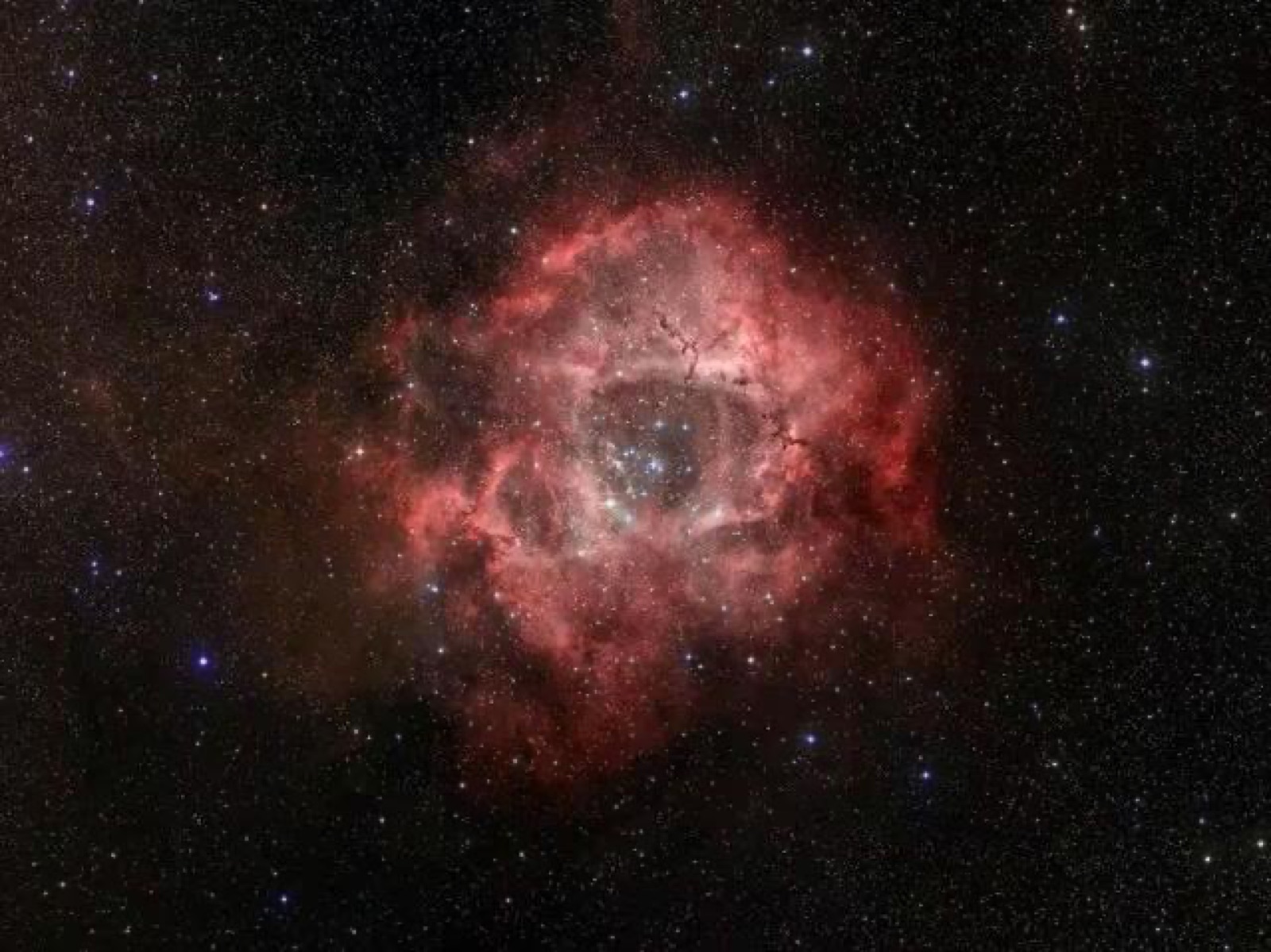
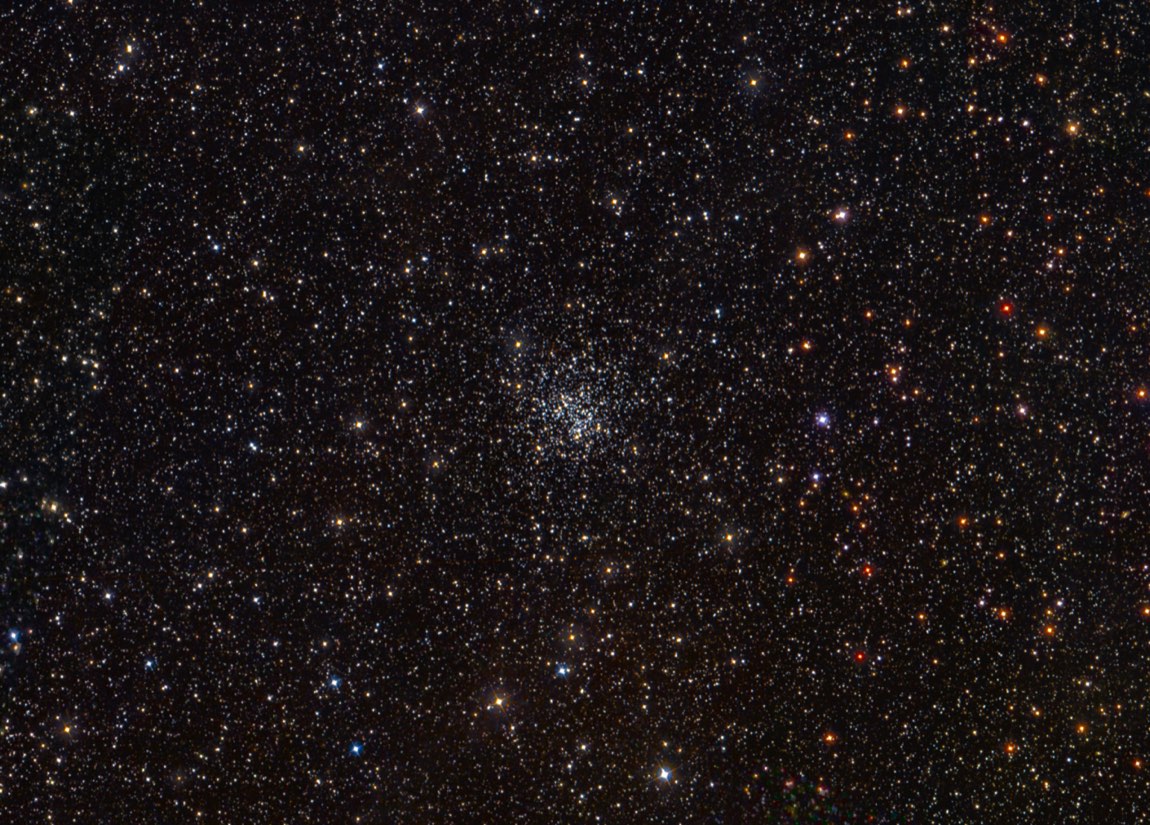
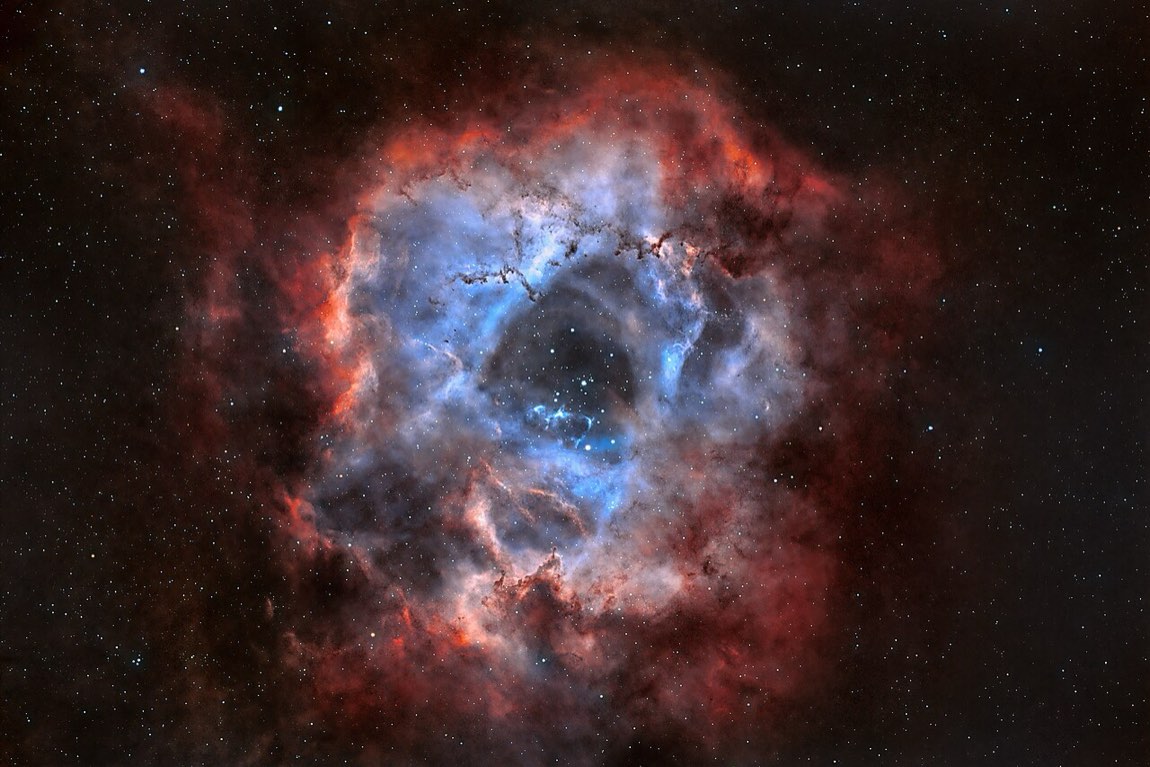
 Photograph · Lviatour · CC BY-SA 2.5
Star Cluster · Deep guide
NGC 2244 (Satellite Cluster)
Also called: Caldwell 50 · C50 · Satellite Cluster · NGC 2239 · Collinder 99
The young cluster of blazing O-type stars that carves out and lights up the Rosette Nebula.
What is it?
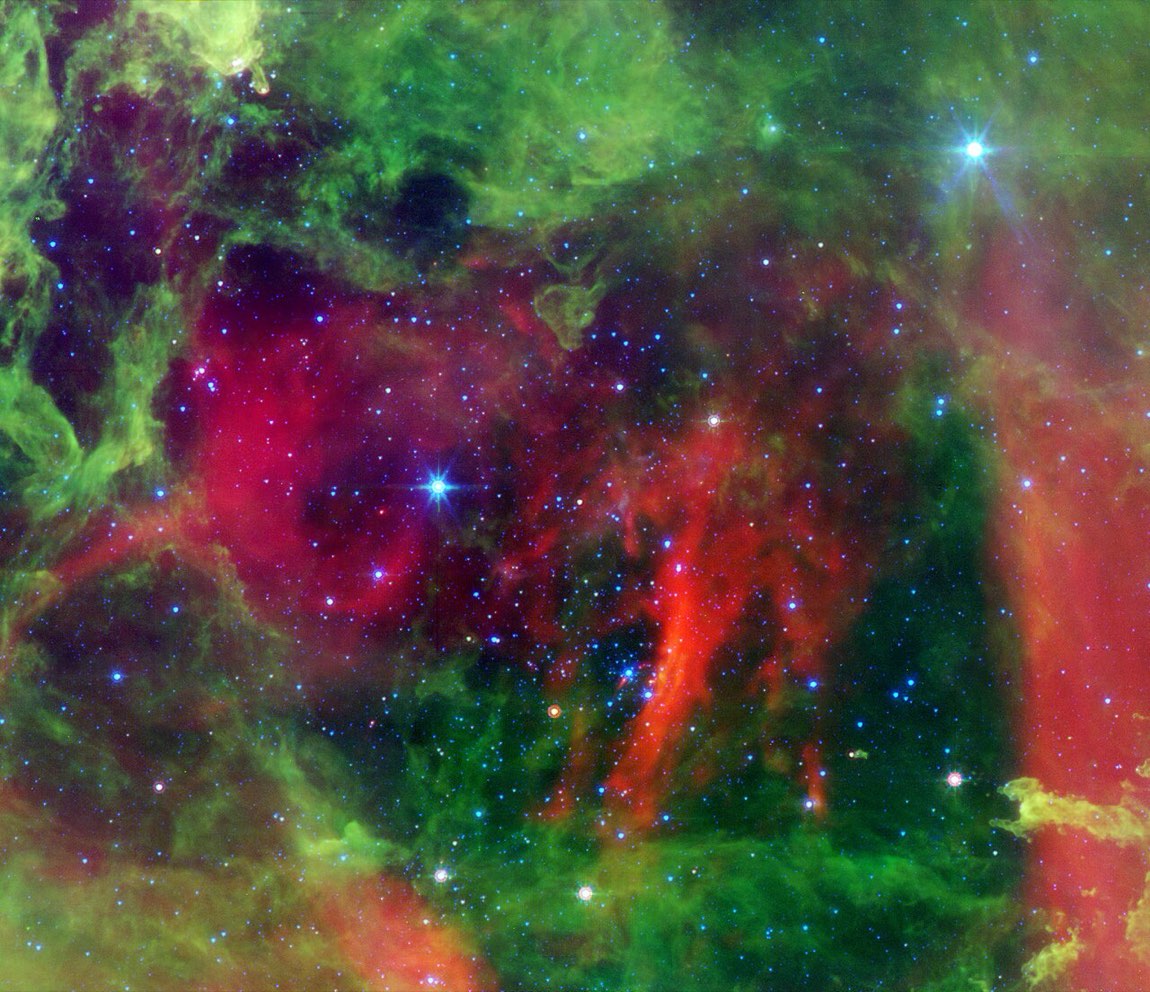
NGC 2244 is a young open star cluster sitting inside the Rosette Nebula in Monoceros. It contains several O-type stars, extremely hot stars whose radiation and winds sculpt and light up the surrounding gas. Its two brightest members, HD 46223 and HD 46150, each shine hundreds of thousands of times brighter than the Sun and are roughly 50–60 times as massive. The cluster is estimated to be less than 5 million years old. The brightest star in its direction, 12 Monocerotis, is actually a foreground giant, not a member.
The deep dive
Researched for the Atlas from Wikipedia — NGC 2244 (1,381 characters read) · updated Nov 15, 2026
01 A Cluster Wrapped Inside a Nebula
NGC 2244 occupies a remarkable address in the sky: it sits inside the Rosette Nebula, one of the most visually striking emission nebulae in the winter sky, found in the constellation Monoceros, the Unicorn. The cluster and the nebula are deeply connected — they did not simply end up in the same neighborhood by chance. The stars of NGC 2244 formed from the same cloud of gas and dust that the Rosette Nebula represents, and those stars are now actively reshaping the nebula around them. This makes NGC 2244 a living example of stellar feedback, where newborn stars aggressively alter the environment that created them. The cluster carries three catalog identities: its standard NGC designation, the Caldwell catalog number 50, and the informal name the Satellite Cluster. Each designation reflects a different cataloging tradition, but all three point to the same loose, young swarm of brilliant stars embedded in glowing hydrogen gas.
02 O-Type Stars: The Cluster's Violent Heart
What makes NGC 2244 genuinely extreme is its population of O-type stars — the hottest, most luminous, and most short-lived category of stars that exist. O-type stars burn their nuclear fuel at a ferocious rate, flooding their surroundings with intense ultraviolet radiation and driving powerful stellar winds outward at thousands of kilometers per second. NGC 2244 hosts several of these stellar heavyweights. The cluster's two standout members are HD 46223, classified O4V, and HD 46150, classified O5V. The "V" suffix means both are still on the main sequence, burning hydrogen in their cores — they are not yet evolved giants, just extraordinarily powerful young stars doing what O-type stars do best: dominating everything around them. Their radiation ionizes the surrounding gas of the Rosette Nebula, making it glow, and their winds are literally pushing the nebula's material outward, carving a central cavity in the cloud.
03 Two Superstars and Their Staggering Numbers Deeper
HD 46223 and HD 46150 are the twin titans of NGC 2244, and their vital statistics are genuinely hard to comprehend at a human scale. HD 46223, with a spectral class of O4V, shines at 400,000 times the luminosity of the Sun. HD 46150 edges it out energetically at 450,000 times solar luminosity, making it one of the more luminous individual stars known in this region. In terms of mass, HD 46223 weighs in at approximately 50 times the mass of the Sun, while HD 46150 reaches up to 60 solar masses — meaning it contains material equivalent to roughly 20 million Earths packed into a single star. HD 46150 carries an additional layer of intrigue: it may actually be a double star, meaning what appears to be one object could be two massive stars orbiting each other. Disentangling the two components would shift our understanding of each star's individual properties. Notably, neither star shows detectable pulsations, which aligns with current stellar modeling for objects sharing their global physical parameters.
04 The Foreground Impostor: 12 Monocerotis
If you look toward NGC 2244 and try to identify its brightest star by eye or on a chart, you might be misled. The apparently brightest star in that direction is 12 Monocerotis, a K-class giant — but it is a foreground object, not a true cluster member. It simply happens to lie along the same line of sight as NGC 2244, positioned between us and the actual cluster. K-class giants are cool, orange-tinted stars far along in their evolutionary lives, nothing like the searing blue-white O-type stars that actually define NGC 2244. This kind of line-of-sight coincidence is common in astronomy and serves as a reminder that the sky is a projection: stars that appear close together on the celestial sphere may be separated by enormous distances in three-dimensional space. Determining true cluster membership requires careful analysis of stellar distances, motions, and spectral types, not just apparent brightness.
05 How Radiation Shapes the Birth of Brown Dwarfs Deeper
A 2023 study of NGC 2244 produced a finding that challenges simple assumptions about how small objects form in star clusters. Researchers discovered that brown dwarfs in NGC 2244 tend to form closer to OB-type stars — the massive, radiating powerhouses of the cluster — than to other, more ordinary stars. This spatial preference points to a specific physical mechanism: photoevaporation. When intense ultraviolet radiation from O- and B-type stars bathes a nearby dense prestellar core, it can strip away the outer layers of that core before the core finishes collapsing. A core that might have gathered enough material to become a low-mass star or even an intermediate-mass star instead loses mass to radiation pressure and evaporation, ending up as a brown dwarf — an object too small to sustain hydrogen fusion. NGC 2244 thus provides a concrete, observed case where the radiation environment of massive stars directly controls what kinds of objects form in their vicinity, steering the local initial mass function toward smaller bodies.
06 Disk Survival in a Hostile Environment Deeper
Protoplanetary disks — the flattened rings of gas and dust around young stars from which planets eventually form — do not last forever, and in a cluster like NGC 2244 they face a particularly rough existence. The 2023 study measured the disk fraction for low-mass objects later than spectral type K0 and found only 39% ± 9% of these objects still retain detectable disks. That means roughly six in ten low-mass young stars in this cluster have already lost their planet-forming material. The culprit is almost certainly the same intense radiation produced by the cluster's O-type stars; the ultraviolet flux eats away at disk material through the same photoevaporation process implicated in brown dwarf formation. Even more striking is a previously discovered cluster member that shows signs of an actively eroding disk, described as reminiscent of a proplyd. Proplyds — photoevaporating protoplanetary disks — were first identified dramatically in the Orion Nebula Cluster, and finding analogous structures in NGC 2244 extends our understanding of how common this disk-destruction process is across different star-forming regions.
07 An Extraordinarily Young Stellar Population
NGC 2244 is strikingly young by cosmic standards. Its age has been estimated at less than 5 million years — a number that sounds large in human terms but represents barely an eyeblink in stellar timescales. For comparison, the Sun is about 900 times older. At this age, the cluster has not had time to dynamically disperse; its stars are still relatively close to where they originally formed. The O-type stars that dominate the cluster will not live long: stars this massive typically exhaust their core hydrogen in just a few million years before exploding as supernovae. Some of NGC 2244's most luminous members may be approaching the end of their short lives even now. This youthfulness also means the cluster is an ideal laboratory for studying the very early stages of stellar evolution, when disks are still present around many stars, brown dwarfs are freshly formed, and the interaction between stars and their birth nebula is ongoing rather than concluded.
08 Stellar Winds Carving the Rosette
The O-type stars of NGC 2244 do not just illuminate the Rosette Nebula — they are actively sculpting it. Stellar winds from O-type stars are streams of charged particles driven outward by intense radiation pressure, reaching speeds that can exceed a thousand kilometers per second. Collectively, the winds from several such stars in NGC 2244 have evacuated a central cavity in the Rosette Nebula's gas, pushing hydrogen and dust outward into a roughly circular shell — the visible "petals" of the Rosette when seen in photographs. This wind-blown bubble continues to expand, compressing the surrounding gas and potentially triggering new star formation in the dense shells at its edges. The cluster thus participates in a feedback loop: its stars destroy the nebula nearby while possibly seeding new stellar generations further out. This interplay between energy output and surrounding gas is one of the central processes by which massive star clusters reshape entire molecular clouds.
09 Stability Without Pulsation Deeper
One specific observational detail about NGC 2244's most massive stars deserves attention: they do not appear to pulsate. Stellar pulsation — periodic expansions and contractions of a star's outer layers — is common across many types of stars and is used by astronomers as a probe of internal structure through the field of asteroseismology. For O-type stars, certain instability mechanisms are predicted under some conditions, so determining whether a given massive star pulsates or remains stable carries theoretical weight. In the case of HD 46223 and HD 46150, the absence of detectable pulsations is noted as being consistent with stellar modeling for stars sharing their global physical parameters. In other words, theorists building computer models of stars with similar masses, luminosities, and temperatures predict these stars should be stable against pulsation, and observations of NGC 2244's brightest members confirm that prediction. This agreement between theory and observation is a small but meaningful validation of the physics built into current massive-star models.
10 Observing NGC 2244 from Earth
NGC 2244 sits in the constellation Monoceros, a faint and somewhat overlooked constellation that lies just east of Orion. Because Monoceros straddles the celestial equator, the cluster is accessible to observers across most of the inhabited world. The cluster itself is bright enough to be visible in binoculars under dark skies, while small telescopes will begin to resolve individual stellar members. The surrounding Rosette Nebula, though large in angular extent, is much more challenging to see visually because its surface brightness is low; it comes out brilliantly in long-exposure photographs, particularly in hydrogen-alpha light. The best time to observe is during northern hemisphere winter months when Orion and Monoceros are high in the evening sky. The apparent magnitude of the cluster makes it a rewarding target even from suburban locations, though the nebula surrounding it rewards a dark-sky site. The catalog designation Caldwell 50 appears in many amateur observing lists, which has helped bring NGC 2244 wider attention beyond professional astronomy circles.
11 Open Questions About This Young Cluster Deeper
Despite being a relatively well-studied region, NGC 2244 and the Rosette Nebula continue to generate active research questions. The possible binary nature of HD 46150 remains unresolved — confirming or ruling out a companion would change our accounting of the cluster's total stellar mass budget and radiation output. The low disk fraction of 39% ± 9% for low-mass members raises the question of how quickly disk dissipation proceeds at different distances from the O-type stars, and whether planet formation can occur at all for stars unlucky enough to be born close to the cluster's radiating core. The spatial preference of brown dwarfs for proximity to OB stars, while explained by photoevaporation in the 2023 study, still invites further testing: is this pattern universal across all OB-dominated clusters, or specific to conditions in NGC 2244? And the proplyd-like object identified among cluster members suggests there may be more such actively eroding disks awaiting discovery as observational sensitivity improves with newer instruments.
 ⤢