 Photograph · NASA/JPL-Caltech/Univ. of Ariz.
Nebula · Deep guide
The Rosette Nebula
A cosmic rose with a cluster of newborn stars for its heart.
What is it?
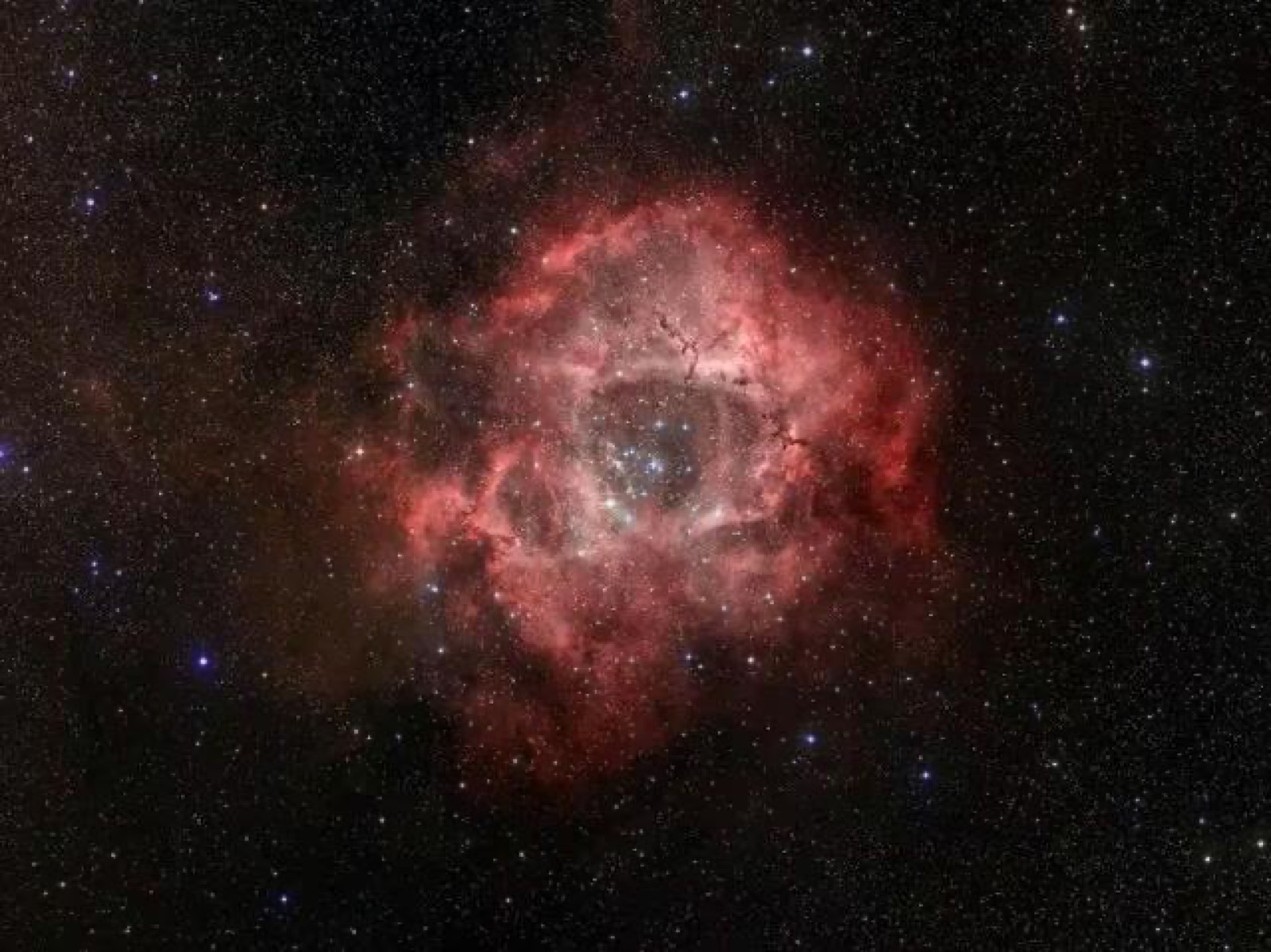
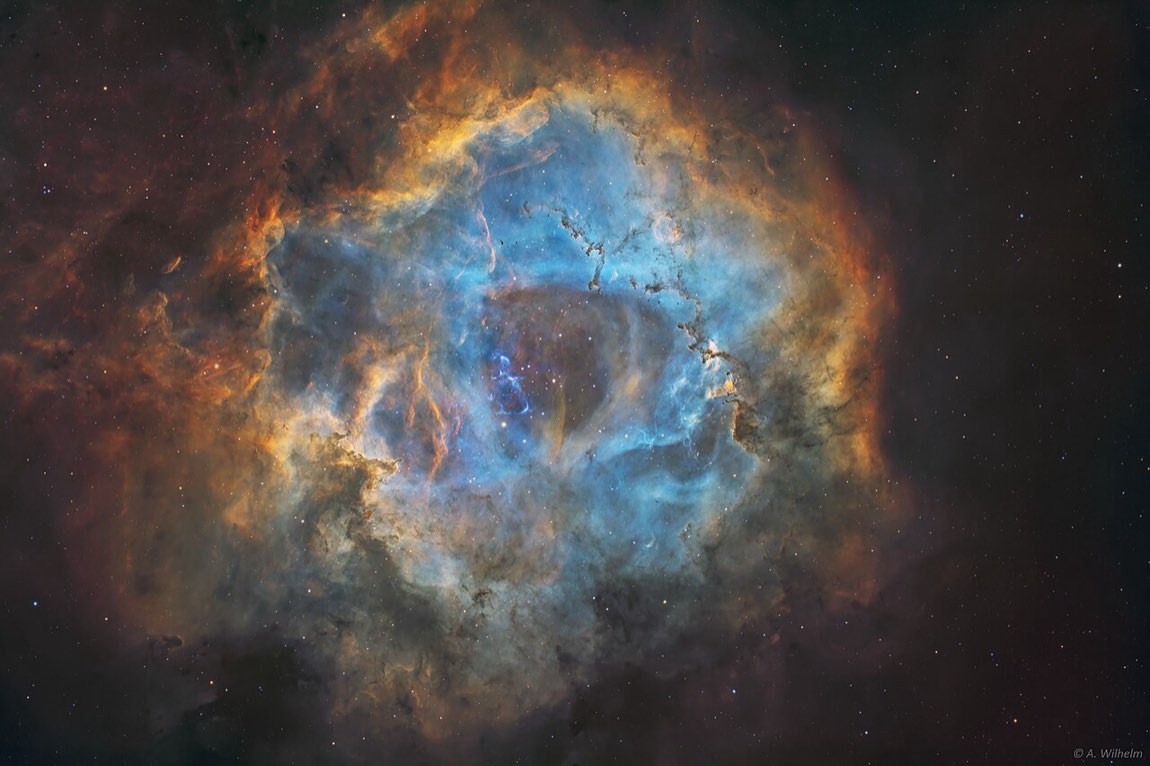
The Rosette, about 5,200 light-years away in Monoceros, is a wreath of glowing hydrogen 130 light-years across, its central cavity blown clear by the young star cluster NGC 2244 shining at its heart. Photographs reveal what the eye cannot: one of the most flower-like structures in the sky, petals sculpted by stellar winds.
The deep dive
Researched for the Atlas from Wikipedia — Rosette Nebula (2,414 characters read) · updated Sep 20, 2026
01 A Nebula With Many Names and Numbers
The Rosette Nebula carries an unusually crowded identity card. In the New General Catalogue it is split across at least five separate designations: NGC 2237, 2238, 2239, 2244, and 2246. That fragmentation happened because different observers recorded different patches of the glowing gas at different times, unaware they were documenting pieces of the same vast structure. The open star cluster embedded inside it, NGC 2244, was discovered first — by John Flamsteed in 1690 — while portions of the nebulosity, including NGC 2239, were later identified by John Herschel. The entire complex is also catalogued as Caldwell 49, with the embedded cluster separately listed as Caldwell 50. Beyond those alphanumeric labels, the nebula's shape has earned it a vivid nickname: the Skull Nebula, because its circular cavity and dark lanes can resemble a human skull. Confusingly, a completely unrelated object — NGC 246 — shares that same nickname, so astronomers are careful to specify which 'Skull' they mean. A smaller, less famous cousin called the Little Rosette Nebula, or Sharpless 2-170, was named in tribute to the original.
02 How the Star Cluster Sculpted Its Own Cradle
The relationship between the Rosette Nebula and the open cluster NGC 2244 sitting at its center is one of cause and effect written in light and gas. The stars of NGC 2244 were themselves born from the nebula's own material, yet once they ignited they began destroying the very cloud that made them. The most powerful actors in this drama are massive O-type stars, specifically HD 46223 and HD 46150, which are identified in Chandra X-ray observations as the objects primarily responsible for blowing the large ionized bubble visible at the nebula's heart. O-type stars are among the hottest and most luminous in the universe, and their fierce stellar winds slam into surrounding gas at tremendous velocities. Those winds shock-heat the local plasma to temperatures ranging from 1 to 10 million K — far above the roughly 10,000 K plasma typical of ordinary H II regions — and in doing so carve out the hollow central cavity that gives the Rosette its distinctive ring-like appearance when viewed in optical wavelengths.
03 An X-ray Window Into Hidden Star Birth Deeper
Optical photographs reveal the Rosette's glowing petals of ionized hydrogen, but much of what is actually happening inside the complex is invisible to ordinary light. A survey conducted with NASA's Chandra X-ray Observatory pulled back that curtain by detecting the high-energy radiation pouring from newborn stars buried within the dense molecular cloud. In total, the survey found approximately 2,500 young stars scattered across the star-forming complex — a population that would be nearly impossible to census in visible light because dense dust blocks optical wavelengths. Among the X-ray findings was a diffuse glow permeating the space between stars inside the central bubble. Astronomers attribute this glow to a super-hot plasma with temperatures between 1 and 10 million K, almost certainly heated by the shock waves generated when the O-type stars' powerful winds collide with surrounding material. That plasma is a direct signature of the mechanical energy being injected into the nebula by its most massive inhabitants, and it represents a phase of nebular evolution that only X-ray telescopes can reliably trace.
04 Where New Stars Are Being Born Right Now
The bright ionized bubble at the Rosette's center is actually not where most of the new star formation is happening today. The majority of ongoing stellar birth is concentrated in the dense molecular cloud lying to the southeast of the bubble — a region so thick with gas and dust that it absorbs visible light almost entirely. The Rosette Nebula sits near one end of a giant molecular cloud in the Monoceros region of the Milky Way, and that larger reservoir of cold gas provides the raw fuel for continued star making. Within the optically visible nebula alone, Chandra observations have confirmed the presence of numerous newborn stars, and the complex as a whole harbors nine known infrared clusters — groups of young stars detected in infrared light precisely because infrared wavelengths penetrate dust far more effectively than visible light. The full picture emerging from multi-wavelength observations is of a system at different stages simultaneously: an older, already-formed cluster in the center aggressively reshaping its surroundings, while fresh stellar embryos continue to condense in the denser outer molecular material.
05 The Sheer Scale of 10,000 Solar Masses
The Rosette Nebula measures roughly 130 light-years in diameter — if you placed it where our Sun is, its edge would extend well past the nearest stars to Earth — and it lies about 5,000 light-years away in the constellation Monoceros, the Unicorn. Its estimated mass is approximately 10,000 solar masses, meaning that if you could somehow gather all the gas and dust spread across those 130 light-years and compress it into Sun-sized balls, you would end up with ten thousand of them. That enormous reservoir explains why the region has already assembled around 2,500 young stars and still has material left over for future generations of star formation. The cloud's location within the Milky Way's Monoceros region places it in a relatively uncrowded part of the galaxy's disk, making it one of the more accessible and visually prominent star-forming complexes visible from Earth's Northern Hemisphere during winter months.
06 The Physics Behind the Glow Deeper
The Rosette Nebula is classified as an H II region — a zone where hydrogen exists primarily in its ionized form rather than as neutral atoms. This ionization is driven by the intense ultraviolet radiation streaming from the hot young stars of NGC 2244, particularly the O-type giants. When that ultraviolet light strikes a neutral hydrogen atom, it strips away the atom's electron entirely. When the electron is later recaptured by a proton, it cascades down through energy levels, releasing photons of specific wavelengths in the process. The dominant red glow seen in most Rosette photographs is hydrogen-alpha emission, released at a wavelength of 656 nanometers during one of these electron transitions. This same physical process — radiation from young stars exciting surrounding atoms, which then emit their own radiation — is described in the article's account of the nebula, and it is the defining mechanism of all emission nebulae. The atoms are not reflecting starlight; they are genuinely re-emitting energy, acting as a vast fluorescent cloud responding to the stellar radiation field around them.
07 Nine Infrared Clusters Hidden in the Dust Deeper
One of the more striking discoveries about the Rosette complex is the presence of nine known infrared clusters embedded within it. Infrared clusters are groupings of young stars detected through infrared-wavelength observations rather than visible light, and their existence in the Rosette signals that star formation has been proceeding across multiple sites and possibly multiple episodes within the complex. Because infrared light passes through dust that would completely block optical wavelengths, infrared telescopes effectively see through the nebula's opaque regions to reveal stellar populations that would otherwise be entirely hidden. The fact that nine such clusters have been identified suggests the Rosette is not simply a single star-forming event but rather an extended, distributed process occurring at numerous locations within the giant molecular cloud. Together with the approximately 2,500 young stars detected across the complex, the infrared clusters paint a picture of a genuinely active stellar nursery — not a relic of past activity but a system still in the energetic middle of building a new generation of stars.
08 Oklahoma's Official Astronomical Object
The Rosette Nebula holds a distinction that no other nebula in the sky can claim: it is the official state astronomical object of Oklahoma. The recognition came through a specific legislative act — House Bill 1292 — which was passed by the Oklahoma Legislature on April 16, 2019. Governor Kevin Stitt signed the bill into law on April 22, 2019, formally enshrining the nebula in state statute. The choice reflects both an appreciation for the Rosette's visual drama and its prominence as one of the most recognizable deep-sky objects in the winter sky. Oklahoma joins a small number of U.S. states that have designated official astronomical objects, and the selection of an emission nebula rather than a planet or star gives the designation a particularly scientific character. For an object sitting 5,000 light-years away in the constellation Monoceros, being named a state symbol of a landlocked American state is an unexpected but charming footnote in its history.
09 How to Find and Observe the Rosette
The Rosette Nebula resides in the constellation Monoceros, which itself sits just east of Orion — one of the most familiar winter constellations for observers in the Northern Hemisphere. Because Monoceros lacks bright stars of its own, the Rosette is best found by using Orion's belt as a starting point and sweeping eastward. The embedded star cluster NGC 2244 is the easier target: binoculars or a small telescope will show the cluster's brightest members clearly on a dark night. The nebula surrounding it, however, is far more challenging for visual observers because emission nebulae emit most of their light in narrow wavelength bands, particularly hydrogen-alpha, which the human eye detects poorly. A narrowband or hydrogen-alpha filter dramatically improves contrast for visual observers, while astrophotographers using such filters can capture the nebula's full ring-like structure with moderate equipment. The article notes it is best seen in certain seasons, consistent with its winter sky position for Northern Hemisphere viewers.
10 The Molecular Cloud Behind the Nebula Deeper
The Rosette Nebula is not an isolated cloud floating alone in space — it sits near one end of a giant molecular cloud in the Monoceros region of the Milky Way. Giant molecular clouds are among the largest discrete structures in the galaxy, typically containing millions of solar masses of mostly hydrogen gas at very low temperatures. The Rosette complex's association with such a cloud explains both its enormous total mass of approximately 10,000 solar masses and the fact that active star formation continues in the molecular cloud to the southeast of the ionized bubble, even as the central cluster has already assembled and turned on. Molecular clouds are gravitationally bound and can sustain star formation over millions of years, with different regions collapsing at different times depending on local density and perturbations. The Rosette's position near one end of this larger structure suggests it represents only a portion of the star-forming potential stored in the full molecular cloud, meaning the wider region could continue spawning stellar clusters long after the current generation of young stars has aged.
 ⤢
⤢