 Photograph · Judy Schmidt from Fresh Meadows, NY, USA · CC BY 2.0
Nebula · Deep guide
Hubble's Variable Nebula
Also called: Caldwell 46 · C46 · NGC 2261
A fan-shaped cloud whose appearance changes over time, lit by a hidden young star.
What is it?
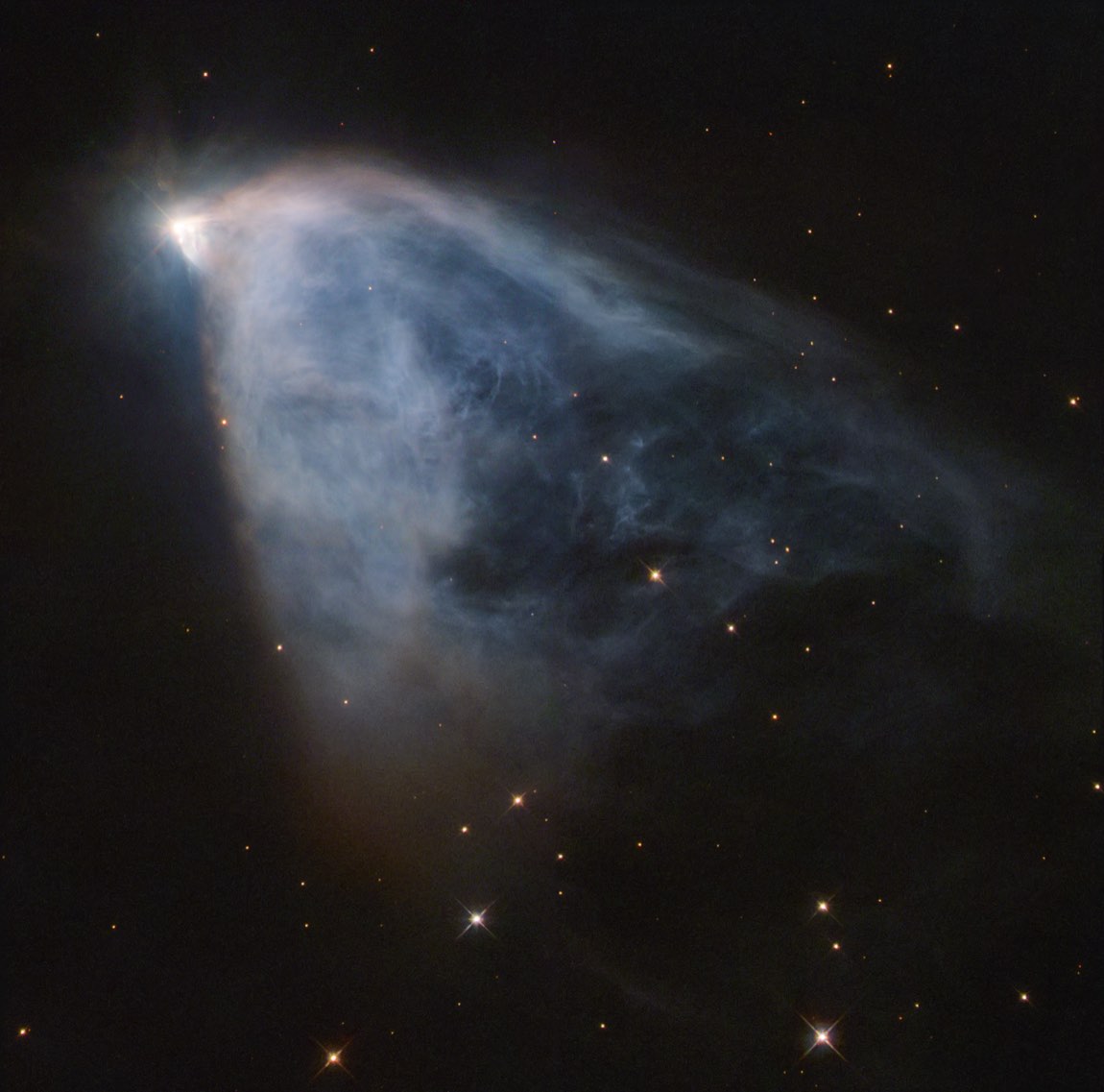
Hubble's Variable Nebula is a fan-shaped reflection nebula in Monoceros, lit by the young star R Monocerotis, which itself is hidden from direct view. The nebula's appearance changes noticeably over time, which is why it is called a variable nebula. Edwin Hubble studied those changes from 1916 onward, and on 26 January 1949 he used it as the first-light target of Palomar Observatory's giant Hale Telescope. William Herschel first recorded it on 26 December 1783.
The deep dive
Researched for the Atlas from Wikipedia — NGC 2261 (1,817 characters read) · updated Nov 15, 2026
01 William Herschel's First Look in 1783
The story of Hubble's Variable Nebula begins on a winter night, 26 December 1783, when William Herschel pointed his telescope at the constellation Monoceros and recorded what he called a considerably bright, fan-shaped glow. That description — fan-shaped — turns out to be remarkably apt, and observers today use almost the same words. Herschel catalogued the object as H IV 2, meaning it was the second entry in his class 4 category for nebulae and star clusters. That designation stuck for well over a century, quietly sitting in catalogue lists while the object's true restless nature remained unappreciated. The fan shape Herschel noticed is real: the nebula is a cone of gas and dust fanning outward from R Monocerotis, the deeply embedded star at its tip. The fact that such an early observer captured its defining geometry with nothing more than a visual description speaks to how structurally distinctive NGC 2261 is, even at a glance.
02 Photographic Plates and the Blink Comparator Deeper
The discovery that NGC 2261 actually changes over time was made possible by systematic photographic observation spanning years. F. C. Jordan took photographic plates of the nebula in 1908 using the Yerkes 24-inch, which is 60.96 centimetres, reflecting telescope. Edwin Hubble then took his own plates with the same instrument in 1916, giving him a comparison baseline of roughly eight years. Using a blink comparator — a device that rapidly alternates between two photographic plates so the eye can detect differences — Hubble could scan for shifts in shape, brightness, or structure that no single image would reveal. This methodical approach transformed what looked like a static curiosity into a confirmed variable object. The blink comparator was the era's best tool for change detection, and its application here exemplified how archival plate collections, combined with patient comparison work, could reveal dynamics operating on human timescales rather than the geological or cosmological timescales typical of most astronomical phenomena.
03 Hubble's Connection to the Hale Telescope
NGC 2261 holds a unique place in the history of telescope technology: it was the first object imaged by the Palomar Observatory's Hale Telescope, captured by Edwin Hubble himself on 26 January 1949. The Palomar Observatory project had begun in 1928, meaning Hubble's first-light image came roughly twenty years after the whole ambitious undertaking started. Choosing this particular nebula for such a momentous occasion was no accident — Hubble had been studying it for decades, first at Yerkes and then at Mount Wilson. For a scientist who had already reshaped humanity's understanding of the scale of the universe, returning to this small, fan-shaped nebula for one of the most anticipated telescope debut photographs ever taken suggests genuine personal attachment to the object. The Hale Telescope was the largest in the world at the time, and NGC 2261 was present at its opening act, cementing a connection between the nebula and the astronomer whose name it now carries.
04 Why the Nebula Changes: Shadows from Dust
The variability that gives this nebula its name has a compelling proposed explanation rooted in simple geometry. R Monocerotis, the illuminating star, is itself not directly visible — it is buried within a dense surrounding environment. Nearby clouds of dust are thought to drift periodically into the line of illumination between R Mon and the broader gas and dust cloud that makes up the visible nebula. When a dense dust clump moves into position, it blocks part of the starlight, casting a temporary shadow onto the lit cloud beyond. Because the cloud is curved and fan-shaped, different shadow angles produce visibly different brightness patterns and even apparent shape changes. The result is that the nebula appears to morph — sometimes brighter, sometimes dimmer, sometimes shifted in outline — over timescales of weeks and months. This shadow-casting mechanism is elegant because it requires no dramatic stellar event, only the routine movement of circumstellar dust clumps across an illumination path.
05 Changes Visible in Small Telescopes
One of the most remarkable facts about Hubble's Variable Nebula is how accessible its variability is. Unlike most astronomical changes, which unfold over millennia or require space-based instruments to detect, the shifting shape and brightness of NGC 2261 can be followed with small telescopes over weeks and months. This makes it an unusually rewarding target for dedicated amateur observers, who can personally witness a nebula in real-time flux. The nebula's appearance has been compared to a small comet — a bright condensed point at one end, the embedded star R Monocerotis, with a fan or tail of luminous gas spreading away from it. That comet-like silhouette combined with its genuine variability means observers returning to it repeatedly are almost guaranteed to see something different from their last session. Few deep-sky objects offer this kind of dynamic, personally verifiable change on a human schedule.
06 The Hidden Star at the Heart Deeper
R Monocerotis, the star responsible for illuminating the entire nebula, is itself invisible to direct observation. It does not appear as a point of light in the telescope view because it is shrouded by the very dust and gas cloud it is energising. This situation places R Mon in a category of young stellar objects deeply embedded within their natal material — stars in the act of formation or very early evolution, not yet emerged from their cocoons. The fan-shaped nebula NGC 2261 represents the illuminated cavity or outflow region around this hidden star, essentially a searchlight beam of reflected and scattered starlight punching through surrounding material. The fact that the star cannot be seen directly but its influence is so visually dramatic illustrates how a hidden source can dominate an entire structure. It also makes R Mon itself an object of significant scientific interest as a young star whose properties must be inferred indirectly from what it does to its surroundings rather than from direct spectroscopic observation.
07 Amateur Astronomers and the Big Telescope Project
In the modern era, NGC 2261 has attracted an organised citizen-science effort that reflects how collaborative amateur astronomy has become. Over twenty amateur astronomers worked together to produce a timelapse of the nebula using the Big Amateur Telescope, gathering data across a six-month window from October 2021 through April 2022. The project then had a natural pause when NGC 2261 passed behind the Sun and became unobservable, before resuming in August 2022 as the nebula returned to the accessible night sky. A coordinated multi-observer timelapse is a methodologically serious undertaking — it requires consistent imaging conditions, calibration across different sessions and potentially different equipment setups, and careful data management. The result captures the nebula's variability in a format that makes the changes viscerally clear, compressing months of slow transformation into a watchable sequence. This kind of project occupies a productive middle ground between professional monitoring programs and purely casual observation.
08 The Hubble Space Telescope's 1999 Image
NGC 2261 was observed by its orbital namesake, the Hubble Space Telescope, and an image was publicly released in 1999. This created a pleasing historical symmetry: a nebula that Edwin Hubble had studied for decades with ground-based telescopes, and that he chose for the first-light image of the Hale Telescope in 1949, was eventually captured by the space telescope bearing his name. The Space Telescope's image brought its characteristic sharp resolution to a nebula whose structure — the fan-shaped cloud, the dark lanes produced by shadowing dust, the hidden central star — benefits greatly from fine angular detail. While the article does not describe specific findings from that HST image in depth, the observatory's involvement added NGC 2261 to the roster of objects that have been examined across the full sweep of twentieth and early twenty-first century instrumentation, from Herschel's visual notes through photographic plates through space-based imaging.
09 A Name With Layered History Deeper
NGC 2261 carries several designations that trace its passage through different cataloguing traditions. Its oldest tag is H IV 2, Herschel's own notation marking it as the second object in his fourth category of nebulae and star clusters — a label that reflects the classification schemes of eighteenth and nineteenth-century observational astronomy. It then received a New General Catalogue number, NGC 2261, as part of the systematic consolidation of nebula lists in the late nineteenth century. The name Hubble's Variable Nebula honours Edwin Hubble's decades of work characterising its changes, from his blink-comparator studies through to the historic Hale Telescope first-light image. Finally, Caldwell 46 is its entry in the Caldwell Catalogue, an independent list of notable deep-sky objects compiled as a supplement to the Messier Catalogue for amateur observers. Having identifiers in four separate systems — Herschel, NGC, an eponymous popular name, and Caldwell — reflects genuine longevity and cross-community interest, from professional cataloguers to dedicated amateur observers.
10 Observing NGC 2261 for Yourself
NGC 2261 sits in the constellation Monoceros, the Unicorn, a faint constellation straddling the celestial equator near the more prominent Orion and Canis Major. The nebula is accessible to small telescopes, which is precisely what makes its variability so scientifically and aesthetically valuable — an observer does not need large aperture to detect it or even to notice changes over successive viewing sessions. Its comet-like appearance, with the illuminated fan spreading away from the position of the hidden star R Monocerotis, makes it immediately recognisable once found. Serious monitoring of its brightness and shape changes contributes meaningful data, as demonstrated by the organised amateur timelapse project carried out in 2021 and 2022. Because the nebula periodically passes behind the Sun from Earth's perspective and becomes unobservable, planning observations during its accessible season is worthwhile. Each session genuinely may reveal a configuration the nebula has not shown before, which is a rarity among deep-sky objects visible in modest equipment.