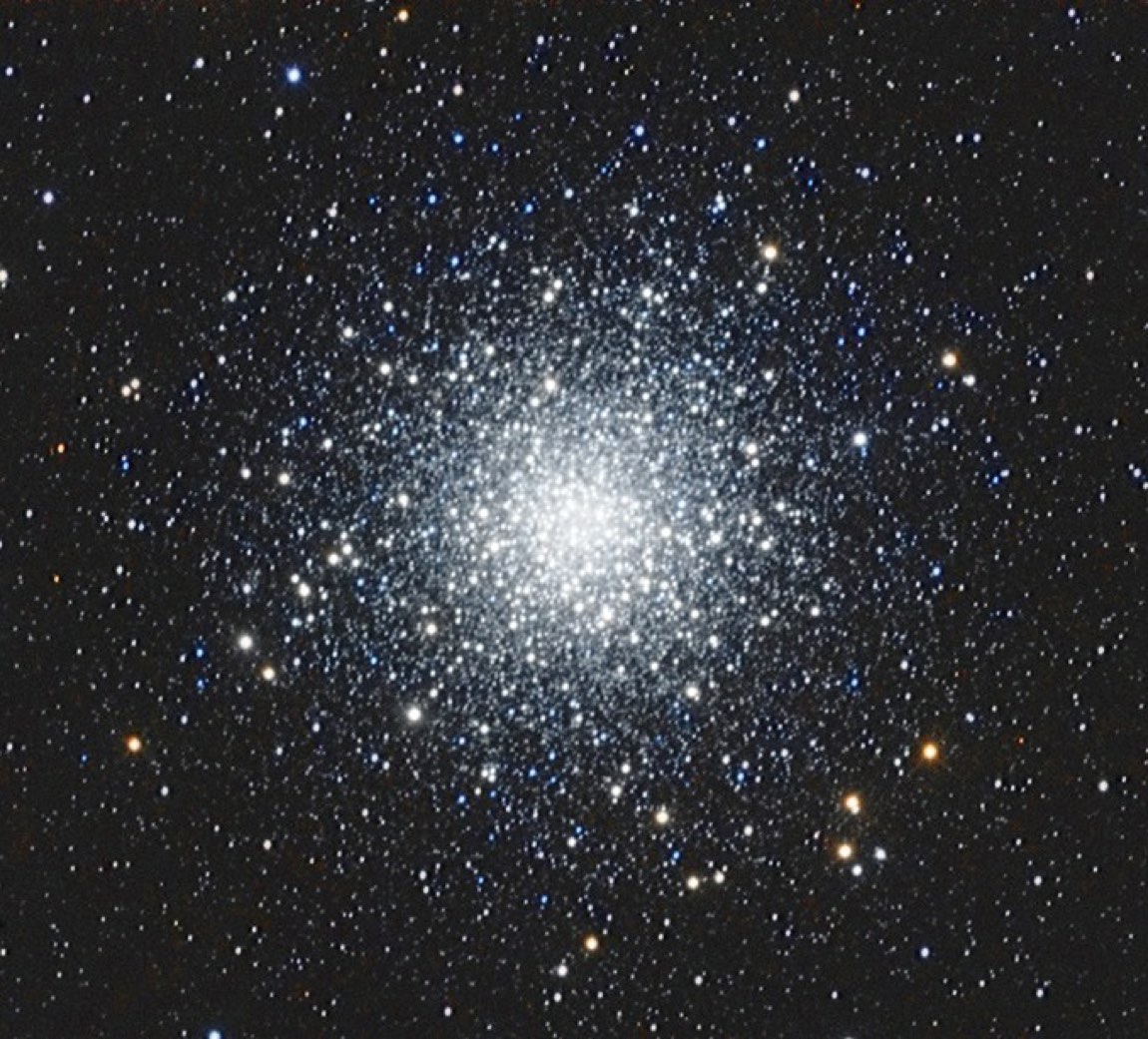
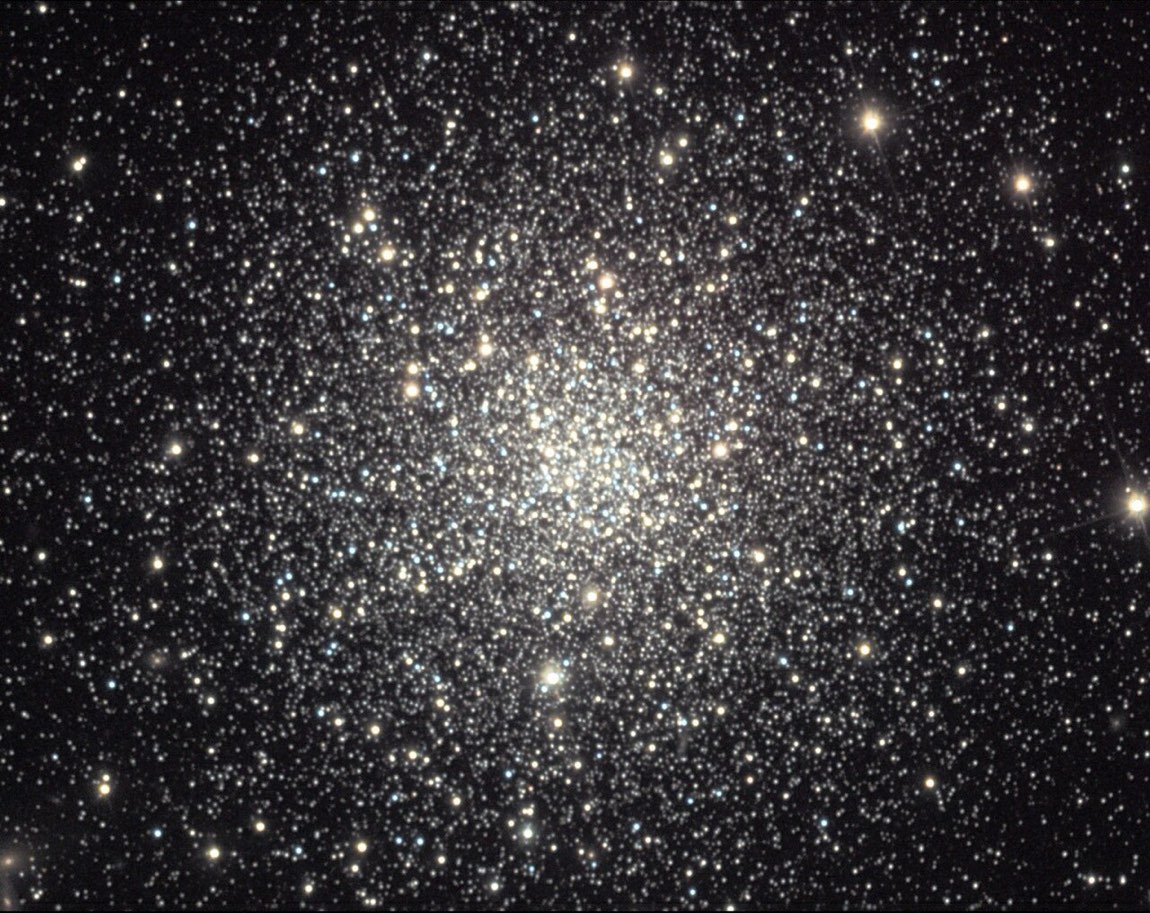
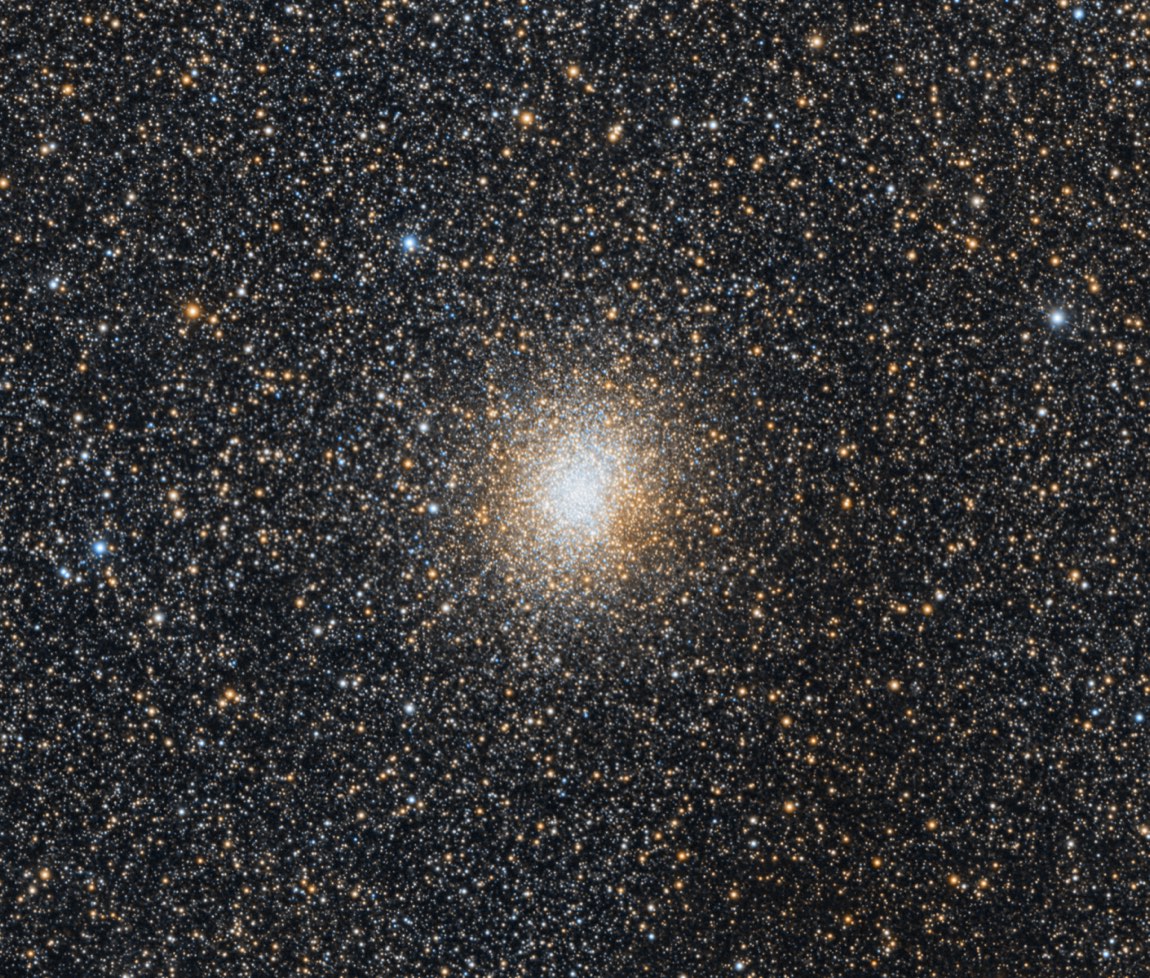
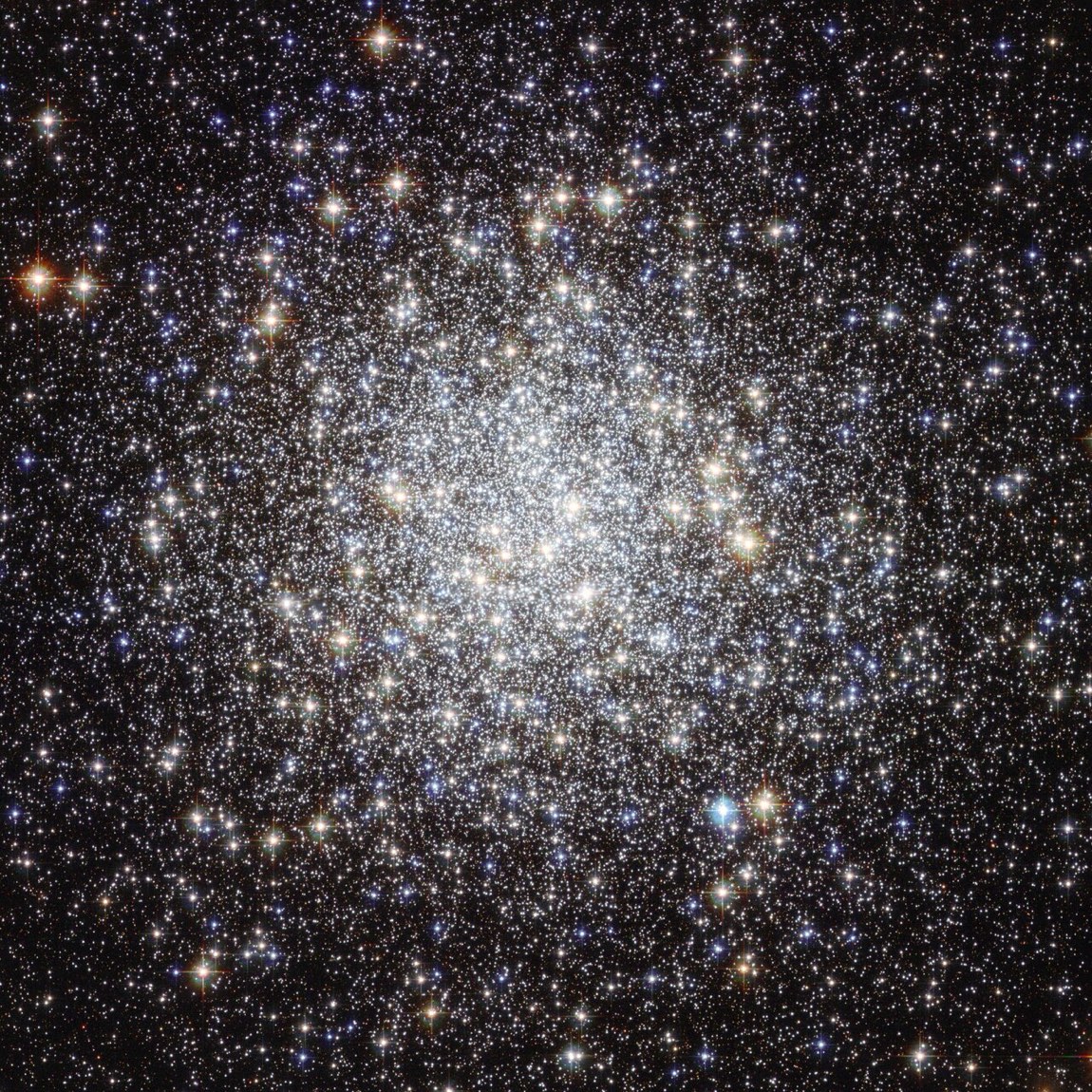
 Photograph · NASA & ESA · CC BY 4.0
Star Cluster · Deep guide
Messier 9
Also called: M9 · NGC 6333
A globular cluster close to the heart of the galaxy, half-veiled by a dark dust cloud.
What is it?
Messier 9 is a globular cluster in southern Ophiuchus, lying in front of a dark cloud of dust called Barnard 64. Charles Messier found it in 1764 and called it a nebula without stars; William Herschel resolved its stars in 1783. It is about 25,800 light-years from Earth but only about 5,500 light-years from the Galactic Center, making it one of the globulars nearest the galaxy's core. Its brightest stars are around magnitude 13.5, so a moderate telescope is needed to see them individually.
The deep dive
Researched for the Atlas from Wikipedia — Messier 9 (1,639 characters read) · updated Nov 15, 2026
01 Discovery: A Nebula That Hid Its Stars
When Charles Messier first spotted M9 on June 3, 1764, he recorded it simply as a "nebula without stars" — a smudge of light with no individual points he could distinguish. This was not a failure of observation so much as a limitation of his instrument. The stars were there all along, packed so tightly and sitting so far away that his telescope blurred them into a single glow. It took nearly two decades for the picture to sharpen. In 1783, English astronomer William Herschel trained his larger reflector on the same patch of sky and achieved what Messier could not: he resolved the cluster into individual stars. Herschel estimated the cluster to be 7 to 8 arcminutes in diameter, with stars noticeably more densely packed near the center. That observation captured something real — globular clusters genuinely do concentrate toward their cores — and it marked the moment M9 changed from a mysterious nebula into a recognizable family of stars.
02 A Cluster Perched on a Dust Cloud
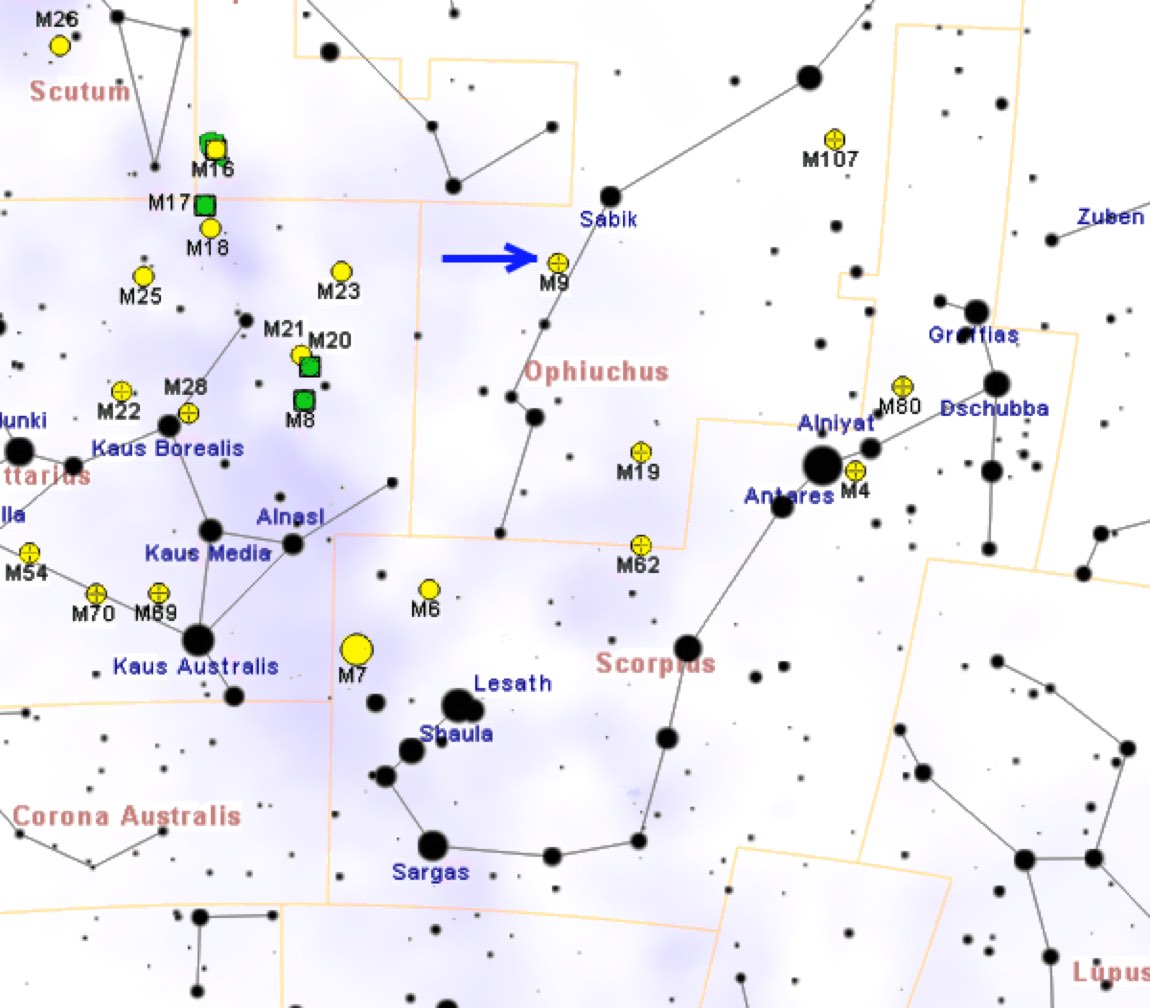
M9 sits in the southern part of the constellation Ophiuchus, positioned to the southwest of the star Eta Ophiuchi. What makes its location especially striking is what lies directly beneath it: a dark cloud of interstellar dust catalogued as Barnard 64. This cloud is not part of the cluster itself — it is a foreground obstacle between us and M9, absorbing and scattering some of the starlight before it reaches our eyes. Dark clouds like Barnard 64 are dense concentrations of gas and dust that block background light, and they are common in this region of the sky, which lies toward the crowded inner Galaxy. The practical consequence for observers is that M9 appears somewhat dimmer and redder than it would if seen through a clear sightline. It is a reminder that even when we look at a distant object, the space in between is rarely empty — the view is always filtered through whatever the Milky Way has scattered along the way.
03 How Close Is M9 to the Galactic Core?
M9 sits about 25,800 light-years from Earth, but its relationship to the center of our Galaxy is what gives it special significance among globular clusters. It lies only around 5,500 light-years from the Galactic Center, making it one of the nearer globular clusters to that turbulent hub of stars, gas, and the supermassive black hole at the Milky Way's heart. For context, the Galactic Center is roughly 26,000 light-years from Earth, so M9 occupies a position almost between us and that core, slightly offset to one side. Globular clusters this close to the center spend their orbits in an environment far more gravitationally intense than clusters in the outer halo. Tidal forces from the Galaxy's mass can gradually strip stars from the cluster's outer edges over billions of years. Studying clusters like M9 in this inner zone helps astronomers understand how the dense stellar environment near the Galactic Center shapes — and slowly erodes — these ancient stellar systems.
04 Light Output: 120,000 Suns in One Object
Despite being unresolvable to the naked eye, M9 is an extraordinarily luminous object. Its total luminosity is around 120,000 times that of the Sun, and this extraordinary combined brightness is captured in its absolute magnitude of −8.04. Absolute magnitude is the brightness a star or cluster would have if placed at a standard distance of 32.6 light-years from Earth, so it allows fair comparisons regardless of how far away objects actually are. An absolute magnitude of −8.04 is impressively bright — comparable to some of the most luminous individual supergiant stars in the Galaxy, except that M9 achieves this by summing the light of hundreds of thousands of stars rather than through any single stellar giant. The apparent magnitude as seen from Earth is 7.9, just below the threshold of naked-eye visibility, which is typically around 6 to 6.5. A modest pair of binoculars or a small telescope will reveal M9 as a fuzzy, slightly concentrated glow, though resolving its individual stars requires a more capable instrument.
05 Seeing Individual Stars Inside M9 Deeper
The brightest individual stars in M9 shine at an apparent magnitude of 13.5. That is roughly 400 times fainter than the dimmest stars a typical human eye can detect under a dark sky, so seeing them requires a moderately sized telescope — not a professional instrument, but something meaningfully beyond a beginner's setup. These bright cluster members are almost certainly red giants, stars that have exhausted the hydrogen in their cores and swollen to large, luminous, cool-surfaced states. Red giants dominate the brightest rungs of old stellar populations like globular clusters, where the most massive stars have long since burned out. William Herschel's early observation that stars were densely packed near the center reflects the genuine structure of the cluster: globular clusters are gravitationally bound systems where stellar density increases toward the core, sometimes dramatically. M9 has an angular size of 9.3 arcminutes across its full extent — slightly larger than Herschel's original 7 to 8 arcminute estimate — and that full width requires a telescope with a reasonably wide field of view to appreciate properly.
06 The Pulsating Stars That Reveal M9's Origins Deeper
Astronomers have identified 24 variable stars within M9 — stars whose brightness changes over time. Twenty-one of these are RR Lyrae variables, a class of pulsating stars that expand and contract in a regular rhythm, changing brightness over periods typically measured in hours to about a day. RR Lyrae stars are enormously useful because their pulsation periods are linked to their intrinsic luminosity, allowing astronomers to calculate precise distances. But in M9's case, their periods reveal something even more fundamental. The cluster is classified as an Oosterhoff type II globular based on those RR Lyrae periods. This classification system, developed in the mid-twentieth century, divides globular clusters into two groups by the average period of their RR Lyrae stars. Oosterhoff type II clusters have longer average periods, and crucially, this classification rules out an extragalactic origin for M9. Clusters captured from satellite galaxies like the Sagittarius Dwarf tend to fall into one Oosterhoff group, while native Milky Way clusters fall into another. M9's RR Lyrae stars stamp it as a homegrown member of our Galaxy.
07 Beyond RR Lyrae: Other Variable Stars in M9 Deeper
The 24 known variable stars in M9 are not all of the same type. Beyond the 21 RR Lyrae variables, the cluster also contains a long-period variable, a Type II Cepheid, and an eclipsing binary — each representing a distinct stellar phenomenon. Long-period variables are typically giant stars pulsating over timescales of months or even years, driven by complex processes in their outer layers. Type II Cepheids are pulsating stars similar to classical Cepheids but found in older, metal-poor populations like globular clusters; they also follow a period-luminosity relationship and serve as distance indicators. The eclipsing binary is a system of two stars whose orbital plane is aligned so that one periodically passes in front of the other as seen from Earth, causing a predictable dip in combined brightness. Notably, the article is equally informative about what M9 lacks: no blue straggler stars and no SX Phoenicis variables have been found within it. Blue stragglers — stars that appear younger than the cluster's age — are common in many globular clusters, so their absence in M9 is itself a data point for understanding how this cluster has evolved.
08 Neighboring Clusters in the Same Field
M9 does not stand alone in its region of sky. About 80 arcminutes — roughly one and one-third degrees — to the northeast lies the globular cluster NGC 6356, and approximately the same angular distance to the southeast sits another globular, NGC 6342. One and one-third degrees is a little more than twice the apparent width of the full Moon, so these three globular clusters form a loose triangle on the sky that an observer with a wide-field telescope or even a good pair of binoculars could appreciate in a single session. NGC 6356 is described as dimmer than M9, meaning it will require more effort to pick out against the star-rich Ophiuchus background. The proximity of all three clusters in this direction of sky reflects the fact that we are looking toward the inner Galaxy, where globular clusters are more numerous. Ophiuchus and neighboring Sagittarius host a disproportionate share of the Milky Way's roughly 150 known globular clusters precisely because that region of sky points toward the Galactic Center, the gravitational focus around which these ancient systems orbit.
09 How to Find and Observe M9
M9 has an apparent magnitude of 7.9, placing it just beyond the reach of the unaided eye but well within range of binoculars or any small telescope. The cluster spans 9.3 arcminutes on the sky — about one-third the apparent diameter of the full Moon — giving it a visually satisfying size once found. It is located in the southern part of Ophiuchus, a large constellation visible from both hemispheres during Northern Hemisphere summer evenings. Finding it is easiest by starting at Eta Ophiuchi and sweeping to the southwest. Even a small telescope will show M9 as a concentrated, misty ball of light, clearly non-stellar at modest magnification. Resolving individual stars within the cluster requires a moderately sized telescope, since the brightest cluster members shine at only apparent magnitude 13.5. The presence of the foreground dust cloud Barnard 64 means the cluster may appear slightly less crisp than its distance alone would suggest, as the dust dims and reddens the light. Dark skies away from city light pollution make a significant difference when hunting for the cluster's outer halo.
10 What the Catalog Number NGC 6333 Tells Us
M9 carries two official designations: Messier 9, from Charles Messier's historic catalog compiled in the eighteenth century to prevent confusion between comet-like nebulae and actual comets, and NGC 6333, from the New General Catalogue published by John Louis Emil Dreyer in 1888. The NGC was a systematic effort to compile all known nebulae and clusters into a single reference, and NGC numbers are still widely used by professional and amateur astronomers today when precision or cross-referencing is needed. The number 6333 simply reflects M9's position in that catalog's sequential ordering — it carries no physical meaning, but it serves as a universal identifier that appears in research papers, observation databases, and telescope software worldwide. Messier's original catalog number, by contrast, reflects roughly the chronological order in which he encountered objects, and M9 being relatively low in that sequence tells us it was among the earlier entries he recorded during his systematic sky surveys of the 1760s. Having both designations is entirely normal for bright, well-studied objects in the sky.
 ⤢