 Photograph · Chuck Ayoub · CC0
Star Cluster · Deep guide
Messier 19
Also called: M19 · NGC 6273
One of the most squashed-looking globular clusters, close to the centre of our galaxy.
What is it?
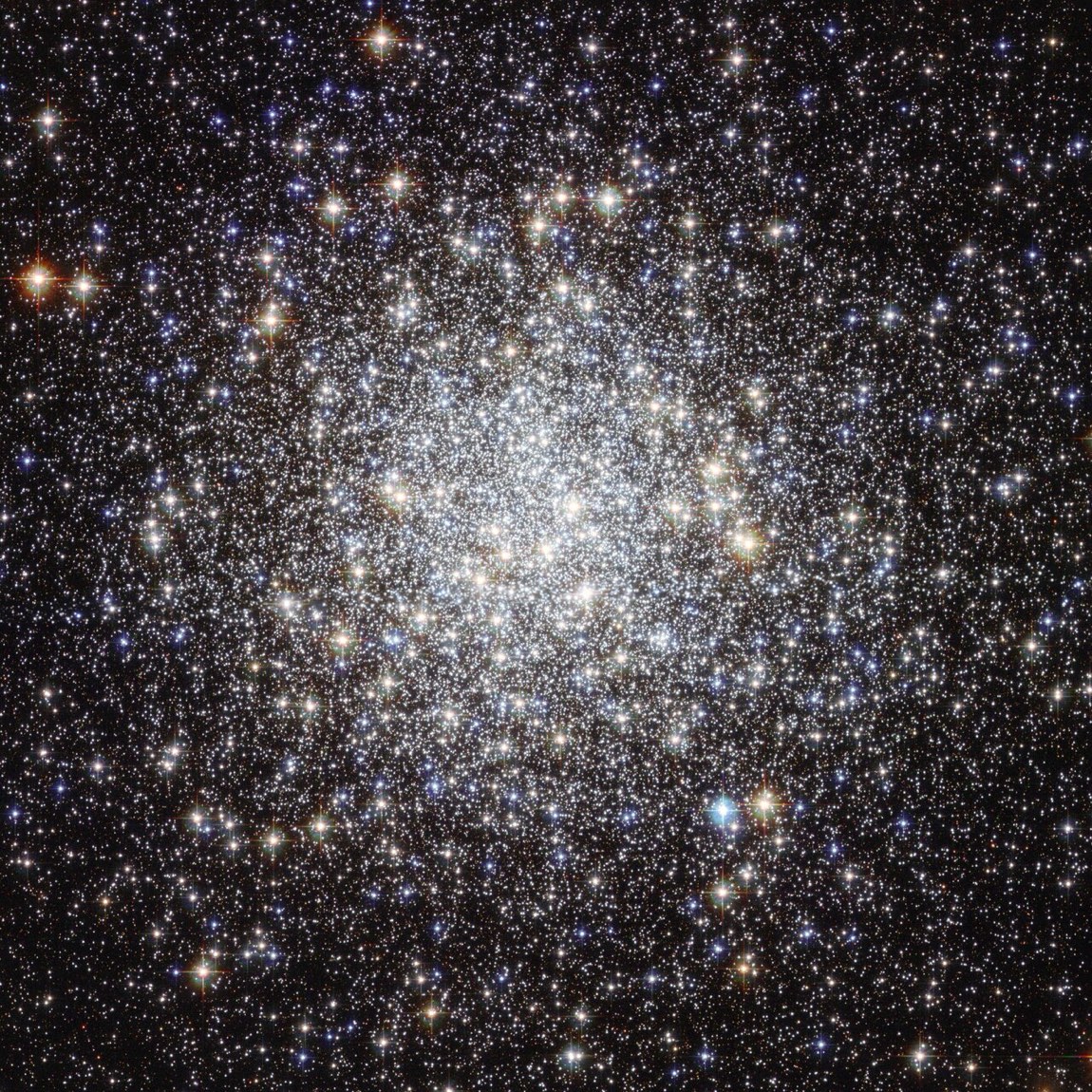
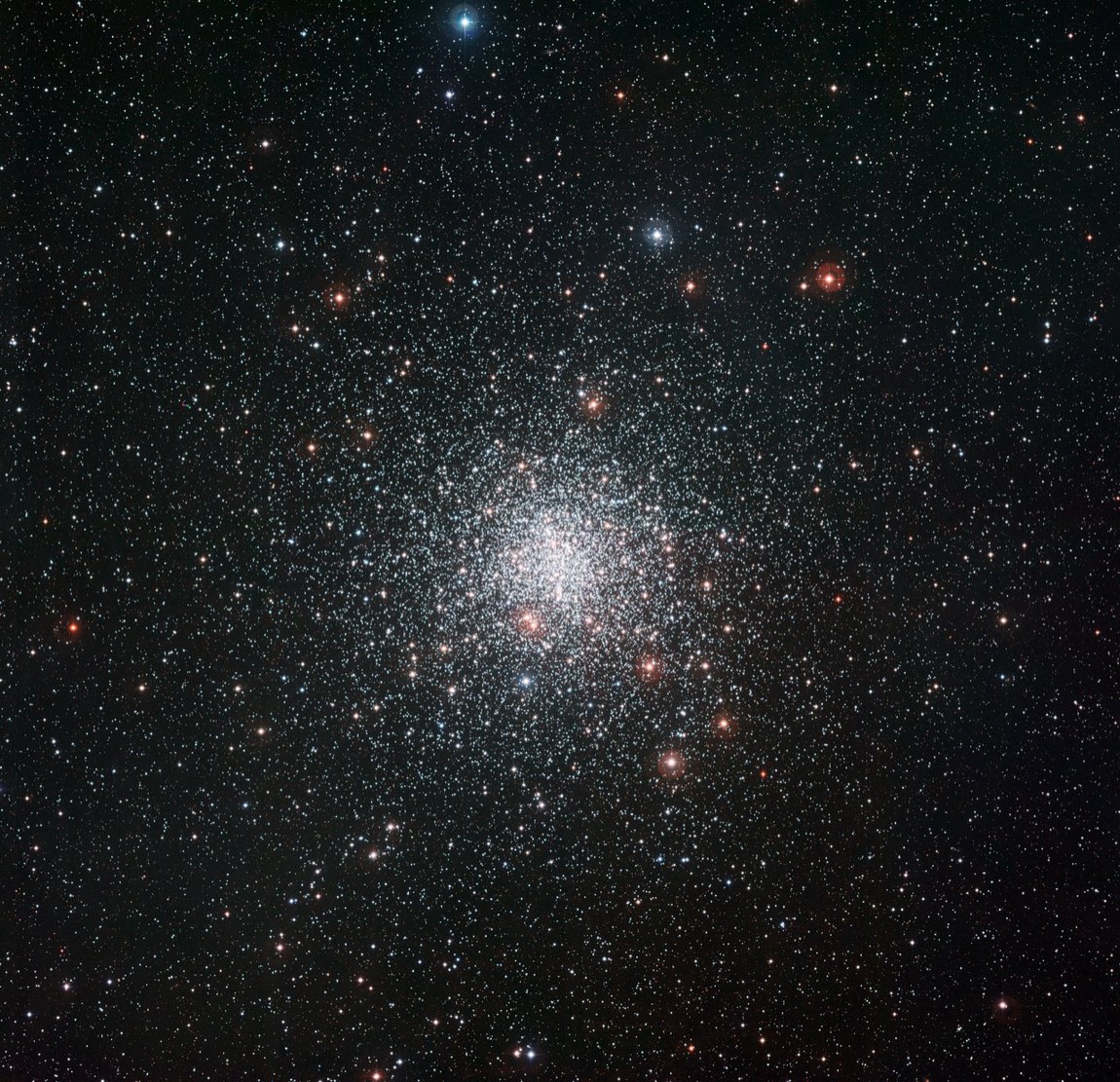
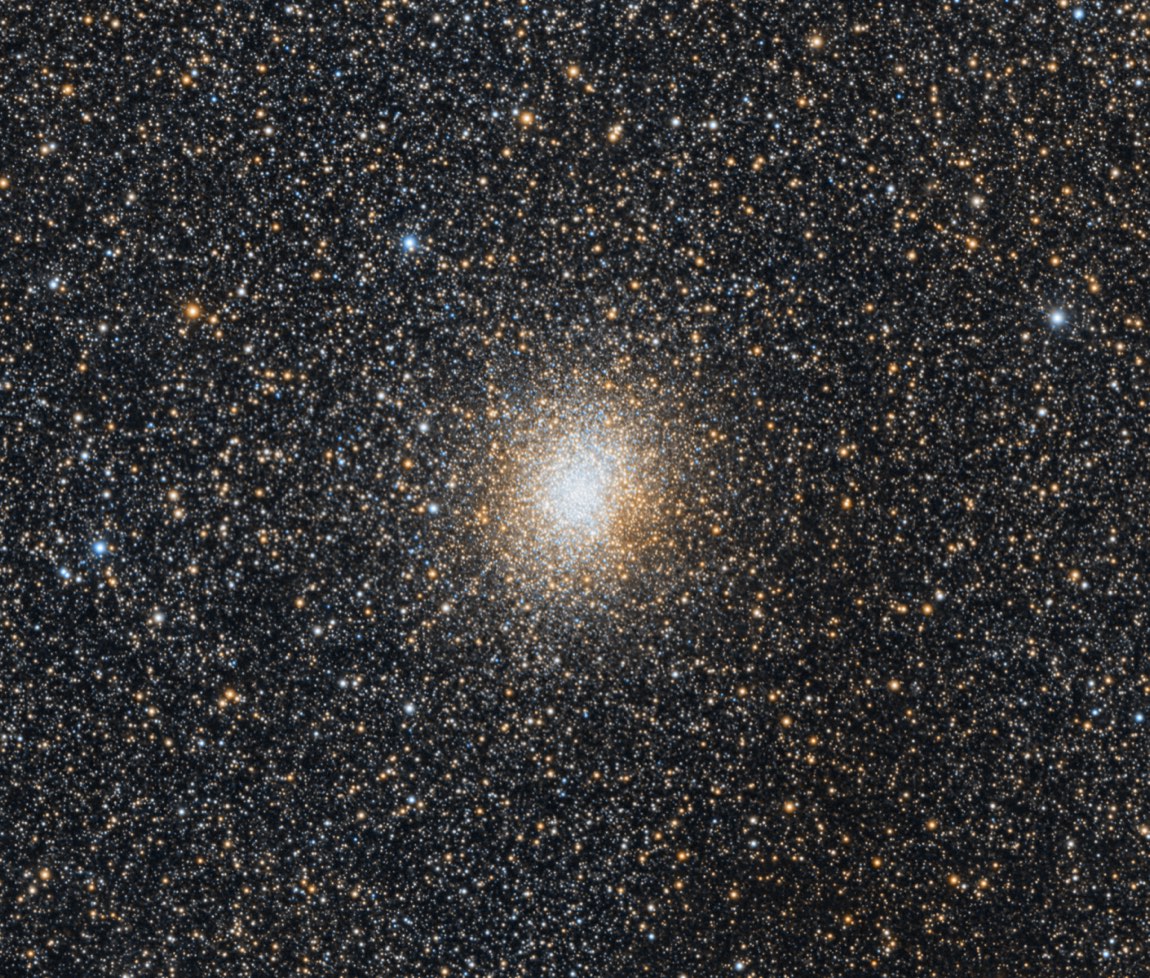
Messier 19 is a globular cluster in Ophiuchus, discovered by Charles Messier in 1764 and first resolved into stars by William Herschel in 1784. It looks noticeably flattened, making it one of the most oblate globulars known, but much of that is an illusion caused by dust dimming its eastern side; in infrared light it appears almost round. M19 is about 28,700 light-years from us yet only about 6,500 light-years from the Galactic Center, and it holds about 1.1 million times the mass of the Sun.
The deep dive
Researched for the Atlas from Wikipedia — Messier 19 (1,482 characters read) · updated Nov 15, 2026
01 Discovered as a Smudge, Resolved into Stars
Charles Messier first spotted M19 on June 5, 1764, cataloguing it among the fuzzy, comet-like objects that could confuse sky-watchers on the hunt for real comets. At the time, no telescope available to him could tease apart what lay inside that glow. Twenty years later, William Herschel turned his more powerful instrument toward the cluster and resolved it into individual stars — a landmark step from blur to comprehension. The discovery passed to the next generation when William's son, John Herschel, trained his own telescope on it and recorded one of astronomy's more enthusiastic observing notes, calling M19 "a superb cluster resolvable into countless stars." That two-generation chain of observation, spanning roughly two decades from Messier's first pencil mark to John Herschel's admiring description, traces the rapid improvement of telescope technology across the late eighteenth and early nineteenth centuries, turning an ambiguous smudge into a recognizable swarm of suns.
02 An Ancient Object Near the Galaxy's Heart
M19 sits about 28.7 thousand light-years (8.8 kiloparsecs) from our Solar System, placing it deep in the inner regions of the Milky Way. More striking still is how close it comes to the Galactic Center itself — only about 6.5 thousand light-years (2.0 kiloparsecs) away. For comparison, our own Sun sits roughly four times farther from that central hub. This proximity to the galaxy's core means M19 formed and has spent billions of years in an unusually crowded, gravitationally intense environment. Its age is estimated at around 11.9 billion years, making it nearly as old as the Milky Way itself and placing its formation in the earliest epoch of galaxy-building, when the universe was less than two billion years old. Objects this ancient serve as fossil records of conditions that no longer exist, giving astronomers a window into the chemical and dynamical state of the very early galaxy.
03 Why M19 Looks Flattened — and Why That's Misleading Deeper
M19 is recognized as one of the most oblate — that is, noticeably squashed — of all known globular clusters, a distinction that immediately raises questions about what forces could stretch a gravitationally bound sphere into an oval shape. However, the article of faith here comes with a major caveat: astronomers suspect the apparent flattening does not accurately reflect the cluster's true physical shape. The culprit is interstellar extinction — gas and dust lying between us and M19 that absorb light particularly strongly along the cluster's eastern edge. This uneven absorption makes one side look dimmer and therefore less extended, skewing the apparent outline. When observers shift to infrared wavelengths, which cut through dust far more effectively than visible light, the cluster shows almost no flattening at all. This contrast between the optical and infrared views is a vivid demonstration of how intervening interstellar material can fundamentally mislead our perception of an object's geometry, and why multi-wavelength astronomy is essential for an honest portrait of deep-sky objects.
04 How to Find and See M19 for Yourself
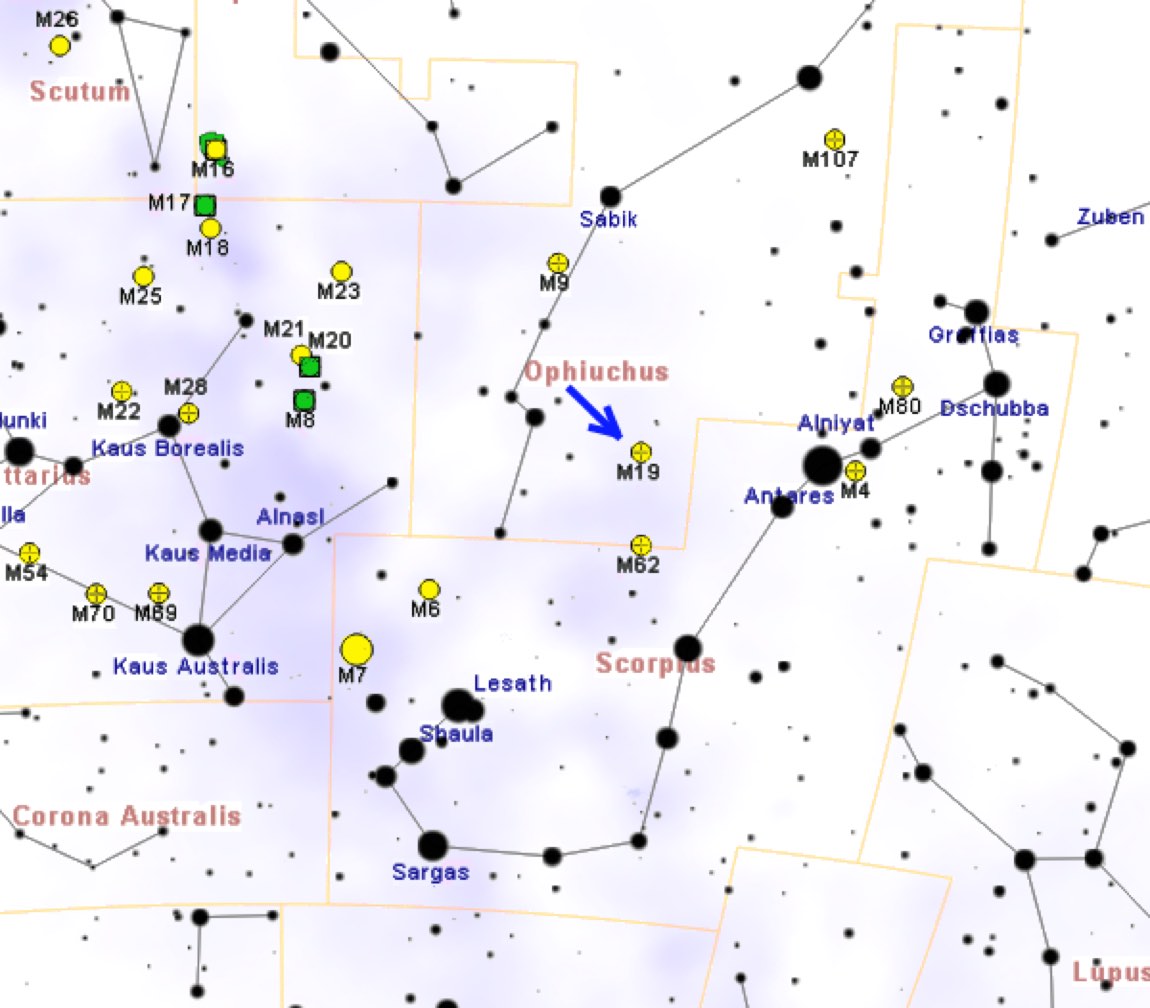
M19 lives in the constellation Ophiuchus and can be pinpointed by star-hoppers as lying 4.5 degrees west-southwest of the star Theta Ophiuchi — roughly the width of four full Moons placed end to end. At that position it is just visible as a fuzzy point of light through 50 mm (2.0 in) binoculars, the kind of modest instrument many casual observers already own. Bump up to a telescope with a 25.4 cm (10.0 in) aperture — a mid-sized amateur reflector — and M19 transforms into something far more interesting: an oval shape with a compact core measuring 3 arcminutes by 4 arcminutes and a broader surrounding halo spanning 5 arcminutes by 7 arcminutes. That oval appearance, even if partially an artifact of dust extinction, gives the cluster a distinctive look compared with the more perfectly circular globulars that fill most star-atlas pages. Ophiuchus is best placed for northern-hemisphere observers during summer evenings, when the constellation rides high in the southern sky.
05 A Stellar Census: Pulsating Variable Stars Deeper
One of M19's scientifically valuable features is its population of pulsating variable stars — stars that rhythmically expand and contract, brightening and dimming on predictable schedules. The cluster contains four Cepheids and RV Tauri variables. Cepheid variables are especially prized because the period of their pulsation correlates tightly with their intrinsic luminosity, making them standard candles for measuring distances. RV Tauri variables are evolved, luminous giants that pulsate in a more complex, semi-regular pattern and are thought to represent a late stage of stellar evolution, potentially on their way to becoming white dwarfs. Additionally, M19 hosts at least one RR Lyrae variable for which a measured period is known. RR Lyrae stars are old, low-mass pulsators common in globular clusters and are themselves useful distance indicators, particularly for old stellar populations. Together these three classes of pulsating star make M19 a small but meaningful laboratory for studying stellar evolution and for cross-checking distance measurements.
06 What ROSAT's Silence Tells Us Deeper
Globular clusters are sometimes home to exotic high-energy objects — millisecond pulsars, cataclysmic variable binary systems, and low-mass X-ray binaries — that betray their presence by emitting X-rays. Astronomers therefore pointed the ROSAT X-ray space observatory at M19, expecting to detect at least some low-intensity X-ray sources lurking within the cluster's dense stellar environment. The result was a non-detection: observations made during the ROSAT mission failed to reveal any such sources. A null result is not a failure; it is data. The absence of detectable X-ray emission sets an upper limit on the number and brightness of compact objects within M19, constraining the population of interacting binary stars and neutron stars the cluster could harbor. It also invites comparison with other globular clusters where ROSAT did find X-ray sources, raising questions about what makes M19's internal dynamics or stellar demographics different. This kind of comparative silence is one of the quieter but legitimate tools of modern astrophysics.
07 The Enormous Mass Packed into One Cluster
M19 contains an estimated 1,100,000 times the mass of the Sun — that is 1.1 million solar masses bound together by gravity in a single cluster. To put that number in everyday terms, if you could somehow replace our Sun with M19, it would outweigh our Solar System's star by more than a million to one. This mass is distributed among hundreds of thousands of stars, most of them old, cool, and orange-red, with the more massive stars having burned out long ago given the cluster's age of 11.9 billion years. The sheer gravitational weight of this system keeps its stars tightly corralled across billions of years, even as it orbits through the chaotic tidal forces near the Galactic Center. Mass estimates for globular clusters like this one are derived from measurements of stellar velocities and the application of dynamical models, so they carry some uncertainty, but the figure gives a reliable order-of-magnitude picture of M19's gravitational heft.
08 Proximity to the Galactic Core: A Harsh Neighborhood Deeper
Being only about 6.5 thousand light-years (2.0 kiloparsecs) from the Galactic Center places M19 in one of the most gravitationally turbulent regions of the Milky Way. The galactic bulge is densely packed with stars, dark matter, and the tidal influence of the supermassive black hole at the galaxy's heart. Globular clusters that orbit close to the center are subject to stronger tidal forces that can gradually strip stars from their outer edges — a process called tidal stripping — and to more frequent passages through the dense galactic disk. Over 11.9 billion years, these forces have had ample time to reshape M19's structure and stellar population. The interstellar gas and dust responsible for the differential extinction that makes the cluster look oblate in visible light is itself a product of this rich inner-galactic environment. M19's position, therefore, is not merely an address but an active influence on its appearance, its dynamics, and even our ability to observe it accurately.
09 Open Questions That M19 Leaves Unanswered Deeper
Several genuine uncertainties hang over M19. The most visually obvious is the question of its true shape: does the cluster have genuine physical oblateness, or does the visible flattening dissolve entirely once extinction is accounted for? Infrared imaging strongly suggests the latter, but pinning down the exact three-dimensional structure requires careful modeling. The ROSAT non-detection leaves open the question of whether M19 truly lacks compact binary systems or whether those systems are simply too faint for ROSAT's sensitivity. Future X-ray observatories with greater collecting area could revisit this. The tally of variable stars — four Cepheids and RV Tauri variables, plus at least one RR Lyrae — is described with the qualifier "at least one," suggesting the census may be incomplete. And like all globular clusters near the Galactic Center, M19 invites ongoing study of how tidal forces and stellar evolution interact across cosmic time. Each of these threads represents a research opportunity that current data has opened rather than closed.
 ⤢