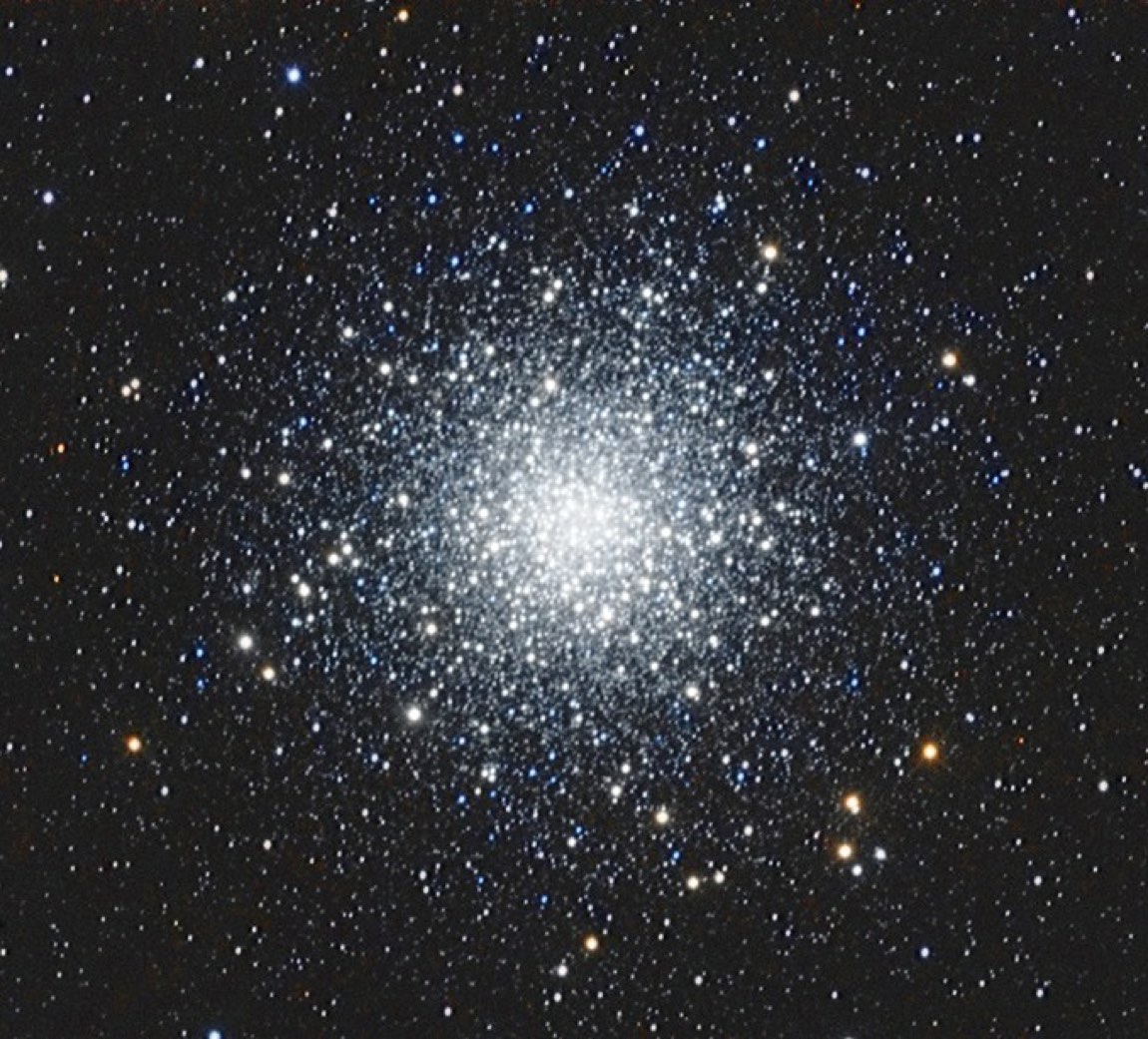
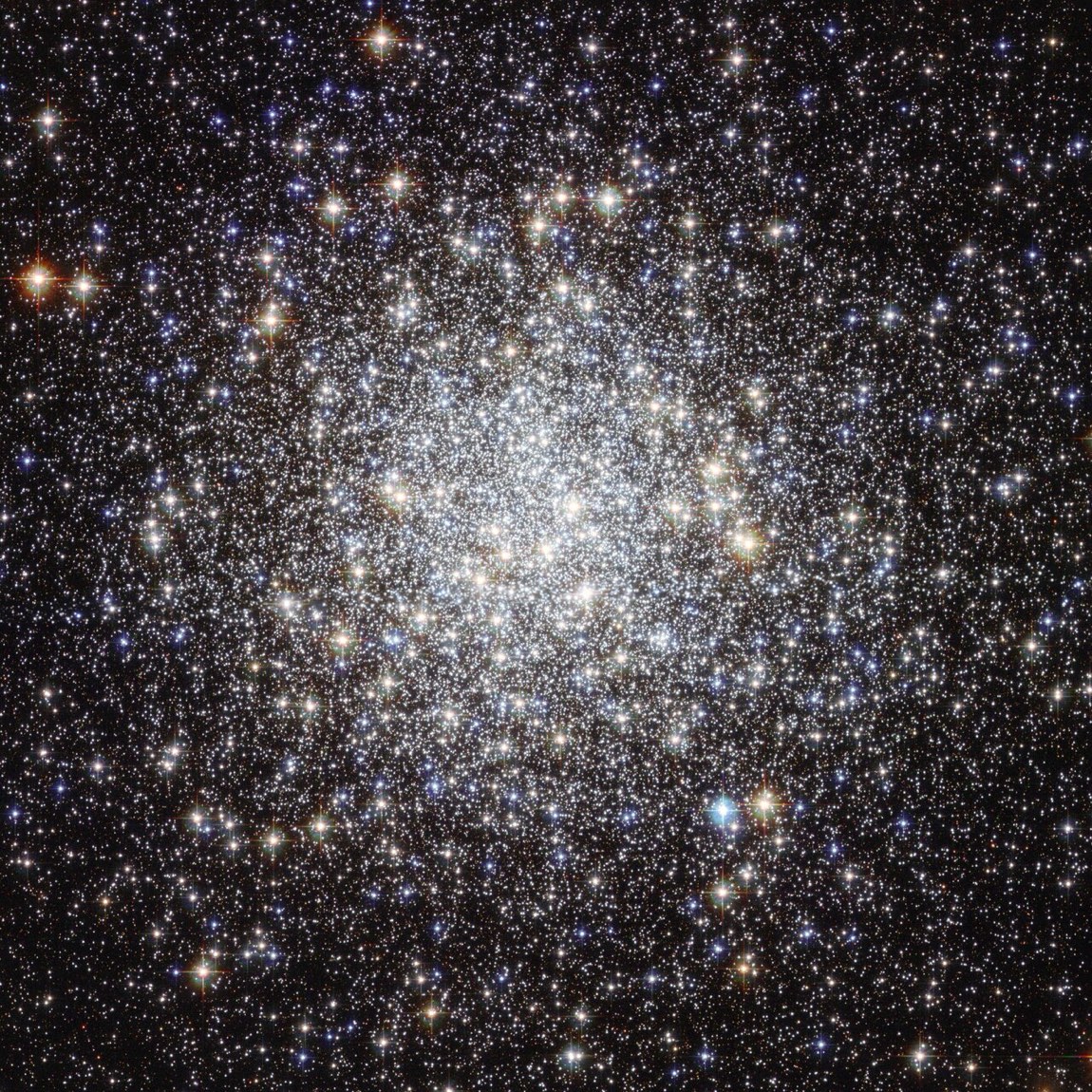
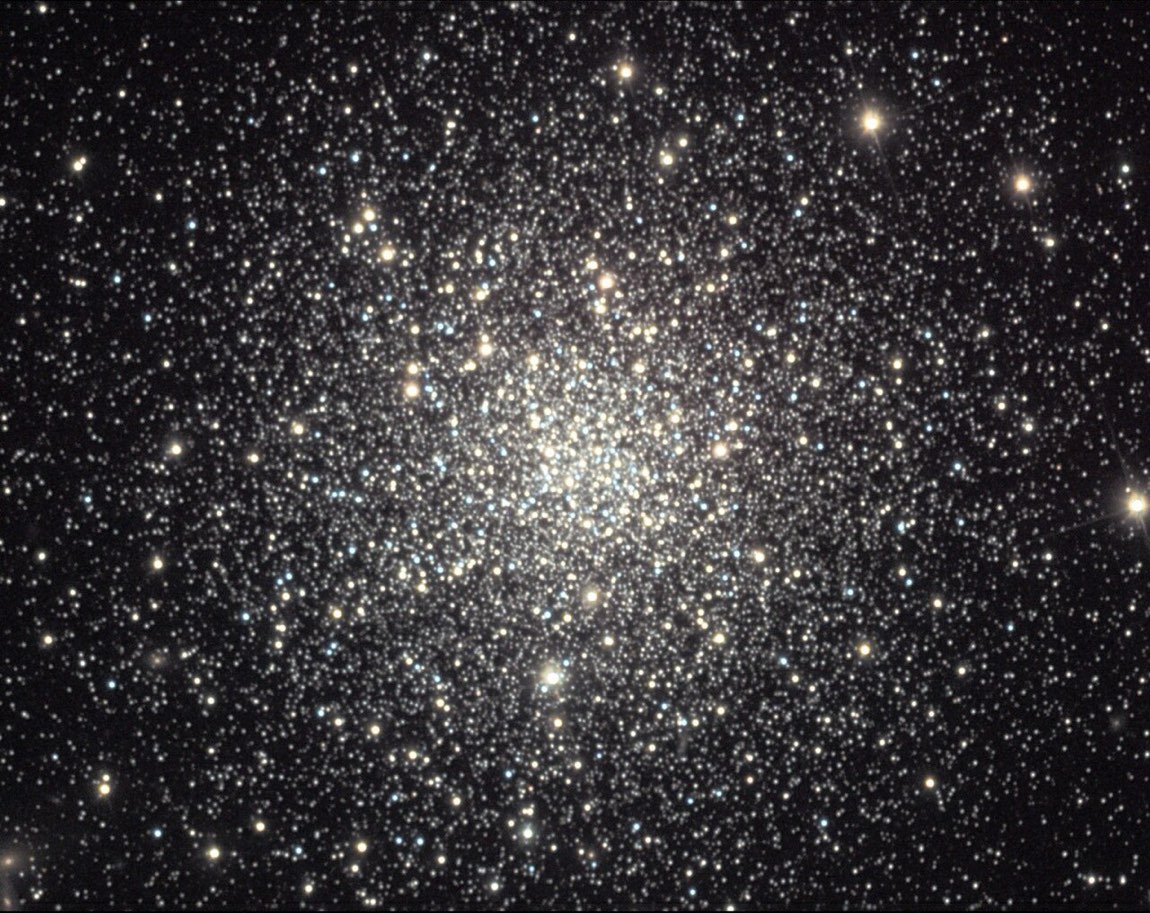
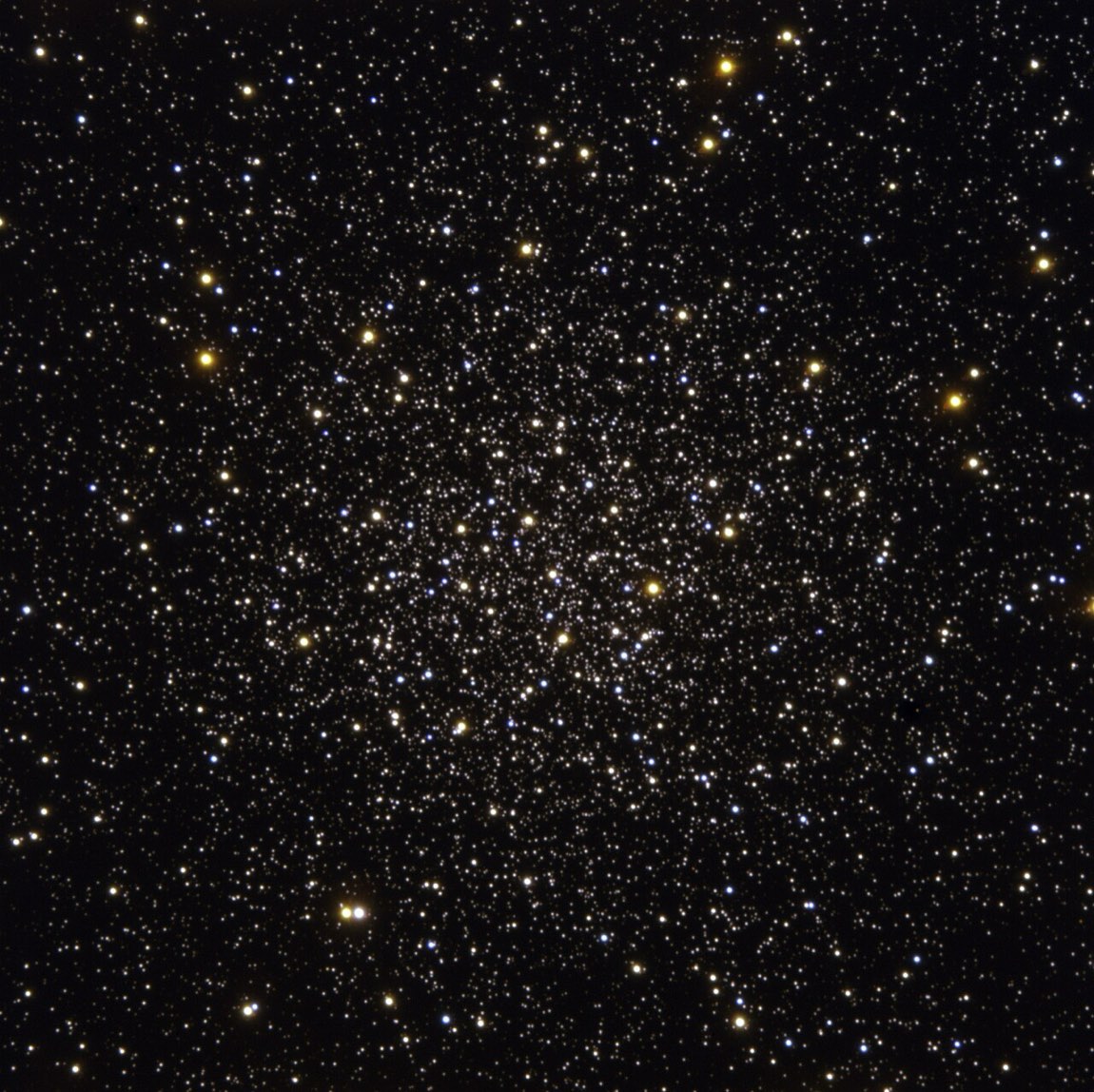
 Photograph · Adam Block · CC BY-SA 4.0
Star Cluster · Deep guide
Messier 12
Also called: M12 · M 12 · NGC 6218
A loosely packed globular cluster that seems to have lost many of its smallest stars.
What is it?
Messier 12 is a globular cluster in Ophiuchus, discovered by Charles Messier in 1764. It is unusually loose for a globular and was once mistaken for a rich open cluster. Lying about 16,400 light-years away, it can be glimpsed in binoculars under dark skies. A 2006 study found it has surprisingly few low-mass stars; the researchers suggest those stars were pulled away as the cluster passed through the crowded plane of the Milky Way. It sits about 3° from its neighbour Messier 10.
The deep dive
Researched for the Atlas from Wikipedia — Messier 12 (1,464 characters read) · updated Nov 15, 2026
01 Mistaken for a nebula, then an open cluster
When Charles Messier first spotted M12 on May 30, 1764, he recorded it as a 'nebula without stars' — a reasonable mistake given the modest optics of the era. The cluster's looseness fooled observers for generations after that as well. With a Shapley-Sawyer concentration rating of IX on a scale where I is the densest, M12 sits near the low-density end of the globular-cluster spectrum, and astronomers once went so far as to classify it as a tightly concentrated open cluster rather than a globular cluster at all. Those two cluster types are fundamentally different beasts — open clusters are young, loosely bound groups born in the galactic disk, while globular clusters are ancient, gravitationally tightly bound spheres containing hundreds of thousands of stars. The misclassification underscores how deceptive appearances can be when a globular is as spread out as M12 is. Modern telescopes and distance measurements eventually settled the question firmly in the globular-cluster camp.
02 How loose is 'loosely packed,' really? Deeper
The Shapley-Sawyer Concentration Class runs from I, representing the most centrally concentrated globular clusters with a dense, almost stellar-looking core, all the way to XII, the most diffuse. M12's rating of IX places it well toward the sparse end of that range. In practical terms, this means that when you look at M12 through a 10-inch (25 cm) telescope, the granular core spans only about 3 arcminutes in diameter, surrounded by a much broader halo of stars extending out to roughly 10 arcminutes across. That halo-to-core size ratio reflects how loosely the stars are concentrated toward the center compared to a tightly packed cluster like M13 or M5. The low central concentration is part of why the cluster can be glimpsed under dark skies with binoculars despite its brightest individual stars shining at only 12th magnitude — the light is simply spread across a wide area rather than blazing from a compact nucleus.
03 A neighbor you can almost wave to
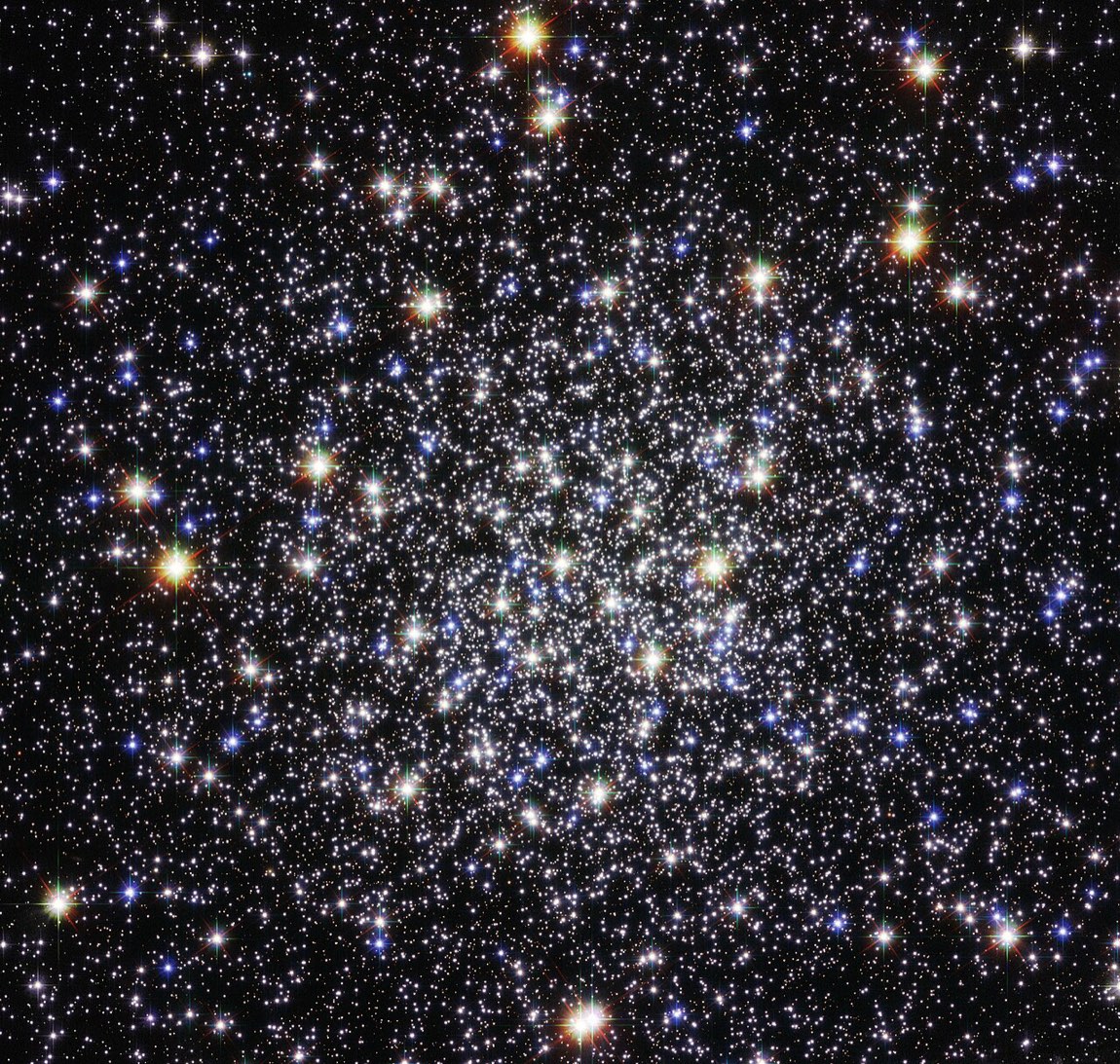
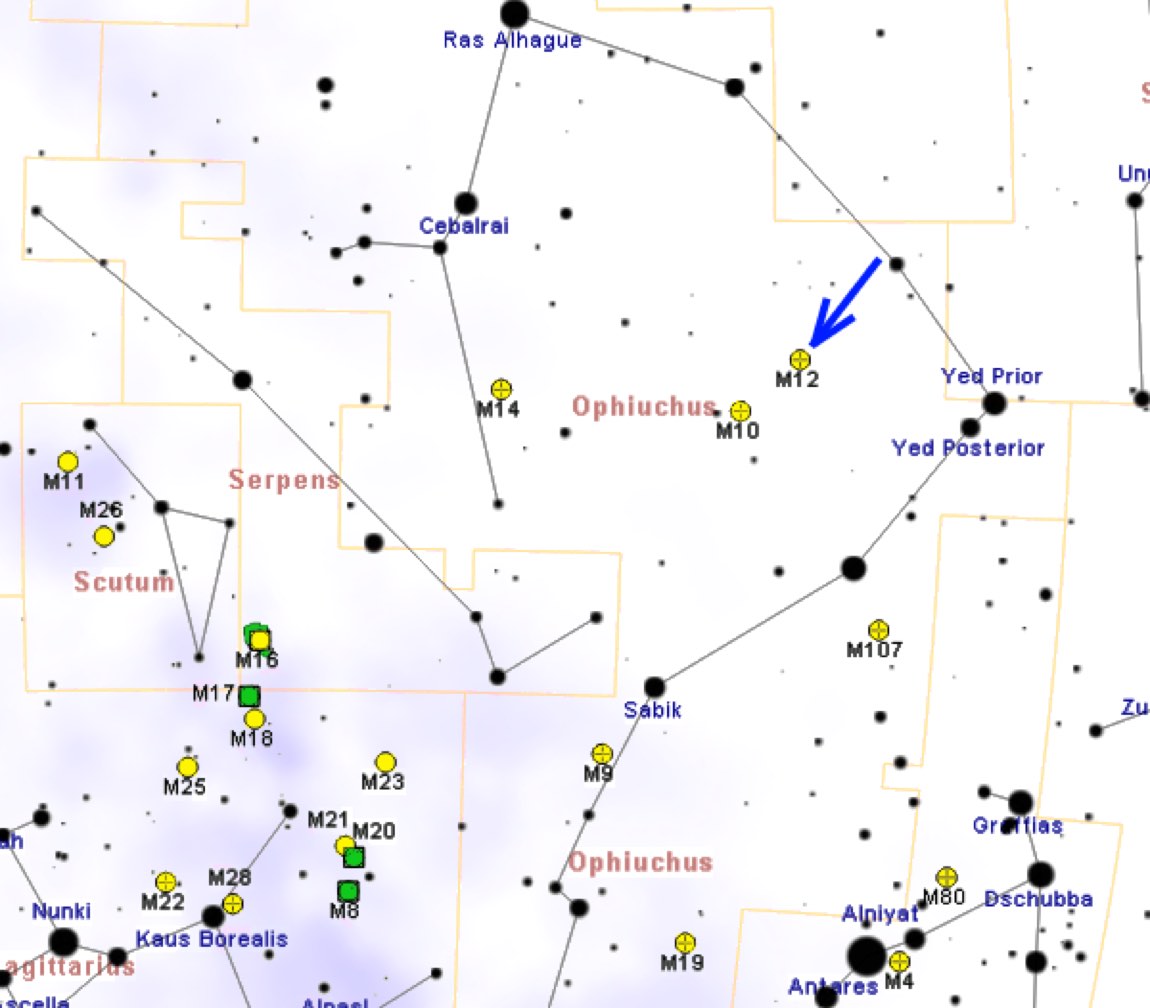
M12 and its nearby companion M10 share one of the more striking spatial relationships among Messier objects. Separated by only a few thousand light-years in three-dimensional space, the two globular clusters are genuinely close neighbors on a cosmic scale. That proximity has a vivid observational consequence: from within either cluster, the other would glow at around magnitude 4.5 in the sky — roughly as bright as a moderately faint naked-eye star seen from Earth, but resolved into a fuzzy, luminous ball rather than a point of light. On the sky as we see it from Earth, M12 sits about 3 degrees northwest of M10, a gap easily bridged in a single binocular field of view. The pair makes an excellent comparison target for observers interested in seeing how differently two globular clusters of similar distance can appear depending on their concentration class and overall structure.
 ⤢
04 The Milky Way's toll on a star cluster Deeper
A 2006 study brought an unexpected finding to light: M12 harbors an unusually low number of low-mass stars compared to what cluster-formation models predict. The authors' explanation points to a process called tidal stripping. Each time M12 passes through the relatively matter-rich plane of the Milky Way galaxy, gravitational tides exert differential forces across the cluster. Lower-mass stars, which move more slowly and are bound less tightly, are preferentially pulled away and scattered into the broader galactic field. Higher-mass stars, being more gravitationally anchored to the cluster's center, survive repeated disk crossings more easily. Over billions of years and many such passages, this sifting process can dramatically deplete the lower end of a cluster's stellar mass function. M12's current stellar census appears to be a direct record of that long erosion — a population shaped not just by the conditions of its birth but by the gravitational geography of the galaxy it has been orbiting ever since.
05 Thirteen stars that change their brightness
Among the many thousands of stars packed into M12, astronomers have identified thirteen variable stars — stars whose brightness fluctuates measurably over time. Variable stars in globular clusters are scientifically prized because certain types, particularly RR Lyrae variables, pulsate with periods directly tied to their intrinsic luminosity. That relationship allows astronomers to calculate precise distances by comparing how bright the star appears against how bright it actually is. The article does not specify which types of variables populate M12's thirteen, but their presence means the cluster has contributed to the long tradition of using globular-cluster variables as cosmic distance markers. Variable stars also serve as probes of stellar physics, revealing how stars at advanced evolutionary stages — red giants, horizontal-branch stars — behave under the specific chemical and age conditions found in an ancient globular cluster like M12.
06 M12 is heading straight toward us
Radial velocity measurements show that M12 is approaching Earth at 16 kilometers per second. To put that in perspective, 16 km/s is roughly 57,600 kilometers per hour — fast enough to cross the continental United States in under a minute. Yet even at that pace, the cluster's current distance of about 16,400 light-years means it poses no concern for the foreseeable future; it would take on the order of hundreds of millions of years to close even a small fraction of that gap, and the cluster's orbit around the Milky Way will curve its path long before any encounter becomes relevant. The measurement itself is a product of the Doppler shift in the cluster's spectral lines. When a light source moves toward an observer, its light is compressed to slightly shorter, bluer wavelengths — an effect that, when carefully measured, yields the line-of-sight velocity with remarkable precision.
 ⤢
07 Finding M12 in the night sky
M12 lives in the constellation Ophiuchus, the serpent bearer, which rides the celestial equator and is best placed for evening viewing in summer for observers in the Northern Hemisphere. The cluster sits about 5.6 degrees east-southeast of Lambda Ophiuchi, a star that can serve as a useful jumping-off point. It is also located near 12 Ophiuchi, a 6th-magnitude star bright enough to be visible without optical aid under dark skies, making it a handy nearby landmark for star-hopping. Under dark conditions M12 can be detected as a faint smudge through binoculars, though the stellar nature of the object — the fact that it is a dense swarm of hundreds of thousands of suns rather than a cloud of gas — only becomes apparent through a telescope. An aperture of at least 8 inches (20 cm) is needed to begin resolving individual stars, and a 10-inch (25 cm) scope reveals the textured, granular core embedded within the broader 10-arcminute halo.
08 Size and distance: putting 75 light-years in context
M12 stretches about 75 light-years across in physical space, while sitting roughly 16,400 light-years from Earth — about 5,000 parsecs. For comparison, 75 light-years is a little less than the distance light travels in 75 years, and it encompasses a volume that could comfortably contain dozens of star systems within the Sun's immediate neighborhood. The cluster's distance of 16,400 light-years places it well within the Milky Way's halo but not at its outer fringes; we are seeing light that left M12 thousands of years before the first cities appeared on Earth. That distance also explains why the cluster's brightest individual stars, though genuinely luminous red giants, appear at only 12th magnitude as seen from Earth — far below what the naked eye can detect, and requiring at minimum a moderate backyard telescope to glimpse individual stellar points against the cluster's glow.
09 What 'ancient' really means for a globular cluster Deeper
The article does not state M12's age explicitly, but globular clusters as a class are among the oldest structures in the Milky Way, and the specific processes described for M12 — tidal stripping over many galactic-plane crossings — require immense spans of time to produce the observed depletion of low-mass stars. The repeated passages through the galactic disk that the 2006 study invokes as the stripping mechanism imply M12 has been orbiting the galaxy long enough to have experienced that process many times over. This kind of long orbital history is consistent with globular clusters in general, which typically formed in the early universe when the raw material for stars was being assembled. M12's current stellar population — whatever survives after billions of years of tidal erosion — is therefore something of a fossil record, encoding information about both the initial conditions of star formation and the subsequent gravitational history of the cluster's journey through the galaxy.
 ⤢