 Photograph · ESO Imaging Survey · CC BY 4.0
Star Cluster · Deep guide
Messier 4
Also called: M4 · NGC 6121 · Spider Globular Cluster
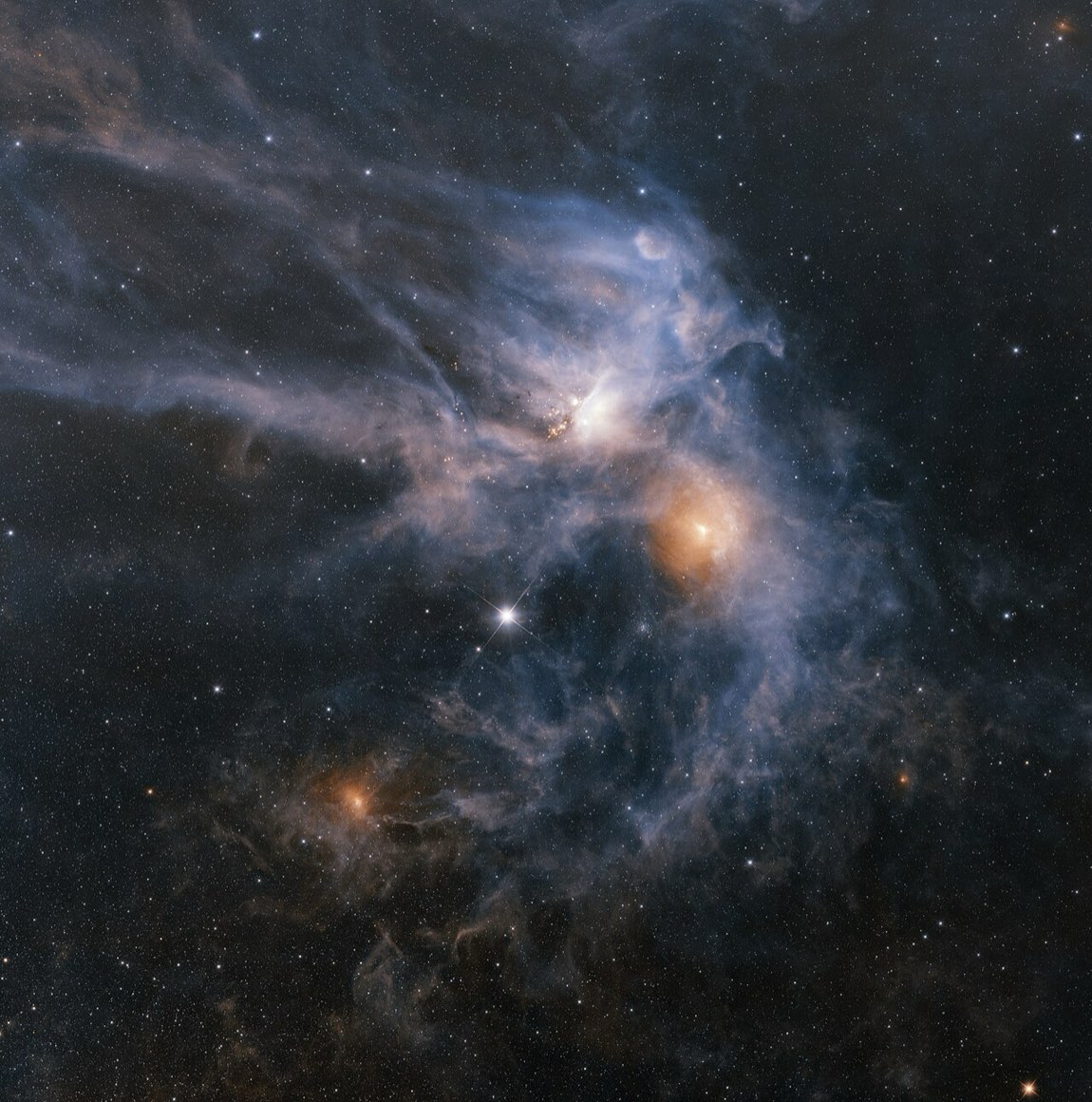
The nearest globular cluster to the Sun, sitting just beside the red star Antares.
What is it?
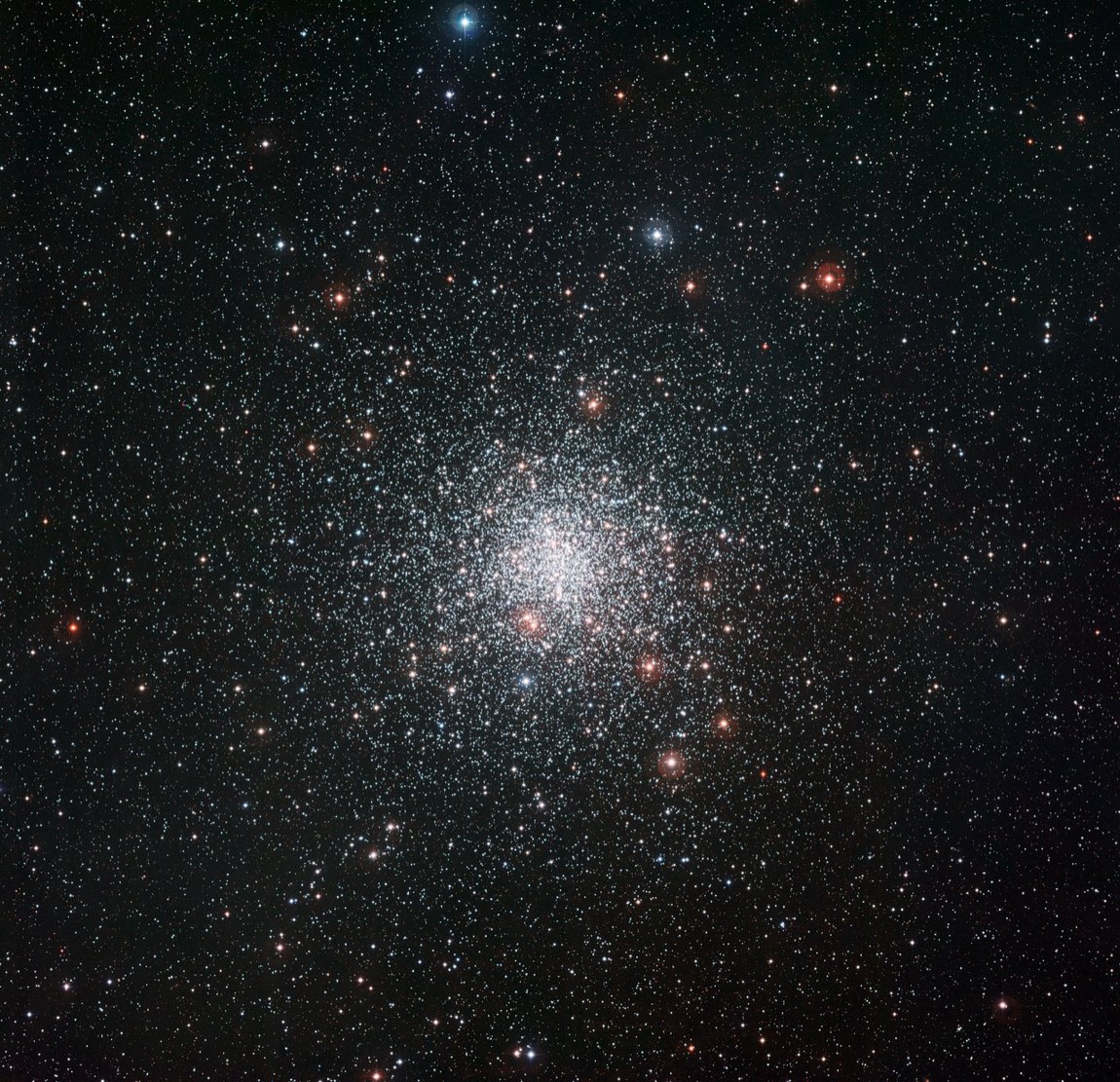
Messier 4 is a globular cluster in Scorpius and, at roughly 6,000 light-years, the closest one to our Solar System. It lies only 1.3 degrees west of the bright red star Antares, which makes it easy to find. Discovered by Philippe Loys de Chéseaux in 1745, it was the first globular cluster whose individual stars were seen through a telescope. Its stars are about 12 billion years old, and a bar of 11th-magnitude stars across its core, first noted by William Herschel, gives it a distinctive look.
The deep dive
Researched for the Atlas from Wikipedia — Messier 4 (3,852 characters read) · updated Nov 15, 2026
01 The First Cluster to Show Its Stars
Before M4, globular clusters were simply unresolved smudges of light — luminous fog with no discernible inner structure. M4 changed that permanently. It holds the distinction of being the first globular cluster in which individual stars were successfully resolved, meaning astronomers could for the first time look into one of these great stellar cities and pick out separate suns. Philippe Loys de Chéseaux first noticed the object in 1745, and Charles Messier added it to his famous catalog in 1764, but it was the technological progress of telescopes over the following decades that finally cracked the cluster open into individual points of light. Today even a modest backyard telescope begins to resolve those stars, with the brightest members shining at apparent magnitude 10.8 — just beyond the naked eye's reach but easily caught with binoculars pointed at the right patch of sky.
02 A Mysterious Bar Across the Core
Most globular clusters look like smooth, symmetrical balls of stars growing denser toward the center. M4 is different. Running across its core is a distinct linear feature — a "bar" structure made of 11th-magnitude stars that stretches approximately 2.5 arcminutes across the sky. First noted by William Herschel in 1783, this bar gives M4 a genuinely unusual appearance among the roughly 150 known globular clusters in the Milky Way. Its origin is not fully explained, but it represents a real concentration of stars aligned in a way that breaks the cluster's otherwise circular symmetry. Moderate-sized amateur telescopes can detect it on a clear night, making M4 one of the few deep-sky objects where structure within the core is accessible outside a research observatory. The cluster is also classified as a class IX object on the standard concentration scale, meaning it is relatively loosely packed rather than being one of the dense, compressed clusters.
03 Two Generations of Stars in One Cluster Deeper
M4's chemical makeup tells a story of not one but two separate waves of star formation. Astronomers measure a cluster's metallicity — the abundance of elements heavier than hydrogen and helium — using the iron-to-hydrogen ratio compared to the Sun, written as [Fe/H]. For M4, that value is −1.07 ± 0.1, which translates to an iron abundance of just 8.5% of what the Sun contains. That low figure alone is consistent with ancient stars born when the universe had not yet had time to forge many heavy elements in stellar interiors. But crucially, this metallicity combined with other observations strongly suggests M4 hosts two distinct stellar populations differing in age, implying the cluster experienced at least two main cycles or phases of star formation rather than one clean burst. This kind of multiple-population architecture is now recognized in many globular clusters and is one of the central puzzles of cluster formation: what process triggers a second generation of stars inside an already-formed cluster?
04 An Extreme Orbit Through the Galaxy Deeper
M4 is not sitting still. Its measured space velocity components are −57 ± 3 km/s in U, −193 ± 22 km/s in V, and −8 ± 5 km/s in W, and taken together these numbers reveal a highly elongated orbit around the Milky Way with an eccentricity of 0.80 ± 0.03 — far more stretched than Earth's nearly circular path around the Sun. The orbital period is 116 ± 3 million years. At its closest approach to the galactic center, periapsis, M4 plunges to within 0.6 ± 0.1 kiloparsecs of the core. At apoapsis it swings out to 5.9 ± 0.3 kiloparsecs. The orbit is also tilted 23° ± 6° from the galactic plane, so the cluster rises as far as 1.5 ± 0.4 kiloparsecs above the disk of the Milky Way at its highest point. Each time M4 punches back through the galactic disk — always within 5 kiloparsecs of the nucleus — it undergoes tidal shock, a gravitational jolt that can strip stars away. The cluster may once have been far more massive than the 75-light-year-wide structure we see today.
05 White Dwarfs That Predate the Solar System
In 1995 the Hubble Space Telescope turned its gaze on M4 and found something remarkable: white dwarf stars so old they rank among the most ancient stars known in the entire Milky Way. These stellar cinders, the burned-out remnants of stars once like the Sun, have been cooling for approximately 13 billion years. To put that figure in context, the Solar System is only about 4.6 billion years old, meaning these white dwarfs were already ancient long before Earth existed. White dwarfs cool at a predictable rate, so their current temperatures serve as a kind of cosmic clock. Finding them in M4 at this age helps anchor the timescale of the early universe and confirms that the first generations of stars formed remarkably soon after the Big Bang. M4's proximity — just 6,000 light-years away, the closest globular cluster to the Solar System — made these faint, cool objects detectable at all; in a more distant cluster they would have been beyond Hubble's reach.
06 A Planet Born in the Ancient Universe
Among M4's white dwarfs, one has an extraordinary companion system. This white dwarf is paired with a pulsar, PSR B1620−26, and orbiting that binary pair is a planet with a mass 2.5 times that of Jupiter. Because the white dwarf in this system is estimated to be around 13 billion years old, the planet is thought to be similarly ancient, making it one of the oldest known planets yet identified. This object challenges assumptions about when in cosmic history planets could form. The early universe was far poorer in heavy elements like carbon, oxygen, and iron — the building blocks planetary scientists consider essential for planet formation — yet here is a giant planet persisting in a globular cluster from that remote era. The system also includes CX-1, a possible millisecond pulsar and neutron star binary located in M4 that orbits with a period of just 6.31 hours, adding to the cluster's already dense collection of exotic compact objects.
07 Lithium: An Element That Shouldn't Be There Deeper
One star in M4 has been found to contain far more lithium than astronomers expected. This matters because lithium is one of only a handful of elements produced in meaningful quantities during Big Bang nucleosynthesis — the first few minutes after the Big Bang — yet observations of old, metal-poor stars like those in globular clusters routinely show less lithium than standard cosmological models predict. The "lithium problem" is a genuine open question in astrophysics. Finding a star in M4 with an unexpectedly high lithium abundance adds a complicating data point: rather than a uniform depletion, stars in old clusters can apparently show a spread in lithium content. The source of the extra lithium — whether from an unusual formation environment, mixing processes within the star, or some other mechanism — remains debated. M4's accessibility makes its member stars among the most studied old, metal-poor stars in the sky, and this single outlier star contributes meaningfully to the ongoing investigation.
08 Is There a Black Hole in the Center?
In 2023, astronomers analyzed data from both the Hubble Space Telescope and the European Space Agency's Gaia spacecraft and found something unexpected lurking at the heart of M4. Their analysis revealed an excess mass of roughly 800 solar masses concentrated in the cluster's center — a concentration so compact that it does not appear to be spatially extended in the data. The most dramatic interpretation is that this represents an intermediate-mass black hole, a category of black hole sitting between stellar-mass objects and the supermassive giants found in galactic nuclei. Intermediate-mass black holes are theoretically important but observationally elusive; a confirmed example in a globular cluster would have major implications for how clusters form and evolve. The researchers are careful to note, however, that an unusually dense and compact cluster of stellar remnants — white dwarfs, neutron stars, or stellar-mass black holes crowded together — cannot be completely ruled out as an alternative explanation. The question remains open.
09 Variable Stars and a Living Cluster
M4 is not a static tableau. At least 43 variable stars have been observed within the cluster — stars whose brightness changes measurably over time. Variable stars in globular clusters are scientifically valuable because certain types, particularly RR Lyrae variables, pulsate with a period directly linked to their intrinsic luminosity. This period-luminosity relationship turns them into standard candles: objects of known brightness that allow astronomers to calculate distances with high precision. The sheer number of variable stars identified in M4 reflects both the richness of the cluster and the intensity with which it has been studied over decades. The cluster also spans 75 light-years in physical diameter and contains stars bright enough — apparent magnitude 10.8 at the brightest — to be resolved individually in modestly sized amateur telescopes, making it a living laboratory that both professionals and dedicated amateurs can contribute to observing.
10 How to Find M4 on Any Clear Night
M4 is one of the most finder-friendly deep-sky objects in the summer sky. The key is Antares, the brilliant red supergiant that marks the heart of Scorpius and is one of the brightest stars visible from the Northern Hemisphere. M4 sits just 1.3 degrees to the west of Antares — close enough that both objects fit simultaneously in the field of view of a wide-field telescope or large binoculars. The cluster appears approximately the same angular size as the full Moon, though far fainter, presenting itself as a fuzzy ball of light conspicuous even in the smallest telescopes. For observers at mid-southern latitudes it rises high enough for comfortable viewing; northern observers need to catch it when Scorpius is near the meridian in midsummer evenings. As aperture increases, the outer halo resolves into individual stars, the core bar becomes detectable, and the cluster transforms from a soft glow into one of the most rewarding sights in an amateur astronomer's eyepiece.
11 The Spinthariscope Comparison
Astronomy writer Robert Burnham Jr. offered one of the most vivid analogies in the amateur literature to describe the visual experience of M4 through a good telescope. He likened it to watching the hyperkinetic luminous alpha particles visible inside a spinthariscope — a small device invented in 1903 that uses a radioactive source to send individual alpha particles streaking across a zinc sulfide screen, creating tiny sparkling flashes of light that dart and shimmer unpredictably. The comparison captures something genuine about M4's appearance: the way the outer regions break into individual stellar points that seem almost to scintillate against the darkness, while the core glows with a concentrated, restless light. It is a rare poetic description that also communicates something true about the physics — a globular cluster really is a swarm of objects in rapid, constant motion, each star orbiting the cluster's common center at speeds shaped by the gravitational well of hundreds of thousands of neighbors.