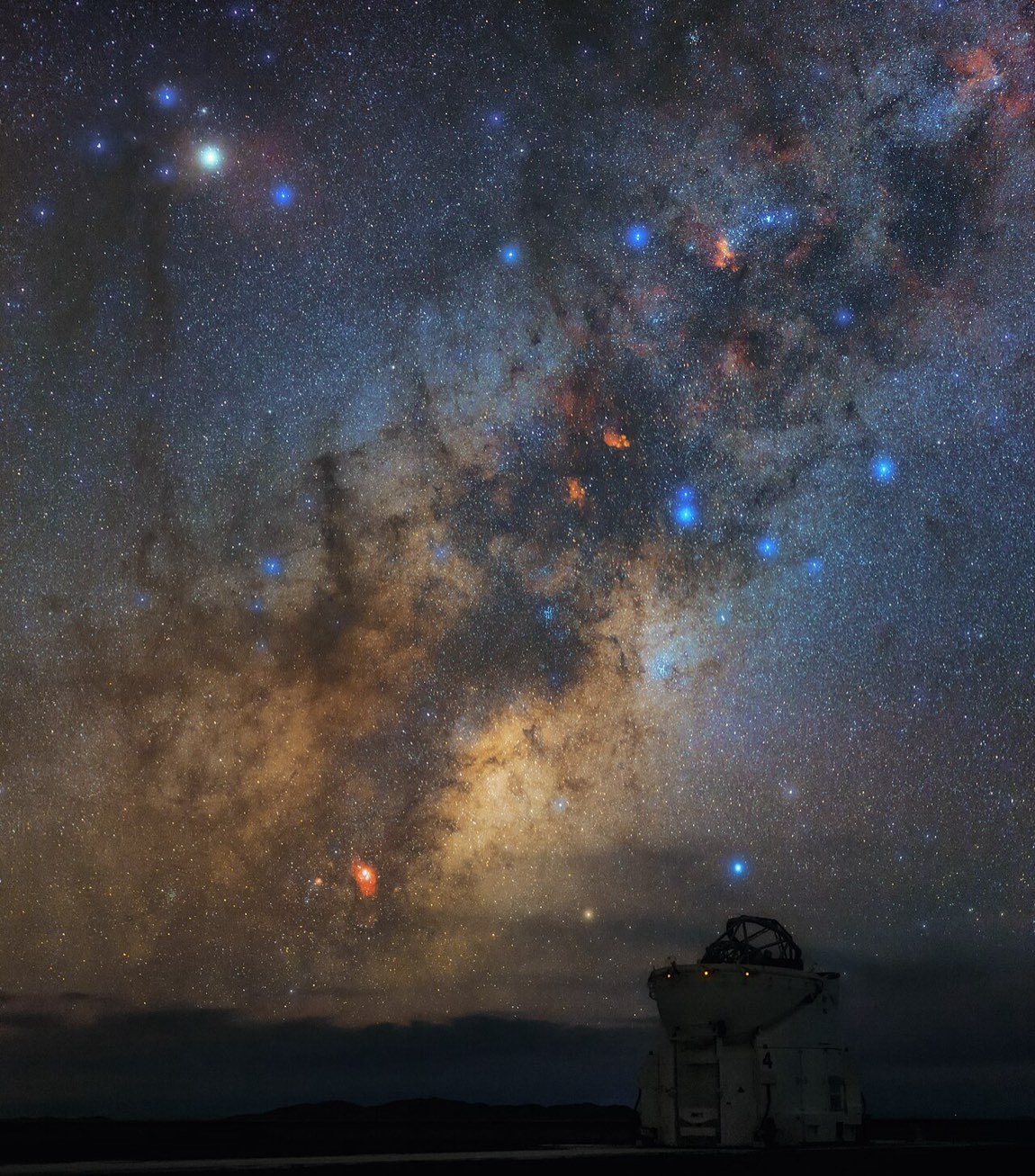
 Photograph · Judy Schmidt from Fresh Meadows, NY, USA · CC BY 2.0
Star · Deep guide
Antares
The Scorpion's burning heart is a red supergiant named 'rival of Mars'.
What is it?
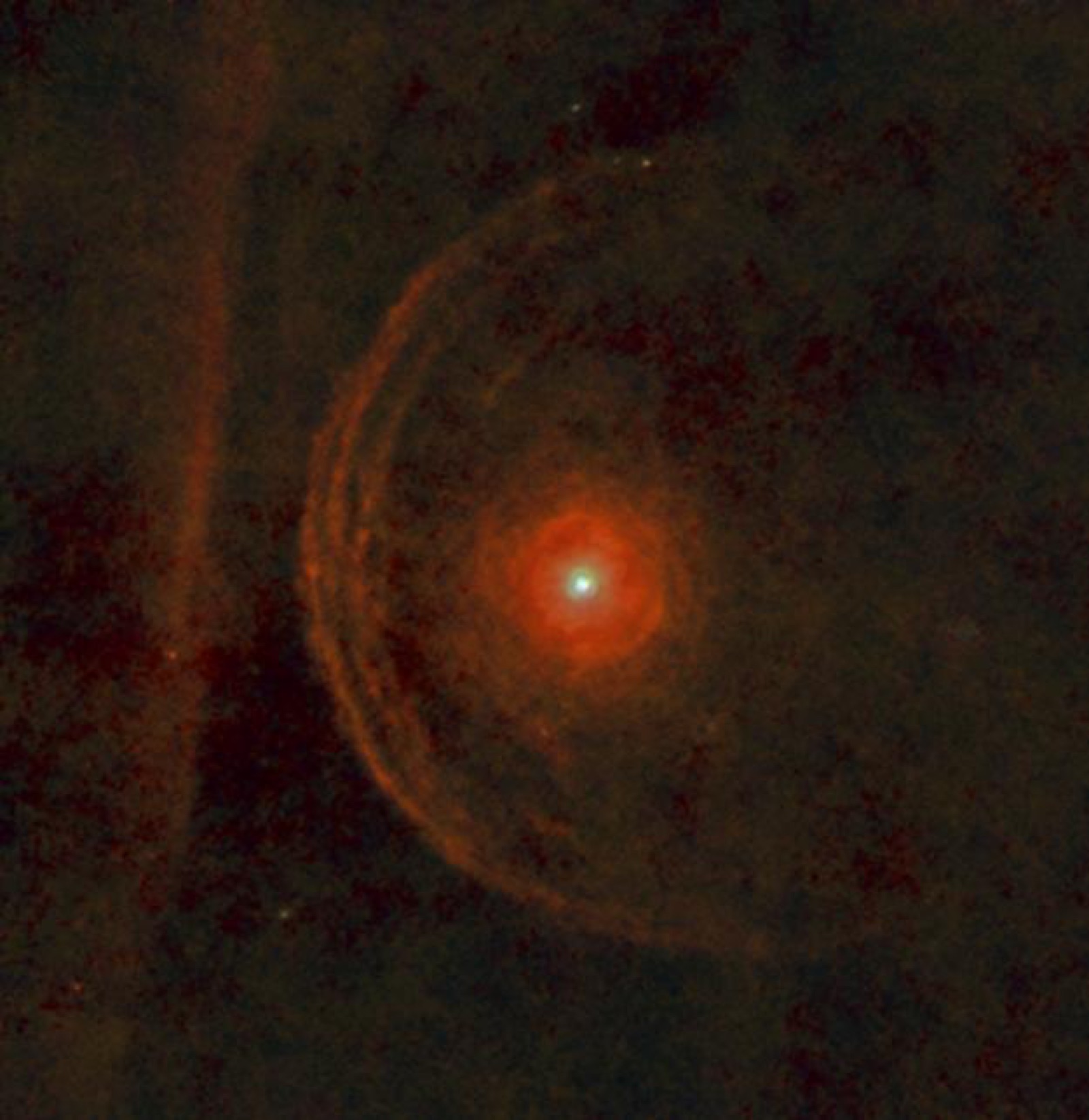
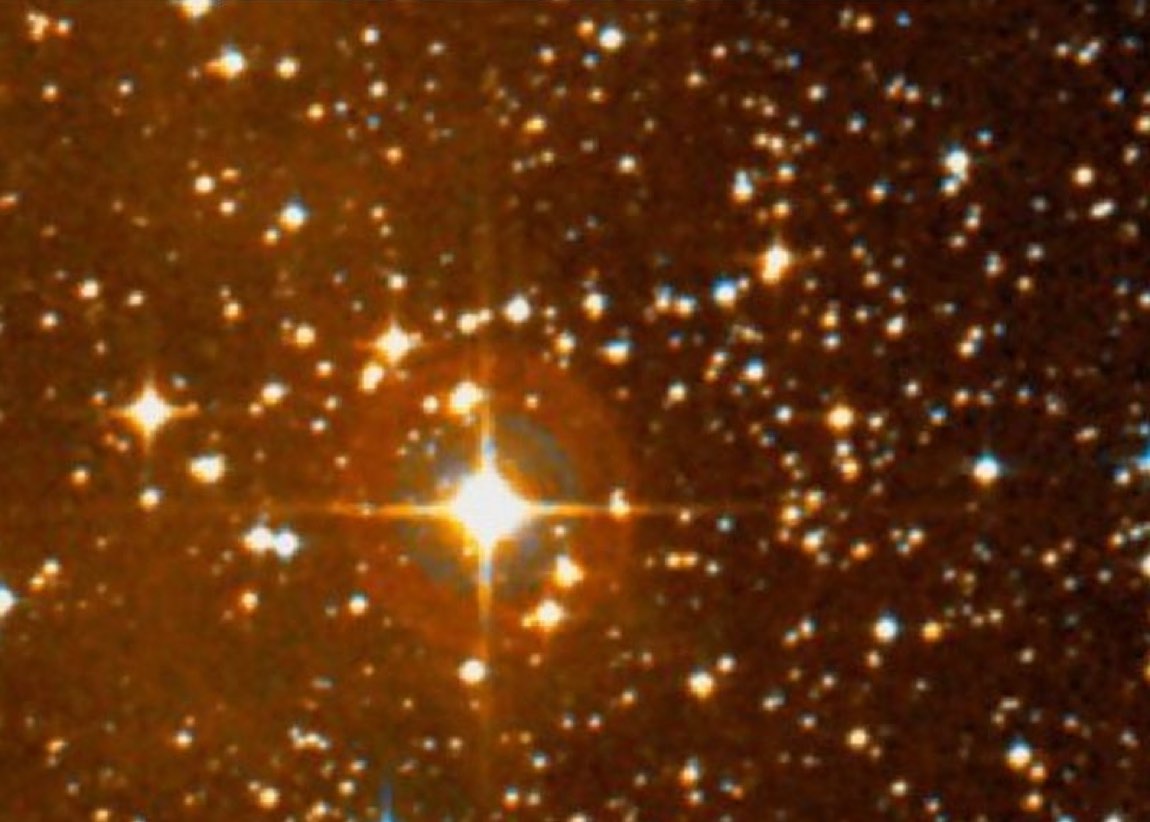
Antares glows deep orange-red at the heart of Scorpius, so like Mars in color that its Greek name means the planet's rival. It is a red supergiant around 550 light-years away, roughly 680 times the Sun's radius — swap it for the Sun and its surface would reach past Mars. A hot blue companion star orbits inside its outer haze.
The deep dive
Researched for the Atlas from Wikipedia — Antares (16,716 characters read) · updated Sep 20, 2026
01 A Name Born from Rivalry with Mars
The name Antares comes from the Ancient Greek Ἀντάρης, meaning "rival to Ares" — or more bluntly, "not Ares" — because its deep reddish hue so closely mimics the appearance of the planet Mars. For centuries it was assumed this comparison originated with early Mesopotamian astronomers, but that idea is now considered an outdated speculation. In Babylonian star catalogues dating to at least 1100 BCE, the star was called GABA GIR.TAB, meaning "the Breast of the Scorpion," and was associated with the goddess Lisin, not with any rivalry with a planet. The Greek name is well attested in Ptolemy's Almagest and Tetrabiblos. One intriguing alternative theory links the name to Antarah ibn Shaddad, the Arab warrior-hero celebrated in pre-Islamic poetry, but scholars consider this unproven given that the Greek name is already confirmed earlier. In 2016 the International Astronomical Union formally approved "Antares" as the standardised proper name specifically for the component α Scorpii A, entering it in the IAU Catalog of Star Names.
02 Antares Across Ancient Cultures
Few stars have accumulated as rich a mythological portfolio as Antares. In ancient Mesopotamia it carried at least six recorded names, including Bilu-sha-ziri ("the Lord of the Seed"), Kak-shisa ("the Creator of Prosperity"), and Kakkab Bir ("the Vermilion Star"). In ancient Egypt it represented the scorpion goddess Serket and was a symbol of Isis in pyramidal ceremonies, called ṯms n ẖntt — "the red one of the prow." Persian astronomers ranked it among the four royal stars of the sky. In India, grouped with σ Scorpii and τ Scorpii, it formed the nakshatra Jyeshthā, meaning "the eldest or biggest." The ancient Chinese called it 心宿二 (Xīnxiù'èr), "second star of the Heart," made it the national star of the Shang dynasty, and nicknamed it Huǒxīng, "fiery star," for its colour. The Māori of New Zealand know it as Rēhua, chief of all stars, and consider it the father of Puanga (Rigel). Aboriginal Australians of the Wotjobaluk people called it Djuit, son of Marpean-kurrk (Arcturus), with flanking stars representing his wives. In 2018 research confirmed that Ngarrindjeri Aboriginal people from South Australia observed Antares's variability and encoded it in oral traditions as Waiyungari, meaning "red man."
03 A Star That Pulses and Wanders in Brightness
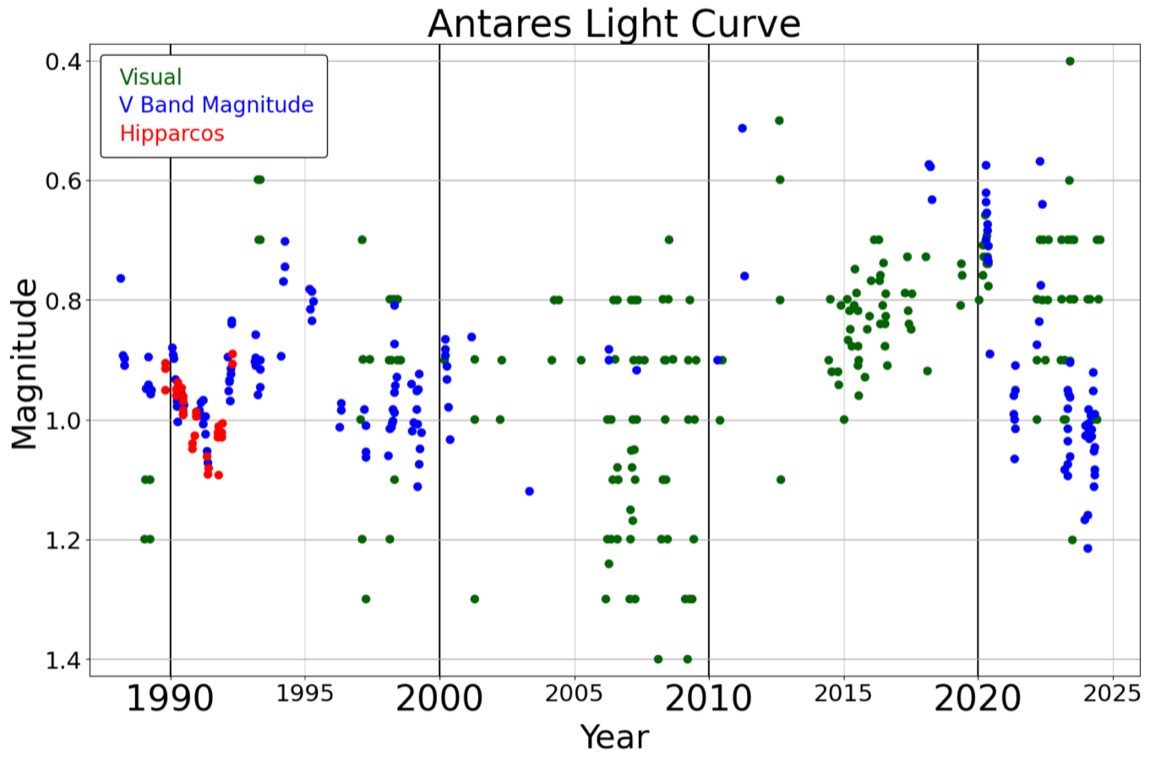
Antares is classified as an LC slow irregular variable star, meaning its brightness changes without a clean, predictable rhythm. Its apparent visual magnitude wanders between extremes of +0.6 and +1.6, though it hovers near +1.0 most of the time. This makes it, on average, the fifteenth-brightest star in the night sky, but not always by the same margin. The American Association of Variable Star Observers has been monitoring this behaviour since 1945. Although no single obvious period emerges, statistical analyses of the data have suggested possible periods of 1,733 days or 1,650 ± 640 days — both in the range of several years. No separate long secondary period has been detected, though astronomers have noted that primary periods longer than a thousand days may be analogous to the long secondary periods seen in other variable stars. Beneath this irregular brightness variation lies a physical pulsation: Antares's radius itself changes by 19%, and its surface temperature shifts by 150 K, with the temperature changes lagging about 70 days behind the radial velocity changes that the pulsations produce.
04 How Astronomers Measure a Star This Huge Deeper
Measuring the diameter of a star 550 light-years away is genuinely difficult, and Antares illustrates both the power and the pitfalls of the techniques involved. The two main approaches are interferometry — combining light from multiple telescopes to synthesise a view of the stellar disc — and timing lunar occultations, when the Moon's edge precisely covers the star. Occultation measurements have yielded an apparent angular diameter of 41.3 ± 0.1 milliarcseconds, while interferometry in 2009 gave a limb-darkened disc diameter of 37.38 ± 0.06 milliarcseconds and in 2010, 37.31 ± 0.09 milliarcseconds. Converting an angular diameter to a physical radius also requires knowing the distance accurately, and Antares's parallax measurement from the Hipparcos satellite — 5.89 ± 1.00 milliarcseconds — carries large uncertainties because the star's extended, translucent atmosphere confuses the measurement. Early interferometry by Francis G. Pease at Mount Wilson Observatory in 1925 produced a diameter of 640 to 690 million kilometres, making Antares the largest star then known. Older radius estimates exceeded 850 R☉, but those measurements were likely distorted by atmospheric asymmetry and the particular infrared wavelengths used, which happen to coincide with strong emission from Antares's extended shell. Current estimates based on Hipparcos parallax and modern angular diameters converge on a radius of about 680 R☉.
 ⤢
⤢
05 The Companion Star Hidden in the Glare
Antares looks like a single point of light to the naked eye, but it is actually a binary system. The companion, α Scorpii B, is a blue-white main-sequence star of spectral type B2.5V with an apparent magnitude of 5.5 — easily visible in its own right if it were isolated, but overwhelmed by Antares's brilliance. The companion has an estimated mass of about 7 M☉, a temperature around 18,500 K, and a radius of about 5 R☉. Because it falls below the mass threshold needed to explode as a supernova, its eventual fate is expansion into a red giant followed by death as a massive white dwarf, similar to Sirius B. Spotting Antares B through a telescope is genuinely challenging: apertures of over 150 millimetres (5.9 inches) are generally required, and even then it is usually described as appearing green — most likely a contrast effect against the vivid orange-red of Antares itself, or a blending artefact when the two stars are nearly unresolved. The clearest views come during lunar occultations, when the Moon briefly hides Antares and the companion is momentarily visible alone, appearing a "profound blue or bluish-green."
06 An Uncertain Orbit Spanning Centuries Deeper
The two stars of the Antares system are separated by a projected distance of about 529 AU — roughly 80 billion kilometres, or more than thirteen times the distance between the Sun and Neptune. Spectroscopic analysis of matter flowing from Antares B suggests the companion lies more than 220 AU beyond the primary, giving a line-of-sight separation of at least 33 billion kilometres. Despite more than a century and a half of measurements, the orbital parameters remain poorly constrained. The best calculated orbit — itself considered unreliable — describes an almost circular path seen nearly edge-on, with a period of 1,218 years and a semi-major axis of about 2.9 arcseconds. Other recent period estimates range from 880 years (a calculated orbital fit) to 2,562 years (a simple Kepler's Law estimate). Early observations in 1847–49 placed the stars about 3.5 arcseconds apart; modern measurements consistently show separations of 2.6 to 2.8 arcseconds. Astronomers note that the apparent changes in separation are more likely the result of observational inaccuracies than actual orbital motion, which underscores just how little the stars appear to have moved relative to each other in recorded history.
07 Antares and the Rho Ophiuchi Nebula
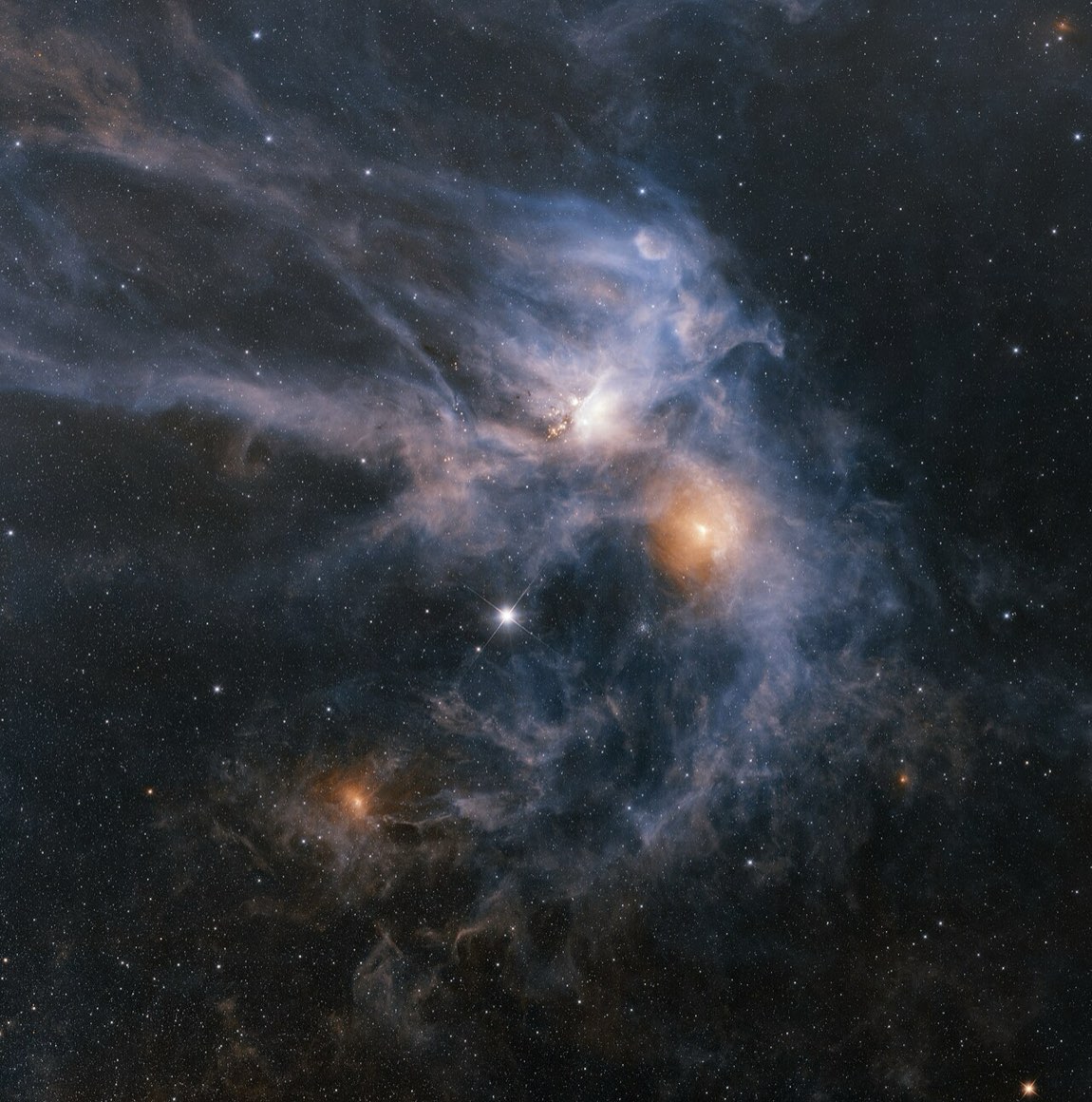
Antares is a member of the Upper Scorpius subgroup of the Scorpius–Centaurus association — the nearest OB association to the Sun — a loose family of thousands of hot, young stars with a mean age of about 11 million years. Antares sits at the rim of this subgroup, at a distance of roughly 170 parsecs (550 light-years). Looking toward Antares from Earth, the famous Rho Ophiuchi cloud complex sits in the foreground, and Antares is the dominant light source illuminating it. The portion of the cloud lit up by Antares is sometimes called the Antares Nebula, or catalogued as VdB 107. This reflection nebula glows with the reddish hue characteristic of its illuminating star and forms part of one of the most photographed regions of the entire night sky. The surrounding stellar neighbourhood itself is young by cosmic standards — Antares, at an estimated age of 11 to 17 million years depending on the method used, is the most evolved and by far the most massive and luminous member of its local stellar family.
08 The Discovery of a Stellar Companion Deeper
The history of identifying Antares as a binary system stretches across three decades of nineteenth-century astronomy. The companion star was first reported by Johann Tobias Bürg during an occultation observed on April 13, 1819, but the claim was not widely accepted and was dismissed at the time as a possible atmospheric effect. The next significant observation came from Scottish astronomer James William Grant FRSE, who observed the companion while stationed in India on July 23, 1844. Ormsby M. Mitchel independently rediscovered it in 1846, and William Rutter Dawes made careful measurements in April 1847. Even before the companion was well established, astronomers in the early twentieth century noticed something odd in the spectrum of Antares: radial velocity variations that at first seemed to suggest orbital motion. It eventually became clear that these small variations were not caused by a companion at all, but by pulsation of the star's own atmosphere. By 1928 this was well enough understood that calculations were already estimating the star's size must vary by about 20% — a figure remarkably close to the modern measured value of 19%.
 ⤢
⤢
09 When and How to Observe Antares
Antares reaches its best observing conditions around May 31 each year, when it is at opposition to the Sun — rising at dusk and setting at dawn as seen from the equator, and visible throughout the entire night. For observers at mid-northern latitudes, there is a frustrating gap of two to three weeks on either side of November 30 when Antares disappears entirely into the Sun's glare near conjunction. The star never rises at all for anyone north of 64° latitude, which excludes most of Scandinavia, Alaska, and northern Canada. Conversely, the star is circumpolar across the entire continent of Antarctica, never setting for any observer there. The star is distinctly red-orange to the naked eye, and because it sits only 4.57 degrees south of the ecliptic, the Moon regularly passes in front of it. Lunar occultations follow an 18.6-year cycle tied to the lunar nodes; the current cycle of occultations began in 2023. These events are particularly rewarding through a telescope because they allow the companion star, Antares B, to be glimpsed briefly on its own, showing its true blue-green colour against the darkness.
10 A Future Supernova Visible in Daylight
Antares is destined to end its life in a supernova explosion, almost certainly within the next 1.0 to 1.4 million years. When it does, astronomers estimate the explosion could shine as brightly as the full Moon for a period of several months, making it easily visible in broad daylight. The comparison star for this fate is Betelgeuse in Orion, which faces a similar end on a similar timescale. What remains of Antares after the explosion will depend on the mass of its core at the moment of collapse — likely a neutron star or, possibly, a black hole. The runup to this event is already visible in several ways: Antares's companion star, Antares B, shows unusual spectral lines that suggest it has been polluted by matter ejected from the red supergiant, hinting at the scale of mass loss already underway. The bolometric luminosity of Antares — the total energy output across all wavelengths — is around 100,000 times that of the Sun, though estimates published as recently as 2012 and 2013 varied between 75,900 L☉ and 97,700 L☉, reflecting a margin of error of 30% or more that is typical for stars this complex.
11 A Planet Occultation Rarer Than You Think Deeper
Because Antares lies only 4.57 degrees south of the ecliptic, it can in principle be occulted by planets as well as the Moon. In practice, planetary occultations of Antares are extraordinarily rare. The last time Venus passed directly in front of Antares was September 17, 525 BC — more than 2,500 years ago. The next such event will not occur until November 17, 2400. Calculations show that other planets have not occulted Antares over the past millennium and will not do so in the next millennium, because most planets orbit close enough to the ecliptic that they pass just north of Antares's position. Venus will, however, come extremely close to Antares on October 19, 2117, and will continue making near-passes south of the star every eight years through to October 29, 2157. Every year around December 2, the Sun itself passes 5° north of Antares. These precise celestial mechanics were significant historically: the timing of such events was used by ancient astronomers across multiple cultures to anchor their calendars and star catalogues, which is part of why Antares appears in so many ancient astronomical records.
12 Antares in Modern Flags and Popular Culture
Antares has left its mark on the modern world well beyond astronomy. It appears on the flag of Brazil, which displays 27 stars representing the country's federated units; Antares specifically represents the state of Piauí. The star was also chosen as the name for a 1995 Oldsmobile concept car, the Antares. In the realm of medieval European astrology, Antares was counted among the Behenian fixed stars — a set of fifteen stars considered especially significant for astrological and magical purposes. Its deep cultural weight stretches from ancient Babylon to the Marshall Islands, where it forms part of an asterism called Tūṃur with σ and τ Scorpii, identified as the first of the ten sons of Lōktañūr (Capella). In Hawaii it carries the name Lehua-kona, meaning "southern lehua blossom," though the alternative name Hōkūʻula simply means "red star" and is sometimes applied to Aldebaran or Mars as well. The fact that a single star has gathered distinct names, mythological roles, and symbolic meanings across so many unconnected civilisations is itself a testament to how conspicuously it dominates its corner of the sky.
 ⤢
⤢