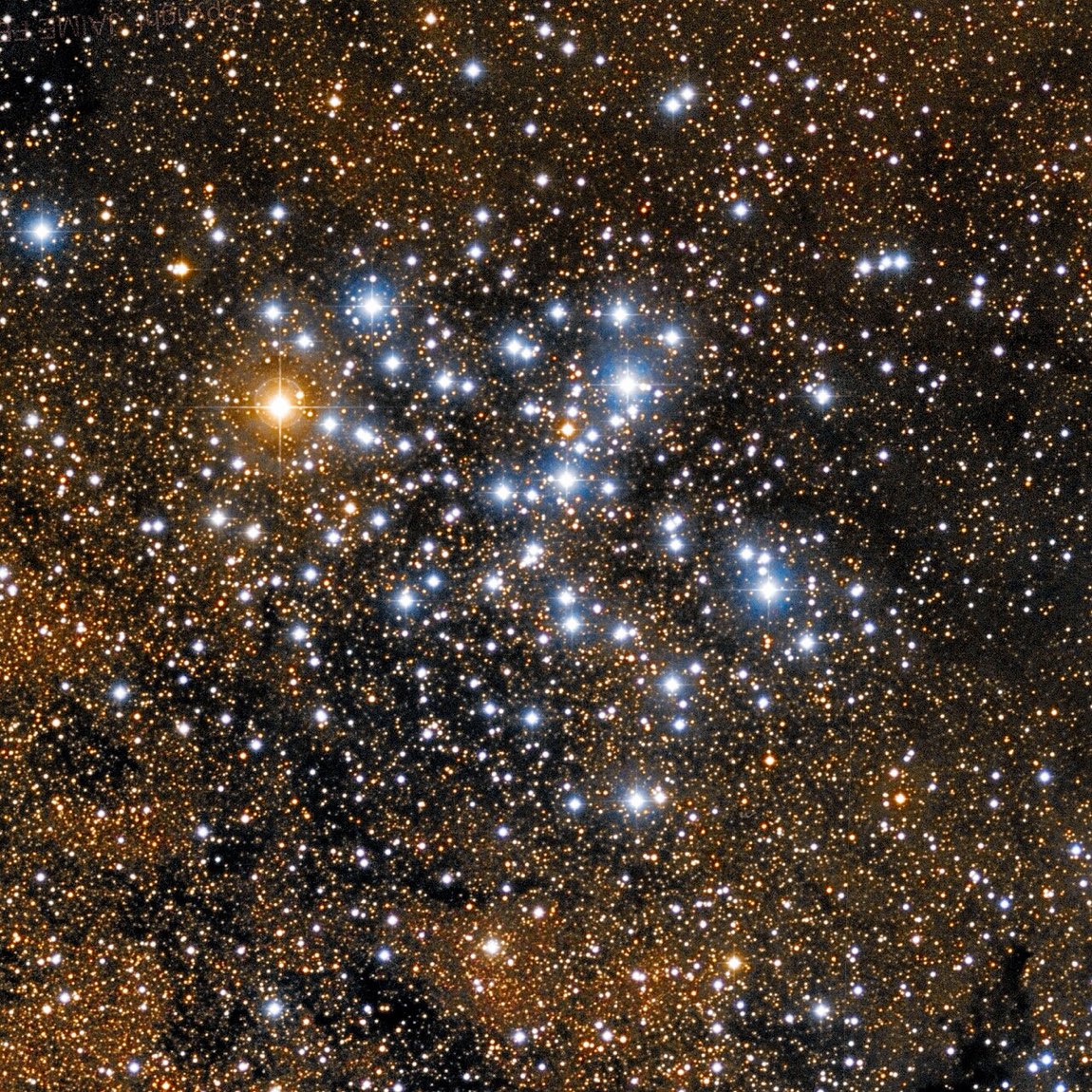
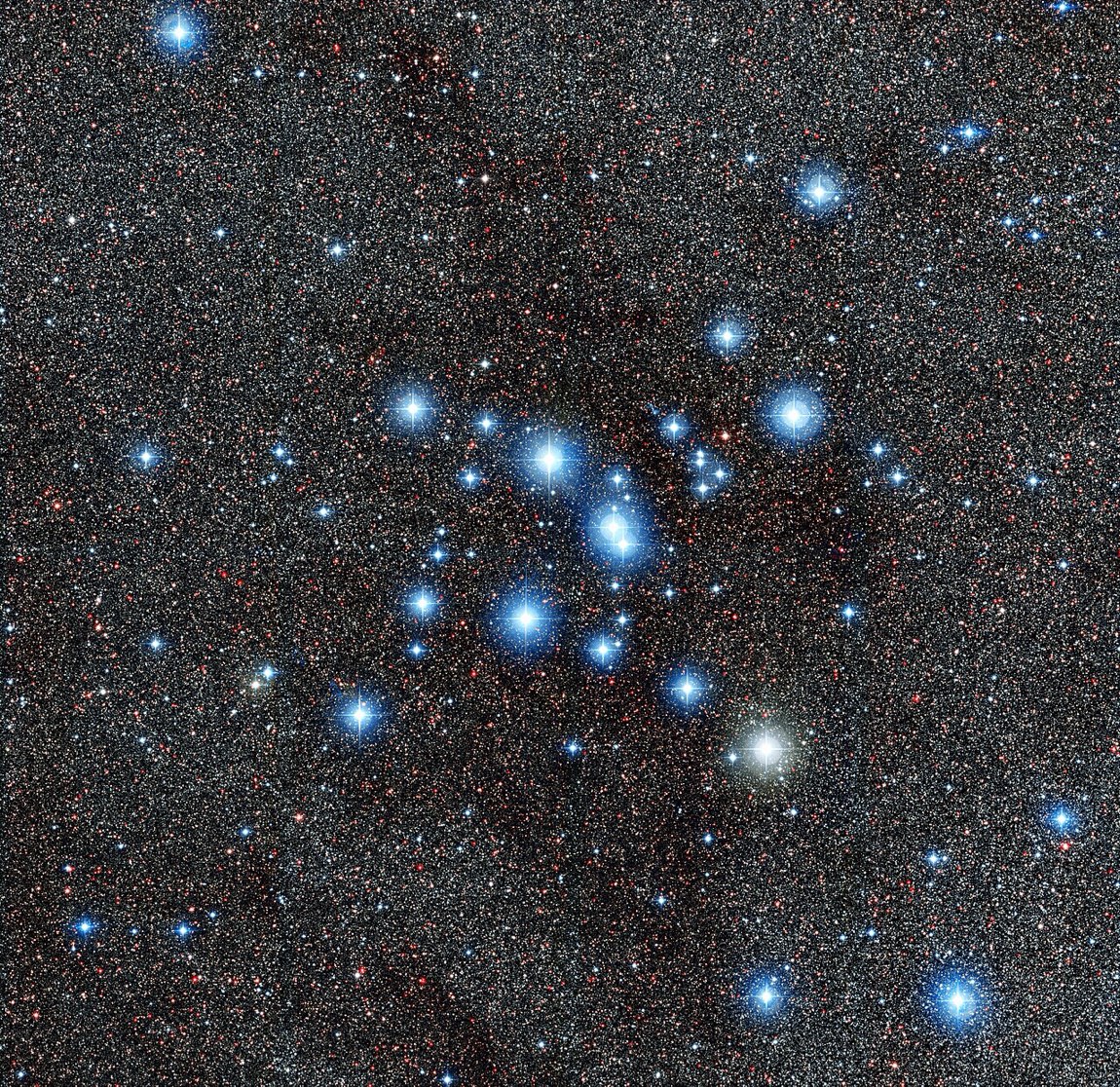
 Photograph · Credit: ESO · CC BY 3.0
Star Cluster · Deep guide
Messier 7 (Ptolemy Cluster)
Also called: M7 · NGC 6475 · Ptolemy Cluster · Ptolemy's Cluster
A naked-eye star cluster near Scorpius's stinger, noted by Ptolemy almost two thousand years ago.
What is it?
Messier 7 is a bright open cluster in Scorpius, easy to see with the naked eye close to the scorpion's curled stinger. It is often called Ptolemy's Cluster because the 2nd-century astronomer Ptolemy described it. At a declination of −34.8°, it is the southernmost object in Messier's catalogue. The cluster sits about 980 light-years away, spans about 80 arcminutes of sky, and its stars are roughly 200 million years old.
The deep dive
Researched for the Atlas from Wikipedia — Messier 7 (2,509 characters read) · updated Nov 15, 2026
01 Seen by ancient eyes for two millennia
Messier 7 holds one of the longest documented observation records of any object in the night sky. The Greek-Roman astronomer Ptolemy was the first to write it down, describing it as a nebula in 130 AD — nearly 1,900 years before modern astrophysics could explain what a nebula actually was. That a naked-eye cluster could be mistaken for a fuzzy cloud is a reminder of how limited pre-telescopic astronomy was, even at its finest. Centuries later, Italian astronomer Giovanni Batista Hodierna turned an early telescope on the cluster before 1654 and counted 30 individual stars within it. When Charles Messier catalogued it in 1764 as the seventh entry in his famous list of comet-like objects, he was simply continuing a tradition of attention that stretches back to classical antiquity. English astronomer John Herschel later described it in characteristically blunt terms as a 'coarsely scattered cluster of stars,' a phrase that captures its loose, sprawling appearance well. In Chinese astronomical tradition, the cluster carries the poetic name Yú, meaning the Fish.
02 The southernmost object in Messier's catalog
Of all 110 objects Charles Messier catalogued, M7 sits furthest south in the sky. Its declination of −34.8° places it deep in the southern celestial hemisphere, close to the curving 'stinger' at the tail end of Scorpius. That position has real practical consequences for observers: anyone north of roughly 55° latitude — covering most of Canada, Scandinavia, and Russia — will struggle to see it at all, because it barely clears the horizon. For observers in the southern United States, southern Europe, or anywhere in the Southern Hemisphere, however, it is a showpiece. The cluster sits in one of the richest fields of the Milky Way, with the star clouds of the galactic center providing a dense and dramatic backdrop. The combination of its southerly declination and its placement near Scorpius means that for northern observers it is best viewed during summer evenings, when Scorpius rides as high as it ever will above the southern horizon.
03 Size and mass: how big is this swarm? Deeper
Telescopic observations reveal around 80 stars within a field of view 1.3° across — that angular width is more than twice the diameter of a full Moon. At M7's estimated distance of 980 light-years, that apparent span translates to a true diameter of 25 light-years. To put that in perspective, the nearest star to our Sun is about 4 light-years away, so the cluster's core would comfortably contain roughly six such interstellar gaps side by side. The cluster's tidal radius — the distance at which a star can still be considered gravitationally bound to the group rather than pulled away by the Milky Way's own gravity — extends further still, to 40.1 light-years, or 12.3 parsecs. The combined mass of M7 is estimated at around 735 times the mass of the Sun. That sounds large, but spread across 25 light-years it represents a remarkably low-density environment compared to a globular cluster, which is why stars here are loosely scattered rather than packed together.
04 A young cluster by cosmic standards
At around 200 million years old, Messier 7 is genuinely young on the timescale of the universe. Earth itself is roughly 23 times older. When M7's stars first ignited, the age of dinosaurs was just beginning on our planet — the Triassic period had recently opened. Open clusters like M7 do not last forever; the gravitational pull of giant molecular clouds and the tidal forces of the Milky Way gradually strip member stars away over hundreds of millions to billions of years. M7 is already old enough that its most massive, shortest-lived stars have burned out and left the main sequence. The article notes that all stars brighter than about 8th magnitude have already evolved away from the main sequence, with the brightest surviving main-sequence stars sitting around spectral class A0 — hot, white stars several times more massive than the Sun. The brightest individual member star reaches a magnitude of 5.6, meaning it is just barely visible to the naked eye on its own.
05 Chemical fingerprint similar to our own Sun Deeper
One of the more quietly significant facts about M7 is its chemical composition. The cluster contains a similar abundance of elements heavier than hydrogen and helium — astronomers call this the metallicity — as the Sun. This matters because metallicity is a tracer of where and when a star formed in the history of the galaxy. Stars born earlier in galactic history, when fewer generations of supernovae had seeded the interstellar medium with heavy elements, tend to be metal-poor. The fact that M7's metallicity matches the Sun's suggests it formed from interstellar gas that had already been enriched by previous stellar generations to roughly the same degree as the solar neighborhood. It is a point of chemical kinship between this cluster and our own star, even though M7 sits nearly 1,000 light-years away. This similarity also implies that the planet-forming potential around M7's stars, in principle, would not be radically different from conditions around solar-type stars elsewhere in the galaxy.
06 More than a thousand members spread wide Deeper
The figure of 80 stars visible in a 1.3° telescopic field gives an incomplete picture of how populous M7 actually is. The cluster contains over a thousand likely member stars spread across several degrees of sky. The difference between what a telescope easily resolves in a compact field and the full stellar census underscores how spread out and gravitationally loose the cluster is. Membership in an open cluster is not always obvious; astronomers assign probability values based on a star's motion through space, its distance, and other properties. The brightest stars listed with a membership probability higher than 75 percent represent the high-confidence population. With over a thousand probable members in total, M7 qualifies as a substantial open cluster, though many of those members are faint stars well below the reach of a small backyard telescope. Observers scanning the cluster visually will count dozens of bright points, but the full family stretches far beyond that bright, coarse core.
07 New Horizons used M7 to test its eye
On August 29, 2006, Messier 7 had a moment in space-exploration history. NASA's New Horizons spacecraft — launched earlier that year on its journey to Pluto — needed to test the Long Range Reconnaissance Imager, known as LORRI. Engineers chose M7 as the target for LORRI's first-light image, the very first picture the instrument ever took in space. First-light images are significant milestones for any telescope or camera; they confirm that the optics survived launch, that the detector is functioning, and that the instrument is correctly aligned. M7's combination of bright, well-separated stars and known positions made it an ideal calibration target. The choice also reflects a recurring theme in the cluster's history: objects that have drawn human eyes for nearly two thousand years keep finding new roles as astronomy advances. From Ptolemy's naked-eye note in 130 AD to a spacecraft camera test in 2006, M7 has served as a benchmark for what observers — whether ancient scholars or modern engineers — want to verify their instruments can see.
08 Why Hubble has never photographed it
As of January 2022, Messier 7 remained one of the few Messier objects never photographed by the Hubble Space Telescope, and the reason reveals something important about the mismatch between Hubble's design and sprawling nearby objects. Hubble's field of view is very small — it was built to peer at faint, distant, compact targets. M7 spans several degrees of sky. Capturing it properly would require an enormous number of individual pointings and exposures. To put the challenge in scale, Hubble's famous panoramic image of the Andromeda Galaxy — which covers less than half of that nearby galaxy — required approximately 400 individual telescope movements and 7,400 separate exposures. M7 is even larger in angular size than the Andromeda mosaic. The practical implication is that Hubble's time and resources are simply better spent elsewhere. This is not a scientific slight; it reflects the fact that M7 is bright, close, and easily studied from the ground. It is the distant, faint universe where Hubble's small field and sharp optics give it an irreplaceable advantage.
09 How to find and observe M7 yourself
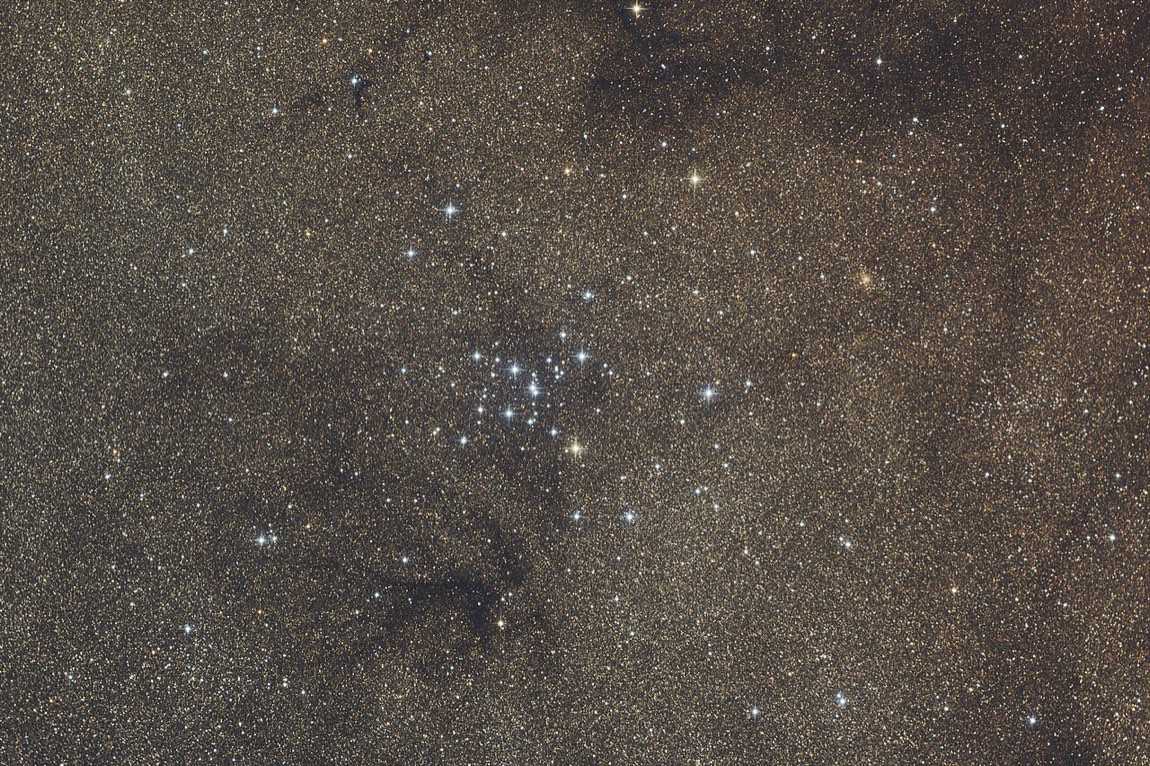
Messier 7 is one of the genuinely easy targets in amateur astronomy, requiring no equipment at all to detect. It is visible to the naked eye close to the stinger of Scorpius, the curved tail of the scorpion figure in the southern sky. Under dark skies it appears as a bright, misty knot against the dense star fields of the Milky Way. Binoculars immediately resolve it into dozens of individual stars scattered across a generous patch of sky. A small telescope at low magnification gives perhaps the best view, revealing the cluster's coarse, open texture that John Herschel noted so plainly — it really does look loosely thrown together rather than tightly packed. Because the cluster spans 1.3° in a telescope's field of view, higher magnifications actually hurt the experience by cutting off the outer stars. Observers in the Northern Hemisphere should look for M7 during summer evenings when Scorpius climbs to its highest point in the south. Those at latitudes below about 35° north will have the best views, with the cluster reaching a reasonable altitude above the murky, light-polluted air near the horizon.
10 Open clusters and the fate of M7's stars Deeper
Open clusters are inherently temporary structures in the galaxy. Unlike the ancient globular clusters that orbit in the galactic halo and can survive for billions of years, open clusters form in the disk of the Milky Way and are subject to constant gravitational harassment. Giant molecular clouds, differential galactic rotation, and the cumulative tug of passing stellar systems all work to gradually unbind a cluster's stars. M7's tidal radius of 40.1 light-years defines the boundary within which the cluster's own gravity can still hold on to its members against the Milky Way's tidal field. Stars that drift beyond that radius are effectively lost to the cluster, joining the general stellar population of the disk. At 200 million years of age, M7 has already lost its most massive stars to stellar evolution, and over future hundreds of millions of years it will slowly bleed away its remaining members. Eventually, the over-a-thousand stars that now travel together will disperse into the galaxy with no memory of their shared origin except for a common chemical composition and similar velocities.
 ⤢