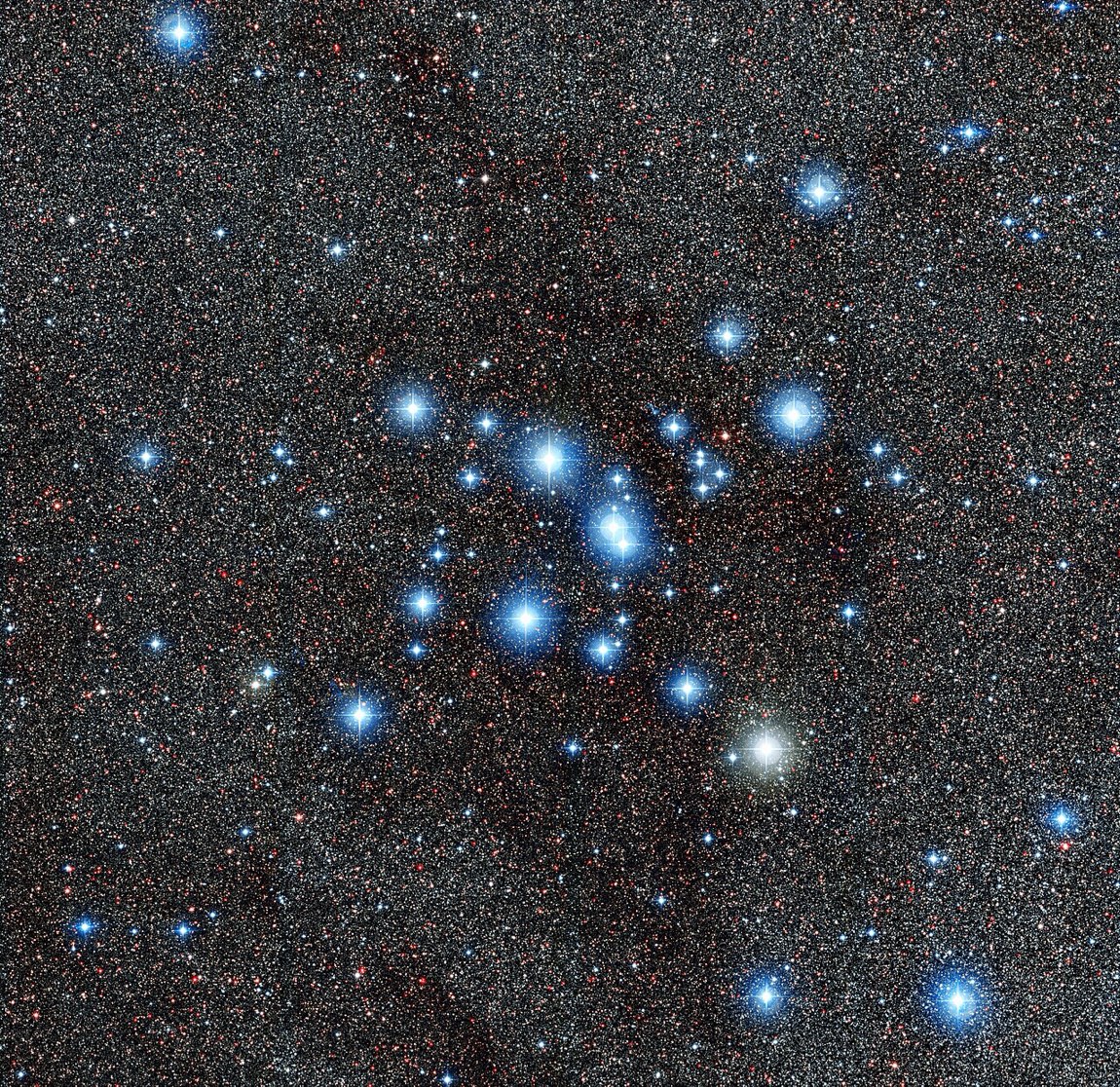
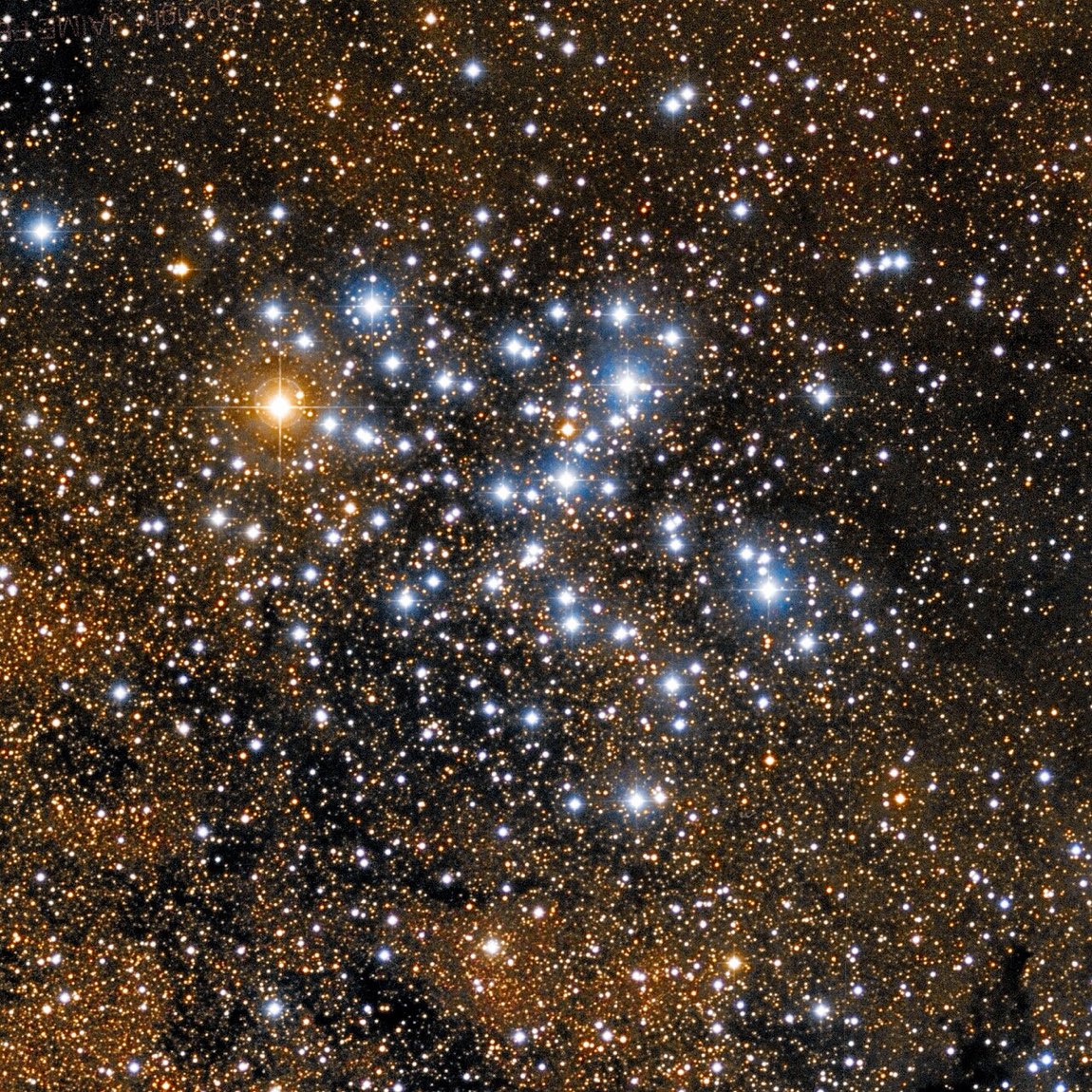
 Photograph · Giuseppe Donatiello from Oria (Brindisi), Italy · CC0
Star Cluster · Deep guide
The Butterfly Cluster (Messier 6)
Also called: M6 · Messier 6 · NGC 6405
A young open cluster in Scorpius whose stars trace the shape of a butterfly's wings.
What is it?
The Butterfly Cluster is an open cluster in Scorpius named for its outline, which resembles a butterfly with spread wings. Giovanni Battista Hodierna recorded it in 1654, and Charles Messier added it to his catalogue in 1764. It lies roughly 1,600 light-years away and is about 94 million years old. Most of its bright members are hot blue B-type stars, but its brightest star, the orange giant BM Scorpii, stands out in contrast. Around 120 stars are considered likely members.
The deep dive
Researched for the Atlas from Wikipedia — Butterfly Cluster (1,917 characters read) · updated Nov 15, 2026
01 A butterfly drawn in blue starlight
The Butterfly Cluster earns its name the honest way: its stars genuinely trace the spread wings of a butterfly when seen through binoculars or a small telescope. That silhouette is not a trick of a single bright star or a stray line — it emerges from the collective arrangement of roughly 120 confirmed member stars spread across about 12 light-years of space. Most of those stars burn with the intense blue-white light of hot B-type stars, so photographs of the cluster glow with a cool, electric blue that makes the wing shape feel almost luminous. The cluster's total visual brightness reaches magnitude 4.2, placing it on the edge of naked-eye visibility from a dark site, though the butterfly outline itself only snaps into focus once optical aid gathers and separates the individual points of light. At that moment, the shape is immediately recognizable — one of the more satisfying pattern-matches in the entire Messier catalog.
02 Three centuries of discovery claims
The Butterfly Cluster has an unusually tangled discovery history. The earliest recorded observation belongs to the Italian astronomer Giovanni Battista Hodierna, who noted it in 1654. Yet researcher Robert Burnham Jr. raised the intriguing possibility that the 2nd-century astronomer Ptolemy might have glimpsed the cluster with the naked eye while studying its neighbor, the Ptolemy Cluster (M7), which sits nearby in Scorpius. That claim remains a proposal rather than a consensus. Official credit for discovery is conventionally awarded to Jean-Philippe Loys de Chéseaux, who cataloged it in 1746 — nearly a century after Hodierna. Charles Messier then independently observed the cluster on May 23, 1764, and secured its place in astronomical history by adding it to his famous catalog. The result is a single object with at least three plausible claimants across more than a thousand years of potential observation, a reminder that the history of astronomy rarely delivers clean, uncontested firsts.
03 One orange star in a crowd of blue
Among the 120 identified members of the Butterfly Cluster, one star stands apart in a dramatic way. BM Scorpii is a K-type orange giant — the brightest single star in the cluster — and in photographs it creates a striking color contrast against the sea of hot blue B-type stars surrounding it. The article's description of this contrast as sharp is no exaggeration; warm orange against cold blue is about as visually opposed as stellar colors get. BM Scorpii adds another layer of interest by being a semiregular variable star, meaning its brightness fluctuates without settling into a perfectly predictable rhythm. It swings between magnitude +5.5 and magnitude +7.0, a range significant enough that careful observers watching the cluster over weeks or months will notice the change. The difference between those two extremes represents a change in perceived brightness by a factor of roughly four, all from a star already embedded in one of the sky's most photogenic clusters.
04 Chemically peculiar stars hiding in the wings Deeper
Beyond BM Scorpii's variability, the Butterfly Cluster harbors eight candidate chemically peculiar stars. This designation in astronomy refers to stars whose surface abundances of certain elements deviate significantly from what standard stellar physics predicts — sometimes dramatically enriched in metals like manganese, mercury, or silicon, or depleted in others. Their origin is debated, but processes like radiative levitation and gravitational settling in stable stellar atmospheres are leading explanations. Finding eight candidates in a single open cluster is scientifically useful because all cluster members share the same age and initial chemical environment, which means researchers can compare peculiar and normal stars while holding those two critical variables constant. The cluster as a whole already shows a slightly higher metallicity than the Sun — meaning a greater abundance of elements heavier than helium — so the peculiar stars stand out against an already metal-enriched backdrop, making the Butterfly Cluster a productive laboratory for studying how and why stellar chemistry diverges during a star's main-sequence lifetime.
05 A young cluster in galactic terms
At an estimated age of 94.2 million years, the Butterfly Cluster is genuinely young by the standards of the cosmos. For comparison, the dinosaurs were wiped from Earth about 66 million years ago, so this cluster is older than that extinction event but still far younger than Earth itself. That youth explains the dominance of hot blue B-type stars in the cluster's membership: these massive, luminous stars burn through their fuel quickly and would already have exploded as supernovae in an older cluster. The fact that so many survive here confirms the cluster has not yet had time to lose them. Youth also means the cluster is still relatively compact and coherent — gravitational interactions with giant molecular clouds and the general tidal forces of the Milky Way have not yet had sufficient time to fully disperse its members into the broader stellar field. Studying clusters at this age gives astronomers a snapshot of stellar evolution at a particularly revealing intermediate stage.
06 Its measured distance and true size Deeper
Pinning down the Butterfly Cluster's distance has required decades of refining measurements. The study by Wu et al. in 2009 placed it at 1,590 light-years from Earth, and from that figure the cluster's physical diameter works out to approximately 12 light-years — a span that, while vast by human standards, is fairly modest for an open cluster. That 12-light-year width means that if you stood at one edge of the cluster, the other edge would be about three times the distance from Earth to Proxima Centauri. The cluster also sits 24.59 ± 0.13 thousand light-years from the Galactic Center, with the small uncertainty in that figure reflecting the precision of modern astrometric data. At present the cluster lies 23 light-years below the galactic plane — a small offset in galactic terms — meaning it has drifted only slightly from the flat disk of the Milky Way where most star formation occurs. These numbers together paint a picture of a compact, well-defined stellar grouping embedded in the outer reaches of the galaxy's star-forming disk.
07 An almost circular orbit around the galaxy Deeper
The Butterfly Cluster is not sitting still in space; it is traveling through the Milky Way on a well-characterized orbit. That orbit has an eccentricity of just 0.03, which is remarkably circular — an eccentricity of 0 would be a perfect circle, while the Earth's orbit around the Sun has an eccentricity of about 0.017 for comparison. The cluster completes one full orbit around the galaxy every 204.2 million years. As it travels, it bobs up and down through the galactic plane, crossing that plane every 29.4 million years. Right now the cluster is 23 light-years below the plane. This vertical oscillation is a common feature of objects embedded in the Milky Way's disk, driven by the gravitational pull of the disk's mass. The near-circular shape of the orbit suggests the cluster formed in a relatively calm part of the galaxy and has not been dramatically perturbed by encounters with massive structures since its birth roughly 94.2 million years ago.
08 How to find and observe the cluster
The Butterfly Cluster lives in the southern constellation of Scorpius, one of the most distinctive and recognizable constellations in the sky. Its total visual magnitude of 4.2 puts it within reach of the naked eye under good dark-sky conditions, but the butterfly shape itself only becomes apparent through binoculars or a small telescope, which reveal the spread of individual stars across about 12 light-years of real space. The cluster sits in a rich region of the Milky Way, so the background is densely scattered with field stars, making the coherent group of the cluster stand out as a distinct concentration. Observers in the northern hemisphere face a challenge: Scorpius rides low on the southern horizon, limiting the window of good viewing. Southern hemisphere observers have a significant advantage, with Scorpius rising high overhead on summer evenings and offering the cluster at its best. Its neighbor M7, the Ptolemy Cluster, lies nearby and makes a natural comparison target in the same field of view.
09 Stars with unusual elemental fingerprints Deeper
The metallicity of the Butterfly Cluster — its overall abundance of elements heavier than helium — is slightly higher than that of the Sun. This matters because metallicity is one of the key parameters astronomers use to trace a star cluster's origin in the galaxy and to understand the chemical evolution of the Milky Way over time. Stars in this cluster formed from a molecular cloud that was already somewhat enriched compared to the solar neighborhood, suggesting the gas from which they condensed had been seeded by multiple earlier generations of stellar nucleosynthesis and supernova ejecta. That enriched starting point then sets the stage for the eight candidate chemically peculiar stars found among the members: they began life with more heavy-element material to work with, and whatever atmospheric processes drive chemical peculiarity had richer raw ingredients. Together, the cluster's bulk metallicity and its chemically peculiar members give researchers two complementary lines of evidence about how elements are distributed, mixed, and segregated inside stars born from the same parent cloud.
10 Stars down to 15th magnitude counted as members
Identifying which stars truly belong to a cluster and which are merely background objects along the same line of sight is one of the persistent challenges of open cluster astronomy. For the Butterfly Cluster, modern analysis has yielded 120 stars identified as most likely members, with the faintest reaching down to visual magnitude 15.1. That is roughly 15,000 times fainter than the dimmest stars a human eye can detect under ideal conditions, so cataloging these members requires telescope imaging and careful statistical comparison of proper motions — the tiny shifts in a star's sky position over time — to separate true cluster residents from coincidental background stars. The fact that the count extends to such faint magnitudes means astronomers are including lower-mass stars well below the sun's luminosity, giving a much more complete census of the cluster's stellar population than early observations could provide. That completeness matters for calculating total cluster mass, understanding its long-term stability, and predicting how it will eventually disperse into the broader Milky Way.
11 Ptolemy's possible ancient sighting
One of the more speculative threads in the Butterfly Cluster's history is the suggestion, raised by researcher Robert Burnham Jr., that the 2nd-century astronomer Claudius Ptolemy may have observed the cluster with the naked eye. The logic rests on the cluster's proximity to M7, which carries the informal name the Ptolemy Cluster precisely because Ptolemy is credited with observing it. The Butterfly Cluster at magnitude 4.2 sits close enough to naked-eye visibility that detecting it while looking toward M7 is physically plausible under dark ancient skies. However, Burnham's proposal remains a suggestion rather than a documented finding — no surviving text explicitly records Ptolemy describing a second cluster at that location. If the idea is correct, it would push the history of observations back by roughly 1,500 years before Hodierna's confirmed 1654 record. As it stands, the story illustrates how difficult it is to reconstruct what ancient astronomers saw when their written records are ambiguous or incomplete.