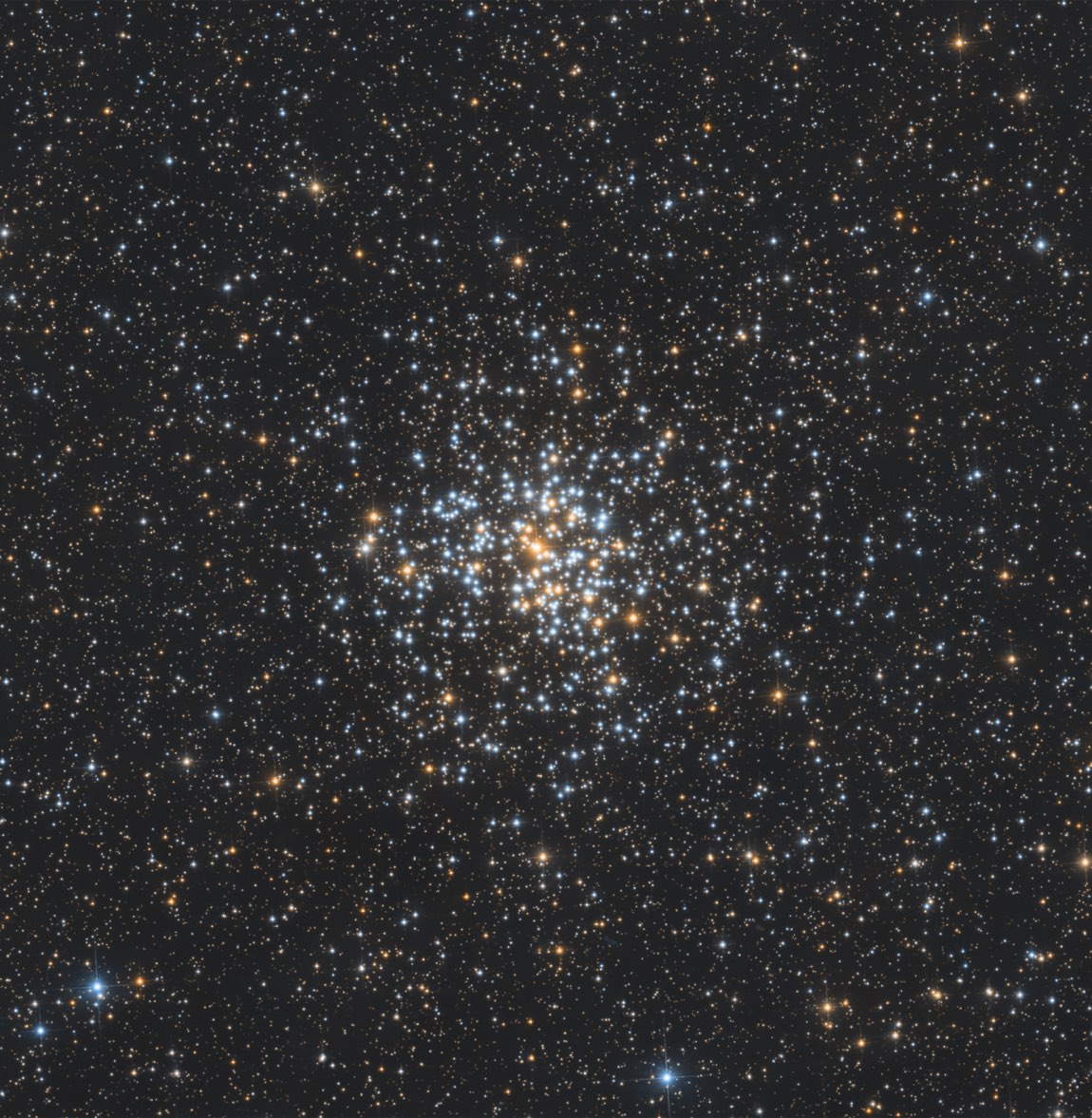
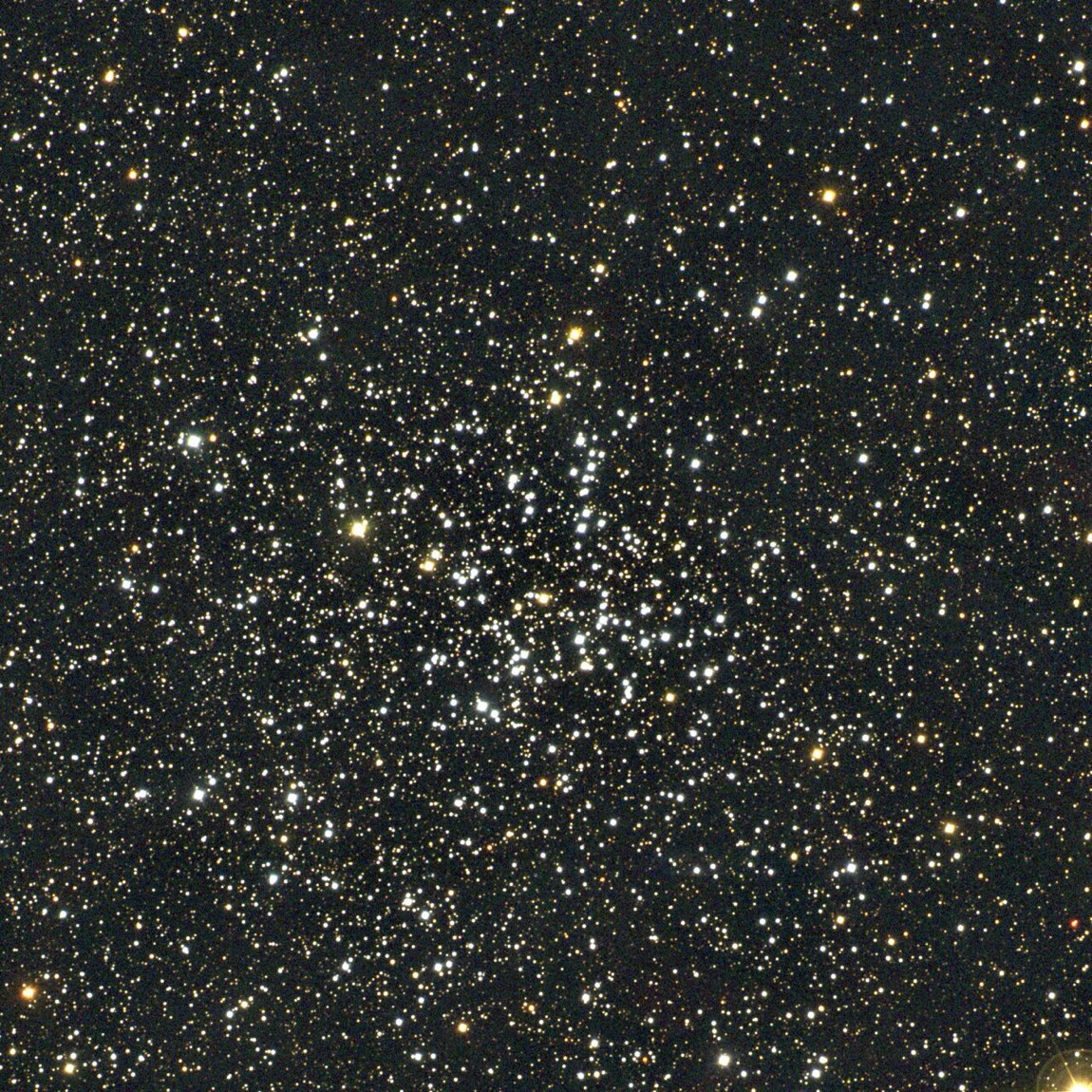
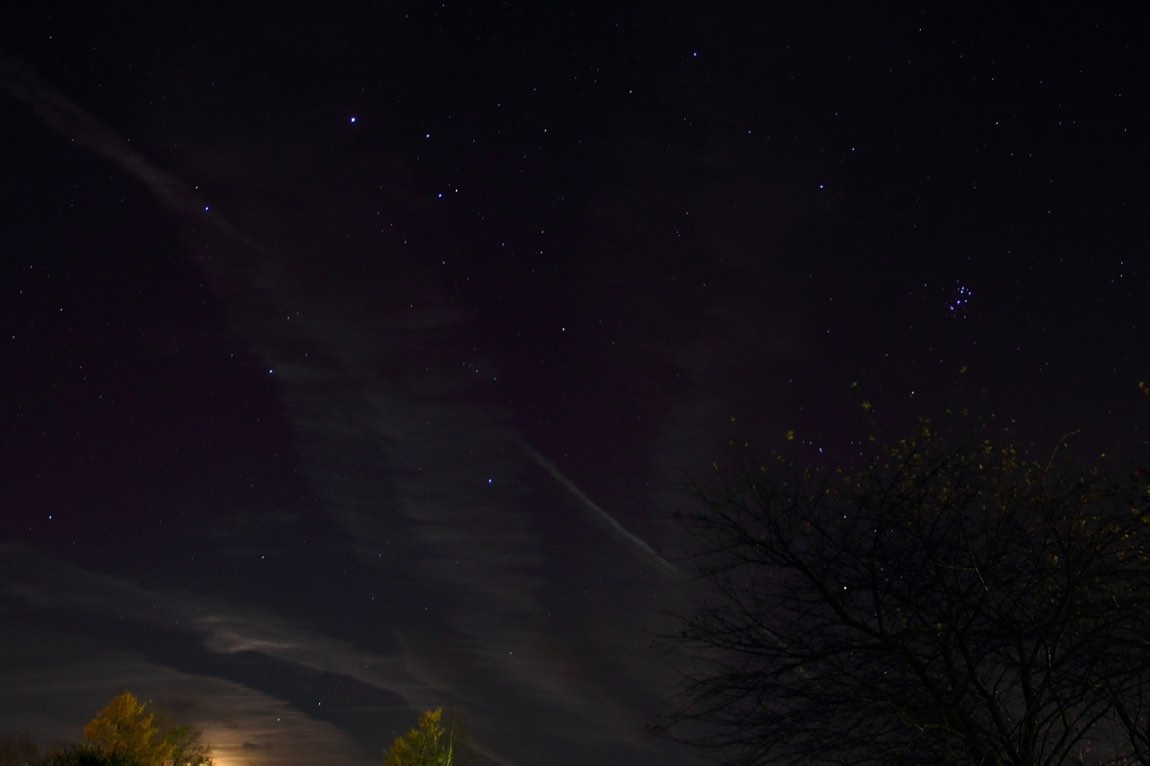
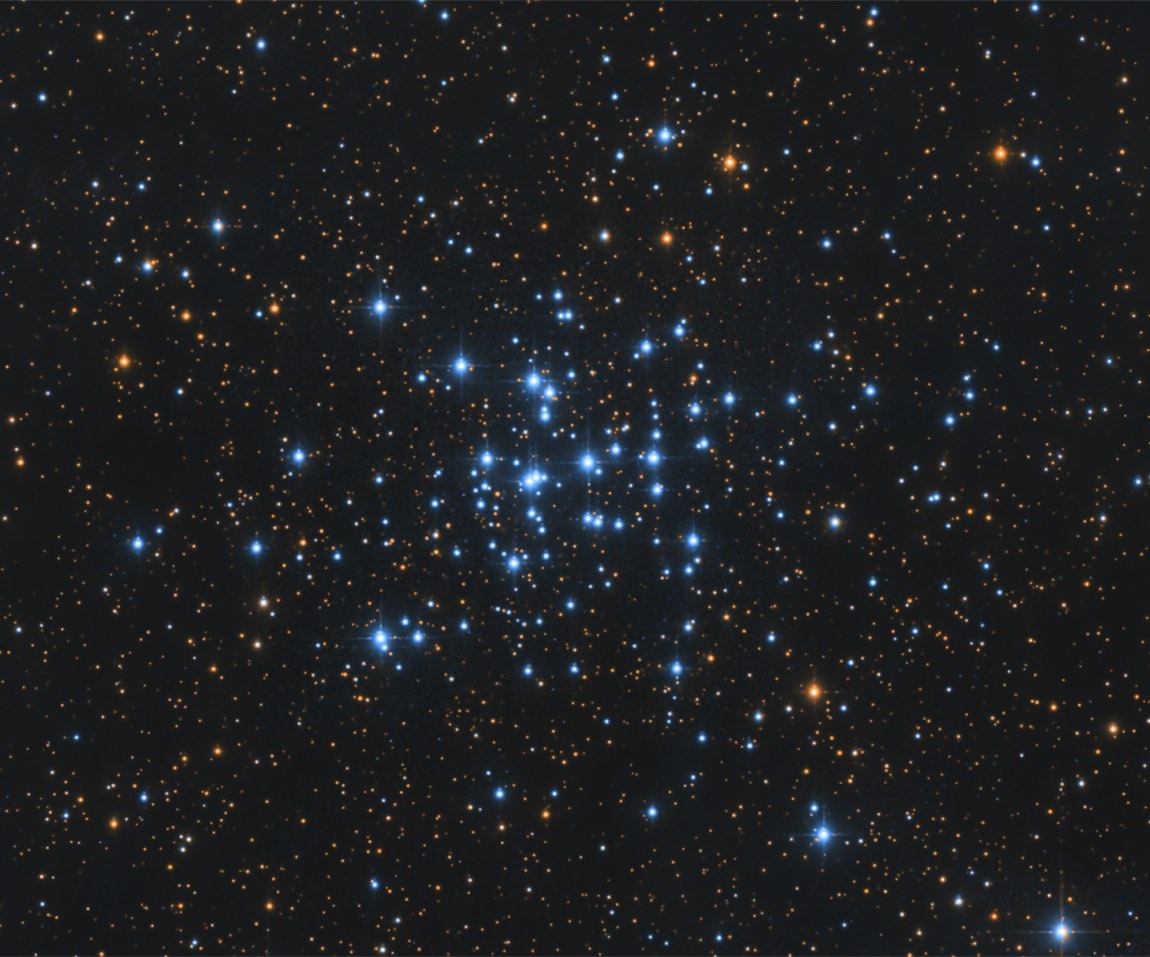
 Photograph · Chuck Ayoub · CC0
Star Cluster · Deep guide
Messier 36 (Pinwheel Cluster)
Also called: M36 · NGC 1960 · Pinwheel Cluster
A young cluster in Auriga that would rival the Pleiades if it were as close.
What is it?
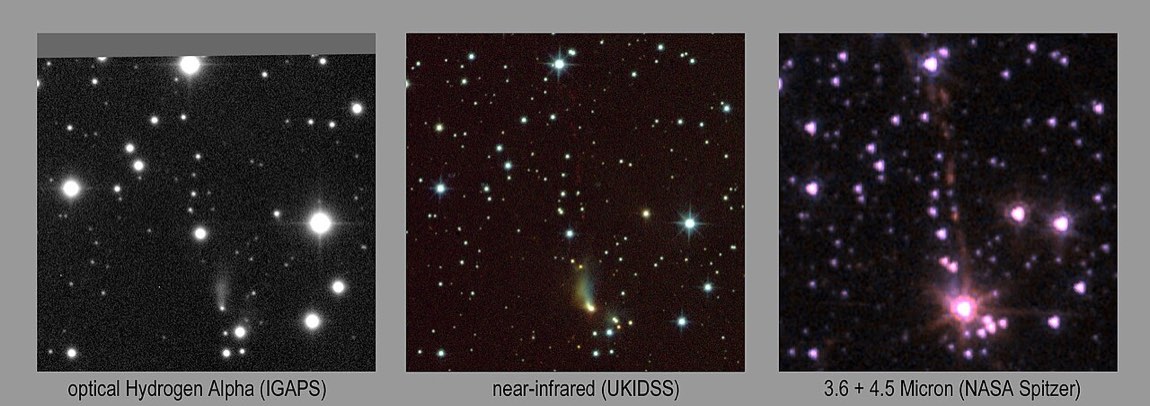
Messier 36 is an open cluster in Auriga, first noted by Giovanni Battista Hodierna before 1654 and catalogued by Messier in 1764. It is about 4,300 light-years away and around 25 million years old. Astronomers note it is very similar to the Pleiades and would look about as bright if it were at the same distance. A young star with an outflow of gas, nicknamed 'Holoea' (Hawaiian for 'flowing gas'), was found within the cluster.
The deep dive
Researched for the Atlas from Wikipedia — Messier 36 (1,878 characters read) · updated Nov 15, 2026
01 A Discovery Three Centuries in the Making
Messier 36 has the distinction of being independently found by three different astronomers across more than a century of observation. Giovanni Batista Hodierna was the first, noting it before 1654 as little more than a nebulous patch — a smudge against the stars of Auriga that his instruments could not fully resolve. Almost a hundred years passed before Guillaume Le Gentil re-discovered it in 1749, apparently unaware of Hodierna's earlier record. Then in 1764, Charles Messier swept it up during his famous comet-hunting surveys and added it as the 36th entry in his landmark catalogue. That catalogue, originally meant only to flag objects that could be confused with comets, became one of the most enduring reference lists in the history of astronomy. M36 thus carries three independent threads of discovery, a reminder that even modest-looking clusters could slip through the cracks of early observational records and surprise later generations of sky-watchers.
02 The Pleiades Twin Hiding in Auriga
One of the most striking facts about M36 is how closely it resembles the Pleiades, the most famous open cluster in the night sky. The article notes explicitly that M36 is very similar to the Pleiades, designated M45, and that if it were as close to Earth as the Pleiades, it would shine with a comparable apparent magnitude. The reason it looks so much dimmer is simply distance: M36 sits roughly 4,340 light-years away, compared to the Pleiades at only about 440 light-years. That tenfold gap in distance dramatically reduces the light reaching our eyes. Both clusters are young, loosely bound collections of hot, luminous stars, and both contain the kind of bright blue-white stellar members that make young open clusters so photogenic. The comparison offers a useful mental exercise — the Pleiades as a nearby preview of what M36 would look like if the universe had placed it much closer to our solar system.
03 How Wide and How Massive Is M36? Deeper
M36 spans an angular diameter of 10 arcminutes on the sky, with a denser core region of 3.2 arcminutes in radius. When translated into physical scale using its distance, the cluster's tidal radius — the boundary beyond which stars are stripped away by the Milky Way's gravitational field — measures 10.6 ± 1.6 parsecs, or equivalently 34.6 ± 5.2 light-years. That uncertainty range is not cosmetic: it reflects genuine measurement challenges in defining where a cluster ends and the surrounding field population begins. The total mass of M36 has been estimated at roughly 746 solar masses. To put that in context, if you could collect all the stars in the cluster and weigh them against the Sun, the pile would be about 746 times heavier. Despite that apparently large number, open clusters are loosely structured objects, and M36's stars are spread across tens of light-years of space rather than packed tightly together.
04 Pinning Down the Age of a Young Cluster Deeper
Determining the age of a star cluster is part science, part detective work, and M36 illustrates how different methods can converge on a consistent answer. Using photometry — measuring how stars' colors and brightnesses compare to theoretical evolutionary tracks — Wu et al. estimated an age of 25.1 million years in 2009. Bell et al. refined this in 2013 to 26.3 million years, with an asymmetric uncertainty of plus 3.2 and minus 5.2 million years. A third independent approach examines the lithium content of cluster stars. Lithium is destroyed inside stars as they age, so stars that have not yet depleted their lithium imply a certain youthfulness. That technique yields an age of 22 ± 4 million years for M36, which the article notes is in good agreement with the photometric estimates. Twenty-five million years may sound ancient, but on cosmic timescales it means M36 formed long after the dinosaurs appeared on Earth, making it a genuinely recent addition to the Milky Way's stellar nurseries.
05 Bright Stars and Infrared Mysteries
M36 is a generous cluster for observers with modest equipment. It contains ten member stars bright enough to shine at visual magnitude 9 or brighter, and a total of 178 stars down to magnitude 14. Among its stellar population, 38 members display an infrared excess — meaning they radiate more infrared light than a bare stellar surface alone would produce. This excess is a telltale signature of warm circumstellar dust, often associated with disks of material left over from star formation. One member shows a particularly pronounced infrared excess, singling it out as an especially interesting candidate for follow-up study. The cluster also hosts one candidate B-type variable star of 9th magnitude. B-type stars are hot, blue-white giants, and their variability can arise from pulsations, rapid rotation, or interactions with nearby material. The combination of infrared excess stars and a variable B-type member hints at a cluster still carrying physical signatures of its recent birth.
06 A Contested Distance to M36 Deeper
Astronomers generally place M36 at about 4,340 light-years, or 1,330 parsecs, from Earth — a figure that has been used for decades and anchors most published analyses of the cluster's physical properties. However, a 2020 study focusing specifically on the cluster's variable stars arrived at a notably shorter distance of 3,800 light-years. That is not a trivial difference: a 540-light-year discrepancy affects every derived physical quantity, from the true luminosities of individual stars to the inferred physical radius of the cluster. Distance measurement in astronomy remains one of the field's most persistent challenges, and open clusters are not immune to the problem. Variable stars can serve as standard candles — objects of known intrinsic brightness — but only when their type is correctly classified and their light curves are well-characterized. The tension between the traditional distance and the 2020 estimate means that some published properties of M36 may need revision as measurement techniques continue to improve.
07 Holoea: A Gas-Flowing Interloper
Among the most colorful discoveries associated with M36 is a young stellar object nicknamed Holoea — a Hawaiian word meaning flowing gas. The name fits: Holoea drives an outflow of material and is linked to the infrared source catalogued as IRAS 05327+3404. It was found during optical observations of M36, appearing projected against the cluster on the sky. Despite that apparent proximity, researchers believe Holoea is probably not a true member of M36 at all. Instead, it may belong to the more distant S235 star-forming region, which lies behind the cluster along the same line of sight. The young star powering the outflow was classified as transitional between a Class I and Class II protostellar object, placing it in a brief evolutionary phase between an embedded protostar and a young star with a cleared but still substantial disk. Holoea is described as being surrounded by large amounts of circumstellar material, reinforcing its identity as a genuinely newborn stellar object caught in an active early stage of development.
08 What Class I and Class II Protostars Mean Deeper
The classification system for young stellar objects divides protostars into broad categories based on the shape of their infrared light distribution. A Class I object is still deeply embedded in its natal envelope of gas and dust, accreting material vigorously and often driving powerful jets and outflows. A Class II object, sometimes called a classical T Tauri star, has largely cleared its surrounding envelope but still retains a prominent protoplanetary disk. Holoea, the young star associated with IRAS 05327+3404 and projected near M36, sits at the boundary between these two classes — a transitional object that has shed much of its envelope but has not yet settled into the quieter disk-dominated phase. The large amounts of circumstellar material that surround it, mentioned explicitly in the article, are consistent with this in-between status. Such transitional objects are scientifically prized because they represent a fleeting evolutionary moment, a snapshot of star formation caught mid-process, rarely observed in detail.
09 Observing M36 in Auriga's Winter Sky
M36 resides in Auriga, a constellation that climbs high in northern winter skies, making the cluster a prime cold-weather target. Its angular diameter of 10 arcminutes fits comfortably in the field of view of most binoculars and small telescopes. With ten stars brighter than visual magnitude 10, even a modest instrument will resolve individual members rather than presenting the cluster as an unresolved glow. The cluster sits in a rich region of the Milky Way, so the surrounding star field adds to the visual drama. Auriga also contains two other Messier clusters, M37 and M38, making the constellation an efficient destination for a single observing session. For those comparing M36 to the Pleiades, the visual contrast is instructive: the Pleiades fill a much larger patch of sky and dominate the naked eye, while M36 requires at least binoculars to appreciate — a direct consequence of the hundredfold difference in their distances from Earth.
10 The S235 Region and Cosmic Coincidences Deeper
The S235 star-forming region, believed to be the likely home of the Holoea outflow source, is a good example of how line-of-sight projections can mislead even careful observers. When astronomers first noticed the young stellar object in optical images of M36, its apparent position within the cluster boundaries made membership seem natural. Only detailed analysis of its infrared properties, outflow characteristics, and likely distance placed it in the more distant background region. S235 is an HII region — a cloud of ionized hydrogen energized by hot stars — associated with ongoing star formation, making it a plausible host for a transitional Class I/II object like Holoea. The situation highlights a broader challenge in cluster astronomy: not every object that appears within a cluster's projected boundary actually belongs to it. Separating true members from foreground and background objects requires combining multiple lines of evidence, including radial velocities, proper motions, and spectral classifications.
11 Open Questions Surrounding M36 Deeper
Despite being observed for nearly four centuries, M36 leaves several questions unresolved. The most immediate is the distance discrepancy between the traditional value of 4,340 light-years and the 2020 variable-star estimate of 3,800 light-years. Until the two are reconciled, every physical parameter derived from distance — stellar luminosities, cluster radius, total mass — carries an additional layer of uncertainty. The nature of the star with a particularly high infrared excess remains uncharacterized beyond that single descriptor in the literature. Whether that object hosts a protoplanetary disk, a debris disk, or something more exotic is not established by the available data. The candidate B-type variable star also invites follow-up: its variability mechanism has not been confirmed. And the true membership status of Holoea — cluster foreground object or background S235 member — rests on indirect arguments rather than a definitive kinematic measurement. Each of these threads represents an open invitation for future observational campaigns targeting one of Auriga's most accessible young clusters.
 ⤢