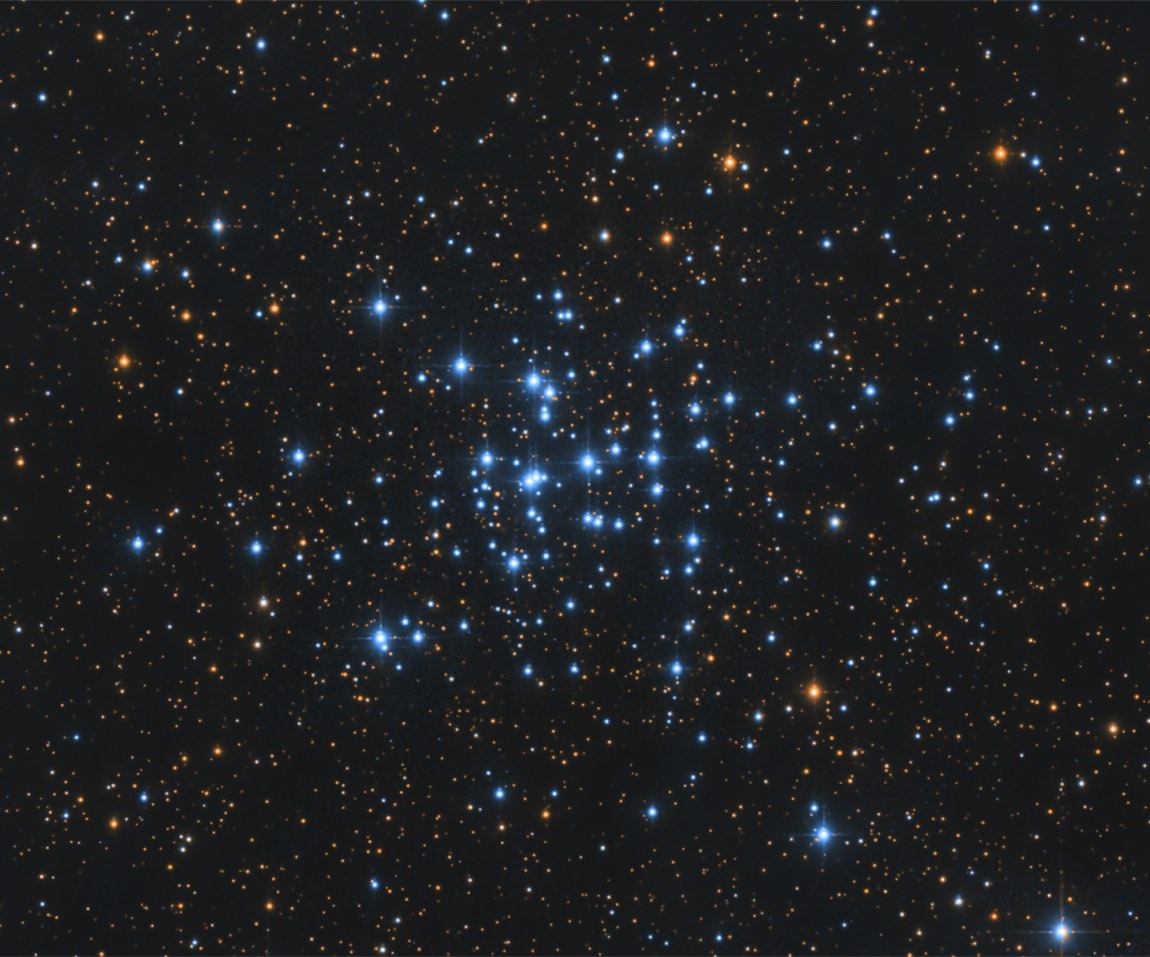
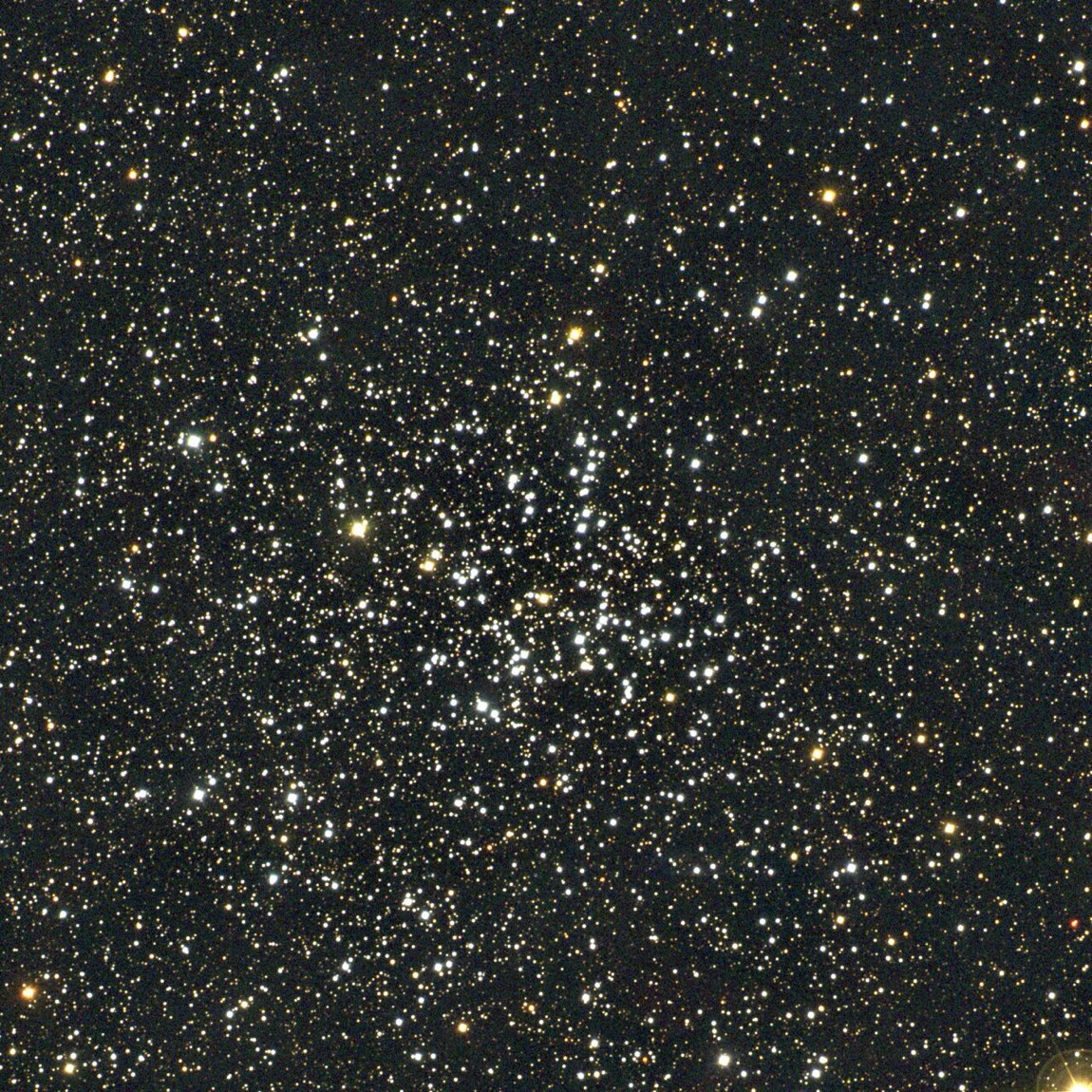
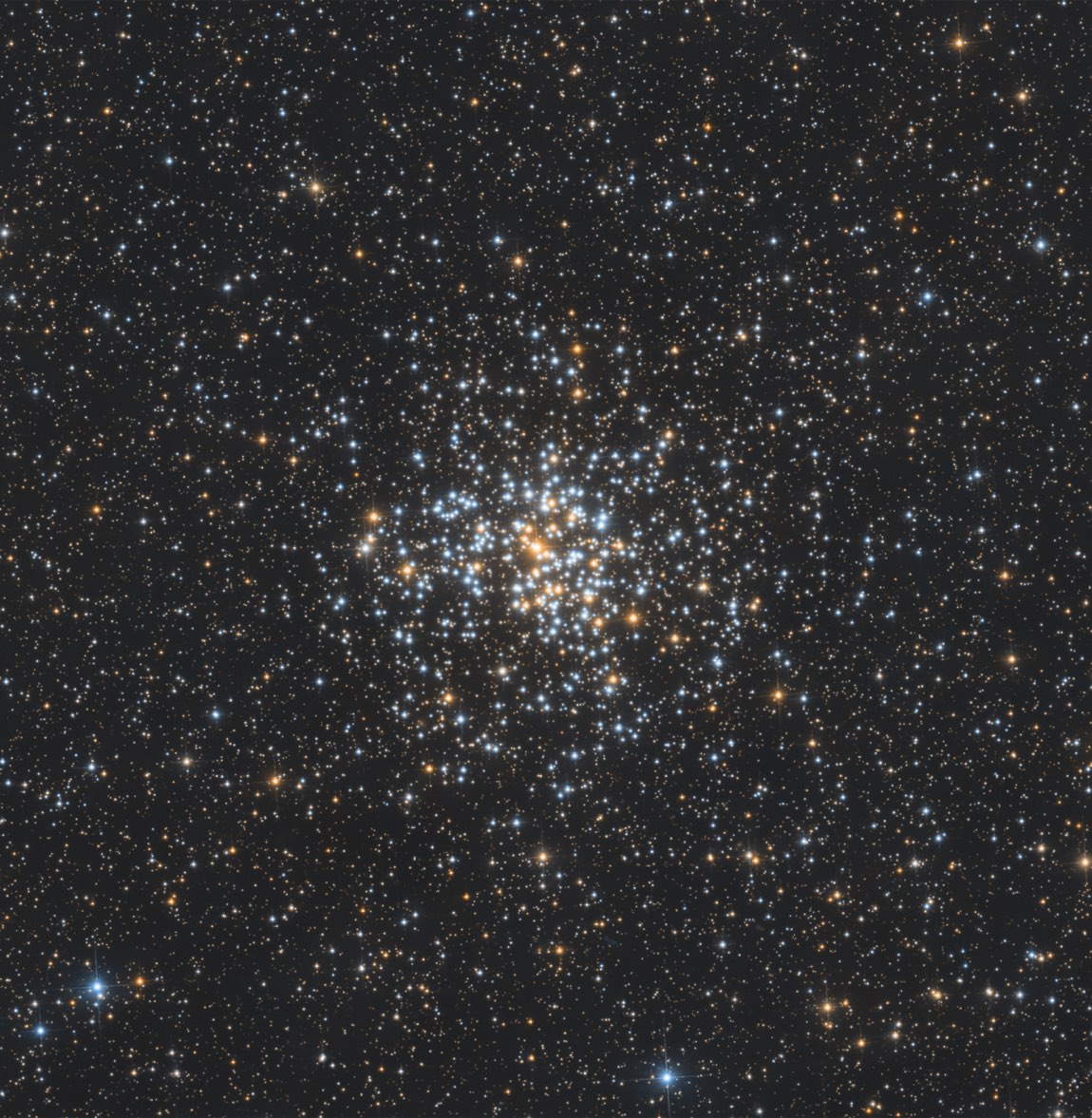
 Photograph · Chuck Ayoub · CC0
Star Cluster · Deep guide
Messier 37 (Salt and Pepper Cluster)
Also called: M37 · NGC 2099 · Salt and Pepper Cluster
The brightest and richest open cluster in Auriga, sprinkled with more than 500 stars.
What is it?
Messier 37 is the brightest and richest open cluster in Auriga. Giovanni Battista Hodierna recorded it before 1654, and Charles Messier found it again in 1764. It lies about 4,500 light-years away, in the direction opposite the Galactic Center, and contains over 500 identified stars, including at least a dozen red giants. Its age is estimated at 350 to 550 million years. As of 2022 it hosted only the third planetary nebula known to belong to an open cluster.
The deep dive
Researched for the Atlas from Wikipedia — Messier 37 (2,035 characters read) · updated Nov 15, 2026
01 The brightest jewel in Auriga's crown
Among all the open clusters scattered across the constellation Auriga, Messier 37 stands alone as the brightest and richest. Its common nickname, the Salt and Pepper Cluster, hints at the visual texture observers notice through a telescope: a dense, granular sprinkling of stars that fills the eyepiece like seasoning across a dark plate. The cluster contains over 500 identified stars, of which roughly 150 shine brighter than magnitude 12.5 — well within reach of a modest amateur telescope. Its angular diameter spans 24 arcminutes on the sky, close to the apparent width of the full Moon, yet nearly all of that light is packed into stars rather than spread across glowing gas. That combination of richness and brightness has made M37 a benchmark cluster for stellar population studies, offering astronomers a large, well-populated sample of stars born at the same time from the same material.
02 Three astronomers, one overlooked cluster
The discovery history of M37 is a small comedy of oversights. The Italian astronomer Giovanni Battista Hodierna catalogued it before 1654, well ahead of the more famous French observers who would follow. When Guillaume Le Gentil swept through Auriga in 1749 and independently found the neighboring clusters M36 and M38, he somehow missed M37 entirely — the brightest of the three. It was Charles Messier who independently rediscovered M37 in September 1764 and added it to his famous catalog of objects that could be confused with comets. Only later did astronomers piece together that Hodierna had already recorded all three Auriga clusters more than a century earlier. This layered history is a good reminder that credit in astronomy often depends as much on publication and circulation as on who first pointed a telescope at a patch of sky.
03 An age written in surviving starlight Deeper
Pinning down exactly how old M37 is turns out to be harder than it might seem. Current estimates span from 347 million to 550 million years — a range of more than 200 million years, reflecting genuine uncertainties in the models used to fit the cluster's color-magnitude diagram. For comparison, 347 million years ago on Earth, the first forests were just beginning to spread across the continents. The upper age limit takes the cluster back to a time before the dinosaurs existed at all. One useful constraint comes from the hottest star still burning on the main sequence: a B9 V star, a hot blue-white type. More massive, hotter stars exhaust their fuel and evolve off the main sequence first, so the spectral type of the hottest survivor acts like a clock — and a B9 V star suggests the cluster is old enough that anything hotter has already died. At least a dozen red giants are present, further evidence that the cluster has aged well past its earliest, most massive generations.
04 A planetary nebula hiding in a star cluster Deeper
As of 2022, M37 harbors only the third known planetary nebula associated with an open cluster anywhere in the sky. This is a genuinely rare finding. Planetary nebulae form when a medium-mass star exhausts its nuclear fuel, sheds its outer layers as an expanding shell of glowing gas, and leaves behind a hot white dwarf at the center. For one to appear inside an open cluster, the progenitor star must have been massive enough to evolve quickly but not so massive that it exploded as a supernova instead. Open clusters tend to disperse their stars over hundreds of millions of years, so catching one at exactly the right evolutionary moment — hosting a star in the brief planetary nebula phase — is statistically uncommon. The presence of this object inside M37 offers astronomers a rare chance to study a planetary nebula whose age and chemical context are constrained by the cluster itself.
05 Metal-rich stars and what that tells us Deeper
In astronomy, "metallicity" refers to the abundance of all elements heavier than hydrogen and helium — everything from carbon and oxygen to iron. M37's metallicity is similar to, or slightly higher than, that of the Sun. This matters for understanding where the cluster fits into the chemical evolution of the Milky Way. Stars that form in regions already enriched by previous generations of supernovae tend to be more metal-rich, and M37's near-solar metallicity places it among clusters that formed in a relatively chemically mature part of the galaxy. A slightly super-solar metallicity, if confirmed, would suggest the material from which M37 condensed had been processed through more stellar generations than the gas that formed our own Sun. This kind of comparison between cluster chemistry and solar chemistry helps astronomers reconstruct the enrichment history of the galactic disk over billions of years.
06 How far do its gravitational bonds stretch?
Although M37 sits about 4,500 light-years from Earth and its visible disk spans roughly 20 to 25 light-years across, the cluster's gravitational reach extends considerably farther. The tidal radius — the distance at which the Milky Way's own gravity begins to tug stars away from the cluster — lies between 46 and 59 light-years from M37's center. Beyond that boundary, stars that wander outward are gradually stolen by the galaxy rather than pulled back. This tidal stripping is one of the main reasons open clusters eventually dissolve: over hundreds of millions of years, the outer envelope of loosely bound stars bleeds away. The gap between M37's visible core (20–25 light-years) and its tidal radius (up to 59 light-years) means there is a substantial halo of stars still gravitationally associated with the cluster but increasingly vulnerable to being lost to the broader galactic field.
07 M37's long orbit through the Milky Way Deeper
M37 does not sit still in the galaxy — it traces a looping path around the Milky Way with an orbital period of 219.3 million years. Its orbit is mildly elliptical, with an eccentricity of 0.22, which carries it as close as 19.6 thousand light-years from the Galactic Center and as far as 30.7 thousand light-years away. Right now it lies in the antipodal direction from the Galactic Center as seen from Earth, placing it in one of the outer spiral arms while still remaining within our own arm's neighborhood. The cluster also bobs up and down through the galactic plane, reaching a maximum height of about 0.29 thousand light-years above the plane and crossing back through it with a period of 31.7 million years. That crossing period is short enough that M37 has punched through the plane many times during its lifetime, repeatedly exposing its member stars to the denser interstellar environment near the disk's midplane.
08 Its location on the galaxy's outer side
The direction from Earth to M37 is almost exactly opposite the direction to the Galactic Center — astronomers call this the antipodal direction. That geometry places M37 in one of the Milky Way's outer spiral arms rather than deep in the crowded inner galaxy. Being on the outer side of our own arm means the cluster formed in a region of the galaxy with lower overall stellar density than regions closer to the center. It also means M37 has spent its life in a relatively quieter gravitational environment, away from the intense tidal forces and frequent star-forming bursts that characterize the inner disk. Despite this outward location, the cluster still sits close enough to our own spiral arm that it is considered part of the same local galactic structure as the Sun, making it one of our comparatively nearby open cluster neighbors.
09 Classified and characterized: Trumpler types Deeper
M37 carries the Trumpler classification I,1,r or I,2,r — a compact shorthand developed by Robert Trumpler in the 1930s to describe the structural and population characteristics of open clusters at a glance. The Roman numeral I indicates that the cluster is strongly concentrated toward its center, with a well-defined core that stands out clearly from the surrounding star field. The number following (1 or 2) describes the range of star brightnesses within the cluster: a "1" means the member stars are all roughly similar in brightness, while a "2" indicates a moderate range. The lowercase "r" at the end signals that the cluster is rich — it contains many stars, consistent with the catalog count of over 500 identified members. The slight ambiguity between I,1,r and I,2,r reflects genuine uncertainty in how evenly matched the cluster's stellar magnitudes are, a detail that depends on how the photometry is measured and which stars are counted as true members.
10 How to find and observe M37
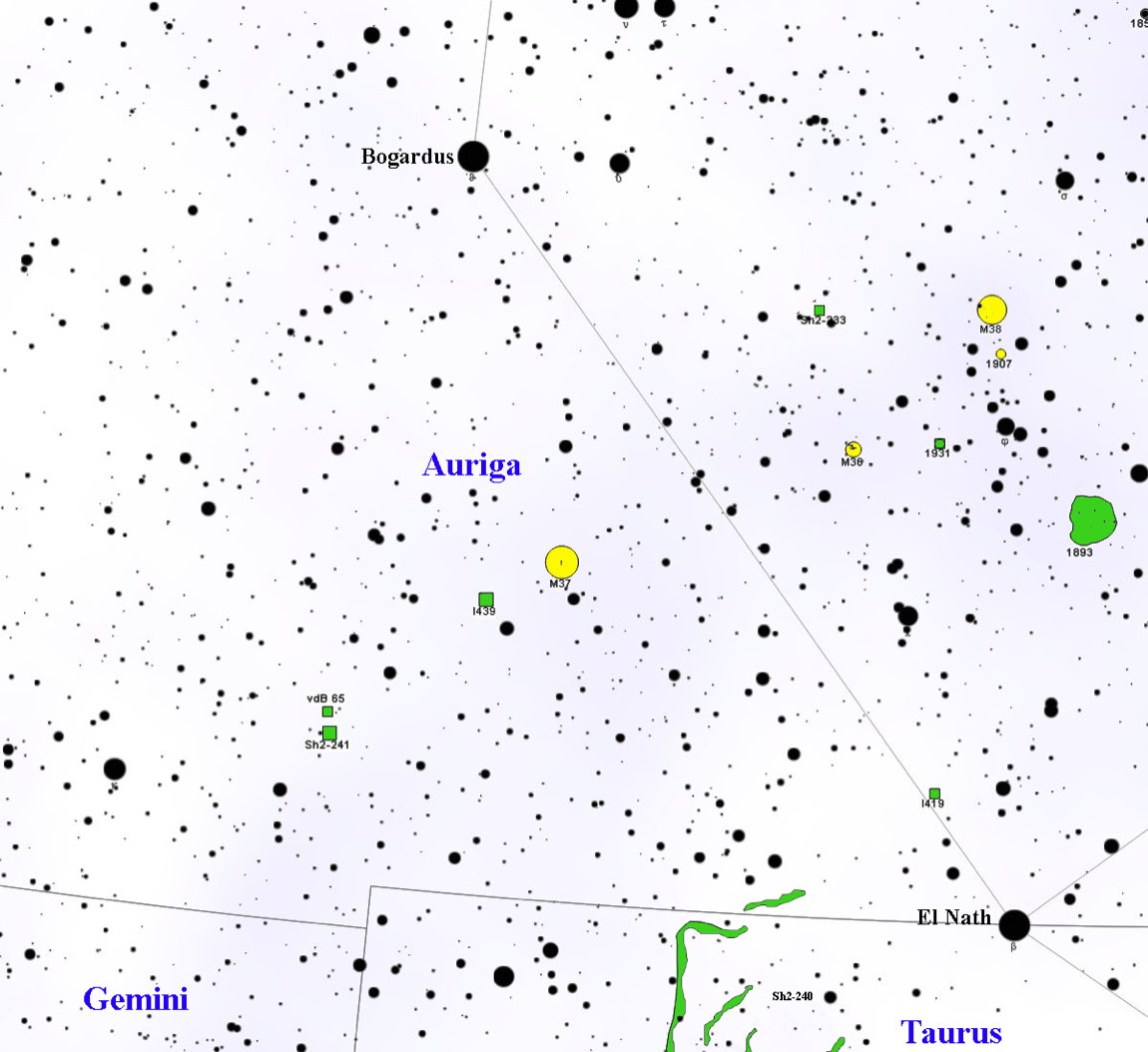
With an apparent magnitude that makes it the brightest of the three Auriga Messier clusters, M37 is one of the more rewarding open clusters to seek out in the winter sky. It sits in Auriga, a constellation well placed for northern hemisphere observers from late autumn through early spring. Even binoculars reveal a hazy glow at its location, but a small telescope begins to resolve the individual stars that earn it the Salt and Pepper nickname — a grainy, densely packed field that rewards higher magnification. Its angular diameter of 24 arcminutes means a wide-field eyepiece captures the whole cluster comfortably. The more than 150 stars brighter than magnitude 12.5 mean that even under suburban skies a 4-inch telescope will show a satisfying stellar swarm, while darker skies reveal the contrast between the red giant members and the surrounding white and blue-white field stars.
11 Red giants standing out in the crowd
At least a dozen red giants have been confirmed as members of M37, and through a telescope their warm orange or reddish tint is visible against the cooler blue-white background stars — a contrast that contributes to the cluster's visual appeal and to its scientific value. Red giants are stars that have already left the main sequence, having burned through the hydrogen in their cores and expanded dramatically. Their presence in M37 is consistent with the cluster's age: at hundreds of millions of years old, stars with masses somewhat greater than the Sun's have had time to evolve into the red giant phase. Each red giant acts as a data point for stellar evolution models, allowing astronomers to compare the observed properties of these aging stars against theoretical predictions. Because all the cluster's stars are assumed to have formed at the same time and from the same gas, the red giants and the surviving main-sequence stars together provide a snapshot of stellar evolution at a fixed age.
 ⤢