 Photograph · NOIRLab/ NSF /AURA · CC BY 4.0
Star Cluster · Deep guide
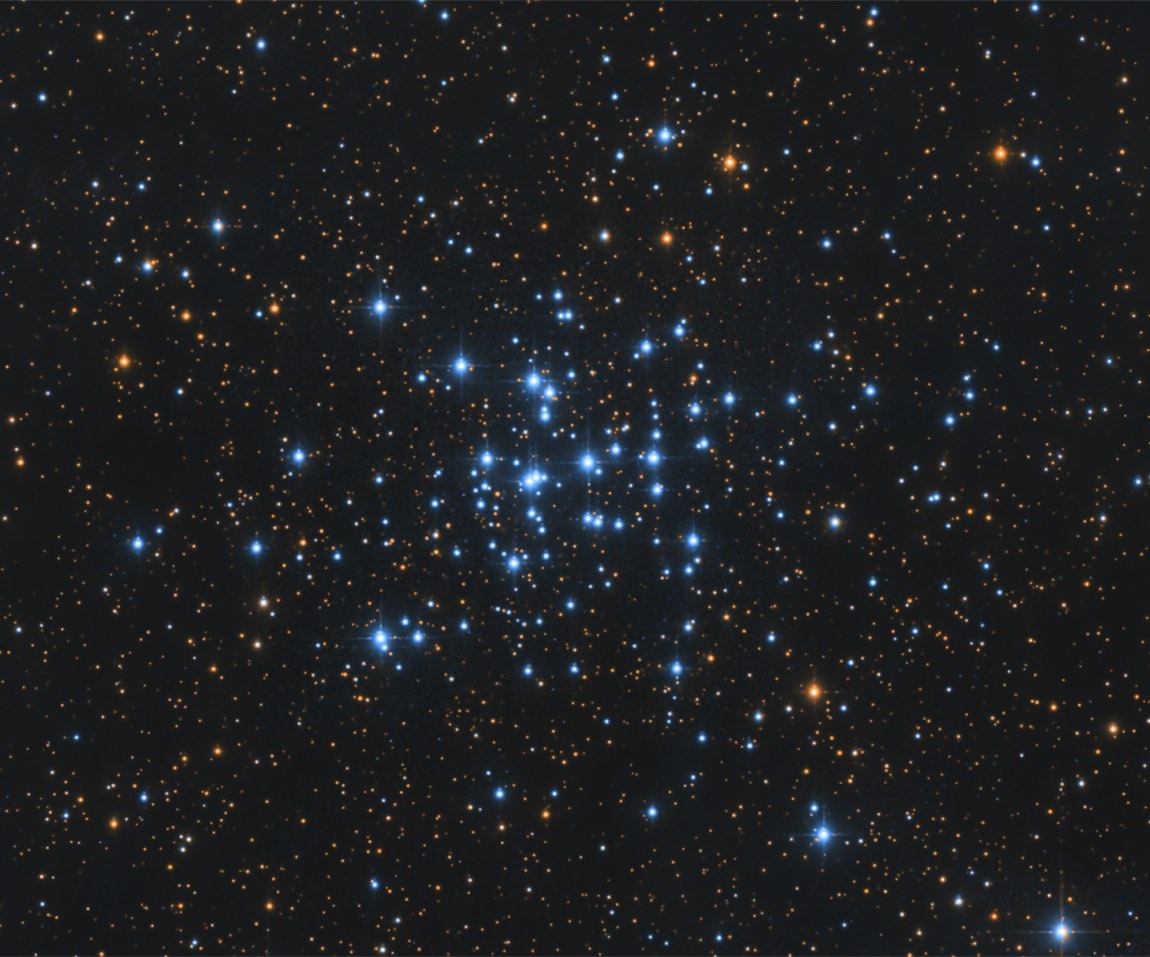
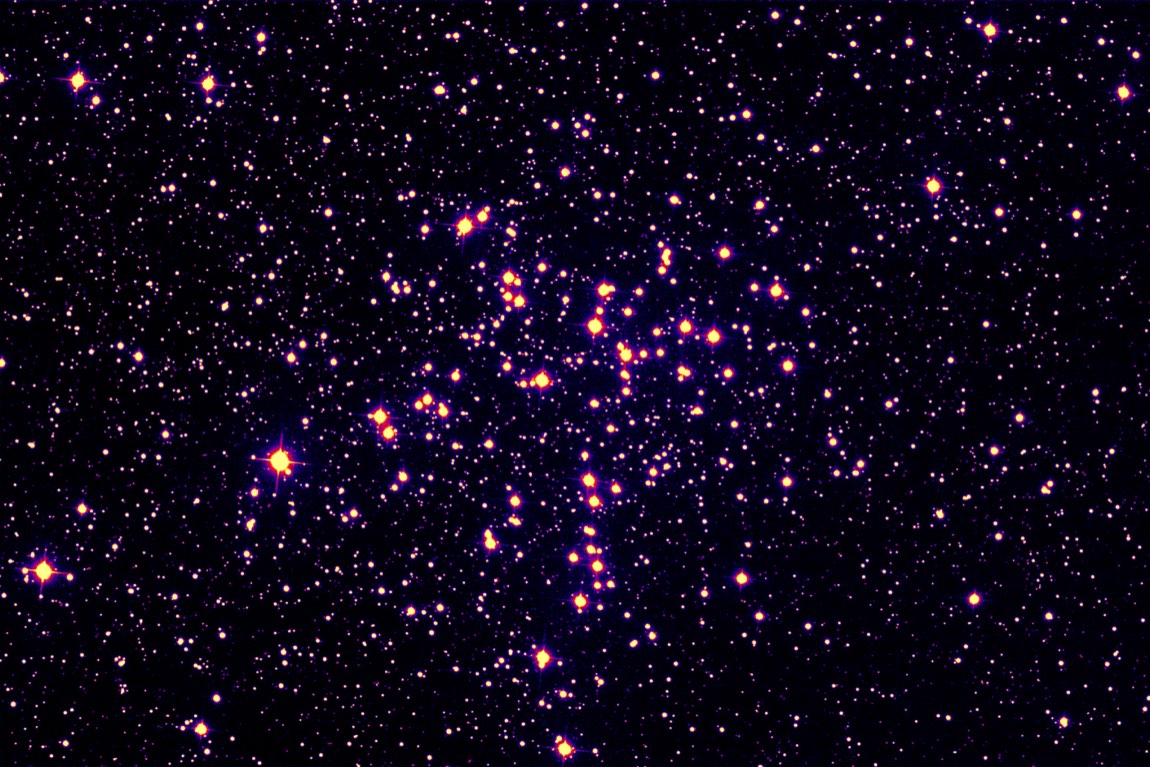
Messier 38 (Starfish Cluster)
Also called: M38 · NGC 1912 · Starfish Cluster
The third of Auriga's bright cluster trio, passing a smaller cluster in the sky.
What is it?
Messier 38 is an open cluster in Auriga, discovered by Giovanni Battista Hodierna before 1654 and found again by Guillaume Le Gentil in 1749. Together with M36 and M37 it forms a well-known trio of clusters. It lies about 3,500 light-years away and is roughly 250 million years old. The open cluster NGC 1907 appears next to it, but the two most likely formed in different parts of the galaxy and are just passing each other.
The deep dive
Researched for the Atlas from Wikipedia — Messier 38 (1,731 characters read) · updated Nov 15, 2026
01 A Cluster Discovered Twice, Centuries Apart
Messier 38 has an unusually well-documented discovery history for a deep-sky object. The Italian astronomer Giovanni Batista Hodierna recorded it before 1654, bundling it together with what we now call M36 and M37 — a trio of open clusters scattered across the constellation Auriga that he seems to have surveyed as a group. Nearly a century later, in 1749, the French astronomer Guillaume Le Gentil independently stumbled upon the same cluster without any knowledge of Hodierna's earlier work. This kind of double discovery was common in an era before astronomical catalogs were systematically shared across Europe. It was Charles Messier who eventually gave the cluster its lasting designation when he added it to his famous catalog of nebulae and star clusters, the work that cemented all three Auriga clusters as fixtures of amateur and professional observing alike. The fact that two careful observers separated by almost a hundred years both found it independently speaks to how conspicuous M38 is in a modest telescope.
02 The Auriga Trio: Three Clusters, One Corner of Sky
M38 belongs to a celebrated grouping of open clusters that share the same patch of the constellation Auriga. M36 and M37, also discovered by Hodierna before 1654, are so often observed alongside M38 that the three are habitually treated as a set by observers sweeping the winter sky. All three fit within the same binocular or low-power telescope field on a good night, making Auriga one of the richest regions for open-cluster hunting in the entire sky. Despite their apparent proximity to one another on the celestial sphere, they are physically distinct objects at different distances and ages, their closeness on the sky being largely a line-of-sight coincidence from our vantage point within the Milky Way. M38 sits at approximately 1.066 kiloparsecs, or about 3,480 light-years from Earth, while its neighbor M37 is described as more distant yet has a similar physical diameter of roughly 4.0 parsecs — an interesting parallel between two clusters born in entirely different circumstances.
03 Shape-Shifting: What Does M38 Actually Look Like?
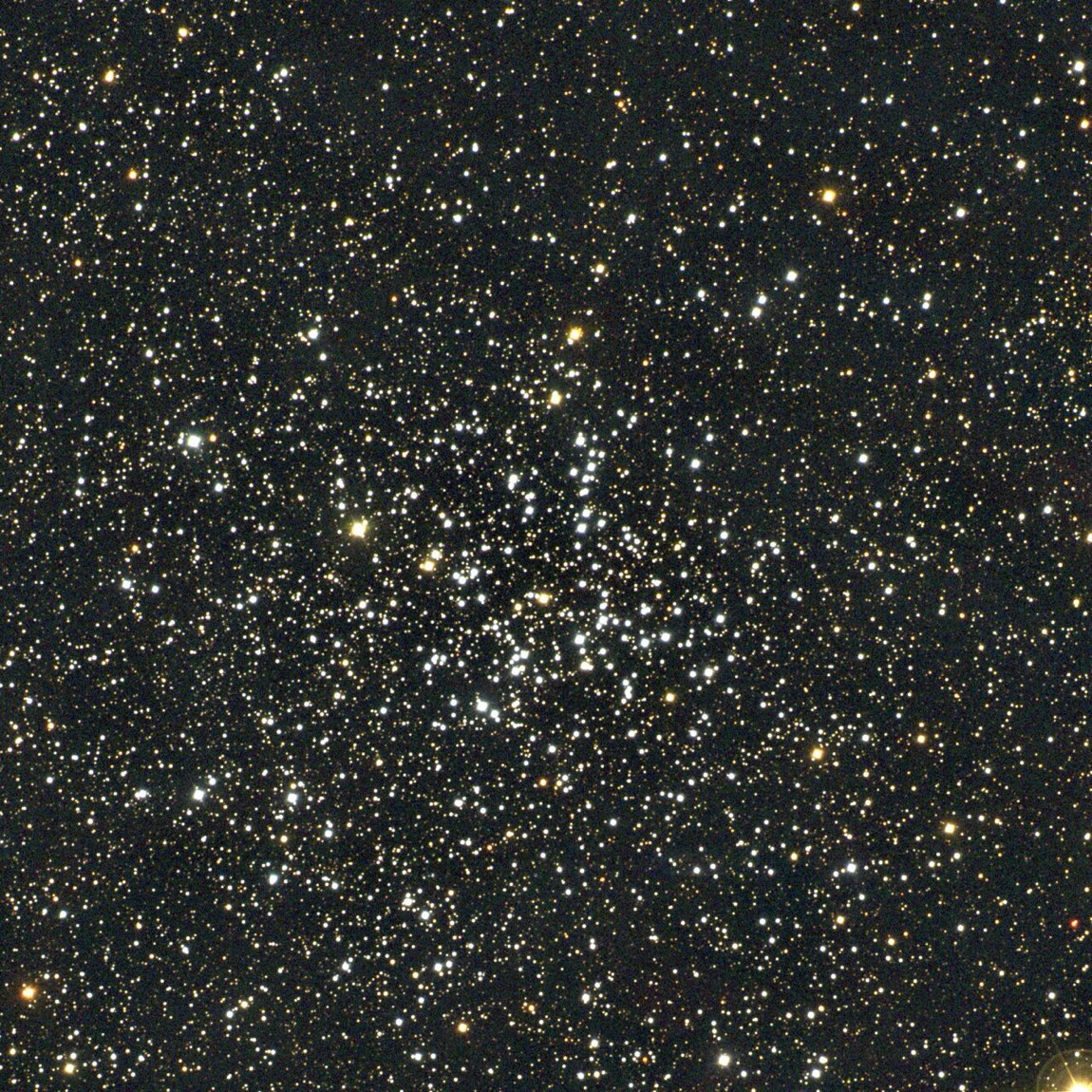
Few open clusters have inspired as much descriptive disagreement as M38. Older observers, particularly those using small instruments, consistently reported seeing a cross shape among its brightest stars. The astronomer Webb went further, describing the pattern specifically as an "oblique cross," while others likened the arrangement of brightest members to the Greek letter Pi. Walter Scott Houston, one of the most respected visual observers of the twentieth century, offered a nuanced perspective: photographs typically reveal a departure from circularity that visual observers can also detect, and the cross shape becomes more pronounced the smaller the telescope used. When Houston turned a large 24-inch reflector on the cluster from a fine Arizona night, the sheer number of stars overwhelmed any geometric impression, making the search for a figure seem "fruitless" in his own words. This tells us something important about how aperture and resolving power change the aesthetic experience of a cluster — small telescopes simplify it into a recognizable pattern, while large ones dissolve that pattern into complexity. The cluster's popular name, the Starfish Cluster, reflects yet another interpretation of its irregular outline.
04 Size on the Sky and in Real Space Deeper
M38 spans an angular diameter of about 20 arc minutes as seen from Earth — roughly two-thirds the apparent diameter of the full Moon. Converting that angle into physical size using the cluster's distance of 1,066 parsecs yields a true diameter of approximately 4.0 parsecs, which is equivalent to about 13 light-years. To put that in perspective, the nearest star to the Sun, Proxima Centauri, lies just over 1.3 parsecs away, so the cluster's full width is roughly three times that distance. Interestingly, M38's physical size is described as similar to that of its more distant neighbor M37, despite M37 being farther from Earth. This correspondence in linear size between two clusters of different ages and distances is a useful reminder that apparent angular size alone can be deceptive — a large angular cluster nearby and a small angular cluster far away might occupy nearly identical volumes of space. M38's modest departure from circular symmetry, visible in photographs, suggests that its stars are not distributed in a perfectly uniform sphere, a common feature among open clusters of intermediate age.
05 290 Million Years Old: A Middle-Aged Cluster
At roughly 290 million years old, M38 sits at an intermediate age for an open cluster. To understand what that means, consider that the solar system itself is about 4.6 billion years old, making M38 young by comparison — it formed long after the dinosaurs had already gone extinct here on Earth, cosmically speaking. Open clusters in general tend to be young objects; gravitational interactions between member stars, as well as tidal forces from the Milky Way itself, gradually pull clusters apart over hundreds of millions to billions of years. At 290 million years, M38 is old enough that it has had time to evolve significantly — its most massive, short-lived stars have already exhausted their fuel and departed the main sequence — but it has not yet dispersed into the background star field. The cluster still retains a population of roughly 100 stars, enough to hold itself together as a recognizable grouping. This intermediate age places it in an interesting evolutionary window, neither the very young clusters still embedded in their birth nebulae nor the aging sparse groupings barely distinguishable from field stars.
 ⤢
06 The Brightest Star: A Yellow Giant Outshining 900 Suns Deeper
The most luminous member of M38 is a yellow giant with an apparent magnitude of +7.9 and a spectral classification of G0, placing it in the same broad color family as our own Sun but far more evolved and powerful. Its absolute magnitude is -1.5, which translates to a luminosity of 900 times that of the Sun — a striking figure for a star that superficially resembles a souped-up solar analog. The G0 spectral type indicates a surface temperature similar to the Sun's, so the enormous luminosity difference comes primarily from the star's greatly expanded size rather than a hotter surface. This star has exhausted the hydrogen in its core and swollen into a giant, tracing the evolutionary path that the Sun itself will follow in roughly five billion years. At apparent magnitude +7.9, it falls just below the naked-eye limit of about +6.5 but is an easy target for binoculars. For context, the article notes that the Sun itself, observed from the distance of M38, would appear as a faint magnitude +15.3 star — invisible to any instrument short of a substantial telescope, illustrating just how far 3,480 light-years truly is.
07 NGC 1907: A Neighbor That Isn't Really a Neighbor
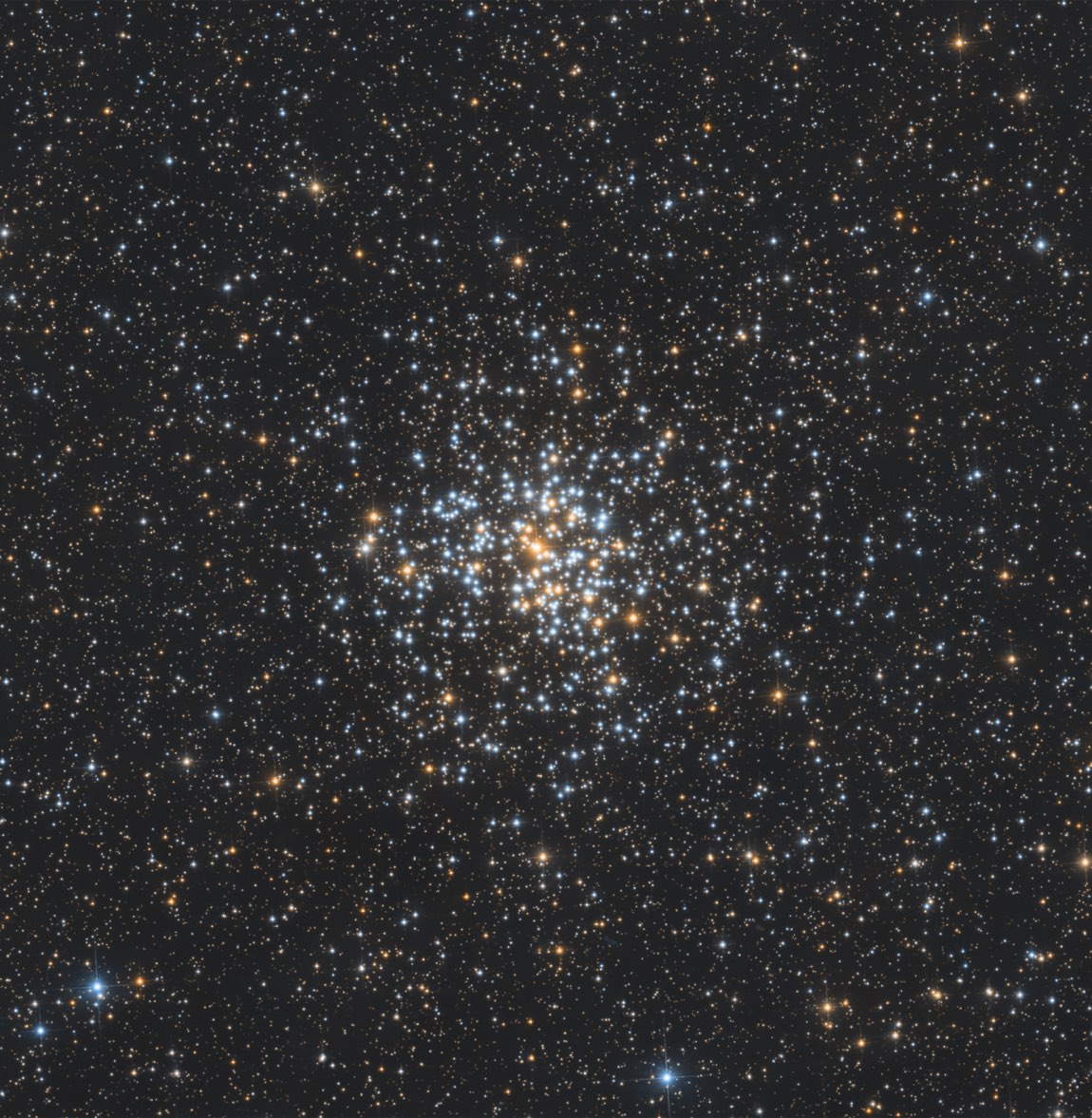
On the sky, the open cluster NGC 1907 appears close to M38, tempting observers to wonder whether the two share a physical connection. The current scientific understanding, however, is that the proximity is most likely a coincidence of line of sight rather than a true physical association. The two clusters are assessed to be experiencing what astronomers describe as a "fly-by" — a chance encounter between objects that originated in different parts of the galaxy and happen to be passing near each other from our perspective. This kind of apparent pairing is not unusual in the crowded star fields of Auriga, a region that lies toward the galactic plane where clusters, nebulae, and dense star fields overlap in projection. The distinction matters because a genuine cluster pair that formed together from the same molecular cloud would share similar ages, chemical compositions, and distances, whereas a chance alignment would show mismatched properties. The article does not elaborate further on the specific differences between M38 and NGC 1907, but the fly-by conclusion implies they do not share a common origin.
08 How to Find and Observe M38 Tonight
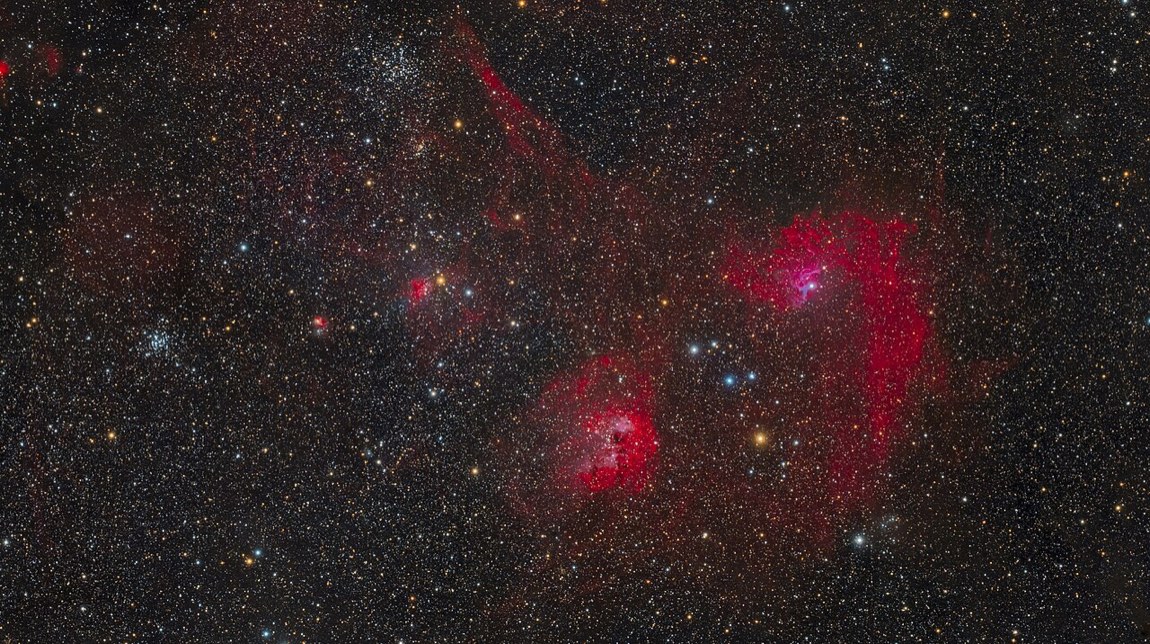
M38 sits in the constellation Auriga, one of the brightest and most recognizable winter constellations in the northern sky. Auriga is dominated by the brilliant yellow star Capella, one of the brightest stars in the entire sky, and the constellation's distinctive pentagonal shape makes it easy to locate even from suburban skies. M38 lies within that pentagon, close to M36 and M37, and all three clusters can be swept up in a single binocular field on a clear night. With an apparent magnitude that places it within reach of binoculars and any small telescope, M38 rewards a range of instruments differently. As Walter Scott Houston observed, small telescopes tend to bring out the cross or Pi-shaped pattern among the brightest stars, while larger apertures resolve the cluster into an irregular swarm that defies simple geometric description. Photographs reveal a departure from circular symmetry that careful visual observers can also detect. The cluster's angular diameter of about 20 arc minutes means it fits comfortably in most eyepiece fields of view, making it an approachable target for beginners and a satisfying one for experienced observers interested in stellar demographics.
09 What 100 Stars Tell Us About a Cluster's Life Deeper
M38's population of approximately 100 stars makes it a moderately rich open cluster, though by no means among the most populous known. The number is significant because it reflects the cluster's current state after 290 million years of internal and external dynamical evolution. Open clusters lose members continuously: the most massive stars burn out quickly and leave as neutron stars or white dwarfs, while lower-mass stars are gradually ejected through close gravitational encounters between cluster members, a process called evaporation. External tidal forces from the Milky Way's gravitational field also strip stars away, particularly from the cluster's outer regions, over timescales of hundreds of millions of years. At 290 million years old, M38 has already shed many of its original members. The remaining ~100 stars represent a surviving core. Among them, the most evolved and visually prominent is the G0 yellow giant, whose presence signals that the cluster has lived long enough for its originally more massive stars to have already evolved off the main sequence. The cluster's intermediate age and modest but real stellar population make it a useful case study in how open clusters age and thin out over geological timescales.
 ⤢