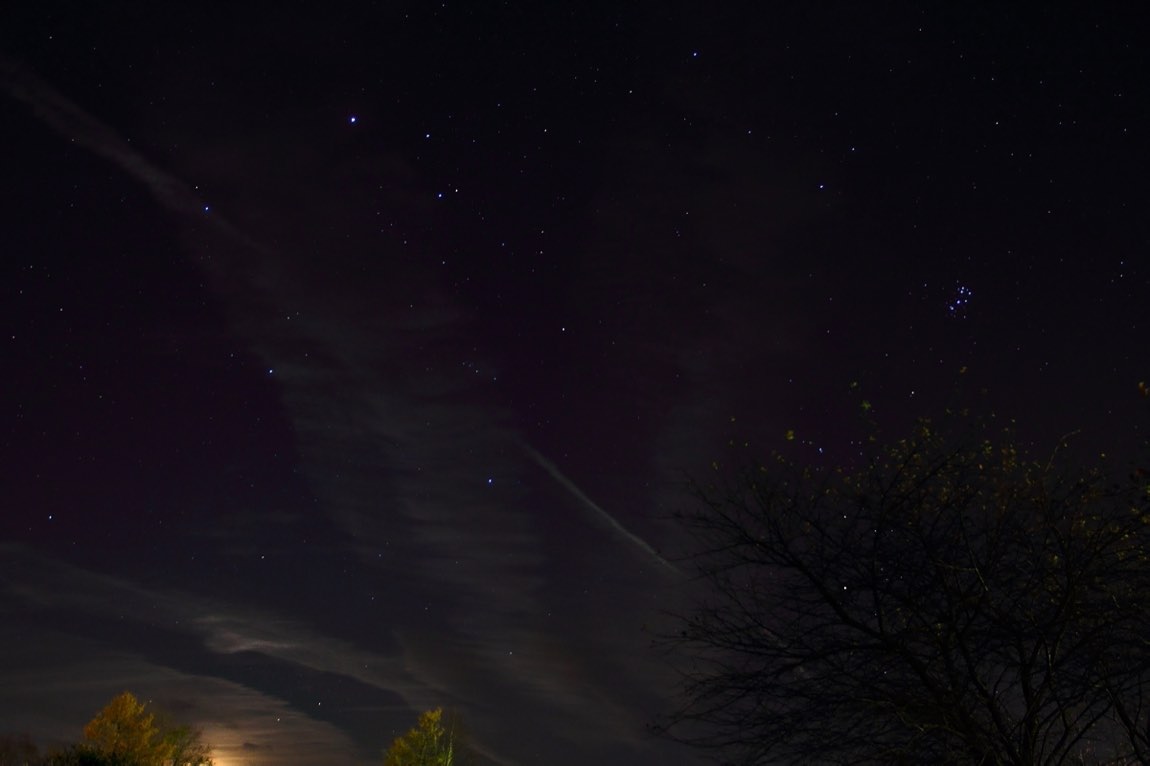
 Photograph · Igor Dvurekov · CC BY-SA 3.0
Star · Deep guide
Capella
The Charioteer's goat star: six stars masquerading as one golden point.
What is it?
Capella, 43 light-years away in Auriga, is the sixth-brightest star in the sky — and not one star but a system: two golden giant stars orbiting each other every 104 days, attended by a distant pair of red dwarfs (and more faint members). Its combined light looks strikingly Sun-colored because the two giants are about the Sun's temperature, just far bigger.
The deep dive
Researched for the Atlas from Wikipedia — Capella (25,098 characters read) · updated Sep 20, 2026
01 A Star That Was Once the Brightest in the Sky
Capella has not always been merely the sixth-brightest star in the night sky. Between about 210,000 and 160,000 years ago, it reigned as the single brightest star visible from Earth, blazing at an apparent magnitude of roughly −1.8. Before that era, Aldebaran held the top spot at −1.1, and the two stars were situated relatively close to each other on the sky, both serving as approximate boreal pole stars for early human ancestors. Capella has also drifted closer to our solar system over geological time: the system passed within about 29 light-years of Earth around 237,000 years ago, when it would have shone at apparent magnitude −0.82, comparable to the brightness of Canopus as we see it today. The system is now settling at 42.9 light-years away, moving neither dramatically closer nor farther in any timescale that matters to modern observers.
02 Ancient Skywatchers and the Goat Star
Capella's cultural footprint stretches back at least four thousand years. An Akkadian inscription thought to date to the 20th century BC may contain one of the earliest references to it. By the 7th century BC, the Mesopotamian astronomical compendium MUL.APIN recorded it within a constellation called GAM, Gamlum, or MUL.GAM — a name evoking a scimitar or crook — which may have referred either to the star alone or to the whole of Auriga. Bedouin astronomers later wove the stars of Auriga into a herd of goats, each star representing one animal. In the pre-Columbian Americas, the star had practical architectural importance: Building J at Monte Albán in Oaxaca, Mexico, constructed around 275 BC, is oriented differently from all other structures on the site, with its steps aligned perpendicular to the rising point of Capella at that time. Someone standing in a doorway of that building would have faced Capella directly — significant because the star's heliacal rising occurred within a day of the Sun passing directly overhead at that latitude.
03 How Science Discovered Capella Is Multiple Deeper
The binary nature of Capella was confirmed almost simultaneously by two astronomers working independently in 1899. Professor William Wallace Campbell at Lick Observatory detected a second spectrum superimposed on the first in photographic plates taken between August 1896 and February 1897, and noticed a Doppler shift toward violet in September and October followed by a redshift in November and February — unmistakable evidence of two bodies orbiting each other. At almost the same moment, British astronomer Hugh Newall used a four-prism spectroscope on a 25-inch (64 cm) telescope at Cambridge in July 1899 to reach the same conclusion. Yet resolving the two stars as separate points of light proved far harder. The pair earned the nickname "The Interferometrist's Friend" because so many observers failed to separate them visually. Success finally came in 1919, when John Anderson and Francis Pease at Mount Wilson Observatory resolved the pair interferometrically — the very first interferometric measurement of any object beyond the Solar System. They published an orbital solution in 1920, and a high-precision orbit followed in 1994 from the Mark III Stellar Interferometer, also at Mount Wilson. Capella then claimed another first: in September 1995 it became the first astronomical object imaged by a separate-element optical interferometer, using the Cambridge Optical Aperture Synthesis Telescope.
04 Two Giants at Very Different Life Stages Deeper
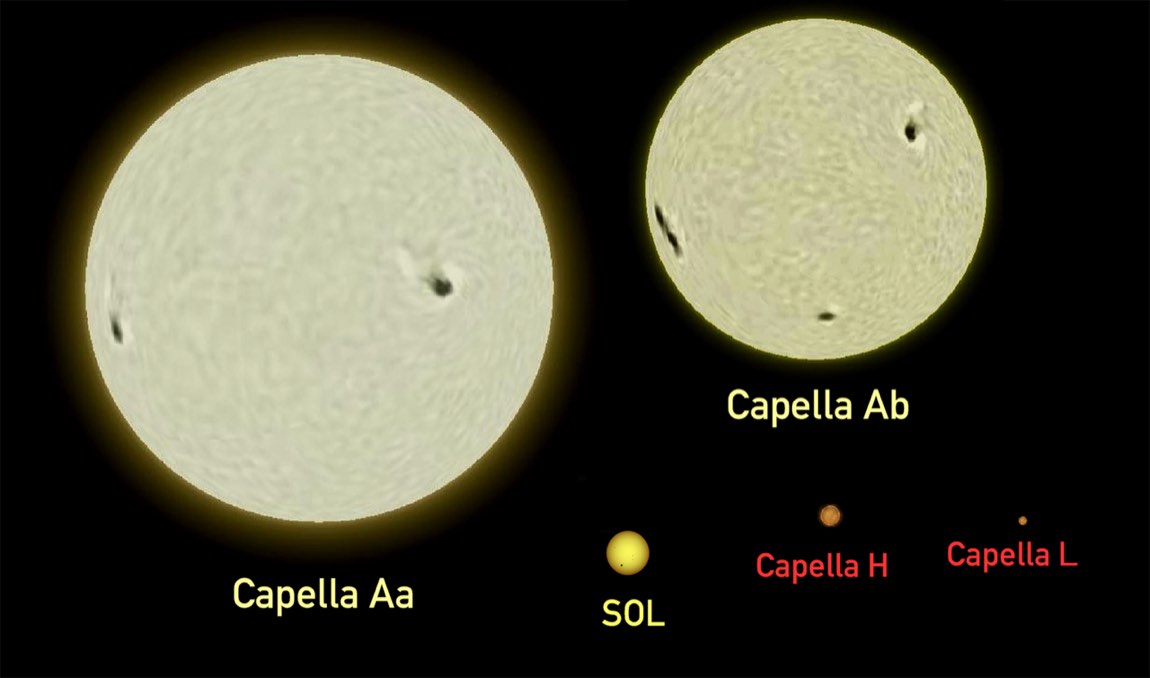
Although Capella Aa and Ab look superficially similar — both yellow giant stars of roughly 2.5 solar masses orbiting just 0.74 AU apart — they are caught at distinctly different moments in their old age. Capella Aa, the cooler and slightly larger star at 11.98±0.57 solar radii and a surface temperature of 4,970±50 K, has already completed its transition off the main sequence. It is now a red clump star, steadily fusing helium into carbon and oxygen in its core. Detailed analysis suggests it is nearing the end of even this phase and will soon begin expanding again toward the asymptotic giant branch. Capella Ab, by contrast, sits squarely in the Hertzsprung gap on the HR diagram at 8.83±0.33 solar radii and 5,730±60 K. It is a subgiant still in the brief, rapid cooling phase between the main sequence and the red giant branch — a stage Capella Aa has already passed through, when Aa swelled to a maximum radius of 36 to 38 solar radii. The two stars are estimated to be 590 to 650 million years old and during their main-sequence lives were probably hot A-type stars similar in character to Vega.
05 Spin, Tides, and a Rotationally Locked Giant Deeper
The two giant stars in Capella A spin at strikingly different speeds, which turns out to encode the story of their evolution. Capella Aa rotates with a projected equatorial velocity of just 4.1±0.4 km/s, taking 104±3 days per rotation — almost exactly the same as the pair's 104-day orbital period. This is not coincidence: tidal forces and the natural braking that comes with expanding into a giant have slowed Aa until it is rotationally locked to its orbit, much like the Moon always shows the same face to Earth. Capella Ab still spins at 35.0±0.5 km/s, completing a full rotation in only 8.5±0.2 days. This rapid spin is unusual for a giant star and is explained by Ab's position in the Hertzsprung gap — it is still adjusting its angular momentum as its convection zone deepens, which also makes its atmosphere unusually active for an RS Canum Venaticorum-type binary system. Capella has long been suspected to be slightly variable at an amplitude of about 0.1 magnitudes, occasionally shifting brighter or fainter than Rigel, Betelgeuse, and Vega, though it remains only listed as a suspected variable in the General Catalogue of Variable Stars.
06 Capella as a Premier X-ray Source Deeper
Capella is one of the brightest X-ray sources in the entire sky, a fact discovered piecemeal over more than a decade of early space astronomy. Two Aerobee-Hi rocket flights — on September 20, 1962, and March 15, 1963 — detected and confirmed an X-ray source in Auriga at approximately the position of Capella. A milestone came on April 5, 1974, when a rocket flight detected X-ray emission more than 10,000 times the X-ray luminosity of the Sun, the strongest stellar X-ray emission measured up to that time; the instrument was a reflector system operating in the 0.2–1.6 keV energy band. The system's total X-ray luminosity stands at approximately 10²⁴ W (10³¹ erg/s), four orders of magnitude above the Sun's X-ray output. The emission is attributed primarily to the corona of the most massive component, Capella Aa, and is catalogued as the ROSAT source 1RXS J051642.2+460001. Crucially, this emission comes from stable coronal structures — likely coronal loops larger than the entire Sun, heated to temperatures of several million kelvin — rather than from eruptive flares. The first coronal X-ray spectrum obtained with HEAO 1 suggested that the corona's extreme temperature would require magnetic confinement, unless it vents as a free-flowing coronal wind.
 ⤢
⤢
07 The Faint Red Dwarf Companions, H and L
About 10,000 AU from the brilliant giant pair — so far that at the scale of Robert Burnham Jr.'s model, where Aa and Ab are spheres 13 and 7 inches across separated by ten feet, the red dwarf pair would be 21 miles away — orbit two dim red dwarf stars designated Capella H and Capella L. Finnish astronomer Ragnar Furuhjelm first noticed the faint companion in 1914 by its similar proper motion to the spectroscopic binary. Carl L. Stearns observed in February 1936 that it appeared double, and Gerard Kuiper confirmed this in September of that year. The two red dwarfs carry the Gliese-Jahreiss designations GJ 195 A and B. Their separation has grown from 1.8 arcseconds at discovery in 1935 to 3.5 arcseconds by 2015, finally making a tentative orbit derivable 80 years after discovery. A 2015 analysis suggests a roughly 300-year near-circular orbit with masses of approximately 0.57 and 0.53 solar masses. An unexplained puzzle remains: the visual magnitude difference between H and L is 3.5 magnitudes, but the difference shrinks significantly at infrared wavelengths, hinting at the possible presence of additional unseen companions.
08 Finding and Watching Capella in the Night Sky
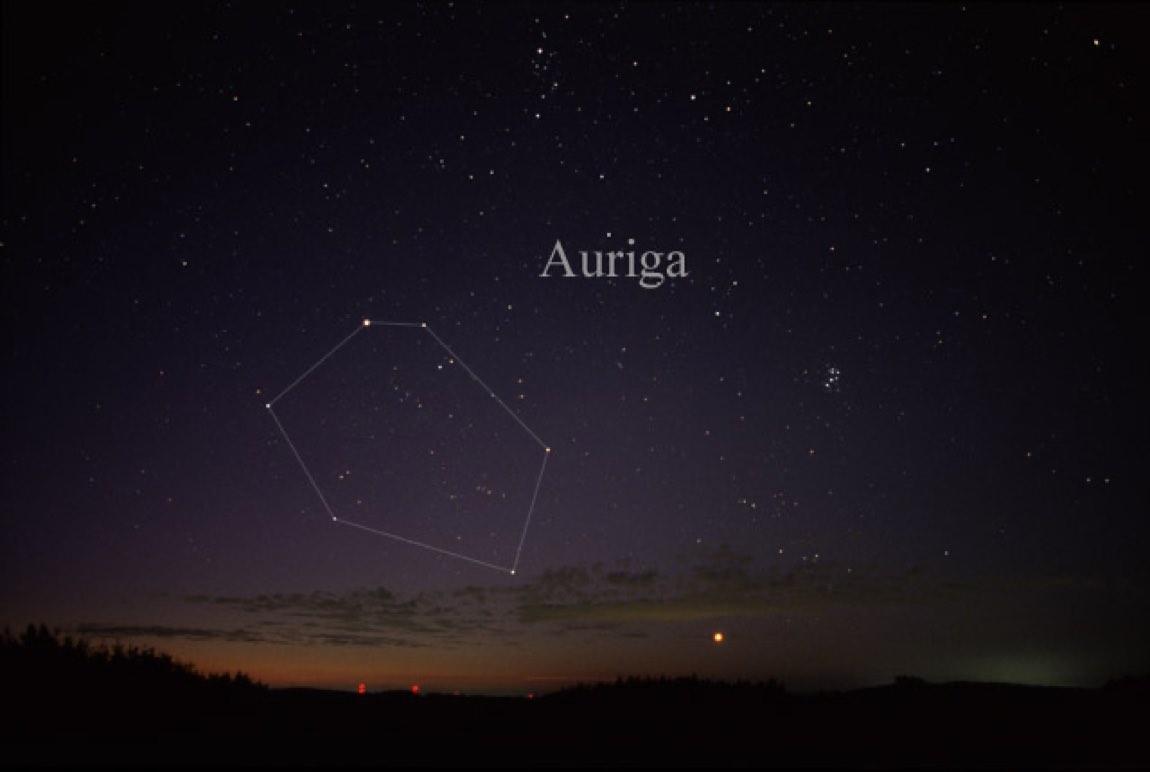
Capella is among the most accessible bright stars for northern-hemisphere observers. With an average apparent magnitude of +0.08, it is the brightest light in Auriga and outshines every star in the northern sky except Arcturus and Vega. It stands closer to the north celestial pole than any other first-magnitude star, making it circumpolar — never setting — for observers north of 44°N latitude, which includes essentially all of the United Kingdom, Canada outside part of Southern Ontario, and most of continental Europe. A useful sky trick: Capella and Vega sit on nearly opposite sides of the pole at about the same angular distance from it, so a line between the two passes almost through Polaris. Capella reaches its highest point at midnight in early December and is readily found halfway between Orion's Belt and Polaris. To the naked eye it glows a rich yellowish-white; the yellow becomes noticeably more vivid when viewed through a telescope against a blue daytime sky. A few degrees to its southwest, the stars Epsilon, Zeta, and Eta Aurigae form a recognizable asterism with it — Zeta and Eta being known as the Kids, or Haedi.
09 Measuring Distance Two Independent Ways Deeper
Capella's distance has been pinned down with exceptional precision using two independent techniques that agree remarkably well. The Hipparcos satellite measured an annual parallax shift of 76.20 milliarcseconds, with a margin of error of 0.46 milliarcseconds, placing the system at 42.8 light-years (13.12 parsecs) with an uncertainty of about 0.3 light-year. A complementary method exploits the geometry of the binary orbit itself: because the orbit's physical dimensions and angular size are both known extremely accurately, the distance can be derived without relying on parallax at all. This orbital parallax gives 42.92 light-years (13.159 parsecs) with a margin of error of only 0.1% — an order of magnitude more precise than the direct trigonometric measurement. The agreement between the two methods validates both approaches. In 1960, astronomer Olin J. Eggen analysed Capella's proper motion and parallax and concluded it belongs to the Hyades moving group, a stream of stars sharing common motion with the Hyades cluster; members of this group at around 2.5 solar masses have predictably evolved off the main sequence in step with Capella's giants.
10 Capella's Name Across Dozens of Cultures
Few stars can match Capella's diversity of cultural identities. The Latin name means "small female goat," a translation of the Greek Aἴξ (aix); the sound of aix also resembled the name of the Aegean Sea, making Capella useful for ancient weather and wind-direction rules. Arabic astronomers called it al-cayyūq and it guided Bedouin navigators toward the Pleiades. Ancient Balts named it Perkūno Ožka, "Thunder's Goat," while Slavic Macedonian tradition saw it as Jastreb, the hawk. In Hindu mythology it was the heart of Brahma, and in Chinese astronomy it served as the Second of the Five Chariots. The Incas revered it as Colça; Hawaiians incorporated it into the canoe-bailer asterism Ke Kā o Makaliʻi for ocean navigation; and Tahitian lore made it the wife of the sky figure Fa'a-nui. In the Marshall Islands it was Lōktañūr, mother of ten sons. The Boorong people of Victoria, Australia, knew it as Purra the kangaroo, and Inuit communities from Alaska to western Greenland placed it in Quturjuuk, the collar-bones constellation, used for navigation and timekeeping through the polar night.
11 Open Questions and Ongoing Puzzles Deeper
Despite being one of the most intensively studied stellar systems in the sky, Capella still harbors genuine mysteries. The brightness difference between the two red dwarfs H and L is 3.5 magnitudes in visible light but shrinks substantially in the infrared passband of the Gaia spacecraft, a discrepancy that may indicate one or both stars have additional unseen companions. The orbital parameters for the HL pair remain tentative even 80 years after Kuiper's confirmation of its duplicity, and mass estimates have swung widely — a 1975 analysis using an eccentric 388-year orbit gave masses of 0.65 and 0.13 solar masses, while a 2015 near-circular 300-year orbit suggested 0.57 and 0.53 solar masses, a dramatically different result. For the main pair, the corona of Capella Aa is so hot that early HEAO 1 observations implied the plasma would need magnetic confinement to remain bound, yet whether it is truly confined or escapes as a coronal wind remains unresolved. Capella's classification as a suspected RS Canum Venaticorum variable is still tentative, and its mild brightness variations — about 0.1 magnitudes — have not been pinned to a definitive physical mechanism.
 ⤢
⤢