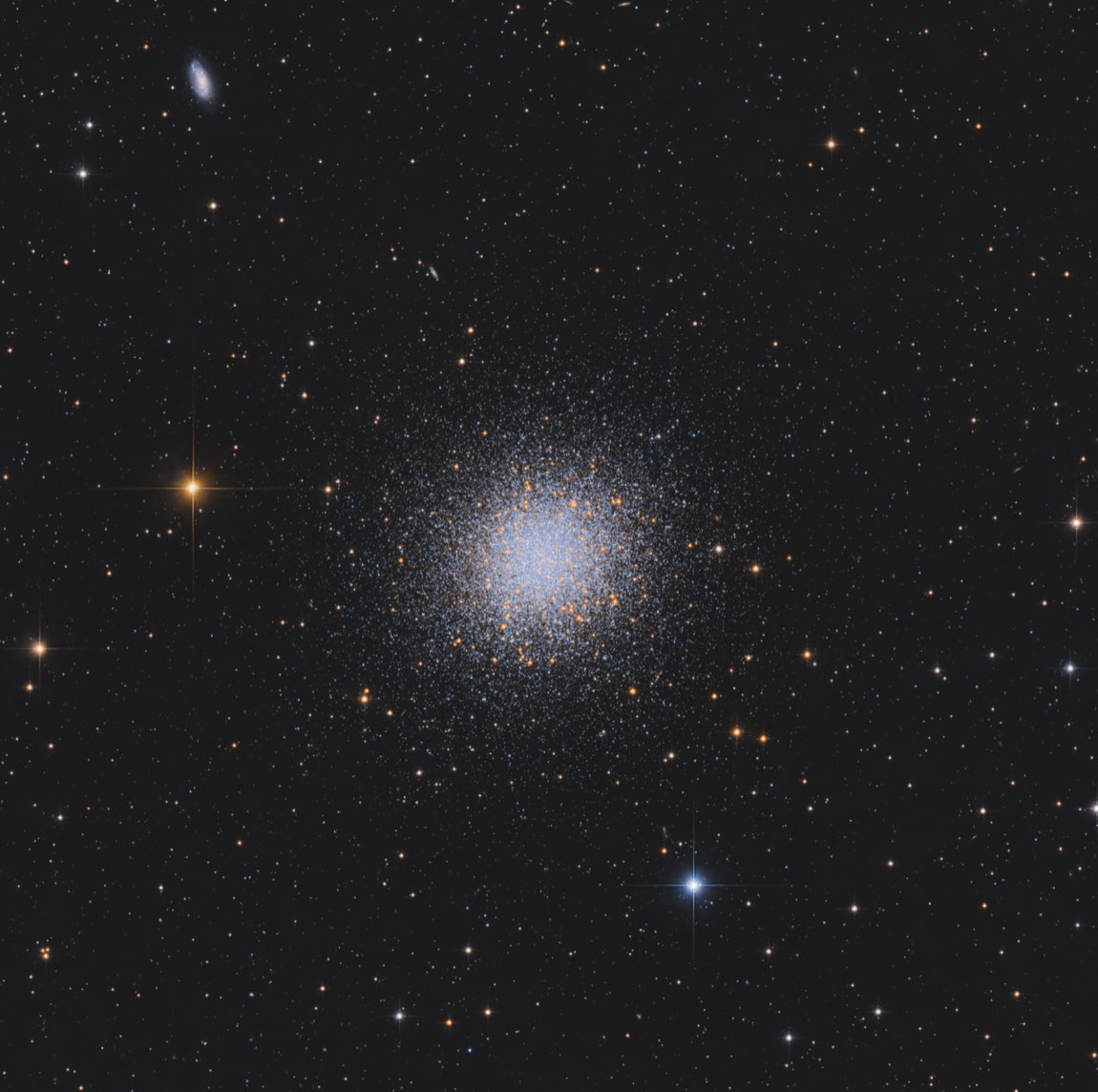
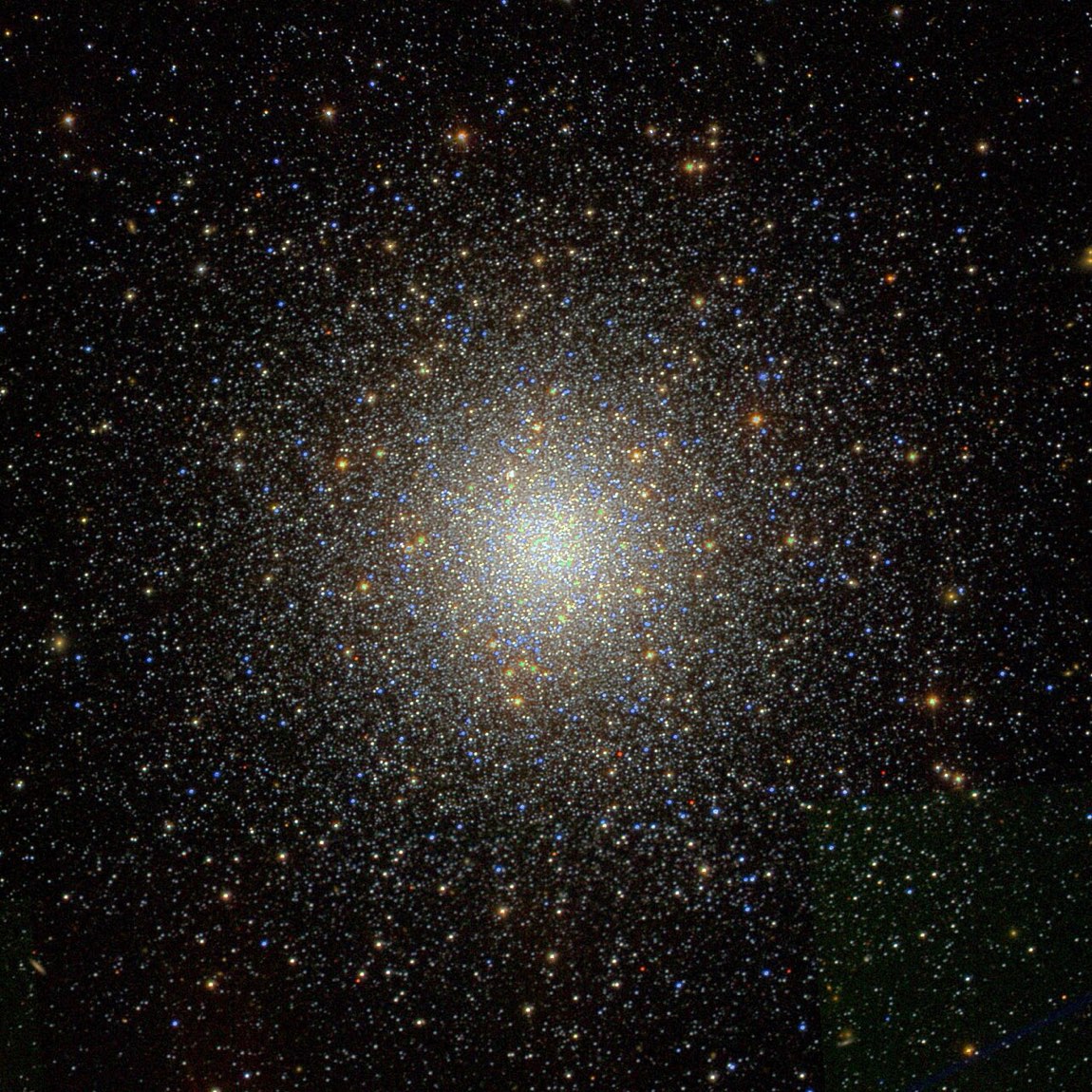
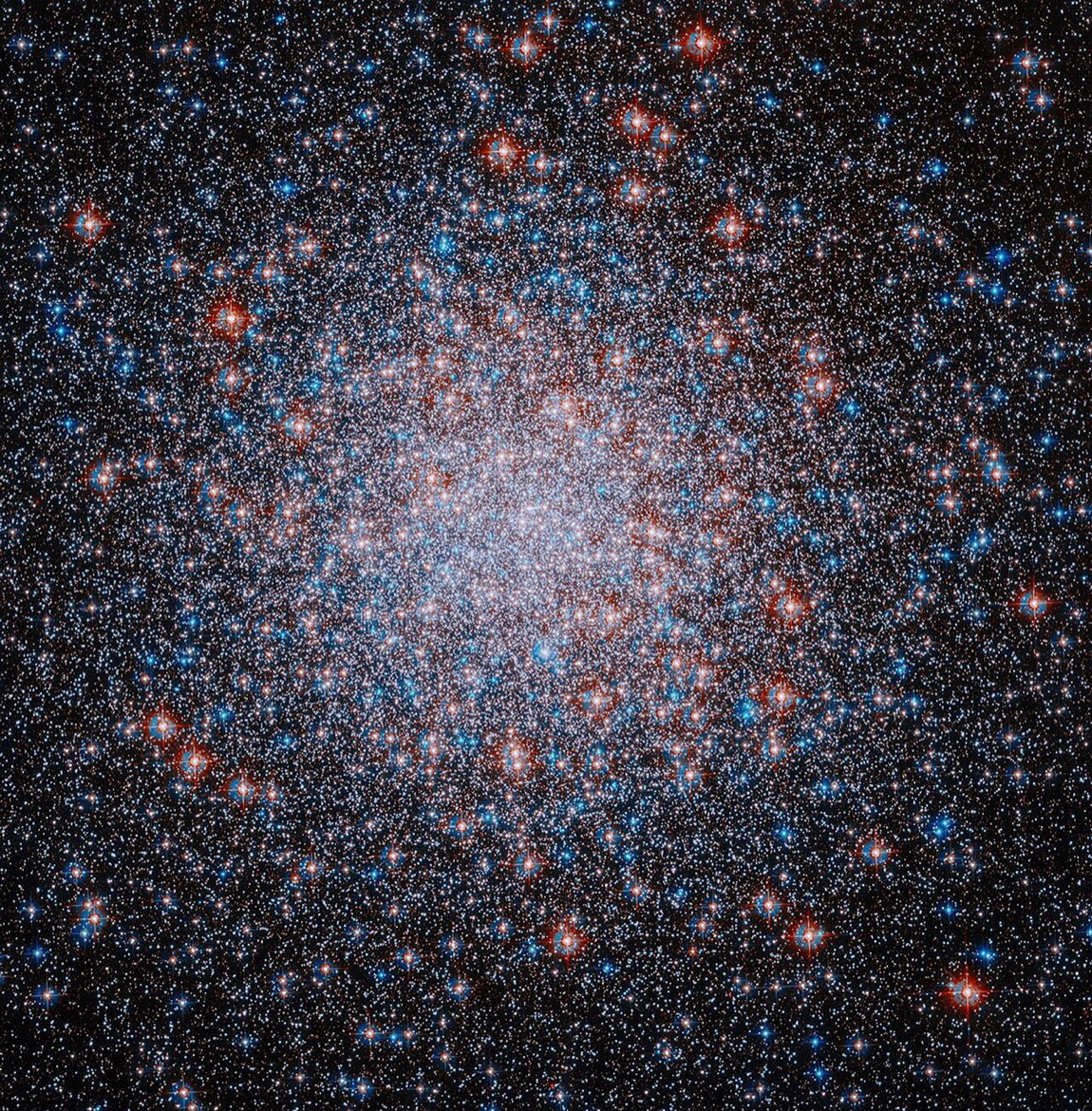
 Photograph · NASA, ESA, and A. Sarajedini (Florida Atlantic University); Processing: Gladys K · Public domain
Star Cluster · Deep guide
Messier 3
Also called: M3 · NGC 5272
Around half a million stars swarming together high above the Milky Way's disk.
What is it?
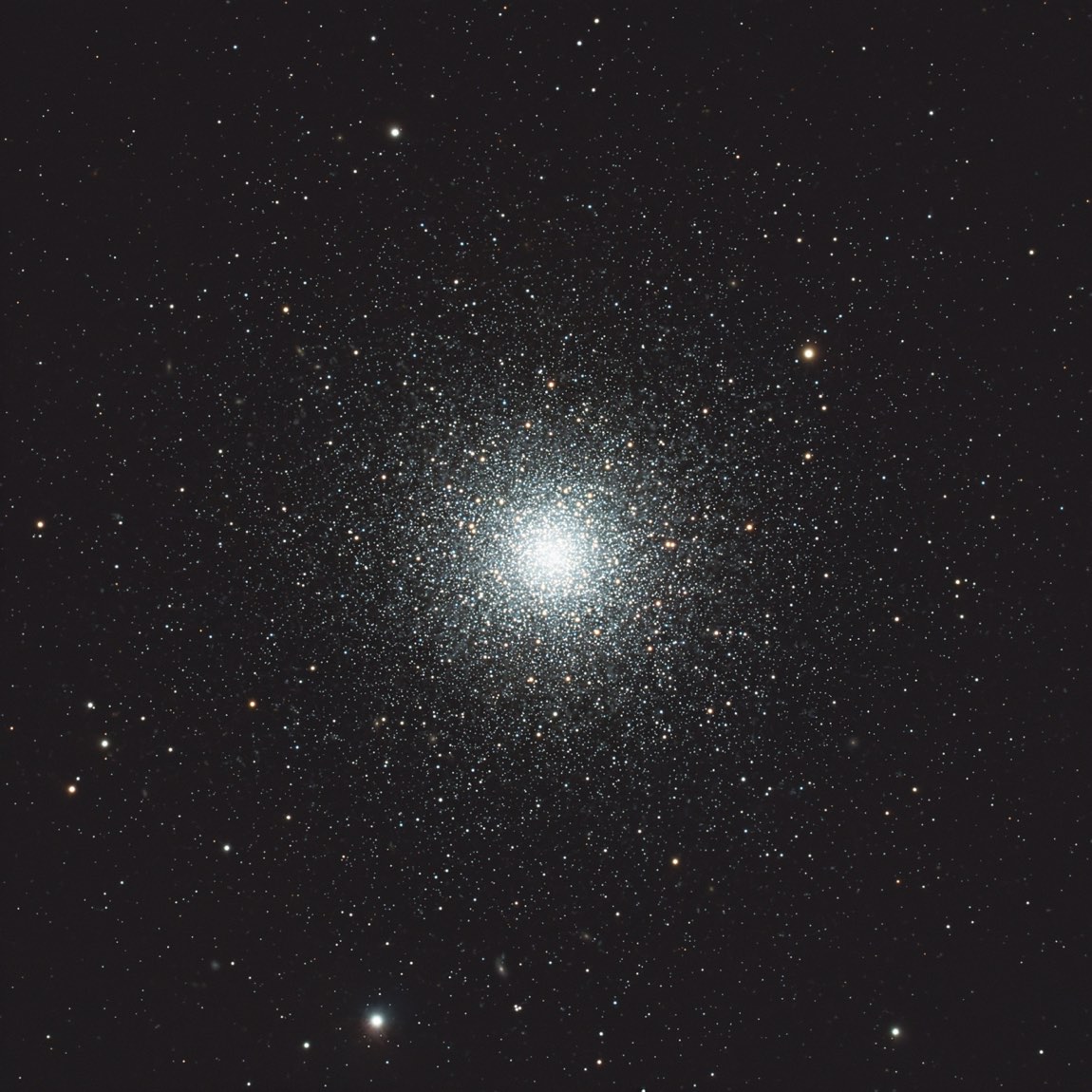
Messier 3 is one of the largest and brightest globular clusters in the sky, found in the small northern constellation Canes Venatici. It contains roughly 500,000 stars, all bound together in a sphere by their shared gravity. Its light has travelled for nearly 34,000 years to reach us. With binoculars it looks like a fuzzy star, while a modest telescope begins to break its edges into countless individual points of light.
The deep dive
Researched for the Atlas from Wikipedia — Messier 3 (2,561 characters read) · updated Nov 15, 2026
01 The Night Messier Got It Wrong
On May 3, 1764, Charles Messier pointed his telescope toward Canes Venatici and logged a fuzzy patch he believed was a nebula without stars. It was the first object he personally discovered for his now-famous catalog, but his interpretation was completely wrong. The blur was not a cloud of gas but a tightly packed ball of roughly 500,000 suns. The mistake stood uncorrected for about two decades until William Herschel turned his more powerful instrument on the same spot around 1784 and resolved individual stars within it. That single correction transformed M3 from a curiosity into a landmark. Since Herschel's resolution of its stellar nature, M3 has grown into one of the most intensively studied globular clusters in the sky, serving as a benchmark object against which theories of stellar evolution and cluster dynamics are continually tested.
02 A Century of Counting Variable Stars Deeper
What truly sets M3 apart from every other globular cluster is its extraordinary population of variable stars — stars whose brightness rises and falls in measurable cycles. The systematic hunt for them began in 1913 when American astronomer Solon Irving Bailey started cataloging M3's unusually large variable star population, and new members continue to be identified as recently as 2025, more than a century later. The current tally stands at 274 known variable stars, by far the most found in any globular cluster. Among these, 133 are RR Lyrae variables, a class of pulsating giant stars that astronomers prize as "standard candles" because their intrinsic brightness can be predicted from their pulsation period. The sheer number of these stars in a single cluster makes M3 an irreplaceable laboratory for studying how RR Lyrae stars age, mix, and evolve over billions of years.
03 The Blazhko Effect: A Puzzle Within a Puzzle Deeper
Of M3's 133 RR Lyrae variables, about a third display what is called the Blazhko effect — a long-period modulation layered on top of their normal pulsation cycle. In plain terms, these stars do not simply brighten and dim like a steady heartbeat; instead, the shape and size of each pulse changes slowly over weeks or months in a pattern that is not yet fully understood. The Blazhko effect has been debated by astronomers for over a century, and M3's exceptionally rich RR Lyrae population makes it one of the best places to study it. Having dozens of Blazhko-exhibiting stars in one cluster means researchers can compare stars at similar ages and chemical compositions, isolating the effect from confounding variables that would plague single-star studies. The cluster thus functions as a controlled experiment that the universe has helpfully assembled in one patch of sky.
04 M3 as a Prototype: The Oosterhoff Classification Deeper
Globular clusters are sorted into families based partly on the average period of their RR Lyrae variables, a scheme called the Oosterhoff classification. Messier 3 is the defining prototype for Oosterhoff type I clusters, the category considered relatively "metal-rich." In astronomy, metallicity refers to the overall abundance of all elements heavier than hydrogen and helium, and for M3 this value ranges from −1.34 to −1.50 dex. Because this is expressed as a logarithm relative to the Sun, the actual proportion is only 3.2 to 4.6 percent of the solar abundance — still metal-poor by everyday standards, but rich compared to most globular clusters. This distinction matters because a cluster's metallicity reflects the chemical state of the early universe when the cluster formed, and Oosterhoff type I clusters like M3 appear to have drawn from gas that was slightly more chemically evolved than their type II counterparts.
05 How Old Is M3, and What Does That Mean?
M3 is estimated to be 11.4 billion years old. For context, the entire Solar System is about 4.6 billion years old, meaning M3 was already ancient — roughly 7 billion years into its life — when the Sun first ignited. At that age, the cluster formed when the universe itself was still in its early chapters, long before most of the Milky Way's disk had assembled into its present shape. Stars inside M3 have therefore had an enormous span of time to evolve, shed mass, and interact gravitationally with one another. Many of its original massive stars burned through their fuel billions of years ago and have long since vanished, leaving behind a population dominated by lower-mass stars that burn slowly and steadily. Studying the mix of stellar types that survive today gives astronomers a direct window into stellar evolution stretched across timescales that no laboratory experiment could replicate.
06 M3's Lonely Address Above the Galaxy
M3 does not sit nestled within the crowded disk of the Milky Way. It orbits far above the galactic plane — 31.6 thousand light-years above it, to be precise — in the sparsely populated halo that surrounds the entire galaxy. Its distance from the galactic center is roughly 38.8 thousand light-years, and its distance from Earth is 33.9 thousand light-years, with the article's characteristics section placing the central distance at 32,600 light-years. This isolation means M3 experiences relatively little gravitational disruption from the dense structures of the galactic disk, such as giant molecular clouds and spiral arms, that can gradually pull globular clusters apart over time. This relatively sheltered existence in the halo may help explain why M3 has survived largely intact for over 11 billion years, retaining its enormous stellar population rather than being shredded into stellar streams.
07 Size and Structure Through a Telescope
Through a telescope with a 25 cm (9.8 in) aperture, M3 reveals a bright, condensed core spanning about 6 arcminutes in diameter, with the full cluster extending to roughly double that — approximately 12 arcminutes across. To put that in perspective, the full Moon is about 30 arcminutes wide, so M3's outer halo spans roughly two-fifths of a lunar diameter as seen from Earth. The cluster contains around 500,000 stars packed into that apparent span, which corresponds to an actual physical volume that is enormous yet gravitationally bound into a coherent sphere. The bright core visible in a telescope represents the most densely populated central region, where stellar encounters and gravitational interactions are most frequent. The gradual fade toward the cluster's outer halo reflects the decreasing stellar density at greater distances from the center.
08 How and Where to Find M3 Tonight
M3 sits in the northern constellation Canes Venatici, the Hunting Dogs, and finding it without a detailed star chart is surprisingly straightforward. The easiest method is to locate two bright stars: Arcturus, the brilliant orange giant designated Alpha Boötis, and Cor Caroli, the brightest star in Canes Venatici and designated Alpha Canum Venaticorum. M3 lies almost exactly halfway along the imaginary line connecting these two stars in a north-west direction from Arcturus. With an apparent magnitude of 6.2, the cluster sits right at the threshold of naked-eye visibility, requiring dark skies and averted vision to glimpse without optical aid. Even a small telescope cuts through significant light pollution and shows M3 as a cloudy smudge. Many amateur astronomers rank it as the finest northern globular cluster after Messier 13, making it a rewarding target across a wide range of observing conditions and equipment levels.
09 Why Variable Stars Make M3 a Standard-Setter Deeper
RR Lyrae variables are among astronomy's most important distance-measuring tools. Because the relationship between their pulsation period and intrinsic luminosity is well established, astronomers can compare how bright an RR Lyrae star appears against how bright it actually is and derive a precise distance. Having 133 such stars concentrated in a single object like M3 means that multiple independent distance estimates can be averaged together, dramatically reducing measurement uncertainty. This is part of why M3 has become one of the best-studied globular clusters since Herschel resolved its stars in around 1784. It offers statistical power that isolated field RR Lyrae stars simply cannot provide. The cluster has therefore played a foundational role in calibrating the cosmic distance ladder — the chain of overlapping techniques astronomers use to measure distances across the universe — and ongoing discoveries of new variable members through 2025 continue to refine that calibration.
10 What Makes a Globular Cluster "Metal-Rich"? Deeper
Calling M3 metal-rich requires some unpacking, because its metallicity of −1.34 to −1.50 dex means its stars contain only 3.2 to 4.6 percent of the heavy-element abundance found in the Sun. By any everyday standard, that is extraordinarily metal-poor. However, within the population of globular clusters — which were among the first structures to form in the universe, when heavy elements were even rarer — M3 sits on the relatively enriched end of the spectrum. The dex scale expresses metallicity as a base-10 logarithm: a value of −1.34 means the actual abundance is 10 raised to the power of −1.34 relative to the Sun. This logarithmic compression is necessary because the range of metallicities across different astronomical objects spans many orders of magnitude. M3's moderate metal content, relative to other globulars, is part of what defines it as the prototype Oosterhoff type I cluster and distinguishes it from older, more pristine type II systems.
11 Open Questions That Keep Researchers Busy Deeper
Despite more than two centuries of study, M3 continues to generate active research. The nature of the Blazhko effect among its RR Lyrae stars remains incompletely understood, and the ongoing discovery of new variable stars as recently as 2025 shows that the cluster's census is still not complete. The precise metallicity is given as a range — −1.34 to −1.50 dex — rather than a single agreed value, reflecting genuine uncertainty in the measurements and methods used to determine elemental abundances in distant stars. Questions about the cluster's internal dynamics, including how stars in the dense core exchange energy and angular momentum over billions of years, are also active areas of inquiry. M3's role as the Oosterhoff type I prototype means that any revision in its measured properties ripples outward, potentially redefining how dozens of other clusters are categorized and interpreted across the broader field of stellar population studies.
 ⤢