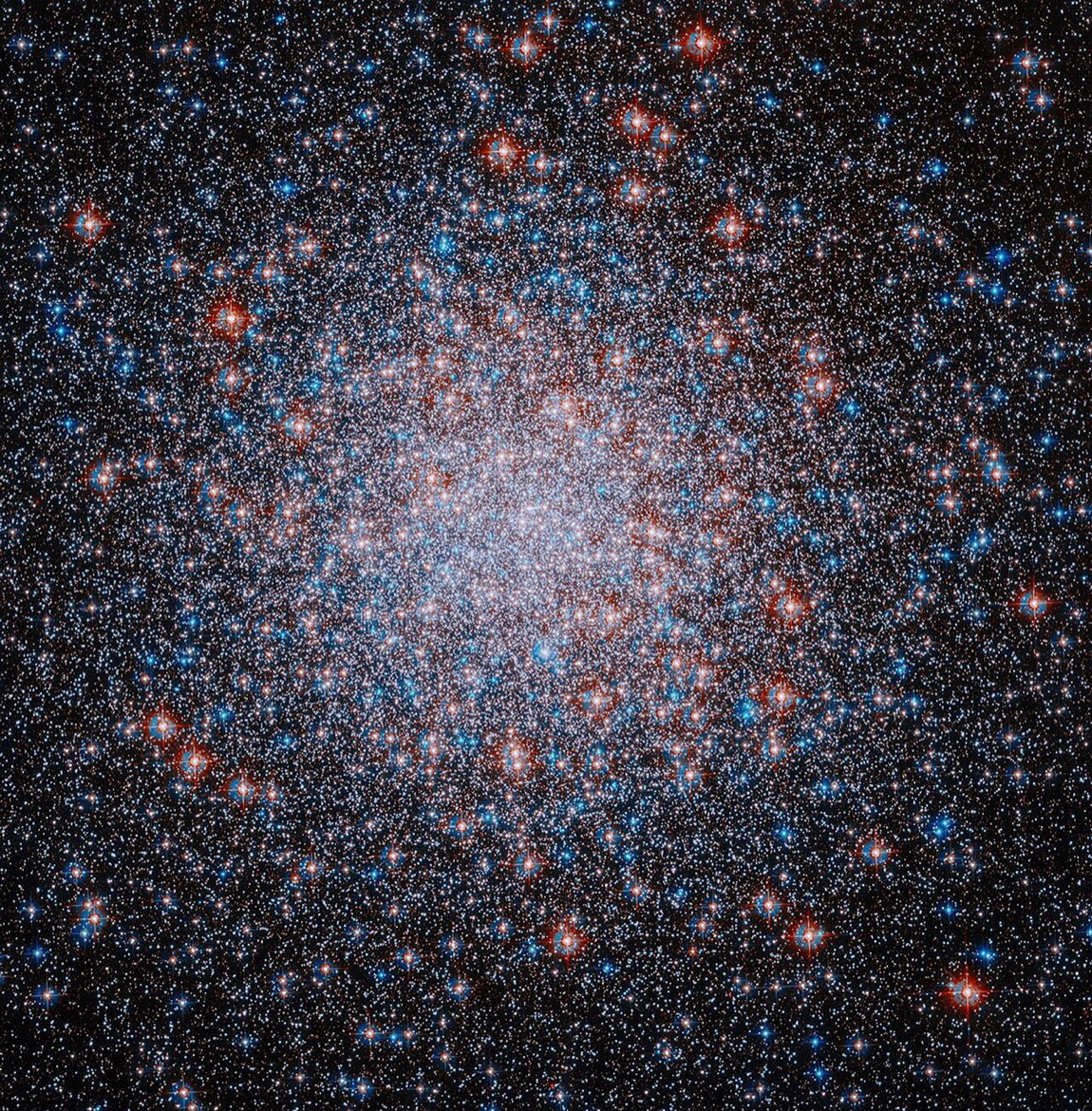
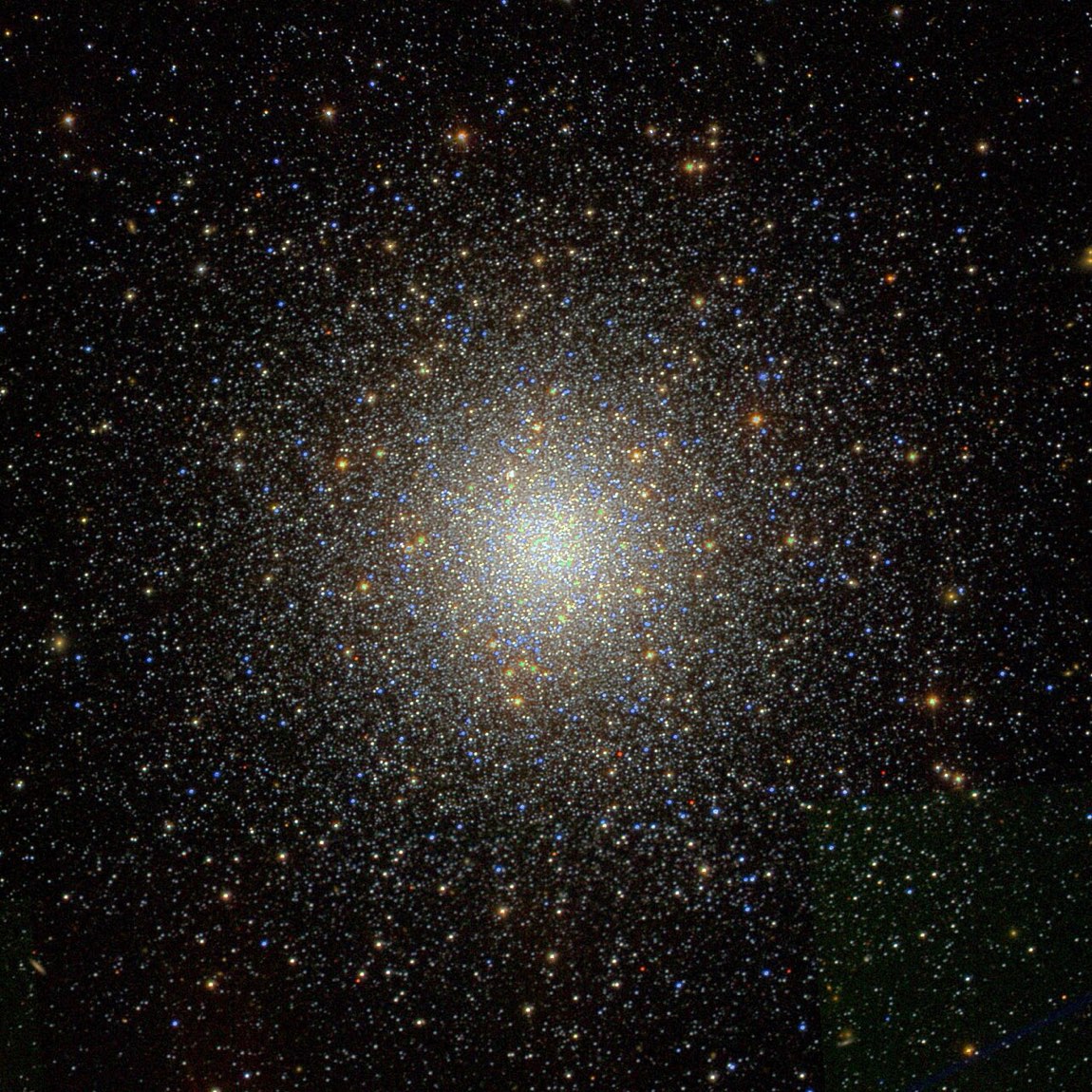
 Photograph · Sloan Digital Sky Survey · CC BY 4.0
Star Cluster · Deep guide
Messier 53
Also called: M53 · NGC 5024
A remote globular cluster that may be linked to its neighbour by a bridge of stars.
What is it?
Messier 53 is a globular cluster in Coma Berenices, discovered by Johann Elert Bode in 1775. It lies about 58,000 light-years away, roughly as far from us as from the Galactic Center. It is poor in heavy elements and was once thought to be the most metal-poor cluster in the Milky Way. Most of its giant stars belong to the first generation of stars formed there. A bridge-like stream of stars appears to connect it to the nearby globular NGC 5053, a possibly unique interaction in our galaxy.
The deep dive
Researched for the Atlas from Wikipedia — Messier 53 (1,590 characters read) · updated Nov 15, 2026
01 Who first spotted M53 and when
Messier 53 was discovered by the German astronomer Johann Elert Bode in 1775, placing its first recorded observation in the era of hand-drawn star atlases and modest refractors. Bode is best remembered today for the numerical pattern called Titius–Bode's law, but he was also a tireless cataloguer of deep-sky objects. The cluster sits in Coma Berenices, a faint but rewarding constellation that lacks bright stars yet rewards patient observers with a region unusually rich in galaxies and clusters. Because Coma Berenices rides high above the galactic plane, the obscuring dust that hides so many clusters along the Milky Way's equator is largely absent here, giving observers a relatively clear line of sight across tens of thousands of light-years to M53's glittering core.
02 A surprisingly metal-poor stellar city Deeper
Chemical composition is one of the most telling fingerprints a globular cluster carries from its birth. Astronomers measure the abundance of elements heavier than helium — collectively called metals — relative to hydrogen, and M53 scores extremely low on that scale. It was at one time considered the most metal-poor globular cluster in the entire Milky Way, a title that speaks to its extreme antiquity and its formation from gas that had been processed by very few previous stellar generations. Metal-poor clusters are prized because they represent the universe closer to its primordial hydrogen-and-helium state. The fact that M53 no longer holds the record does not diminish its scientific value; it remains a benchmark object for studies of early chemical enrichment in the Galaxy, and its stellar compositions are described as broadly similar to stars found throughout the Milky Way's halo — the vast, ancient, sparsely populated sphere surrounding the galactic disk.
03 First-generation stars dominate the red giants Deeper
Inside most globular clusters a generational drama has played out over billions of years. Early stars explode or shed mass, enriching the local gas, and a second wave of stars forms from that recycled material — often more centrally concentrated than their predecessors. M53 is unusual because most of its red giant branch stars are first-generation objects, meaning they formed directly from the original gas cloud rather than from chemically enriched leftovers. This flips the typical pattern seen in the majority of Milky Way globular clusters, which are dominated by second-generation stars. Where second-generation stars do exist in M53, they tend to cluster toward the core region rather than spreading evenly throughout. Understanding why M53 ended up so first-generation-heavy is an active area of inquiry, touching on questions about the mass of the original cluster, its star-formation efficiency, and how much gas was available for a second round of star birth.
04 Size, position, and place in the Galaxy
M53 spans a physical diameter of about 12 parsecs — roughly 39 light-years, or about 370 trillion kilometres, end to end. Despite that impressive girth, it is a compact, gravitationally bound ball of stars rather than the sprawling, loosely associated groups called open clusters. Its location is doubly interesting: it sits approximately 60,000 light-years from the Galactic Center and very nearly the same distance — about 58,000 light-years — from our own Solar System. That near-symmetry places it on the far side of the Galaxy's halo from our perspective, yet still well within the Milky Way's gravitational reach. Its position high above the galactic plane, in Coma Berenices, is consistent with membership in the halo population, the ancient stellar constituency that surrounds the galactic disk like a vast, diffuse shell.
05 Tidal tails stretching east and west
As a globular cluster orbits the Milky Way, the Galaxy's gravitational field tugs differently on stars at the cluster's near side versus its far side, gradually pulling stars away and stringing them along the orbital path. M53 shows clear evidence of this process. It displays tidal features that include clumps, ripples, and actual tails extending in an east–west direction along its orbit. These tails are not tight structures but rather diffuse streamers of stars that have been gently liberated from the cluster's grip over long timescales. Mapping such features requires careful subtraction of background stars and meticulous photometry, but their detection tells astronomers about the cluster's mass, its orbital history, and how vigorously the Galaxy has been stripping it. The tails also provide a tracer of M53's past trajectory through the halo.
06 A tidal bridge linking two clusters
Perhaps the most striking feature associated with M53 is a tidal bridge-like structure that appears to connect it with the nearby globular cluster NGC 5053. Beyond the bridge, observations suggest a shared stellar envelope surrounding both clusters together. This kind of physical linkage between two independent globular clusters is considered potentially unique within the Milky Way — a distinction that makes the M53–NGC 5053 pair a high-priority target for dynamical studies. The bridge implies that a genuine tidal interaction has occurred between the two clusters, meaning their gravitational fields have influenced each other's outer stellar populations. Whether this interaction is ongoing or represents the aftermath of a close passage in the past is an open question. The sheer rarity of such a configuration makes it valuable for testing models of how globular clusters evolve when they are not isolated.
07 Possible link to the Sagittarius stream Deeper
The Sagittarius dwarf galaxy is a small companion galaxy that the Milky Way has been consuming for billions of years. As it has been shredded by tidal forces, the Sagittarius dwarf has left behind a vast stream of stars wrapping around the Galaxy. M53 is listed as a candidate member of this Sagittarius dwarf galaxy tidal stream, which would mean the cluster did not originally form inside the Milky Way at all — it would instead be an immigrant, torn away from the Sagittarius system and deposited into the Milky Way's halo. Candidate status means the evidence is suggestive but not conclusive; establishing membership typically requires matching the cluster's position, distance, and velocity to the stream's known properties. If confirmed, M53's origin story would be rewritten from a native halo cluster to a trophy of galactic cannibalism.
08 Variable stars as cosmic measuring sticks
M53 contains a rich population of variable stars, and the most numerous class is the RR Lyrae type, with 55 confirmed members. RR Lyrae stars are old, pulsating giants whose period of brightness variation is tightly linked to their intrinsic luminosity, making them standard candles — objects of known brightness that astronomers can use to measure distances across the Galaxy. Having 55 of them in one cluster is a substantial sample, useful for pinning down M53's distance independently and for studying how pulsation properties vary in a metal-poor environment. In addition to the RR Lyrae variables, the cluster hosts at least three variables of the type SX Phoenicis, which are lower-mass, shorter-period pulsators. There is also a semi-regular red giant variable, which pulsates in a less predictable, more complex rhythm tied to processes occurring in its extended outer atmosphere.
09 SX Phoenicis stars: the exotic minority Deeper
Among M53's variable stars, the at least three SX Phoenicis variables deserve separate attention. SX Phe stars are a subclass of pulsating variable found preferentially in metal-poor environments — globular clusters and the halo — which is exactly the setting M53 provides. They oscillate with periods typically measured in hours rather than the day-scale periods of RR Lyrae stars, and they are thought to include so-called blue straggler stars: objects that appear younger and bluer than the cluster's main population, possibly because they gained mass through stellar mergers or mass transfer from a binary companion. Finding SX Phe variables therefore opens a window onto the binary and merger history of the cluster. Their presence alongside the dominant RR Lyrae population and the semi-regular red giant gives M53 a diverse variable-star census that continues to reward photometric monitoring campaigns.
10 How to find and observe M53
Messier 53 sits in Coma Berenices, a constellation best seen on spring evenings from the Northern Hemisphere when it climbs high overhead. The cluster's apparent magnitude makes it accessible to binoculars under dark skies, where it appears as a small, unresolved fuzzy patch. A modest telescope — 15 to 20 centimetres of aperture — begins to show a concentrated core surrounded by a hazy envelope, and larger instruments start to resolve individual stars toward the edges. Its position above the galactic plane means relatively low dust extinction, which preserves the cluster's apparent brightness and colour. Observers willing to push their optics can look for the nearby NGC 5053 in the same field of view; spotting both objects together and contemplating the tidal bridge hypothesised to connect them adds a layer of physical meaning to what might otherwise seem like two separate smudges of ancient starlight.
11 Open questions still surrounding M53 Deeper
Despite decades of study, M53 leaves several questions unresolved. The nature of the tidal bridge connecting it to NGC 5053 — whether it represents an ongoing interaction or a historical close encounter — has not been definitively settled, and the claim that this pairing is unique in the Milky Way awaits confirmation as surveys of other cluster pairs improve. The candidate membership in the Sagittarius tidal stream remains unconfirmed; a positive result would significantly change interpretations of the cluster's age, formation environment, and chemical history. The dominance of first-generation stars over second-generation stars also invites explanation: did M53 simply fail to form many second-generation stars, or did it once have more and lose them preferentially over time? Each of these threads connects to broader unsolved problems in galactic archaeology and the formation of the Milky Way's halo.