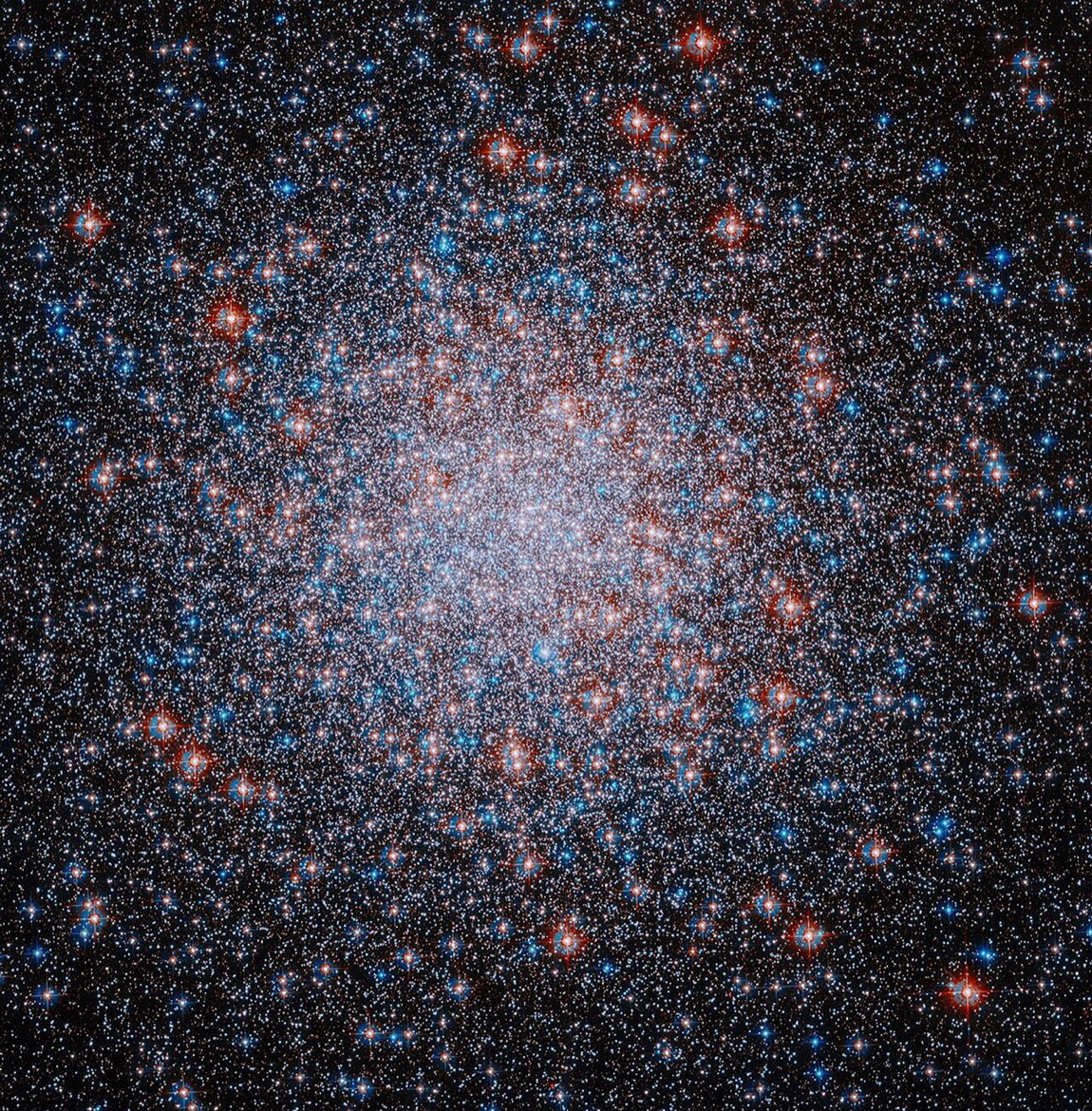
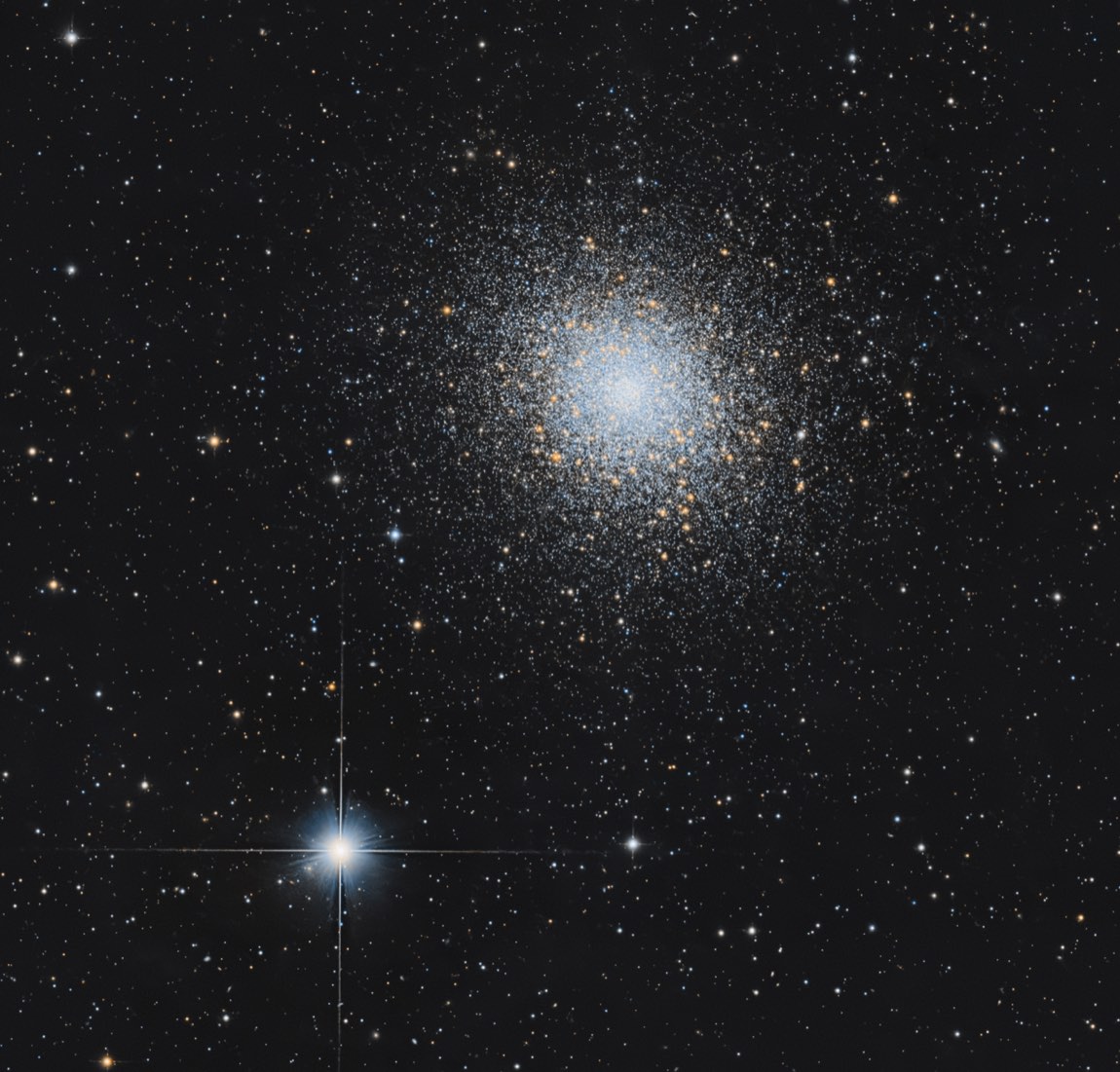
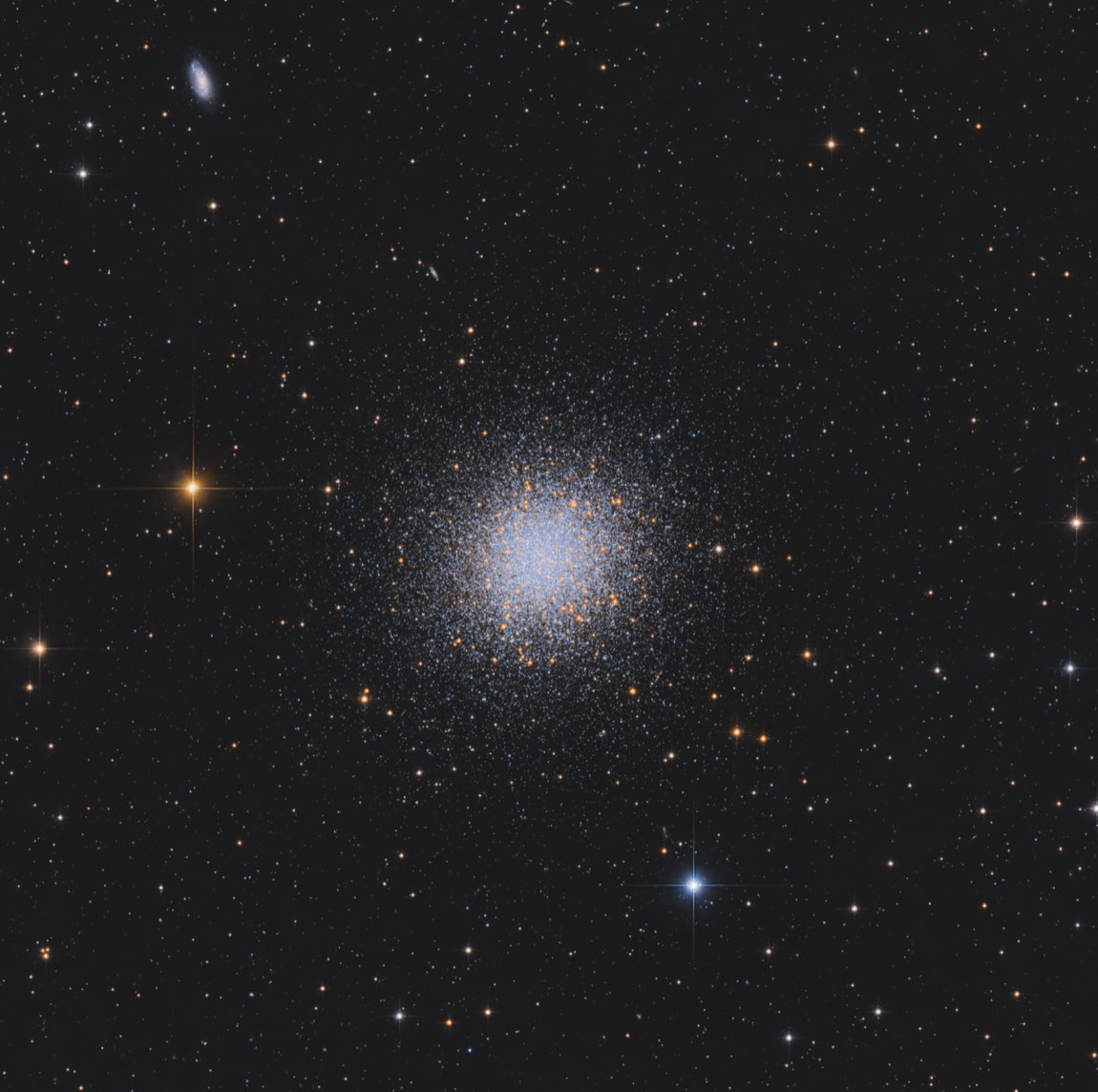
 Photograph · Chuck Ayoub · CC0
Star Cluster · Deep guide
Messier 13 (Hercules Globular Cluster)
Also called: M13 · NGC 6205 · Great Globular Cluster in Hercules · Hercules Globular Cluster
Several hundred thousand stars packed into a ball you can spot from a dark backyard.
What is it?
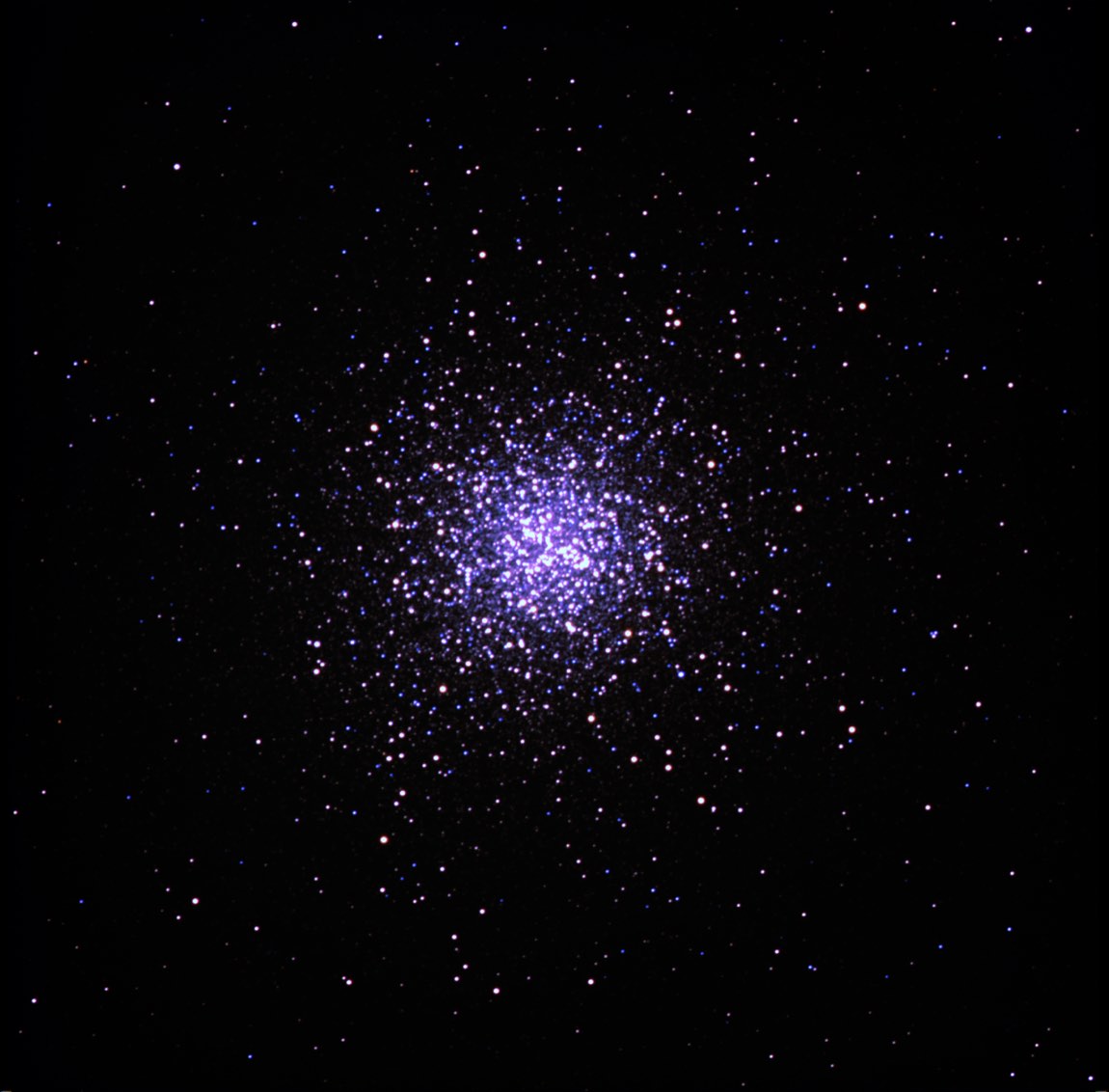
Messier 13 is the showpiece globular cluster of northern skies, sitting in the Keystone pattern of Hercules. Edmond Halley discovered it in 1714 and Messier catalogued it in 1764. It holds several hundred thousand stars about 24,000 light-years away, and their ages are around 11.6 billion years. On dark nights it can just be seen with the naked eye using averted vision, binoculars show a round glow, and a small telescope starts to reveal individual stars at its edges.
The deep dive
Researched for the Atlas from Wikipedia — Messier 13 (5,436 characters read) · updated Nov 15, 2026
01 Halley, Messier, and a Case of Mistaken Identity
Messier 13 has a two-part discovery story that says a great deal about how science actually works. Edmond Halley — the same astronomer famous for the comet bearing his name — first spotted the cluster in 1714, noting a faint, hazy glow in Hercules. Nearly half a century later, on June 1, 1764, Charles Messier cataloged it as object number 13 in a list he was building not to celebrate great objects of the sky, but to avoid confusing them with comets. Fuzzy, stationary blobs were the bane of comet hunters, and Messier wanted them flagged and dismissed. What he dismissed as a nuisance became one of the most studied stellar systems in the northern sky. The catalog that grew from that practical frustration — now known simply as the Messier catalog — eventually became a cornerstone of amateur and professional astronomy alike. It is a remarkable irony that an anti-comet cheat sheet turned into a celebrated roadmap of deep-sky wonders.
02 Finding M13 in the Summer Sky
Locating Messier 13 begins with the Keystone asterism, a rough trapezoid of four bright stars that marks the broad torso of the mythological hero Hercules. Once you have the Keystone in view, M13 sits about two-thirds of the way north — tilted slightly west — along the line from Zeta to Eta Herculis. With an apparent magnitude of 5.8, the cluster sits right at the edge of naked-eye visibility; on a genuinely dark, moonless night, averted vision — looking slightly to the side of the target — can tease it out as the faintest of smudges. Through traditional binoculars it becomes a bright, round patch that is unmistakably non-stellar. A small telescope with at least four inches of aperture begins to resolve individual stars in the cluster's outer regions as tiny pinpoints. Reaching the denser core demands larger instruments. Observers above latitude 36 degrees north can follow M13 throughout the entire year, with the longest and most convenient viewing windows falling during Northern Hemisphere spring and summer.
03 The Neighborhood Around the Cluster
Messier 13 does not sit alone in its patch of sky. Twenty-eight arcminutes directly to the northeast — a distance less than the apparent width of the full Moon — lies NGC 6207, a 12th-magnitude edge-on galaxy. The two objects make a compelling pairing for telescope observers, since they can often share the same field of view, dramatically illustrating the difference in scale and distance between a globular cluster within our own galaxy and an entirely separate spiral system far beyond it. Nestled roughly halfway between NGC 6207 and M13, north-northeast of the globular's center, is the smaller galaxy IC 4617. At low magnification, two seventh-magnitude stars bracket M13 on either side, acting as convenient guide markers and lending the view a sense of framed depth. This rich local field rewards the observer who takes time to sweep around rather than simply centering on the headline object.
04 Stars So Dense They Collide Deeper
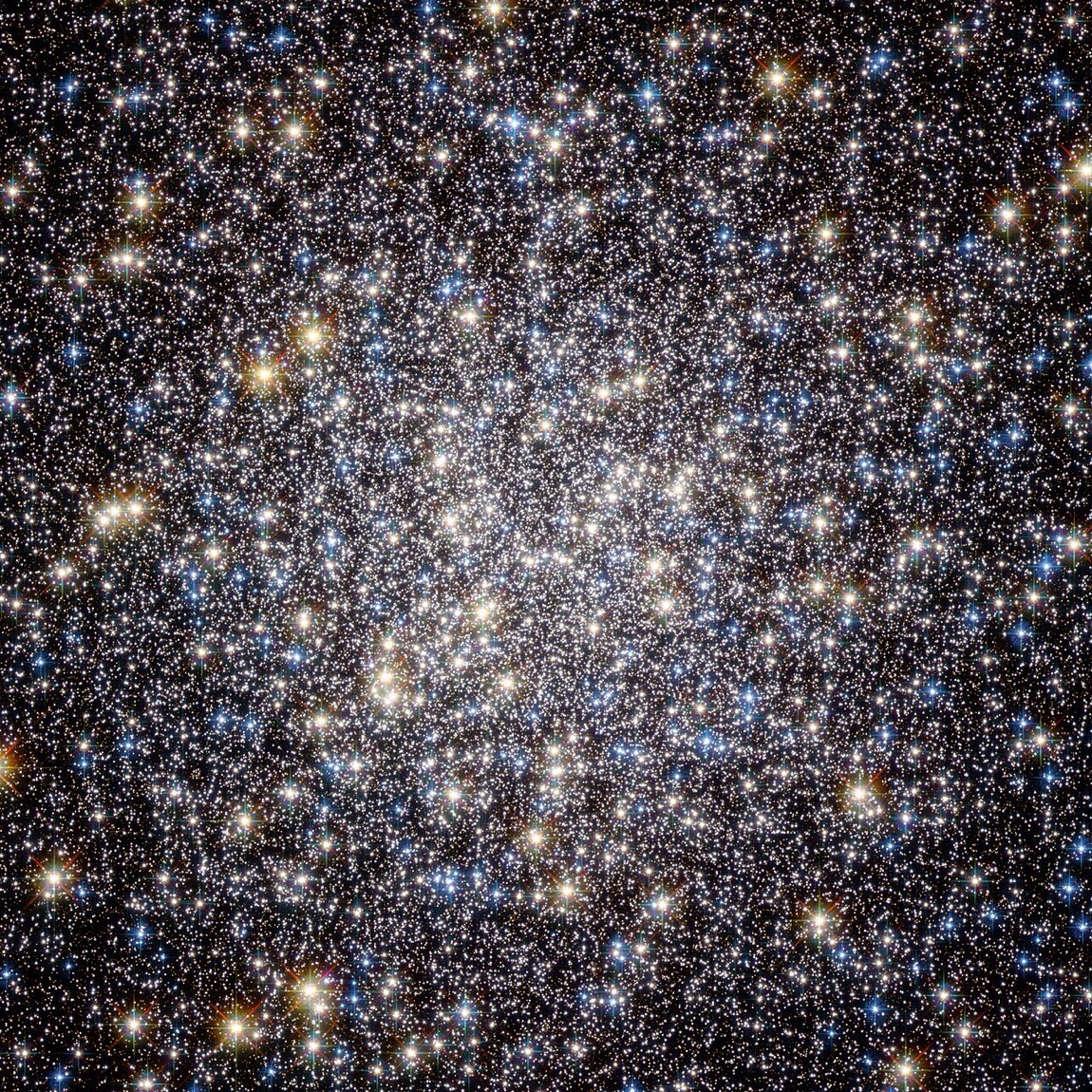
The stars within M13 are packed more than a hundred times more densely than the stars in the Sun's local neighborhood. That extraordinary crowding has a physical consequence that sounds almost fictional: individual stars sometimes actually collide. When two aging stars merge, the resulting object has more mass and therefore more hydrogen fuel than either parent did at this stage of their lives, causing it to burn hotter and blaze blue-white. These objects appear younger than the surrounding population and have been dubbed blue stragglers because they seem to lag behind the normal aging sequence of the cluster. They are of particular interest to astronomers because they offer a rare, natural laboratory for studying stellar mergers and the physics of close gravitational encounters. Blue stragglers are not unique to M13, but the cluster's density makes them especially accessible for study. Their existence is a vivid reminder that stellar evolution is not always a solitary journey.
 ⤢
05 Population II Stars and the Iron Deficit Deeper
Every star in M13 belongs to what astronomers classify as Population II — a cohort of ancient stars born when the universe had not yet had time to build up heavy elements through successive generations of stellar nucleosynthesis. The practical signature of this ancient lineage is a striking poverty of metals, which in astronomical terminology means every element heavier than helium. M13 as a whole contains only about 4.6% as much iron as the Sun. That deficit is not a curiosity; it is a timestamp. The cluster's stars formed from gas clouds that had barely been enriched by earlier supernova cycles, placing their birth in the deep history of the Milky Way. By contrast, the Sun and most stars in its immediate neighborhood are Population I objects, forged from material that had already been recycled through many prior stellar generations. Comparing M13's stars with nearby Population I stars lets astronomers trace how the chemical composition of the galaxy has evolved over billions of years.
06 Resolving Individual Stars: A Long Journey
For decades after Halley first noted the glow of M13 in 1714, the cluster appeared as nothing more than a nebulous smear. It was not until 1779 — sixty-five years later — that individual stars within it were first resolved and recorded. That delay reflects how difficult it is to separate the light of hundreds of thousands of densely packed stars at a distance of roughly 22,200 to 25,000 light-years. Even today, resolving stars in the core of M13 demands larger telescope apertures because the central regions are so compressed that their light blurs together in all but the sharpest instruments. The progression from indistinct glow to resolvable stellar population mirrors the broader arc of telescope technology across three centuries. The cluster's diameter of about 23 arcminutes — comparable to roughly three-quarters the apparent width of the full Moon — means that its outer halo is generous and accessible, even as its heart remains a challenge.
07 Variable Stars and Recent Discoveries Deeper
Among the several hundred thousand stars in M13, a population of variable stars — stars that change in brightness over time — has been cataloged and studied. The brightest individual star in the cluster is a red giant and variable star designated V11, also known as V1554 Hercules, which shines at an apparent visual magnitude of 11.95. The story of variable star discovery in M13 extends to remarkably recent times. The last three known variables in the cluster — designated V63, V64, and V65 — were discovered from Spain in April 2021, March 2022, and January 2024, respectively. The fact that new variables are still being identified in one of the most studied globular clusters in the northern sky is a pointed reminder that even familiar, well-observed objects have not surrendered all their secrets. Each newly confirmed variable adds a data point to our understanding of stellar pulsation, stellar evolution, and the internal dynamics of the cluster.
08 A Disputed Black Hole at the Core Deeper
In 2007, a scientific paper raised a striking possibility: that an intermediate-mass black hole of up to 13,000 solar masses might lurk at the center of M13. Intermediate-mass black holes occupy a theoretically important but observationally elusive middle ground between the stellar-mass black holes produced by collapsing individual stars and the supermassive black holes found at the centers of galaxies. If confirmed, such an object in M13 would provide evidence that this category of black hole can form in globular clusters, with significant implications for theories of galaxy formation and black hole growth. However, the article is clear that this suggestion is heavily disputed. The observational evidence is contested, and the scientific community has not reached a consensus. M13's center remains a subject of active investigation, and the question of whether it hides a massive compact object continues to drive research into globular cluster dynamics.
 ⤢
09 The Arecibo Message and Its 25,000-Year Journey
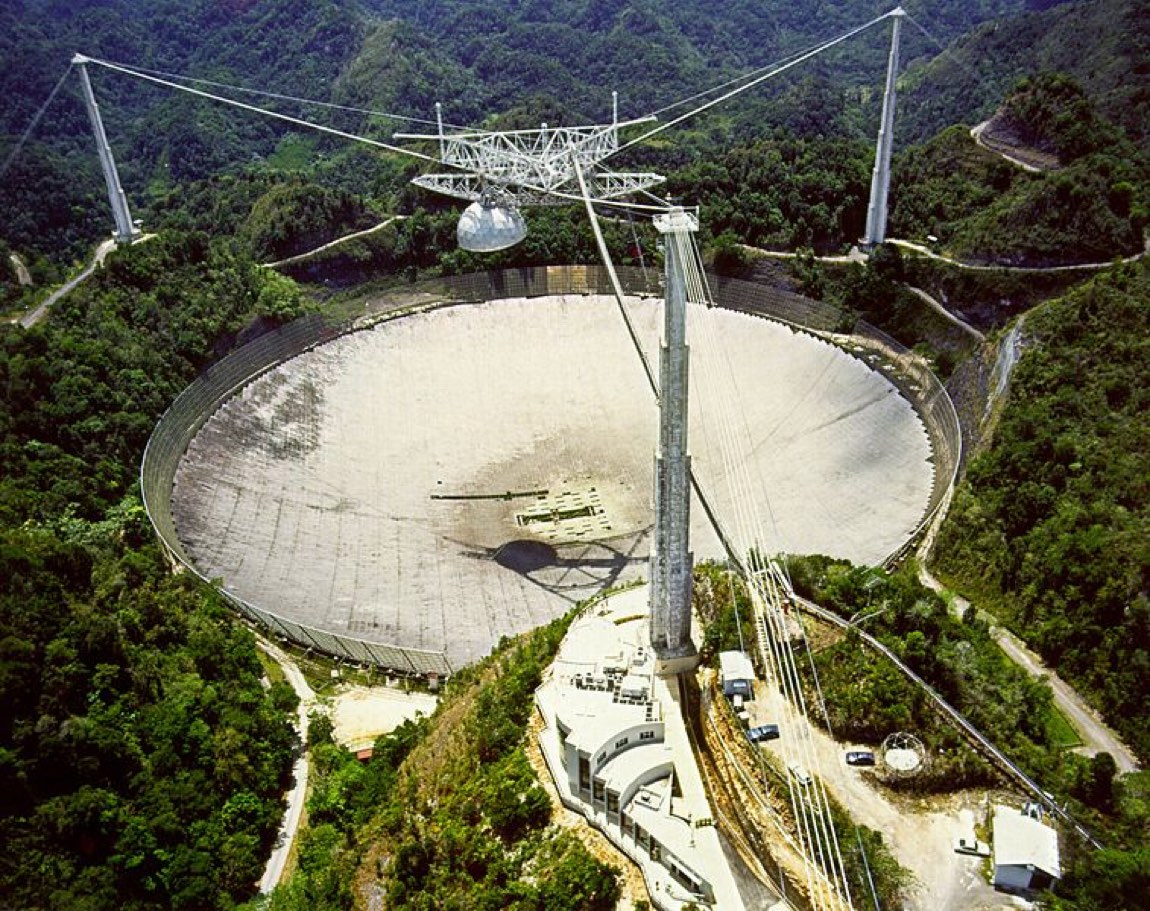
On a day in 1974, the Arecibo Observatory radio telescope in Puerto Rico beamed a carefully encoded signal toward Messier 13. The broadcast — now known as the Arecibo message — packed information about humanity into a brief radio transmission: atomic numbers of key elements, the structure of DNA, Earth's position in the solar system, and other details intended to sketch a portrait of civilization. M13 was selected as the target not because of any particular scientific expectation of a reply, but for practical reasons: it was a large, relatively close star cluster that happened to be available at the right position in the sky at the time of the ceremony. The organizers themselves framed it as a demonstration of technological capability, not a genuine conversation opener. The signal travels at the speed of light and will take around 25,000 years to reach the cluster's current position — but because M13 moves through space, there is genuine debate among astronomers about whether the cluster will even be in a position to intercept the message by the time it arrives.
10 M13 in Fiction: A Galaxy of Imagination
Few deep-sky objects have fired the imagination of science fiction writers as consistently as Messier 13. Isaac Asimov set his novella Sucker Bait there, as did Poul Anderson's novel Question and Answer — both placing fictional worlds within the cluster. In the long-running German series Perry Rhodan, M13 hosts the homeworld of the Arkonides, a central alien civilization in that universe. James Blish's Cities in Flight features the alien "Web of Hercules" launching its threat from the cluster. Dan Simmons used M13 in the Hyperion Cantos as the secret location where a replica of Earth was recreated after the original was destroyed. Kurt Vonnegut took a more philosophical angle in The Sirens of Titan, noting that the solar system draws 43,000 miles closer to M13 with every passing hour and using that relentless drift as a metaphor for progress. Even Doctor Who visited the cluster in the 1968 story The Wheel in Space, in which the Cybermen hatch a plan to engineer a stellar nova within it.
11 M13's Place in Milky Way Architecture Deeper
Messier 13 is not an isolated curiosity but one member of a large family. It is one of more than one hundred globular clusters known to orbit the center of the Milky Way. These clusters form a roughly spherical halo around the galactic disk, and M13 — sitting at a distance of somewhere between 22,200 and 25,000 light-years from Earth — is among the more accessible members of that halo for northern hemisphere observers. With a diameter of about 145 light-years, it is a substantial structure, containing an estimated 300,000 to over 500,000 stars in that volume. For comparison, the nearest star to our Sun is about 4.2 light-years away; fitting even 300,000 stars into a sphere 145 light-years across requires a density that strains everyday intuition. Globular clusters like M13 are thought to be among the oldest surviving structures in the galaxy, and their chemical and dynamical properties carry encoded histories of the Milky Way's earliest epochs.
12 M13 Painted Onto a Church Dome
Messier 13 has an unusual presence in the physical world beyond the observatory: it is depicted on the interior of the dome of St Anne's Church in Kew, London. The image is based on a NASA photograph of the cluster. The connection has a certain historical symmetry — Edmond Halley discovered M13 in 1714, the same year that St Anne's Church was first dedicated. That coincidence of dates gives the artwork a quietly poetic resonance, linking the moment of the cluster's first recorded observation to the founding of a building that would eventually display its likeness on its ceiling. It is a rare example of a deep-sky object finding its way into sacred architecture, and it anchors M13 not only in the history of astronomy but in the cultural and civic life of a specific London neighborhood.
 ⤢