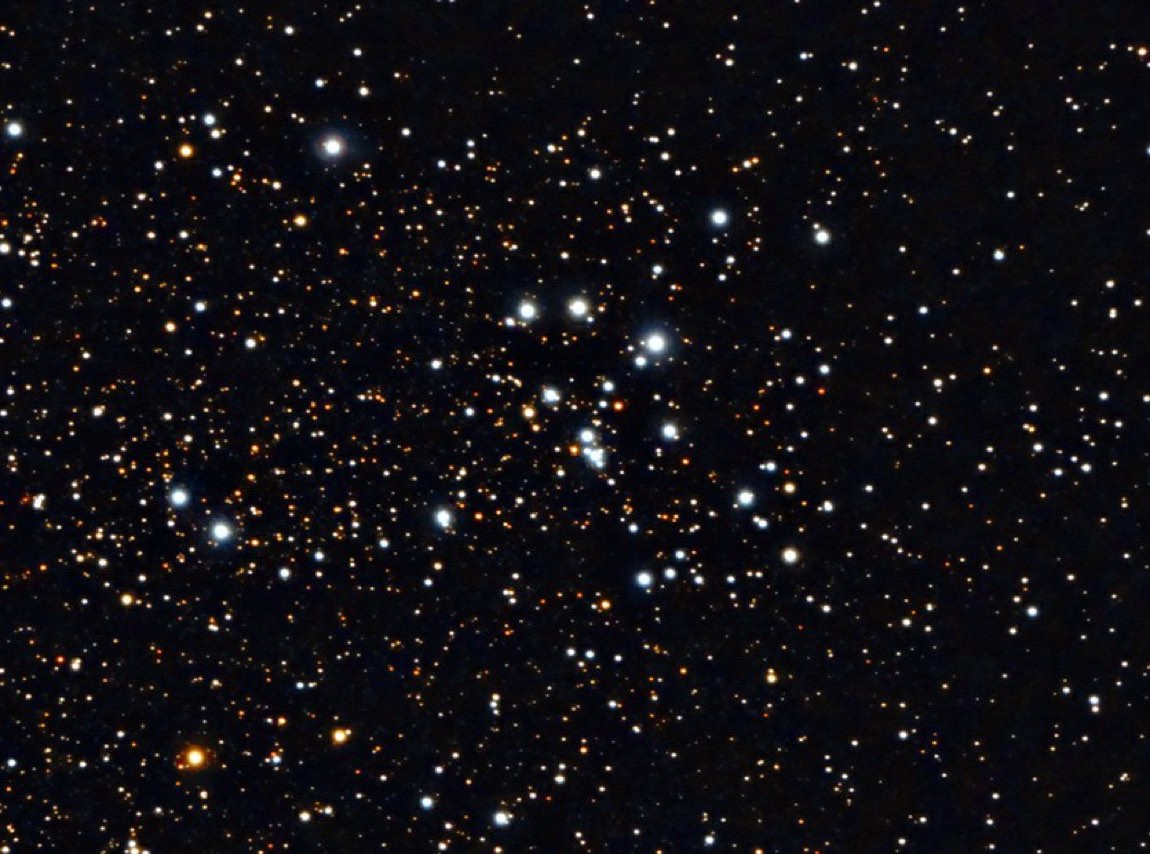
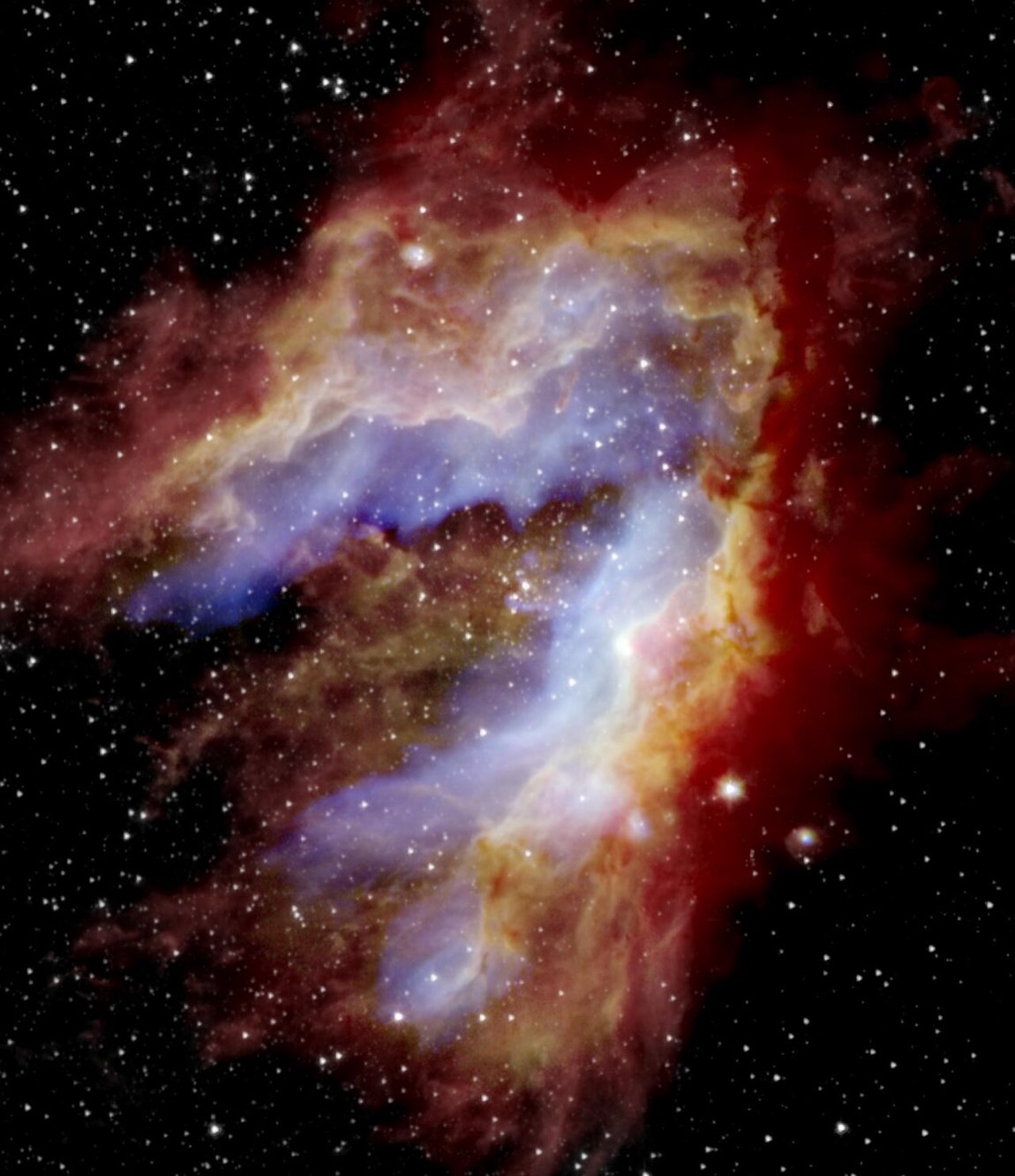
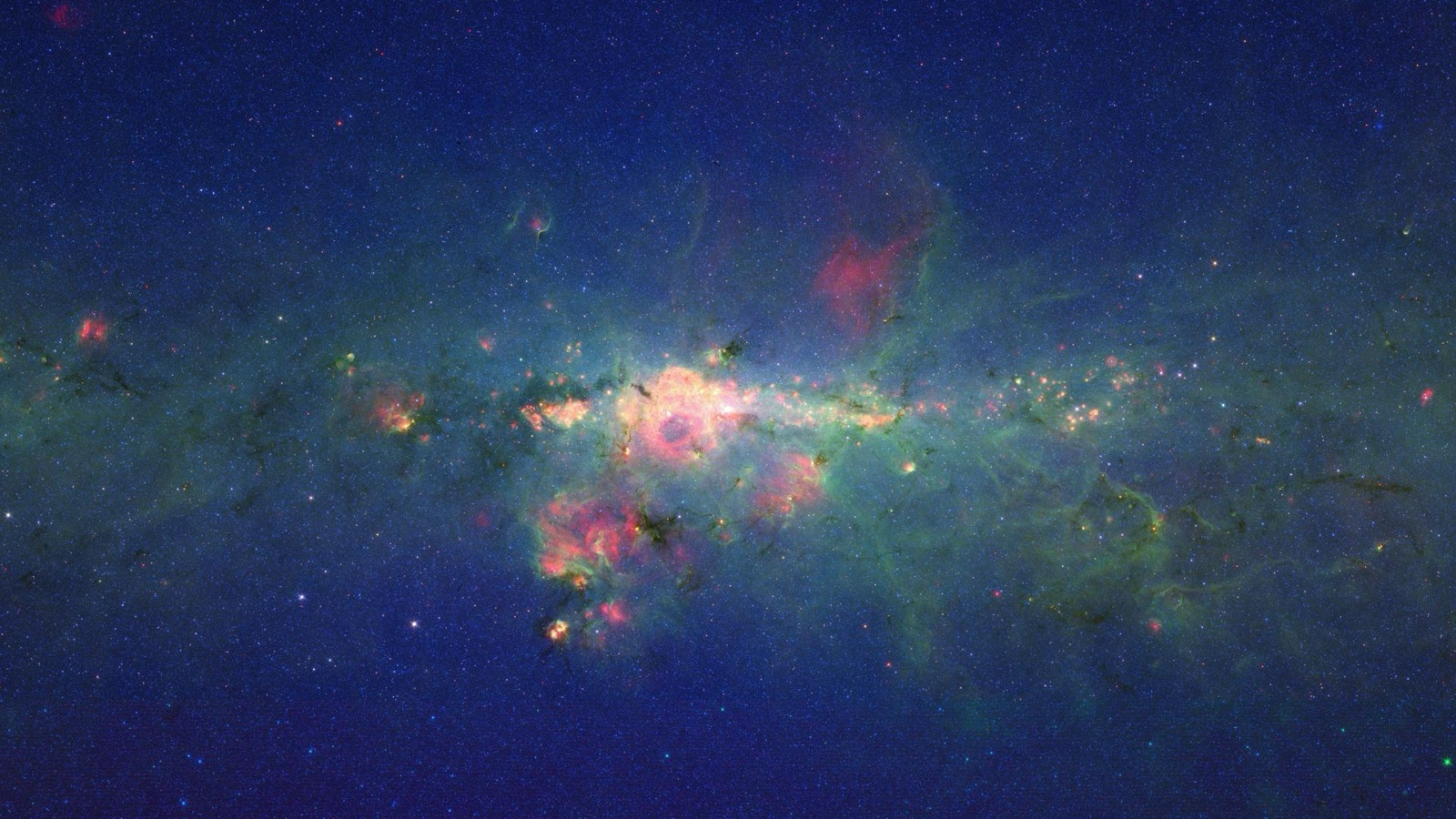
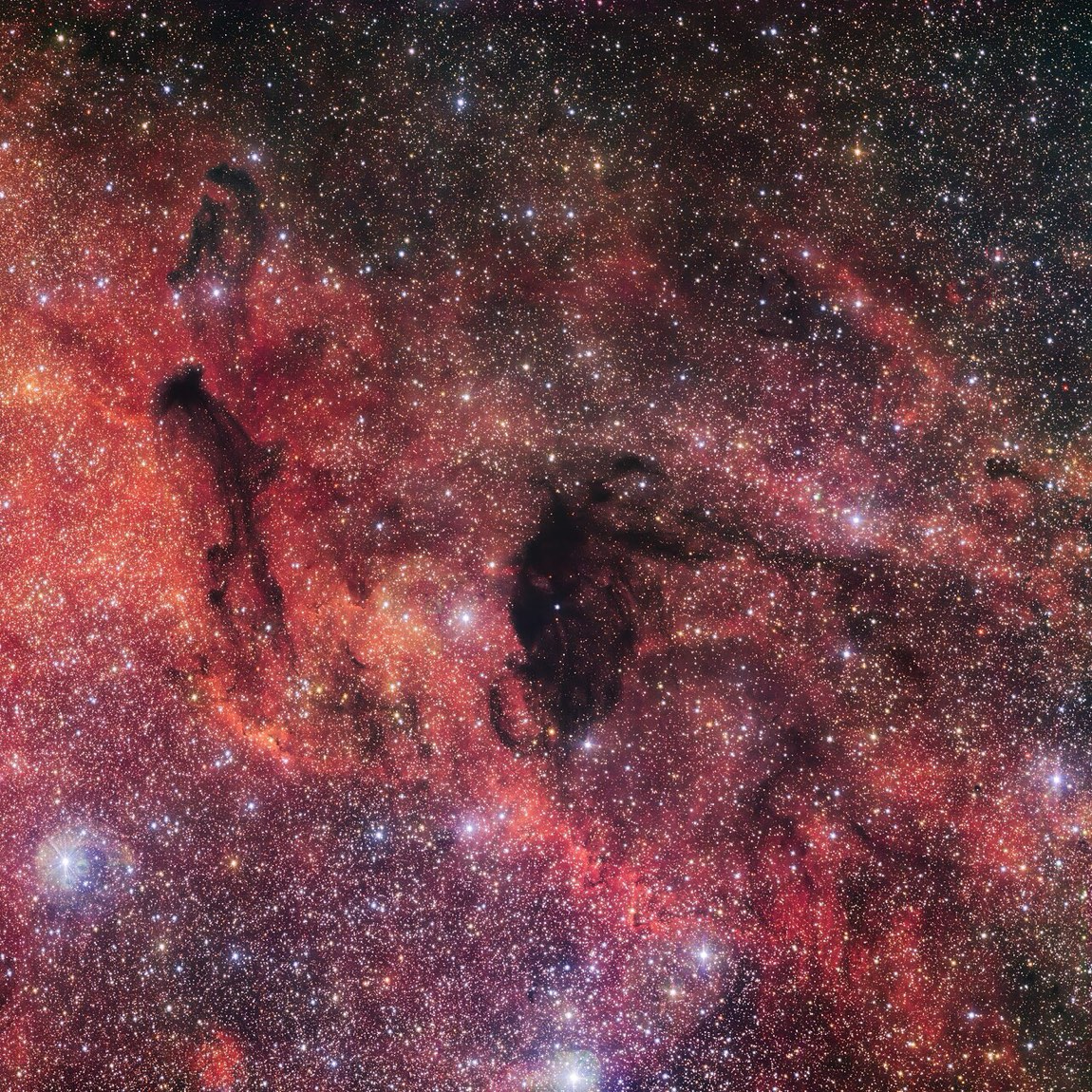
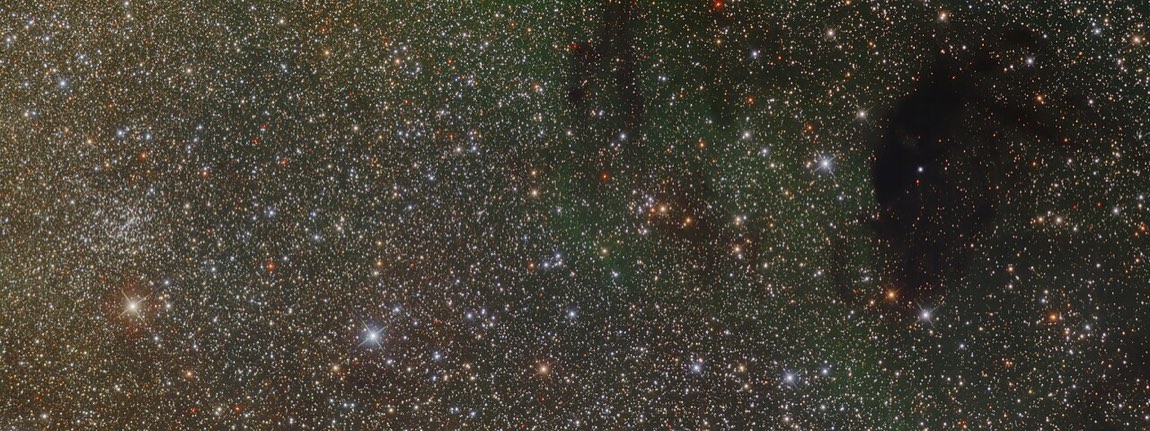
 Photograph · (Credit) ESO/TIMER survey · CC BY 4.0
Star Cluster · Deep guide
Messier 24 (Small Sagittarius Star Cloud)
Also called: M24 · Messier 24 · IC 4715 · Small Sagittarius Star Cloud · Delle Caustiche
Not a cluster at all, but a window through the dust onto thousands of distant Milky Way stars.
What is it?
Messier 24, the Small Sagittarius Star Cloud, is not a single object but a gap in the dark dust of the Great Rift that lets us see deep into the Milky Way. The stars visible through it lie roughly 10,000 to 15,000 light-years away, in the Scutum–Centaurus spiral arm. It is about 600 light-years wide, and binoculars show around 1,000 stars in a single view, the densest star field visible that way. Messier catalogued it in 1764.
The deep dive
Researched for the Atlas from Wikipedia — Small Sagittarius Star Cloud (2,770 characters read) · updated Nov 15, 2026
01 A Window, Not an Object
Most entries in Messier's famous catalogue are discrete objects — a galaxy, a nebula, a cluster with a clear edge. Messier 24 is something genuinely different: not a thing in space but a gap in the obscuring dust that fills the plane of the Milky Way. That dust, collectively called the Great Rift, normally blocks our view deep into the galaxy, but in the direction of M24 the curtain parts. Through this opening we look across 10,000 to 15,000 light-years of galactic interior in a single glance. The stars you see are not neighbors clustered together; they lie at wildly different distances, stacked along the line of sight like lights seen down a long corridor. This is why astronomers call it a star cloud rather than a star cluster, and why some sources incorrectly labeling it as the compact open cluster NGC 6603 get the nature of M24 fundamentally wrong. NGC 6603 is simply one small cluster embedded within the much larger visual phenomenon.
02 How Deep the Window Really Goes Deeper
The apparent width of M24 on the sky is about 600 light-years across — a figure that already sounds vast — but the depth of the star cloud is what truly staggers. It extends 10,000 to 15,000 light-years away from Earth along our line of sight, meaning the volume of space we sample through this window is shaped less like a coin and more like a long, wide tunnel bored into the Milky Way's disk. Within that tunnel lies the Scutum-Centaurus Arm, one of the major spiral arms of the galaxy sitting between Earth and the Galactic Center. When you observe M24 you are therefore looking straight into one of the Milky Way's grand structural features. The concentration of stars from that arm, combined with the relatively clear sightline, is precisely why M24 hosts the densest concentration of individual stars visible through binoculars — roughly 1,000 stars appear within a single binocular field of view.
03 Messier's Own Description of M24
Charles Messier catalogued M24 in 1764, writing that it was "a large nebulosity in which there are many stars of different magnitudes" — a description that, however simple, captures the essential visual experience of the object remarkably well. He measured its dimensions as roughly 1.5 degrees across, a reasonable estimate given the instruments of his era, though modern observations show its full extent reaches considerably beyond that. Messier was working during an age when the distinction between a star cloud and a true nebula was not yet possible to draw clearly; his telescopes could resolve individual stars but could not reveal the galactic architecture behind them. Nevertheless, his inclusion of M24 in the catalogue was justified on purely practical grounds: it is a prominent feature of the summer Milky Way, easily confused with a nebula at low resolution, and his catalogue was explicitly meant to prevent such confusions for comet hunters sweeping the sky.
04 The Puzzle of M24's True Brightness Deeper
Measuring the apparent magnitude of M24 turns out to be surprisingly contentious. Older references settled on a magnitude of 4.6, a figure that would make it a moderately faint naked-eye object. More recent estimates, however, place its integrated brightness at magnitude 2.5 — a full two magnitudes brighter, which corresponds to roughly six times more light reaching the eye. The discrepancy arises directly from M24's unusual nature. Because its light is spread over a very large area of sky rather than concentrated in a small disk or point, different measuring techniques sample different fractions of its total area and disagree sharply on the result. This is the same challenge astronomers face with any low-surface-brightness extended object, but M24's sheer angular size makes the problem especially acute. At magnitude 2.5 it would rival some of the brightest stars in the sky in total output, though that brightness is diluted across degrees of sky rather than a point.
05 HD 167356: The Cloud's Brightest Star
Among the roughly thousand individually visible stars within M24, one stands clearly above the rest in brightness: HD 167356, a white supergiant shining at an apparent magnitude of 6.05, right at the threshold of naked-eye visibility under dark skies. What makes HD 167356 especially interesting is its classification as an Alpha-2 Canum Venaticorum variable — a category of star that shows subtle, periodic changes in brightness as the star rotates. These variations arise because the magnetic field of such stars is tilted relative to their rotation axis, causing regions of different chemical abundances to rotate in and out of view, slightly altering the light output with each turn. The changes are small but detectable. Three other stars in M24 carry visual magnitudes between 6.5 and 7.0, making the star cloud a surprisingly rich hunting ground for variable-star observers willing to study individual stellar personalities within what otherwise looks like an undifferentiated river of starlight.
 ⤢
06 Dark Nebulae: Holes Punched in the Star Field
The brilliance of M24's star field makes the dark nebulae embedded within it even more dramatic — regions where thick clouds of interstellar dust absorb the background starlight so completely that they appear as stark, almost circular voids. The most prominent is Barnard 92, sitting on the northwestern side of the star cloud. It is the darker of the two main nebulae, and through a telescope or binoculars it looks startlingly like a hole punched cleanly through the star field. American astronomer Edward Emerson Barnard discovered this dark nebula in 1913. On the northeastern side lies Barnard 93, comparable in size to Barnard 92 but less visually obvious because the contrast is not as sharp. Both nebulae are vast clouds of dense, obscuring interstellar dust whose opacity prevents the light of stars behind them from reaching Earth. M24 also contains two further catalogued dark nebulae, Barnard 304 and Barnard 307, making the cloud a remarkably rich environment for studying dust structures in the inner galaxy.
07 Planetary Nebulae Hidden in the Glow Deeper
Beyond stars and dust clouds, M24 harbors two planetary nebulae: M 1-43 and NGC 6567. Planetary nebulae are the glowing shells of gas expelled by dying Sun-like stars in their final evolutionary stages, the cores of which then shine as hot white dwarfs and cause the surrounding gas to fluoresce. Finding them inside M24 is a matter of picking out small, faint puffs of light against one of the most star-crowded fields visible to amateur telescopes — a genuine needle-in-a-haystack challenge. Their presence is scientifically useful, however, because planetary nebulae are sensitive tracers of the chemical enrichment history of a galaxy's disk: the gas they expel carries elements forged in the star's lifetime back into the interstellar medium. Having catalogued examples embedded within the long sightline of M24 gives astronomers reference points at known distances for studying conditions inside the Scutum-Centaurus Arm region.
08 An Extragalactic Twin in Andromeda Deeper
Astronomers have noted that M24 bears meaningful similarities to NGC 206, a bright and large star cloud found within the Andromeda Galaxy. The comparison is instructive: NGC 206 is an enormous concentration of young stars set against the disk of its host galaxy, visible to observers here as a bright knot in Andromeda's spiral structure. That M24 and NGC 206 share common characteristics suggests that such optically prominent star-cloud features — dense concentrations of luminous stars seen against a backdrop of galactic disk — may be a recurring structural phenomenon in spiral galaxies generally, not a quirk unique to the Milky Way. When we look at Andromeda and admire NGC 206, we may be seeing something functionally analogous to what an extragalactic astronomer would observe if they could point their telescope at our own galaxy from two million light-years away and find M24 glowing in our Sagittarius arm region.
09 How and When to Observe M24
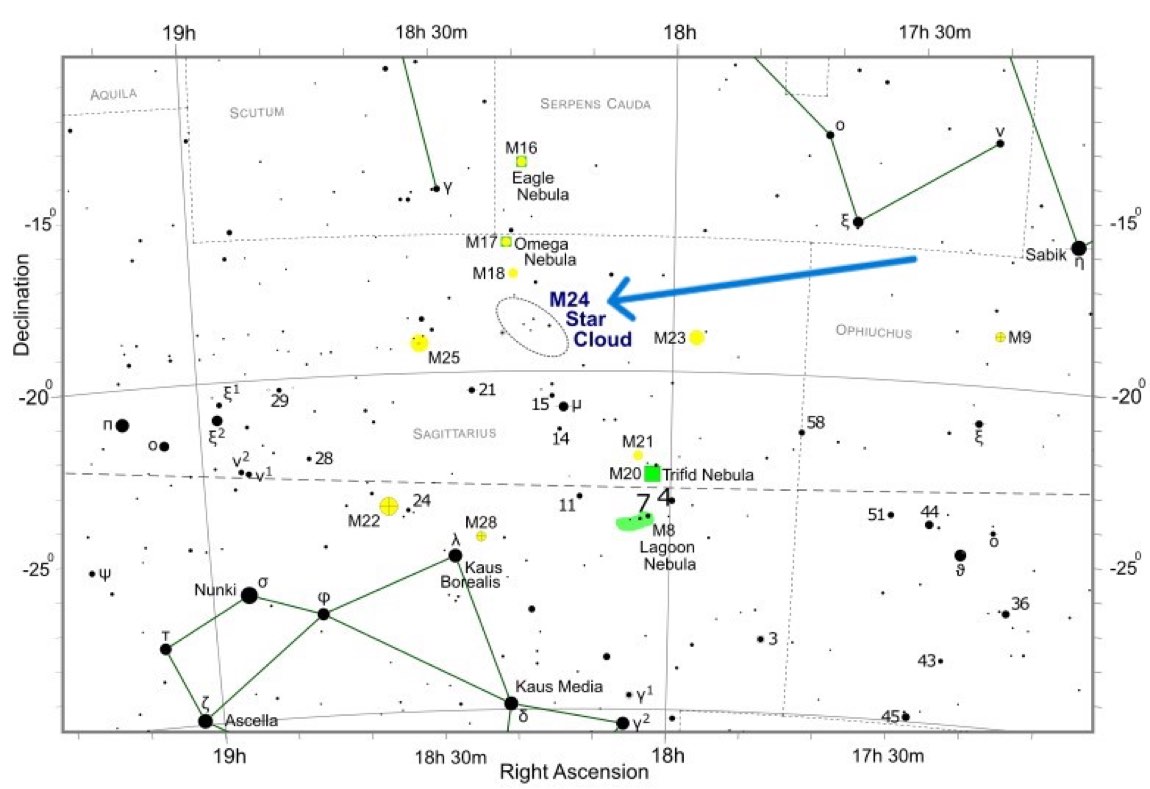
M24 is a rewarding target precisely because it demands almost no equipment. The article is unambiguous: it is visible to the naked eye whenever the Milky Way itself is visible, which under a truly dark sky means any clear summer or early-autumn night from mid-latitudes. Its location near the Omega Nebula (M17) and the open cluster Messier 18, both lying to the north of M24, makes the region easy to star-hop to once you have identified the Sagittarius teapot asterism. For binocular users it is arguably the finest single target in the summer sky, delivering around 1,000 individually resolved stars in a single field of view in a display that has been described as "a virtual carpet of stellar jewels." Telescope users are specifically advised to use low magnification and ensure a field of view of at least 2 degrees; high magnification defeats the purpose by zooming past the sweeping panorama that makes M24 unique. The dark nebulae Barnard 92 and Barnard 93 become the most striking features once the eye has adjusted to the star field.
10 Nearby Landmarks in a Rich Sky Region
M24 sits at the center of one of the most object-rich areas of the entire sky. To its north lie the Omega Nebula, also catalogued as M17, and the open cluster Messier 18. About 10 degrees to the south stretches the Large Sagittarius Star Cloud, a visually similar but distinct feature that is a common source of confusion with M24. Keeping these neighbors sorted matters because each represents a different kind of object: the Omega Nebula is an active star-forming region with glowing gas, M18 is a true gravitationally bound open cluster, and the Large Sagittarius Star Cloud is yet another line-of-sight window, albeit in a different part of the sky. The fact that Messier felt the need to catalogue this particular region at all, and that NGC 6603 is frequently and incorrectly substituted for the true M24, underscores how visually complex and easily misread this stretch of Sagittarius sky really is.
 ⤢