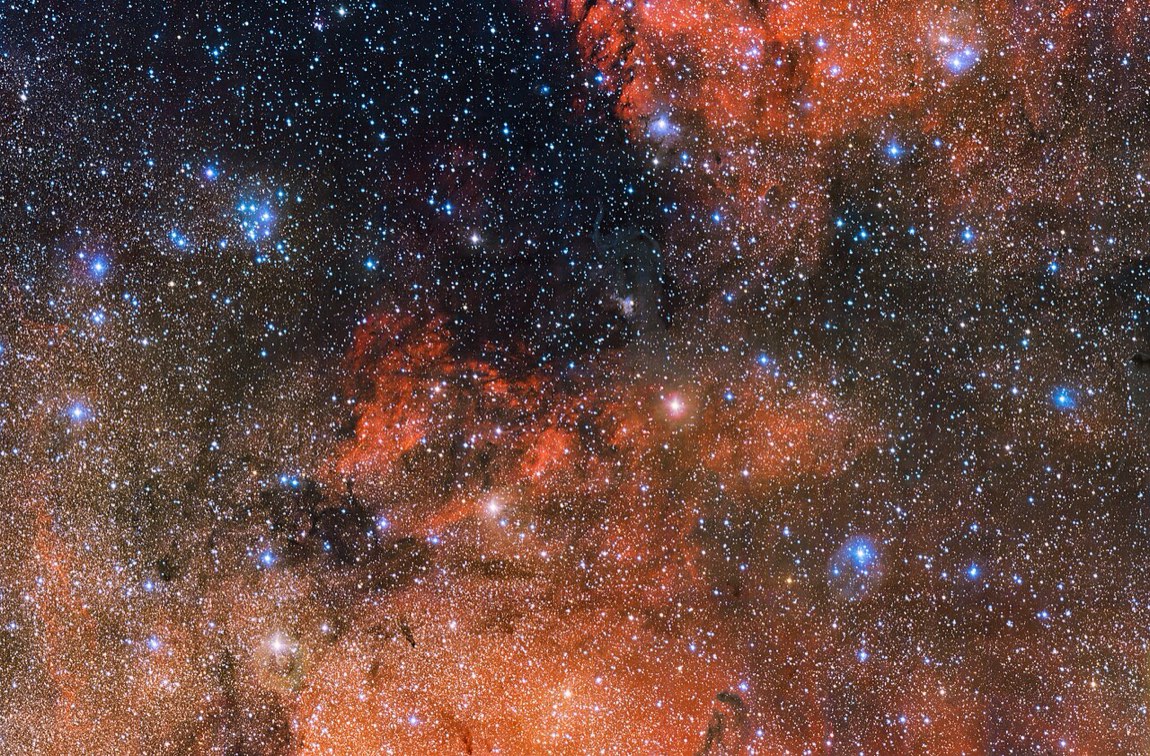
 Photograph · Fabian Rodriguez Frustaglia · CC BY-SA 4.0
Star Cluster · Deep guide
Messier 18 (Black Swan Cluster)
Also called: M18 · NGC 6613 · Black Swan Cluster
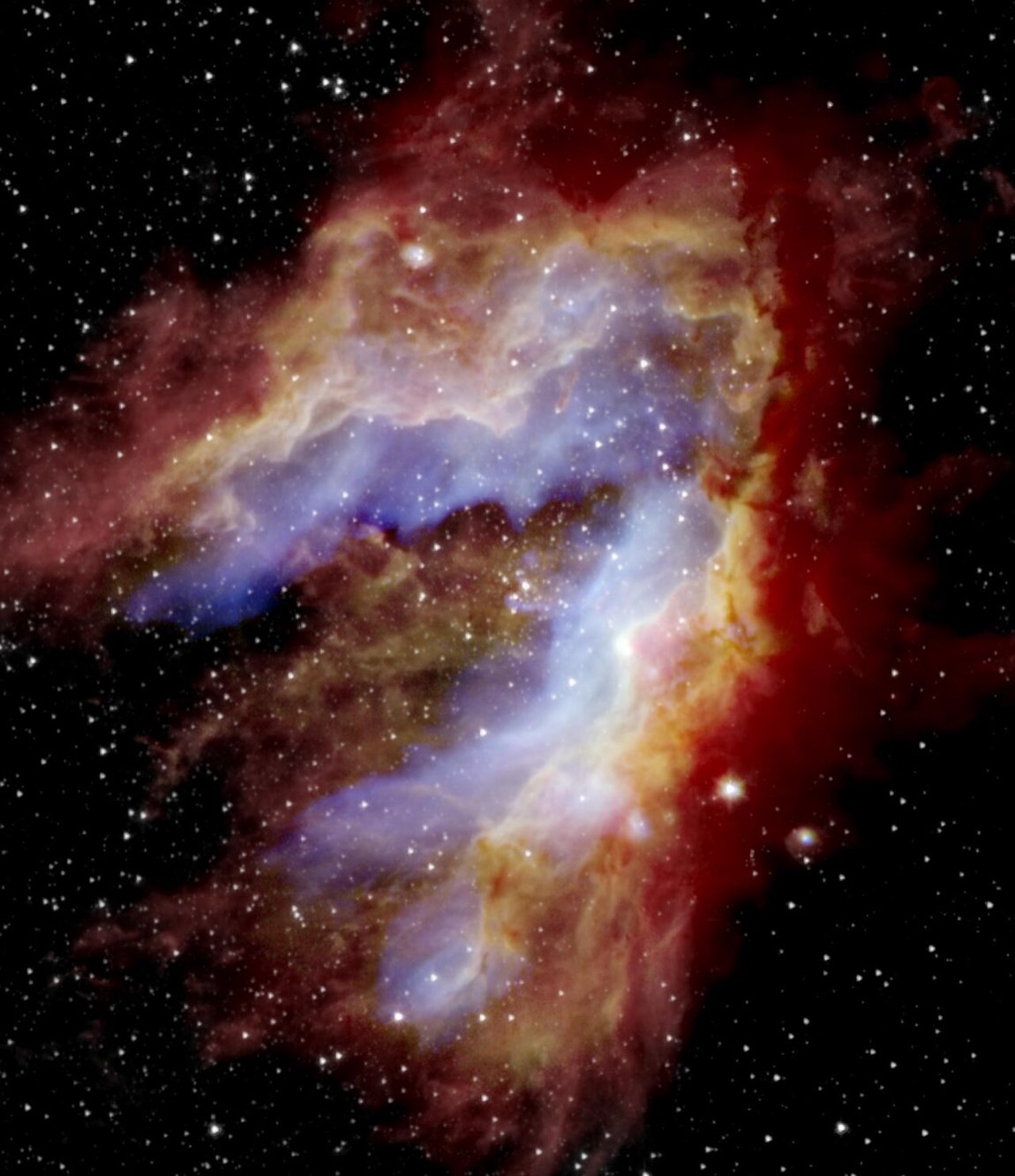
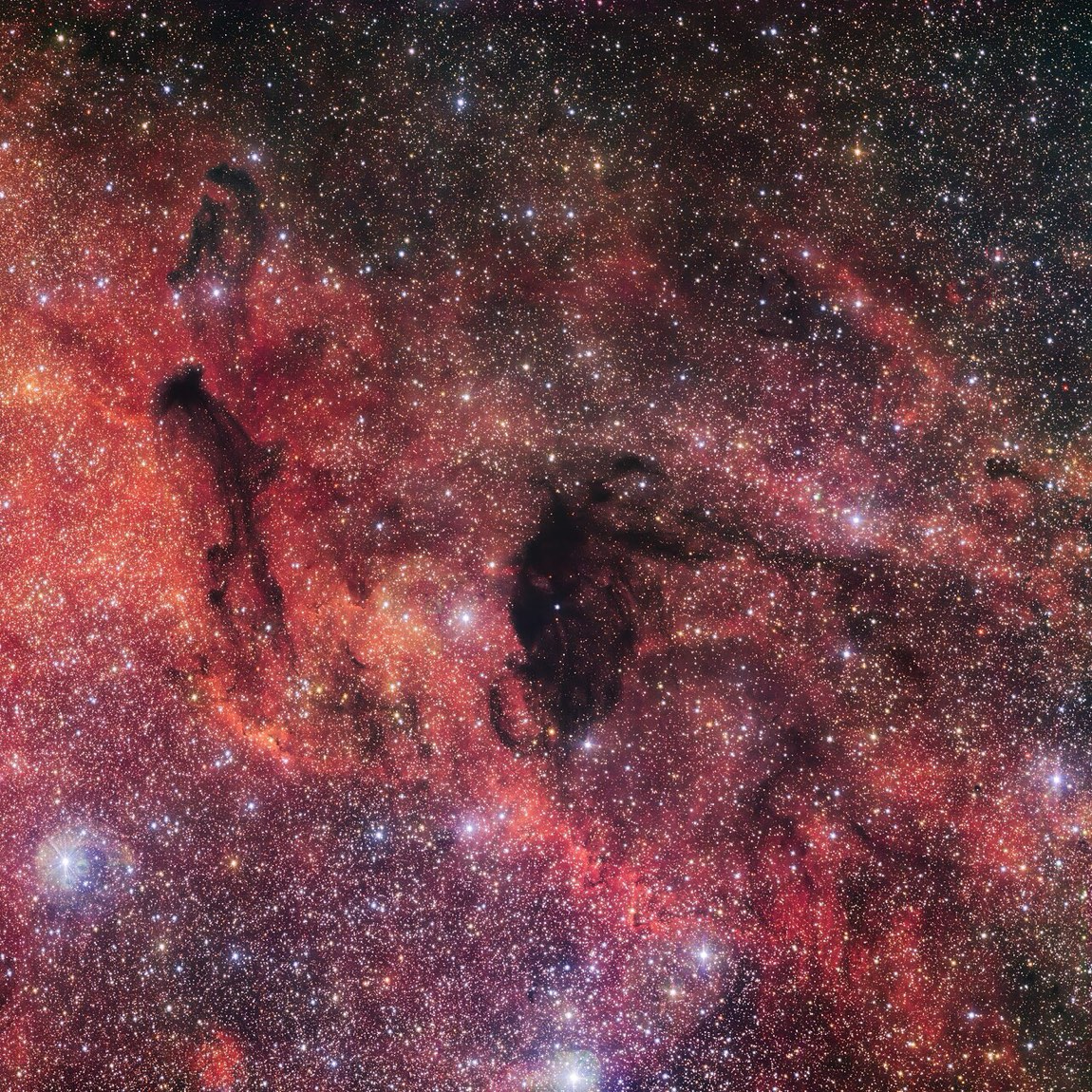
A small, sparse young cluster tucked between the Omega Nebula and the M24 star cloud.
What is it?
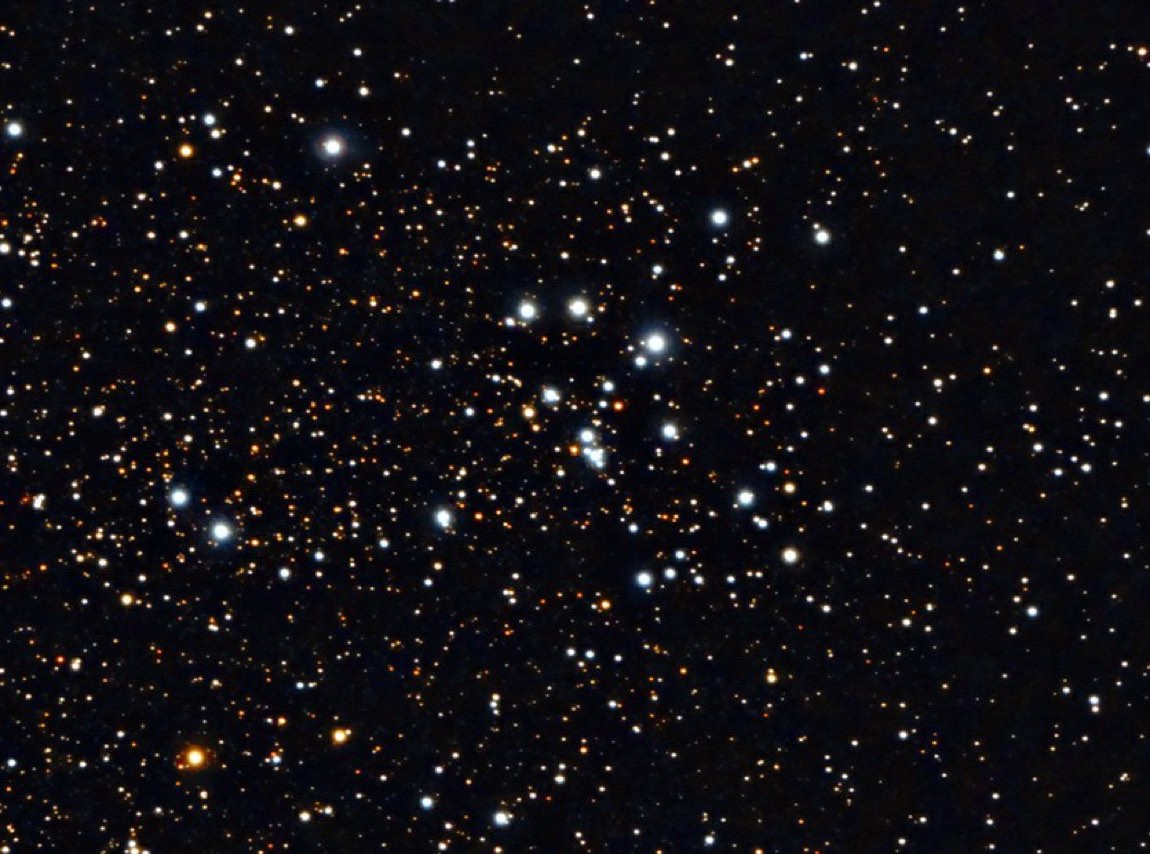
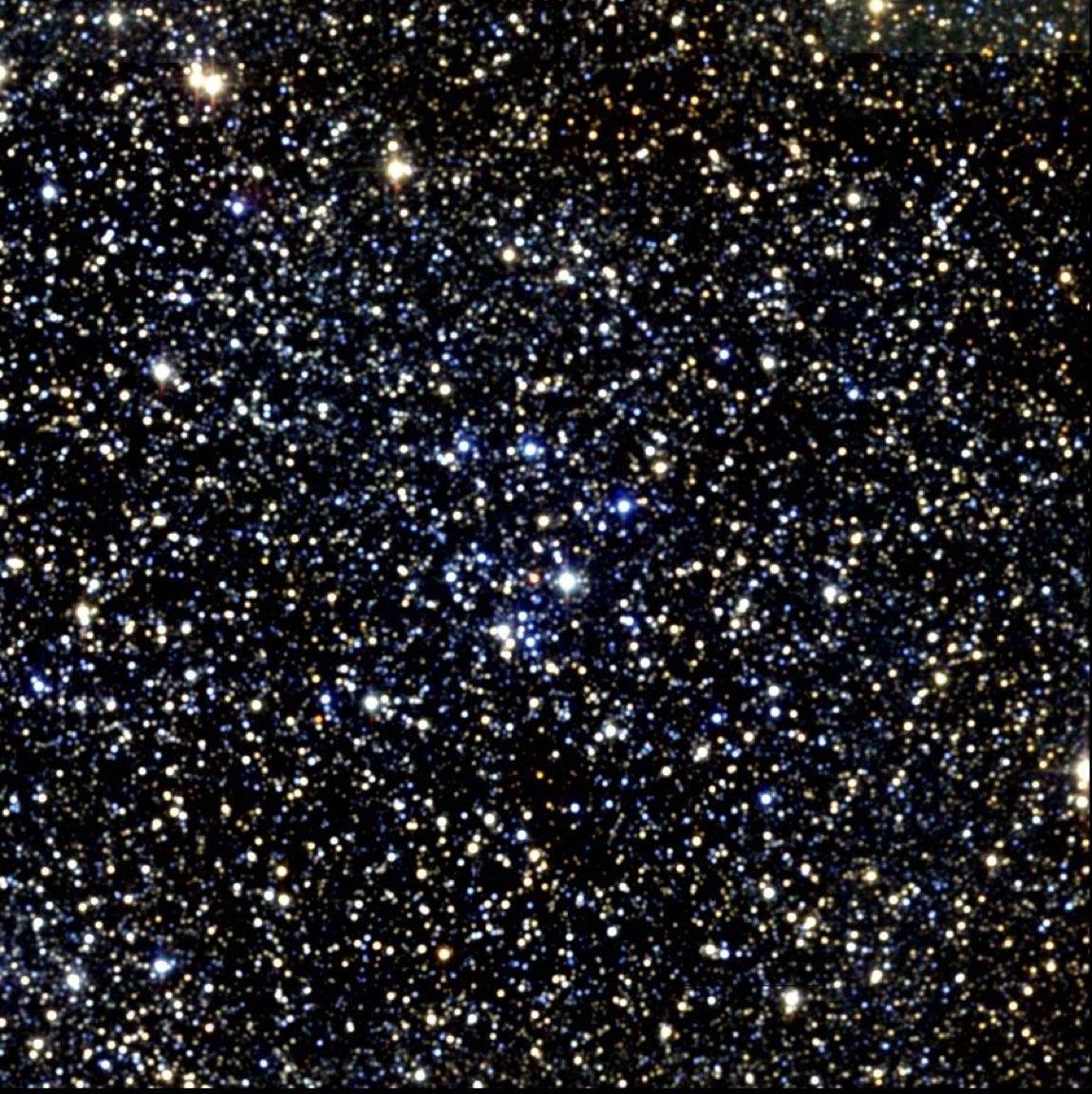
Messier 18 is a modest open cluster in Sagittarius, discovered by Charles Messier in 1764. Seen from Earth, it lies between the Omega Nebula (M17) and the Small Sagittarius Star Cloud (M24). The cluster is only about 33 million years old and is sparse, with an estimated mass of under 200 Suns. Its brightest star is a blue B-type giant. As of January 2022 it was one of the few Messier objects the Hubble Space Telescope had not photographed.
The deep dive
Researched for the Atlas from Wikipedia — Messier 18 (1,434 characters read) · updated Nov 15, 2026
01 Discovered hunting comets that were not there
Charles Messier was one of history's most determined comet hunters, and M18 owes its place in astronomical history entirely to that obsession. In 1764, Messier systematically catalogued fuzzy, comet-like smudges visible through his telescope — objects that could fool an observer into thinking they had spotted a new comet. M18 was one of these imposters: a loose scattering of stars that, at low magnification, blurred together into a hazy patch indistinguishable from a distant comet without a tail. Messier logged it, numbered it, and moved on. What began as a nuisance list became one of astronomy's most beloved catalogues, still in active use more than 250 years later. M18 sits in the constellation Sagittarius, visually nestled between two far more spectacular neighbours — the Omega Nebula (M17) and the Small Sagittarius Star Cloud (M24) — which means it is frequently overlooked even today, overshadowed by celestial objects that grab attention far more readily than a sparse and understated cluster.
02 A famously sparse and lightly populated cluster
M18 carries the Trumpler classification II 3 p, and that final letter is telling: 'p' stands for poor, meaning the cluster contains a relatively small number of stars compared to richer open clusters. Its linear diameter stretches 8.04 parsecs across — roughly 26 light-years — yet it holds an estimated total mass of only 188 solar masses. For context, 188 solar masses spread across 26 light-years represents a very thinly populated neighbourhood. The cluster does show some central concentration, but the core radius is an extraordinarily compact 0.012 parsecs, while the tidal radius reaches 7.3 parsecs. That contrast between a tiny dense core and a wide tidal boundary hints at a structure where most of the cluster's stars are loosely distributed in the outer regions, gravitationally bound but widely spaced. This sparse character is part of why M18 often gets described as unremarkable — it lacks the visual drama of a dense, jewel-box cluster — yet its structure makes it a useful benchmark for studying how open clusters evolve and disperse over time.
03 Young, hot, and dominated by massive blue stars Deeper
At just 33 million years old, M18 is a cosmically young cluster — it formed long after the dinosaurs appeared on Earth, to put the timescale in perspective. That youth is written across its stellar population in vivid blue-white light. The cluster contains 29 B-type stars, the category of hot, luminous stars that burn through their fuel rapidly and therefore only appear in young stellar populations. Among these, one is a confirmed Be star — a B-type star spinning so rapidly that it ejects material from its equator, forming a characteristic disc of gas that produces distinctive emission lines in its spectrum. Even more dramatic are the three supergiant stars, all of spectral class A or earlier, meaning they are massive stars that have already begun evolving off the main sequence despite the cluster's young age. The brightest star in the entire cluster, designated HD 168352, is a B2 III giant with a visual magnitude of 8.65, just bright enough to be glimpsed with binoculars under good conditions. This population of hot, short-lived stars confirms that M18 has not yet had time to lose its most massive members.
04 An almost perfectly circular orbit around the galaxy Deeper
M18 sits 1,296 parsecs from Earth and approximately 6,830 parsecs from the Galactic Center, placing it comfortably within the Milky Way's disc. What makes its orbit genuinely striking is its near-perfect circularity: the orbital eccentricity is just 0.02, where 0 would be a perfect circle and 1 would be a straight-line plunge through the galaxy. In practice, this means M18 never strays dramatically from its average galactic distance — it ranges only between 6.5 and 6.8 kiloparsecs from the galactic core over its entire orbit. That is a variation of just 300 parsecs, or about 4.5 percent of its average distance. The orbital period is 186.5 million years, meaning the cluster has completed less than one fifth of a single galactic orbit since it formed 33 million years ago. Such a nearly circular, stable orbit keeps M18 in a relatively consistent region of the Milky Way's disc, shielded from the more disruptive gravitational environments near the galactic centre or the sparse halo far above the plane.
05 Bobbing gently through the galactic plane
While M18 traces its near-circular path around the galactic centre, it simultaneously oscillates up and down through the flat disc of the Milky Way like a horse on a carousel. This vertical motion carries the cluster no more than 80 parsecs above or below the galactic midplane — a relatively modest excursion compared to some clusters that swing hundreds of parsecs out of the plane. It passes completely through the galactic plane once every 27.4 million years, meaning it has crossed the midplane roughly once since its formation 33 million years ago. These crossings are of interest to astronomers because the galactic plane is where the density of gas, dust, and other stellar systems is highest. Each crossing exposes the cluster to slightly elevated gravitational perturbations from passing molecular clouds and other clusters. Over millions of years, these small nudges can gradually strip away a loosely bound cluster's outer stars, contributing to its eventual dispersal into the broader galactic field population.
 ⤢
06 How to find and observe the Black Swan Cluster
M18 sits in Sagittarius, one of the richest regions of the summer sky for observers in the Northern Hemisphere, best viewed on clear nights from June through August when it rises high enough above the horizon. The cluster's visual position between the spectacular Omega Nebula (M17) and the dense star cloud of M24 makes it easy to locate by star-hopping — M17 is bright and distinctive, and M18 lies just a short step to its south. The lucida star, HD 168352, shines at visual magnitude 8.65, putting it just beyond naked-eye visibility but accessible with binoculars. Through a small telescope, M18 appears as a scattered group of moderately bright stars without the tight, sparkling richness of more famous open clusters. Its Trumpler class of II 3 p signals exactly what observers will see: a moderate level of central concentration, a range of star brightnesses, and a noticeably sparse membership. For those with a methodical interest in completing the Messier catalogue visually, M18 is a genuinely achievable target — just do not expect fireworks.
07 Why Hubble has never photographed it
As of January 2022, Messier 18 remains one of the very few objects in the entire Messier Catalogue that has not been formally imaged by the Hubble Space Telescope. This absence is not an oversight born of ignorance — Hubble has photographed the vast majority of Messier objects over its decades of operation — but rather a reflection of scientific prioritisation. Hubble's observing time is extraordinarily competitive, allocated through a rigorous proposal process, and sparse nearby open clusters like M18 offer less scientific return per hour than distant galaxies, nebulae, or more structurally complex clusters. The cluster's relative simplicity and proximity mean that ground-based telescopes can study it effectively without requiring Hubble's precision. Nevertheless, the gap stands as a minor curiosity in the history of the catalogue: Messier logged M18 in 1764, and more than 250 years later, humanity's most famous space telescope has yet to turn its mirror toward it.
08 The nickname: Black Swan and what it suggests
The informal name 'Black Swan Cluster' attached to M18 is evocative but not deeply rooted in a formal astronomical tradition the way constellation names are. The name appears to reference the cluster's sparse, understated appearance — an object that is technically there, catalogued and real, but conspicuously lacking the visual splendour observers might expect from a Messier object. In a catalogue full of brilliant nebulae, dense globular clusters, and sprawling galaxies, M18 is an outlier: a poor open cluster that arguably would not make a modern catalogue of showpiece objects. The 'black swan' metaphor resonates with the philosophical concept of an unexpected or anomalous entity — in this case, an object that surprises not by being spectacular but by being so decidedly unspectacular for its category. Whether the name sticks in common usage remains to be seen; most observers simply know it as M18 or NGC 6613, its New General Catalogue designation, which is the identifier most frequently used in the professional literature.
09 Core structure: a tiny nucleus in a wide halo Deeper
The structural parameters recorded for M18 reveal an unusual internal geometry worth examining closely. The core radius — the region where the stellar density is highest — measures just 0.012 parsecs, which is approximately 2,470 astronomical units, or roughly 40 times the distance from the Sun to Pluto. That is an extremely compact core by the standards of open clusters. The tidal radius, by contrast, extends to 7.3 parsecs, more than 600 times larger than the core. The tidal radius marks the outer boundary within which stars remain gravitationally bound to the cluster rather than being stripped away by the Milky Way's differential gravitational pull. The linear diameter of 8.04 parsecs is close to but slightly larger than the tidal radius, suggesting the full physical extent of the cluster roughly coincides with its gravitational sphere of influence. This combination — a pinpoint dense core surrounded by a relatively expansive halo of loosely bound stars — is consistent with an aging open cluster that has been gradually losing its outer members to galactic tides over its 33-million-year lifetime.
 ⤢