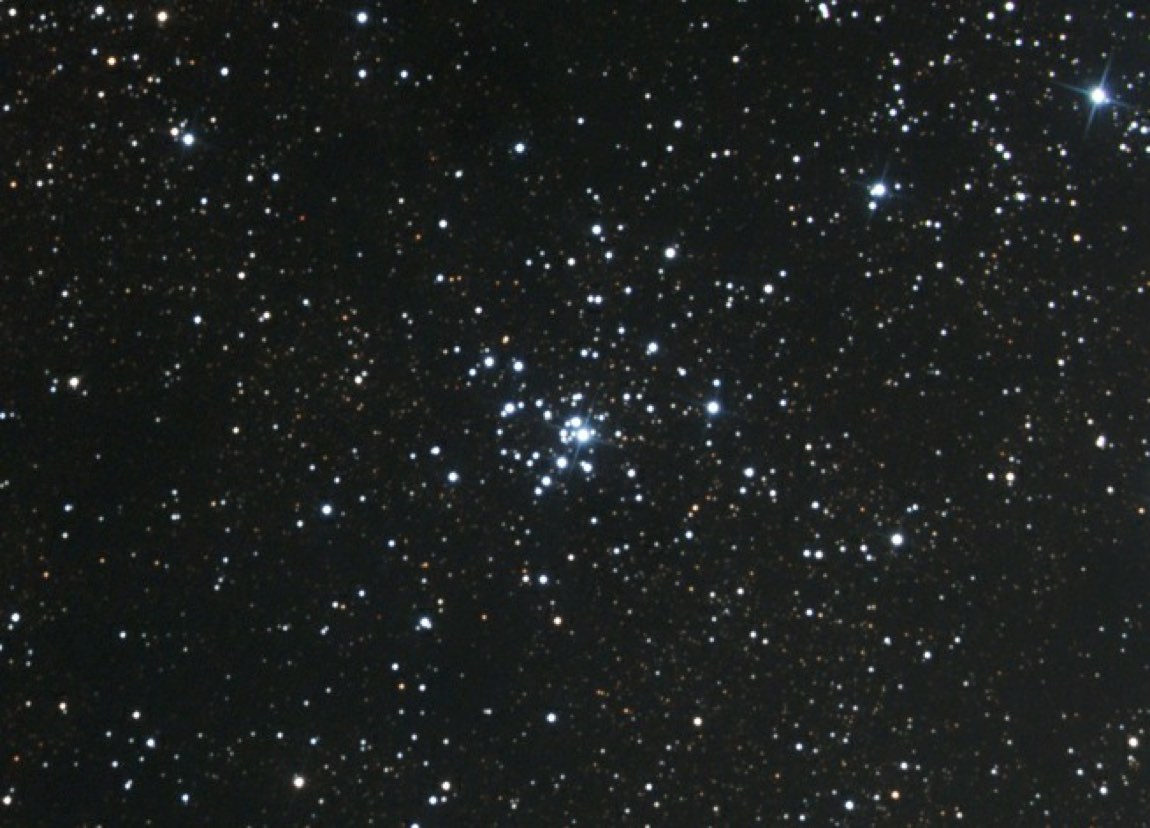
 Photograph · RubinObs/NOIRLab/SLAC/NSF/DOE/AURA · CC BY 4.0
Star Cluster · Deep guide
Messier 21
Also called: M21 · NGC 6531 · Webb's Cross
A very young star cluster near the Trifid Nebula, with stars still settling into adulthood.
What is it?
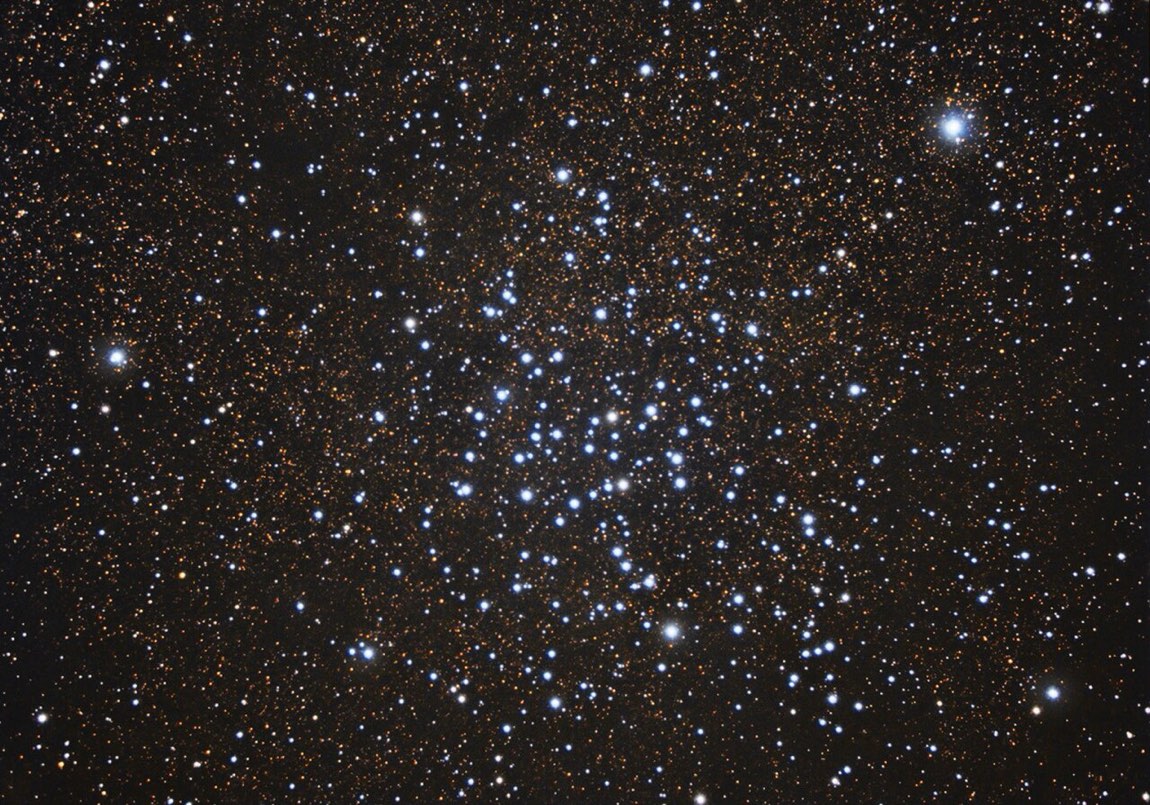
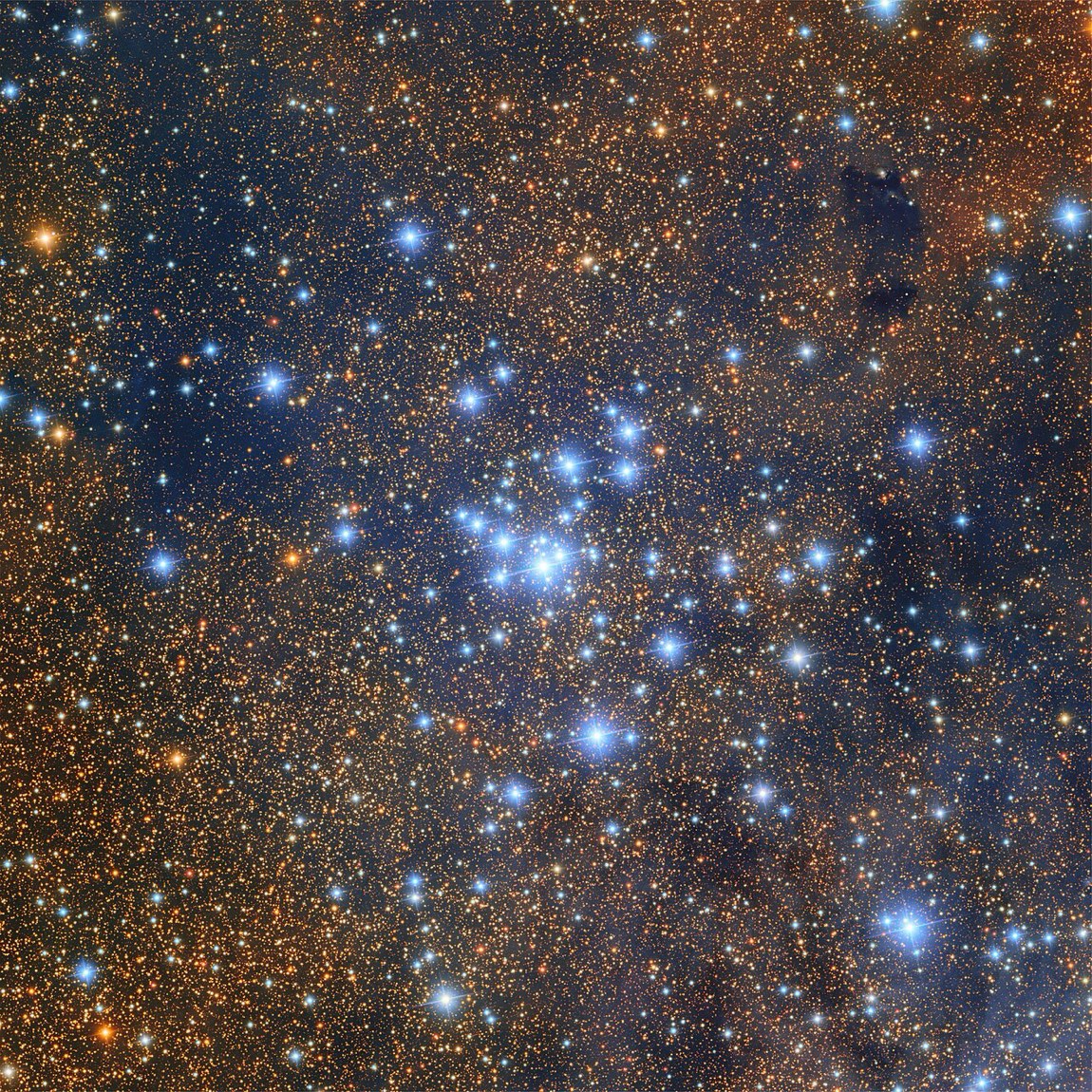
Messier 21 is a young, tightly packed open cluster in Sagittarius, catalogued by Charles Messier in 1764. It appears close to the Trifid Nebula but is not connected to that cloud of gas. The cluster is only about 6.6 million years old, and dozens of its smaller members are thought to be pre-main-sequence stars that have not yet begun steady hydrogen burning. At magnitude 6.5 it is just below naked-eye visibility but easy in small binoculars.
The deep dive
Researched for the Atlas from Wikipedia — Messier 21 (1,619 characters read) · updated Nov 15, 2026
01 A Star Cluster Caught in the Act of Youth
At roughly 6.6 million years old, Messier 21 is a genuinely young star cluster — so young, in fact, that many of its members have not yet settled into the stable, hydrogen-burning phase of stellar life called the main sequence. Between 40 and 60 of the observed low-mass stars are expected to be pre-main-sequence stars, essentially stellar infants still contracting under gravity and generating heat that way rather than through nuclear fusion. Astronomers have identified 26 of these candidates directly by looking for two telltale spectral signatures: hydrogen-alpha emission, produced when excited gas in a young star's surrounding disk glows red, and the presence of lithium in their spectra. Mature stars consume their lithium quickly once nuclear reactions begin, so detecting lithium is a reliable age marker. The cluster's youth makes it a living laboratory for studying how stars form and evolve in their earliest millions of years, a phase that most older, better-known clusters have long since passed through.
02 One Birth Event, Not a Long Slow Trickle Deeper
One of the more revealing findings about Messier 21 is that its stars do not show a significant spread in ages. In many star-forming regions, new stars ignite over tens of millions of years in a drawn-out, staggered process. Messier 21 tells a different story: the stellar population appears to have formed essentially all at once, implying that star formation was triggered by a single event rather than a gradual accumulation. That triggering event could have been a shockwave from a nearby supernova, a collision between interstellar gas clouds, or the compression of a molecular cloud by radiation pressure from already-forming massive stars. The article does not specify which mechanism was responsible, and the question remains open. What the uniform age distribution does confirm is that whatever set off star formation here, it was rapid, widespread, and efficient — sweeping the available gas into stars across the cluster in what amounts to an astronomical instant.
03 Blue Giants Among Dim Companions
Messier 21 is described as composed mainly of small, dim stars, yet it also harbors a notable minority of blue giant stars. Blue giants are massive, extraordinarily luminous stars that burn through their fuel at a ferocious rate, living only a few tens of millions of years before exploding as supernovae. Their presence in a cluster only 6.6 million years old is not surprising — massive stars form alongside lower-mass ones — but it does mean that M21 will look dramatically different in another few million years, as these giants expire one by one. The cluster also contains many early B-type stars, which sit just below the blue giant category in terms of mass and temperature, confirming that the upper end of the stellar mass spectrum is well represented here. This mixture of brilliant massive stars and faint low-mass members spanning a wide range of luminosities makes the cluster scientifically rich but visually dominated by its brightest few members.
04 The Cluster's Size and Inner Architecture Deeper
Messier 21 has a layered internal structure described in terms of three nested radii. The innermost is the nucleus radius, measured at 1.6 ± 0.1 parsecs — roughly 5.2 light-years across, comparable to the distance from the Sun to Alpha Centauri multiplied by just over one. Surrounding that is the coronal radius of 3.6 ± 0.2 parsecs, the region within which at least 105 ± 11 member stars have been counted down to visual magnitude 15.5. Beyond both of these lies the tidal radius of 11.7 parsecs, the boundary beyond which the Milky Way's gravitational field overpowers the cluster's own self-gravity and begins stripping stars away into the broader galaxy. Stars outside the tidal radius are essentially lost to the cluster over time. The extinction value of 0.87 magnitudes indicates that interstellar dust between Earth and the cluster dims and reddens its light measurably, something observers and researchers must correct for when studying the cluster's true brightness and stellar properties.
05 Part of a Larger Stellar Family
Messier 21 does not exist in isolation. It is a member of the Sagittarius OB1 association, a sprawling grouping of young, hot, massive stars and clusters spread across the Sagittarius constellation region. OB associations are loose collections of O-type and B-type stars — the most massive and luminous stars known — that share a common origin in the same giant molecular cloud but are too thinly spread to be gravitationally bound to one another the way a compact cluster is. Messier 21's membership in Sagittarius OB1 places it in a broader context of active, recent star formation across that part of the Milky Way's spiral arm. The region as a whole is one of the more productive stellar nurseries in the galaxy's inner disk, and M21 represents one of its younger, denser concentrations of freshly formed stars embedded within that larger, looser stellar family.
06 A Neighbor That Only Looks Related
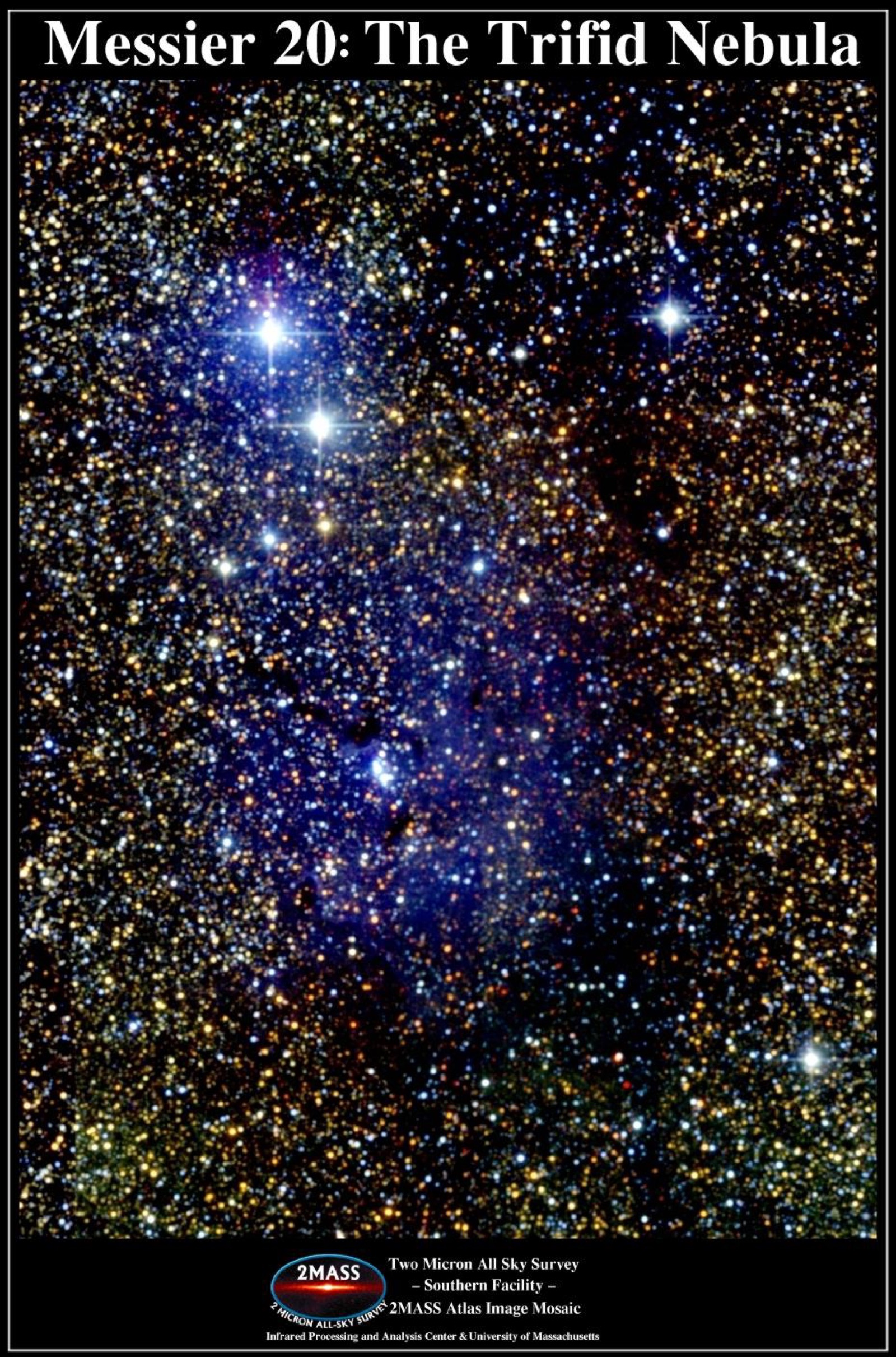
On the sky, Messier 21 sits close to the Trifid Nebula, also catalogued as NGC 6514, a spectacular cloud of glowing gas and dust famous for its three-lobed appearance. The two objects appear near each other from our vantage point on Earth, and it would be natural to assume they are physically connected — that the cluster perhaps formed from or is embedded within the nebula's gas. The article is explicit, however: Messier 21 is not associated with that nebulosity. The apparent proximity is a line-of-sight coincidence rather than a true physical relationship. This is a good reminder that the night sky is a two-dimensional projection of a three-dimensional universe, and objects that appear neighbors on a star chart can be entirely unrelated in space. The cluster also sits close on the sky to numerous other Messier objects — M20 through M25 are all in the same general region of Sagittarius — making this part of the constellation exceptionally rewarding for a single sweeping binocular session.
07 How and When Messier Found It
Charles Messier discovered and catalogued Messier 21 on June 5, 1764, during his systematic survey of the sky aimed at identifying objects that might be confused with comets. Messier was primarily a comet hunter, and his famous catalogue was essentially a nuisance list — a record of fixed, fuzzy objects that could fool observers into thinking they had found a new comet when they had not. M21 was one of many clusters and nebulae he swept up during this work. The cluster also carries the alternative designation NGC 6531, assigned later when John Louis Emil Dreyer compiled his New General Catalogue of Nebulae and Clusters of Stars, as well as the informal name Webb's Cross. The NGC designation gives it a place in the broader cataloguing system used by professional astronomers, while the Messier number remains its most widely recognized identity among amateur observers today.
08 Observing M21 With Modest Equipment
With an apparent magnitude of 6.5, Messier 21 falls just below the threshold of naked-eye visibility under even the darkest skies, where the human eye typically reaches to about magnitude 6 to 6.5 under ideal conditions. In practice this means it is effectively an instrument object, but not a demanding one: the article states that with the smallest binoculars it can be easily spotted on a dark night. The cluster lies to the northeast of the main body of Sagittarius, a constellation best viewed from the Northern Hemisphere during summer evenings when it climbs above the southern horizon. Its proximity on the sky to the Trifid Nebula makes it a convenient target to hop to after finding that more visually dramatic object. Because the cluster is relatively compact and young with bright blue giant members, it resolves well in a small telescope, showing individual stars against the rich Milky Way star field of the Sagittarius region.
09 Still Waiting for Its Hubble Portrait
As of January 2022, Messier 21 holds a somewhat unusual distinction: it is one of the very few objects in the entire Messier Catalogue that has not been photographed by the Hubble Space Telescope. The Messier Catalogue lists 110 objects, and over the decades Hubble has captured the vast majority of them in stunning detail — nebulae, galaxies, globular clusters, and open clusters alike have all received the telescope's attention. M21 remains an outlier. This absence is notable given that Hubble has photographed its near neighbors on the sky and that the cluster, as a young, scientifically interesting open cluster with pre-main-sequence stars, would seem to be a compelling target. The gap has not been publicly explained in the available record. For now, our sharpest wide-field images of M21 come from ground-based observatories, leaving the cluster's close-up Hubble portrait as a gap in the catalogue's visual record.
 ⤢