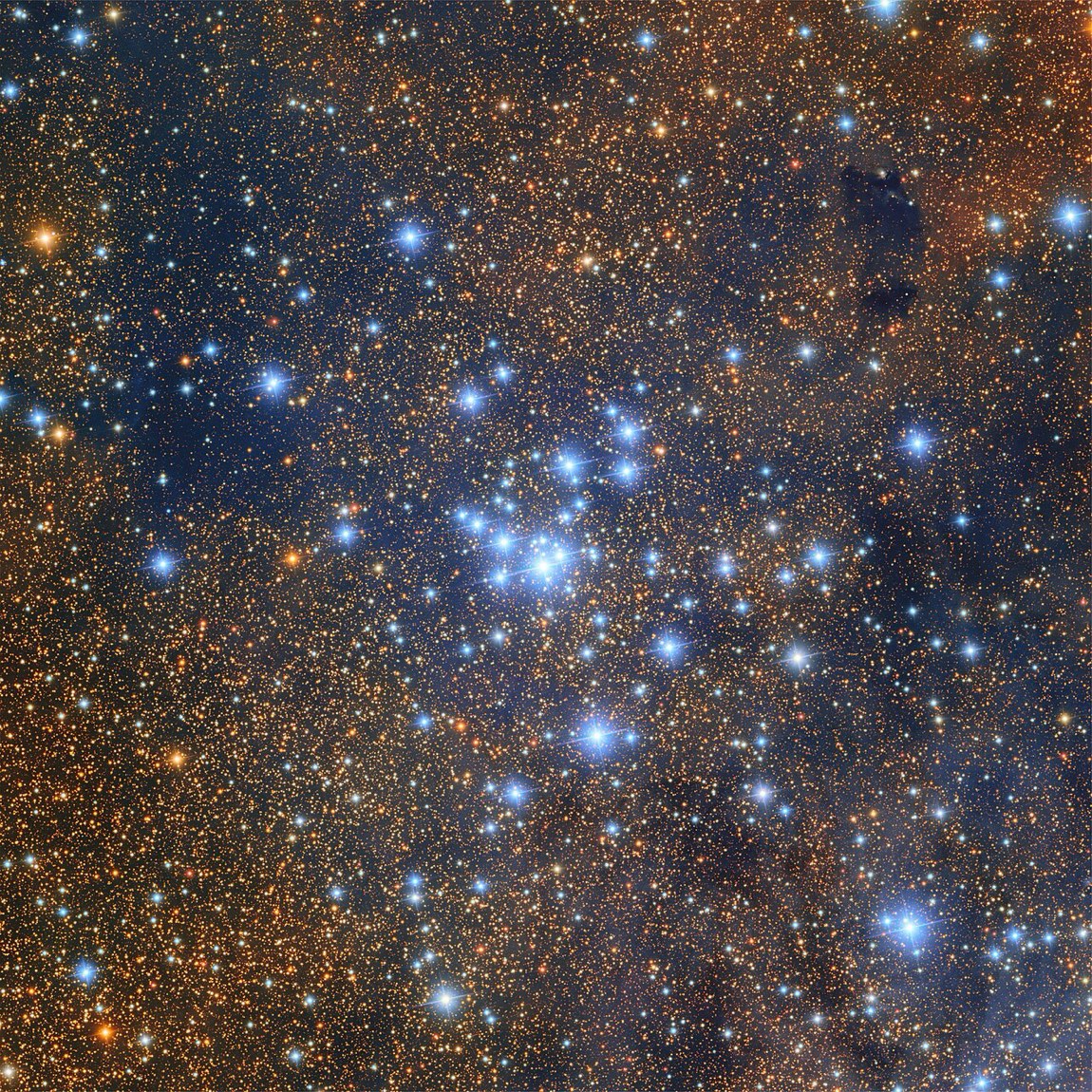
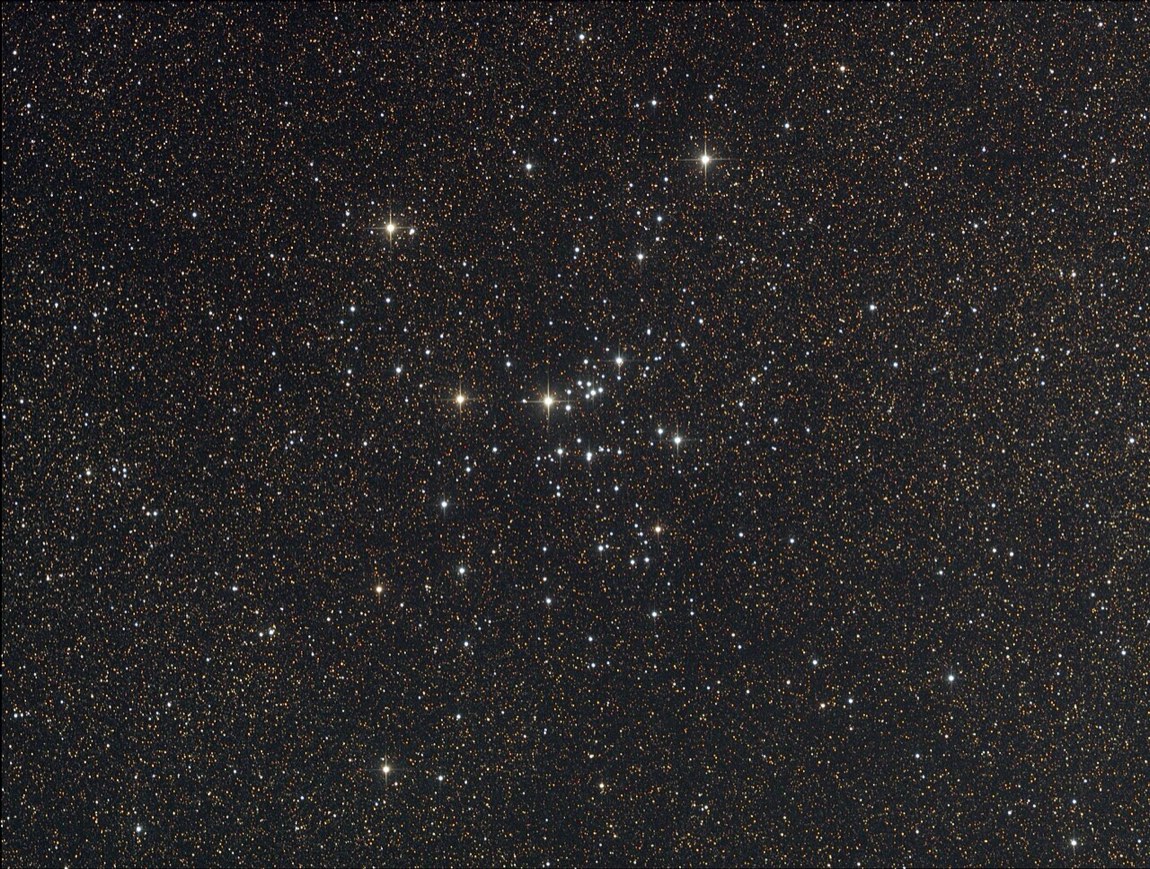
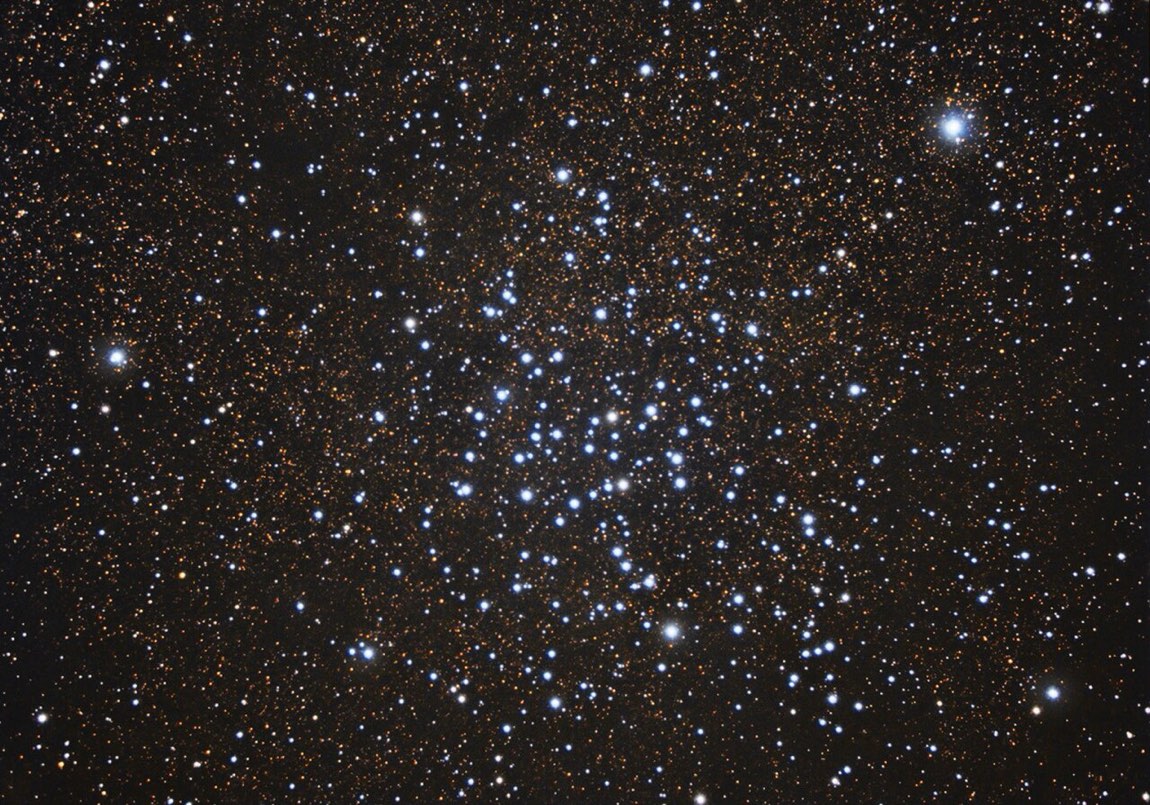
 Photograph · Sergio Eguivar · CC BY-SA 4.0
Star Cluster · Deep guide
Messier 23
Also called: M23 · NGC 6494
A rich binocular cluster in Sagittarius, about a third of a billion years old.
What is it?
Messier 23 is an open cluster in northwestern Sagittarius, discovered by Charles Messier in 1764. It lies about 2,050 light-years away and can be found with binoculars or a small telescope. Estimates of its membership range from 169 to 414 stars, and its counted mass is about 1,200 Suns. The cluster is around 330 million years old, and its chemical makeup is close to the Sun's. Because it lies near the Sun's path across the sky, the Moon can sometimes pass in front of it.
The deep dive
Researched for the Atlas from Wikipedia — Messier 23 (1,223 characters read) · updated Nov 15, 2026
01 Discovered by Messier Himself in 1764
Charles Messier, the great 18th-century comet hunter, added this star cluster to his famous catalog in 1764. His catalog was designed as a practical tool — a list of fuzzy, comet-like objects that might fool astronomers into thinking they had found a new comet. M23 earned its place precisely because it can look deceptively soft and nebulous at low magnification. Today we know it as NGC 6494, its designation in the New General Catalogue compiled more than a century after Messier's original observation. The fact that Messier himself detected it speaks to how accessible this cluster is: even with the modest instruments of the 1760s, its combined glow was bright enough to catch his eye. That same accessibility makes it a rewarding target for modern amateur astronomers using nothing more than a good pair of binoculars or a small backyard telescope under reasonably dark skies.
02 A Cluster Sitting in Front of Cosmic Fog
M23 appears projected against what the article describes as "an extensive gas and dust network" in the crowded star fields of Sagittarius. This backdrop gives photographs of the region a rich, textured appearance. Importantly, however, the article notes there may be no actual physical association between the cluster and that gas-and-dust complex — the two may simply share the same line of sight by coincidence, like a street lamp appearing to hover above a distant mountain range when viewed from the right angle. This kind of line-of-sight coincidence is common in the direction of Sagittarius, which looks toward the dense inner regions of the Milky Way. Disentangling true physical relationships from projected alignments is one of the quieter challenges of cluster astronomy, requiring precise distance measurements and careful analysis of stellar motions.
03 How Far, How Heavy, How Many Stars Deeper
The cluster's center sits roughly 2,050 light-years from Earth — close enough that it falls within our own spiral arm of the Milky Way. Counting its members is surprisingly contentious: estimates range from a low of 169 stars all the way up to 414, a spread that reflects the genuine difficulty of deciding which stars belong to the cluster versus which are foreground or background objects that happen to share the same patch of sky. The mass is better constrained by two independent methods. Direct counting of identified members yields 1,206 solar masses, while applying the virial theorem — a physics tool that relates a system's internal motions to its gravitational energy — gives a slightly higher figure of 1,332 solar masses. That the two approaches agree so closely is reassuring, suggesting the cluster is dynamically well-behaved and not in the process of rapidly losing members to gravitational escape.
04 Near-Solar Chemistry and What It Tells Us Deeper
One of the most scientifically informative numbers associated with M23 is its metallicity: [Fe/H] = −0.04. In astronomical shorthand, this compares the ratio of iron to hydrogen in the cluster's stars against the same ratio in our Sun. A value of zero would be a perfect solar match; −0.04 is so close to zero that M23's stars are, for all practical purposes, as metal-rich as the Sun itself. This matters because a star's metallicity is a fingerprint of the chemical environment in which it formed. Metal-rich clusters tend to form in regions of the galaxy where previous generations of stars have already seeded the interstellar gas with heavy elements forged in stellar cores and supernova explosions. M23's near-solar metallicity places it comfortably within the chemical mainstream of the Milky Way's disk — consistent with its location and its age of around 330 million years.
05 Red Giants and an Aging Stellar Population
At 330 million years old, M23 is old enough that some of its more massive original members have already evolved off the main sequence and swelled into giants. The article identifies five cluster members as candidate red giants — stars that have exhausted the hydrogen fuel in their cores and are now burning hydrogen in a shell around an inert helium center, causing their outer layers to expand dramatically. Even more evolved is VV Sgr, an orange variable star located in the cluster's far south. It is described as a candidate asymptotic giant branch star, meaning it may have already passed through the red giant phase and is now on a second, even more luminous giant phase before eventually shedding its outer layers entirely. Variable stars like VV Sgr are especially valuable because their brightness changes carry encoded information about their internal structure and mass.
06 The Brightest Star the Cluster Can Offer
The lucida of M23 — the single brightest individual member — shines at magnitude 9.3. That number means it sits just beyond what the naked eye can detect under any conditions; the conventional limit for unaided human vision is around magnitude 6.5. Yet magnitude 9.3 is bright enough to pick out easily with binoculars, and in a telescope it becomes a crisp, identifiable point of light that anchors the cluster visually. The lucida's brightness relative to its neighbors gives the cluster a subtle central concentration that helps the eye recognize it as a physical grouping rather than a random scatter of stars. In an open cluster as populous as M23, the brightest member often sets the tone for how the whole object appears through an eyepiece — and at magnitude 9.3, that tone is one of accessibility and visual reward even for observers with modest equipment.
07 The Impostor in the Corner: HD 163245 Deeper
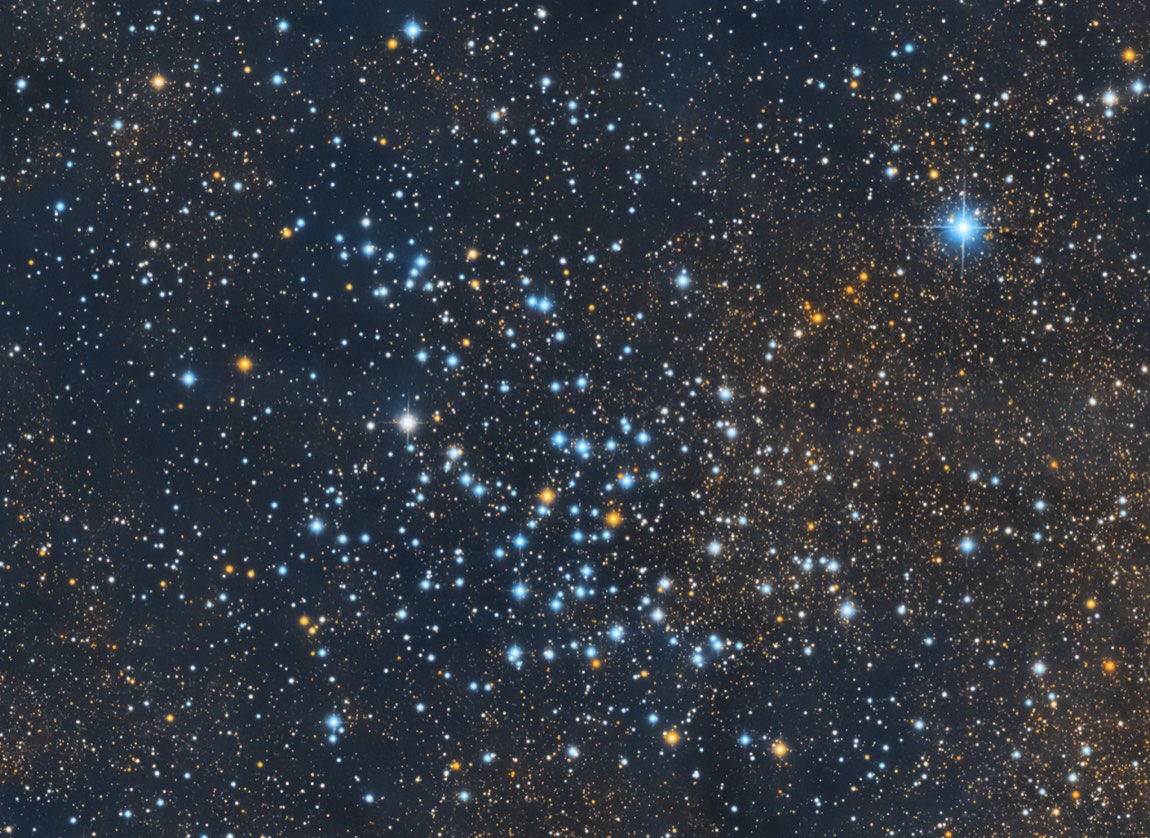
Wide-field images of M23 show a noticeably bright star sitting in the top-right corner of the frame, toward the far northwest. This star, catalogued as HD 163245 or HR 6679, appears at 6th magnitude — bright enough to be just at the threshold of naked-eye visibility — and might easily be mistaken for a cluster member. It is not. Its parallax shift has been measured at 9.8912 ± 0.0518 milliarcseconds, a tiny wobble in its apparent position caused by Earth's annual orbit around the Sun. After correcting for the star's own proper motion across the sky, that parallax translates to a distance of roughly 101 parsecs, or about 330 light-years. Since M23 itself lies approximately 2,050 light-years away, HD 163245 is a pure foreground interloper — roughly six times closer to us than the cluster it appears to adorn. It is a vivid reminder that the sky is a projection, not a map.
08 Moon Crossings and the Ecliptic's Influence
M23 lies within 5° of the Sun's annual path through the sky — the ecliptic — which carries a practical observational consequence: the Moon can pass directly in front of the cluster, an event called an occultation. The article notes that this geometry places M23 near the Sun's position in mid-December, which is when observers need to be aware of both the Moon's potential interference and the Sun's proximity in that direction. Lunar occultations of star clusters are scientifically useful events, not just inconveniences: as the Moon's limb sweeps across individual stars one by one, the precise timing of each star's disappearance and reappearance can be used to refine the Moon's orbital position and even, in some cases, to probe whether the "star" being occulted is actually a close double star too tight to resolve in a telescope.
09 How to Find and Observe M23 Tonight
M23 sits in the northwest of Sagittarius, a constellation best placed for observation from the northern hemisphere during the summer months, when it rises high enough in the southern sky to clear the murk near the horizon. The cluster's total apparent brightness makes it findable with binoculars under good conditions, and even a small telescope begins to resolve individual stars across its face. Because it lies in one of the richest star fields in the sky — the direction toward the galactic center — patience and a detailed star chart are helpful to avoid confusing it with nearby clusters and nebulae. An aperture of 100 mm or more will start to show the gentle uneven distribution of stars across the cluster's face, hinting at the internal structure that more careful photometric surveys have mapped in detail.
 ⤢