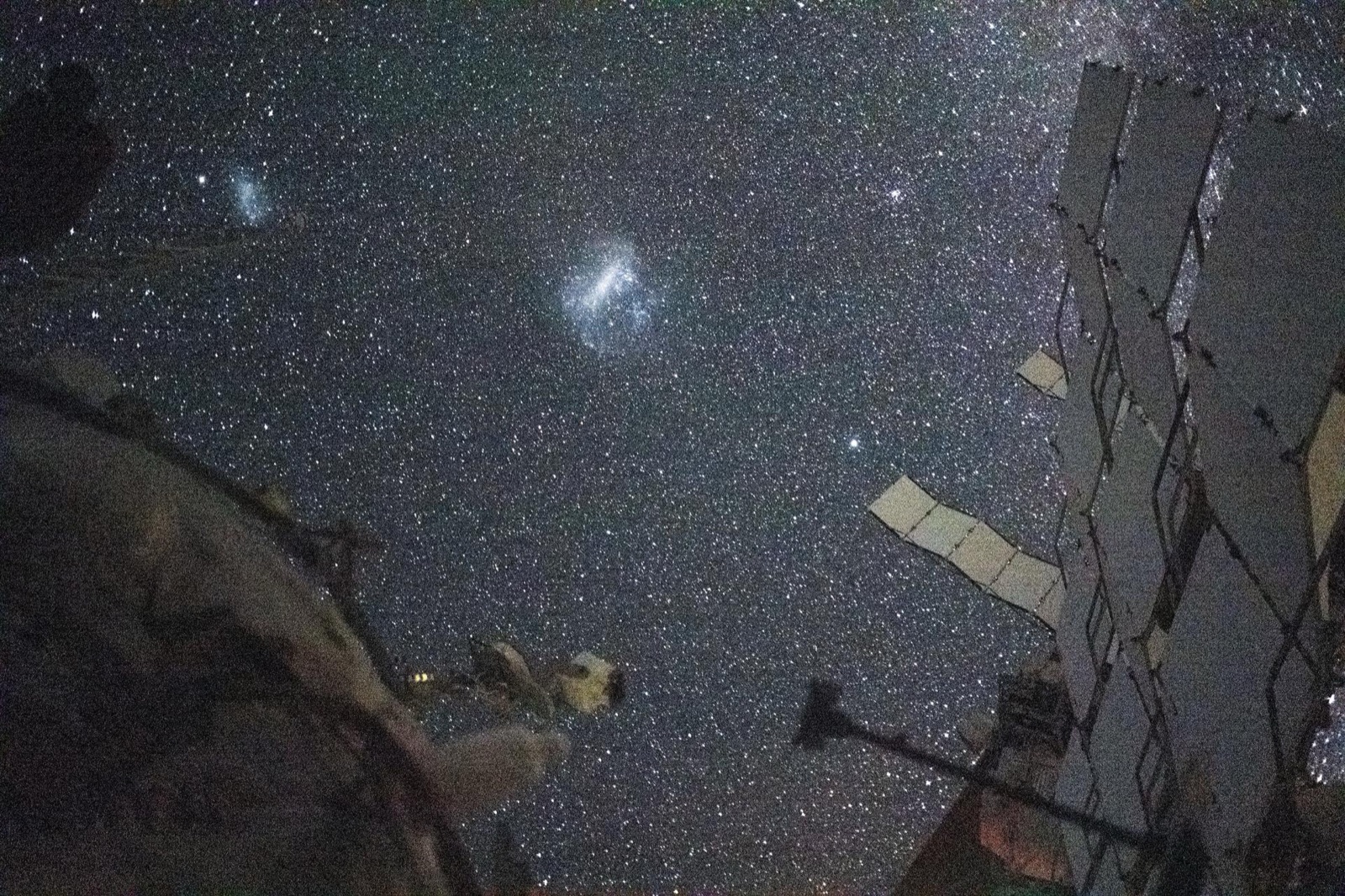
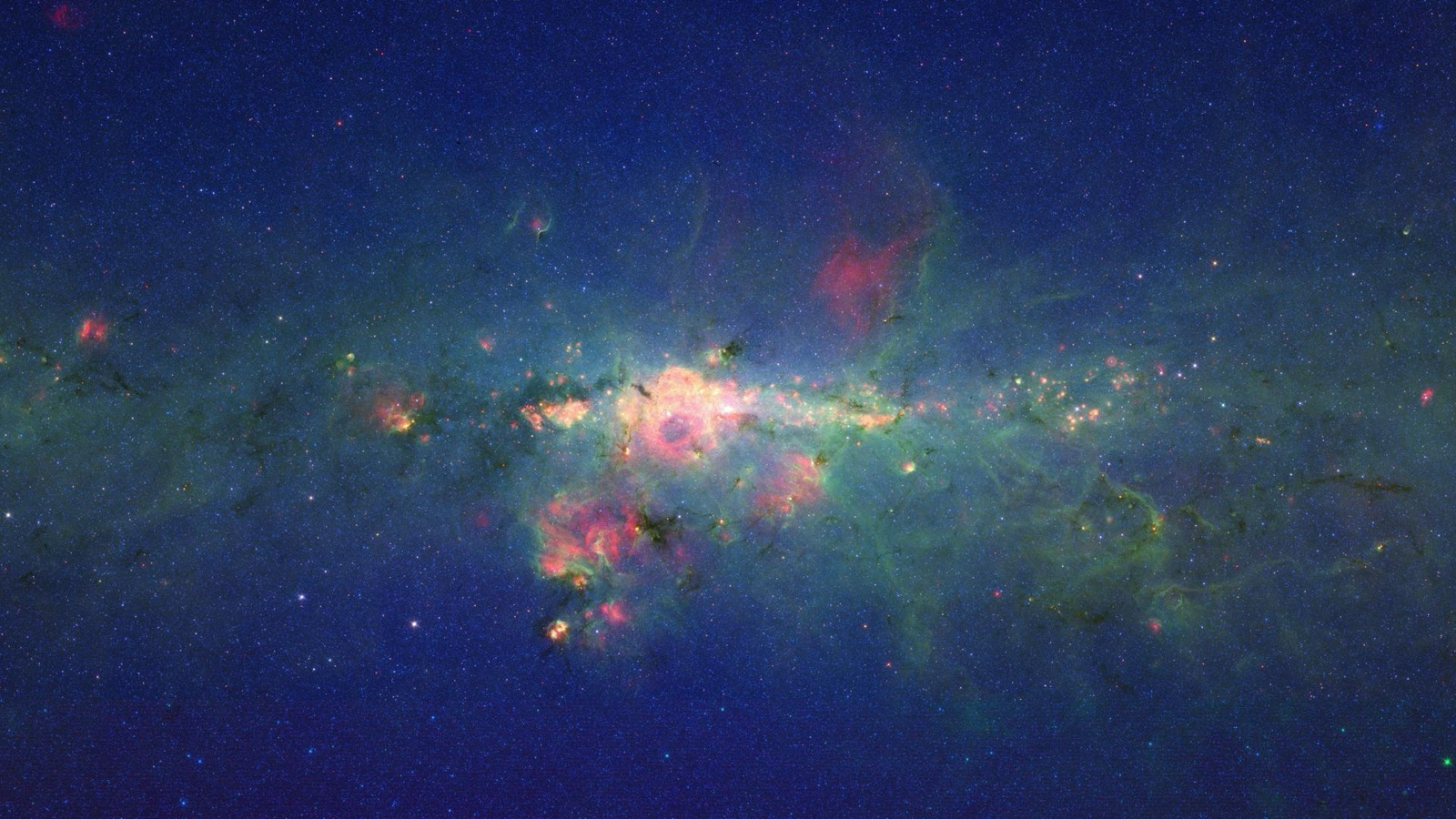
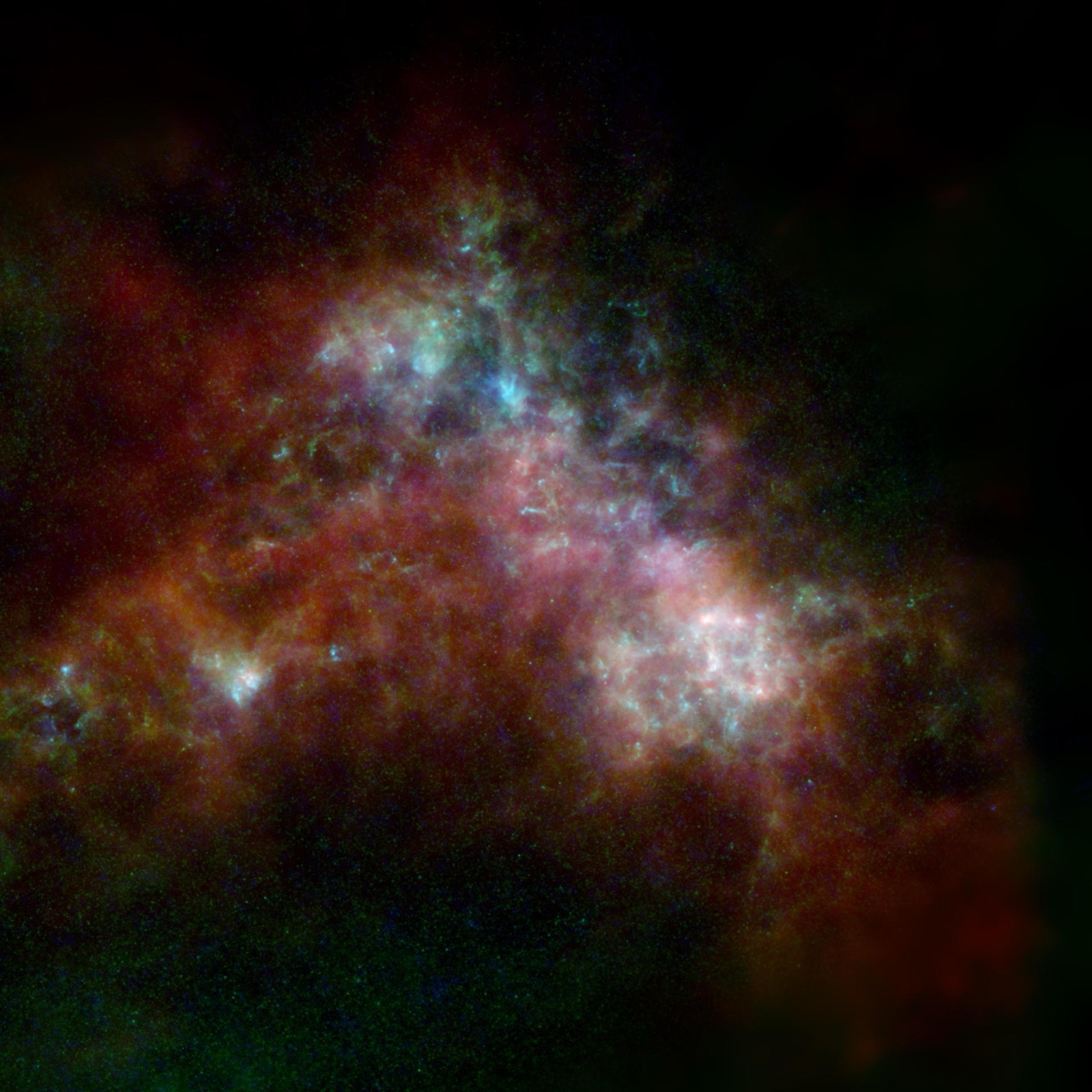
 Photograph · ESA/NASA/JPL-Caltech/CSIRO/NANTEN2/C. Clark (STScI)
Galaxy · Deep guide
Small Magellanic Cloud
The Milky Way's second cloud. This galaxy is being pulled apart before our eyes.
What is it?
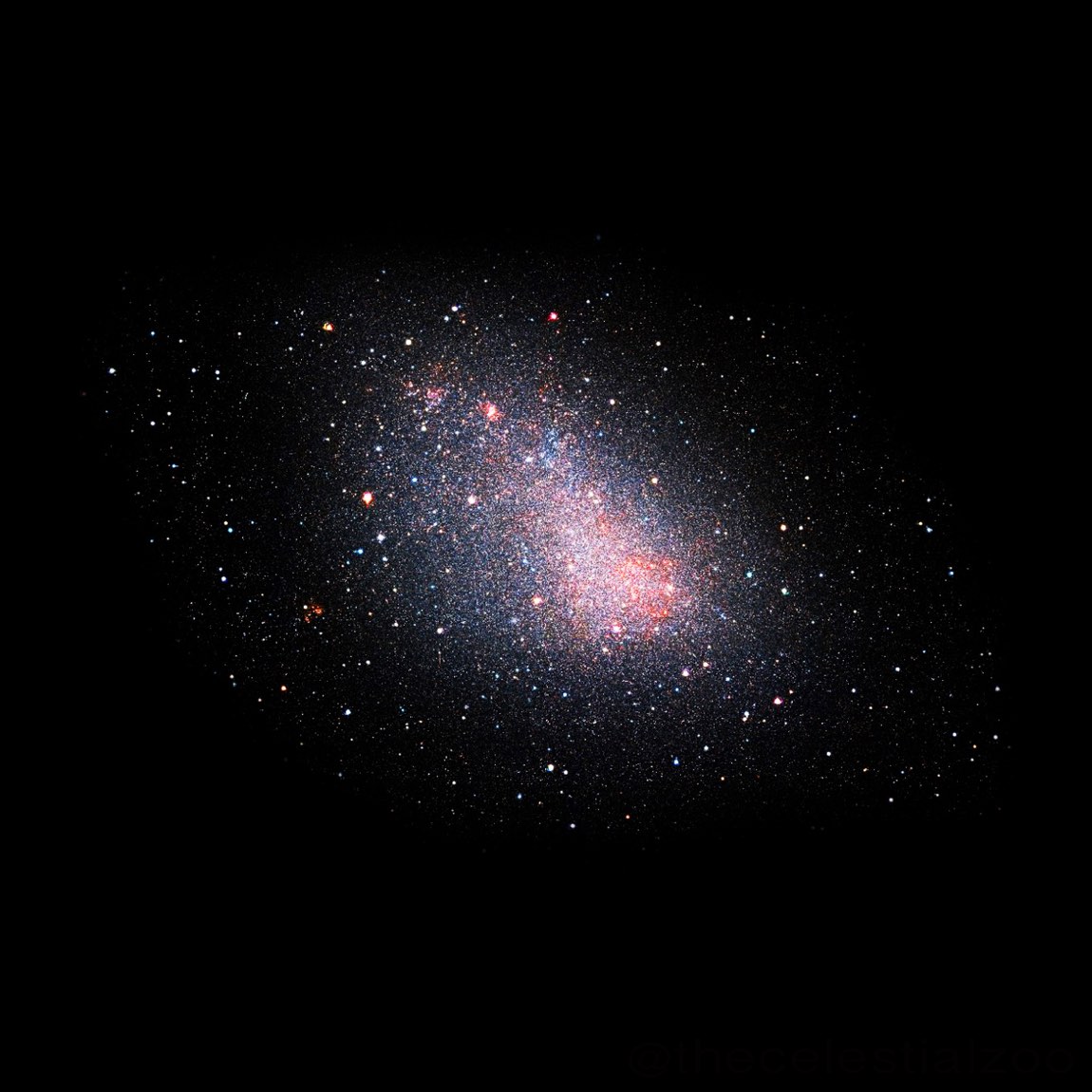
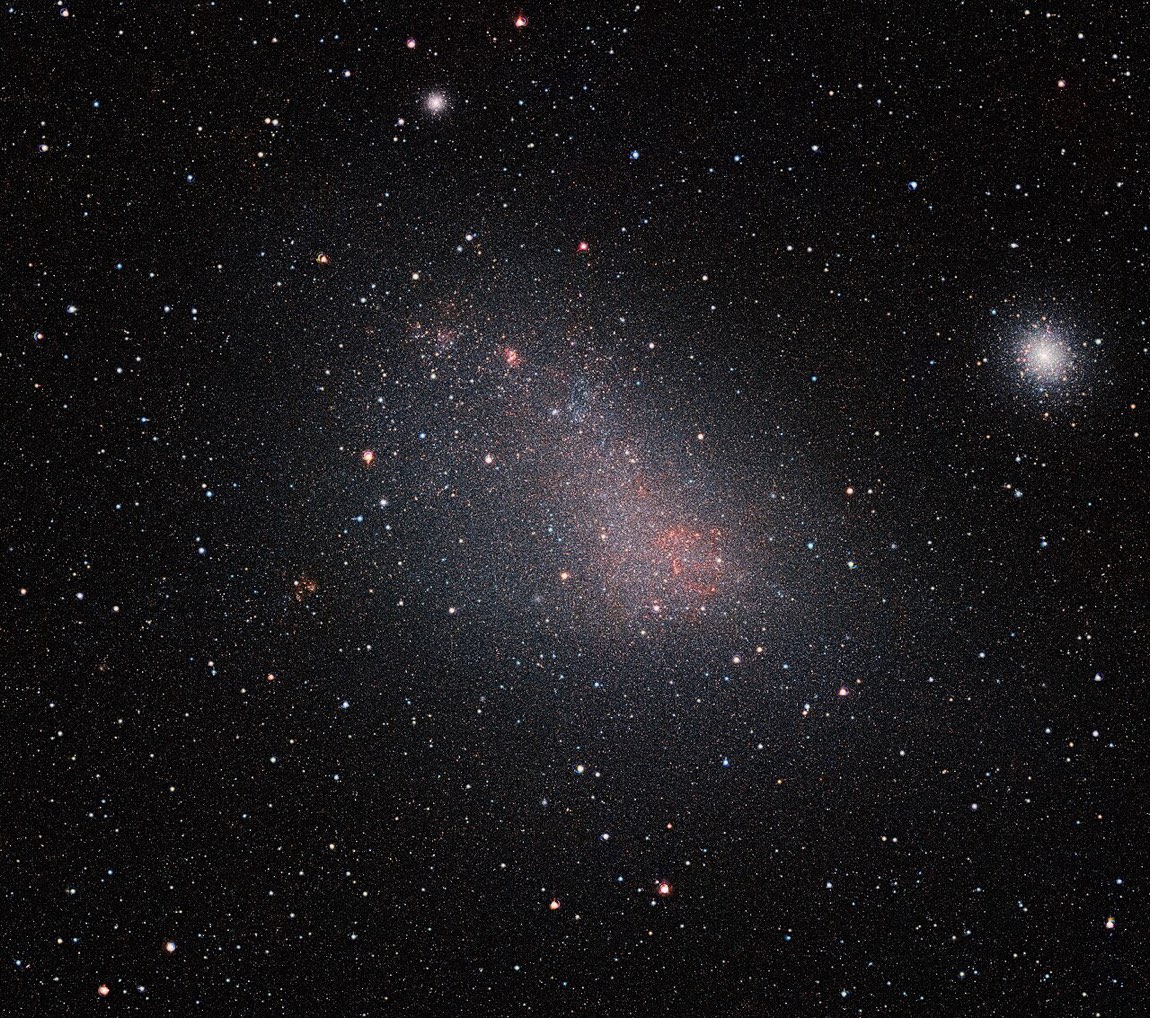
The Small Magellanic Cloud drifts about 200,000 light-years away, visible to southern eyes as a detached wisp of the Milky Way. It is a dwarf galaxy of a few hundred million stars being visibly stretched by the gravity of our galaxy and its larger sibling — a stream of hydrogen called the Magellanic Bridge literally connects the two Clouds. Its calibrated Cepheid stars helped build the cosmic distance ladder.
The deep dive
Researched for the Atlas from Wikipedia — Small Magellanic Cloud (8,967 characters read) · updated Sep 20, 2026
01 A Galaxy Hiding Its Former Shape
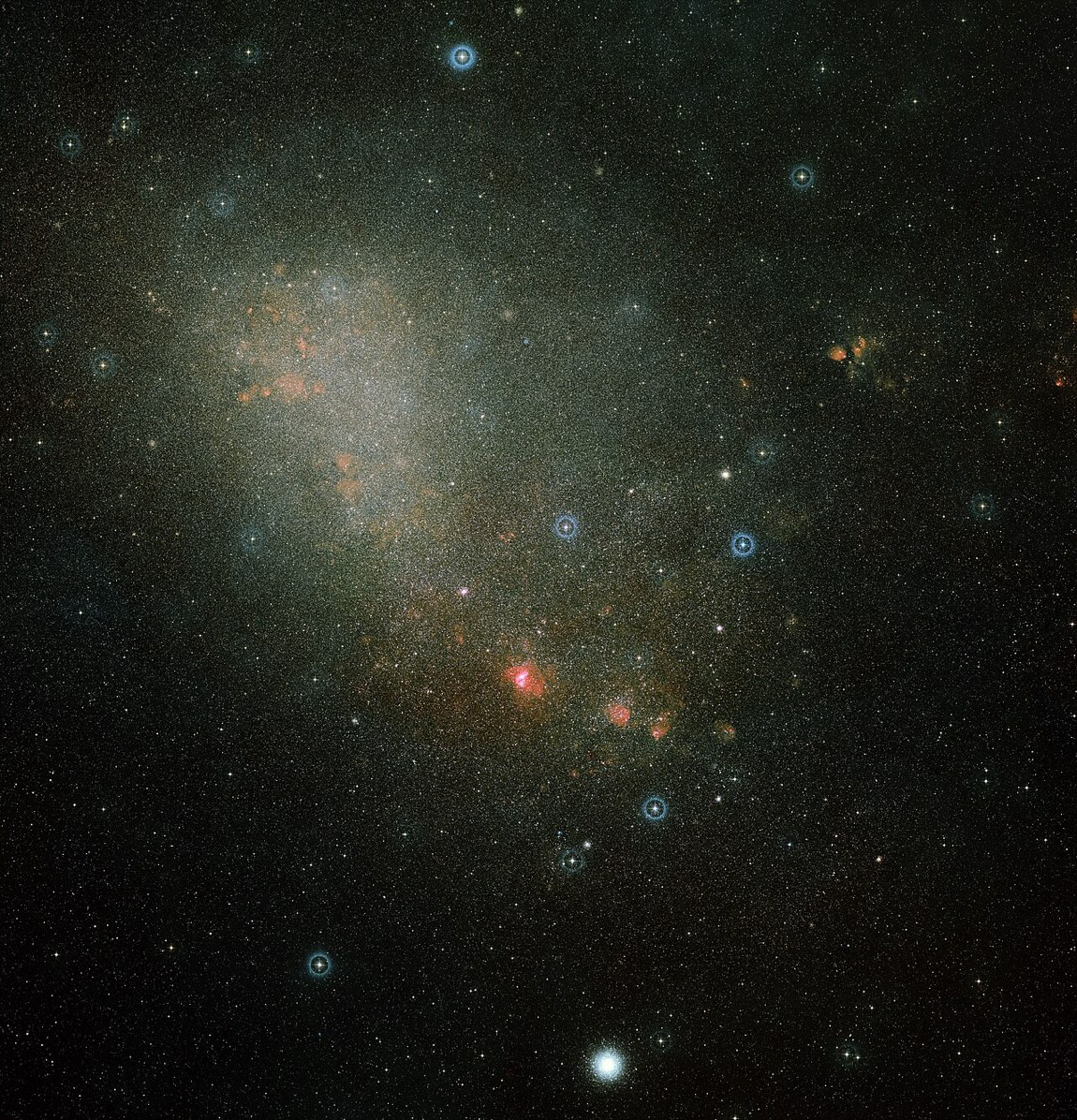
Look closely at the SMC and you can still find a ghost of its past. Astronomers have identified a central bar structure inside the cloud, and they speculate that the SMC was once a barred spiral galaxy — a type with orderly, sweeping arms anchored by a dense central rod of stars, much like many grand galaxies photographed by Hubble. Repeated gravitational tugging from the Milky Way appears to have scrambled that elegant structure, leaving the SMC classified today as a dwarf irregular galaxy. The bar has not vanished entirely, though. The young stellar population and most of the known X-ray binaries in the SMC cluster along this surviving bar, making it the most active and energetic zone in the entire galaxy. It is a striking example of how a close neighbour can permanently remodel another galaxy's architecture over billions of years without any collision at all.
02 The Bridge That Connects Two Clouds
The SMC does not drift through space in isolation. A stream of gas physically connects it to the Large Magellanic Cloud, which sits about 20 degrees to the east on the sky. This Magellanic Bridge is direct, visible evidence that the two galaxies have been pulling on each other through tidal forces. The bridge is not merely a passive ribbon of gas — it is actively forming new stars. Beyond the bridge, the two clouds share a common envelope of neutral hydrogen, a sign that they have been gravitationally bound to each other for a very long time. In 2017, data from the Dark Energy Survey combined with the MagLiteS survey revealed a stellar over-density associated with the SMC, almost certainly a scar left by interactions between the SMC and LMC. The two clouds, in other words, have been reshaping each other for eons.
03 A Galaxy That May Be Two Galaxies Deeper
One of the most startling proposals in recent SMC research is that what we call one galaxy might actually be two. Astrophysicists D. S. Mathewson, V. L. Ford, and N. Visvanathan proposed that the SMC is split into a main body and a smaller section sitting behind it from Earth's perspective, separated by about 30,000 light-years — roughly the distance across the Milky Way's central bulge. They named this background remnant the Mini Magellanic Cloud, or MMC, and attributed the split to a past violent interaction with the LMC that effectively tore the SMC apart, with the two pieces still moving away from each other. This idea gained significant support in 2023, when researchers reported that the SMC is indeed two separate structures with distinct stellar and gaseous chemical compositions, separated by around 5 kiloparsecs. That chemical difference is key: it means the two pieces have genuinely different histories, not just different positions.
 ⤢
⤢
04 Henrietta Leavitt's Revolutionary Discovery
The SMC's greatest contribution to science may be a discovery made not about the cloud itself, but by using it as a tool. Astronomer Henrietta Swan Leavitt at the Harvard College Observatory studied photographic plates taken at the Arequipa station in Peru between 1893 and 1906. She was examining variable stars in the SMC when she noticed something profound: a class of pulsating stars she called cluster variables — later renamed Cepheid variables after the prototype Delta Cephei — showed a clear, consistent relationship between how long they took to brighten and dim and how bright they appeared. Because all stars in the SMC sit at roughly the same distance from Earth, she realised the same period-luminosity link must apply to true, absolute brightness. Published in 1908, this period-luminosity relation gave astronomers a cosmic ruler. If you measure a Cepheid's pulsation period, you can calculate its intrinsic luminosity and, by comparing that to its apparent brightness, derive its distance — anywhere in the universe.
05 The First Rough Distance and Its Legacy Deeper
Leavitt's period-luminosity relation was immediately put to work. In 1913, Danish astronomer Ejnar Hertzsprung used it to make the first quantitative estimate of the SMC's distance. He measured thirteen nearby Cepheid variables to pin down the absolute magnitude of a variable with a one-day period, then compared that standard to the periodicities Leavitt had recorded for SMC Cepheids. His answer was 10,000 parsecs — about 30,000 light-years. We now know the true distance is roughly 200,000 light-years, making Hertzsprung's figure a gross underestimate by a factor of nearly seven. Yet the method itself was sound, and the exercise proved the technique's enormous potential. Once a few nearby Cepheids had their distances pinned down by direct parallax measurement — exactly as Leavitt had hoped — the distance ladder could be extended across the Milky Way and eventually to other galaxies, enabling discoveries that transformed our understanding of the entire cosmos.
06 A Hotbed of X-ray Binaries Deeper
The SMC punches well above its weight when it comes to high-energy astrophysics. It harbours a large and active population of X-ray binaries, especially high-mass X-ray binaries, or HMXBs. These systems pair a rotating neutron star — a pulsar — with a massive companion star, typically a Be-type star of spectral class O9 to B2. Be stars spin so rapidly that they fling material into an equatorial disk. When the neutron star swings close to the companion during its eccentric orbit, it scoops up matter from this disk, releasing X-rays with luminosities of 10 to the power of 36 to 10 to the power of 37 ergs per second. In the Milky Way, about 70 percent of HMXBs are of this Be type; in the SMC, the fraction rises to 98 percent. By the end of 2008, NASA's Rossi X-ray Timing Explorer had counted 50 X-ray pulsars in the SMC exceeding 10 to the power of 36 ergs per second — a density that makes the SMC one of the richest known laboratories for studying these extreme objects.
 ⤢
⤢
07 Decades of X-ray Exploration Deeper
Detecting X-rays from the SMC was a painstaking, multi-decade effort. A Nike-Tomahawk rocket flight on September 20, 1966, found no X-rays above background from the Magellanic Clouds. A balloon observation from Mildura, Australia, on October 24, 1967, only managed to set an upper detection limit. Progress came on September 24, 1970, when an X-ray instrument carried aboard a Thor missile launched from Johnston Atoll at 12:54 UTC climbed above 300 kilometres and successfully detected the SMC — recording an X-ray luminosity of 5×10 to the 38th power ergs per second in the 1.5–12 keV band. The Uhuru satellite then observed the SMC on multiple dates in January 1971 and confirmed a point source designated SMC X-1. Later missions — ROSAT, ASCA, and ultimately the far sharper XMM-Newton and Chandra observatories — catalogued several hundred individual X-ray sources in the SMC's direction, of which perhaps half are considered likely HMXBs, with the rest being foreground stars and background active galactic nuclei.
08 Is the SMC Actually Orbiting Us?
The SMC has long been described as a satellite galaxy of the Milky Way, meaning our galaxy's gravity should keep it in a stable orbit. But measurements announced in 2006 using the Hubble Space Telescope complicated that picture. The data suggested that both the Large and Small Magellanic Clouds might be moving too fast to be gravitationally bound to the Milky Way in a long-term orbit — or, alternatively, that the Milky Way itself is significantly more massive than astronomers had assumed at the time. Neither conclusion was comfortable. If the clouds are just passing through on a one-time flyby rather than completing repeated orbits, it changes everything about how we model their long history of interaction with our galaxy. The question remains genuinely open, and it has pushed astronomers to refine estimates of the Milky Way's total mass in ways that continue to influence galaxy formation research.
09 How to Find It in the Night Sky
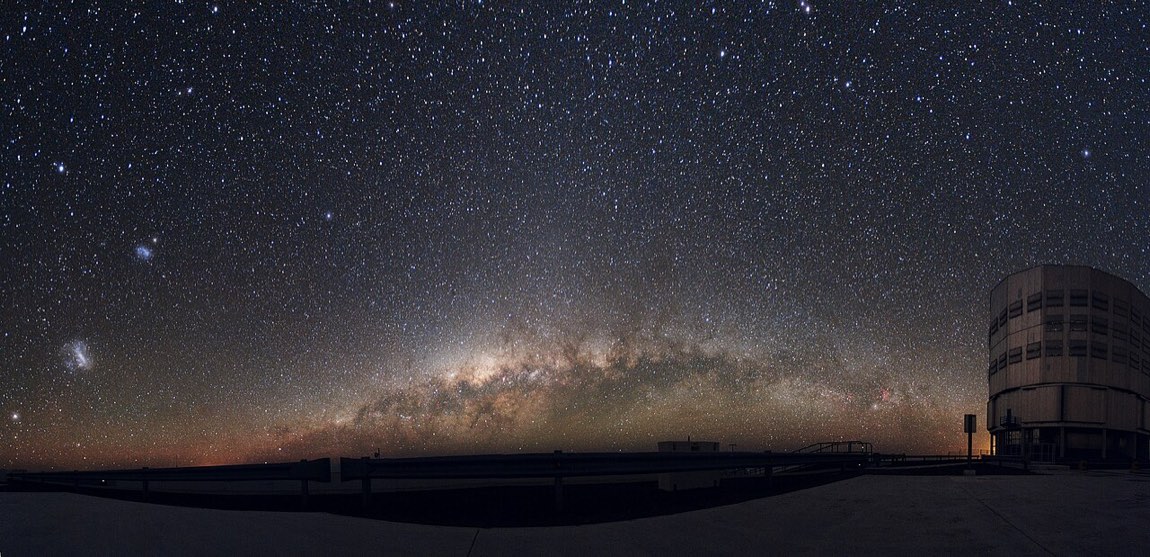
The SMC is visible to the naked eye from the entire Southern Hemisphere and can be glimpsed low on the southern horizon from any location south of about 15 degrees north latitude. It spans the constellation Tucana and spills into part of Hydrus, appearing as a soft, hazy patch — like a piece of the Milky Way that has somehow drifted free. Its average apparent diameter is about 4.2 degrees, which is eight times the angular width of the full Moon, and it covers roughly 14 square degrees of sky, approximately 70 times the Moon's area. Despite this generous size, the SMC's surface brightness is very low, so it is best seen on clear, moonless nights well away from light pollution. Under ideal dark-sky conditions it is an impressive and unmistakable smudge. In Johann Bayer's 1603 star atlas Uranometria, it was named Nubecula Minor — Latin for 'little cloud' — a name that perfectly captures how it looks to the unaided eye.
 ⤢
⤢
10 Centuries of Human Observation
Long before European astronomers gave the SMC a formal name, it was woven into the sky lore of indigenous peoples across the Southern Hemisphere, including south sea islanders and Aboriginal Australians. The Persian astronomer Al Sufi mentioned the Magellanic Clouds in his Book of Fixed Stars, repeating a passage from the polymath Ibn Qutaybah, though he acknowledged he had not personally observed them. European sailors may have first noticed the clouds during the Middle Ages, finding them useful for navigation. Portuguese and Dutch sailors called them the Cape Clouds, a name that persisted for centuries. During Ferdinand Magellan's circumnavigation of the Earth from 1519 to 1522, Antonio Pigafetta described them as dim clusters of stars. It was Bayer's 1603 atlas that coined Nubecula Minor. Between 1834 and 1838, John Herschel studied the SMC with a 14-inch reflector from the Royal Observatory, describing an oval cloud with a bright centre and cataloguing 37 nebulae and clusters within it.
11 Size, Mass, and Place in the Local Group
The SMC has a D25 isophotal diameter of about 5.78 kiloparsecs, equal to roughly 18,900 light-years — making it a small fraction of the Milky Way's roughly 100,000-light-year span. Its total mass is approximately 7 billion solar masses, modest compared to the Milky Way's hundreds of billions, yet substantial enough to contain several hundred million stars and sustain vigorous star formation. At a distance of about 200,000 light-years it sits among the Milky Way's nearest intergalactic neighbours and is one of the most distant objects visible to the naked eye from Earth — a remarkable fact for something so faint and diffuse. The SMC is a full member of the Local Group, the collection of galaxies that includes the Milky Way and the Andromeda Galaxy, and is currently classified as a satellite of the Milky Way, though it is thought to have been a satellite of the LMC before that.
 ⤢
⤢