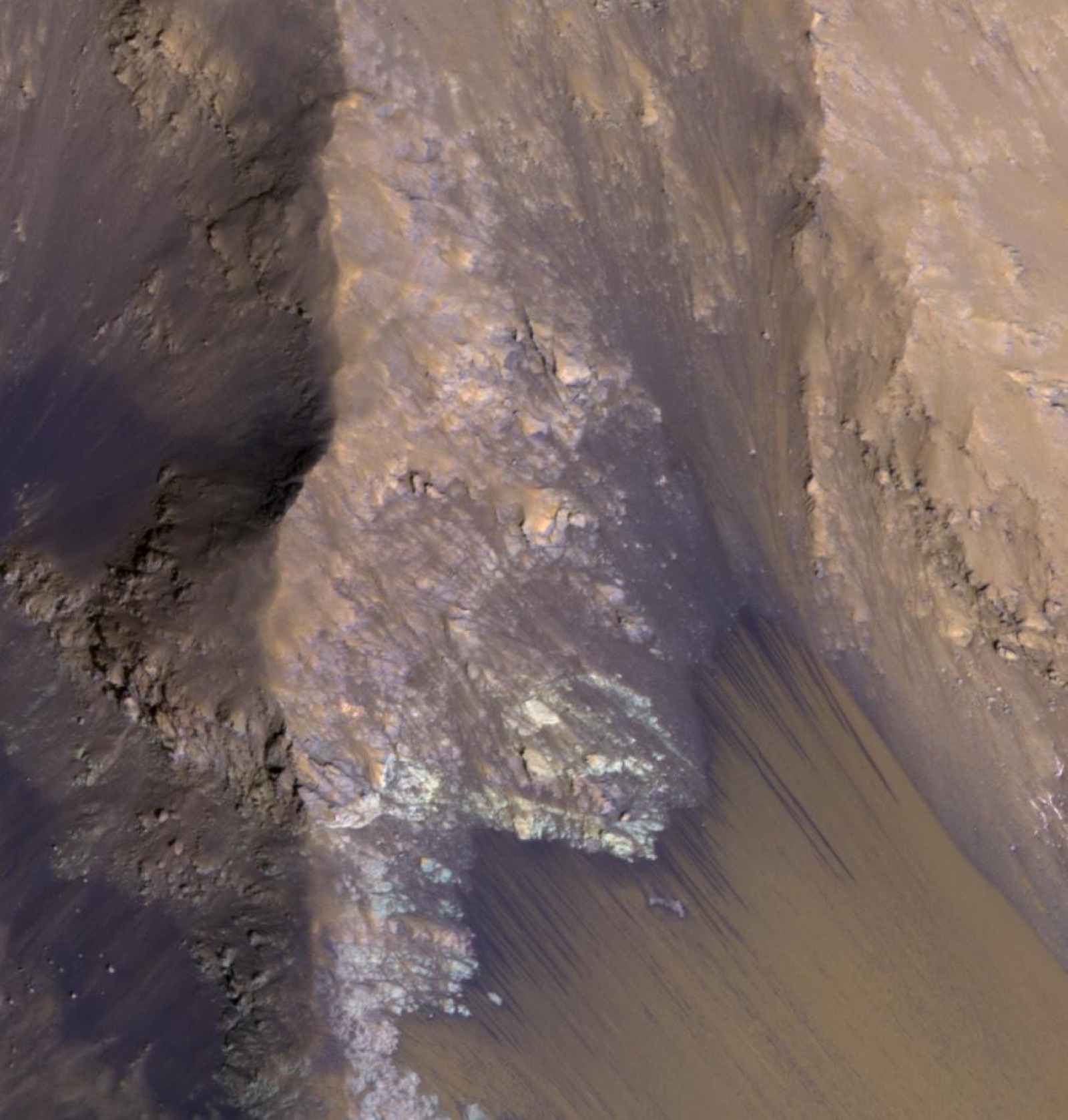
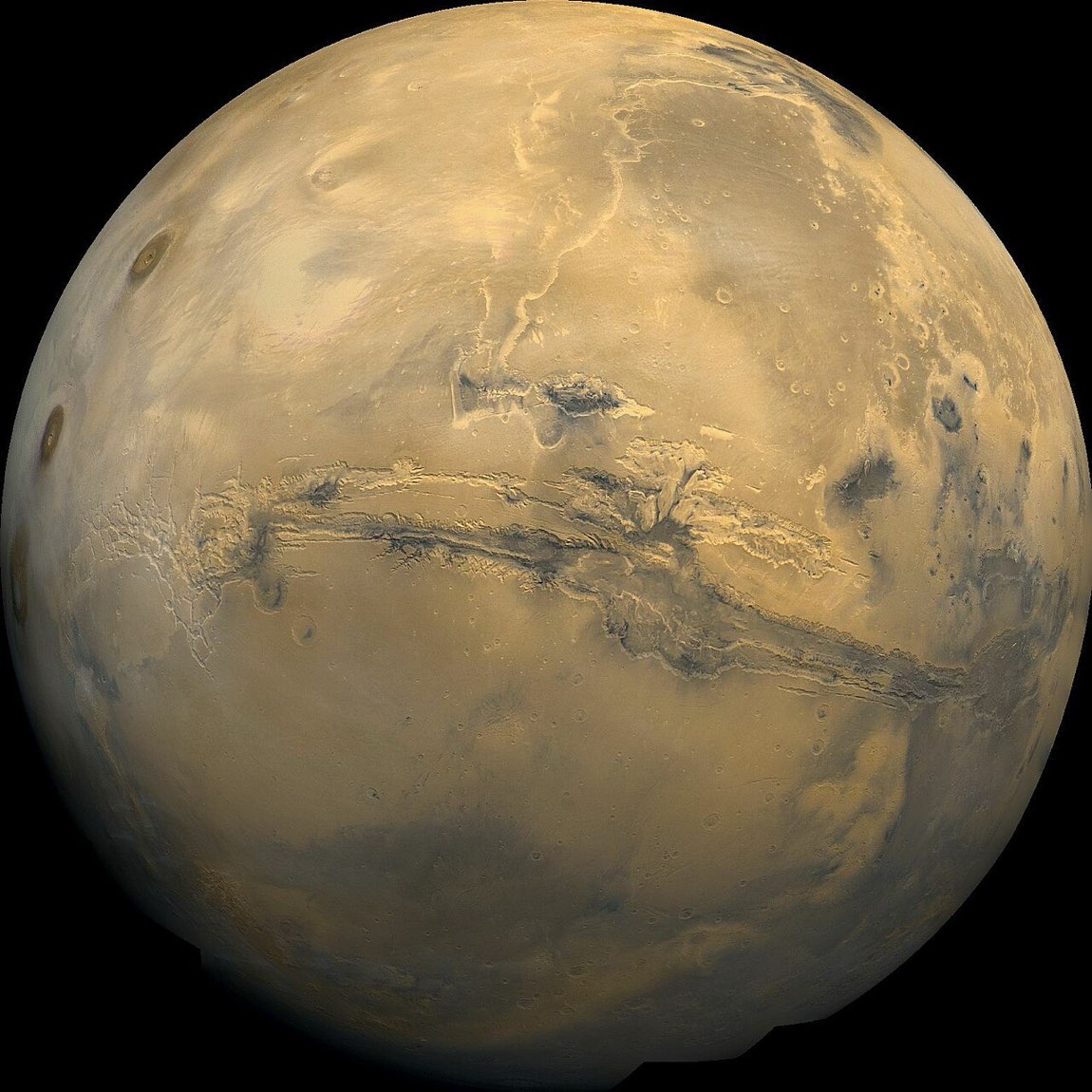
 Photograph · NASA / USGS (see PIA04304 catalog page ) · Public domain
Spacecraft · Deep guide
Viking 1 & 2
The first successful Mars landings, which also ran the first search for life there.
What is it?
NASA's twin Vikings arrived at Mars in 1976: two orbiters mapping the planet, two landers touching down safely — the first fully successful Mars landings. Each lander carried a biology lab that performed humanity's first life-detection experiments on another world. The results were tantalizingly ambiguous (one test fizzed positive; the others said chemistry, not biology), a scientific argument that shaped every Mars mission since.
The deep dive
Researched for the Atlas from Wikipedia — Viking program (17,639 characters read) · updated Sep 20, 2026
01 From Voyager to Viking: how the mission began
The Viking program did not spring fully formed from NASA's imagination. It grew directly out of an earlier, far more ambitious effort called the Voyager Mars program — not to be confused with the famous Voyager deep-space probes launched later in the 1970s. That earlier Voyager concept was eventually scrapped, and Viking emerged as its leaner successor. Planning began in 1968 and was managed by the NASA Langley Research Center, giving the project more than seven years of development before either spacecraft left the ground. The pressure to succeed was intense: Viking was conceived during the Cold War and in the long shadow of the Space Race, and engineers knew they might be building humanity's first instrument to detect extraterrestrial life. A special 1971 directive added to the engineering burden by mandating that no single failure could be allowed to stop the return of more than one experiment — a demanding standard for a device containing over 40,000 individual parts.
02 Two rockets, two spacecraft, one summer
Viking 1 lifted off on August 20, 1975, aboard a Titan IIIE rocket fitted with a Centaur upper stage — one of the most powerful American launch vehicles of its era. Viking 2 followed on September 9, 1975, on an identical stack. The fully fueled orbiter-lander pair weighed 3,527 kg (7,776 lb) at launch, of which a striking 1,445 kg (3,186 lb) — more than 40 percent of the total — was propellant and attitude-control gas, reflecting just how much energy it takes to brake into Mars orbit and then descend to the surface. Viking 1 reached Mars orbit on June 19, 1976, and its companion arrived on August 7. Rather than diving straight for the surface, each spacecraft spent more than a month circling Mars, photographing candidate landing zones so mission scientists could identify terrain safe enough for a soft landing.
03 The orbiter: an eight-sided relay station Deeper
Each orbiter was an octagonal structure roughly 2.5 m (8.2 ft) across, derived from the earlier Mariner 9 spacecraft. Its ring had sixteen modular compartments — three on each of the four longer faces and one on each shorter face. Four solar panel wings stretched outward, spanning 9.75 m (32 ft) from tip to tip. Those wings held 34,800 solar cells across a combined area of 15 square meters (160 square feet), generating 620 W of power at Mars. Two nickel-cadmium 30-amp-hour batteries stored energy for periods when the spacecraft passed into shadow. The main engine burned a bipropellant mix of monomethylhydrazine and nitrogen tetroxide, producing 1,323 N (297 lbf) of thrust and enabling a velocity change of up to 1,480 m/s (3,300 mph). Attitude control used 12 small compressed-nitrogen jets, while a Canopus star tracker and six gyroscopes kept the craft precisely oriented in three axes. Two onboard tape recorders could each store 1,280 megabits of data.
04 Descending through a thin, cold atmosphere
The journey from orbit to the Martian surface was a tightly choreographed four-phase sequence. First came a deorbit burn; then atmospheric entry, during which frictional heating peaked just seconds after the spacecraft first bit into the thin Martian air. At roughly 6 km (3.7 miles) altitude, with the lander still hurtling at 900 km/h (600 mph), a parachute deployed, the aeroshell was released, and the landing legs unfolded. At about 1.5 km (5,000 feet) the lander cut loose from the parachute entirely and fired three throttleable hydrazine retrorockets — each with 18 nozzles specifically designed to disperse exhaust and avoid disturbing the ground below. Those engines could vary thrust between 276 and 2,667 N (62 to 600 lbf). The lander carried 85 kg (187 lb) of hydrazine propellant at launch, held in two spherical titanium tanks, giving the complete lander a total launch mass of 657 kg (1,448 lb). After burning through that fuel, it touched down at about 600 kg (1,300 lb).
05 Sterilizing a spacecraft to protect a planet Deeper
Scientists and engineers faced an ethical and scientific problem long before launch: if life existed on Mars, crashing Earth microbes into it would be both a contamination of a pristine world and a catastrophic spoiler for any future biology experiment. The solution was rigorous sterilization. Each lander, once assembled and sealed inside its aeroshell heat shield, was enclosed in a pressurized "bioshield" and baked at 111 °C (232 °F) for 40 hours. Even the hydrazine propellant used for the terminal descent engines was specially purified to avoid depositing Earth microbes on the Martian surface. The thermal bioshield cap was jettisoned after the Centaur upper stage had pushed the spacecraft out of Earth orbit, since keeping it in place all the way to Mars would have caused heat management problems. This level of planetary protection was unprecedented for its time and shaped sterilization standards for missions that followed.
06 Power from plutonium: the lander's beating heart Deeper
Unlike the orbiters, which relied on sunlight, the Viking landers drew their continuous power from two radioisotope thermoelectric generators (RTGs) fueled by plutonium-238. Each RTG stood 28 cm (11 in) tall and 58 cm (23 in) in diameter, weighed 13.6 kg (30 lb), and delivered a steady 30 watts at 4.4 volts — modest by any earthly standard, roughly comparable to a dim incandescent night-light, but enough to keep a sophisticated science package running around the clock on a cold, dusty planet. The two RTGs were mounted on opposite sides of the lander base and shielded by windscreens to reduce thermal interference from Martian winds. Four nickel-cadmium 8-amp-hour sealed batteries supplemented the RTGs during peak power demands. This combination of steady nuclear baseline plus rechargeable surge capacity proved reliable enough to keep Viking 1's lander functioning years beyond the planned mission.
 ⤢
⤢
07 Cameras that saw Mars for the first time up close
Thomas A. Mutch, a geologist at Brown University in Providence, Rhode Island, led the imaging team. The cameras worked through an unusual mechanism: a movable mirror directed light onto 12 silicon photodiodes, each tuned to a different part of the spectrum. Four broad-band diodes (BB1 through BB4) focused sharply on objects between roughly six and 43 feet from the lander. Three narrow-band diodes named BLUE, GREEN, and RED captured color images, while three infrared diodes — IR1, IR2, and IR3 — extended the camera's vision beyond what human eyes could see. The cameras scanned at five vertical lines per second, each line made up of 512 pixels, and a full 300-degree panorama required 9,150 lines to complete. The scanning was slow enough that during ground tests, several crew members who moved while the camera swept across them appeared multiple times in the same image.
08 What the orbiters revealed about ancient water
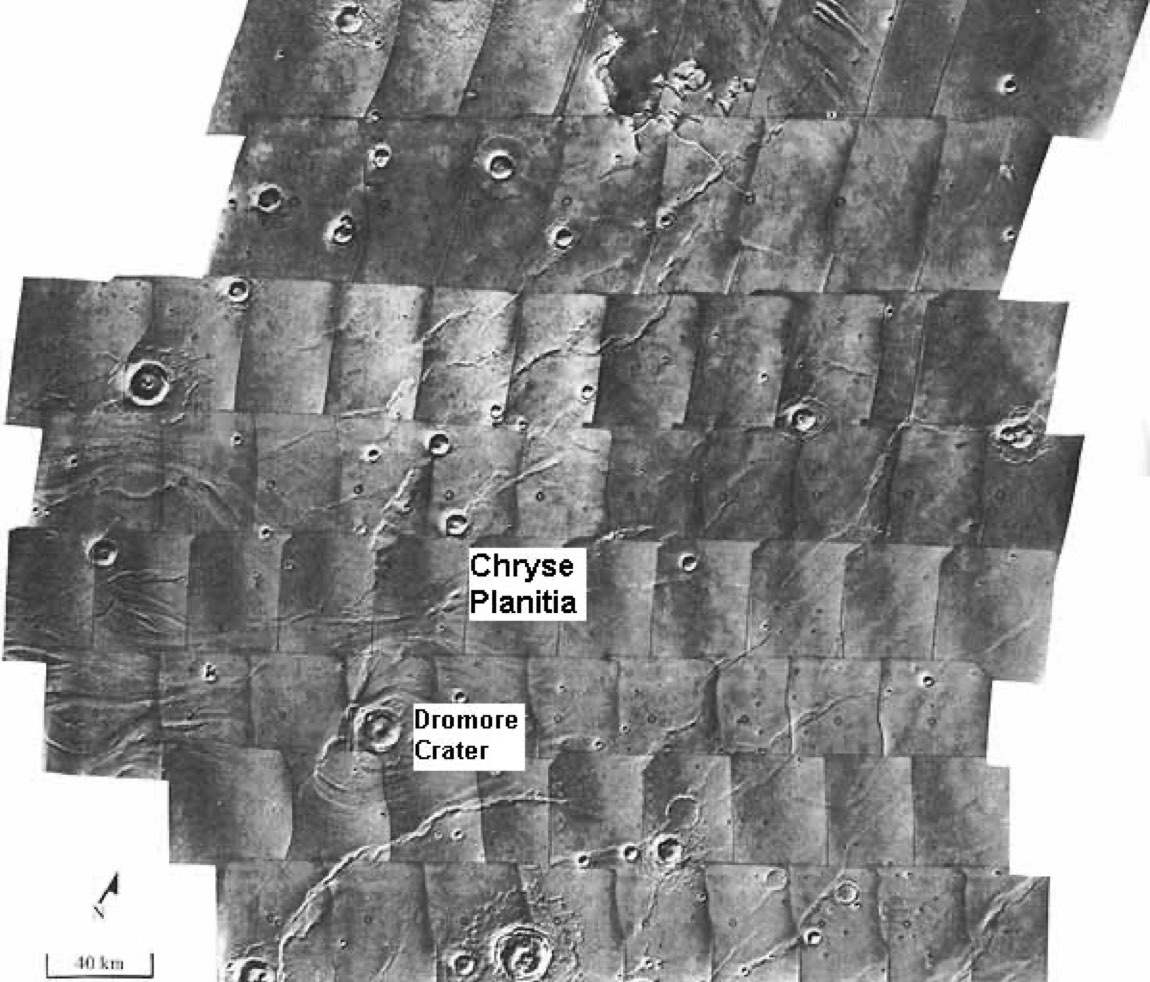
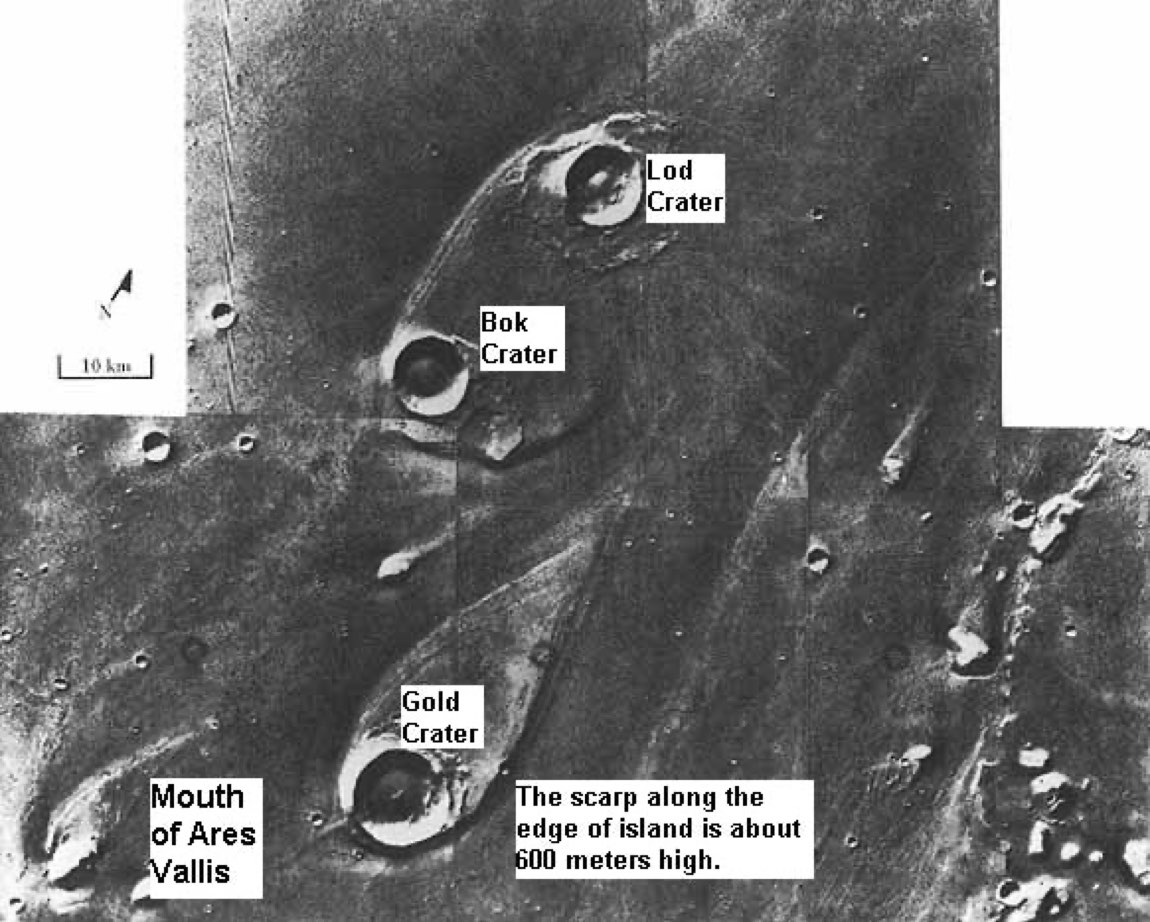
The orbiter cameras did far more than scout landing sites — they rewrote planetary science. Images returned by the two Viking orbiters showed enormous river valleys across many regions of Mars, with evidence that catastrophic floods had broken through natural dams, carved deep valleys, and eroded grooves into bedrock over distances of thousands of kilometers. The southern hemisphere displayed branching stream networks consistent with rainfall rather than simple flooding. Some volcanic flanks bore textures resembling those formed on Hawaiian volcanoes by rain. Many impact craters showed ejecta that appeared to have flowed like mud around obstacles rather than simply falling ballistically, suggesting that heat from impacts had melted ground ice. Regions called "Chaotic Terrain" appeared to have rapidly lost enormous volumes of water — the estimated flow involved was ten thousand times the discharge of the Mississippi River — possibly when underground volcanism melted frozen ice and the surface subsequently collapsed.
09 The biology experiments and their contested results Deeper
Three separate experimental teams, under chief scientist Gerald Soffen of NASA, designed the Viking biology package. One experiment — the Labeled Release (LR) test — returned a positive signal consistent with metabolic activity. However, the Gas Chromatograph Mass Spectrometer found no organic molecules in the soil, which led most scientists to conclude that the LR result was caused by highly oxidizing chemical reactions in the soil rather than living organisms. The debate did not end there. When the Phoenix lander discovered perchlorate salts in Martian soil in 2008, researchers proposed that perchlorate could have destroyed organic compounds during the Viking heating tests, producing chloromethane and dichloromethane — the exact chlorine compounds Viking's instruments had detected. New findings from re-examination of the GCMS results were published as recently as 2018. An international team reported in 2012 that complexity analysis of the LR data might support detection of extant microbial life. NASA issued no definitive biosignature conclusion during the mission, and the question of microbial life on Mars officially remains unresolved.
10 What Viking 1 cost, and what justified the bill
The Viking program carried a price tag of roughly US$1 billion in 1970s dollars, equivalent to about $6 billion in 2024. The two orbiters alone cost $217 million at the time (about $1 billion in 2024 dollars), while developing the lander design consumed $357 million. The single most expensive component was the life-detection unit: about $60 million then, or roughly $400 million adjusted to 2024. The camera system cost $27.3 million to develop (about $200 million today), and finding a manufacturer capable of building its advanced design proved genuinely difficult. Program managers were later praised for resisting pressure to accept a simpler imaging system — a decision vindicated by the quality of the images returned. The program did save money by eliminating a planned third lander and reducing the number of surface experiments. Even so, Viking was deliberately and expensively overengineered, a philosophy diametrically opposite to the "faster, better, cheaper" approach NASA would adopt in later decades.
11 How the missions ended, and what remains
The Viking program formally ended on May 21, 1983, though its scientific influence stretched through the late 1990s and early 2000s. The Viking 1 orbiter's orbit was raised on August 7, 1980, to prevent an uncontrolled impact with Mars, and the orbiter was shut down ten days later. The article notes that an impact — and potential contamination — from the orbiter on the Martian surface became possible from 2019 onward. The Viking 1 lander proved hardier, outlasting both orbiters; it continued operating through direct communication with Earth after the orbiters went silent, a capability built into its two S-band antennae from the start. In December 2006, the Mars Reconnaissance Orbiter photographed the surface and located the Viking 1 lander, finding it about 6 km (3.7 miles) from its originally planned landing site. Each lander also carried a small message artifact: a dot of microfilm bearing the names of several thousand people who had worked on the mission.
12 The computers guiding a 1970s Mars mission Deeper
Navigating and operating spacecraft nearly 400 million kilometers from Earth required onboard computing power that, while primitive by any modern standard, was carefully engineered for reliability. The Viking landers used a Guidance, Control and Sequencing Computer (GCSC) built from two Honeywell HDC 402 processors, each running on a 24-bit word length with 18K of plated-wire memory — a storage technology chosen for its resistance to radiation and vibration. The orbiters relied on a Command Computer Subsystem (CCS) using two custom-designed 18-bit serial processors. The lander computer held a 6,000-word memory dedicated to command instructions. Data was stored on a 40-megabit tape recorder before transmission back to Earth, and the UHF relay link to the orbiter operated at 381 MHz with a 30-watt relay radio. These systems had to operate autonomously during communication gaps and survive the temperature extremes, radiation, and dust of the Martian environment for years, a test they largely passed.
 ⤢
⤢