 Photograph · Emerezhko · CC BY-SA 4.0
Spacecraft · Deep guide
Venera 7
The first landing on another planet sent back 23 minutes of data from Venus's furnace.
What is it?
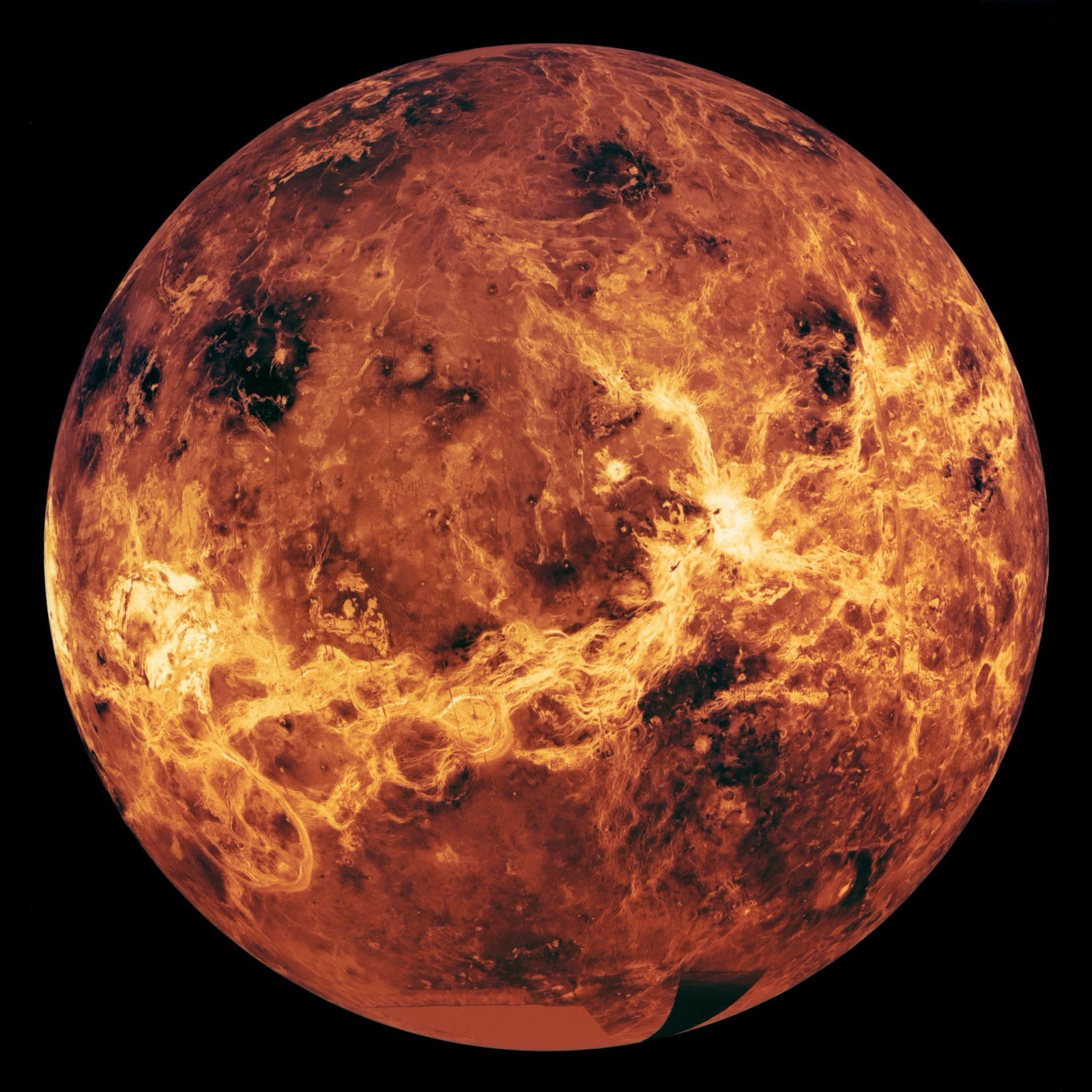
On December 15, 1970, the Soviet Venera 7 capsule crashed through Venus's crushing atmosphere and became the first spacecraft to land on another planet and speak. Its parachute partly failed, it toppled onto its side, and its signal fell to 3% strength — yet it transmitted 23 minutes of data, reporting 465 °C and a pressure 90 times Earth's: the first direct proof of how hellish Venus truly is.
The deep dive
Researched for the Atlas from Wikipedia — Venera 7 (3,491 characters read) · updated Sep 20, 2026
01 A Spacecraft Built for the Worst Case
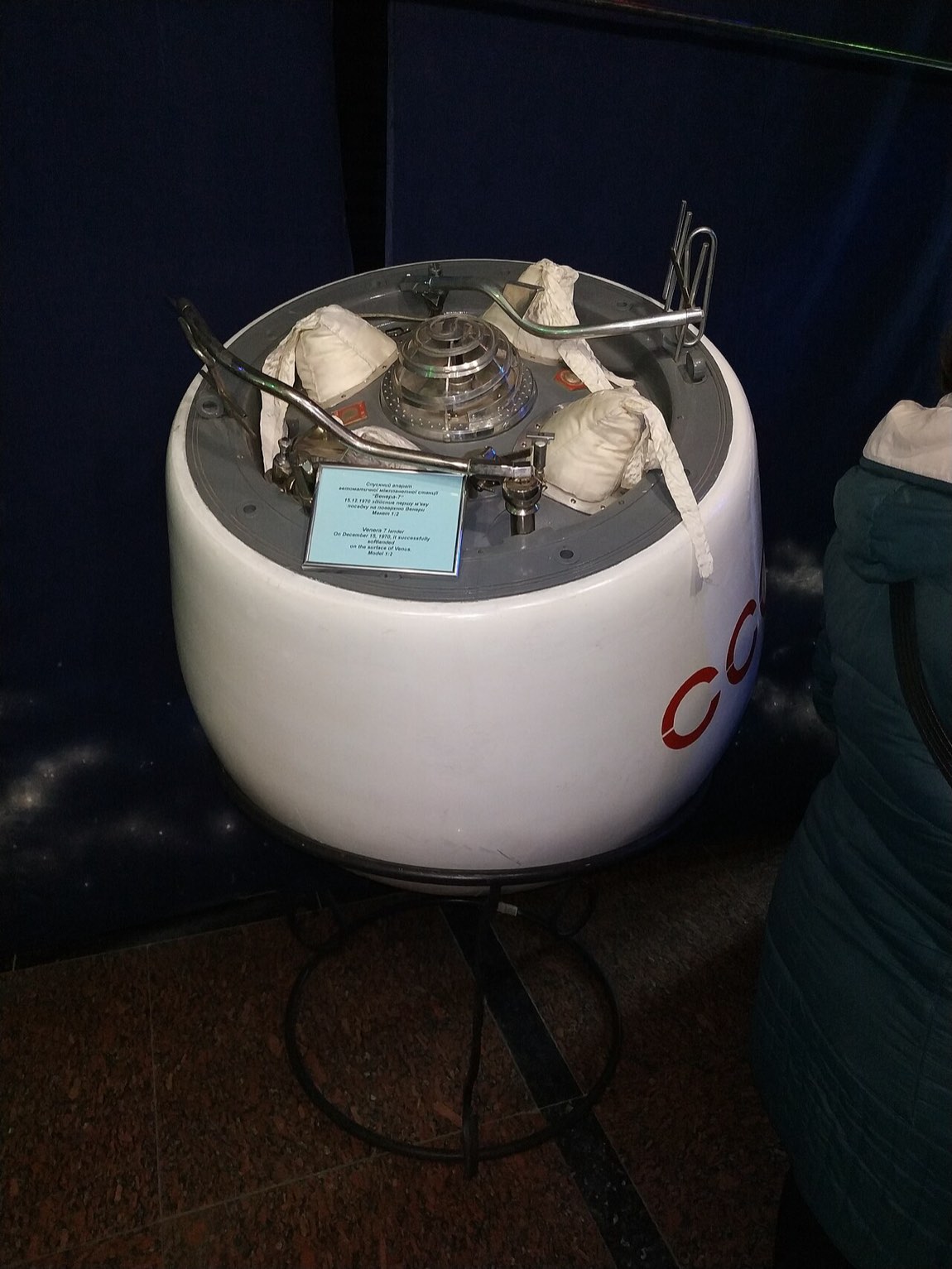
Every engineering choice on Venera 7 was driven by one overriding concern: Venus might be far more brutal than anyone could prove in advance. Designers built the lander to withstand pressures up to 18 megapascals — roughly 2,600 psi, equivalent to diving nearly 1.8 kilometres into Earth's ocean — and temperatures up to 580 °C. These figures were deliberately chosen well above the best scientific estimates of the time, because significant uncertainties remained about actual Venusian surface conditions. That caution came at a steep cost. Hardening the capsule against such extremes consumed so much of the spacecraft's mass budget that only a minimal suite of scientific instruments could be included: temperature and pressure sensors, an accelerometer to measure atmospheric density, and a radar altimeter. The interplanetary bus, which carried the lander to Venus, had a little more room and hosted a solar-wind charged-particle detector and a cosmic-ray detector. There was simply no mass left for cameras or chemical analyzers. The probe was, in essence, a heavily armored thermometer launched toward the most uncertain destination in the solar system.
02 Leaving Earth in the Summer of 1970
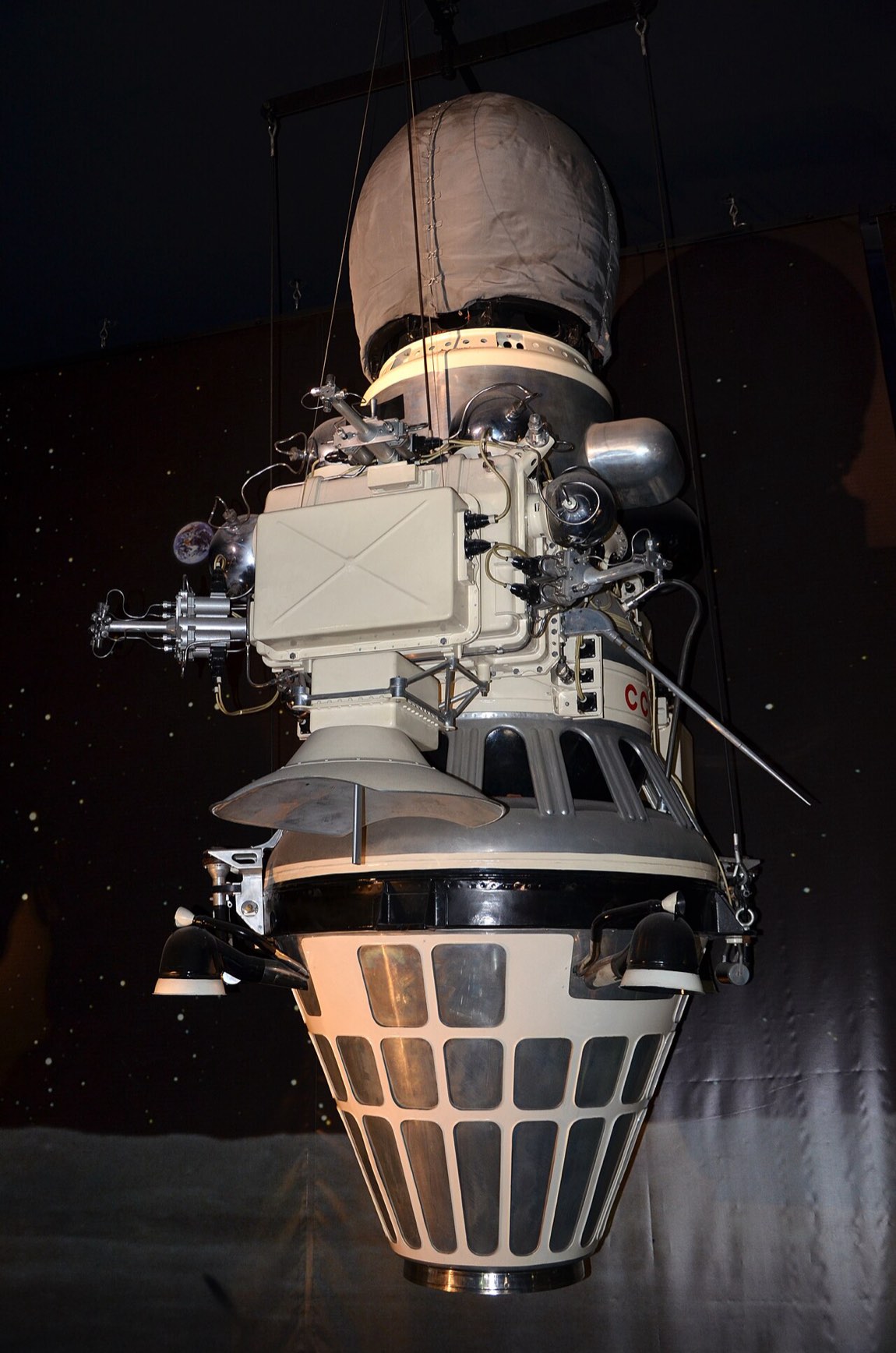
Venera 7 lifted off from Earth on 17 August 1970 at 05:38 UTC, beginning a journey that would last nearly four months. The spacecraft consisted of two main parts: the interplanetary bus, based on the established Soviet 3MV platform, and the lander nestled within it. The 3MV design had served as the backbone of multiple earlier Soviet planetary probes, giving engineers a relatively proven foundation even as they pushed the lander's survivability to new limits. Navigation during the cruise phase was not simply a matter of coasting — two in-course corrections were executed using the bus's onboard KDU-414 engine, fine-tuning the trajectory so the probe would arrive at exactly the right point in Venus's atmosphere. These mid-flight burns were a routine but critical part of interplanetary missions of the era, compensating for small launch inaccuracies that would otherwise compound into enormous positional errors over tens of millions of kilometres of travel.
03 The Descent: Parachutes, Freefall, and a Hard Landing Deeper
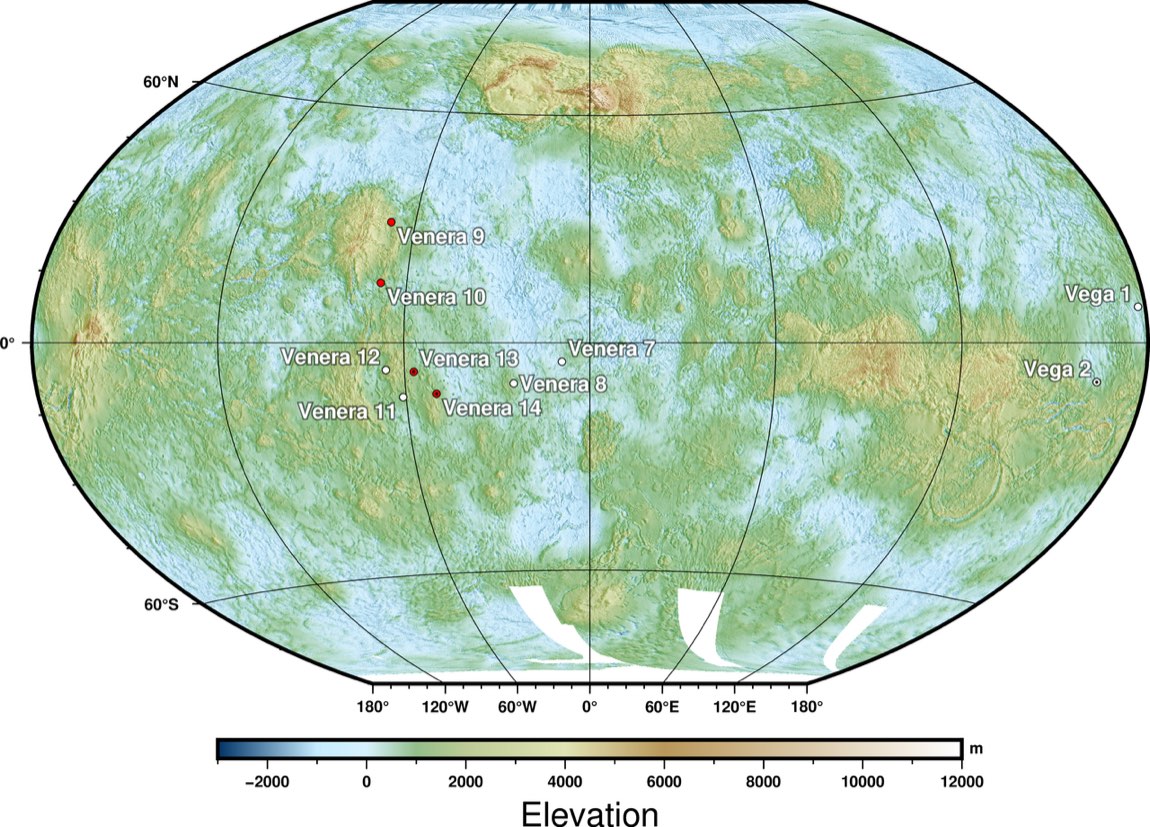
Venera 7's descent through Venus's atmosphere was a carefully choreographed sequence that ultimately went partly wrong — and yet still succeeded. The lander stayed attached to the interplanetary bus during initial atmospheric entry so the bus could actively cool it down to −8 °C, buying thermal margin before the real punishment began. Once atmospheric buffeting broke the bus's communication lock with Earth, the lander was ejected. At 60 kilometres altitude, a parachute opened and atmospheric sampling confirmed the air was 97% carbon dioxide. The parachute began reefed down to just 1.8 square metres, then expanded to 2.5 square metres thirteen minutes later when a reefing line melted as designed — a deliberately engineered trigger. But six minutes after that, the parachute began to fail. It collapsed entirely, sending the probe into freefall. Venera 7 struck the Venusian surface at approximately 16.5 metres per second — about 59 kilometres per hour — at coordinates 5°S 351°E, at 05:37:10 UTC on 15 December 1970. The abrupt stop from falling to motionless in under 0.2 seconds was violent, but it also provided unexpected data: from that rapid deceleration, scientists could deduce the probe had hit a solid surface with low levels of dust.
04 The Tape That Saved the Mission
Impact apparently silenced the spacecraft. Ground controllers saw no signal after Venera 7 hit the surface, and the mission seemed to have ended at the moment of its greatest triumph. But the recording equipment on the ground kept running, capturing whatever noise existed on the frequency. Weeks later, radio astronomer Oleg Rzhiga went back through those tapes with careful attention. Hidden within them, at very low strength, were another 23 minutes of transmission. Venera 7 had not gone silent — it had almost certainly bounced on impact and come to rest on its side, leaving its medium-gain antenna pointed in the wrong direction for strong Earth-facing transmission. The signal was weak but real. Those 23 minutes on the surface, combined with roughly 20 minutes of total surface data extracted from the full 53-minute transmission record, gave scientists enough information to characterize Venusian surface conditions for the first time. Without Rzhiga's patient review of what appeared to be blank tape, the most important data from the mission might have been lost entirely.
05 What the Numbers Revealed About Venus Deeper
The data recovered from Venera 7's surface transmission produced the first directly measured physical portrait of another planet's surface. The temperature sensor reported 475 ± 20 °C — hot enough to melt lead and zinc simultaneously, and maintained not by proximity to a volcano but as the planet's ordinary baseline. From that temperature measurement, and using atmospheric models, scientists calculated a surface pressure of 9.0 ± 1.5 megapascals, or roughly 1,310 ± 220 psi. That figure means standing on Venus's surface would subject a human body to pressure comparable to being nearly 900 metres underwater on Earth. The error bars on both values matter: they reflect genuine measurement uncertainty from a probe operating at the edge of its design limits with a misaligned antenna broadcasting a weak signal. Even so, the numbers were consistent with earlier theoretical predictions and later confirmed with greater precision by subsequent Venera missions. Venera 7's measurements also definitively ruled out the presence of liquid water anywhere on the surface — at 475 °C, no liquid water phase is possible under any plausible pressure regime.
06 Pre-Cooling: An Elegant Thermal Strategy Deeper
One of the subtler engineering innovations in the Venera 7 mission was the deliberate use of the interplanetary bus as a refrigeration unit during atmospheric entry. Rather than separating the lander immediately upon reaching Venus, mission designers kept it attached to the bus specifically so the bus's systems could cool the lander's interior down to −8 °C before exposure to Venusian heat began. This created a cold reservoir inside the probe — thermal mass that the lander would slowly consume as temperatures rose during descent. Every degree of pre-cooling extended the time the instruments could function before reaching their operational limits. The separation was not triggered by a timer but by a physical event: atmospheric buffeting became intense enough to break the bus's communication lock with Earth, at which point the lander was released. This elegant coupling of a navigation event to a thermal strategy meant the lander retained its cold reservoir for as long as physically possible without any additional control system required to time the separation.
07 A First That Rewrote the Record Books
Before Venera 7, no human-made object had ever transmitted data from the surface of another planet. Earlier probes had reached other worlds — some had even impacted or entered atmospheres — but none had survived long enough in contact with a surface to send back measurements. Venera 7 changed that on 15 December 1970, simultaneously achieving a soft landing on another planet and transmitting surface data back to Earth, two firsts in a single mission. The soft landing distinction matters: the probe was designed to survive impact and operate, not merely to arrive. Its roughly 20 minutes of recoverable surface data, extracted later from weak signals on recording tape, represent humanity's first direct physical measurements from another world's surface. The mission was part of the broader Venera series, a sustained Soviet program that would go on to achieve additional planetary firsts over the following decades, but Venera 7 established the foundational achievement that gave the entire series its historical significance.
08 What the Rapid Halt Told Scientists Deeper
Venera 7 carried an accelerometer primarily to measure atmospheric density during descent, but the instrument inadvertently provided something else: a mechanical characterization of the Venusian surface at the landing site. The probe went from falling at about 16.5 metres per second to completely stationary in under 0.2 seconds. That extraordinarily rapid deceleration — a stop time shorter than a human blink — placed a lower bound on the solidity of whatever the probe landed on. Scientists were able to conclude from this figure that the surface at 5°S 351°E was solid rock or compact material, not a deep layer of soft dust or loose sediment. This mattered because some pre-mission models had speculated that Venus's surface could be covered in thick, compressible dust layers that might swallow a lander. Venera 7's abrupt halt ruled out that scenario at its landing site. The same accelerometer data that captured this violent stop had also been recording the lander's smoother deceleration through the thick lower atmosphere during the parachute and freefall phases, giving a profile of atmospheric density with altitude.
09 The Carbon Dioxide Atmosphere, Confirmed
As Venera 7 descended beneath its parachute at 60 kilometres altitude, its instruments began sampling the atmosphere and quickly returned a result that, while expected by many scientists, now had direct experimental confirmation: the atmosphere of Venus is 97% carbon dioxide. This figure, measured in the middle atmosphere during descent, established the overwhelming dominance of carbon dioxide in a way that ground-based spectroscopy had suggested but never proven from within the atmosphere itself. Combined with the surface temperature of 475 ± 20 °C and pressure of 9.0 ± 1.5 megapascals measured at the bottom of that same atmosphere, the picture that emerged was of a world trapped in an extreme greenhouse effect — a massive blanket of carbon dioxide holding in heat to temperatures that bear no resemblance to what the planet's distance from the Sun alone would produce. Venus sits further from the Sun than Mercury yet maintains surface temperatures far higher, and Venera 7's atmospheric and surface data together helped demonstrate why.
10 The Interplanetary Bus and Its Instruments Deeper
While the lander captured all the historic attention, the interplanetary bus that carried it to Venus was itself a functioning scientific platform. Built on the Soviet 3MV system, the bus hosted two instruments aimed at the space environment rather than Venus itself: a solar-wind charged-particle detector and a cosmic-ray detector. These instruments gathered data during the months-long cruise from Earth to Venus, contributing to the broader Soviet effort to characterize the interplanetary environment in the inner solar system. The bus served its secondary role as a thermal management system for the lander, actively cooling it during the early atmospheric entry phase, then separated when atmospheric forces intervened. It also performed two trajectory correction maneuvers using the onboard KDU-414 engine during the interplanetary cruise. Once the lander was ejected, the bus's scientific mission was effectively complete, though its structural role in protecting and preparing the lander had already been the decisive factor in whether the surface mission could even attempt to succeed.
11 How Venera 7 Fits in the Venera Program
Venera 7 was one mission in a long-running Soviet program that systematically targeted Venus over more than two decades. The Venera series probes progressively built on each mission's results and failures, with engineers hardening each successive lander against conditions that kept proving more extreme than anticipated. Venera 7 represented a turning point: it was the first to actually survive and transmit from the surface, vindicating the design philosophy of overbuilding for pressure and temperature tolerance. The instrument limitations imposed by that hardening — the minimal science payload that resulted from the mass penalties of the heavy pressure vessel — were a deliberate tradeoff that the mission's success validated. The series legacy Venera 7 established, of proven soft-landing and surface-transmission capability, gave subsequent missions a confirmed baseline to build from, eventually leading to landers that would survive long enough to transmit images and conduct chemical analyses that Venera 7's stripped-down payload could never attempt.
 ⤢
⤢